low SKODA FABIA 2006 2.G / 5J Service Manual
[x] Cancel search | Manufacturer: SKODA, Model Year: 2006, Model line: FABIA, Model: SKODA FABIA 2006 2.G / 5JPages: 258, PDF Size: 44.86 MB
Page 69 of 258
Lights and Visibility68
Adjusting the right-hand exterior mirror*
– Turn the rotary knob to position . The movement of the mirror
surface is identical to the movement of the rotary knob.
The exterior mirror heater only operates when the engine is running.
WARNING
•Convex (curved outward) or a spherical exterior mirrors increase the vision field. They do, however, ma ke objects appear smaller in the mirror. These mirrors are only of limited use, therefore, for estimating distances to the following vehicles.
•Use whenever possible the interior rear mirror, for estimating the distances to the following vehicles.
Note
•Do not touch the surfaces of the exterior mirrors if the exterior mirror heater is switched on.
•You can set the exterior mi rrors by hand, if the power setting function fails at any time, by pressing on the edge of the mirror surface.
•Contact your specialist garage if a fault exists with the power setting of the exterior mirrors.
NKO A05Fabia 20.book Page 68 Tuesday, September 26, 2006 8:38 AM
Page 70 of 258
Seats and Stowage69
Using the systemSafetyDriving TipsGeneral MaintenanceBreakdown assistanceTechnical Data
Seats and Stowage
Front seats
Basic information
The front seats have a wide range of different settings and can thus be matched to the physical characteristics of the driver and front passenger. Correct adjust-ment of the seats is particularly important for
•safely and quickly reaching the controls,
•a relaxed, fatigue-free body position,
•achieving the maximum protection offered by the seat belts and the airbag system.
The chapters which follow describe th e procedure which you should adopt for adjusting the seats.
WARNING
•Never transport more occupants than the maximum seating in the vehicle.
•Each occupant must correctly fasten the seat belt belonging to the seat. Children must be fastened ⇒page 155, “Transporting children safely” with a suitable restraint system.
•The front seats and the head restraints must always be adjusted to match the body size of the seat occupant as well as the seat belts must always be correctly fastened in order to provide an optimal protection for you and your occupants.
•Always keep your feet in the footwell when the car is being driven - never place your feet on the instrument panel, out of the window or on the surfaces of the seats. This is particularly important for the front seat
passenger. You will be exposed to increased risk of injury if it becomes necessary to apply the brake or in the ev ent of an accident. If an airbag is deployed, you may suffer fatal injuries when adopting an incorrect seated position!
•It is important for the driver and front passenger to maintain a distance of at least 25 cm from the steering wheel or dash panel. Not maintaining this minimum distance will mean that the airbag system will not be able to properly protect you - hazard! The front seats and the head restraints must always also be correctly adjusted to match the body size of the occupant.
•Ensure that there are no objects in the footwell as any objects may get behind the pedals during a drivin g or braking manoeuvre. You would then no longer be able to operate the clutch, to brake or accelerate.
WARNING (continued)
NKO A05Fabia 20.book Page 69 Tuesday, September 26, 2006 8:38 AM
Page 71 of 258
Seats and Stowage70
Adjusting the front seats
Adjusting a seat in a forward/back direction
– Pull the lever ⇒page 70, fig. 49 up and push the seat into the
desired position.
– Release the lever and push the seat further until the lock is
heard to engage.
Adjusting height of seat*
– Lift the seat if required by pulling or pumping lever upwards.
– Lower the seat if required by pushing or pumping lever down-
wards.
Adjust the angle of the seat backrest
– Relieve any pressure on the backrest (do not lean on it) and turn
the handwheel to adjust the angle of the backrest.
The driver's seat should be adjusted in such a way that the pedals can be pressed to the floor with slightly bent legs.
The backrest on the driver's seat should be adjusted in such a way that the upper point of the steering wheel can be easily reached with slightly bent arms.
WARNING
•Only adjust the driver seat when the vehicle is stationary - risk of injury!
•Take care when adjusting the seat ! Adjusting the seat without care can lead to bruises or injuries.
•The backrests must not be angled too far back when driving other- wise this will affect proper operation of the seat belts and of the airbag system - risk of injury!Fig. 49 Controls at seat
A1
A1
A2
A2
A3
NKO A05Fabia 20.book Page 70 Tuesday, September 26, 2006 8:38 AM
Page 76 of 258
Seats and Stowage75
Using the systemSafetyDriving TipsGeneral MaintenanceBreakdown assistanceTechnical Data
Pedals
You should use only footmats which do not obstruct the movement of the pedals and have an anti-slip protection.
We recommend only to use footmats from Škoda genuine accessories offered by your Škoda dealer.
Operation of the pedals must not be hindered!
WARNING
•Greater pedal distances may be need ed when there is a fault in the brake system.
•Do not place any footmats or other additional floor coverings in the area of the pedals in order to ensure that all the pedals can be fully depressed and are able to return unobstructed to their initial position - risk of accident!
•There must be no objects on the floor which could roll under the pedals. You would then no longer be able to apply the brakes, operate the clutch or accelerator - risk of accident!
luggage compartment
Loading the luggage compartment
Please observe the following in the interest of having good handling
characteristics of your vehicle:
– Distribute the items of luggage as evenly as possible.
– Place heavy objects as far forward as possible.
– Attach the items of luggage to the lashing eyes or the safety net*
⇒ page 76.
In the event of an accident, there is such a high kinetic energy which is produced by small and light objects that they can cause severe injuries. The magnitude of the kinetic energy depends on the speed at which the vehicle is travelling and on the weight of the object. The speed at which the vehicle is travelling is in this case the more significant factor.
Example: In the event of a frontal collision at a speed of 50 km/h, an unsecured object with a weight of 4.5 kg produc es an energy, which corresponds to 20 times its own weight. This means that it results in a weight of approx. 90 kg. You can imagine the injuries that can occur, if this “bullet” is flying through the inte- rior compartment and hits an occupant.
WARNING
•Store the objects in the luggage comp artment and attach them to the lashing eyes.
•Loose objects in the passenger compartment can be thrown forward during a sudden manoeuvre or in case of an accident and can injure the occupants or other oncoming traffic. This risk is still increased, if the objects which are flying around are hit by a deployed airbag. In this case, the objects which are thrown back can injure the occupants - hazard.
•Please note that the handling properties of your vehicle may be affected when transporting heavy objects as a result of the displacement of the centre of gravity. The speed an d style of driving must be adjusted accordingly.
•The items carried in the luggage compartment should be stored in such a way that no objects are able to slip forward if there are any sudden driving or braking manoeuvres undertaken - risk of injury!
•When transporting fastened objects which are sharp and dangerous in the luggage compartment enlarged by folding the rear seats forward or removing the rear seats, ensure the safety of the passengers trans-
NKO A05Fabia 20.book Page 75 Tuesday, September 26, 2006 8:38 AM
Page 78 of 258

Seats and Stowage77
Using the systemSafetyDriving TipsGeneral MaintenanceBreakdown assistanceTechnical Data
•The load to be transported must be fixed in place in such a way that it cannot move during the journey and when braking.
Folding hooks*
A folding hook* for attaching small items of luggage, such as bags etc., is provided on both sides of the luggage compartment ⇒fig. 58.
An item of luggage weighing up to 10 kg can be attached to the hook.
The luggage compartment cover
You can use the luggage compartment cover behind the head
restraints for storing light and soft items.
The luggage compartment cover can be removed as required if one
must transport bulky goods.
– Unhook the support straps on the tailgate ⇒fig. 59.
– Slightly raise the luggage compartment cover.
– Remove the luggage compartment cover from the holders by
pulling to the rear or with adequa te blows to the bottom side of the
luggage compartment cover in the area between the holders.
WARNING (continued)
Fig. 58 Luggage compartment: folding hooks
Fig. 59 Removing the luggage compartment cover
A1
A2
NKO A05Fabia 20.book Page 77 Tuesday, September 26, 2006 8:38 AM
Page 79 of 258
Seats and Stowage78
– To re-install, place the luggage compartment cover on the contact
surfaces of the side trim pane ls and press the luggage compart-
ment cover into the holders by pushing forward and then hang
the support straps on the tailgate.
The luggage compartment cover in the upper position is foreseen for storage of small objects of up to 2.5 kg. in weight.
Caution
Please ensure that the heating elements of the rear window heater are not damaged as a result of objects placed in this area.
Note
When opening the tailgate, lift the lu ggage compartment cover - risk that objects placed in this area can slip forward!
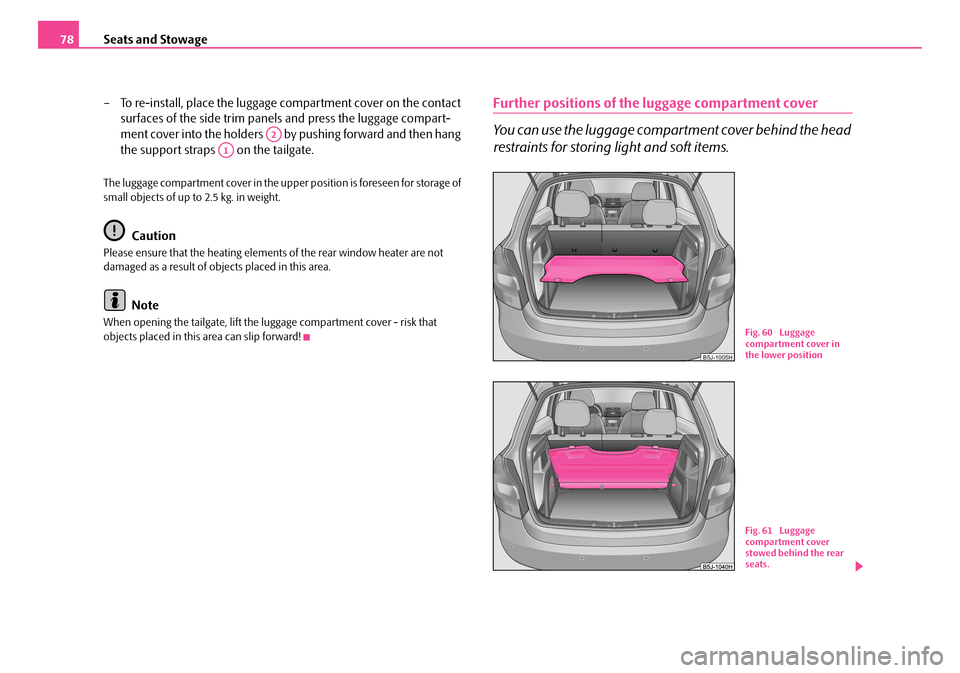
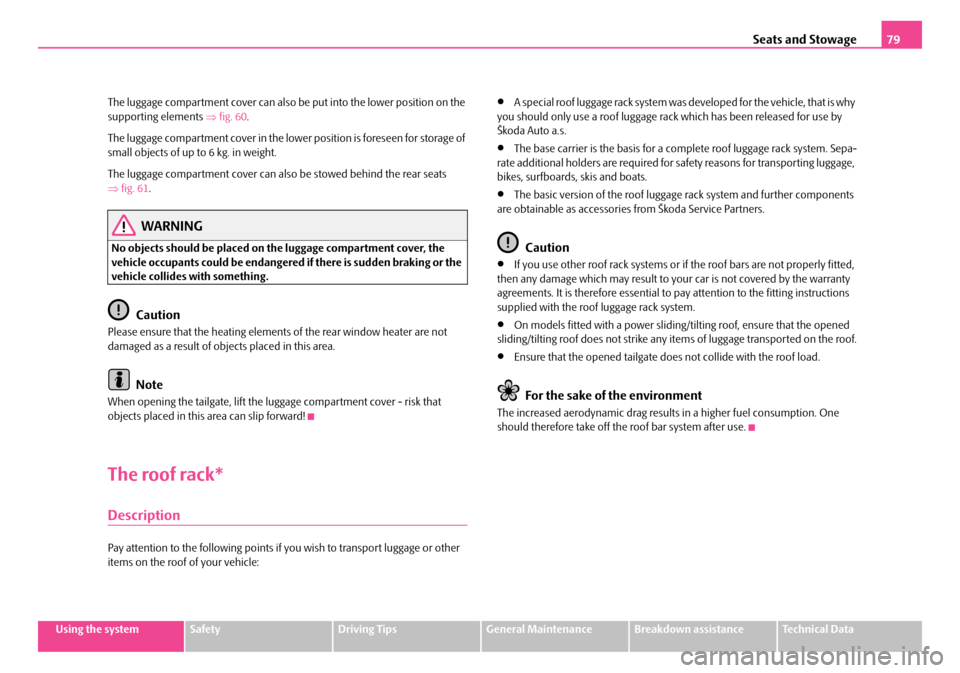
Further positions of the luggage compartment cover
You can use the luggage compartment cover behind the head
restraints for storing light and soft items.A2
A1
B5J-1005H
Fig. 60 Luggage compartment cover in the lower position
Fig. 61 Luggage compartment cover stowed behind the rear seats.
NKO A05Fabia 20.book Page 78 Tuesday, September 26, 2006 8:38 AM
Page 80 of 258
Seats and Stowage79
Using the systemSafetyDriving TipsGeneral MaintenanceBreakdown assistanceTechnical Data
The luggage compartment cover can also be put into the lower position on the supporting elements ⇒fig. 60.
The luggage compartment cover in the lower position is foreseen for storage of small objects of up to 6 kg. in weight.
The luggage compartment cover can also be stowed behind the rear seats ⇒ fig. 61.
WARNING
No objects should be placed on the luggage compartment cover, the vehicle occupants could be endangered if there is sudden braking or the vehicle collides with something.
Caution
Please ensure that the heating elements of the rear window heater are not damaged as a result of obje cts placed in this area.
Note
When opening the tailgate, lift the luggage compartment cover - risk that objects placed in this area can slip forward!
The roof rack*
Description
Pay attention to the following points if you wish to transport luggage or other items on the roof of your vehicle:
•A special roof luggage rack system was developed for the vehicle, that is why you should only use a roof luggage rack which has been released for use by Škoda Auto a.s.
•The base carrier is the basis for a comp lete roof luggage rack system. Sepa- rate additional holders are required for safety reasons for transporting luggage, bikes, surfboards, skis and boats.
•The basic version of the roof luggage rack system and further components are obtainable as accessories from Škoda Service Partners.
Caution
•If you use other roof rack systems or if the roof bars are not properly fitted, then any damage which may result to yo ur car is not covered by the warranty agreements. It is therefore essential to pay attention to the fitting instructions supplied with the roof luggage rack system.
•On models fitted with a power sliding/ tilting roof, ensure that the opened sliding/tilting roof does not strike any items of luggage transported on the roof.
•Ensure that the opened tailgate does not collide with the roof load.
For the sake of the environment
The increased aerodynamic drag results in a higher fuel consumption. One should therefore take off the roof bar system after use.
NKO A05Fabia 20.book Page 79 Tuesday, September 26, 2006 8:38 AM
Page 81 of 258
Seats and Stowage80
Attachment points
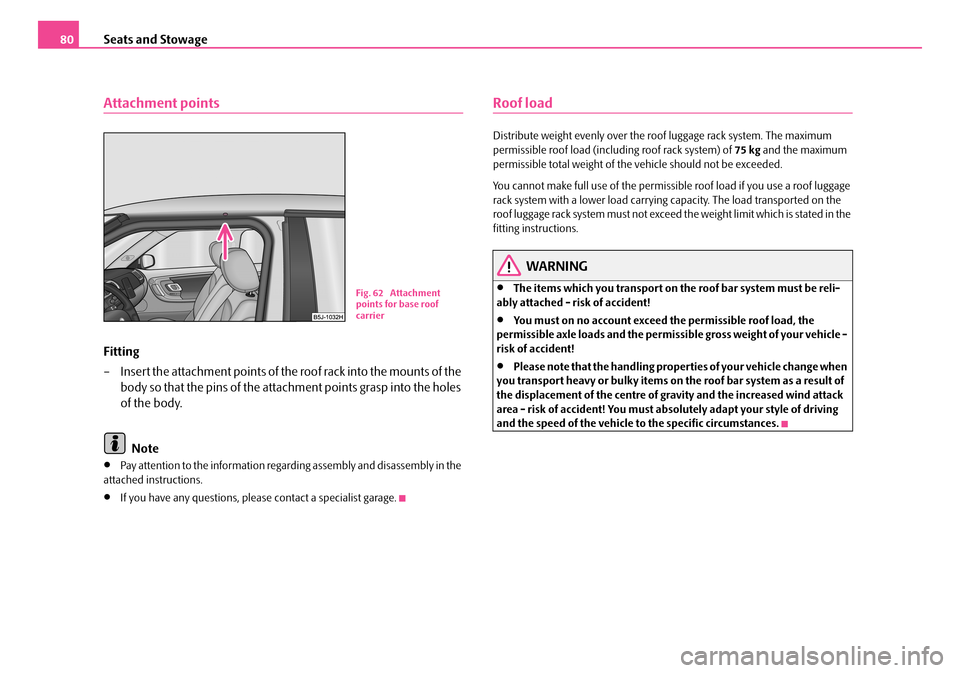
Fitting
– Insert the attachment points of th e roof rack into the mounts of the
body so that the pins of the attachment points grasp into the holes
of the body.
Note
•Pay attention to the information regarding assembly and disassembly in the attached instructions.
•If you have any questions, plea se contact a specialist garage.
Roof load
Distribute weight evenly over the roof luggage rack system. The maximum permissible roof load (inclu ding roof rack system) of 75 kg and the maximum permissible total weight of the vehicle should not be exceeded.
You cannot make full use of the permissibl e roof load if you use a roof luggage rack system with a lower load carrying capacity. The load transported on the roof luggage rack system must not exceed the weight limit which is stated in the fitting instructions.
WARNING
•The items which you transport on the roof bar system must be reli-ably attached - risk of accident!
•You must on no account exceed the permissible roof load, the permissible axle loads and the permissi ble gross weight of your vehicle - risk of accident!
•Please note that the handling prop erties of your vehicle change when you transport heavy or bulky items on the roof bar system as a result of the displacement of the centre of gravity and the increased wind attack area - risk of accident! You must absolutely adapt your style of driving and the speed of the vehicle to the specific circumstances.
Fig. 62 Attachment points for base roof carrier
NKO A05Fabia 20.book Page 80 Tuesday, September 26, 2006 8:38 AM
Page 85 of 258
Seats and Stowage84
– Insert the plug of the electrical appliance into the socket of the
cigarette lighter.
The 12 volt power socket can also be us ed to supply power to electrical acces- sories with a power uptake up to 180 watts.
WARNING
•Take care when using the cigarette lighter! Not paying proper atten- tion or incorrect use the cigarette li ghter in an uncontrolled manner may result in burns.
•The cigarette lighter and the power socket also operates when the ignition is switched off or the ignition key withdrawn. This is why you should never leave children unattended in the vehicle!
Caution
Only use matching plugs, which fulfils the DIN - ISO Standard 4165, to avoid damaging the power sockets.
Note
Connecting electrical co mponents when the engine is not running will drain the battery of the vehicle - risk of battery draining!
Storage compartments
Overview
You will find the following stor age facilities in your vehicle:
WARNING
•Please do not place anything on top of the dash panel. Such objects might slide or fall down when driving (when accelerating or cornering) and may distract you from concentrating on the traffic situation - risk of accident!
•Ensure that when driving no objects from the centre console of from other storage possibilities may get into the footwell of the driver. You would then no longer be able to appl y the brakes, operate the clutch or accelerator - risk of accident!
Storage compartments on the front passenger side*⇒ page 85
Storage compartment on the driver's side⇒page 86
Stowage compartment for spectacles*⇒page 86
Stowage compartment in centre console⇒page 87
Storage compartment in the front seat*⇒page 87
Front seat armrest with stowage compartment*⇒page 88
Storage compartment in the front doors⇒page 88
Storage compartments in the luggage compart- ment⇒ page 89
Flexible storage compartment*⇒page 89
Clothes hooks*⇒page 90
NKO A05Fabia 20.book Page 84 Tuesday, September 26, 2006 8:38 AM
Page 86 of 258

Seats and Stowage85
Using the systemSafetyDriving TipsGeneral MaintenanceBreakdown assistanceTechnical Data
Storage compartments on the front passenger side*
Certain model versions are equipped without lid for the storage
compartments.
Opening and closing the storage compartments on the front
passenger side
– Pull or press the handle of the lid in the direction of arrow ⇒fig. 69
and fold open the lid.
– Raise the lid until it is heard to engage.
A pin holder is loca ted inside the lid.
WARNING
The storage compartment must always be closed when driving for safety reasons.
Cooling of storage compartment on front passenger side*
The storage compartment can be fitted for vehicles with an
air-conditioning system with a closable inlet for cooled air.
– You can switch the cooling system on or off using the control dial
⇒ fig. 70.
Opening the air inlet when the air conditioning system is on causes fresh or interior air to flow into the storage compartment.
The storage compartment is only cooled in the cooling mode. We recommend that you switch off the cooling (opening concealed) if it is operating in the heating mode or if you are not using the cooling system for the storage compartment.
Fig. 69 Dash panel: Storage compartments on the front passenger side
Fig. 70 Storage compartment: Using cooling system
NKO A05Fabia 20.book Page 85 Tuesday, September 26, 2006 8:38 AM