bulb SKODA FABIA 2008 2.G / 5J Owner's Manual
[x] Cancel search | Manufacturer: SKODA, Model Year: 2008, Model line: FABIA, Model: SKODA FABIA 2008 2.G / 5JPages: 252, PDF Size: 40.88 MB
Page 5 of 252
Contents4
How are seat belts correctly fastened? . . . . . . . . . . Belt tensioner . . . . . . . . . . . . . . . . . . . . . . . . . . . . . . . .
Airbag system . . . . . . . . . . . . . . . . . . . . . . . . . . . . . . . . . Description of the airbag system . . . . . . . . . . . . . . . Front airbags . . . . . . . . . . . . . . . . . . . . . . . . . . . . . . . . . Side airbags* . . . . . . . . . . . . . . . . . . . . . . . . . . . . . . . . . Head airbags* . . . . . . . . . . . . . . . . . . . . . . . . . . . . . . . . Deactivating an airbag . . . . . . . . . . . . . . . . . . . . . . . .
Transporting children safely . . . . . . . . . . . . . . . . . . What you should know about transporting children!Child seat . . . . . . . . . . . . . . . . . . . . . . . . . . . . . . . . . . . . Attaching a child seat using the “ISOFIX” system*Attaching child seat using the “Top Tether” system
Driving Tips. . . . . . . . . . . . . . . . . . . . . . . . . . . . . .
Intelligent Technology . . . . . . . . . . . . . . . . . . . . . . . . Electronic stability programme (ESP)* . . . . . . . . . . Brakes . . . . . . . . . . . . . . . . . . . . . . . . . . . . . . . . . . . . . . . Brake booster . . . . . . . . . . . . . . . . . . . . . . . . . . . . . . . . Antilock brake system (ABS)* . . . . . . . . . . . . . . . . . . Brake Assist* . . . . . . . . . . . . . . . . . . . . . . . . . . . . . . . . . Electrohydraulic power steering . . . . . . . . . . . . . . . Tyre inflation pressure-control system* . . . . . . . . . Diesel particle filter* (diesel engine) . . . . . . . . . . . .
Driving and the Environment. . . . . . . . . . . . . . . . . The first 1 500 kilometres and then afterwards . . Catalytic converter . . . . . . . . . . . . . . . . . . . . . . . . . . . . Driving in an economical and environmentally conscious manner . . . . . . . . . . . . . . . . . . . . . . . . . . . . Environmental compatibility . . . . . . . . . . . . . . . . . . . Motoring abroad . . . . . . . . . . . . . . . . . . . . . . . . . . . . . Avoiding damage to your vehicle . . . . . . . . . . . . . .
To w i n g a t r a i l e r. . . . . . . . . . . . . . . . . . . . . . . . . . . . . . . . Towing a trailer . . . . . . . . . . . . . . . . . . . . . . . . . . . . . . .
General Maintenance. . . . . . . . . . . . . . .
Taking care of your vehicle and cleaning the vehicle. . . . . . . . . . . . . . . . . . . . . . . . . . . . . . . . . . . . . . . . .General . . . . . . . . . . . . . . . . . . . . . . . . . . . . . . . . . . . . . .Care of the exterior of vehicle . . . . . . . . . . . . . . . . . .Care of the interior of vehicle . . . . . . . . . . . . . . . . . .
Fuel. . . . . . . . . . . . . . . . . . . . . . . . . . . . . . . . . . . . . . . . . . . .Petrol . . . . . . . . . . . . . . . . . . . . . . . . . . . . . . . . . . . . . . . .Diesel . . . . . . . . . . . . . . . . . . . . . . . . . . . . . . . . . . . . . . . .Refuelling . . . . . . . . . . . . . . . . . . . . . . . . . . . . . . . . . . . .
Inspecting and Replenishing. . . . . . . . . . . . . . . . . .Engine compartment . . . . . . . . . . . . . . . . . . . . . . . . .Engine oil . . . . . . . . . . . . . . . . . . . . . . . . . . . . . . . . . . . .Cooling system . . . . . . . . . . . . . . . . . . . . . . . . . . . . . . .Brake fluid . . . . . . . . . . . . . . . . . . . . . . . . . . . . . . . . . . .Battery . . . . . . . . . . . . . . . . . . . . . . . . . . . . . . . . . . . . . . .Windshield washer system . . . . . . . . . . . . . . . . . . . .
Wheels and Tyres. . . . . . . . . . . . . . . . . . . . . . . . . . . . . .Wheels . . . . . . . . . . . . . . . . . . . . . . . . . . . . . . . . . . . . . .
Accessories, changes and replacement of partsAccessories and replacement parts . . . . . . . . . . . . .Technical changes . . . . . . . . . . . . . . . . . . . . . . . . . . . .
Breakdown assistance. . . . . . . . . . . . . .
Breakdown assistance . . . . . . . . . . . . . . . . . . . . . . . .First-aid box* and Warning triangle* . . . . . . . . . . .Fire extinguisher* . . . . . . . . . . . . . . . . . . . . . . . . . . . . .Vehicle tool kit . . . . . . . . . . . . . . . . . . . . . . . . . . . . . . . .Tyre repair kit* . . . . . . . . . . . . . . . . . . . . . . . . . . . . . . . .Spare wheel* . . . . . . . . . . . . . . . . . . . . . . . . . . . . . . . . .Changing a wheel . . . . . . . . . . . . . . . . . . . . . . . . . . . . .Jump-starting . . . . . . . . . . . . . . . . . . . . . . . . . . . . . . . .Tow-starting and towing vehicle . . . . . . . . . . . . . . .
Fuses and light bulbs. . . . . . . . . . . . . . . . . . . . . . . . . .Electric fuses . . . . . . . . . . . . . . . . . . . . . . . . . . . . . . . . .Bulbs . . . . . . . . . . . . . . . . . . . . . . . . . . . . . . . . . . . . . . . .
Technical Data . . . . . . . . . . . . . . . . . . . . . . . . . .
Technical Data. . . . . . . . . . . . . . . . . . . . . . . . . . . . . . . . .General information . . . . . . . . . . . . . . . . . . . . . . . . . . .Used abbreviations . . . . . . . . . . . . . . . . . . . . . . . . . . .Performances . . . . . . . . . . . . . . . . . . . . . . . . . . . . . . . . .Weight . . . . . . . . . . . . . . . . . . . . . . . . . . . . . . . . . . . . . . .Identification details . . . . . . . . . . . . . . . . . . . . . . . . . .Fuel consumption according to the regulations (99/100/EU) . . . . . . . . . . . . . . . . . . . . . . . . . . . . . . . . . .Dimensions . . . . . . . . . . . . . . . . . . . . . . . . . . . . . . . . . .1.2 l/44 kW - EU 4/EU 2DDK . . . . . . . . . . . . . . . . . . .1.2 l/51 kW - EU 4/EU 2DDK . . . . . . . . . . . . . . . . . . .1,4 l/63 kW - EU 4/EU 2DDK . . . . . . . . . . . . . . . . . . .1,6 l/77 kW - EU 4/EU 2DDK . . . . . . . . . . . . . . . . . . .1.4 ltr./51 kW TDI PD - EU 4 . . . . . . . . . . . . . . . . . . . .1.4 ltr./59 kW TDI PD - EU 4 . . . . . . . . . . . . . . . . . . . .1.9 ltr./77 kW TDI PD - EU 4 . . . . . . . . . . . . . . . . . . . .Vehicles of the group Fabia N1 . . . . . . . . . . . . . . . . .Vehicles of the group Combi N1 . . . . . . . . . . . . . . . .
Index . . . . . . . . . . . . . . . . . . . . . . . . . . . . . . . . . . . . . . . .
128130
132132133136138139
142142145148149
151
151151154154155155156156158
159159160
160163164165
166166
169
169169169174
177177177178
180180183186188189193
194194
200200200
201
201201201202202202203208209
213213217
223
223223223223223223
224225226228230232234236238240241
243
NKO A05F 20.book Page 4 Wednesday, April 2, 2008 1:02 PM
Page 51 of 252
Lights and Visibility50
The interior light is switched on for about 20 seconds when a vehicle with a central locking system is unlocked, when a door is opened or when the ignition key is removed. The requirement for this is that the switch is in the door contact position. The inner light goes out out immediately after the ignition is switched on.
A time delay switch* causes the inner lighting on vehicles without a central locking system stays on for a few seconds after the doors have been closed. The inner light goes out out immediately after the ignition is switched on.
The interior lighting is switched off after about 30 minutes when a door has been left open in order to avoid discharging the battery of the vehicle.
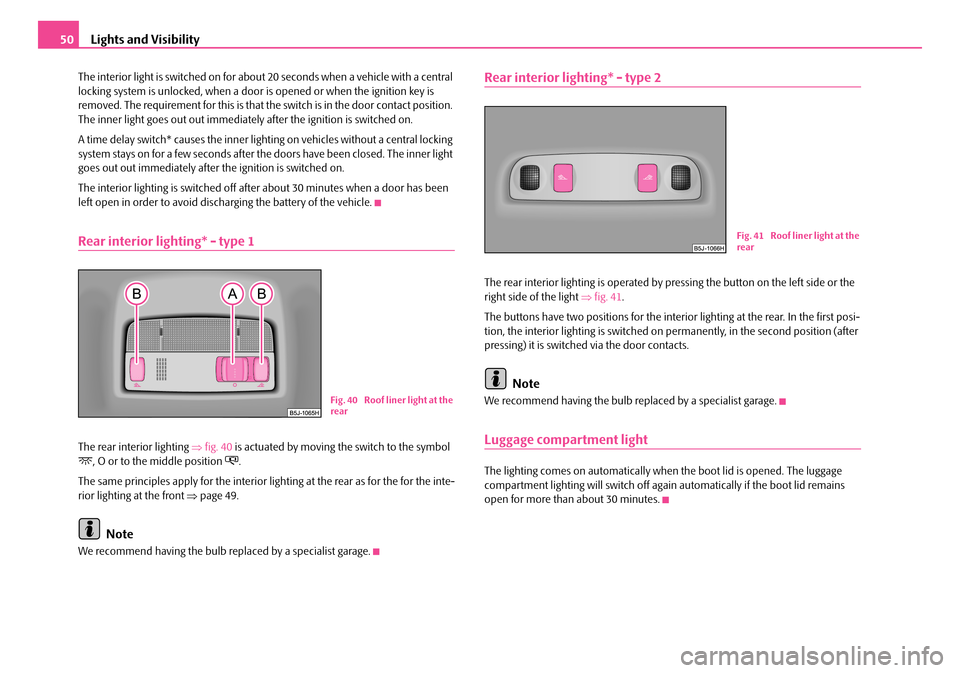
Rear interior lighting* - type 1
The rear interior lighting ⇒fig. 40 is actuated by moving the switch to the symbol , O or to the middle position .
The same principles apply for the interior lighting at the rear as for the for the inte-rior lighting at the front ⇒page 49.
Note
We recommend having the bulb replaced by a specialist garage.
Rear interior lighting* - type 2
The rear interior lighting is operated by pressing the button on the left side or the right side of the light ⇒fig. 41.
The buttons have two positions for the interior lighting at the rear. In the first posi-tion, the interior lighting is switched on permanently, in the second position (after pressing) it is switched via the door contacts.
Note
We recommend having the bulb replaced by a specialist garage.
Luggage compartment light
The lighting comes on automatically when the boot lid is opened. The luggage compartment lighting will switch off again automatically if the boot lid remains open for more than about 30 minutes.
Fig. 40 Roof liner light at the rear
Fig. 41 Roof liner light at the rear
NKO A05F 20.book Page 50 Wednesday, April 2, 2008 1:02 PM
Page 191 of 252
Inspecting and Replenishing190
WARNING
•The battery acid is strongly corrosive and must, therefore, be handled with the greatest of care. Always wear protective gloves, eye and skin protection when handling batteries. Corrosive fumes in the air irritate the air passages and lead to conjunctivitis and inflammation of the air passages in the lungs. Battery acid corrodes dental enamel and creates deep wounds after contact with the skin which take a long time to heal. Repeated contact with diluted acids causes skin diseases (inflammations, ulcers, slin cracks). Acids coming into contact with water are diluted accompanied by significant development of heat.
•Do not tilt the battery otherwise battery electrolyte may flow out of the battery vent openings. Protect the eyes with safety glasses or a shield! There is the danger of suffering blindness! If any battery electrolyte gets into your eye, rinse out your eye immediately with clear water for several minutes. Contact a doctor without delay.
•Splashes of acid on your skin or clothes should be neutralised as soon as possible using soap suds and then rinsed with plenty of water. Contact a doctor immediately if you swallow battery electrolyte.
•Keep batteries out of the reach of children.
•Hydrogen is released when you charge a battery and a highly explosive gas mixture is produced. An explosion can be caused through sparkling over during unclamping or loosening of the cable plug while the ignition is on.
•Bridging of the poles will create a short circuit (e.g. through metal objects, cables). Possible consequences of a short circuit: Melting of lead struts, explosion and burning of the battery, jets of acid spurting out.
•It is prohibited to work with a naked flame and light, to smoke or to carry out any activities which produce sparks. Avoid creating sparks when working with cables and electrical devices. Strong sparking represents a risk of injury.
•Before carrying out any work on the electrical system, switch off the engine, the ignition as well as all electrical components and disconnect the negative cable (-) on the battery. If you wish to replace a bulb it is sufficient to switch off the appropriate light.
•Never charge a frozen or thawed battery - risk of explosion and caustic burns! Replace a frozen battery.
•Never use a battery which is damaged - risk of explosion! Immediately replace a damaged battery.
Caution
•You must only disconnect the battery if the ignition is switched off, otherwise the electrical system (electronic components) of the vehicle may be damaged. When disconnecting the battery from the electrical system of the vehicle, first disconnect the negative terminal (-) of the battery. Then disconnect the positive terminal (+).
•When reconnecting the battery, first connect the positive terminal (+) and only then the negative terminal (-) of the battery. You must on no account connect the cables wrongly - risk of a cable fire.
•Ensure that battery acid does not come into contact with the vehicle body otherwise damage could occur to the paintwork.
•Do not place the battery in direct daylight in order to protect the battery housing from the effects of ultra-violet light.
For the sake of the environment
A removed battery is a special type of waste which is harmful to the environment - we recommend that you contact your Škoda Service Partner regarding disposing of the battery.
Note
•Please also refer to the guidelines ⇒page 192, “Disconnecting and recon-necting the battery”, also after connecting the battery.
WARNING (continued)
NKO A05F 20.book Page 190 Wednesday, April 2, 2008 1:02 PM
Page 214 of 252

Fuses and light bulbs213
Using the systemSafetyDriving TipsGeneral MaintenanceBreakdown assistanceTechnical Data
Fuses and light bulbs
Electric fuses
Replacing fuses in the dash panel
Defect fuses must be replaced.
Individual electrical circuits are protected by fuses. The fuses are located
on the left side of the dash panel behind the safety cover.
– Switch the ignition off and also the electrical component affected.
– Carefully swivel the cover in the direction of arrow and pull it out
⇒fig. 192.
– Find out which fuse belongs to the component which is not operating
⇒page 214, “Fuse assignment in the dash panel”.
– Take the plastic clip out of its fixture in the fuse cover, insert it onto the
respective fuse and pull out this fuse.
– Defect fuses can be detected by their melted metal strips. Replace the
defect fuse by a new fuse of the same ampere number.
– Insert the fuse cover into the dash panel in such a way that the guide
lugs are guided into the openings of the dash panel and then lock
them by pressing.
We recommend that you carry the box of replacement fuses with you which was delivered in your vehicle. You can obtain replacement fuses 8) from a Škoda Service Par tner.
Colour coding of fuses
Caution
•Never attempt to “repair” fuses and also do not replace them with a fuse of a higher amperage - risk of fire! This may also cause damage at another part of the electrical system.
•Have the electrical system checked as quickly as possible by a specialist garage if a newly inserted fuse blows again after a short time.
Fig. 192 Bottom side of the dash panel: fuse cover
8)Replacement fuses are, on the other hand, part of the basic equipping of the vehicle in somecountries.
ColourMaximum amperage
light brown5
brown7,5
red10
blue15
yellow20
white25
green30
NKO A05F 20.book Page 213 Wednesday, April 2, 2008 1:02 PM
Page 215 of 252
Fuses and light bulbs214
Note
We recommend that you have these fuses replaced by a specialist garage.
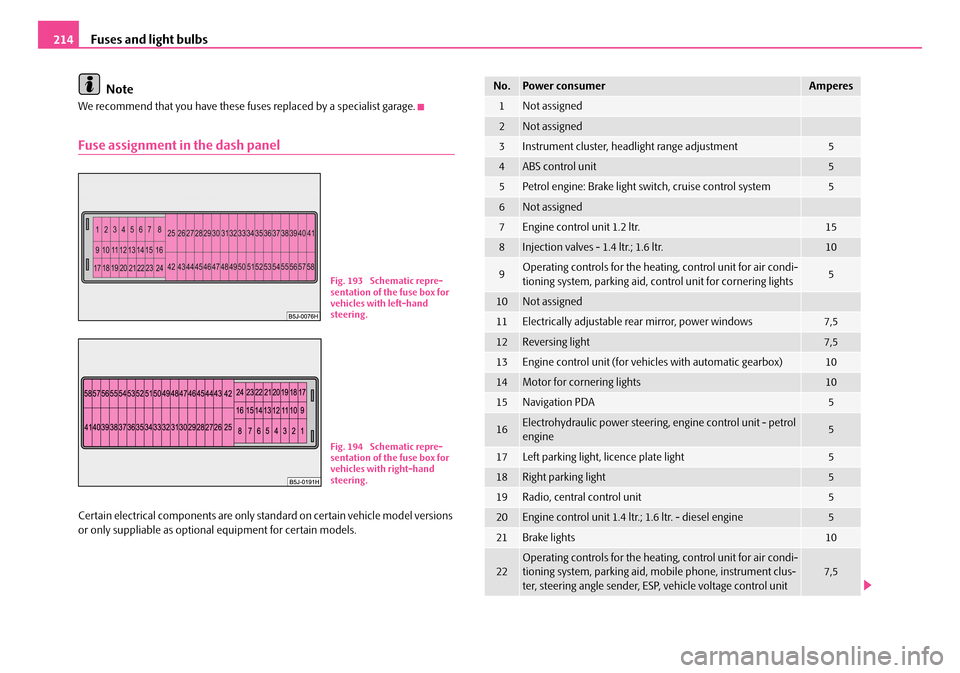
Fuse assignment in the dash panel
Certain electrical components are only standard on certain vehicle model versions or only suppliable as optional equipment for certain models.
Fig. 193 Schematic repre-sentation of the fuse box for vehicles with left-hand steering.
Fig. 194 Schematic repre-sentation of the fuse box for vehicles with right-hand steering.
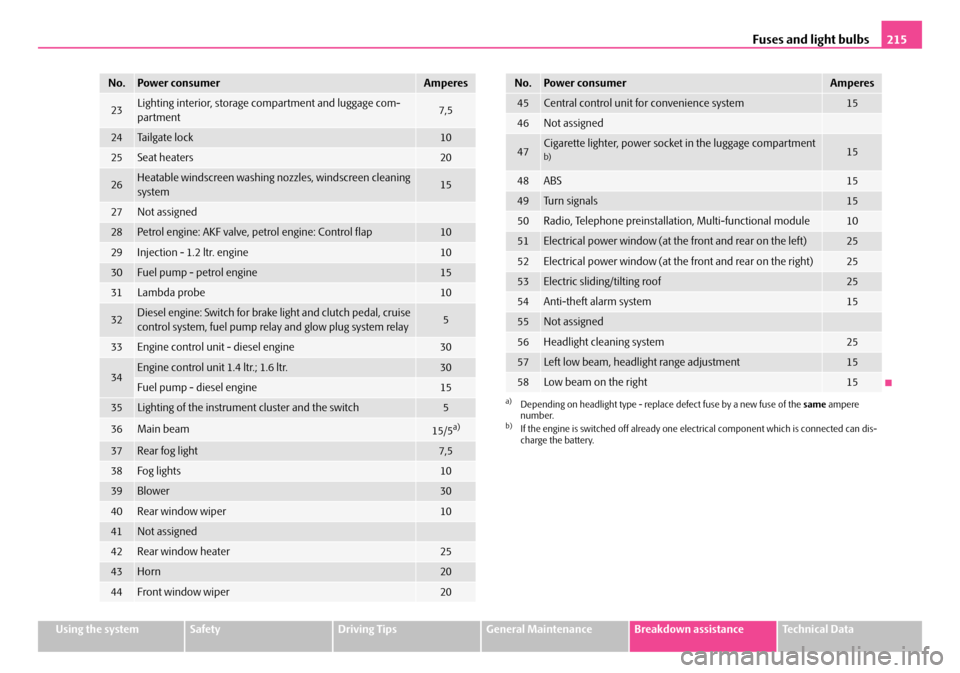
No.Power consumerAmperes
1Not assigned
2Not assigned
3Instrument cluster, headlight range adjustment5
4ABS control unit5
5Petrol engine: Brake light switch, cruise control system5
6Not assigned
7Engine control unit 1.2 ltr.15
8Injection valves - 1.4 ltr.; 1.6 ltr.10
9Operating controls for the heating, control unit for air condi-tioning system, parking aid, control unit for cornering lights5
10Not assigned
11Electrically adjustable rear mirror, power windows7,5
12Reversing light7,5
13Engine control unit (for vehicles with automatic gearbox)10
14Motor for cornering lights10
15Navigation PDA5
16Electrohydraulic power steering, engine control unit - petrol engine5
17Left parking light, licence plate light5
18Right parking light5
19Radio, central control unit5
20Engine control unit 1.4 ltr.; 1.6 ltr. - diesel engine5
21Brake lights10
22Operating controls for the heating, control unit for air condi-tioning system, parking aid, mobile phone, instrument clus-ter, steering angle sender, ESP, vehicle voltage control unit7,5
NKO A05F 20.book Page 214 Wednesday, April 2, 2008 1:02 PM
Page 216 of 252
Fuses and light bulbs215
Using the systemSafetyDriving TipsGeneral MaintenanceBreakdown assistanceTechnical Data
23Lighting interior, storage compartment and luggage com-partment7,5
24Tailgate lock10
25Seat heaters20
26Heatable windscreen washing nozzles, windscreen cleaning system15
27Not assigned
28Petrol engine: AKF valve, petrol engine: Control flap10
29Injection - 1.2 ltr. engine10
30Fuel pump - petrol engine15
31Lambda probe10
32Diesel engine: Switch for brake light and clutch pedal, cruise control system, fuel pump relay and glow plug system relay5
33Engine control unit - diesel engine30
34Engine control unit 1.4 ltr.; 1.6 ltr.30
Fuel pump - diesel engine15
35Lighting of the instrument cluster and the switch5
36Main beam15/5a)
37Rear fog light7,5
38Fog lights10
39Blower30
40Rear window wiper10
41Not assigned
42Rear window heater25
43Horn20
44Front window wiper20
No.Power consumerAmperes
45Central control unit for convenience system15
46Not assigned
47Cigarette lighter, power socket in the luggage compartment b)15
48ABS15
49Turn signals15
50Radio, Telephone preinstallation, Multi-functional module10
51Electrical power window (at the front and rear on the left)25
52Electrical power window (at the front and rear on the right)25
53Electric sliding/tilting roof25
54Anti-theft alarm system15
55Not assigned
56Headlight cleaning system25
57Left low beam, headlight range adjustment15
58Low beam on the right15
a)Depending on headlight type - replace defect fuse by a new fuse of the same ampere number.b)If the engine is switched off already one electrical component which is connected can dis-charge the battery.
No.Power consumerAmperes
NKO A05F 20.book Page 215 Wednesday, April 2, 2008 1:02 PM
Page 217 of 252
Fuses and light bulbs216
Replaces fuses at the battery
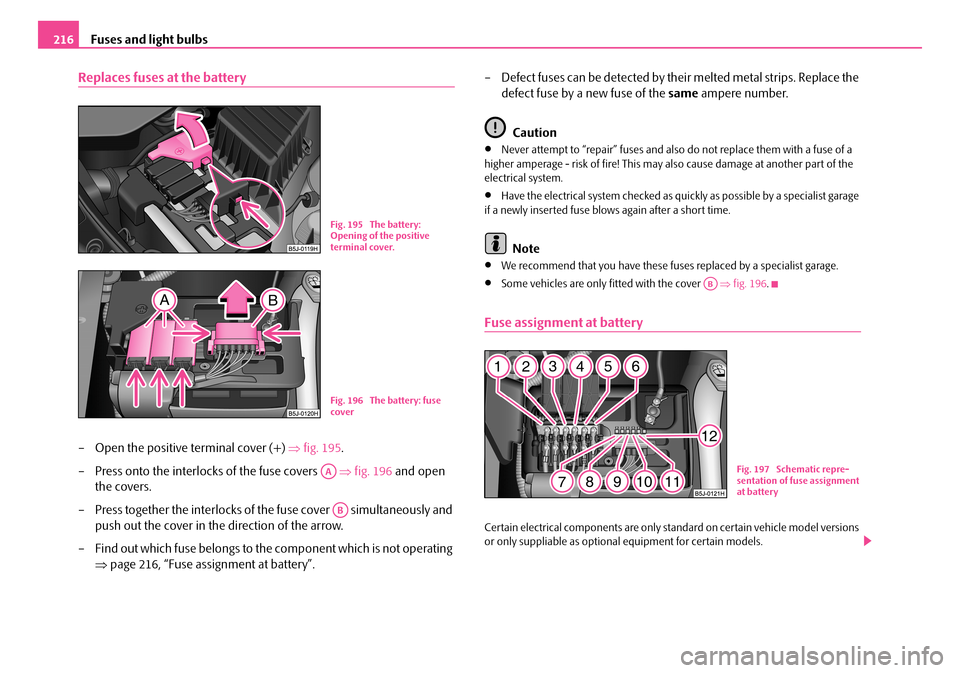
– Open the positive terminal cover (+) ⇒fig. 195.
– Press onto the interlocks of the fuse covers ⇒fig. 196 and open
the covers.
– Press together the interlocks of the fuse cover simultaneously and
push out the cover in the direction of the arrow.
– Find out which fuse belongs to the component which is not operating
⇒page 216, “Fuse assignment at battery”.
– Defect fuses can be detected by their melted metal strips. Replace the
defect fuse by a new fuse of the same ampere number.
Caution
•Never attempt to “repair” fuses and also do not replace them with a fuse of a higher amperage - risk of fire! This may also cause damage at another part of the electrical system.
•Have the electrical system checked as quickly as possible by a specialist garage if a newly inserted fuse blows again after a short time.
Note
•We recommend that you have these fuses replaced by a specialist garage.
•Some vehicles are only fitted with the cover ⇒fig. 196.
Fuse assignment at battery
Certain electrical components are only standard on certain vehicle model versions or only suppliable as optional equipment for certain models.
Fig. 195 The battery: Opening of the positive terminal cover.
Fig. 196 The battery: fuse cover
AA
AB
AB
Fig. 197 Schematic repre-sentation of fuse assignment at battery
NKO A05F 20.book Page 216 Wednesday, April 2, 2008 1:02 PM
Page 218 of 252
Fuses and light bulbs217
Using the systemSafetyDriving TipsGeneral MaintenanceBreakdown assistanceTechnical Data
Bulbs
Replacing bulbs
The relevant lamp must always be switched off before a light bulb is replaced.
Do not take hold of the glass bulb with naked fingers (even the smallest amount of dirt reduces the working life of the light bulb). Use a clean cloth, serviette or some-thing similar.
Defect light bulbs should only be replaced with light bulbs of the same type. The designation is located on the light socket or the glass bulb.
Changing certain bulbs is not something which you can do yourself, but requires to be done by a specialist. Other parts of the vehicle must be removed in order to change the light bulbs. This applies, in particular, to bulbs which can only be reached from the engine compartment.
We therefore recommend that you have any bulbs changed by a Škoda Service Partner or, in exceptional cases, by calling on other professional assistance.
Please note that the engine compartment is a hazardous area ⇒page 181, “Working in the engine compartment”.
We recommend that you carry the set of light bulbs with you which was delivered in your vehicle. Replacement light bulbs 9) are available at a Škoda Service Partner.
The set of light bulbs can be stowed in the locable box in the spare wheel.
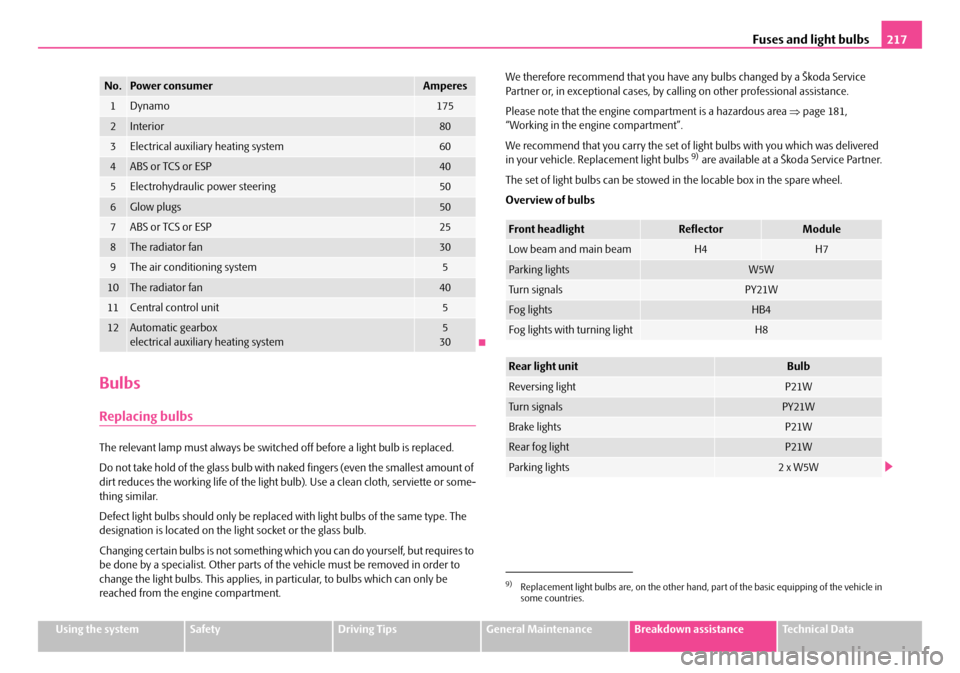
Overview of bulbs
No.Power consumerAmperes
1Dynamo175
2Interior80
3Electrical auxiliary heating system60
4ABS or TCS or ESP40
5Electrohydraulic power steering50
6Glow plugs50
7ABS or TCS or ESP25
8The radiator fan30
9The air conditioning system5
10The radiator fan40
11Central control unit5
12Automatic gearboxelectrical auxiliary heating system530
9)Replacement light bulbs are, on the other hand, part of the basic equipping of the vehicle insome countries.
Front headlightReflectorModule
Low beam and main beamH4H7
Parking lightsW5W
Tu r n s i g n a l sPY21W
Fog lightsHB4
Fog lights with turning lightH8
Rear light unitBulb
Reversing lightP21W
Tu r n s i g n a l sPY21W
Brake lightsP21W
Rear fog lightP21W
Parking lights2 x W5W
NKO A05F 20.book Page 217 Wednesday, April 2, 2008 1:02 PM
Page 219 of 252
Fuses and light bulbs218
WARNING
•Bulbs H7 and H4 are pressurised and may burst when changing the bulb - risk of injury!
•It is recommended to wear gloves and eye protection when changing a light bulb.
Note
This Owner's Manual only describes the replacement of bulbs where it is assumed that no major complications will arise. Other light bulbs should be changed by your specialist garage.
Front headlight
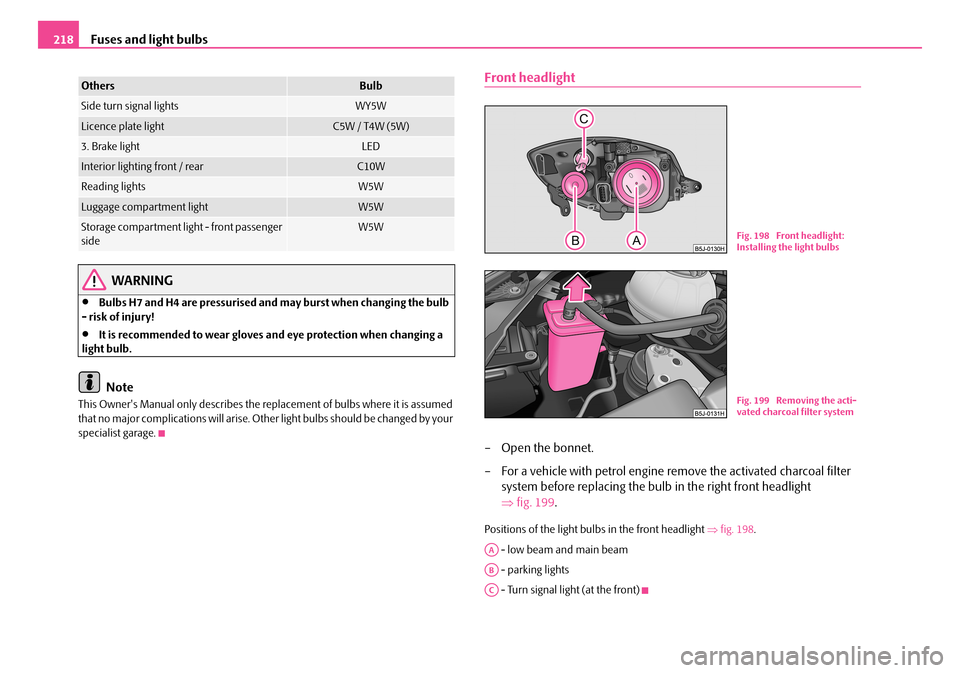
– Open the bonnet.
– For a vehicle with petrol engine remove the activated charcoal filter
system before replacing the bulb in the right front headlight
⇒fig. 199.
Positions of the light bulbs in the front headlight ⇒fig. 198.
- low beam and main beam
- parking lights
- Turn signal light (at the front)
OthersBulb
Side turn signal lightsWY5W
Licence plate lightC5W / T4W (5W)
3. Brake lightLED
Interior lighting front / rearC10W
Reading lightsW5W
Luggage compartment lightW5W
Storage compartment light - front passenger sideW5WFig. 198 Front headlight: Installing the light bulbs
Fig. 199 Removing the acti-vated charcoal filter system
AA
AB
AC
NKO A05F 20.book Page 218 Wednesday, April 2, 2008 1:02 PM
Page 220 of 252
Fuses and light bulbs219
Using the systemSafetyDriving TipsGeneral MaintenanceBreakdown assistanceTechnical Data
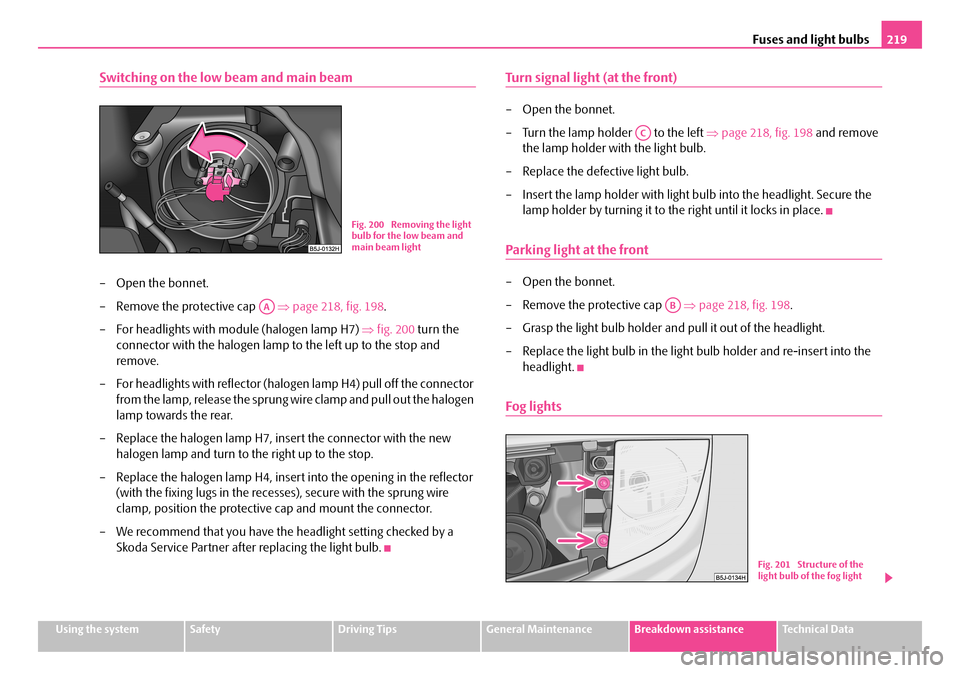
Switching on the low beam and main beam
– Open the bonnet.
– Remove the protective cap ⇒page 218, fig. 198.
– For headlights with module (halogen lamp H7) ⇒fig. 200 turn the
connector with the halogen lamp to the left up to the stop and
remove.
– For headlights with reflector (halogen lamp H4) pull off the connector
from the lamp, release the sprung wire clamp and pull out the halogen
lamp towards the rear.
– Replace the halogen lamp H7, insert the connector with the new
halogen lamp and turn to the right up to the stop.
– Replace the halogen lamp H4, insert into the opening in the reflector
(with the fixing lugs in the recesses), secure with the sprung wire
clamp, position the protective cap and mount the connector.
– We recommend that you have the headlight setting checked by a
Skoda Service Partner after replacing the light bulb.
Turn signal light (at the front)
– Open the bonnet.
– Turn the lamp holder to the left ⇒page 218, fig. 198 and remove
the lamp holder with the light bulb.
– Replace the defective light bulb.
– Insert the lamp holder with light bulb into the headlight. Secure the
lamp holder by turning it to the right until it locks in place.
Parking light at the front
– Open the bonnet.
– Remove the protective cap ⇒page 218, fig. 198.
– Grasp the light bulb holder and pull it out of the headlight.
– Replace the light bulb in the light bulb holder and re-insert into the
headlight.
Fog lights
Fig. 200 Removing the light bulb for the low beam and main beam light
AA
AC
AB
Fig. 201 Structure of the light bulb of the fog light
NKO A05F 20.book Page 219 Wednesday, April 2, 2008 1:02 PM