boot SKODA FABIA 2009 2.G / 5J User Guide
[x] Cancel search | Manufacturer: SKODA, Model Year: 2009, Model line: FABIA, Model: SKODA FABIA 2009 2.G / 5JPages: 259, PDF Size: 31.99 MB
Page 57 of 259
Lights and Visibility 56A time delay switch* causes the inner lighting on vehicles without a central locking
system stays on for a few seconds after the doors have been closed. The inner light
goes out out immediately after the ignition is switched on.
The interior lighting is switched off after about 30 minutes when a door has been
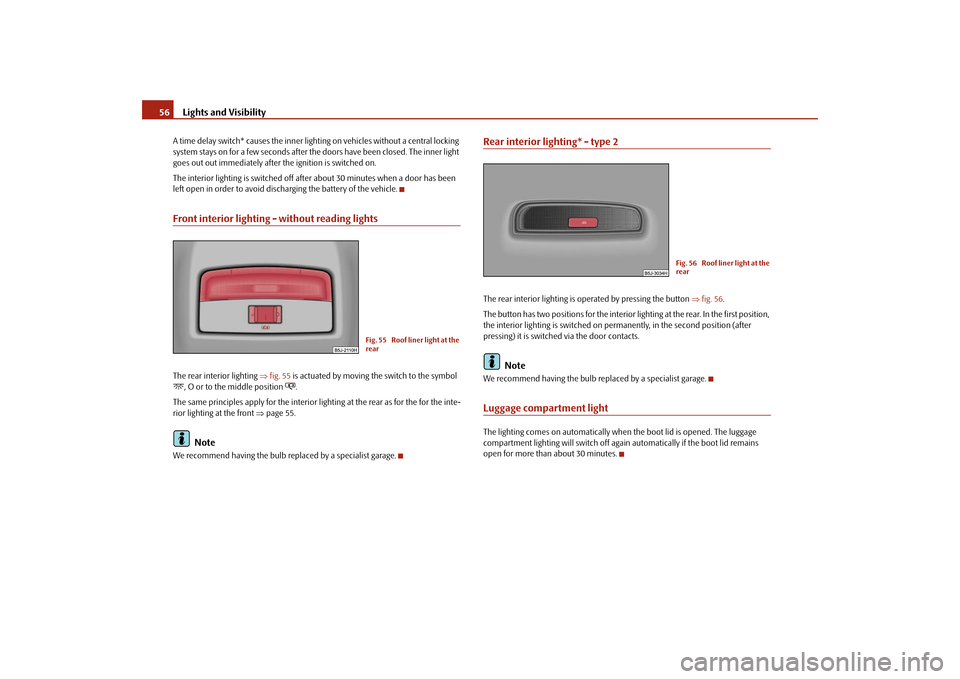
left open in order to avoid discharging the battery of the vehicle.Front interior lighting - without reading lightsThe rear interior lighting ⇒fig. 55 is actuated by moving the switch to the symbol , O or to the middle position
.
The same principles apply for the interior lighting at the rear as for the for the inte-
rior lighting at the front ⇒page 55.
Note
We recommend having the bulb replaced by a specialist garage.
Rear interior lighting* - type 2The rear interior lighting is operated by pressing the button ⇒fig. 56.
The button has two positions for the interior lighting at the rear. In the first position,
the interior lighting is switched on permanently, in the second position (after
pressing) it is switched via the door contacts.
Note
We recommend having the bulb replaced by a specialist garage.Luggage compartment lightThe lighting comes on automatically when the boot lid is opened. The luggage
compartment lighting will switch off again automatically if the boot lid remains
open for more than about 30 minutes.
Fig. 55 Roof liner light at the
rear
Fig. 56 Roof liner light at the
rear
s3f4.1.book Page 56 Thursday, June 18, 2009 11:07 AM
Page 68 of 259
Seats and Storage67
Using the system
Safety
Driving Tips
General Maintenance
Breakdown assistance
Technical Data
PedalsYou should use only footmats which do not obstruct the movement of the pedals
and have an anti-slip protection.
We recommend only to use footmats from Škoda genuine accessories offered by
your Škoda dealer.
Operation of the pedals must not be hindered!
WARNING
•
Greater pedal distances may be needed when there is a fault in the brake
system.
•
Do not place any footmats or other additional floor coverings in the area
of the pedals in order to ensure that all the pedals can be fully depressed and
are able to return unobstructed to their initial position - risk of accident!
•
There must be no objects on the floor which could roll under the pedals.
You would then no longer be able to apply the brakes, operate the clutch or
accelerator - risk of accident!
luggage compartmentLoading the luggage compartmentPlease observe the following in the interest of having good handling char-
acteristics of your vehicle:
– Distribute the items of luggage as evenly as possible.
– Place heavy objects as far forward as possible.
– Attach the items of luggage to the lashing eyes or the fixing net*
⇒page 68.In the event of an accident, there is such a high kinetic energy which is produced by
small and light objects that they can cause severe injuries. The magnitude of the kinetic energy depends on the speed at which the vehicle is travelling and on the
weight of the object. The speed at which the vehicle is travelling is in this case the
more significant factor.
Example: In the event of a frontal collision at a speed of 50 km/h, an unsecured
object with a weight of 4.5 kg produces an energy, which corresponds to 20 times
its own weight. This means that it results in a weight of approx. 90 kg. You can
imagine the injuries that can occur, if this “bullet” is flying through the interior
compartment and hits an occupant.
WARNING
•
Store the objects in the luggage compartment and attach them to the
lashing eyes.
•
Loose objects in the passenger compartment can be thrown forward
during a sudden manoeuvre or in case of an accident and can injure the
occupants or other oncoming traffic. This risk is still increased, if the objects
which are flying around are hit by a deployed airbag. In this case, the objects
which are thrown back can injure the occupants - hazard.
•
Please note that the handling properties of your vehicle may be affected
when transporting heavy objects as a result of the displacement of the
centre of gravity. The speed and style of driving must be adjusted accord-
ingly.
•
The items carried in the luggage compartment should be stored in such
a way that no objects are able to slip forward if there are any sudden driving
or braking manoeuvres undertaken - risk of injury!
•
When transporting fastened objects which are sharp and dangerous in
the luggage compartment enlarged by folding the rear seats forward or
removing the rear seats, ensure the safety of the passengers transported on
the other rear seats ⇒page 130, “Correct seated position for the occupants
on the rear seats”.
•
If the rear seats next to the folded forward seat are occupied, ensure
maximum safety, e.g. by placing the goods to be transported in such a way
that a folding back of the seat is prevented in case of a rear collision.
•
Never drive with the boot lid fully opened or slightly ajar otherwise
exhaust gases may get into the interior of the vehicle - risk of poisoning!
s3f4.1.book Page 67 Thursday, June 18, 2009 11:07 AM
Page 71 of 259
Seats and Storage 70Luggage compartment cover
You can use the luggage compartment cover behind the head
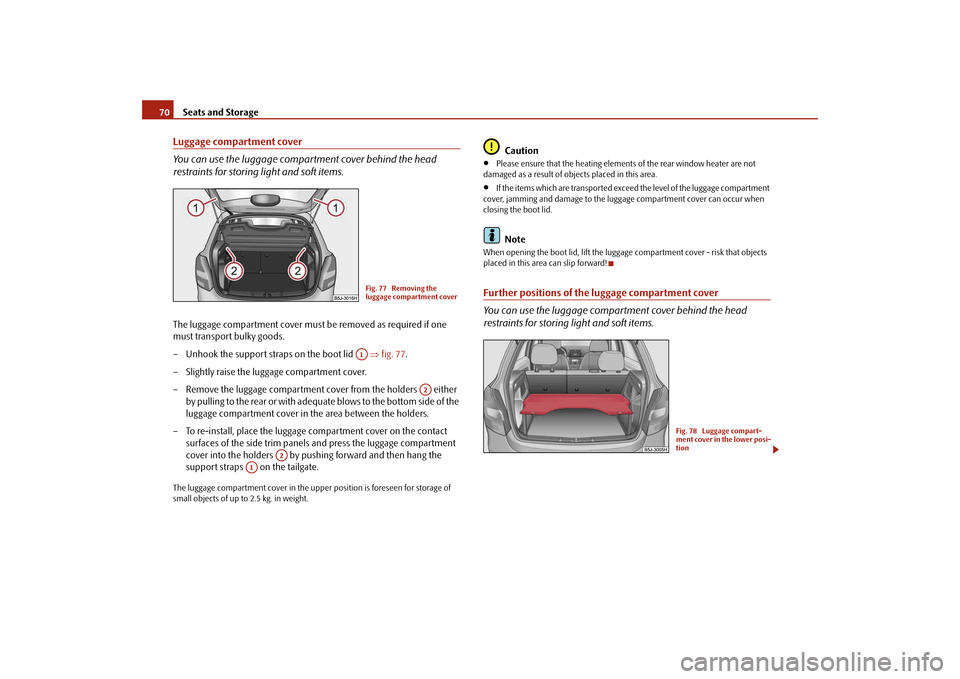
restraints for storing light and soft items.The luggage compartment cover must be removed as required if one
must transport bulky goods.
– Unhook the support straps on the boot lid ⇒fig. 77.
– Slightly raise the luggage compartment cover.
– Remove the luggage compartment cover from the holders either
by pulling to the rear or with a dequate blows to the bottom side of the
luggage compartment cover in the area between the holders.
– To re-install, place the luggage compartment cover on the contact
surfaces of the side trim panels and press the luggage compartment
cover into the holders by pushing forward and then hang the
support straps on the tailgate.The luggage compartment cover in the upper position is foreseen for storage of
small objects of up to 2.5 kg. in weight.
Caution
•
Please ensure that the heating elements of the rear window heater are not
damaged as a result of objects placed in this area.
•
If the items which are transported exceed the level of the luggage compartment
cover, jamming and damage to the luggage compartment cover can occur when
closing the boot lid.Note
When opening the boot lid, lift the luggage compartment cover - risk that objects
placed in this area can slip forward!Further positions of the luggage compartment cover
You can use the luggage compartment cover behind the head
restraints for storing light and soft items.
Fig. 77 Removing the
luggage compartment coverA1
A2
A2
A1
Fig. 78 Luggage compart-
ment cover in the lower posi-
tion
s3f4.1.book Page 70 Thursday, June 18, 2009 11:07 AM
Page 72 of 259
Seats and Storage71
Using the system
Safety
Driving Tips
General Maintenance
Breakdown assistance
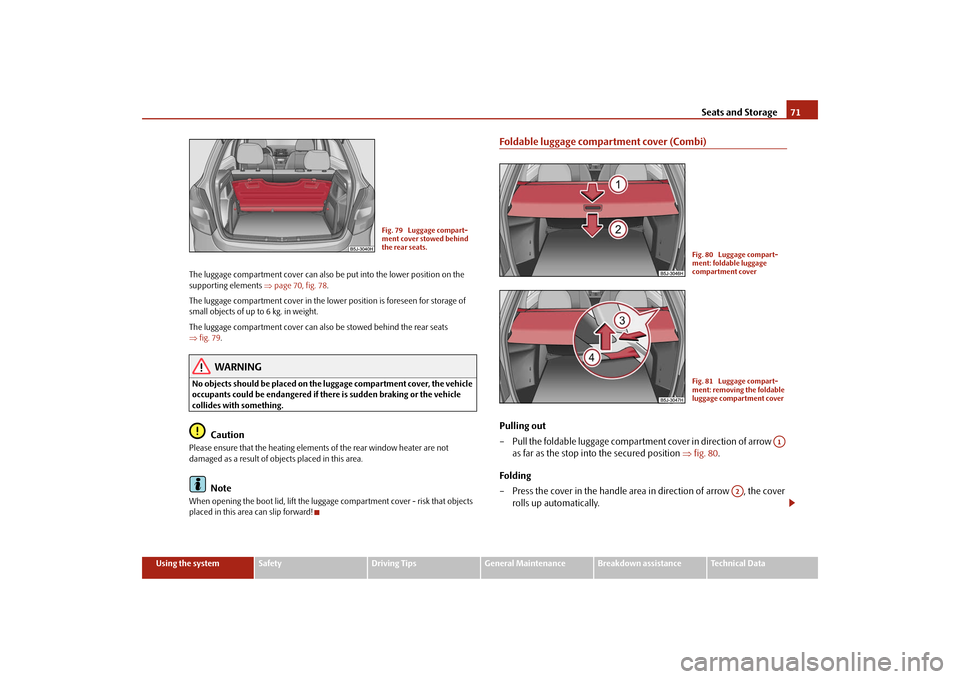
Technical Data The luggage compartment cover can also be put into the lower position on the
supporting elements ⇒page 70, fig. 78.
The luggage compartment cover in the lower position is foreseen for storage of
small objects of up to 6 kg. in weight.
The luggage compartment cover can also be stowed behind the rear seats
⇒fig. 79.
WARNING
No objects should be placed on the luggage compartment cover, the vehicle
occupants could be endangered if there is sudden braking or the vehicle
collides with something.
Caution
Please ensure that the heating elements of the rear window heater are not
damaged as a result of objects placed in this area.
Note
When opening the boot lid, lift the luggage compartment cover - risk that objects
placed in this area can slip forward!
Foldable luggage compartment cover (Combi)Pulling out
– Pull the foldable luggage compartment cover in direction of arrow
as far as the stop into the secured position ⇒fig. 80.
Folding
– Press the cover in the handle area in direction of arrow , the cover
rolls up automatically.
Fig. 79 Luggage compart-
ment cover stowed behind
the rear seats.
Fig. 80 Luggage compart-
ment: foldable luggage
compartment coverFig. 81 Luggage compart-
ment: removing the foldable
luggage compartment cover
A1
A2
s3f4.1.book Page 71 Thursday, June 18, 2009 11:07 AM
Page 78 of 259
Seats and Storage77
Using the system
Safety
Driving Tips
General Maintenance
Breakdown assistance
Technical Data
WARNING
When transporting the bicycles in the luggage compartment, ensure the
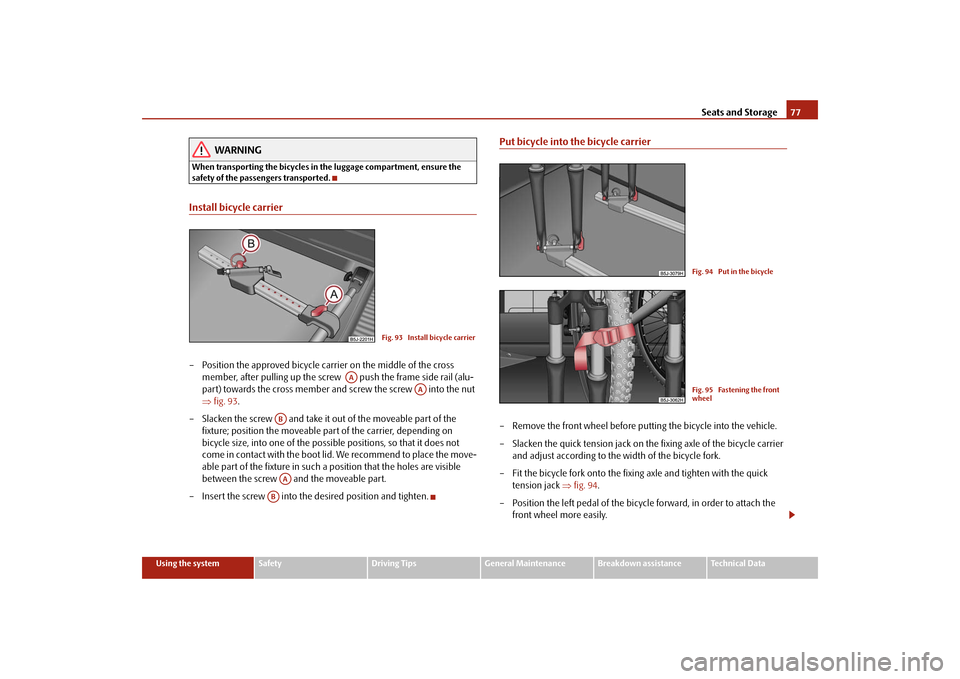
safety of the passengers transported.Install bicycle carrier– Position the approved bicycle carrier on the middle of the cross
member, after pulling up the screw push the frame side rail (alu-
part) towards the cross member and screw the screw into the nut
⇒fig. 93.
– Slacken the screw and take it out of the moveable part of the
fixture; position the moveable part of the carrier, depending on
bicycle size, into one of the possible positions, so that it does not
come in contact with the boot lid. We recommend to place the move-
able part of the fixture in such a position that the holes are visible
between the screw and the moveable part.
– Insert the screw into the desired position and tighten.
Put bicycle into the bicycle carrier– Remove the front wheel before putting the bicycle into the vehicle.
– Slacken the quick tension jack on the fixing axle of the bicycle carrier
and adjust according to the width of the bicycle fork.
– Fit the bicycle fork onto the fixing axle and tighten with the quick
tension jack ⇒fig. 94.
– Position the left pedal of the bicycle forward, in order to attach the
front wheel more easily.
Fig. 93 Install bicycle carrier
AA
AA
ABAA
AB
Fig. 94 Put in the bicycleFig. 95 Fastening the front
wheel
s3f4.1.book Page 77 Thursday, June 18, 2009 11:07 AM
Page 79 of 259
Seats and Storage 78
– Slacken the screw ⇒page 77, fig. 93 and push the bicycle holder
together with the attached bicycle to the left (in the direction of the
arrow), so that no collision between the steering arm and the side
window of the luggage compartment can occur.
– Carefully guide the boot lid to the bottom without letting it go and at
the same time check if there is adequate room between the steering
arm of the bicycle and the window of the boot lid. If necessary adapt
the position of the moveable part of the bicycle carrier in such a way
that no collision can occur ⇒page 77.
– It is best to push the removed front wheel between the crank of the left
pedal and the bicycle frame, attach it with a strap to the front fork
⇒page 77, fig. 95, and/or to a fixing point.
– Make sure that it does not lead to damage of the trim panel of the
luggage compartment, the bicycle and the placed objects.
– Perform the installation of the second fixture and the attachment of
the bicycle analogously.
WARNING
Place the bicycles in the bicycle carrier in such a position that no collision
between the steering arm and the side and/or rear window can occur.
Note
If the front wheel is equipped with disc brake, attach the wheel in such a way that
the brake disc is opposite the frame.
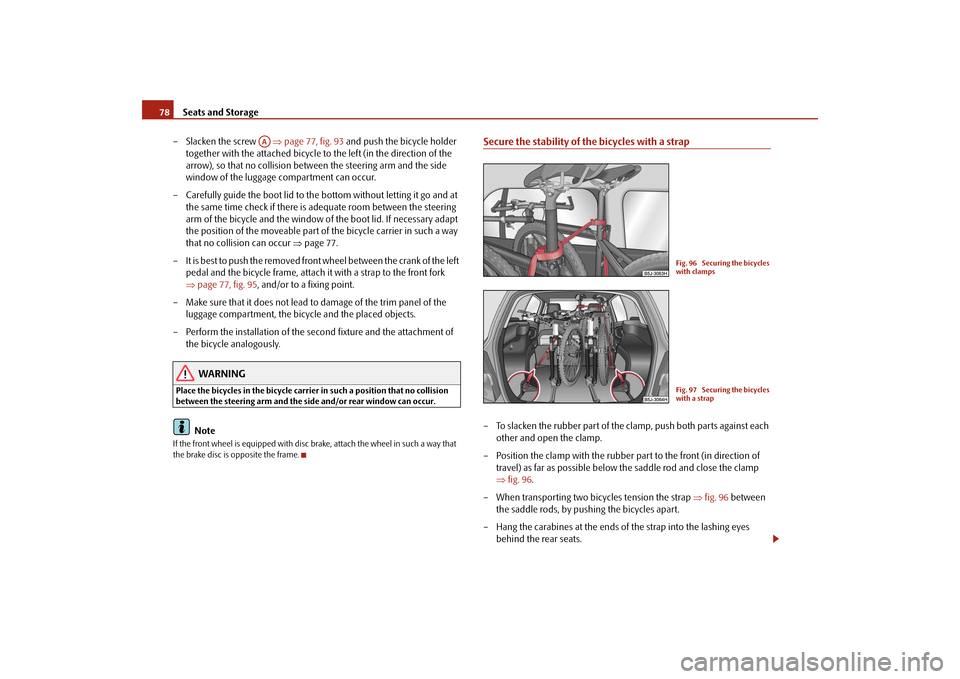
Secure the stability of the bicycles with a strap– To slacken the rubber part of the clamp, push both parts against each
other and open the clamp.
– Position the clamp with the rubber part to the front (in direction of
travel) as far as possible below the saddle rod and close the clamp
⇒fig. 96.
– When transporting two bicycles tension the strap ⇒fig. 96 between
the saddle rods, by pushing the bicycles apart.
– Hang the carabines at the ends of the strap into the lashing eyes
behind the rear seats.
AA
Fig. 96 Securing the bicycles
with clampsFig. 97 Securing the bicycles
with a strap
s3f4.1.book Page 78 Thursday, June 18, 2009 11:07 AM
Page 80 of 259
Seats and Storage79
Using the system
Safety
Driving Tips
General Maintenance
Breakdown assistance
Technical Data
– Pull the strap through the tensioning clasp, first of all on the one side
and then on the other side.
– If it is necessary, the position of the bicycles in the vehicle can be addi-
tionally rectified.
WARNING
•
When transporting passengers and objects, which require the seats to be
folded forwards, ensure the safety of the passengers being transported.
•
Place the bicycles in the bicycle carrier in such a position that no collision
between the steering arm and the rear window can occur.
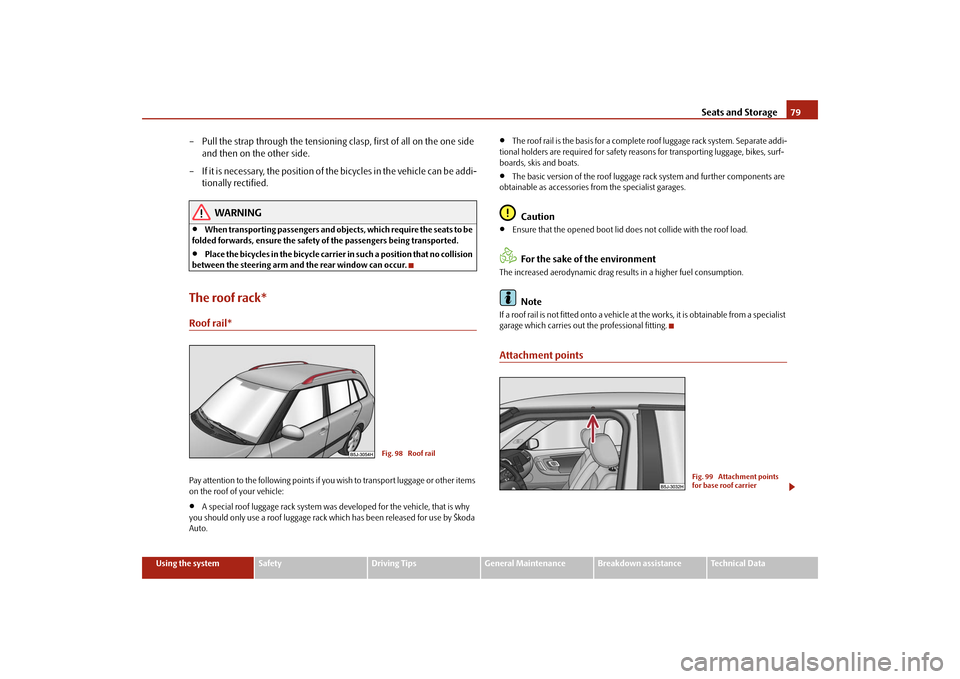
The roof rack*Roof rail*Pay attention to the following points if you wish to transport luggage or other items
on the roof of your vehicle:•
A special roof luggage rack system was developed for the vehicle, that is why
you should only use a roof luggage rack which has been released for use by Škoda
Auto.
•
The roof rail is the basis for a complete roof luggage rack system. Separate addi-
tional holders are required for safety reasons for transporting luggage, bikes, surf-
boards, skis and boats.
•
The basic version of the roof luggage rack system and further components are
obtainable as accessories from the specialist garages.Caution
•
Ensure that the opened boot lid does not collide with the roof load.For the sake of the environment
The increased aerodynamic drag results in a higher fuel consumption.
Note
If a roof rail is not fitted onto a vehicle at the works, it is obtainable from a specialist
garage which carries out the professional fitting.Attachment points
Fig. 98 Roof rail
Fig. 99 Attachment points
for base roof carrier
s3f4.1.book Page 79 Thursday, June 18, 2009 11:07 AM
Page 177 of 259
Taking care of your vehicle and cleaning the vehicle 176Plastic partsExternal plastic parts are cleaned by normal washing. Plastic parts and synthetic
leather can also be treated with special solvent-free plastic cleaning agents if a
damp cloth is not sufficient. Paint care products are not suitable for plastic parts.
Caution
Solvent-free cleaners attack the material and can damage it.WindowsOnly use a plastic ice scraper for removing snow and ice from the windows and
mirrors. You should not move the ice scraper forward and backward but in one
direction on the window which you are cleaning in order to avoid any damage to
the surface of the glass.
You can best remove residues of rubber, oil, grease, wax or silicone by using a
special window cleaner or a special silicone remover.
You should also clean the windows regularly from the inside.
Do not use window leathers which you have used to polish the vehicle body to dry
off the windows. Residues of preservatives in the window leather can dirty the
window and reduce visibility.
Do not affix any stickers over the inside of the rear window to avoid damage to the
heating elements of the rear window heater.
We recommend using a preservative from Škoda genuine accessories offered by
your Škoda dealer.
Caution
•
Never remove snow or ice from the glass parts with warm or hot water - risk of
formation of cracks in the glass!
•
When removing snow or ice from the windows and mirror lenses make sure not
to damage the paintwork of the vehicle.
The headlight lensesPlease do not use any aggressive cleaning or chemical solvent products for cleaning
the front headlights - risk of damage to the plastic lenses. Please use soap and
clean warm water.
Caution
Never wipe the headlights dry and do not use any sharp objects for cleaning the
plastic lenses, this may result in damage to the protective paintwork and conse-
quently in formation of cracks on the headlight lenses, e.g through effect of chem-
ical products.Door and window sealsThe rubber seals on the doors, boot lid, bonnet and windows remain supple and
last longer if you treat them from time to time with a rubber care product (e.g. with
a spray with silicone-free oil). You also avoid premature wear of the seals and
prevent leakages in this way. It is also easier to open the doors. Rubber seals which
are well cared for also do not stick together in cold winter weather.Locking cylinderWe recommend that you use the spray from Škoda original accessories with
regreasing and anticorrosive effect for de-icing locking cylinders.
Note
When washing your vehicle, ensure that as little water as possible gets into the
locking cylinders.
s3f4.1.book Page 176 Thursday, June 18, 2009 11:07 AM
Page 225 of 259
Fuses and light bulbs 224Turn signal light (at the front)– Open the bonnet.
– Turn the lamp holder to the left ⇒page 222, fig. 212 and remove
the lamp holder with the light bulb.
– Replace the defective light bulb.
– Insert the lamp holder with light bulb into the headlight. Secure the
lamp holder by turning it to the right until it locks in place.Parking light at the front– Open the bonnet.
– Remove the protective cap ⇒page 222, fig. 212.
– Grasp the light bulb holder and pull it out of the headlight.
– Replace the light bulb in the light bulb holder and re-insert into the
headlight.Fog lights
– Remove the grille next to the fog light with the function “Corner” or the
grill around the round fog light ⇒page 213.
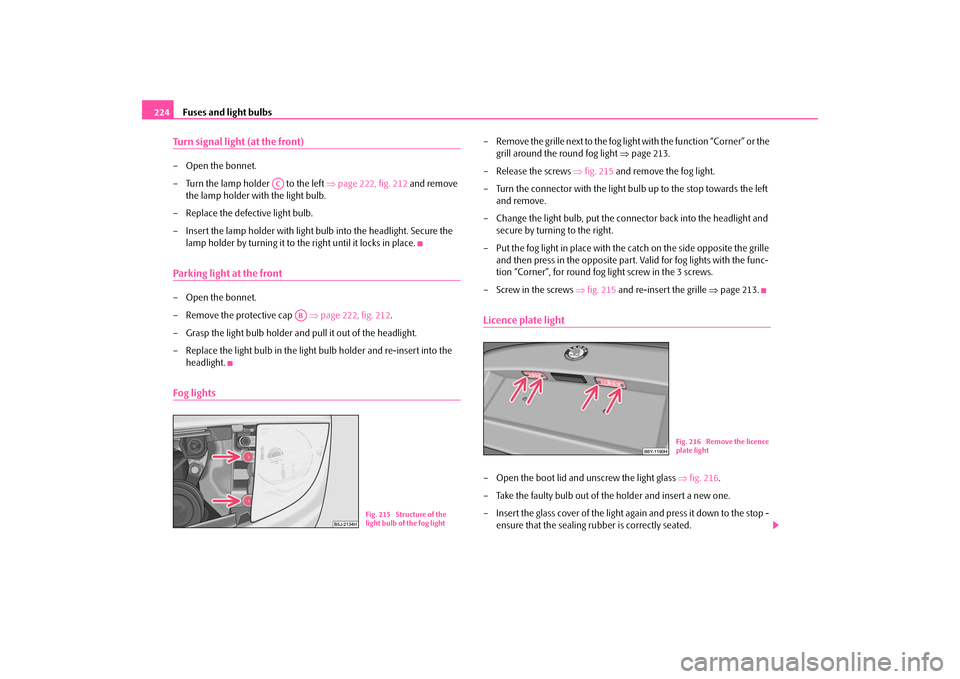
– Release the screws ⇒fig. 215 and remove the fog light.
– Turn the connector with the light bulb up to the stop towards the left
and remove.
– Change the light bulb, put the connector back into the headlight and
secure by turning to the right.
– Put the fog light in place with the catch on the side opposite the grille
and then press in the opposite part. Valid for fog lights with the func-
tion “Corner”, for round fog light screw in the 3 screws.
– Screw in the screws ⇒fig. 215 and re-insert the grille ⇒page 213.Licence plate light– Open the boot lid and unscrew the light glass ⇒fig. 216.
– Take the faulty bulb out of the holder and insert a new one.
– Insert the glass cover of the light again and press it down to the stop -
ensure that the sealing rubber is correctly seated.
AC
AB
Fig. 215 Structure of the
light bulb of the fog light
Fig. 216 Remove the licence
plate light
s3f4.1.book Page 224 Thursday, June 18, 2009 11:07 AM
Page 226 of 259
Fuses and light bulbs225
Using the system
Safety
Driving Tips
General Maintenance
Breakdown assistance
Technical Data
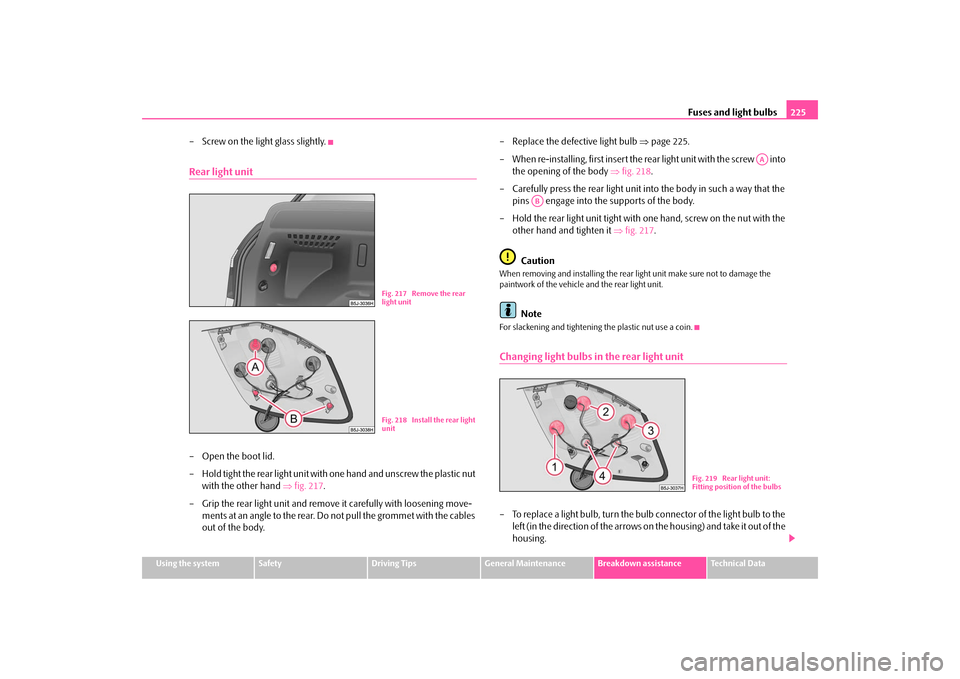
– Screw on the light glass slightly.Rear light unit– Open the boot lid.
– Hold tight the rear light unit with one hand and unscrew the plastic nut
with the other hand ⇒fig. 217.
– Grip the rear light unit and remove it carefully with loosening move-
ments at an angle to the rear. Do not pull the grommet with the cables
out of the body.– Replace the defective light bulb ⇒page 225.
– When re-installing, first insert the rear light unit with the screw into
the opening of the body ⇒fig. 218.
– Carefully press the rear light unit into the body in such a way that the
pins engage into the supports of the body.
– Hold the rear light unit tight with one hand, screw on the nut with the
other hand and tighten it ⇒fig. 217.
Caution
When removing and installing the rear light unit make sure not to damage the
paintwork of the vehicle and the rear light unit.
Note
For slackening and tightening the plastic nut use a coin.Changing light bulbs in the rear light unit– To replace a light bulb, turn the bulb connector of the light bulb to the
left (in the direction of the arrows on the housing) and take it out of the
housing.
Fig. 217 Remove the rear
light unitFig. 218 Install the rear light
unit
AA
AB
Fig. 219 Rear light unit:
Fitting position of the bulbs
s3f4.1.book Page 225 Thursday, June 18, 2009 11:07 AM