Service SKODA FABIA 2010 2.G / 5J User Guide
[x] Cancel search | Manufacturer: SKODA, Model Year: 2010, Model line: FABIA, Model: SKODA FABIA 2010 2.G / 5JPages: 244, PDF Size: 29.53 MB
Page 140 of 244
Intelligent Technology
139
Using the system
Safety
Driving Tips
General Maintenance
Breakdown assistance
Technical Data
General The EDL makes it much easier, and sometimes
at all possible, to start off, accelerate
and climb a steep hill when the conditions of the road surface are unfavourable. Operating principle The EDL is activated automaticall
y, that is without any action on the part of the driver.
It monitors the speeds of the driven wheels with the aid of the ABS sensors. Should only
one
drive wheel begin spinning on a slippery surface there will be an appreciable
difference in the speed of the driven wheels. The EDL function brakes the slipping wheel and the differential transmits a greate
r driving force to the other driven wheel.
This control process is also accompanied by noises. Overheating of the brakes The EDL switches off automatically if unusually severe stresses exist in order to avoid excessive heat generation in the disc brake on the wheel which is being braked. The vehicle can continue to be driven and has
the same characteristics as a vehicle not
fitted with EDL. The EDL switches on again automatically as soon as the brake has cooled down.
WARNING
Carefully depress the accelerator when accelerating on uniformly slippery
road surfaces, such as ice and snow. The driven wheels might still spin despite the EDL and affect the stability of
the vehicle - risk of an accident!
You should always adapt your style of driving to the condition of road
surface and to the traffic situation even
when your vehicle is fitted with EDL.
The increased safety offered must not tempt you to take greater risks than otherwise - risk of an accident!
Note
If the ABS or TCS or ESP warning light comes on, this may also indicate a fault in the
EDL. Please have the vehicle inspected as
soon as possible by a specialist garage.
Changes to vehicle (e.g. on engine, on th
e brakes, on chassis or another combina-
tion of tyres and wheels) can in
fluence the function of the EDL
page 184, “Accesso-
ries, changes and replacement of parts”.
BrakesWhat has a negative effect on braking efficiency?Wear-and-tear Wear-and-tear to the brake pa
ds is greatly dependent on
the operating conditions of
the vehicle and your style of driving. Particularly if you drive a great deal in towns and over short distances or if you adopt a sporty
style of driving, it may be necessary to
have the thickness of the brake pads insp
ected at a specialist garage between the
service inspections. Wet roads or road salt There may be a certain delay before the brakes
take full effect un
der certain conditions
such as when driving through water, during
heavy rain showers or
after the vehicle has
been washed in an automatic vehicle wash
, since the brake discs and brake pads may
be moist or even have a coating of ice on them in winter. You should dry the brakes as soon as possible by applying and
releasing the brakes several times.
There also may be a certain delay before the
full braking efficiency is available when
driving on roads which have been treated with
road salt if you have not used the brakes
for some considerable time beforehand. The
layer of salt on the brake discs and brake
pads must first be rubbed off when you apply the brakes. Corrosion Corrosion on the brake discs and dirt on th
e bake pads occur if
the vehicle has been
parked for a long period and if you do
not make much use of the braking system.
We recommend cleaning the brake discs by firm
ly applying the brakes at a fairly high
speed if you do not make much use of the braking system or if surface corrosion is present
.
Faults in the brake surface If you notice that the braking distance has
suddenly become longer and that the brake
pedal can be depressed further, it is possib
le that a brake circuit of the dual-circuit
brake system has failed. Drive, in such cases, to the nearest specialist garage without delay in order to have the problem rectified. Drive at a reduced speed while on your way to the dealer and adapt your style of
driving to the higher brake pedal pressure
required.
s3j8.a.book Page 139 Tuesday, April 20, 2010 1:10 PM
Page 144 of 244
Intelligent Technology
143
Using the system
Safety
Driving Tips
General Maintenance
Breakdown assistance
Technical Data
If the warning light
does not go out after the basic setting, there is a fault in the
system. Have the vehicle inspected by your nearest specialist garage. Functional description After the basic setting of the system the “adaptation” of the tyre inflation pressures and then the tyre pressure control in the individual tyres are performed. Warning light
lights up
If the tyre inflation pressure of at least one wheel is insufficiently inflated in comparison to the stored basic value, the warning light
lights up. Inflate all tyres to the
specified inflation pressure
page 178, “Tyre life” and then perform a basic setting of
the system. Warning light
flashes
If the warning light flashes, there is a system fault. Have the vehicle inspected by your nearest specialist garage.
WARNING
When the warning light
lights up, immediately reduce the speed and
avoid sudden steering and brake manoeuvr
es. Please stop the vehicle without
delay at the nearest possible stop and in
spect the tyres and their inflation pres-
sures.
The driver is responsible
for the correct tyre inflation pressures. For this
reason, the tyre inflation pressu
res must be checked regularly.
Under certain circumstances (e.g. sporty style of driving, wintry or unpaved
roads) the warning light
can be delayed or does not light up at all.
The tyre pressure monitoring system does not take away the responsibility
from the driver for the correct tyre inflation pressure.
Note
The tyre pressure monitoring system:
does not replace the regular tyre inflatio
n pressure control, because the system
cannot detect an even pressure loss;
cannot warn in case of very rapid tyre inflation pressure loss, e.g. in case of sudden
tyre damage. In this case ca
refully bring the vehicle to a standstill without sudden
steering movements and without sharp braking.Diesel particle filter* (diesel engine)In the diesel particle filter the resu
lting soot particles are collected and
burnt during the combustion of diesel fuel.Code
7GG
, 7MB
or 7MG
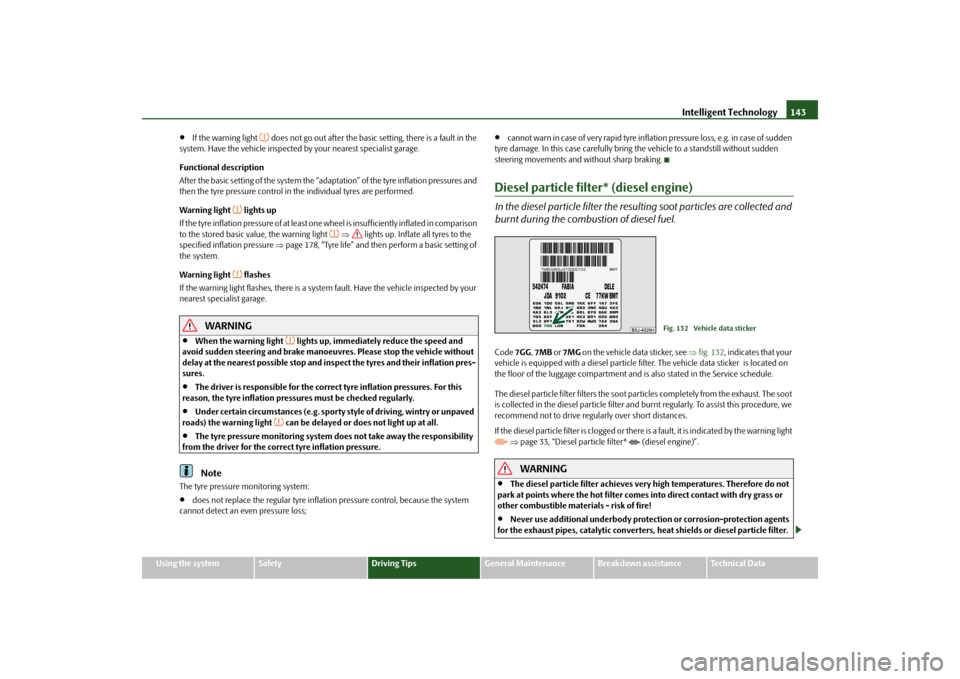
on the vehicle data sticker, see
fig. 132
, indicates that your
vehicle is equipped with a diesel particle fi
lter. The vehicle data st
icker is located on
the floor of the luggage compartment and is
also stated in the Service schedule.
The diesel particle filter filters the soot particles completely from the exhaust. The soot is collected in the diesel particle filter and
burnt regularly. To assist this procedure, we
recommend not to drive regu
larly over short distances.
If the diesel particle filter is clogged or there is a fault, it is indicated by the warning light
page 33, “Diesel particle filter*
(diesel engine)”.
WARNING
The diesel particle filter
achieves very high temp
eratures. Therefore do not
park at points where the hot filter comes into direct contact with dry grass or other combustible materials - risk of fire!
Never use additional underbody protection or corrosion-protection agents
for the exhaust pipes, catalytic converters,
heat shields or diesel particle filter. Fig. 132 Vehicle data sticker
s3j8.a.book Page 143 Tuesday, April 20, 2010 1:10 PM
Page 149 of 244
Driving and the Environment
148
Reducing idling Idling also costs fuel.It is worthwhile switching off the engine in
a traffic jam or when waiting at a level
crossing or at traffic lights with a lengthy red phase. Even after just 30 - 40 seconds you will have saved more fuel th
an that is needed when you start the engine up again.
If an engine is only idling it takes much
longer for it to reach its normal operating
temperature. Wear-and-tear and pollutant emis
sions, though, are particularly high in
the warming-up phase. This is why you should drive off right after starting the engine. Do avoid high engine revolu
tions at this time, however.
Regular servicing A poorly tuned engine consumes an unnecessarily high amount of fuel.Having your vehicle serviced regularly at a specialist garge enables you to satisfy
one
of the requirements for economical motoring even before you set off on your journey. Keeping your vehicle properly serviced not on
ly has a positive effect on the safety of
your vehicle and maintaining its value, but also saves on
fuel
.
A poorly tuned engine can result in a fu
el consumption which
is 10% higher than
normal. The foreseen maintenance work should be
undertaken exactly according to the
Service schedule by a specialist garage. Also check the
oil level
after refueling.
Oil consumption
is dependent to a consider-
able extent on the load and speed of the en
gine. Oil consumption co
uld be as high as
0.5 litres/1 000 km depending on your style of driving. It is quite normal that a new engine has a
higher oil consumption
at first, and reaches
its lowest level only after a certain running in time. It is therefore not possible to correctly assess the oil consumption of a new
vehicle until after yo
u have driven about
5 000 km.
For the sake of the environment
You can achieve additional
improvements in your fuel economy by using high-
lubricity oils.
Check the ground below your vehicle at regular intervals to detect any leakages in
good time. Please have your vehicle inspec
ted by a specialist garge if you find any
stains caused by oil or other fluids on the floor.Avoid driving short distances Short distances result in an above-average high fuel consumption.– Avoid driving a distance of no more
than 4 km if th
e engine is cold.
The engine and catalytic converter mu
st first have reached their optimal
operating
temperature
in order to effectively reduce fuel consumption and pollutant emissions.
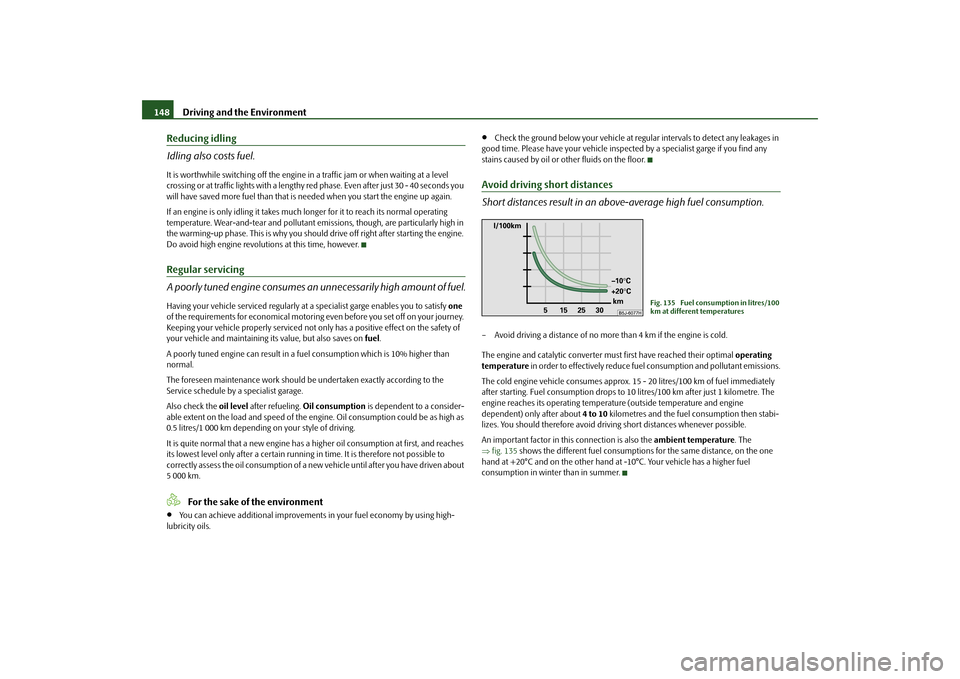
The cold engine vehicle cons
umes approx. 15 - 20 litres/100 km of fuel immediately
after starting. Fuel co
nsumption drops to 10 litres/100
km after just 1 kilometre. The
engine reaches its operating temperat
ure (outside temperature and engine
dependent) only after about
4 to 10
kilometres and the fuel consumption then stabi-
lizes. You should therefore avoid driving short distances whenever possible. An important factor in this connection is also the
ambient temperature
. The
fig. 135
shows the different fuel consumptions for the same distance, on the one
hand at +20°C and on the other hand at
-10°C. Your vehicle has a higher fuel
consumption in winter than in summer.
Fig. 135 Fuel consumption in litres/100 km at different temperatures
s3j8.a.book Page 148 Tuesday, April 20, 2010 1:10 PM
Page 151 of 244
Driving and the Environment
150
Solvent-free protection of the vehicle for
transportation from the production plant
to the customer.
The use of solvent-free adhesives.
No CFCs used in the production process.
Without use of mercury.
Use of water-soluble paints.
Trade-in and recycling of old cars Škoda Auto meets the requirements of the brand and its products regarding environ- ment and ressource protection. All new Škoda
vehicles can be utilized up to 95% and
always
11) be returned. In a lot of countries sufficient trade-in networks have been
created, where you can trade-in your vehicle.
After you trade-in your vehicle, you will
receive a confirmation stating the recycling
in accordance with environmental regula-
tions. Vehicles with special built-on types Technical documents regarding changes carried
out on the vehicle must be kept by the
vehicle user, in order to hand over later to the old car user. This ensures the recycling in accordance with en
vironmental regulations.
Motoring abroadGeneral Other circumstances may exist abroad.It is also possible, in certai
n countries, that the
Škoda Service Partner network is limited
or has not been established yet. This is
the reason why obtaining certain spare parts
may be somewhat complicated and specialist
garage personnel may only be able to
make limited repairs. Škoda
Auto in the Czech Republic and relevant importers are
happy to provide information
about technical aspects of the vehicle, required mainte-
nance work and possibilities for getting repairs done.
Unleaded petrolA vehicle fitted with a petrol engine must
always be refuelled
with unleaded petrol
page 146. The automobile associations can provide you with information regarding the locations of filling stations which offer unleaded petrol.HeadlightsThe low beam of your headligh
ts is set asymmetrically. It illuminates the side of the
road on which you are driving to a greater ex
tent. If you drive abroad on the other side
of the road, you will da
zzle oncoming traffic.
Halogen projector headlights The adaptation of the headlights (valid for vehicles which are designed for driving on the left and on the right) must be performe
d by switching over a bezel by a specialist
garage. Halogen headlight When using Halogen headlights, it is necessary to stick a sticker over a certain part of the headlights in order to prevent the dazzling of oncoming traffic. You can purchase headlight stickers from
the range of the Škoda original parts.
Note
You can obtain further information regardin
g masking over or converting the head-
lights from your specialist garage.Avoiding damage to your vehicleWhen driving on poor roads and lanes or when driving over kerbstones, steep ramps etc., you must pay particular attention to
ensuring that any low-slung parts of the
vehicle, such as spoiler and exhaust,
do not touch the ground and get damaged.
This particularly applies to models with a lowered suspension (sport suspension) and also when your vehicle is fully laden.
11)Subject to fulfilment of the national legal requirements.s3j8.a.book Page 150 Tuesday, April 20, 2010 1:10 PM
Page 154 of 244

Towing a trailer
153
Using the system
Safety
Driving Tips
General Maintenance
Breakdown assistance
Technical Data
Detachable ball head The ball rod is detachable on
vehicles with towing devi
ce and suppliable from Škoda
original accessories. It is stowed together with separate fitting instructions in the spare wheel well in the luggage compartment of the vehicle.
Note
We recommend that you also have your
vehicle inspected between service inter-
vals if you tow a trailer frequently.
The handbrake on the towing vehicle must be put on when coupling and decou-
pling the trailer.
Keep the mechanism of the ball head of
the towing device clean and take proper
care of it with a suitable preservative.Driving Tips Particular caution is required when towing a trailer.– Do not, as far as possible, drive with
your vehicle unladen and the trailer laden.
– Do not make full use of the legal maximum speeds. This applies in particular to
downhill sections.
– Apply the brakes in good time.– Keep a check on the coolant temperature gauge if the outside temperature is high. Distribution of weight The distribution of the weight
is very poor if your vehicle
is unladen and the trailer is
laden. Maintain a particularly low speed if you cannot avoid driving with this combina- tion. Driving speed Do not drive faster than 80 km/h for safety
reasons. This also a
pplies for countries in
which higher speeds are allowed. The fact that the driving stability of the
vehicle + trailer comb
ination reduces with
increasing speed means that the legally allo
wed speed should not be used when there
are unfavourable road, weather or wind cond
itions as well as on downhill sections.
You must always reduce your speed immediat
ely as soon as you detect even just the
slightest swaying
of the trailer. On no account attempt to stop the trailer from
“swaying” by accelerating. Apply the brakes in good time! If
the trailer is fitted with a
trailer brake
, apply the
brakes gently at first and then brake firmly. This will avoid brake jolts resulting from the trailer wheels locking. Shift down gears in good time before negotiating a downhill section to allow the engine to also act as a brake. Engine overheating Please keep a check on the coolant temperature gauge if you have to negotiate a lengthy slope in a low gear at a high engi
ne speed when the outside temperature is
very high
page 16.
If the needle of the coolant temperature gauge moves into the right-hand area or even the red area of the scale, reduce your speed immediately. Stop and switch off the engine if the warning light
in the instrument cluster begins flashing. Wait a few
minutes and check the level of coolant in the coolant expansion bottle
page 170,
“Inspecting the coolant level”. Please refer to the following guidelines
page 29, “Coolant temperature/coolant
quantity
”.
The coolant temperature can be reduced by switching on the heating.Any increase in the cooling effect of the coolant fan through shifting down a gear and increasing the engine speed is not possible
since the fan speed is independent of the
engine speed. One should also not drop a gear
for this reason when towing a trailer as
long as the engine can manage th
e slope without any drop in speed.
s3j8.a.book Page 153 Tuesday, April 20, 2010 1:10 PM
Page 164 of 244
Fuel
163
Using the system
Safety
Driving Tips
General Maintenance
Breakdown assistance
Technical Data
Caution
Therefore, your vehicle can only be operated with diesel fuel which complies with
the standard
EN 590
(standard
DIN 51628
in Germany, standard
ÖNORM C 1590
in
Austria). Filling the tank even only once wi
th diesel fuel which does not comply with
the standard, can result in damage to the engine parts, the lubrication system, the fuel and exhaust system.
If by mistake you have refuelled with a different fuel other than the diesel fuel
which complies to the above mentioned standards (e.g. petrol), do not start the engine or switch on the ignition! This can result in
severe engine damage! Contact a specialist
garage and have the fuel sy
stem of the engine cleaned.
Water which has collected in the fuel fi
lter can result in engine problems.
Your vehicle is not adapted for use of biofue
l (RME), therefore this fuel must not be
refuelled and driven. The use of biofuel (RME) can lead to damage to the engine or the fuel system.Operation in winterWinter-grade diesel fuel A different grade of diesel fuel is available at
filling stations in winter than during the
summer. Using “summer-grade diesel fuel” at temperatures below 0°C can result in operational problems because th
e diesel becomes viscous as a result of paraffin sepa-
ration. It is therefore the case that the standard
EN 590
(standard
DIN 51628
in Germany,
standard
ÖNORM C 1590
in Austria) is the diesel fuel class prescribed for certain
periods of the year which can also be purc
hased at the correspond
ing time during the
year. “Winter-grade diesel fuel” will still operate properly even at a temperature of - 20°C. It is often the case in countries with different climatic conditions that diesel fuels avail- able have a different temperature characte
ristic. The authorised Škoda Service Part-
ners and filling stations in the country concer
ned will be able to provide you with infor-
mation regarding the diesel fuels available. Prewarming fuel The vehicle is fitted with a fuel filter prewarming system. This secures operation of a vehicle using diesel fuel down to an environmental temperature of -25°C.
Caution
It is not permitted to add the various fuel
additives on the market, including petrol, to
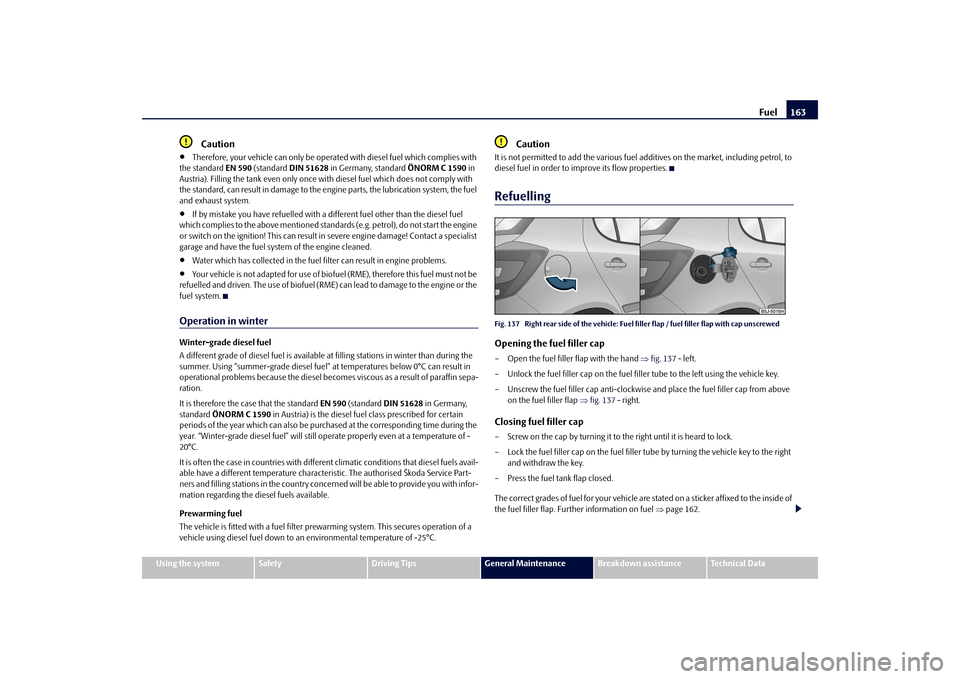
diesel fuel in order to improve its flow properties.RefuellingFig. 137 Right rear side of the vehicle: Fuel
filler flap / fuel filler
flap with cap unscrewed
Opening the fuel filler cap– Open the fuel filler flap with the hand
fig. 137
- left.
– Unlock the fuel filler cap on the fuel fi
ller tube to the left using the vehicle key.
– Unscrew the fuel filler ca
p anti-clockwise and place the fuel filler cap from above
on the fuel filler flap
fig. 137
- right.
Closing fuel filler cap– Screw on the cap by turning it to the right until it is heard to lock. – Lock the fuel filler cap on the fuel filler tube by turning the vehicle key to the right
and withdraw the key.
– Press the fuel tank flap closed. The correct grades of fuel for your vehicle are stated on a sticker affixed to the inside of the fuel filler flap. Further information on fuel
page 162.
s3j8.a.book Page 163 Tuesday, April 20, 2010 1:10 PM
Page 169 of 244
Inspecting and replenishing
168
It is normal for the engine to consume oil.
The oil consumption may be as much as 0.5
l/1 000 km depending on your style of driving and the conditions under which you operate your vehicle. The oil
consumption may be slightly hi
gher than this during the
first 5 000 kilometres. One should therefore check the oil level at regular intervals, preferably every time after the fuel tank is filled or after driving for long stretches. We recommend maintaining the oil level within the range if the engine has been operating at high loads, for example duri
ng a lengthy motorway trip during the
summer months, towing a trailer or
negotiating a high mountain pass,
but not above
this
.
The warning light in the instrument cluster* will indicate
page 29 whether the oil
level is too low. In this case, check the oil
level as soon as possible. Top up with an
appropriate quantity of oil.
WARNING
Read and observe the warning notes
page 166, “Working in the engine
compartment” before working in the engine compartment.
Caution
Always check the oil level on vehicles with engine 1.2 ltr./44 kW when the engine is
cold, on other vehicles when the engine is warm. Otherwise the measuring result is incorrect und oil could be incorrectly
replenished - risk of engine damage!
The oil level must on no account extend
beyond the range . Danger of damaging
the catalytic converter.
Do not continue your journey
if for some reason it is not possible under the
conditions prevailing to top up with oil.
Switch the engine off
and obtain professional
assistance from a specialist garage, otherwise it could lead to severe engine damage.Replenishing engine oil– Inspect the oil level
page 167.
– Unscrew the cap of the engine oil filler opening.
– Wipe off the oil from the sealing surface of the cover and on the counterpart using
a clean cloth.
– Pour in a suitable grade of oi
l in portions of 0.5 litres
page 210.
– Inspect the oil level
page 167.
– Carefully screw on the cap of the filler opening and push the dipstick in fully.
WARNING
Avoid dripping oil onto hot parts of the engine when topping up will oil - a
risk of fire!
Read and observe the warning notes
page 166, “Working in the engine
compartment” before working in the engine compartment.
For the sake of the environment
The oil level must on no account be above the range
page 167. Oil will otherwise
be drawn in through the cr
ankcase ventilation and may
pass through the exhaust
system to atmosphere. The oil may combust
in the catalytic conv
erter and damage it.
Changing engine oilThe engine oil must be changed at the intervals stated in the Service schedule or according to the service interval indicator
page 17.
WARNING
Only carry out the engine oil change, if you have the required professional
knowledge!
Read and observe the warning notes
page 166, “Working in the engine
compartment” before working in the engine compartment.
First of all, let the engine cool down, we
ar an eye protection and gloves - risk
of caustic burns due to hot oil.
AaAa
Aa
s3j8.a.book Page 168 Tuesday, April 20, 2010 1:10 PM
Page 170 of 244
Inspecting and replenishing
169
Using the system
Safety
Driving Tips
General Maintenance
Breakdown assistance
Technical Data
Caution
You must not pour any additives into the en
gine oil - risk of engine damage! Damage,
which results from such product,
are excluded from the warranty.
For the sake of the environment
You must on no account pour oil into
the ground or into the sewage system.
In view of the problems involved in prop
erly disposing of old oil, the necessary
special tools and the knowledge required for such work, we recommend that you have the oil and oil filter change carried out
by an authorised Škoda Service Partner.
Note
After your skin has come in contact with th
e oil, you must thoroughly wash your skin.
Cooling systemCoolant The job of the coolant is to cool the engine.The cooling system does not require any maintenance under normal operating condi- tions. The coolant consists of water with a
concentration of coolant additive of 40 %.
This mixture not only provides
antifreeze protection down to -25°C but also protects
the cooling and heating system from corrosion.
It also prevents the formation of scale
and significantly increases the boiling point of the coolant. You must therefore not reduce the concentration of antifreeze agent in the coolant by adding water, also not during the summer mo
nths or in countries with a warm climate.
The concentration of coolant additive in the coolant must be at least 40%. You can increase the amount of antifreeze in the coolant if a higher concentration of antifreeze is necessary for climatic reasons
but only up to 60% (antifreeze protection
down to approx. -40°C). The antifreeze prot
ection tails off above that concentration.
Vehicles exported to countries with a cold
climate (e.g. Sweden, Norway, Finland) are
already factory-filled with a coolant which offers antifreeze protection down to about -35°C. In these countries the concentration of coolant additive should be at least 50%.
Coolant The cooling system is factory-
filled with coolant (purple in colour), which complies
with the specification TL-VW 774 G. We recommend that you use the coolant addi
tive G13 (purple in colour) for topping
up the system. We recommend that you contact your Škoda
Service Partner if yo
u have any questions
regarding the coolant or if you wish
to fill up with a different coolant.
A specialist garage can also supply
you with the correct coolant additives.
Coolant capacity
Caution
Other coolant additives may cause operational problems which, in particular,
involves significantly reduci
ng the anticorrosion effect.
Petrol engines
Content
1.2 ltr./44 kW - EU5
5,5
1.2 ltr./51 kW - EU5 / EU2 DDK
5,5
1.4 ltr./63 kW - EU5
5,5
1,6 ltr./77 kW - EU4 / EU2 DDK
5,5
1.4 ltr./132 kW TSI - EU5
6,6
1.2 ltr./63 kW TSI - EU5
7,7
1.2 ltr./77 kW TSI - EU5
7,7
Diesel engines
Content
1.2 ltr./55 kW TDI CR DPF - EU5
6,6
1.6 ltr./55 kW TDI CR DPF - EU5
8,4
1.6 ltr./66 kW TDI CR DPF - EU5
8,4
1.6 ltr./77 kW TDI CR DPF - EU5
8,4
s3j8.a.book Page 169 Tuesday, April 20, 2010 1:10 PM
Page 173 of 244
Inspecting and replenishing
172
WARNING
Read and observe the warning notes
page 166, “Working in the engine
compartment” before working in the engine compartment.
If the fluid level has dropped below the MIN marking, do not drive any
further - risk of accident! Obtain professional assistance.Replacing brake fluidBrake fluid absorbs moisture. This causes the fluid to absorb moisture from the surrounding air over a period of time. Excessive water in the brake fluid may be the cause of corrosion in the brake system. The
water content also lowers the boiling point
of the brake fluid. One may only use new brake fluid approved
by Škoda Auto. The brake fluid must
comply with one of the following standards or specifications:
VW 501 14,
FMVSS 116 DOT4,
DIN ISO 4925 CLASS 4.
We recommend that you have the brake fluid replaced by an
authorised Škoda
Service Partner
as part of an Inspection Service.
WARNING
Using old brake fluid can result in severe
stress on the brakes because of the
formation of vapour bubbles in the br
ake system. This greatly impairs the
braking efficiency and thus also the safety of your vehicle.
Brake fluid is toxic! It must therefor
e be kept safely in closed original
containers and well away from children and unauthorized persons.
Caution
Brake fluid damages the paintwork of the vehicle.
For the sake of the environment
In view of the problems involved with proper
disposal of brake fluid, the special tools
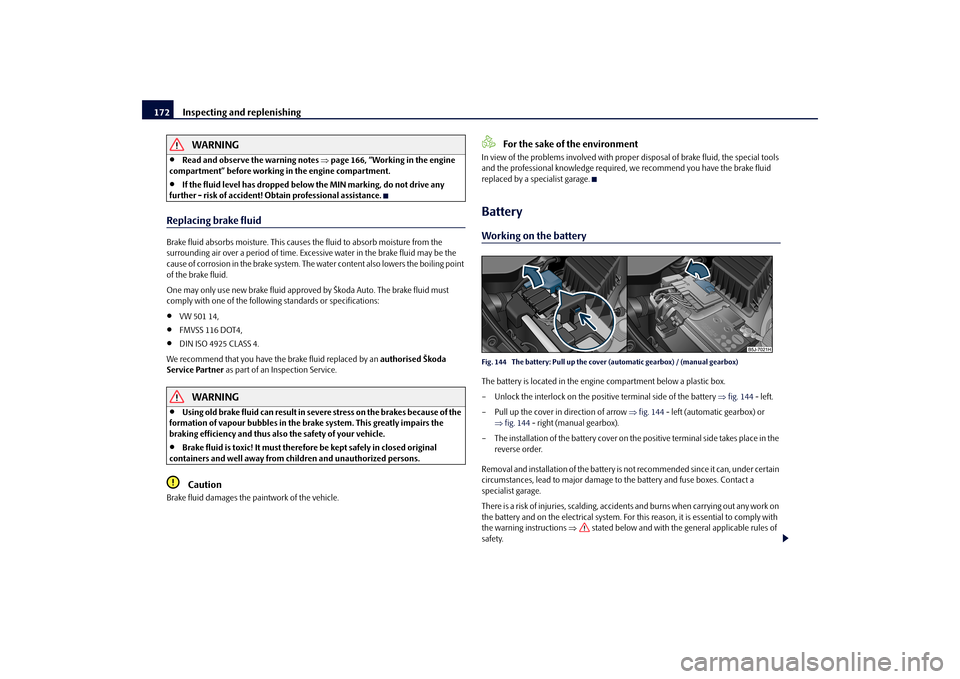
and the professional knowledge required, we recommend you have the brake fluid replaced by a specialist garage.BatteryWorking on the batteryFig. 144 The battery: Pull up the cove
r (automatic gearbox) / (manual gearbox)
The battery is located in the engi
ne compartment below a plastic box.
– Unlock the interlock on the positive terminal side of the battery
fig. 144
- left.
– Pull up the cover in direction of arrow
fig. 144
- left (automatic gearbox) or
fig. 144
- right (manual gearbox).
– The installation of the battery cover on th
e positive terminal side takes place in the
reverse order.
Removal and installation of the battery is
not recommended since it can, under certain
circumstances, lead to ma
jor damage to the battery and fuse boxes. Contact a
specialist garage. There is a risk of injuries, scalding, accidents and burns when carrying out any work on the battery and on the electrical system. For th
is reason, it is essential to comply with
the warning instructions
stated below and with the general applicable rules of
safety.
s3j8.a.book Page 172 Tuesday, April 20, 2010 1:10 PM
Page 174 of 244
Inspecting and replenishing
173
Using the system
Safety
Driving Tips
General Maintenance
Breakdown assistance
Technical Data
WARNING
The battery acid is strongly corrosive
and must, therefore, be handled with
the greatest of care. Always wear prot
ective gloves, eye and skin protection
when handling batteries. Corrosive fumes
in the air irritate the air passages and
lead to conjunctivitis and inflammation of the air passages in the lungs. Battery acid corrodes dental enamel and create
s deep wounds after contact with the
skin which take a long time to heal. Repeated contact with diluted acids causes skin diseases (inflammations, ulcers, slin cracks). Acids coming into contact with water are diluted accompanied by
significant development of heat.
Do not tilt the battery otherwise batt
ery electrolyte may flow out of the
battery vent openings. Protec
t the eyes with safety glas
ses or a shield! There is
the danger of suffering blindness! If an
y battery electrolyte
gets into your eye,
rinse out your eye immediately with cl
ear water for several minutes. Contact a
doctor without delay.
Splashes of acid on your skin or clothes should be neutralised as soon as
possible using soap suds and then rinsed with plenty of water. Contact a doctor immediately if you swal
low battery electrolyte.
Keep batteries out of the reach of children.
Hydrogen is released when you charge
a battery and a highly explosive gas
mixture is produced. An explosion can be caused through sparkling over during unclamping or loosening of the cabl
e plug while the ignition is on.
Bridging of the poles will create a short circuit (e.g. through metal objects,
cables). Possible consequences of a short circuit: Melting of lead struts, explo- sion and burning of the battery, jets of acid spurting out.
It is prohibited to work with a naked flame and light, to smoke or to carry out
any activities which produce sparks. Avoi
d creating sparks when working with
cables and electrical devices. Strong sparking represents a risk of injury.
Before carrying out any work on the el
ectrical system, swit
ch off the engine,
the ignition as well as all electrical components and disconnect the negative cable (-) on the battery. If you wish to replace a bulb it is sufficient to switch off the appropriate light.
Never charge a frozen or thawed battery - risk of explosion and caustic
burns! Replace a frozen battery.
Never use a battery which is damaged - risk of explosion! Immediately
replace a damaged battery.
Caution
You must only disconnect the battery if th
e ignition is switched off, otherwise the
electrical system (electronic components
) of the vehicle may be damaged. When
disconnecting the battery from the electrical system of the vehicle, first disconnect the negative terminal (-) of the battery. Then
disconnect the positive terminal (+).
When reconnecting the battery, first connect the positive terminal (+) and only
then the negative terminal (-) of the batt
ery. You must on no account connect the
cables wrongly - risk of a cable fire.
Ensure that battery acid does not come
into contact with the vehicle body other-
wise damage could occur to the paintwork.
Do not place the battery in direct daylight in order to protect the battery housing
from the effects of ultra-violet light.
For the sake of the environment
A removed battery is a special type of wast
e which is harmful to the environment - we
recommend that you contact your Škoda Service Partner regarding disposing of the battery.
Note
Please also refer to the guidelines
page 176, “Disconnectin
g and reconnecting
the battery”, also after connecting the battery.
WARNING (continued)
s3j8.a.book Page 173 Tuesday, April 20, 2010 1:10 PM