check engine SKODA FABIA 2010 2.G / 5J Owner's Guide
[x] Cancel search | Manufacturer: SKODA, Model Year: 2010, Model line: FABIA, Model: SKODA FABIA 2010 2.G / 5JPages: 244, PDF Size: 29.53 MB
Page 168 of 244
Inspecting and replenishing
167
Using the system
Safety
Driving Tips
General Maintenance
Breakdown assistance
Technical Data
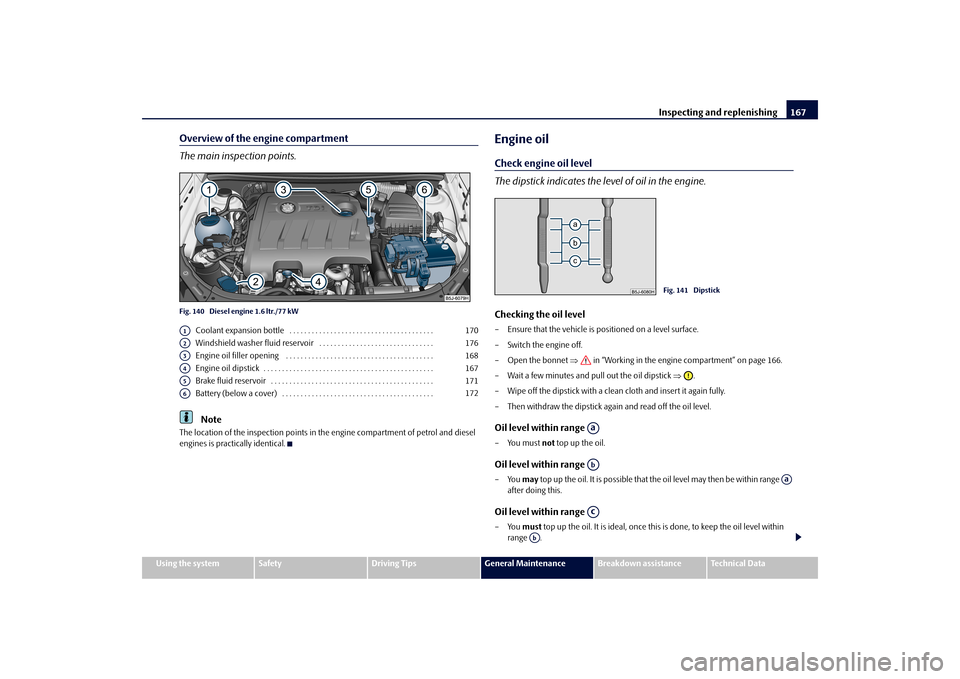
Overview of the engine compartment The main inspection points.Fig. 140 Diesel engine 1.6 ltr./77 kW
Coolant expansion bottle . . . . . . . . . . . . . . . . . . . . . . . . . . . . . . . . . . . . . . . Windshield washer fluid reservoir . . . . . . . . . . . . . . . . . . . . . . . . . . . . . . . Engine oil filler opening . . . . . . . . . . . . . . . . . . . . . . . . . . . . . . . . . . . . . . . .Engine oil dipstick . . . . . . . . . . . . . . . . . . . . . . . . . . . . . . . . . . . . . . . . . . . . . . Brake fluid reservoir . . . . . . . . . . . . . . . . . . . . . . . . . . . . . . . . . . . . . . . . . . . . Battery (below a cover) . . . . . . . . . . . . . . . . . . . . . . . . . . . . . . . . . . . . . . . . .Note
The location of the inspection points in th
e engine compartment of petrol and diesel
engines is practically identical.
Engine oilCheck engine oil level The dipstick indicates the le
vel of oil in the engine.
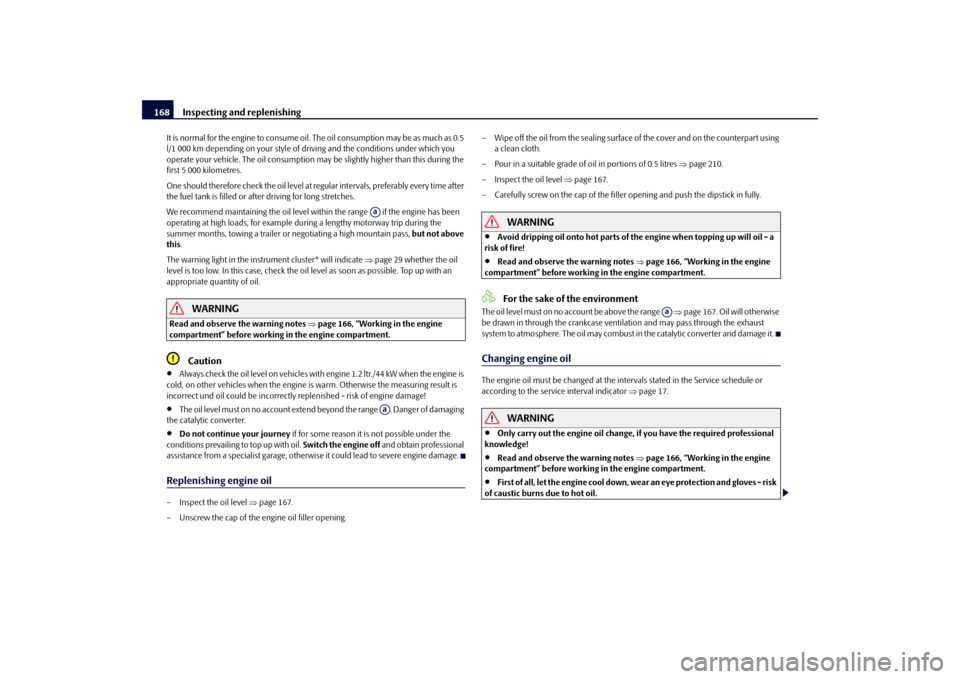
Checking the oil level– Ensure that the vehicle is po
sitioned on a level surface.
– Switch the engine off.– Open the bonnet
in “Working in the engine compartment” on page 166.
– Wait a few minutes and pull out the oil dipstick
.
– Wipe off the dipstick with a clea
n cloth and insert it again fully.
– Then withdraw the dipstick again and read off the oil level.Oil level within range –You must
not
top up the oil.
Oil level within range –You
may
top up the oil. It is possible that the oil level may then be within range
after doing this.
Oil level within range –You
must
top up the oil. It is ideal, once this
is done, to keep the oil level within
range .
A1
170
A2
176
A3
168
A4
167
A5
171
A6
172
Fig. 141 Dipstick
AaAb
Aa
Ac
Ab
s3j8.a.book Page 167 Tuesday, April 20, 2010 1:10 PM
Page 169 of 244
Inspecting and replenishing
168
It is normal for the engine to consume oil.
The oil consumption may be as much as 0.5
l/1 000 km depending on your style of driving and the conditions under which you operate your vehicle. The oil
consumption may be slightly hi
gher than this during the
first 5 000 kilometres. One should therefore check the oil level at regular intervals, preferably every time after the fuel tank is filled or after driving for long stretches. We recommend maintaining the oil level within the range if the engine has been operating at high loads, for example duri
ng a lengthy motorway trip during the
summer months, towing a trailer or
negotiating a high mountain pass,
but not above
this
.
The warning light in the instrument cluster* will indicate
page 29 whether the oil
level is too low. In this case, check the oil
level as soon as possible. Top up with an
appropriate quantity of oil.
WARNING
Read and observe the warning notes
page 166, “Working in the engine
compartment” before working in the engine compartment.
Caution
Always check the oil level on vehicles with engine 1.2 ltr./44 kW when the engine is
cold, on other vehicles when the engine is warm. Otherwise the measuring result is incorrect und oil could be incorrectly
replenished - risk of engine damage!
The oil level must on no account extend
beyond the range . Danger of damaging
the catalytic converter.
Do not continue your journey
if for some reason it is not possible under the
conditions prevailing to top up with oil.
Switch the engine off
and obtain professional
assistance from a specialist garage, otherwise it could lead to severe engine damage.Replenishing engine oil– Inspect the oil level
page 167.
– Unscrew the cap of the engine oil filler opening.
– Wipe off the oil from the sealing surface of the cover and on the counterpart using
a clean cloth.
– Pour in a suitable grade of oi
l in portions of 0.5 litres
page 210.
– Inspect the oil level
page 167.
– Carefully screw on the cap of the filler opening and push the dipstick in fully.
WARNING
Avoid dripping oil onto hot parts of the engine when topping up will oil - a
risk of fire!
Read and observe the warning notes
page 166, “Working in the engine
compartment” before working in the engine compartment.
For the sake of the environment
The oil level must on no account be above the range
page 167. Oil will otherwise
be drawn in through the cr
ankcase ventilation and may
pass through the exhaust
system to atmosphere. The oil may combust
in the catalytic conv
erter and damage it.
Changing engine oilThe engine oil must be changed at the intervals stated in the Service schedule or according to the service interval indicator
page 17.
WARNING
Only carry out the engine oil change, if you have the required professional
knowledge!
Read and observe the warning notes
page 166, “Working in the engine
compartment” before working in the engine compartment.
First of all, let the engine cool down, we
ar an eye protection and gloves - risk
of caustic burns due to hot oil.
AaAa
Aa
s3j8.a.book Page 168 Tuesday, April 20, 2010 1:10 PM
Page 171 of 244
Inspecting and replenishing
170
Any faults or problems resulting from corrosion may cause a loss of coolant
and, as a consequence of this,
result in major engine damage.
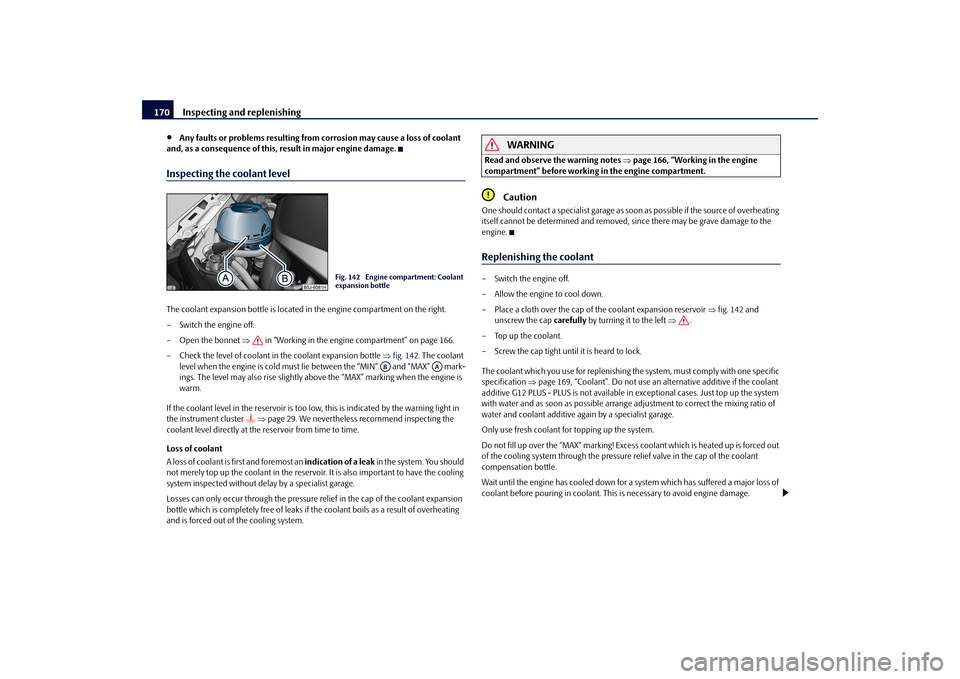
Inspecting the coolant levelThe coolant expansion bottle
is located in the engine compartment on the right.
– Switch the engine off.– Open the bonnet
in “Working in the engine compartment” on page 166.
– Check the level of coolant in the coolant expansion bottle
fig. 142
. The coolant
level when the engine is cold must lie between the “MIN” and “MAX” mark- ings. The level may also rise slightly ab
ove the “MAX” marking when the engine is
warm.
If the coolant level in the reservoir is too lo
w, this is indicated by the warning light in
the instrument cluster
page 29. We nevertheless recommend inspecting the
coolant level directly at the reservoir from time to time. Loss of coolant A loss of coolant is first and foremost an
indication of a leak
in the system. You should
not merely top up the coolant in the reservoir.
It is also important to have the cooling
system inspected without delay by a specialist garage. Losses can only occur through
the pressure relief in the cap of the coolant expansion
bottle which is completely free of leaks if
the coolant boils as a
result of overheating
and is forced out of the cooling system.
WARNING
Read and observe the warning notes
page 166, “Working in the engine
compartment” before working in the engine compartment.
Caution
One should contact a specialist garage as s
oon as possible if the source of overheating
itself cannot be determined and removed,
since there may be grave damage to the
engine.Replenishing the coolant– Switch the engine off. – Allow the engine to cool down.– Place a cloth over the cap of the coolant expansion reservoir
fig. 142
and
unscrew the cap
carefully
by turning it to the left
.
–Top up the coolant.– Screw the cap tight until it is heard to lock. The coolant which you use for replenishing the system, must comply with one specific specification
page 169, “Coolant”. Do not use an al
ternative additive if the coolant
additive G12 PLUS - PLUS is not available in
exceptional cases. Just top up the system
with water and as soon as possible arrange
adjustment to correct
the mixing ratio of
water and coolant additive again by a specialist garage. Only use fresh coolant for topping up the system.Do not fill up over the “MAX” marking! Excess
coolant which is heated up is forced out
of the cooling system through the pressure relief valve in the cap of the coolant compensation bottle. Wait until the engine has cooled down for a
system which has suffered a major loss of
coolant before pouring in coolant. This
is necessary to avoid engine damage.
Fig. 142 Engine compartment: Coolant expansion bottle
AB
AA
s3j8.a.book Page 170 Tuesday, April 20, 2010 1:10 PM
Page 176 of 244
Inspecting and replenishing
175
Using the system
Safety
Driving Tips
General Maintenance
Breakdown assistance
Technical Data
Note
Batteries with three-tone indicator, which are mounted as of factory, are marked
with a code which always begins with
1J0
, 7N0
or 3B0
. The exact marking can be e.g.
1J0 915 105 AC
.
Replacement batteries with three-tone indi
cator, which were obtained from Škoda
original accessories, are marked with the code
000 915 105 Ax
, whereby “x” stands for
a variable. The exact marking can be e.g.
000 915 105 AB
.
Inspecting the electrolyte levelThe battery is practically
maintenance-free
under normal operating conditions. We
do, however, recommend that you have the electrolyte level inspected from time to time by a specialist garage when outside
temperatures are high or when driving on
long trips. You should also have the electrolyte level
page 175 checked each time
the battery is charged. The electrolyte level of the battery will al
so be checked as part of the Inspection
Service.Operation in winterThe battery has to provide greater amounts of
electricity during the winter. It also has
only part of the initial power output at low temperatures that it has at normal temper-atures. A discharged battery may already freez
e at temperatures just below 0°C.
We therefore recommend that you have the
battery checked by a specialist garage
before the start of the winter, and recharged if necessary.Charging the battery A properly charged battery is essentia
l for reliably starting the engine.
– Read the warning notes
in “Working on the battery” on page 172 and
.
– Switch the ignition and all electrical components off.
– Only for “quick-charging”: Disconnect both
battery cables (first
of all “negative”,
then “positive”).
– Carefully attach the terminal
clamps of the charger to the battery terminals (red =
“positive”, black = “negative”).
– You can now plug the mains cable of the
charger into the power socket and switch
on the charger.
– When charging is completed: switch th
e charger off and unplug the mains cable
from the power socket.
– Only then should you disconnect th
e terminal clamps of the charger.
– Reconnect the cables to the battery (first of all “positive”, then “negative”). It is not normally necessary to
disconnect the cables of th
e battery if you recharge the
battery using low amperages (as for example from a
mini-charger
). Please also refer
to the instructions from the charger manufacturer. A charging current of 0.1 of the total battery
capacity (or lower) is that which should be
used until full charging is achieved. It is, however, necessary to disconnect both
cables before charging the battery with
high amperages, so-called “
quick-charging
”.
“Quick-charging” a battery is
dangerous
in “Working on the battery” on
page 172. It requires a special charger an
d appropriate knowledge. We therefore
recommend that you have your battery quick-
charged only by your specialist garage.
A discharged battery may already
freeze
at temperatures just below 0°C
. We
recommend that you no longer use a battery
which has thawed out because the casing
of the battery may be cracked through the formation of ice and this would allow battery electrolyte to flow out. The vent plugs of the battery should not be opened for charging.
WARNING
Never charge a frozen or thawed battery - risk of explosion and caustic burns! Replace a frozen battery.
s3j8.a.book Page 175 Tuesday, April 20, 2010 1:10 PM
Page 177 of 244
Inspecting and replenishing
176
Caution
On vehicles with the “START/STOP” system,
the pole terminal of the charger must not
be connected directly to the negative termin
al of the vehicle battery, but only to the
engine earth
page 192, fig. 158
.
Disconnecting and reconnecting the batteryOn disconnecting and reconnecting the batt
ery the following functions are initially
deactivated or are no longer able to operate fault-free. We recommend having the vehicle checked by a specialist garage to ensure full func- tionality of all electrical systems.Replacing the batteryYou should only replace a battery with a ne
w battery of the same
capacity, voltage (12
V), amperage and of the same size. Specialist garages have a range of suitable batteries available. We recommend that you only have an old ba
ttery disposed of by a specialist garage
since it does require special disposal.
For the sake of the environment
Batteries contain poisonous substances such
as sulphuric acid and lead. They must be
disposed of in accordance with local environmental protection regulations and on no account as domestic waste.
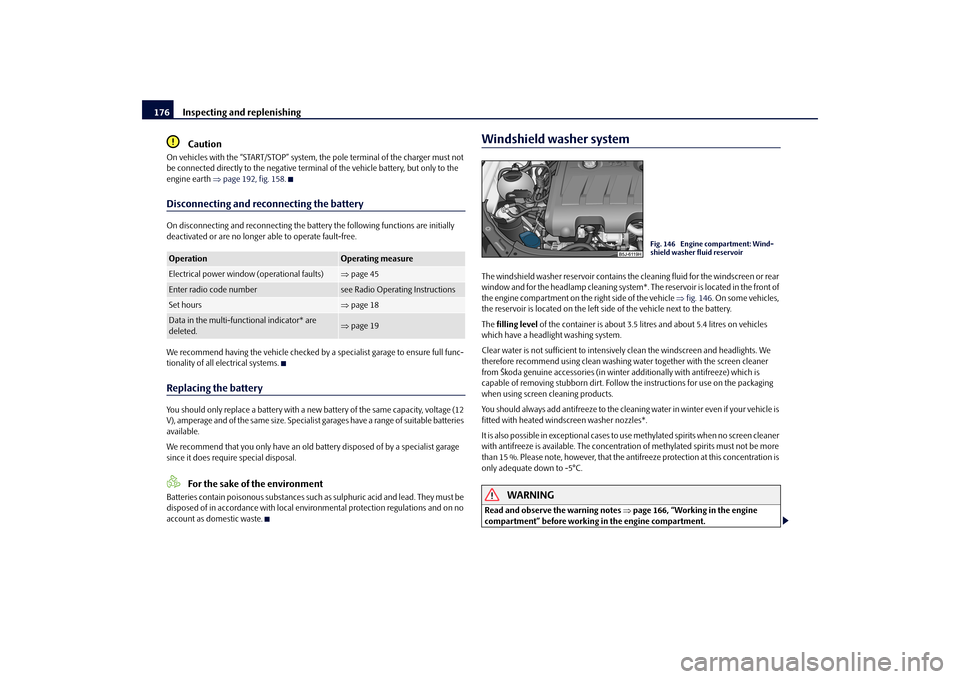
Windshield washer systemThe windshield washer reservoir contains the
cleaning fluid for the
windscreen or rear
window and for the headlamp cleaning system*.
The reservoir is located in the front of
the engine compartment on the right side of the vehicle
fig. 146
. On some vehicles,
the reservoir is located on the left si
de of the vehicle next to the battery.
The
filling level
of the container is about 3.5 litres and about 5.4 litres on vehicles
which have a headlight washing system. Clear water is not sufficient to intensivel
y clean the windscreen and headlights. We
therefore recommend using clean washing water together with the screen cleaner from Škoda genuine accessories (in winter additionally with antifreeze) which is capable of removing stubborn
dirt. Follow the instructions for use on the packaging
when using screen cleaning products. You should always add antifreeze to the cleani
ng water in winter even
if your vehicle is
fitted with heated wind
screen washer nozzles*.
It is also possible in exceptional cases to use methylated spirits when no screen cleaner with antifreeze is available. The concentration of methylated spirits must not be more than 15 %. Please note, however, that the anti
freeze protection at this concentration is
only adequate down to -5°C.
WARNING
Read and observe the warning notes
page 166, “Working in the engine
compartment” before working in the engine compartment.
Operation
Operating measure
Electrical power window
(operational faults)
page 45
Enter radio code number
see Radio Operat
ing Instructions
Set hours
page 18
Data in the multi-functional indicator* are deleted.
page 19
Fig. 146 Engine compartment: Wind- shield washer fluid reservoir
s3j8.a.book Page 176 Tuesday, April 20, 2010 1:10 PM
Page 180 of 244
Wheels and Tyres
179
Using the system
Safety
Driving Tips
General Maintenance
Breakdown assistance
Technical Data
The tyre pressure should be
at the highest pressure specified for your vehicle at all
times. Always check the inflation pressure of tyres
when cold. Do not reduce the higher pres-
sure of warm tyres. Adapt the inflation pressure of the tyres accordingly if your vehicle is carrying a significantly higher payload. Tyre inflation pressure - Tyre size 185/55 R15 The same inflation pressure values apply to ty
res of the tyre size 195/55 R15 as to tyres
of the tyre size 185/55 R15 which are intended to be used with snow chains, see the inside of the fuel filler flap. The tyres of the tyre size 185/55 R15, which are intended to be used with snow chains and are fitted on models Fabia Combi Scout, have the following inflation pressure values in kPa. Driving style Fast cornering, sharp acceleration and brak
ing (squealing tyres) increase wear-and-
tear on your tyres. Balancing wheels The wheels of a new vehicle are balanced. There are a wide range of influences when driving which may result in an imbalance
and which makes themselves felt through
vibration in the steering.
You should have the wheels rebalanced si
nce any imbalance increases wear-and-tear
on the steering, the suspension and tyres. A wheel must also be rebalanced when a new tyre is fitted and each time a tyre is repaired. Wheel alignment errors Incorrect wheel alignment at the front and rear
will not only increase wear-and-tear on
the tyres but will also has an adverse effect on vehicle safety. Contact your specialist garage if you notice any unusual tyre wear.
WARNING
If the inflation pressure is too low,
the tyre must perform a higher rolling
resistance. At higher speeds the tyre will warm up as a result of this. This can result in tread separation and even a tyre blowout.
Immediately replace the damaged rims or tyres.
Tyres which are 6 years old or more should only be fitted in exceptional
cases and when adopting an approp
riately cautious style of driving.
For the sake of the environment
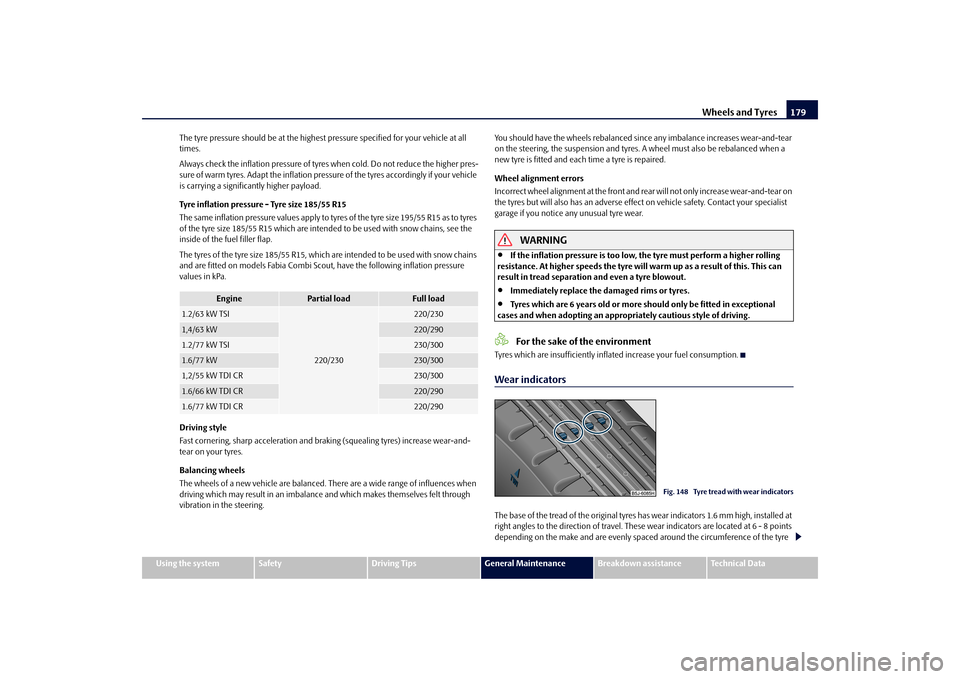
Tyres which are insufficiently inflated increase your fuel consumption.Wear indicatorsThe base of the tread of the original tyres has wear indicators 1.6 mm high, installed at right angles to the direction of travel. These
wear indicators are lo
cated at 6 - 8 points
depending on the make and are evenly spaced around the circumference of the tyre
Engine
Partial load
Full load
1.2/63 kW TSI
220/230
220/230
1,4/63 kW
220/290
1.2/77 kW TSI
230/300
1.6/77 kW
230/300
1,2/55 kW TDI CR
230/300
1.6/66 kW TDI CR
220/290
1.6/77 kW TDI CR
220/290
Fig. 148 Tyre tread with wear indicators
s3j8.a.book Page 179 Tuesday, April 20, 2010 1:10 PM
Page 188 of 244
Breakdown assistance
187
Using the system
Safety
Driving Tips
General Maintenance
Breakdown assistance
Technical Data
Changing a wheelPreliminary workThe following steps should be carried ou
t before actually changing the wheel.
– If it is necessary to change a wheel, park
the vehicle as far aw
ay as possible from
the traffic flow. The place you choose should be
level
.
– Have all the occupants
get out
. While changing a wheel, the occupants of the
vehicle should not stand on the ro
ad (e.g. behind a crash barrier).
– Apply the
handbrake
firmly.
–Engage
1st gear
or if your vehicle is fitted with
an automatic gearbox, position the
selector lever into position P
.
– If a trailer is coupled, uncouple it.– Take the
vehicle tool kit
and the
spare wheel*
page 185 out of the luggage
compartment.
WARNING
If you find yourself in flowing traffic switch on the hazard warning lights
system and place the warning triangle on
the side of the road at the prescribed
distance from your vehicle while observing all national legal provisions. In this way you are protecting not only yourself but also other road users.
Never start the engine with the vehicle si
tting on the raised
jack - danger of
suffering injury.
Caution
If you have to change a wheel on a slope first block the opposite wheel with a stone or similar object in order to secure the
vehicle from unexpectedly rolling away.
Note
Comply with the national legal regulations.
Changing a wheelAlways change a wheel on a level surface as far as possible. – Take off the full wheel trim*
page 188 or the caps
page 188.
– Slacken the wheel bolts
page 189.
– Jack up the vehicle until the wheel to
be changed is clear of the ground
page 189.
– Unscrew the wheel bolts and place them
on a clean surface (cloth, paper etc.).
– Take off the wheel.– Fit on the spare wheel* and tighten the wheel bolts slightly.– Lower the car.– Tighten the wheel bolts firmly, alternatel
y and diagonally using the wrench (cross-
wise)
page 189.
– Mount the full wheel trim/wheel trim cap or the caps.
Note
All bolts must be clean and must turn easily.
You must never grease or oil the wheel bolts!
When fitting on unidirectiona
l tyres, ensure that the tyres rotate in the correct
direction
page 178.
Subsequent stepsAfter changing the wheel, you mu
st perform the following steps.
– Stow the vehicle tool kit in the space provided.– Stow the replaced wheel in the luggage compartment.–
Check
the
tyre pressure
on the spare wheel just mounted as soon as possible.
– Have the
tightening torque
of the wheel bolts
checked
with a torque wrench as
soon as possible. Steel and light alloy wheels must be tightened to a tightening torque of
120 Nm
.
s3j8.a.book Page 187 Tuesday, April 20, 2010 1:10 PM
Page 191 of 244
Breakdown assistance
190
Not positioning the lifting jack at the specified points can result in damage
to the vehicle. The jack can also slip off if it does not have sufficient grip - risk of injury!
Never start the engine if the vehicle is lifted - risk of accident.
Never lie under the vehicle if the vehicle is only lifted with the vehicle lifting
jack.
It is important to support the vehicle with suitable supporting blocks if you
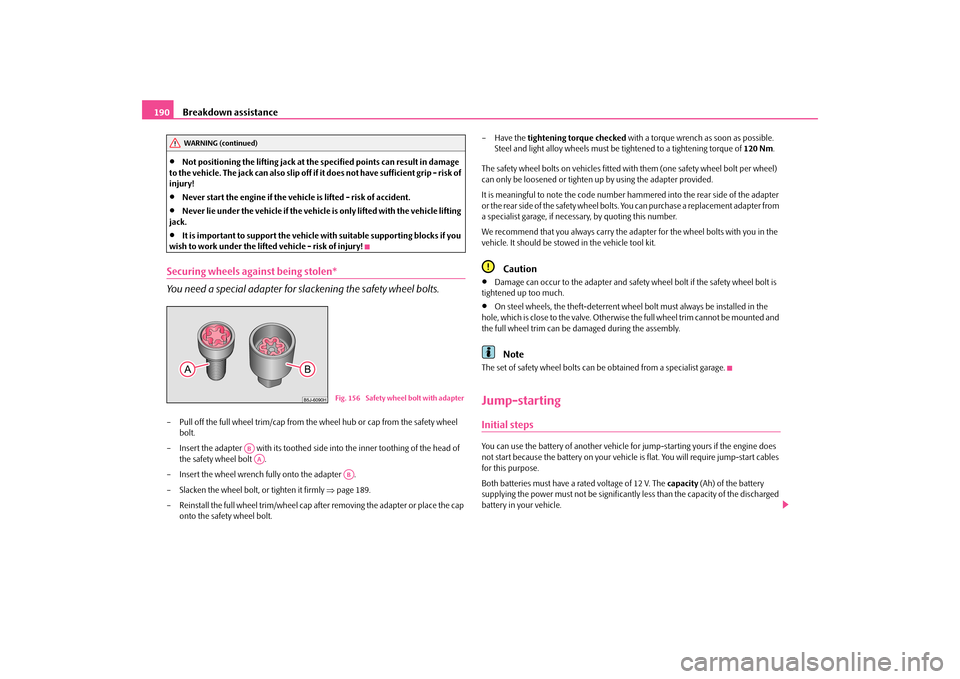
wish to work under the lifted vehicle - risk of injury!Securing wheels against being stolen* You need a special adapter for sl
ackening the safety wheel bolts.
– Pull off the full wheel trim/cap from the wheel hub or cap from the safety wheel
bolt.
– Insert the adapter with its toothed side
into the inner toothing of the head of
the safety wheel bolt .
– Insert the wheel wrench fully onto the adapter .– Slacken the wheel bolt, or tighten it firmly
page 189.
– Reinstall the full wheel trim/wheel cap afte
r removing the adapter or place the cap
onto the safety wheel bolt.
– Have the
tightening torque
checked
with a torque wrench as soon as possible.
Steel and light alloy wheels must be tightened to a tightening torque of
120 Nm
.
The safety wheel bolts on vehicles fitted with them (one safety wheel bolt per wheel) can only be loosened or tighten
up by using the adapter provided.
It is meaningful to note th
e code number hammered into the rear side of the adapter
or the rear side of the safety wheel bolts. You can purchase a replacement adapter from a specialist garage, if necessary, by quoting this number. We recommend that you always carry the ad
apter for the wheel bolts with you in the
vehicle. It should be stow
ed in the vehicle tool kit.
Caution
Damage can occur to the adapter and safety
wheel bolt if the safety wheel bolt is
tightened up too much.
On steel wheels, the theft-deterrent wheel
bolt must always be installed in the
hole, which is close to the valve. Otherwise
the full wheel trim cannot be mounted and
the full wheel trim can be damaged during the assembly.
Note
The set of safety wheel bolts can be
obtained from a specialist garage.
Jump-startingInitial stepsYou can use the battery of another vehicle fo
r jump-starting yours if the engine does
not start because the battery on your vehicle
is flat. You will require jump-start cables
for this purpose. Both batteries must have a rated voltage of 12 V. The
capacity
(Ah) of the battery
supplying the power must not be significantly
less than the capacity of the discharged
battery in your vehicle.
WARNING (continued)
Fig. 156 Safety wheel bolt with adapter
ABAA
AB
s3j8.a.book Page 190 Tuesday, April 20, 2010 1:10 PM
Page 211 of 244
Technical Data
210
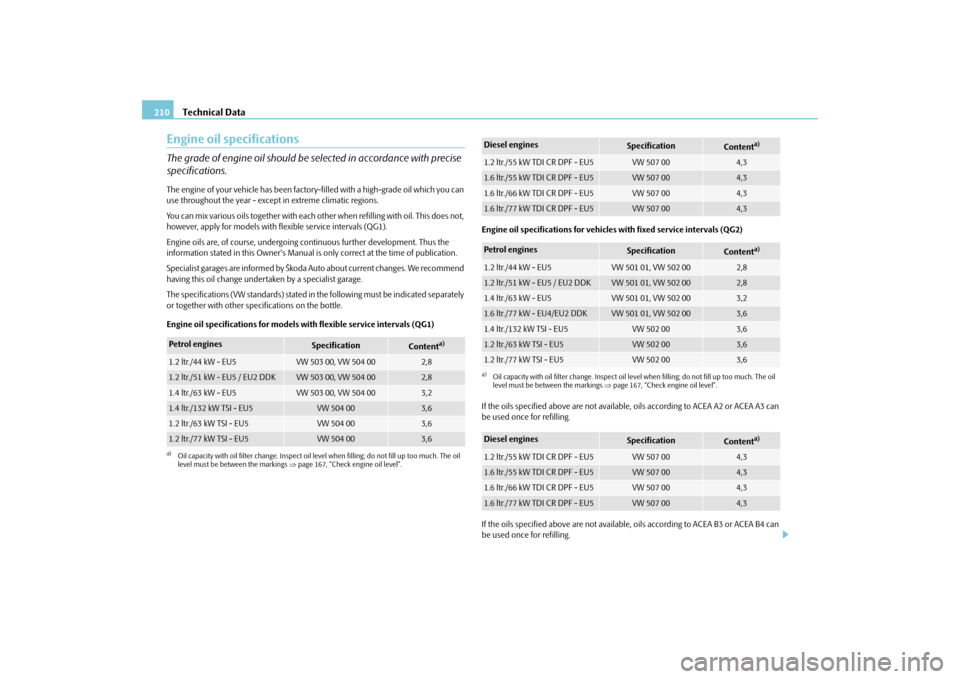
Engine oil specificationsThe grade of engine oil should be se
lected in accordance with precise
specifications.The engine of your vehicle has been factory-
filled with a high-grade oil which you can
use throughout the year - except in extreme climatic regions. You can mix various oils together with each other when refilling with oil. This does not, however, apply for models with flexible service intervals (QG1). Engine oils are, of course, undergoing co
ntinuous further deve
lopment. Thus the
information stated in this Owner's Manual is
only correct at the time of publication.
Specialist garages are informed by Škoda
Auto about current changes. We recommend
having this oil change undertaken by a specialist garage. The specifications (VW standards) stated in the following must be indicated separately or together with other specifications on the bottle. Engine oil specifications for models
with flexible service intervals (QG1)
Engine oil specifications for vehicles with fixed service intervals (QG2) If the oils specified above are not available, oils according to ACEA A2 or ACEA A3 can be used once for refilling. If the oils specified above are not available,
oils according to ACEA B3 or ACEA B4 can
be used once for refilling.
Petrol engines
Specification
Content
a)
a)Oil capacity with oil filter change. Inspect oil leve
l when filling; do not fill up too much. The oil
level must be between the markings
page 167, “Check engine oil level”.
1.2 ltr./44 kW - EU5
VW 503 00, VW 504 00
2,8
1.2 ltr./51 kW - EU5 / EU2 DDK
VW 503 00, VW 504 00
2,8
1.4 ltr./63 kW - EU5
VW 503 00, VW 504 00
3,2
1.4 ltr./132 kW TSI - EU5
VW 504 00
3,6
1.2 ltr./63 kW TSI - EU5
VW 504 00
3,6
1.2 ltr./77 kW TSI - EU5
VW 504 00
3,6
Diesel engines
Specification
Content
a)
1.2 ltr./55 kW TDI CR DPF - EU5
VW 507 00
4,3
1.6 ltr./55 kW TDI CR DPF - EU5
VW 507 00
4,3
1.6 ltr./66 kW TDI CR DPF - EU5
VW 507 00
4,3
1.6 ltr./77 kW TDI CR DPF - EU5
VW 507 00
4,3
Petrol engines
Specification
Content
a)
a)Oil capacity with oil filter change. Inspect oil le
vel when filling; do not fill up too much. The oil
level must be between the markings
page 167, “Check engine oil level”.
1.2 ltr./44 kW - EU5
VW 501 01, VW 502 00
2,8
1.2 ltr./51 kW - EU5 / EU2 DDK
VW 501 01, VW 502 00
2,8
1.4 ltr./63 kW - EU5
VW 501 01, VW 502 00
3,2
1.6 ltr./77 kW - EU4/EU2 DDK
VW 501 01, VW 502 00
3,6
1.4 ltr./132 kW TSI - EU5
VW 502 00
3,6
1.2 ltr./63 kW TSI - EU5
VW 502 00
3,6
1.2 ltr./77 kW TSI - EU5
VW 502 00
3,6
Diesel engines
Specification
Content
a)
1.2 ltr./55 kW TDI CR DPF - EU5
VW 507 00
4,3
1.6 ltr./55 kW TDI CR DPF - EU5
VW 507 00
4,3
1.6 ltr./66 kW TDI CR DPF - EU5
VW 507 00
4,3
1.6 ltr./77 kW TDI CR DPF - EU5
VW 507 00
4,3
s3j8.a.book Page 210 Tuesday, April 20, 2010 1:10 PM
Page 236 of 244
Index235
Using the system
Safety
Driving Tips
General Maintenance
Breakdown assistance
Technical Data
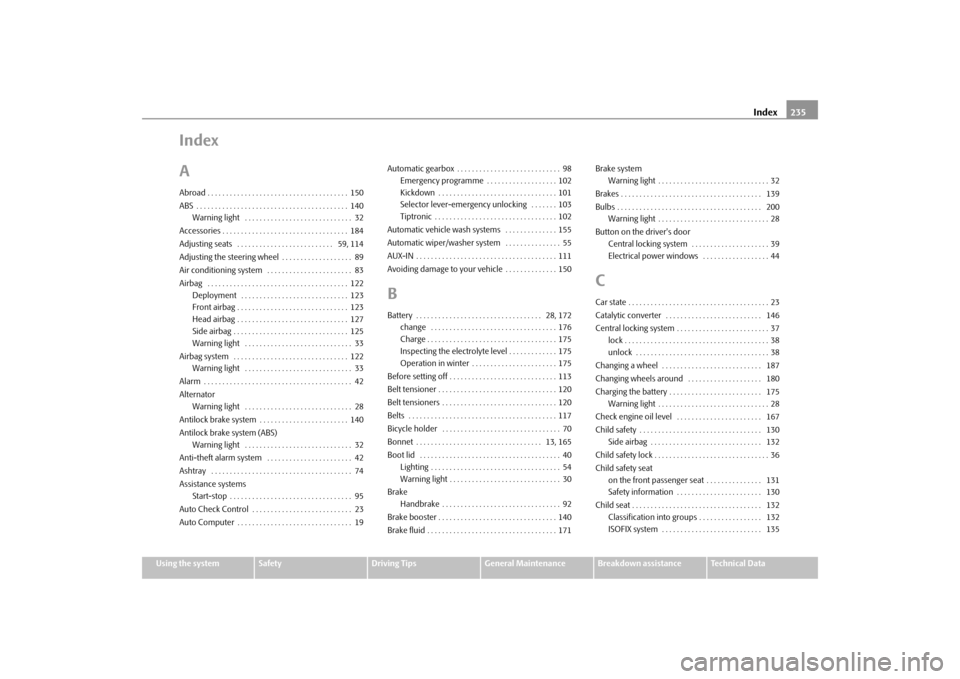
Index
AAbroad . . . . . . . . . . . . . . . . . . . . . . . . . . . . . . . . . . . . . . 150
ABS . . . . . . . . . . . . . . . . . . . . . . . . . . . . . . . . . . . . . . . . . 140
Warning light . . . . . . . . . . . . . . . . . . . . . . . . . . . . . 32
Accessories . . . . . . . . . . . . . . . . . . . . . . . . . . . . . . . . . . 184
Adjusting seats . . . . . . . . . . . . . . . . . . . . . . . . . . 59, 114
Adjusting the steering wheel . . . . . . . . . . . . . . . . . . . 89
Air conditioning system . . . . . . . . . . . . . . . . . . . . . . . 83
Airbag . . . . . . . . . . . . . . . . . . . . . . . . . . . . . . . . . . . . . . 122
Deployment . . . . . . . . . . . . . . . . . . . . . . . . . . . . . 123
Front airbag . . . . . . . . . . . . . . . . . . . . . . . . . . . . . . 123
Head airbag . . . . . . . . . . . . . . . . . . . . . . . . . . . . . . 127
Side airbag . . . . . . . . . . . . . . . . . . . . . . . . . . . . . . . 125
Warning light . . . . . . . . . . . . . . . . . . . . . . . . . . . . . 33
Airbag system . . . . . . . . . . . . . . . . . . . . . . . . . . . . . . . 122
Warning light . . . . . . . . . . . . . . . . . . . . . . . . . . . . . 33
Alarm . . . . . . . . . . . . . . . . . . . . . . . . . . . . . . . . . . . . . . . . 42
Alternator
Warning light . . . . . . . . . . . . . . . . . . . . . . . . . . . . . 28
Antilock brake system . . . . . . . . . . . . . . . . . . . . . . . . 140
Antilock brake system (ABS)
Warning light . . . . . . . . . . . . . . . . . . . . . . . . . . . . . 32
Anti-theft alarm system . . . . . . . . . . . . . . . . . . . . . . . 42
Ashtray . . . . . . . . . . . . . . . . . . . . . . . . . . . . . . . . . . . . . . 74
Assistance systems
Start-stop . . . . . . . . . . . . . . . . . . . . . . . . . . . . . . . . . 95
Auto Check Control . . . . . . . . . . . . . . . . . . . . . . . . . . . 23
Auto Computer . . . . . . . . . . . . . . . . . . . . . . . . . . . . . . . 19Automatic gearbox . . . . . . . . . . . . . . . . . . . . . . . . . . . . 98
Emergency programme . . . . . . . . . . . . . . . . . . . 102
Kickdown . . . . . . . . . . . . . . . . . . . . . . . . . . . . . . . . 101
Selector lever-emergency unlocking . . . . . . . 103
Tiptronic . . . . . . . . . . . . . . . . . . . . . . . . . . . . . . . . . 102
Automatic vehicle wash systems . . . . . . . . . . . . . . 155
Automatic wiper/washer system . . . . . . . . . . . . . . . 55
AUX-IN . . . . . . . . . . . . . . . . . . . . . . . . . . . . . . . . . . . . . . 111
Avoiding damage to your vehicle . . . . . . . . . . . . . . 150
BBattery . . . . . . . . . . . . . . . . . . . . . . . . . . . . . . . . . . 28, 172
change . . . . . . . . . . . . . . . . . . . . . . . . . . . . . . . . . . 176
Charge . . . . . . . . . . . . . . . . . . . . . . . . . . . . . . . . . . . 175
Inspecting the electrolyte level . . . . . . . . . . . . . 175
Operation in winter . . . . . . . . . . . . . . . . . . . . . . . 175
Before setting off . . . . . . . . . . . . . . . . . . . . . . . . . . . . . 113
Belt tensioner . . . . . . . . . . . . . . . . . . . . . . . . . . . . . . . . 120
Belt tensioners . . . . . . . . . . . . . . . . . . . . . . . . . . . . . . . 120
Belts . . . . . . . . . . . . . . . . . . . . . . . . . . . . . . . . . . . . . . . . 117
Bicycle holder . . . . . . . . . . . . . . . . . . . . . . . . . . . . . . . . 70
Bonnet . . . . . . . . . . . . . . . . . . . . . . . . . . . . . . . . . . 13, 165
Boot lid . . . . . . . . . . . . . . . . . . . . . . . . . . . . . . . . . . . . . . 40
Lighting . . . . . . . . . . . . . . . . . . . . . . . . . . . . . . . . . . . 54
Warning light . . . . . . . . . . . . . . . . . . . . . . . . . . . . . . 30
Brake
Handbrake . . . . . . . . . . . . . . . . . . . . . . . . . . . . . . . . 92
Brake booster . . . . . . . . . . . . . . . . . . . . . . . . . . . . . . . . 140
Brake fluid . . . . . . . . . . . . . . . . . . . . . . . . . . . . . . . . . . . 171Brake system
Warning light . . . . . . . . . . . . . . . . . . . . . . . . . . . . . . 32
Brakes . . . . . . . . . . . . . . . . . . . . . . . . . . . . . . . . . . . . . . 139
Bulbs . . . . . . . . . . . . . . . . . . . . . . . . . . . . . . . . . . . . . . . 200
Warning light . . . . . . . . . . . . . . . . . . . . . . . . . . . . . . 28
Button on the driver's door
Central locking system . . . . . . . . . . . . . . . . . . . . . 39
Electrical power windows . . . . . . . . . . . . . . . . . . 44
CCar state . . . . . . . . . . . . . . . . . . . . . . . . . . . . . . . . . . . . . . 23
Catalytic converter . . . . . . . . . . . . . . . . . . . . . . . . . . 146
Central locking system . . . . . . . . . . . . . . . . . . . . . . . . . 37
lock . . . . . . . . . . . . . . . . . . . . . . . . . . . . . . . . . . . . . . . 38
unlock . . . . . . . . . . . . . . . . . . . . . . . . . . . . . . . . . . . . 38
Changing a wheel . . . . . . . . . . . . . . . . . . . . . . . . . . . 187
Changing wheels around . . . . . . . . . . . . . . . . . . . . 180
Charging the battery . . . . . . . . . . . . . . . . . . . . . . . . . 175
Warning light . . . . . . . . . . . . . . . . . . . . . . . . . . . . . . 28
Check engine oil level . . . . . . . . . . . . . . . . . . . . . . . 167
Child safety . . . . . . . . . . . . . . . . . . . . . . . . . . . . . . . . . 130
Side airbag . . . . . . . . . . . . . . . . . . . . . . . . . . . . . . 132
Child safety lock . . . . . . . . . . . . . . . . . . . . . . . . . . . . . . . 36
Child safety seat
on the front passenger seat . . . . . . . . . . . . . . . 131
Safety information . . . . . . . . . . . . . . . . . . . . . . . 130
Child seat . . . . . . . . . . . . . . . . . . . . . . . . . . . . . . . . . . . 132
Classification into groups . . . . . . . . . . . . . . . . . 132
ISOFIX system . . . . . . . . . . . . . . . . . . . . . . . . . . . 135
s3j8.a.book Page 235 Tuesday, April 20, 2010 1:10 PM