technical data SKODA FABIA 2011 2.G / 5J Repair Manual
[x] Cancel search | Manufacturer: SKODA, Model Year: 2011, Model line: FABIA, Model: SKODA FABIA 2011 2.G / 5JPages: 220, PDF Size: 3.37 MB
Page 121 of 220
WARNING (Continued)
● There must not be any other persons (e.g. children) or animals between
the car occupant and the deployment area of the head airbag. In addition,
none of the occupants should lean their head out of the window when driving,
or extend their arms and hands out of the window.
● The sun visors must not be swivelled to the side windows into the deploy-
ment area of the head airbags if any objects, such as ball-point pens etc. are
attached to them. This might result in injuries to the occupants if the head air-
bag is deployed.
● Installing impermissible accessories in the area of the head airbags may
considerably impair the protection offered by the head airbag in the event of it
being deployed. When the deployed head airbag is inflated, parts of the acces-
sories fitted may in certain circumstances be thrown into the interior of the
car and cause injuries to the occupants ⇒ page 169.
● Any work on the head airbag system including installing and removing sys-
tem components because of other repair work (e.g. removing headliner) must
only be carried out by a specialist garage.
Deactivating airbags Deactivating airbags If any airbags have been deactivated, switch them on again as
soon as possible so that they are able to again provide their proper
protection.
There is the technical means installed within your vehicle to switch off the front,
side or head airbag (take out of commission).
This is why you should have the deactivation of the airbags carried out by a spe-
cialist garage.
On vehicles equipped with the switch for deactivation of the airbags, you can de-
activate the front passenger front airbag by means of this switch ⇒ page 120.Deactivation of airbags is envisaged only for particular instances, such as if:
●
You must in exceptional cases use a child seat on the front passenger seat
where the child is seated with its back to the direction of travel (in some countries
this must be in the direction of travel due to other legal regulations applying)
⇒ page 121, Important safety information regarding the use of child safety seats ;
● you are not able to maintain the distance of at least 25 cm between middle of
steering wheel and chest, despite the driver seat being correctly adjusted;
● special attachments are required in the area of the steering wheel because of
a physical disability;
● you have installed other seats (e.g. orthopaedic seats without side airbags).
Monitoring the airbag system
The functionality of the airbag system is also monitored electronically when one
airbag has been switched off.
If the airbag was switched off using diagnostic equipment:
● The airbag indicator light lights up for 3 seconds each time the ignition is
switched on and then flashes after that for about 12 seconds.
If the airbag was switched off using the airbag switch on the side of the dash
panel:
● the airbag indicator light in the instrument cluster comes on for about 3 sec-
onds each time the ignition is switched on;
● switching off the airbag is indicated by the lighting up of the indicator light in
the display in the middle of the dash panel ⇒ fig. 109 - right. Note
Your authorised ŠKODA Service Partner will be able to advise you whether nation-
al legislation in your country allows airbags in your vehicle to be deactivated, and
which ones. 119
Airbag system Using the system Safety Driving Tips General Maintenance Breakdown assistance Technical data
Page 123 of 220
Transporting children safely
What you should know about transporting children! An introduction to the subject Accident statistics have revealed that children are generally more
safely transported on the rear seats than on the front passenger
seat.
Children who are less than 1.50 m in height and who weigh less than 36 kg should,
under normal circumstances, sit on the rear seat (take note of any national legal
provisions which differ from this). They should be secured there by means of a
child restraint system or by using the existing seat belts depending on their body
size and weight. The child seat should be mounted behind the front passenger
seat for safety reasons.
The physical principle of an accident does, of course, also apply to children
⇒ page 109
, The physical principle of a frontal collision. They differ from adults in
that their muscles and bone structure of children are not yet fully developed. Thus
children are exposed to increased risk of injury.
Children should be transported by using special child safety seats in order to re-
duce this risk of injury.
Only use child safety seats which are officially approved, suitable for children and
which comply with the standard ECE-R 44, which classifies child safety seats into
5 groups ⇒ page 123, Classification of child seats into groups. Child restraint sys-
tems which have been tested for conformity to ECE-R 44 standard have a non-de-
tachable test seal (a large E within a circle and below this the test number) attach-
ed to the seat.
We recommend that you use child safety seats from the ŠKODA Original Accesso-
ries. These child seats were developed and also tested for use in ŠKODA vehicles.
They fulfil the ECE-R 44 standard. WARNING
Always comply with national legal provisions and instructions from the rele-
vant child safety seat manufacturer when installing and using a child seat
⇒ in Important safety information regarding the use of child safety seats
on
page 121. Note
National legal provisions, which deviate from the information contained in these
operating instructions, take precedence over the information contained in the op-
erating instructions.
Important safety information regarding the use of child safety
seats Correct use of child safety seats considerably reduces the risk of in-
jury!
WARNING
● All the occupants of the car - in particular children - must wear a seat belt
when the car is moving.
● Children who are less than 1.50 m in height and who weigh less than 36 kg
must not use a normal seat belt without a child restraint system, otherwise
this may result in injuries to the stomach and neck areas. Comply with the na-
tional legal requirements.
● One should never carry children, and also not babies! - on one's lap.
● You can transport a child safely in a suitable child safety seat ⇒ page 123,
Child seat
!
● Only one child may be fastened with a seat belt into a child safety seat.
● Never leave the child sitting unattended in the seat.
● Certain outside climatic conditions can cause life-threatening tempera-
tures in the vehicle.
● Never allow your child to be transported in a vehicle without the use of a
suitable restraint system.
● Children should also never stand up in a vehicle or kneel on the seats
when the vehicle is moving. In the event of an accident the child will be
thrown through the vehicle and may as a result suffer fatal injuries, and also
injure other occupants. £ 121
Transporting children safely Using the system Safety Driving Tips General Maintenance Breakdown assistance Technical data
Page 125 of 220
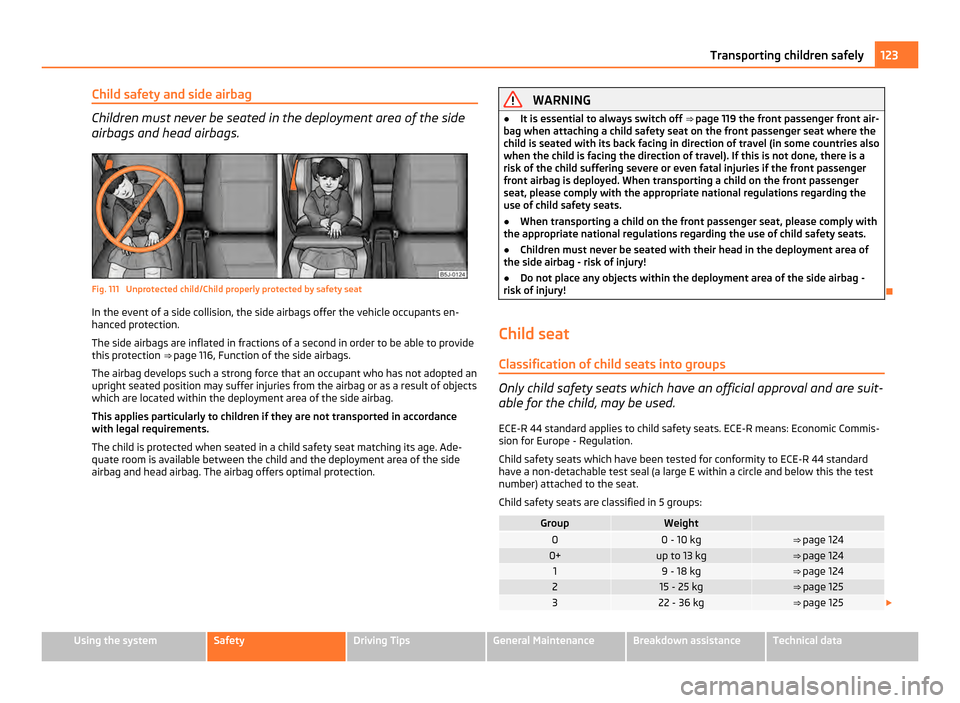
Child safety and side airbag
Children must never be seated in the deployment area of the side
airbags and head airbags.
Fig. 111 Unprotected child/Child properly protected by safety seat
In the event of a side collision, the side airbags offer the vehicle occupants en-
hanced protection.
The side airbags are inflated in fractions of a second in order to be able to provide
this protection
⇒ page 116, Function of the side airbags
.
The airbag develops such a strong force that an occupant who has not adopted an
upright seated position may suffer injuries from the airbag or as a result of objects
which are located within the deployment area of the side airbag.
This applies particularly to children if they are not transported in accordance
with legal requirements.
The child is protected when seated in a child safety seat matching its age. Ade-
quate room is available between the child and the deployment area of the side
airbag and head airbag. The airbag offers optimal protection. WARNING
● It is essential to always switch off ⇒ page 119
the front passenger front air-
bag when attaching a child safety seat on the front passenger seat where the
child is seated with its back facing in direction of travel (in some countries also
when the child is facing the direction of travel). If this is not done, there is a
risk of the child suffering severe or even fatal injuries if the front passenger
front airbag is deployed. When transporting a child on the front passenger
seat, please comply with the appropriate national regulations regarding the
use of child safety seats.
● When transporting a child on the front passenger seat, please comply with
the appropriate national regulations regarding the use of child safety seats.
● Children must never be seated with their head in the deployment area of
the side airbag - risk of injury!
● Do not place any objects within the deployment area of the side airbag -
risk of injury!
Child seat Classification of child seats into groups Only child safety seats which have an official approval and are suit-
able for the child, may be used.
ECE-R 44 standard applies to child safety seats. ECE-R means: Economic Commis-
sion for Europe - Regulation.
Child safety seats which have been tested for conformity to ECE-R 44 standard
have a non-detachable test seal (a large E within a circle and below this the test
number) attached to the seat.
Child safety seats are classified in 5 groups: Group Weight
0 0 - 10 kg ⇒ page 124
0+ up to 13 kg ⇒ page 124
1 9 - 18 kg ⇒ page 124
2 15 - 25 kg ⇒
page 125 3 22 - 36 kg ⇒
page 125 £ 123
Transporting children safely Using the system Safety Driving Tips General Maintenance Breakdown assistance Technical data
Page 127 of 220
Child seats in which the child is facing with its back towards the direction of
travel should not be used on the front passenger seat when the vehicle is fitted
with a front passenger airbag
⇒
page 122, Use of child safety seats on the front
passenger seat. WARNING
● It is essential to always switch off the front passenger front airbag at a
specialist garage or with the switch for front passenger airbag when attaching
in exceptional circumstances a child safety seat on the front passenger seat
where the child is seated with its back facing in direction of travel ⇒ page 120.
● Please comply with any differing national legal regulations regarding the
use of child safety seats.
● If this is not done, a child seated on the front passenger seat may suffer
severe or even fatal injuries if the front passenger airbag or airbags are de-
ployed.
● You should have the front passenger airbag (or airbags) reactivated just as
soon as you no longer use a child safety seat on the front passenger seat.
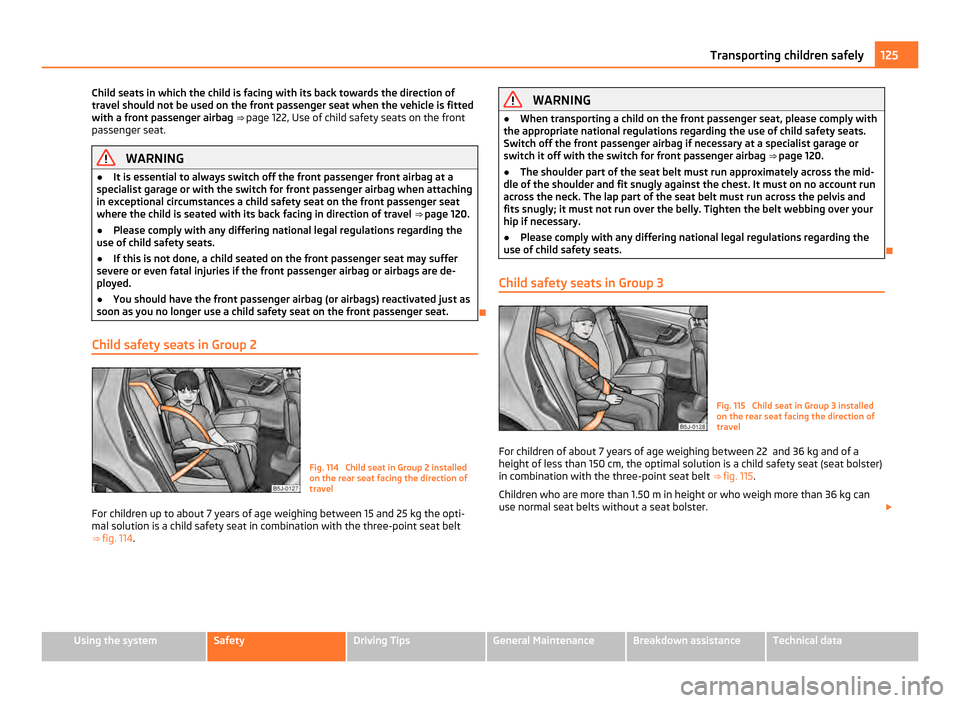
Child safety seats in Group 2 Fig. 114 Child seat in Group 2 installed
on the rear seat facing the direction of
travel
For children up to about 7 years of age weighing between 15 and 25 kg the opti-
mal solution is a child safety seat in combination with the three-point seat belt
⇒ fig. 114 . WARNING
● When transporting a child on the front passenger seat, please comply with
the appropriate national regulations regarding the use of child safety seats.
Switch off the front passenger airbag if necessary at a specialist garage or
switch it off with the switch for front passenger airbag ⇒ page 120.
● The shoulder part of the seat belt must run approximately across the mid-
dle of the shoulder and fit snugly against the chest. It must on no account run
across the neck. The lap part of the seat belt must run across the pelvis and
fits snugly; it must not run over the belly. Tighten the belt webbing over your
hip if necessary.
● Please comply with any differing national legal regulations regarding the
use of child safety seats.
Child safety seats in Group 3 Fig. 115 Child seat in Group 3 installed
on the rear seat facing the direction of
travel
For children of about 7 years of age weighing between 22 and 36 kg and of a
height of less than 150 cm, the optimal solution is a child safety seat (seat bolster)
in combination with the three-point seat belt ⇒ fig. 115.
Children who are more than 1.50
m in height or who weigh more than 36 kg can
use normal seat belts without a seat bolster. £ 125
Transporting children safely Using the system Safety Driving Tips General Maintenance Breakdown assistance Technical data
Page 129 of 220
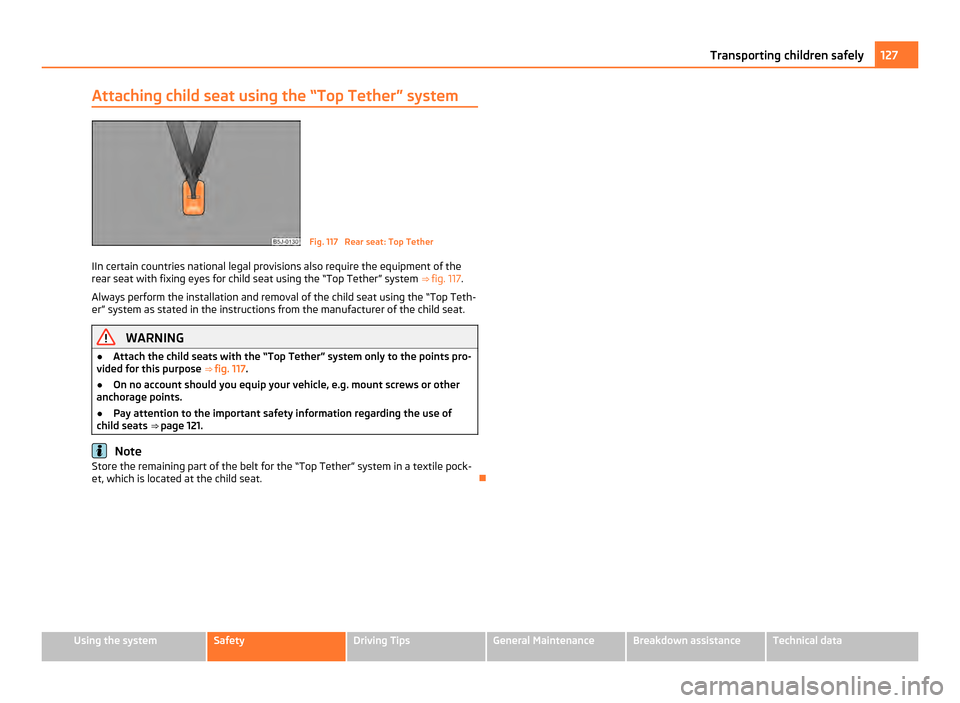
Attaching child seat using the “Top Tether” system
Fig. 117 Rear seat: Top Tether
IIn certain countries national legal provisions also require the equipment of the
rear seat with fixing eyes for child seat using the “Top Tether” system
⇒
fig. 117.
Always perform the installation and removal of the child seat using the “Top Teth-
er” system as stated in the instructions from the manufacturer of the child seat. WARNING
● Attach the child seats with the “Top Tether” system only to the points pro-
vided for this purpose
⇒ fig. 117.
● On no account should you equip your vehicle, e.g. mount screws or other
anchorage points.
● Pay attention to the important safety information regarding the use of
child seats ⇒ page 121. Note
Store the remaining part of the belt for the “Top Tether” system in a textile pock-
et, which is located at the child seat. 127
Transporting children safely Using the system Safety Driving Tips General Maintenance Breakdown assistance Technical data
Page 130 of 220
Driving Tips
Intelligent Technology Electronic stability programme (ESP)
General General
The ESP aids you in maintaining control of your vehicle in situations in which the
vehicle is driving at its dynamic limits, such as entering a curve fast. The risk of
skidding is reduced and your car thus offers greater driving stability depending on
the conditions of the road surface. The system operates at all speeds.
The following systems are integrated into the electronic stability programme:
●
Electronic Differential Lock (EDL),
● Traction control system (TCS),
● Antilock brake system (ABS),
● Brake Assist,
● Uphill Start Assist.
Operating principle
The ESP switches on automatically when the engine is started and then conducts
a self-test. The ESP control unit processes data from the individual systems. It al-
so processes additional measurement data which are supplied by highly sensitive
sensors: the rotational velocity of the vehicle about its vertical axis, the lateral ac-
celeration of the vehicle, the braking pressure and the steering angle.
The direction which the driver wishes to take is determined based on the steering
angle and the speed of the vehicle and is constantly compared with the actual be-
haviour of the vehicle. If differences exist, such as the car beginning to skid, the
ESP will automatically brake the appropriate wheel.
The car is stabilised again by the forces which take effect when the wheel is
braked. Intervention into the brake system takes place primarily on the outer front
wheel of a vehicle which tends to oversteer (tendency for the rear of the vehicle
to break away) while occurs this is on the inner rear wheel of a vehicle which
tends to understeer (tendency to shift out of the curve). This braking control cycle
is accompanied by noises. During an intervention of the system, the warning light
flashes quickly in the
instrument cluster.
The ESP system cannot be switched off, only the TCS system can be switched off
by pressing the button ⇒ fig. 118 . The warning light
⇒ page 24 lights up if the
TCS system is switched off.
The warning light lights up permanently if there is a fault in the ESP system.
The fact that the ESP system operates together with the ABS means that the ESP
warning light will also come on if the ABS system is not operating properly.
If the warning light comes on immediately after starting the engine, the ESP
system can be switched off for technical reasons. In this case, the ESP system can
be switched on again by switching the ignition on and off. If the warning light
goes out, the ESP system is fully functional again. WARNING
It is also not possible for the ESP to overcome the physical limits of the vehi-
cle. Even if a vehicle fitted with ESP you should still always adapt your style of
driving to the condition of the road surface and the traffic situation. This par-
ticularly applies when driving on slippery and wet roads. The increased safety
offered must not tempt you to take greater risks than otherwise - risk of an
accident! Note
● All four wheels must be fitted with the same tyres in order to achieve prob-
lem-free operation of the ESP. Differing rolling circumferences of the tyres can
lead to an undesirable reduction in the engine output.
● Changes to vehicle (e.g. on engine, on the brakes, on chassis or another combi-
nation of tyres and wheels) can influence the function of the ESP ⇒ page 169,
Accessories, changes and replacement of parts
.128
Intelligent Technology
Page 131 of 220
Electronic Differential Lock (EDL and XDL)
The electronic differential lock prevents an individual wheel from
slipping.
Models fitted with ESP are equipped with electronic differential lock (EDL).
General
The EDL makes it much easier, and sometimes at all possible, to start off, acceler-
ate and climb a steep hill when the conditions of the road surface are unfavoura-
ble.
Operating principle
The EDL is activated automatically, that is without any action on the part of the
driver. It monitors the speeds of the driven wheels with the aid of the ABS sen-
sors. Should only
one drive wheel begin spinning on a slippery surface there will
be an appreciable difference in the speed of the driven wheels. The EDL function
brakes the slipping wheel and the differential transmits a greater driving force to
the other driven wheel. This control process is also accompanied by noises.
Overheating of the brakes
The EDL switches off automatically if unusually severe stresses exist in order to
avoid excessive heat generation in the disc brake on the wheel which is being
braked. The vehicle can continue to be driven and has the same characteristics as
a vehicle not fitted with EDL.
The EDL switches on again automatically as soon as the brake has cooled down.
XDL function (Fabia RS and Fabia Combi RS only)
The XDL function is an extension to the electronic differential lock. The XDL func-
tion does not respond to traction, but to the relief of the inner front wheel during
fast cornering. An active brake intervention on the brake of the inner wheel pre-
vents it from spinning. Thus, the traction is improved and the vehicle continues to
follow the desired track. WARNING
● Depress the accelerator carefully when accelerating on uniformly slippery
road surfaces, such as ice and snow. The driven wheels might still spin despite
the EDL and affect the stability of the vehicle - risk of an accident!
● You should always adapt your style of driving to the condition of road sur-
face and to the traffic situation even when your vehicle is fitted with EDL. The
increased safety offered must not tempt you to take greater risks than other-
wise - risk of an accident! Note
● If the ABS or ASR or, where applicable, ESP indicator light lights up, the EDl
may have a fault. Have the vehicle inspected by your specialist garage as soon as
you can.
● Changes to vehicle (e.g. on engine, on the brakes, on chassis or another combi-
nation of tyres and wheels) can influence the function of the EDL ⇒
page 169
,
Accessories, changes and replacement of parts.
Traction control system (TCS) The traction control system prevents the driven wheels from spin-
ning when accelerating.
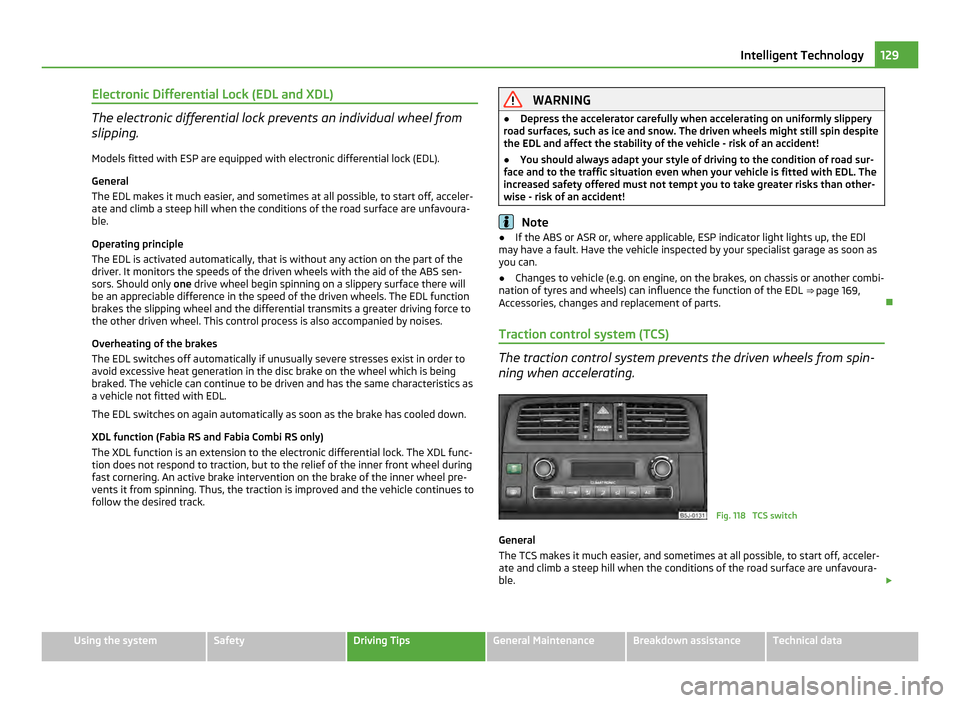
Fig. 118 TCS switch
General
The TCS makes it much easier, and sometimes at all possible, to start off, acceler-
ate and climb a steep hill when the conditions of the road surface are unfavoura-
ble. £ 129
Intelligent Technology Using the system Safety Driving Tips General Maintenance Breakdown assistance Technical data
Page 133 of 220
Faults in the brake surface
If you notice that the braking distance has suddenly become longer and that the
brake pedal can be depressed further, it is possible that a brake circuit of the dual-
circuit brake system has failed. Drive, in such cases, to the nearest specialist ga-
rage without delay in order to have the problem rectified. Drive at a reduced
speed while on your way to the dealer and adapt your style of driving to the high-
er brake pedal pressure required.
Low brake fluid level
An insufficient level of brake fluid may result in problems in the brake system. The
level of the brake fluid is monitored electronically
⇒ page 26, Brake system .WARNING
● Only apply the brakes for the purpose of drying and cleaning the brake
discs if the traffic conditions permit this. Do not place any other road users in
jeopardy.
● When retrospectively mounting a front spoiler, solid wheel hubs etc. one
must ensure that the air supply to the front wheel brakes is not reduced oth-
erwise the braking system could run too hot.
● Allow for the fact that new brake pads do not achieve their full braking ef-
ficiency until approximately 200 kilometres. New brake pads must be first
“run in ”
before they develop their optimal friction force. You can, however,
compensate for this slightly reduced braking force by increasing the pressure
on the brake pedal. This guideline also applies to any new brake pads installed
at a future date. CAUTION
● Never allow the brakes to rub by applying slight pressure if you do not wish to
brake the vehicle. This causes the brakes to overheat and can also result in a lon-
ger braking distance and excessive wear.
● Before negotiating a steep downhill section, please reduce your speed, shift
down into the next lower gear (manual gearbox) or select a lower driving stage
(automatic gearbox). This enables you to make full use of the braking power of
the vehicle and reduces the strain on the brakes. Any additional braking should be
done intermittently, not continuously. Note
The brake light flashes automatically in case of an emergency braking at speeds
greater than 60 km/h or with the intervention of the ABS, which lasts longer than
1.5 seconds. After the speed was reduced below 10 km/h or the vehicle was stop-
ped, the brake light stops flashing and the hazard warning light system switches
on. The hazard warning light system is switched off automatically after accelerat-
ing or driving off again.
Brake booster The brake booster boosts the pressure which you generate with the brake pedal.
The necessary pressure is only generated when the engine is running.
WARNING
● Never switch off the engine before the vehicle is stationary.
● The brake booster only operates when the engine is running. Greater
physical effort for braking is required when engine is switched off. Because if
you do not stop as normal, this can cause an accident and severe injuries.
● While stopping or braking with a vehicle with a petrol engine and manual
transmission in the low rev range, press down on the clutch pedal. If you fail
to do so, the result may be an impairment of the function of the power brake.
You will apply a greater force to the brake pedal which you are usde to - dan-
ger of accident!
Antilock brake system (ABS) ABS prevents the wheels locking when braking.
General
The ABS contributes significantly to enhancing the active safety of your vehicle.
Compared to a car not fitted with the ABS brake system, you are able to retain op-
timal steering ability even during a full brake application on a slippery road surface
because the wheels do not lock up.
You must not expect, however, that the braking distance will be shorter under all
circumstances as a result of the ABS. The braking distance for example on gravel
and fresh snow, when you should anyway be driving slowly and cautiously, will be
longer. £ 131
Intelligent Technology Using the system Safety Driving Tips General Maintenance Breakdown assistance Technical data
Page 135 of 220
The uphill start assist is active as of a 3 % slope, if the driver door is closed. It is
always active on slopes when in forward or reverse start off. When driving down-
hill, it is inactive.
Electrohydraulic power steering The power steering enables you to steer the vehicle with less physical force.
The steering characteristics can be changed by a specialist garage.
You will place great stresses on the power steering system if the steering is
turned to full lock when the vehicle is stationary. Turning the steering to full lock
in such a situation will be accompanied by noises.
It is still possible to fully steer the vehicle if the power steering fails or if the en-
gine is not running (vehicle being towed in). The only difference is that greater
physical effort is required.
It is possible that the hydraulic pump of the power steering will not run due to the
low vehicle network voltage if the battery has gone flat and the engine must star-
ted with the help off jump leads. This condition will be indicated by lighting up of
the warning light.
The power steering operates again if the battery is charged to a specific range
when engine is running. It also operates again, if the engine can be started with
its own battery.
If there is a fault in the power steering, the warning light lights up in the instru-
ment cluster
⇒ page 20. WARNING
Contact your specialist garage if the power steering is defective. CAUTION
Never leave the steering wheel at full lock for more than 15 seconds when the en-
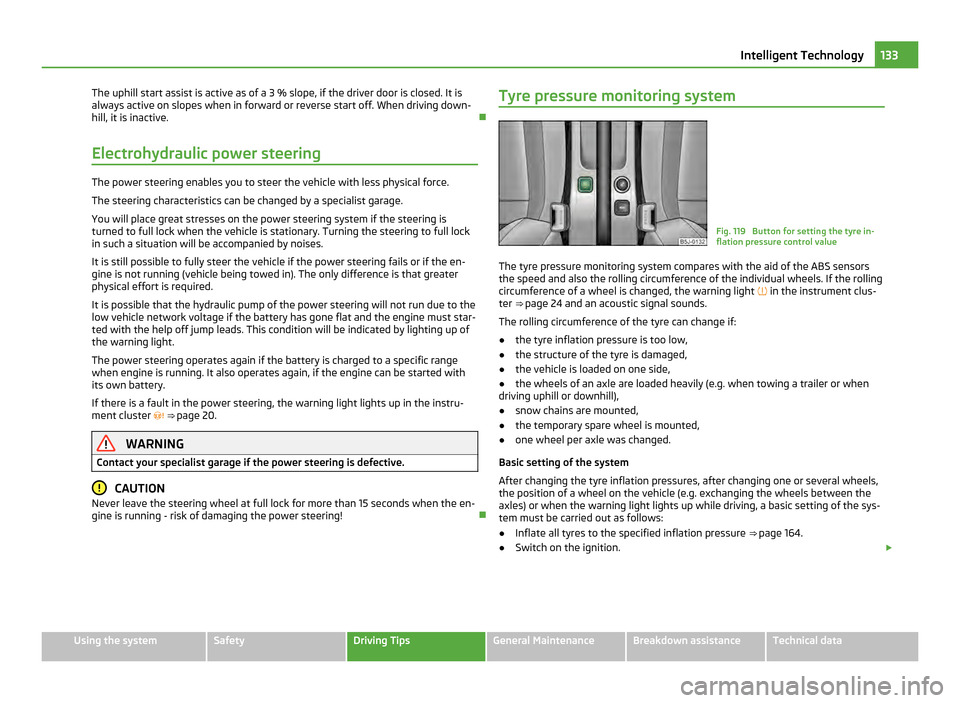
gine is running - risk of damaging the power steering! Tyre pressure monitoring system Fig. 119 Button for setting the tyre in-
flation pressure control value
The tyre pressure monitoring system compares with the aid of the ABS sensors
the speed and also the rolling circumference of the individual wheels. If the rolling
circumference of a wheel is changed, the warning light in the instrument clus-
ter ⇒ page 24 and an acoustic signal sounds.
The rolling circumference of the tyre can change if:
● the tyre inflation pressure is too low,
● the structure of the tyre is damaged,
● the vehicle is loaded on one side,
● the wheels of an axle are loaded heavily (e.g. when towing a trailer or when
driving uphill or downhill),
● snow chains are mounted,
● the temporary spare wheel is mounted,
● one wheel per axle was changed.
Basic setting of the system
After changing the tyre inflation pressures, after changing one or several wheels,
the position of a wheel on the vehicle (e.g. exchanging the wheels between the
axles) or when the warning light lights up while driving, a basic setting of the sys-
tem must be carried out as follows:
● Inflate all tyres to the specified inflation pressure ⇒ page 164.
● Switch on the ignition. £ 133
Intelligent Technology Using the system Safety Driving Tips General Maintenance Breakdown assistance Technical data
Page 137 of 220
Driving and the Environment
The first 1 500 kilometres and afterwards
New engine The engine has to be run in during the first 1 500 kilometres.
Up to 1 000 kilometres
– Do not drive faster than 3/4 of the mamimum speed of the gear in use, that is
3/4 of the maximum permissible engine speed.
– Do not use full throttle.
– Avoid high engine revolutions.
– Do not tow a trailer.
From 1 000 up to 1 500 kilometres
– Increase the power output of the engine gradually up to the full speed of the
gear engaged, that is up to the maximum permissible engine revolutions.
During the first operating hours the engine has higher internal friction than later
until all of the moving parts have harmonized. The driving style which you adopt
during the first approx.1 500 kilometres plays a decisive part in the success of run-
ning in your car.
You should not drive at unnecessarily high engine revolutions even after the run-
ning-in period is complete. The maximum permissible engine speed is marked by
the beginning of the red zone on the scale of the revolutions counter. Shift up in-
to the next higher gear on a vehicle fitted with manual gearbox before the red
zone is reached. During acceleration (depressing the accelerator) exceptionally
high engine speeds are automatically reduced, yet the engine is not protected
against too high engine speeds which are caused by incorrectly shifting down the
gears resulting in a sudden increase of the engine speeds above the permitted
maximum revolutions which can lead to engine damage.
For a vehicle fitted with a manual gearbox the converse situation also applies: Do
not drive at engine revolutions which are too low. Shift down as soon as the en-
gine is no longer running smoothly. CAUTION
All the speed and engine revolution figures apply only when the engine is at its
normal operating temperature. Never rev up an engine which is cold, neither when
the vehicle is stationary nor when driving in individual gears. For the sake of the environment
Not driving at unnecessarily high engine revolutions and shifting to a higher gear
as early as possible are ways to minimise fuel consumption and operating noise
levels and protects the environment.
New tyres New tyres have to be “run in” since they do not offer optimal grip at first. You
should take account of this fact for the first 500 kilometres and drive particularly
carefully.
New brake pads Allow for the fact that new brake pads do not achieve their full braking efficiency
until approximately 200 kilometres. New brake pads must be first
“run in
” before
they develop their optimal friction force. You can, however, compensate for this
slightly reduced braking force by increasing the pressure on the brake pedal.
This guideline also applies to any new brake pads installed at a future date.
During the running-in period, you should avoid excessive stresses on the brakes.
This includes, for example, violent braking, particularly from very high speeds, and
also when crossing mountain passes.
Catalytic converter Proper operation of the emission control system (catalytic convert-
er) is of major significance for driving your vehicle in an environ-
mentally conscious way.
Please refer to the following guidelines: £ 135
Driving and the Environment Using the system Safety Driving Tips General Maintenance Breakdown assistance Technical data