lock SKODA FABIA 2012 2.G / 5J Owner's Guide
[x] Cancel search | Manufacturer: SKODA, Model Year: 2012, Model line: FABIA, Model: SKODA FABIA 2012 2.G / 5JPages: 196, PDF Size: 4.83 MB
Page 38 of 196
Operation in winter
In the winter, ice accumulating on the surface of the window may cause there to
be more resistance when closing the window. The window will stop and move
back several centimetres.
It is necessary to deactivate the force limiter to close the window » page 35.ÐElectric sliding/tilting roof
Introductory information
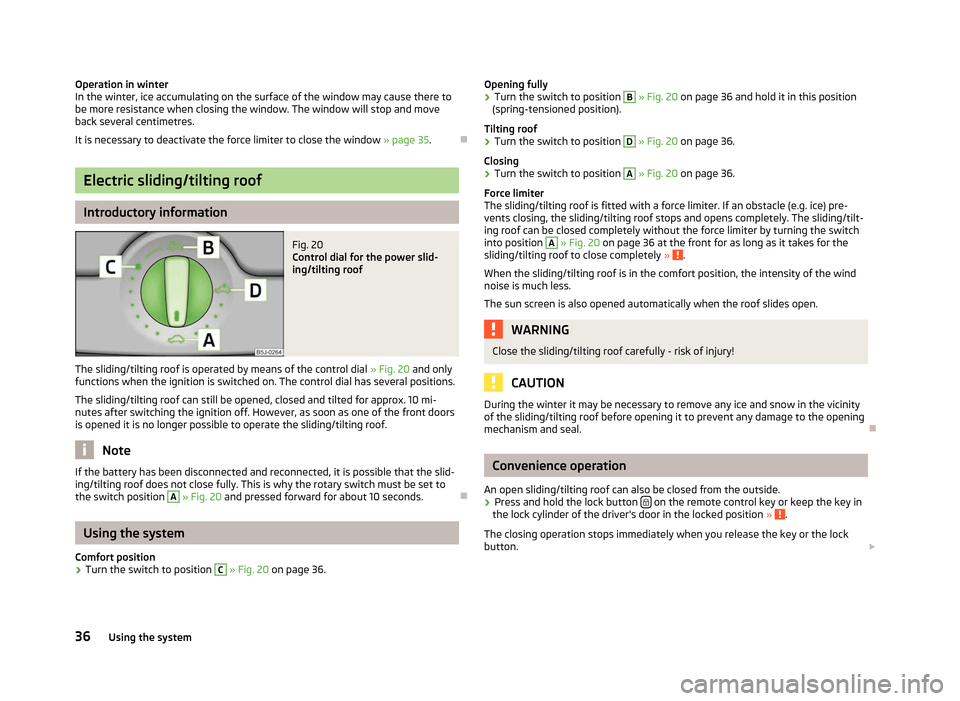
Fig. 20
Control dial for the power slid-
ing/tilting roof
The sliding/tilting roof is operated by means of the control dial » Fig. 20 and only
functions when the ignition is switched on. The control dial has several positions.
The sliding/tilting roof can still be opened, closed and tilted for approx. 10 mi-
nutes after switching the ignition off. However, as soon as one of the front doors
is opened it is no longer possible to operate the sliding/tilting roof. Note
If the battery has been disconnected and reconnected, it is possible that the slid-
ing/tilting roof does not close fully. This is why the rotary switch must be set to
the switch position A
» Fig. 20 and pressed forward for about 10
seconds.ÐUsing the system
Comfort position
› Turn the switch to position C
» Fig. 20 on page 36. Opening fully
› Turn the switch to position B
» Fig. 20 on page 36 and hold it in this position
(spring-tensioned position).
Tilting roof
› Turn the switch to position D
» Fig. 20 on page 36.
Closing
› Turn the switch to position A
» Fig. 20 on page 36.
Force limiter
The sliding/tilting roof is fitted with a force limiter. If an obstacle (e.g. ice) pre-
vents closing, the sliding/tilting roof stops and opens completely. The sliding/tilt-
ing roof can be closed completely without the force limiter by turning the switch
into position A
» Fig. 20 on page 36 at the front for as long as it takes for the
sliding/tilting roof to close completely » .
When the sliding/tilting roof is in the comfort position, the intensity of the wind
noise is much less.
The sun screen is also opened automatically when the roof slides open. WARNING
Close the sliding/tilting roof carefully - risk of injury! CAUTION
During the winter it may be necessary to remove any ice and snow in the vicinity
of the sliding/tilting roof before opening it to prevent any damage to the opening
mechanism and seal. Ð Convenience operation
An open sliding/tilting roof can also be closed from the outside.
› Press and hold the lock button
on the remote control key or keep the key in
the lock cylinder of the driver's door in the locked position » .
The closing operation stops immediately when you release the key or the lock
button. £
36 Using the system
Page 39 of 196
WARNING
Close the sliding/tilting roof carefully - risk of injury! The force limiter does not
operate with the convenience closing. ÐEmergency operation
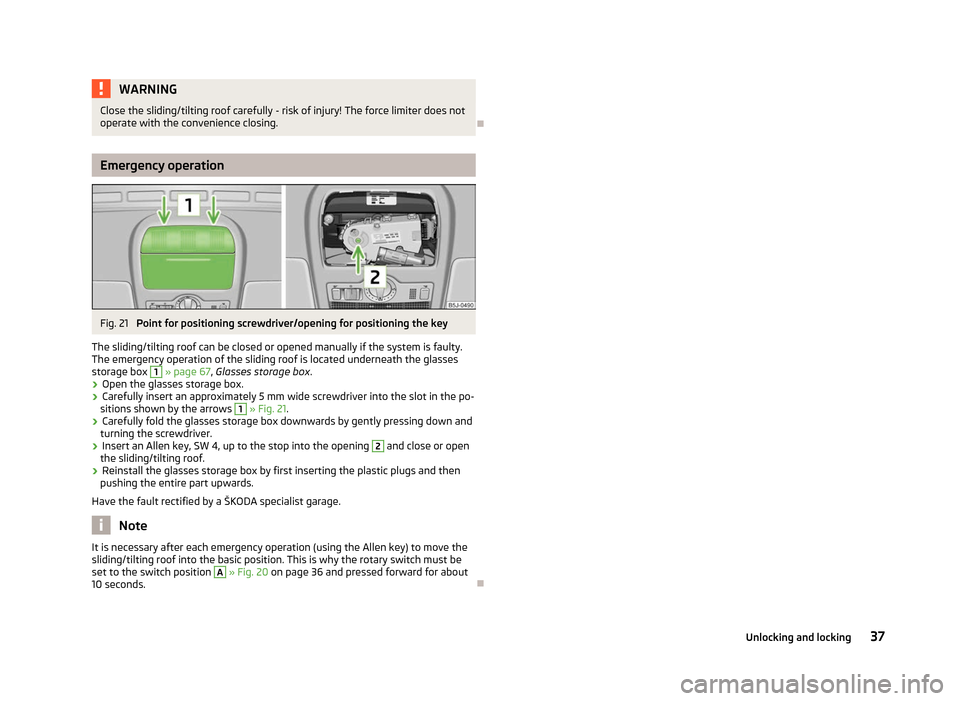
Fig. 21
Point for positioning screwdriver/opening for positioning the key
The sliding/tilting roof can be closed or opened manually if the system is faulty.
The emergency operation of the sliding roof is located underneath the glasses
storage box 1
» page 67,
Glasses storage box .
› Open the glasses storage box.
› Carefully insert an approximately 5 mm wide screwdriver into the slot in the po-
sitions shown by the arrows 1
» Fig. 21.
› Carefully fold the glasses storage box downwards by gently pressing down and
turning the screwdriver.
› Insert an Allen key, SW 4, up to the stop into the opening 2
and close or open
the sliding/tilting roof.
› Reinstall the glasses storage box by first inserting the plastic plugs and then
pushing the entire part upwards.
Have the fault rectified by a
ŠKODA specialist garage.Note
It is necessary after each emergency operation (using the Allen key) to move the
sliding/tilting roof into the basic position. This is why the rotary switch must be
set to the switch position A
» Fig. 20 on page 36 and pressed forward for about
10 seconds. Ð 37
Unlocking and locking
Page 41 of 196
Switching off lights (except daytime running lights)
›
Turn the light switch
» Fig. 22 - to position O. ÐDAY LIGHT function (Daylight driving light)
First read and observe the introductory information and safety warn-
ings on page 38.
Switching on
› Remove the cover on the fuse box on the left-hand side of the dash pan-
el » page 169, Fuses in the dash panel.
› Turn the light switch into position O
» Fig. 22 on page 38 - .
› Switch on the switch for daylight driving lights
» Fig. 22 on page 38 - .
Switching off
› Remove the cover on the fuse box on the left-hand side of the dash pan-
el » page 169, Fuses in the dash panel.
› Switch off the switch for daylight driving lights
» Fig. 22 on page 38 - .
› Turn the light switch to the position Parking light
or Low beam » Fig. 22
on page 38 - .
Activating daylight driving lights for vehicles with the
START-STOP system
› Switch off the ignition.
› At the same time, slide the turn signal light lever upwards and hold it in this po-
sition for at least 3 seconds.
› Switch on the ignition - wait until the right-turn signal light flashes 4x.
› Switch off the ignition - an audible signal sounds which confirms the activation
of the daylight driving lights.
› Release the turn signal lever.
Deactivating daylight driving lights for vehicles with the
START-STOP system
› Switch off the ignition.
› At the same time, slide the turn signal light lever downwards and hold it in this
position for at least 3 seconds.
› Switch on the ignition - wait until the left-turn signal light flashes 4x.
› Switch off the ignition - an audible signal sounds which confirms the deactiva-
tion of the daylight driving lights.
› Release the turn signal lever.
On vehicles with separate lights for daylight driving lights in the fog lights or in
the front bumper, the parking lights and the licence plate light do not come on
when activating the function daylight driving lights (neither front nor rear).
ä
If the vehicle is not equipped with separate lights for daylight driving lights, the
combination of the low beam, the parking lights (front and rear) including the li-
cence plate light is used as daylight driving lights.
Ð Halogen projector headlights with cornering light function
First read and observe the introductory information and safety warn-
ings on page 38.
For a better cornering illumination, the halogen projector headlights with corner-
ing light function are set in the optimal position in line with the vehicle speed and
the steering angle. WARNING
If the halogen projector headlights with cornering light function are faulty, the
headlights are automatically lowered to the emergency position, which pre-
vents a possible dazzling of oncoming traffic. Thus the illuminated length of
the road is shortened. Drive carefully and visit a
ŠKODA specialist garage as
soon as possible. Ð Parking light
First read and observe the introductory information and safety warn-
ings on page 38.
Parking light
› Switch off the ignition.
› Pull the turn signal light lever
» Fig. 26 on page 42 upwards or downwards -
the side light on the right or left side of the vehicle is switched.
Parking light on both sides
› Turn the light switch into the position
and lock the vehicle. Note
■ The parking light can only be activated if the ignition is switched off.
■ If the right or left turn signal light has been switched on and the ignition is
switched off, the parking light is not automatically switched on. Ð
ä
ä
39
Lights and visibility
Page 45 of 196
Note
■ The turn signal system only operates when the ignition is switched on. The cor-
responding warning light or in the instrument cluster also flashes.
■ The turn signal is automatically cancelled after negotiating a curve.
■ The warning light flashes at twice its normal rate if a bulb for the turn signal
light fails. ÐInterior light
Interior lights at the front
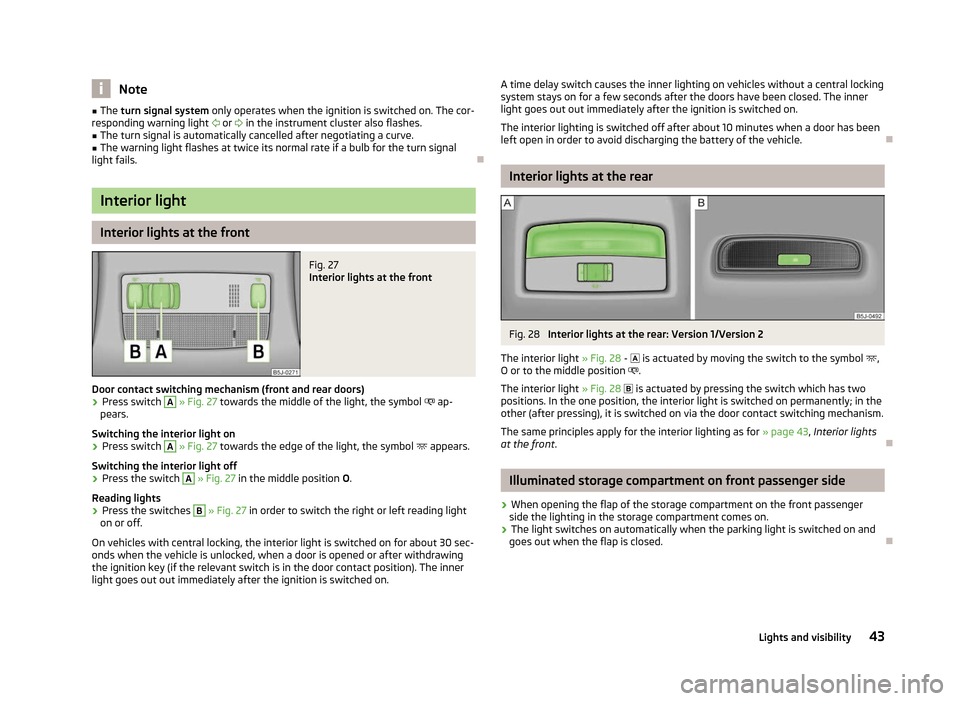
Fig. 27
Interior lights at the front
Door contact switching mechanism (front and rear doors) › Press switch A
» Fig. 27 towards the middle of the light, the symbol
ap-
pears.
Switching the interior light on
› Press switch A
» Fig. 27 towards the edge of the light, the symbol
appears.
Switching the interior light off
› Press the switch A
» Fig. 27 in the middle position
O.
Reading lights
› Press the switches B
» Fig. 27 in order to switch the right or left reading light
on or off.
On vehicles with central locking, the interior light is switched on for about 30 sec-
onds when the vehicle is unlocked, when a door is opened or after withdrawing
the ignition key (if the relevant switch is in the door contact position). The inner
light goes out out immediately after the ignition is switched on. A time delay switch causes the inner lighting on vehicles without a central locking
system stays on for a few seconds after the doors have been closed. The inner
light goes out out immediately after the ignition is switched on.
The interior lighting is switched off after about 10 minutes when a door has been
left open in order to avoid discharging the battery of the vehicle. Ð Interior lights at the rear
Fig. 28
Interior lights at the rear: Version 1/Version 2
The interior light » Fig. 28 -
is actuated by moving the switch to the symbol ,
O or to the middle position .
The interior light » Fig. 28 is actuated by pressing the switch which has two
positions. In the one position, the interior light is switched on permanently; in the
other (after pressing), it is switched on via the door contact switching mechanism.
The same principles apply for the interior lighting as for » page 43, Interior lights
at the front . Ð Illuminated storage compartment on front passenger side
› When opening the flap of the storage compartment on the front passenger
side the lighting in the storage compartment comes on.
› The light switches on automatically when the parking light is switched on and
goes out when the flap is closed. Ð
43
Lights and visibility
Page 48 of 196
›
Release the lever. The washer system stops and the wiper continues for anoth-
er 1 to 3 wiper strokes (depending on the duration of the spraying process). The
lever will stay in position after releasing it 6
.
Switching windscreen wipers off
› Move the lever back into the home position 0
» Fig. 31.
ÐHeadlight cleaning system
First read and observe the introductory information and safety warn-
ings on page 44.
When the low beam or main beam are switched on, and the windscreen wiper
lever is pulled into the position
5
» Fig. 31 on page 45, the headlights are sprayed
briefly. To clean the headlights, the windshield is also sprayed after every five
squirts.
You should remove stubborn dirt (such as insect residues) from the headlight len-
ses at regular intervals, for example when refuelling. The following guidelines
must be observed » page 132, Headlight lenses .
To ensure the proper operation of the cleaning system during the winter, any
snow should be removed from the washer nozzle fixtures and ice should be
cleared with a de-icing spray. CAUTION
Never remove the nozzles from the headlight cleaning system by hand - risk of
damage! ÐReplacing the windscreen wiper blades
Fig. 32
Windscreen wiper blade
ä
First read and observe the introductory information and safety warn-
ings on page 44.
Removing the wiper blade
›
Fold the windscreen wiper arm away from the windscreen.
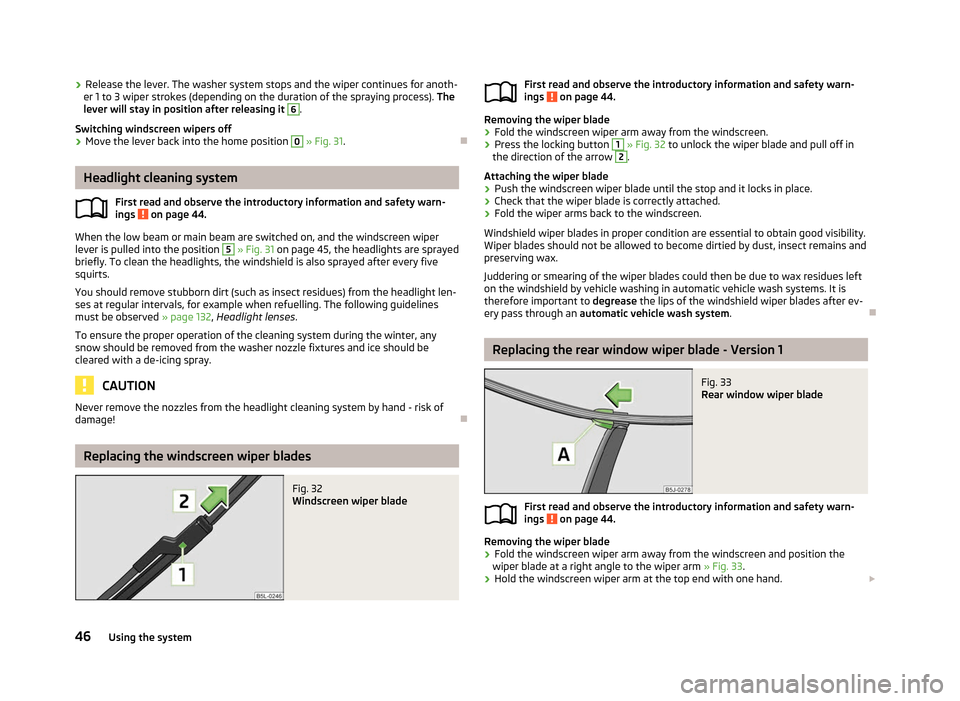
› Press the locking button 1
» Fig. 32 to unlock the wiper blade and pull off in
the direction of the arrow 2
.
Attaching the wiper blade
› Push the windscreen wiper blade until the stop and it locks in place.
› Check that the wiper blade is correctly attached.
› Fold the wiper arms back to the windscreen.
Windshield wiper blades in proper condition are essential to obtain good visibility.
Wiper blades should not be allowed to become dirtied by dust, insect remains and
preserving wax.
Juddering or smearing of the wiper blades could then be due to wax residues left
on the windshield by vehicle washing in automatic vehicle wash systems. It is
therefore important to degrease the lips of the windshield wiper blades after ev-
ery pass through an automatic vehicle wash system .Ð Replacing the rear window wiper blade - Version 1
Fig. 33
Rear window wiper blade
First read and observe the introductory information and safety warn-
ings on page 44.
Removing the wiper blade
›
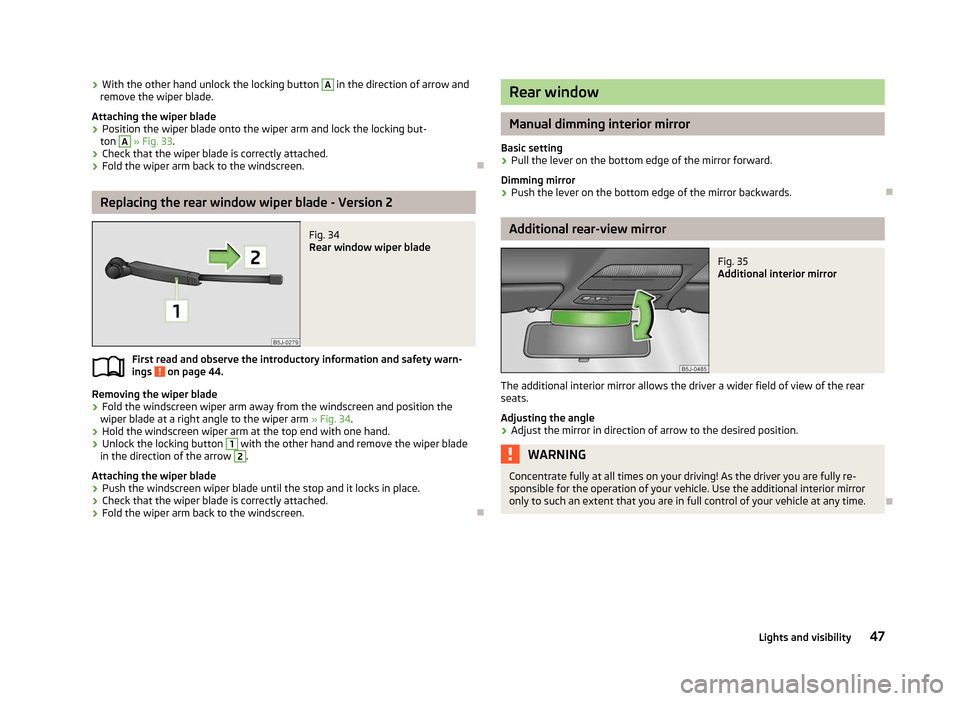
Fold the windscreen wiper arm away from the windscreen and position the
wiper blade at a right angle to the wiper arm » Fig. 33.
› Hold the windscreen wiper arm at the top end with one hand.
£
ä
ä
46 Using the system
Page 49 of 196
›
With the other hand unlock the locking button A
in the direction of arrow and
remove the wiper blade.
Attaching the wiper blade
› Position the wiper blade onto the wiper arm and lock the locking but-
ton A
» Fig. 33
.
› Check that the wiper blade is correctly attached.
› Fold the wiper arm back to the windscreen. ÐReplacing the rear window wiper blade - Version 2
Fig. 34
Rear window wiper blade
First read and observe the introductory information and safety warn-
ings on page 44.
Removing the wiper blade
›
Fold the windscreen wiper arm away from the windscreen and position the
wiper blade at a right angle to the wiper arm » Fig. 34.
› Hold the windscreen wiper arm at the top end with one hand.
› Unlock the locking button 1
with the other hand and remove the wiper blade
in the direction of the arrow 2
.
Attaching the wiper blade
› Push the windscreen wiper blade until the stop and it locks in place.
› Check that the wiper blade is correctly attached.
› Fold the wiper arm back to the windscreen. Ð
ä Rear window
Manual dimming interior mirror
Basic setting
› Pull the lever on the bottom edge of the mirror forward.
Dimming mirror
› Push the lever on the bottom edge of the mirror backwards. Ð Additional rear-view mirror
Fig. 35
Additional interior mirror
The additional interior mirror allows the driver a wider field of view of the rear
seats.
Adjusting the angle › Adjust the mirror in direction of arrow to the desired position. WARNING
Concentrate fully at all times on your driving! As the driver you are fully re-
sponsible for the operation of your vehicle. Use the additional interior mirror
only to such an extent that you are in full control of your vehicle at any time. Ð
47
Lights and visibility
Page 52 of 196
Adjusting the front seats - Version 1
Fig. 37
Control elements at the seat
First read and observe the introductory information and safety warn-
ings on page 49.
Adjusting a seat in a forward/back direction
›
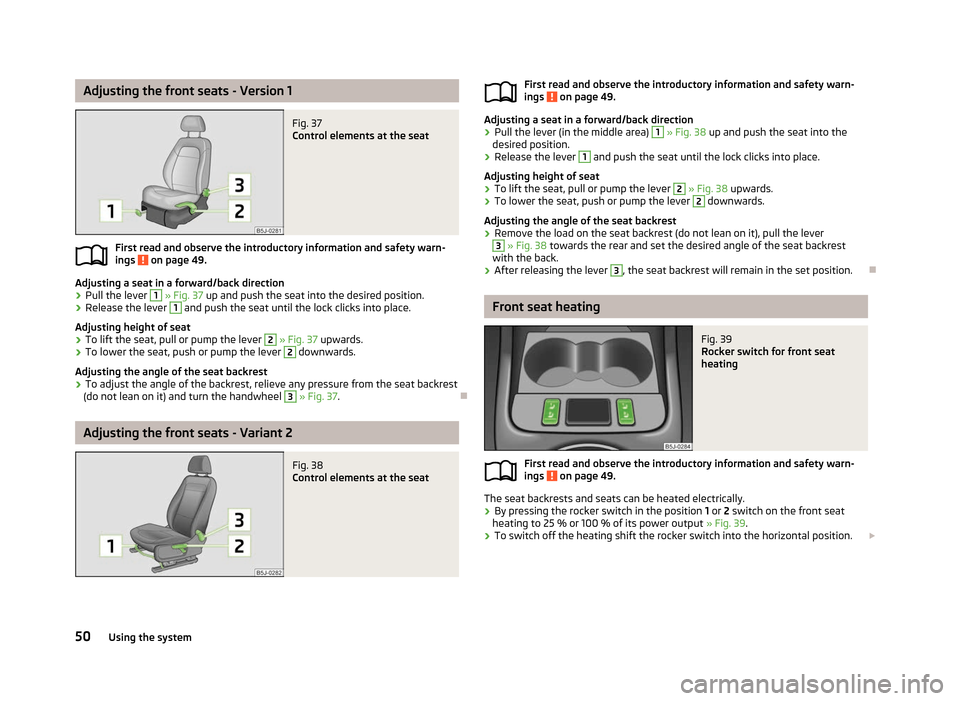
Pull the lever 1
» Fig. 37
up and push the seat into the desired position.
› Release the lever 1
and push the seat until the lock clicks into place.
Adjusting height of seat
› To lift the seat, pull or pump the lever 2
» Fig. 37
upwards.
› To lower the seat, push or pump the lever 2
downwards.
Adjusting the angle of the seat backrest
› To adjust the angle of the backrest, relieve any pressure from the seat backrest
(do not lean on it) and turn the handwheel 3
» Fig. 37
. ÐAdjusting the front seats - Variant 2
Fig. 38
Control elements at the seat
ä
First read and observe the introductory information and safety warn-
ings on page 49.
Adjusting a seat in a forward/back direction
›
Pull the lever (in the middle area) 1
» Fig. 38 up and push the seat into the
desired position.
› Release the lever 1
and push the seat until the lock clicks into place.
Adjusting height of seat
› To lift the seat, pull or pump the lever 2
» Fig. 38 upwards.
› To lower the seat, push or pump the lever 2
downwards.
Adjusting the angle of the seat backrest
› Remove the load on the seat backrest (do not lean on it), pull the lever 3
» Fig. 38 towards the rear and set the desired angle of the seat backrest
with the back.
› After releasing the lever 3
, the seat backrest will remain in the set position.
Ð Front seat heating
Fig. 39
Rocker switch for front seat
heating
First read and observe the introductory information and safety warn-
ings on page 49.
The seat backrests and seats can be heated electrically.
›
By pressing the rocker switch in the position
1 or 2 switch on the front seat
heating to 25 % or 100 % of its power output » Fig. 39.
› To switch off the heating shift the rocker switch into the horizontal position.
£
ä
ä
50 Using the system
Page 53 of 196
WARNING
If, as an occupant, you have a subdued pain and/or temperature sensitivity,
e.g. through medication, paralysis or because of chronic illness (e.g. diabetes),
we recommend not to use the seat heating. This can lead to burns on the
back, the posterior and the legs which are difficult to heal. If the seat heating
is used, we recommend to make regular breaks in your journey when driving
long distances, so that the body can recuperate from the stress of the jour-
ney. Please consult your doctor, who can evaluate your specific condition. CAUTION
■ Do not kneel on the seats or otherwise apply pressure at specific points to
avoid damaging the heating elements for the seat heaters.
■ Do not use the seat heaters if the seats are not occupied by persons or if ob-
jects, such as a child seat, bag, etc., are fastened or stored on them. A fault of the
heating elements in the seat heating can occur.
■ Do not clean the seats using moisture » page 134. Note
■ The seat heating should only be switched on when the engine is running. This
has a significant effect of saving on the battery capacity. ■ If the on-board voltage drops, the seat heating is switched off automatically, in
order to provide sufficient electrical energy for the engine control » page 149, Au-
tomatic load deactivation . ÐHead restraints
Fig. 40
Head restraint: adjusting/removing Adjusting the height of a head restraint
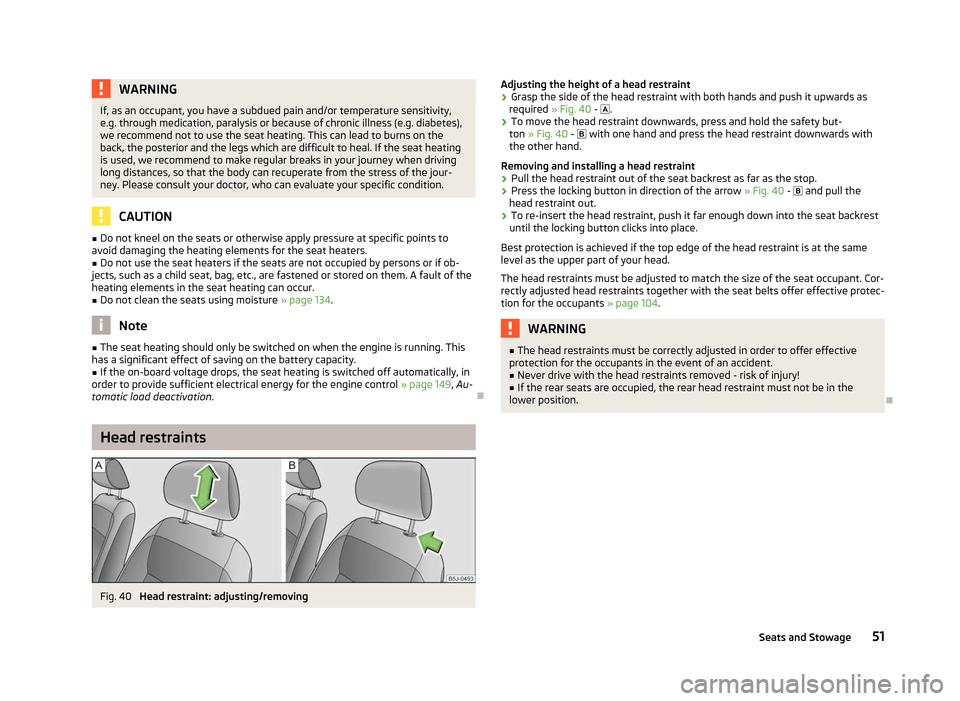
› Grasp the side of the head restraint with both hands and push it upwards as
required » Fig. 40 - .
› To move the head restraint downwards, press and hold the safety but-
ton » Fig. 40 - with one hand and press the head restraint downwards with
the other hand.
Removing and installing a head restraint
› Pull the head restraint out of the seat backrest as far as the stop.
› Press the locking button in direction of the arrow
» Fig. 40 - and pull the
head restraint out.
› To re-insert the head restraint, push it far enough down into the seat backrest
until the locking button clicks into place.
Best protection is achieved if the top edge of the head restraint is at the same
level as the upper part of your head.
The head restraints must be adjusted to match the size of the seat occupant. Cor-
rectly adjusted head restraints together with the seat belts offer effective protec-
tion for the occupants » page 104. WARNING
■ The head restraints must be correctly adjusted in order to offer effective
protection for the occupants in the event of an accident. ■ Never drive with the head restraints removed - risk of injury!
■ If the rear seats are occupied, the rear head restraint must not be in the
lower position. Ð
51
Seats and Stowage
Page 54 of 196
Rear seats
Folding the seat backrest forwards
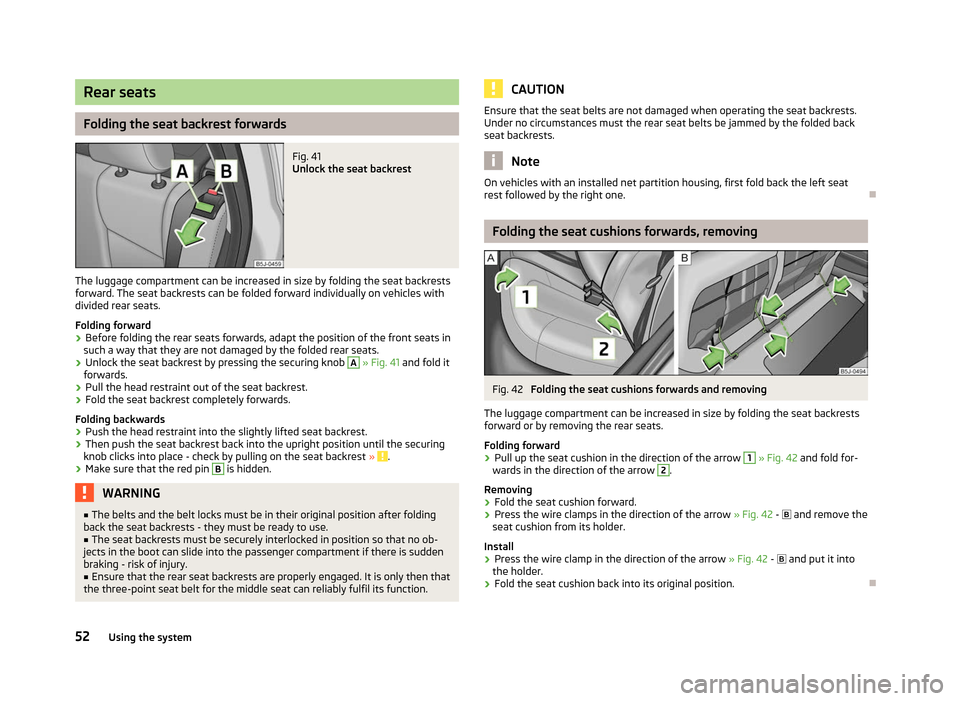
Fig. 41
Unlock the seat backrest
The luggage compartment can be increased in size by folding the seat backrests
forward. The seat backrests can be folded forward individually on vehicles with
divided rear seats.
Folding forward
› Before folding the rear seats forwards, adapt the position of the front seats in
such a way that they are not damaged by the folded rear seats.
› Unlock the seat backrest by pressing the securing knob A
» Fig. 41 and fold it
forwards.
› Pull the head restraint out of the seat backrest.
› Fold the seat backrest completely forwards.
Folding backwards
› Push the head restraint into the slightly lifted seat backrest.
› Then push the seat backrest back into the upright position until the securing
knob clicks into place - check by pulling on the seat backrest » .
› Make sure that the red pin B
is hidden.
WARNING
■ The belts and the belt locks must be in their original position after folding
back the seat backrests - they must be ready to use.
■ The seat backrests must be securely interlocked in position so that no ob-
jects in the boot can slide into the passenger compartment if there is sudden
braking - risk of injury.
■ Ensure that the rear seat backrests are properly engaged. It is only then that
the three-point seat belt for the middle seat can reliably fulfil its function. CAUTION
Ensure that the seat belts are not damaged when operating the seat backrests.
Under no circumstances must the rear seat belts be jammed by the folded back
seat backrests. Note
On vehicles with an installed net partition housing, first fold back the left seat
rest followed by the right one. Ð Folding the seat cushions forwards, removing
Fig. 42
Folding the seat cushions forwards and removing
The luggage compartment can be increased in size by folding the seat backrests
forward or by removing the rear seats.
Folding forward
› Pull up the seat cushion in the direction of the arrow 1
» Fig. 42 and fold for-
wards in the direction of the arrow 2
.
Removing
› Fold the seat cushion forward.
› Press the wire clamps in the direction of the arrow
» Fig. 42 - and remove the
seat cushion from its holder.
Install
› Press the wire clamp in the direction of the arrow
» Fig. 42 - and put it into
the holder.
› Fold the seat cushion back into its original position. Ð
52 Using the system
Page 57 of 196
Fixing nets
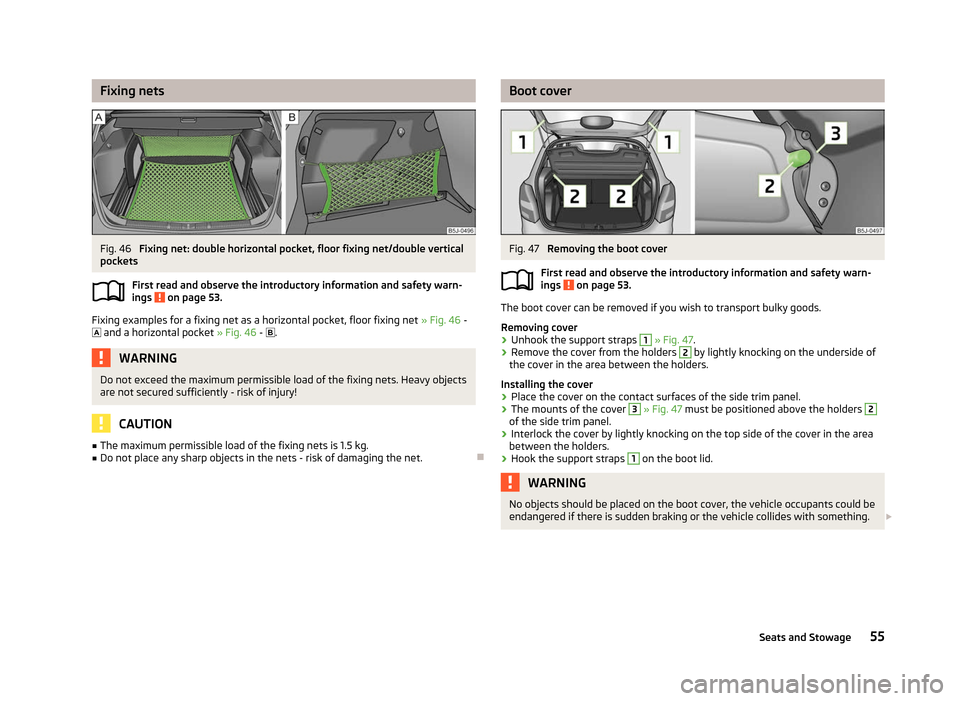
Fig. 46
Fixing net: double horizontal pocket, floor fixing net/double vertical
pockets
First read and observe the introductory information and safety warn-
ings on page 53.
Fixing examples for a fixing net as a horizontal pocket, floor fixing net
» Fig. 46 -
and a horizontal pocket » Fig. 46 - . WARNING
Do not exceed the maximum permissible load of the fixing nets. Heavy objects
are not secured sufficiently - risk of injury! CAUTION
■ The maximum permissible load of the fixing nets is 1.5 kg.
■ Do not place any sharp objects in the nets - risk of damaging the net. Ð
ä Boot cover
Fig. 47
Removing the boot cover
First read and observe the introductory information and safety warn-
ings on page 53.
The boot cover can be removed if you wish to transport bulky goods.
Removing cover
›
Unhook the support straps 1
» Fig. 47.
› Remove the cover from the holders 2
by lightly knocking on the underside of
the cover in the area between the holders.
Installing the cover
› Place the cover on the contact surfaces of the side trim panel.
› The mounts of the cover 3
» Fig. 47
must be positioned above the holders 2
of the side trim panel.
› Interlock the cover by lightly knocking on the top side of the cover in the area
between the holders.
› Hook the support straps 1
on the boot lid.
WARNING
No objects should be placed on the boot cover, the vehicle occupants could be
endangered if there is sudden braking or the vehicle collides with something. £
ä
55
Seats and Stowage