oil SKODA FABIA 2013 2.G / 5J User Guide
[x] Cancel search | Manufacturer: SKODA, Model Year: 2013, Model line: FABIA, Model: SKODA FABIA 2013 2.G / 5JPages: 223, PDF Size: 12.77 MB
Page 111 of 223
›Minimum fuel leakage during accidents.
› Reduced noise.
Choice of materials › Extensive use of recyclable material.
› Air conditioning filled with CFC-free refrigerant.
› No cadmium.
› No asbestos.
› Reduction in the “vaporisation” of plastics.
Manufacture › Solvent-free cavity protection.
› Solvent-free protection of the vehicle for transportation from the production
plant to the customer.
› The use of solvent-free adhesives.
› No CFCs used in the production process.
› Without use of mercury.
› Use of water-soluble paints.
Trade-in and recycling of old cars
ŠKODA meets the requirements of the brand and its products with regard to pro- tecting the environment and the preserving resources. All new ŠKODA vehicles
can be utilized up to 95 % and always 1)
be returned.
In a lot of countries sufficient trade-in networks have been created, where you
can trade-in your vehicle. After you trade-in your vehicle, you will receive a confir-
mation stating the recycling in accordance with environmental regulations.
Note
Detailed information about the trade-in and recycling of end-of-life cars is availa-
ble from a specialist garage.
Avoiding damage to your vehicle
Introduction
This chapter contains information on the following subjects:
General information
108
Driving through water on streets
109
General information
First read and observe the introductory information given on page 108.
Pay attention to low-slung parts of the vehicle, such as the spoiler and exhaust,particularly in the following situations.
› When driving on poorly maintained roads and tracks.
› When driving over kerb stones.
› When driving on steep ramps, etc.
Particular attention is necessary for vehicle with a sports suspension and when then vehicle is fully laden.
1)
Subject to fulfilment of the national legal requirements.
108Driving
Page 132 of 223
WARNINGObserve the following instructions for the proper use of the seat belts.■Never use a seatbelt to secure two persons (not even children). Nor may the
seat belt be placed over a child who is sitting on the lap of another passenger.■
The lock tongue should only be inserted into the lock which is the correct
one for your seat. Wrong use of the safety belt will reduce its capacity to pro-
tect and the risk of injury increases.
■
The slot of the belt tongue must not be blocked otherwise the belt tongue
will not lock in place properly.
■
Many layers of clothing and loose clothing (e. g. a winter coat over a jacket)
do not allow you to be correctly seated and impairs proper operation of the
seat belts.
■
It is prohibited to use clamps or other objects to adjust seat belts (e. g. for
shortening the belts for smaller persons).
■
The seat belts for the rear seats can only fulfil their function reliably when
the seat backrests are correctly locked into position » page 56.
WARNINGObserve the following instructions for proper use of the seat belts.■The belt webbing must always be kept clean. Soiled belts may impair proper
operation of the inertia reel » page 157, Seat belts .■
The seat belts must not be removed or changed in any way. Do not attempt
to repair the seat belts yourself.
■
Check the condition of all the seat belts on a regular basis. If any damage to
the seat belts, seat belt connections, inertia reel or the lock is detected, the
seat belt concerned must be replaced by a specialist garage.
■
Damaged seat belts which have been subjected to stress in an accident and
were therefore stretched, must be replaced - this is best done by a specialist
garage. The anchorage points of the belts must also be inspected. The an-
chorage points for the belts should also be checked.
Note
The national legal requirements must be observed when using seat belts.
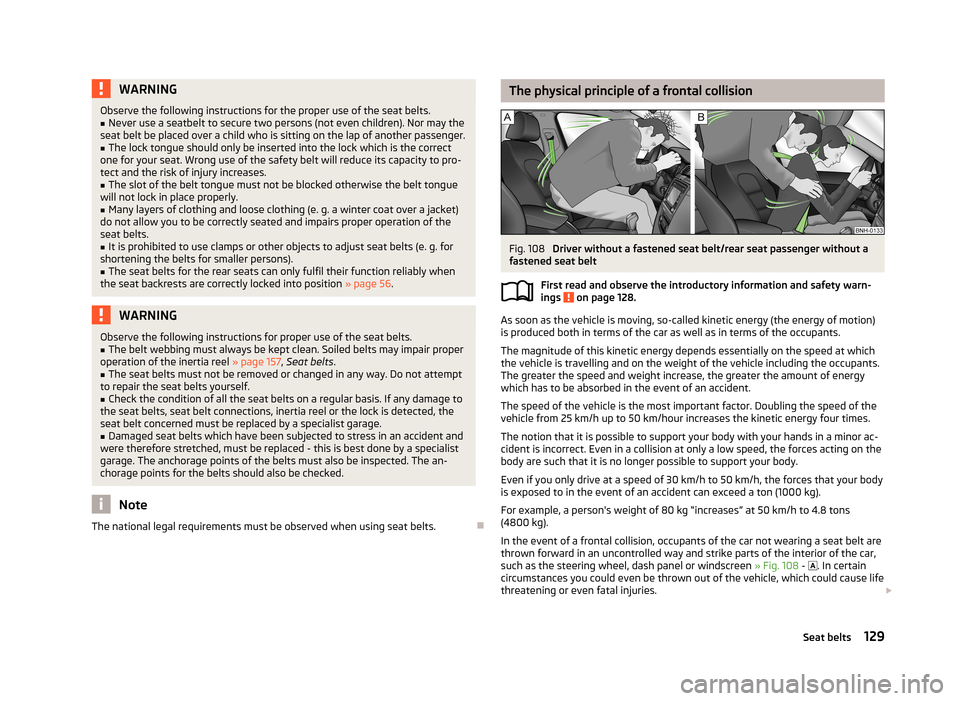
The physical principle of a frontal collisionFig. 108
Driver without a fastened seat belt/rear seat passenger without a
fastened seat belt
First read and observe the introductory information and safety warn-ings
on page 128.
As soon as the vehicle is moving, so-called kinetic energy (the energy of motion)
is produced both in terms of the car as well as in terms of the occupants.
The magnitude of this kinetic energy depends essentially on the speed at which
the vehicle is travelling and on the weight of the vehicle including the occupants.
The greater the speed and weight increase, the greater the amount of energy
which has to be absorbed in the event of an accident.
The speed of the vehicle is the most important factor. Doubling the speed of the
vehicle from 25 km/h up to 50 km/hour increases the kinetic energy four times.
The notion that it is possible to support your body with your hands in a minor ac-cident is incorrect. Even in a collision at only a low speed, the forces acting on thebody are such that it is no longer possible to support your body.
Even if you only drive at a speed of 30 km/h to 50 km/h, the forces that your body is exposed to in the event of an accident can exceed a ton (1000 kg).
For example, a person's weight of 80 kg “increases” at 50 km/h to 4.8 tons
(4800 kg).
In the event of a frontal collision, occupants of the car not wearing a seat belt are
thrown forward in an uncontrolled way and strike parts of the interior of the car,
such as the steering wheel, dash panel or windscreen » Fig. 108 -
. In certain
circumstances you could even be thrown out of the vehicle, which could cause life threatening or even fatal injuries.
129Seat belts
Page 148 of 223
General Maintenance
Car care
Service intervals
Introduction
This chapter contains information on the following subjects:
Overview of service intervals
145
Fixed service intervals QI1 - QI4
146
Variable service interval QI6
146
Information about the ŠKODA service
146
The Service Interval Display in the instrument cluster will remind you to have ev- ery service specified by the manufacturer at the right time so that you never for- get a service.
A timely and adequate performance of servicing works is one of the requirements for the settlement of possible warranty claims.
The completion of services can be verified through the confirmed service certifi-
cation and the corresponding receipts.
The service intervals are appropriate for normal operating conditions.
In case of difficult operating conditions, it is necessary to have some servicing
work performed before the date of the next service or between the service inter- vals stated. This applies mainly to the cleaning or the replacement of the air filter
insert in regions with heavy dust pollution as well as checking and replacing the
toothed belt, but also vehicles with diesel particle filter which can use the engine
oil more intensely.
These severe conditions are:
› fuel containing sulphur;
› frequent short trips;
› longer idling mode of the engine (e.g. taxi vehicles);
› operation in areas with heavy dust pollution;
› frequent trailer towing;
›
predominantly stop-and-go traffic as tends to occur in city driving, for example;
› operation predominantly during winter.
A service adviser at the specialist garage will tell you whether your vehicle's oper- ating conditions make it necessary for such work to be carried out between the
normal service intervals.
Different service charges may apply, depending on the scope of necessary works
as well as the model, features and condition of your vehicle.
Note
■ The customer is responsible for covering the cost of all services including
changing or replenishing the operating fluid, even during the warranty period, un-
less the ŠKODA AUTO a.s. warranty terms or other agreements state otherwise.■
You will be informed about the scope of the service with regard to a particular
service event by the specialist garage.
Overview of service intervals
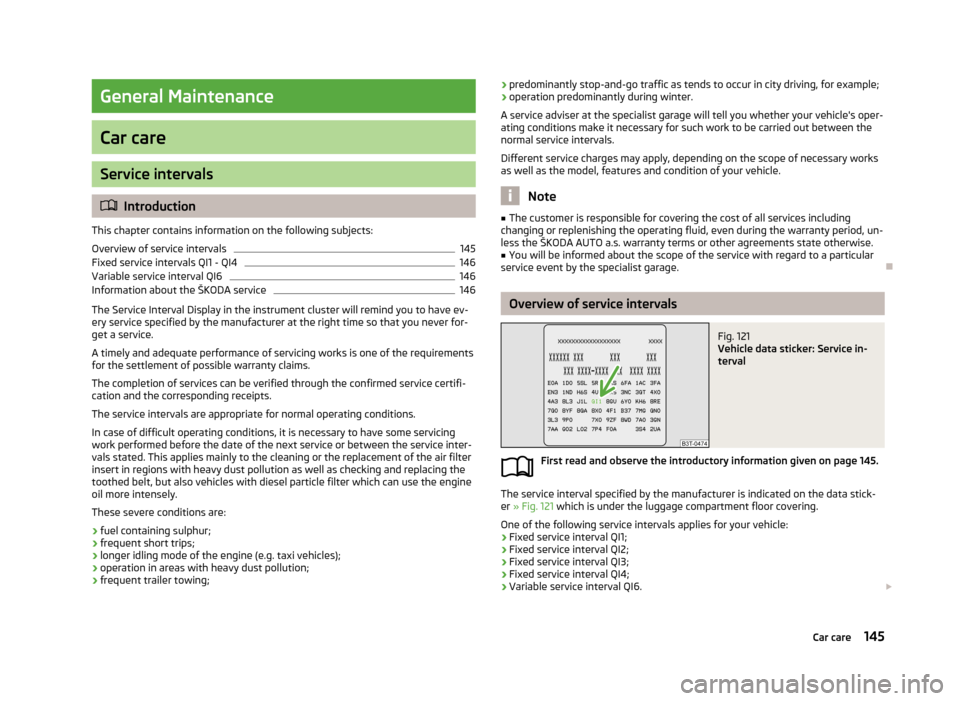
Fig. 121
Vehicle data sticker: Service in-
terval
First read and observe the introductory information given on page 145.
The service interval specified by the manufacturer is indicated on the data stick-
er » Fig. 121 which is under the luggage compartment floor covering.
One of the following service intervals applies for your vehicle: › Fixed service interval QI1;
› Fixed service interval QI2;
› Fixed service interval QI3;
› Fixed service interval QI4;
› Variable service interval QI6.
145Car care
Page 149 of 223
A vehicle must only be filled and topped up with the specified engine oil if it is
to be operated with a variable service interval.
If this engine oil is not available, the oil change is subject to a fixed service inter-
val. In this case, the vehicle must be changed to the fixed service interval.
Note
■
The corresponding motor oil specifications » page 164.■A specialist workshop is able to change the vehicle over from the variable serv-
ice interval to the fixed service interval, or from the fixed service interval to the variable service interval.
Fixed service intervals QI1 - QI4
First read and observe the introductory information given on page 145.
InspectionQI1 - QI4
First after 30,000 km or 2 years a)
, then every
30,000 km or every 1 year a)
.Every 15,000 km or every 1 year a)
(Applies to Rus-
sia).
Oil change service
QI1Every 5000 km or every 1 year a)
.QI2Every 7500 km or every 1 year a)
.QI3Every 10,000 km or every 1 year a)
.QI4After 15,000 km or every 1 year a)
.Brake fluid
change First change after 3 years, then every 2 years.a)
(Whichever comes first).
WARNINGThe brake fluid must always be changed after the first 3 years and then every
2 years. When the brake fluid becomes too old, vapour bubbles may form in
the brake system under heavy braking. The efficiency of the brakes could be
seriously affected – there is a risk of an accident.NoteThe engine oil change interval for operation using diesel fuels with a high sulphur
content will be every 7500 km. Please ask your specialist garage for information
on the countries where diesel fuel has a high sulphur content.
Variable service interval QI6
First read and observe the introductory information given on page 145.
The service intervals depend on how the vehicle is driven and the local conditions
in which the vehicle is used. For example, your vehicle is subjected to different
loads when driven over short distances than long distances. The service intervals
are also variable.
InspectionFirst after 30,000 km or 2 years a)
, then every 30,000 km or
every 1 year a)
.Oil change serviceAccording to the service interval display (at the latest after
30,000 km or every 2 years a)
).Brake fluid
changeFirst change after 3 years, then every 2 years.a)
(Whichever comes first).
WARNINGThe brake fluid must always be changed after the first 3 years and then every
2 years. When the brake fluid becomes too old, vapour bubbles may form in
the brake system under heavy braking. The efficiency of the brakes could be
seriously affected – there is a risk of an accident.
Information about the ŠKODA service
First read and observe the introductory information given on page 145.
There is an extensive servicing network of ŠKODA Service Partners at your dis-
posal to look after your vehicle.
146General Maintenance
Page 150 of 223
ŠKODA Service Partners are equipped with modern, specially developed tools and
equipment. Here, trained specialists have a comprehensive range of ŠKODA Origi-
nal Parts and ŠKODA Original Accessories at their disposal.
All ŠKODA Service Partners operate in accordance with the latest guidelines and instructions from the manufacturer. All service work is therefore carried out ontime and in accordance with quality standards. Adhering to these instructions and
guidelines helps ensure road safety and helps keep your vehicle in a good techni-
cal condition.
In addition, the ŠKODA service partners offer an array of other services. ŠKODA Service Partners are therefore properly prepared to service your vehicleand to provide quality work. We therefore recommend that you have your vehicle
maintained by a ŠKODA Service Partner.
Services, modifications and technical alterations
Introduction
This chapter contains information on the following subjects:
Legally required inspections
148
ŠKODA Service Partners
148
ŠKODA Original Parts
148
ŠKODA Original Accessories
148
Spoiler
149
Airbags
149
The instructions and guidelines issued by ŠKODA AUTO a.s. must be observed
when making any modifications, repairs or technical changes to your vehicle.
Compliance with these guidelines and instructions is in the interest of the road-
worthiness and technical condition of your vehicle. The vehicle will comply with
road traffic regulations following the modifications, repairs and technical
changes.
You should always consult a ŠKODA Partner » page 148 before buying accesso-
ries, parts or before making any modifications, repairs or technical changes to
your vehicle.
WARNING■ Work not properly performed on your vehicle can lead to faults - there is a
risk of an accident resulting in serious injury.■
We recommend only having these modifications and technical changes per-
formed by a specialist garage.
■
Interference on the electronic components and their software can lead to
operational faults. This interference can also impair not directly affected sys-
tems because of the networking of the electronic components. The operation-
al safety of the vehicle may be at significant risk and parts may suffer in-
creased wear.
■
The ŠKODA Partner cannot assume any liability for products which have not
been approved by ŠKODA AUTO a.s. even though these may be products with
a type approval or have been approved by a nationally recognised testing lab-
oratory.
WARNING■ We advise you only to use ŠKODA Original Accessories and ŠKODA Original
Parts which have been expressly approved for use on your vehicle. Reliability,
safety and suitability for your vehicle are guaranteed with these.■
ŠKODA Original Accessories and ŠKODA Original Parts can be purchased
from a ŠKODA Partner who will also fit the purchased parts correctly.
For the sake of the environment
Technical documents regarding changes carried out on the vehicle must be kept
by the vehicle user, in order to be handed over to the recyclers later. This ensures
that vehicle recycling is in accordance with environmental regulations.
Note
Any damage caused by technical modifications made without the approval of the
manufacturer is excluded from the warranty.
147Car care
Page 152 of 223
We recommend that you use ŠKODA Genuine Accessories in your vehicle. ŠKODA
AUTO a.s. offers a warranty on the reliability, safety and suitability for your partic-
ular vehicle of these accessories. Although we constantly monitor the market, we
are not able to assess or offer a warranty on other products even though in some
instances such products may have a type approval or may have been approved by
a nationally recognised approval authority.
All accessory products go through a fastidious process of technical development(technical tests) and quality inspection (customer tests), and only if all tests are positive does the product become a ŠKODA Genuine Accessory.
Our ŠKODA Genuine Accessories service also provides expert advice and profes-
sional fitting if requested by the customer.
ŠKODA Service Partners are liable for any defects in ŠKODA Genuine Parts for a period of 2 years after installation or delivery in accordance with materials defectliability legislation, unless otherwise agreed in the purchase contract or in any
other agreements. You should keep the confirmed warranty certificate and the
receipt for these accessories for this period, so that the commencement of the
warranty term may be verified.
In addition, ŠKODA Service Partners also stock a range of suitable car care prod-
ucts as well as those parts which are subject to natural wear and tear, such as
tyres, batteries, bulbs and wiper blades.
Note
The accessories authorized by ŠKODA AUTO a.s. will be offered by the ŠKODA
Partners in all countries where ŠKODA AUTO a.s. has a sales and service network.
This will usually be in the form of a printed catalogue of Original ŠKODA Accesso-
ries, in the form of separate printed brochures or in the form of offers for ŠKODA
Genuine Accessories on the ŠKODA Partner's website.
Spoiler
First read and observe the introductory information and safety warn-ings
on page 147.
The following instructions shall be observed if your new vehicle is equipped with
a spoiler fitted to the front bumper in combination with the spoiler on the tail-
gate.
› For safety reasons the vehicle must only ever be equipped with a spoiler on the
front bumper in combination with the associated spoiler on the tailgate.
› A spoiler cannot be fitted alone on the front bumper nor in combination without
a spoiler on the tailgate or in combination with an inappropriate spoiler on the
tailgate.
› We recommend that you consult a ŠKODA Service Partner for any repairs, re-
placement, fitting or removal of spoilers.
WARNINGWork not properly performed on the spoilers on your vehicle can result in faults - there is a risk of an accident and serious injury.
Airbags
First read and observe the introductory information and safety warn-
ings
on page 147.
The system components for the airbag system may be found in the front bumper,
doors, front seats, the roof lining or in the bodywork.
WARNINGAny work on the airbag system including the installation and removal of sys-
tem components due to other repair work (e.g. removal of the steering wheel) must only be carried out by a specialist garage.■
Adjustments, repairs and modifications which have been carried out unpro-
fessionally can cause damage, operational faults, and can also seriously impair
the effectiveness of airbag system – there is the risk of an accident and fatal
injury.
■
The airbag system must be replaced if an airbag has been deployed. Airbag
modules cannot be repaired.
149Car care
Page 154 of 223
CAUTION■When washing the car by hand, protect your hands and arms from sharp-edged
metal parts (e.g. when cleaning the undertray, exhaust system, the inside of the
wheel housings or the wheel trims etc.) - there is a risk of cutting yourself.■
Only apply slight pressure when cleaning the vehicle's paintwork.
Automatic car wash systems
First read and observe the introductory information and safety warn-
ings
on page 150.
The usual precautionary measures must be taken before washing the vehicle in
an automatic car wash system (e.g. closing the windows including the sliding/tilt-
ing roof, etc.).
If your vehicle is fitted with any particular mounted parts, such as a spoiler, roof
rack, two-way radio aerial – it is best to consult the operator of the car wash sys-
tem beforehand.
The lips of the windscreen wiper rubbers must be cleaned and degreased with
cleaning agents especially formulated for the task after an automatic wash with
wax.
WARNINGFold in the exterior mirrors to prevent damage before washing the vehicle in
an automatic car wash system.
Washing with a high-pressure cleaner
First read and observe the introductory information and safety warn-
ings
on page 150.
When washing the vehicle with a high-pressure cleaner, the instructions for use
of the equipment must be observed. This applies in particular to the pressure
used and to the spraying distance .
Maintain a sufficiently large distance to the parking aid sensors and soft materials
such as rubber hoses or insulation material.
WARNINGNever use circular spray nozzles or dirt cutters!
CAUTION
■ Do not aim the water jet directly at the lock cylinders or the door or opening
joints when washing the vehicle in the winter using a hose or high-pressure
cleaner – there is a risk of freezing.■
To avoid damaging the parking aid sensors while cleaning with high-pressure
cleaners or steam jets, the sensors must only be directly sprayed for short periods
while a minimum distance of 10 cm must be observed.
■
The temperature of the water used for cleaning must not exceed 60 °C – there
is a risk of damaging the vehicle.
■
See also Washing a vehicle with decorative film trim using a high-pressure
cleaner » page 153 .
Vehicle exterior care
Introduction
This chapter contains information on the following subjects:
Caring for vehicle paintwork
152
Plastic parts
152
Rubber seals
153
Chrome parts
153
Decorative films
153
Windows and exterior mirrors
153
Headlight lenses
154
Door lock cylinders
154
Underbody waxing
154
Wheels
154
Underbody protection
154
Regular and proper care help to retain the efficiency and value of your vehicle. It
may also be one of the requirements for the acceptance of warranty claims relat- ing to corrosion damage and paint defects on the bodywork.
151Car care
Page 159 of 223
We recommend that you remove dust at regular short intervals with a cloth or
vacuum cleaner.
Clean soiled leather surfaces with a cotton or woollen cloth lightly moistened
with water and then dry with a clean dry cloth »
.
Clean more severely soiled areas with a cloth soaked in a mild soap solution (2
tablespoons of natural soap to 1 litre of water).
Use a cleaning agent specially developed for the purpose to remove stains.
Treat the leather with a suitable leather care product at suitable regular intervals.
CAUTION
■ Ensure that the leather is not soaked through at any point during cleaning and
that no water gets into the stitching of the seams. The leather would then be-
come brittle and cracked.■
Avoid leaving the vehicle for lengthy periods in bright sunlight to avoid the
leather from bleaching. If the vehicle is parked in the open for lengthy periods,
protect the leather from direct sunlight by covering it.
■
Sharp-edged objects on items of clothing such as zip fasteners, rivets, sharp-
edged belts, jewellery and pendants may leave permanent scratches or signs of
rubbing on the surface. Damage of this nature cannot later be recognized as a
justified complaint.
■
The use of a mechanical steering wheel lock may damage the leather surface of
the steering wheel.
■
Use a care cream with light blocker and impregnation effect on a regular basis
and each time after cleaning. The cream nourishes the leather, allows it to
breathe and keeps it supple and also provides moisture. It also creates surface
protection.
■
Some clothing materials, such as dark denim, do not have sufficient colour fast-
ness. This can cause damage or clearly visible discolouration to seat covers even
when treated correctly. This is particularly true for light-coloured upholstery. This
is not a defect in the seat cover, but poor colour fastness of the clothing textiles.
Note
During the life of the vehicle, minor visible changes can occur on the leather parts
of the covers (e. g wrinkles or creases as a result of the stress of the covers).
Synthetic leather, fabrics and Alcantara ®
First read and observe the introductory information and safety warn- ings
on page 155.
Synthetic leather
Clean the synthetic leather with a damp cloth.
If the synthetic leather does not come completely clean with this method, a mild soap solution or specific cleaning agent must be used.
Fabrics
Clean upholstery cover materials and cloth trims on doors, boot cover, etc. using
specific cleaning agents, e.g., dry foam.
Use a soft sponge, brush, or commercially available microfibre cloth. Use a cloth and special detergent to clean the headlining.
Remove pilling and residues on upholstery with a brush.Remove stubborn hair with a “cleaning glove”.
Alcantara ®
Dust and fine dirt particles in pores, creases and seams may chafe and damage
the surface.
If you leave your vehicle parked in the open for lengthy periods, protect the Al-
cantara ®
seat upholstery from direct sunlight to prevent fading.
Minor changes in colour caused by use are normal.
CAUTION
■ Do not use leather cleaners on Alcantara ®
seat upholstery.■Do not use solvents, floor wax, shoe cream, stain remover or similar agents on
Alcantara ®
seat upholstery.■
Avoid leaving the vehicle for lengthy periods in bright sunlight to prevent the
fabrics from bleaching. If the vehicle is parked in the open for lengthy periods,
protect the fabrics against direct sunlight by covering them.
■
Some clothing materials, such as dark denim, do not have sufficient colour fast-
ness. This can cause damage or clearly visible discolouration to seat covers even when treated correctly. This is particularly true for light-coloured upholstery. This
is not a defect in the seat cover, but poor colour fastness of the clothing textiles.
156General Maintenance
Page 160 of 223
Seat coversFirst read and observe the introductory information and safety warn-
ings
on page 155.
Electrically heated seats
Do not wet clean the seat covers as this can damage the seat heating system.
Use a specific cleaning agent such as dry foam or similar to clean the covers.
Seats without seat heating
Thoroughly vacuum the seat covers with a vacuum cleaner before cleaning.
Clean the seat covers with a damp cloth or cleaning agents particularly formula-
ted for them.
Compressed areas created on the fabrics by everyday use can be removed by brushing against the nap with a lightly moistened brush.
Always treat all parts of the upholstery so that no visible boundaries are created.
Then leave the seat to dry completely.
CAUTION
■ Regularly vacuum dust from the seat covers using a vacuum cleaner.■Electrically heated seats must not be dried after cleaning by switching on the
heater.■
Do not sit on wet seats - there is a risk of stretching the upholstery.
■
Always clean the seats “from seam to seam”.
Seat belts
First read and observe the introductory information and safety warn-
ings
on page 155.
The belt must always be kept clean.
Wash dirty seat belts with a mild, soapy solution.
Remove dirt with a soft brush.
Soiled belts may impair proper operation of the inertia reels.
WARNING■ The seat belts must not be removed for cleaning.■Never clean the seat belts chemically as chemical cleaning products could
destroy the fabric.■
The seat belts must not be allowed to come into contact with corrosive liq-
uids (such as acids etc.).
■
Check the condition of all the seat belts on a regular basis. If any damage is
found in the belt fabric, seat belt connections, inertia reel or the buckle, the relevant seat belt must be replaced by a specialist garage.
■
Inertia reel belts must be completely dried before being rolled up.
157Car care
Page 166 of 223
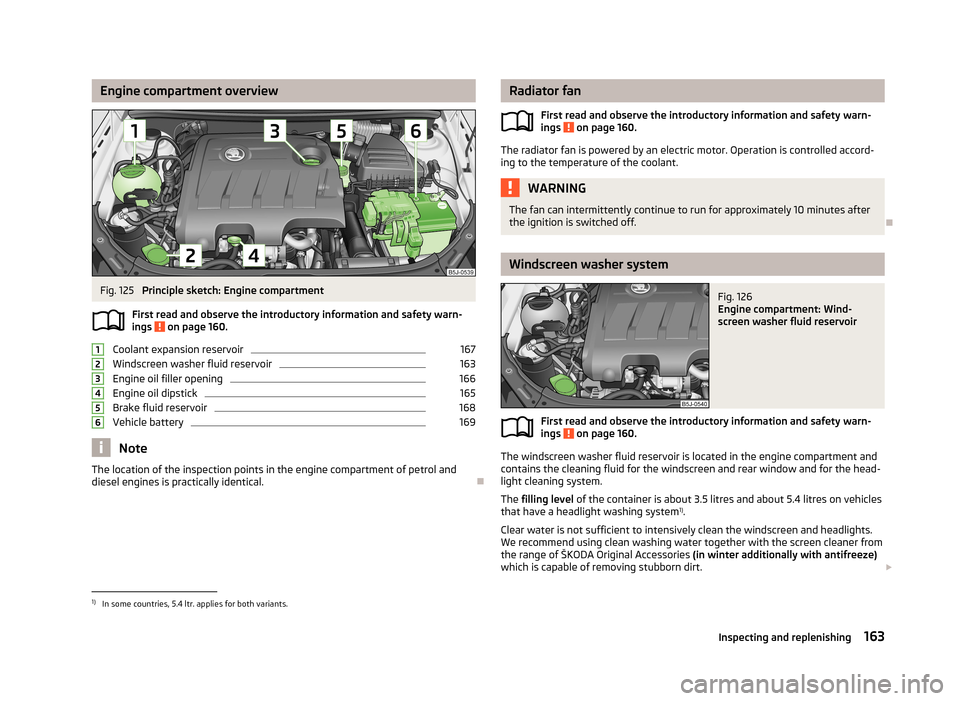
Engine compartment overviewFig. 125
Principle sketch: Engine compartment
First read and observe the introductory information and safety warn- ings
on page 160.
Coolant expansion reservoir
167
Windscreen washer fluid reservoir
163
Engine oil filler opening
166
Engine oil dipstick
165
Brake fluid reservoir
168
Vehicle battery
169
Note
The location of the inspection points in the engine compartment of petrol and
diesel engines is practically identical.
123456Radiator fan
First read and observe the introductory information and safety warn-
ings
on page 160.
The radiator fan is powered by an electric motor. Operation is controlled accord-
ing to the temperature of the coolant.
WARNINGThe fan can intermittently continue to run for approximately 10 minutes after
the ignition is switched off.
Windscreen washer system
Fig. 126
Engine compartment: Wind-
screen washer fluid reservoir
First read and observe the introductory information and safety warn- ings on page 160.
The windscreen washer fluid reservoir is located in the engine compartment and
contains the cleaning fluid for the windscreen and rear window and for the head- light cleaning system.
The filling level of the container is about 3.5 litres and about 5.4 litres on vehicles
that have a headlight washing system 1)
.
Clear water is not sufficient to intensively clean the windscreen and headlights. We recommend using clean washing water together with the screen cleaner from
the range of ŠKODA Original Accessories (in winter additionally with antifreeze)
which is capable of removing stubborn dirt.
1)
In some countries, 5.4 ltr. applies for both variants.
163Inspecting and replenishing