roof SKODA FABIA 2013 2.G / 5J User Guide
[x] Cancel search | Manufacturer: SKODA, Model Year: 2013, Model line: FABIA, Model: SKODA FABIA 2013 2.G / 5JPages: 223, PDF Size: 12.77 MB
Page 110 of 223
Always ensure the tyre inflation pressure is correct. If the pressure is too low, the
tyres will have to overcome a higher rolling resistance. This will not only increase fuel consumption but also tyre wear and the driving behaviour will worsen.
Always check the tyre inflation pressure when the tyres are cold.
Avoiding unnecessary ballast
First read and observe the introductory information and safety warn-
ings
on page 104.
Transporting ballast costs fuel.
Each kilogramme of weight increases the fuel consumption. Therefore, we rec-
ommend that you carry no unnecessary weight.
It is particularly in town traffic, when one is accelerating quite often, that the ve-
hicle weight will have a significant effect upon the fuel consumption. A rule of
thumb here is that an increase in weight of 100 kilograms will cause an increase in fuel consumption of about 1 litre/100 kilometres.
At a speed of 100 - 120 km/h, a vehicle fitted with a roof rack cross member with-
out a load will use about 10 % more fuel than normal due to the increased aero- dynamic drag.
Regular maintenance
First read and observe the introductory information and safety warn-
ings
on page 104.
A poorly tuned engine uses an unnecessarily high amount of fuel.
By having your vehicle regularly maintained by a specialist garage, you create theconditions needed for driving economically. The maintenance state of your vehi-
cle has a positive effect on traffic safety and value retention
A poorly tuned engine can result in a fuel consumption which is 10 % higher than normal.
Check the oil level at regular intervals, e.g. when refuelling. Oil consumption is
dependent to a considerable extent on the load and speed of the engine. Oil con-
sumption could be as high as 0.5 litres/1 000 km depending on your style of driv-
ing.
It is quite normal that a new engine has a higher oil consumption at first, and rea-
ches its lowest level only after a certain running in time. The oil consumption of a
new vehicle can therefore only be correctly assessed after driving about 5 000 km.
For the sake of the environment
■ Additional improvements to the fuel economy can be made by using synthetic
high-lubricity oils.■
Regularly check the ground under the vehicle. Have your vehicle inspected by a
specialist garage if you find any stains caused by oil or other fluids on the ground.
Note
We recommend that your vehicle is serviced on a regular basis by a ŠKODA Serv-
ice Partner.
Saving electrical energy
First read and observe the introductory information and safety warn-ings
on page 104.
When the engine is running, the alternator generates and supplies electrical pow-
er. If more electrical components of the electrical system are switched on, more
fuel is needed to operate the alternator. We therefore recommend switching off
electrical components if these are no longer required.
Environmental compatibility
First read and observe the introductory information and safety warn-ings
on page 104.
Environmental protection has played a major role in the design, selection of mate- rials, and manufacture of your new ŠKODA. Particular emphasis has been placed
on the following points.
Design measures › Joints designed to be easily detached.
› Simplified disassembly due to the modular structure system.
› Improved purity of different classes of materials.
› Identification of all plastic parts in accordance with VDA Recommendation 260.
› Reduced fuel consumption and exhaust emission CO
2.
107Starting-off and Driving
Page 152 of 223
We recommend that you use ŠKODA Genuine Accessories in your vehicle. ŠKODA
AUTO a.s. offers a warranty on the reliability, safety and suitability for your partic-
ular vehicle of these accessories. Although we constantly monitor the market, we
are not able to assess or offer a warranty on other products even though in some
instances such products may have a type approval or may have been approved by
a nationally recognised approval authority.
All accessory products go through a fastidious process of technical development(technical tests) and quality inspection (customer tests), and only if all tests are positive does the product become a ŠKODA Genuine Accessory.
Our ŠKODA Genuine Accessories service also provides expert advice and profes-
sional fitting if requested by the customer.
ŠKODA Service Partners are liable for any defects in ŠKODA Genuine Parts for a period of 2 years after installation or delivery in accordance with materials defectliability legislation, unless otherwise agreed in the purchase contract or in any
other agreements. You should keep the confirmed warranty certificate and the
receipt for these accessories for this period, so that the commencement of the
warranty term may be verified.
In addition, ŠKODA Service Partners also stock a range of suitable car care prod-
ucts as well as those parts which are subject to natural wear and tear, such as
tyres, batteries, bulbs and wiper blades.
Note
The accessories authorized by ŠKODA AUTO a.s. will be offered by the ŠKODA
Partners in all countries where ŠKODA AUTO a.s. has a sales and service network.
This will usually be in the form of a printed catalogue of Original ŠKODA Accesso-
ries, in the form of separate printed brochures or in the form of offers for ŠKODA
Genuine Accessories on the ŠKODA Partner's website.
Spoiler
First read and observe the introductory information and safety warn-ings
on page 147.
The following instructions shall be observed if your new vehicle is equipped with
a spoiler fitted to the front bumper in combination with the spoiler on the tail-
gate.
› For safety reasons the vehicle must only ever be equipped with a spoiler on the
front bumper in combination with the associated spoiler on the tailgate.
› A spoiler cannot be fitted alone on the front bumper nor in combination without
a spoiler on the tailgate or in combination with an inappropriate spoiler on the
tailgate.
› We recommend that you consult a ŠKODA Service Partner for any repairs, re-
placement, fitting or removal of spoilers.
WARNINGWork not properly performed on the spoilers on your vehicle can result in faults - there is a risk of an accident and serious injury.
Airbags
First read and observe the introductory information and safety warn-
ings
on page 147.
The system components for the airbag system may be found in the front bumper,
doors, front seats, the roof lining or in the bodywork.
WARNINGAny work on the airbag system including the installation and removal of sys-
tem components due to other repair work (e.g. removal of the steering wheel) must only be carried out by a specialist garage.■
Adjustments, repairs and modifications which have been carried out unpro-
fessionally can cause damage, operational faults, and can also seriously impair
the effectiveness of airbag system – there is the risk of an accident and fatal
injury.
■
The airbag system must be replaced if an airbag has been deployed. Airbag
modules cannot be repaired.
149Car care
Page 153 of 223
WARNINGObserve the following instructions for the airbag system.■It is prohibited to tamper with individual parts of the airbag system as this
might result in the airbag being deployed.■
Never install any airbag parts into the vehicle that have been removed from
old cars or have been recycled.
■
Never fit damaged airbag parts to a vehicle. The airbags may then not be
triggered properly or not at all in the event of an accident.
■
No modifications of any kind must be made to parts of the airbag system.
WARNING■ A change in the suspension of the vehicle including the use of non-approved
wheels and tyre combinations can alter the functioning of the airbag system -
there is a risk of accident and fatal injury.■
Never make any changes to the front bumper or bodywork.
Washing the car
Introduction
This chapter contains information on the following subjects:
Washing by hand
150
Automatic car wash systems
151
Washing with a high-pressure cleaner
151
The best protection for your vehicle against harmful environmental influences is
frequent washing.
How often the vehicle should be washed depends, for example, on the following
factors.
› Frequency of use.
› Parking situation (garage, under trees, etc.).
› Season of the year.
› Weather conditions.
› Environmental influences.
The longer insect residues, bird droppings, tree sap, road and industrial dust, tar,
soot particles, road salt and other aggressive deposits remain adhering to the
paintwork of your vehicle, the more detrimental their destructive effect can be.
High temperatures, such as those caused by intensive sun's rays, accentuate this
caustic effect.
It is essential to also thoroughly clean the underside of the vehicle at the end of
the winter.WARNING■ Washing your vehicle in the winter: water and ice in the brake system can
affect the braking efficiency – there is the risk of an accident.■
Only wash the vehicle when the ignition is switched off – there is the risk of
an accident.
CAUTION
Do not wash your vehicle in bright sunlight – there is a risk of paint damage.
For the sake of the environment
Only wash the vehicle at washing bays intended for this purpose.
Washing by hand
First read and observe the introductory information and safety warn-
ings
on page 150.
Soften the dirt with plenty of water and rinse as much as you can of this off.
Clean the vehicle with a soft sponge, a washing glove or a washing brush . Work
from the top to the bottom - starting with the roof.
Only use a car shampoo for stubborn dirt.
Wash out the sponge or washing glove thoroughly at short intervals.
Clean wheels, door sills and similar parts last. Use a second sponge for such
areas.
Give the vehicle a good rinse after washing it and dry it off using a chamois leath- er.
150General Maintenance
Page 154 of 223
CAUTION■When washing the car by hand, protect your hands and arms from sharp-edged
metal parts (e.g. when cleaning the undertray, exhaust system, the inside of the
wheel housings or the wheel trims etc.) - there is a risk of cutting yourself.■
Only apply slight pressure when cleaning the vehicle's paintwork.
Automatic car wash systems
First read and observe the introductory information and safety warn-
ings
on page 150.
The usual precautionary measures must be taken before washing the vehicle in
an automatic car wash system (e.g. closing the windows including the sliding/tilt-
ing roof, etc.).
If your vehicle is fitted with any particular mounted parts, such as a spoiler, roof
rack, two-way radio aerial – it is best to consult the operator of the car wash sys-
tem beforehand.
The lips of the windscreen wiper rubbers must be cleaned and degreased with
cleaning agents especially formulated for the task after an automatic wash with
wax.
WARNINGFold in the exterior mirrors to prevent damage before washing the vehicle in
an automatic car wash system.
Washing with a high-pressure cleaner
First read and observe the introductory information and safety warn-
ings
on page 150.
When washing the vehicle with a high-pressure cleaner, the instructions for use
of the equipment must be observed. This applies in particular to the pressure
used and to the spraying distance .
Maintain a sufficiently large distance to the parking aid sensors and soft materials
such as rubber hoses or insulation material.
WARNINGNever use circular spray nozzles or dirt cutters!
CAUTION
■ Do not aim the water jet directly at the lock cylinders or the door or opening
joints when washing the vehicle in the winter using a hose or high-pressure
cleaner – there is a risk of freezing.■
To avoid damaging the parking aid sensors while cleaning with high-pressure
cleaners or steam jets, the sensors must only be directly sprayed for short periods
while a minimum distance of 10 cm must be observed.
■
The temperature of the water used for cleaning must not exceed 60 °C – there
is a risk of damaging the vehicle.
■
See also Washing a vehicle with decorative film trim using a high-pressure
cleaner » page 153 .
Vehicle exterior care
Introduction
This chapter contains information on the following subjects:
Caring for vehicle paintwork
152
Plastic parts
152
Rubber seals
153
Chrome parts
153
Decorative films
153
Windows and exterior mirrors
153
Headlight lenses
154
Door lock cylinders
154
Underbody waxing
154
Wheels
154
Underbody protection
154
Regular and proper care help to retain the efficiency and value of your vehicle. It
may also be one of the requirements for the acceptance of warranty claims relat- ing to corrosion damage and paint defects on the bodywork.
151Car care
Page 197 of 223
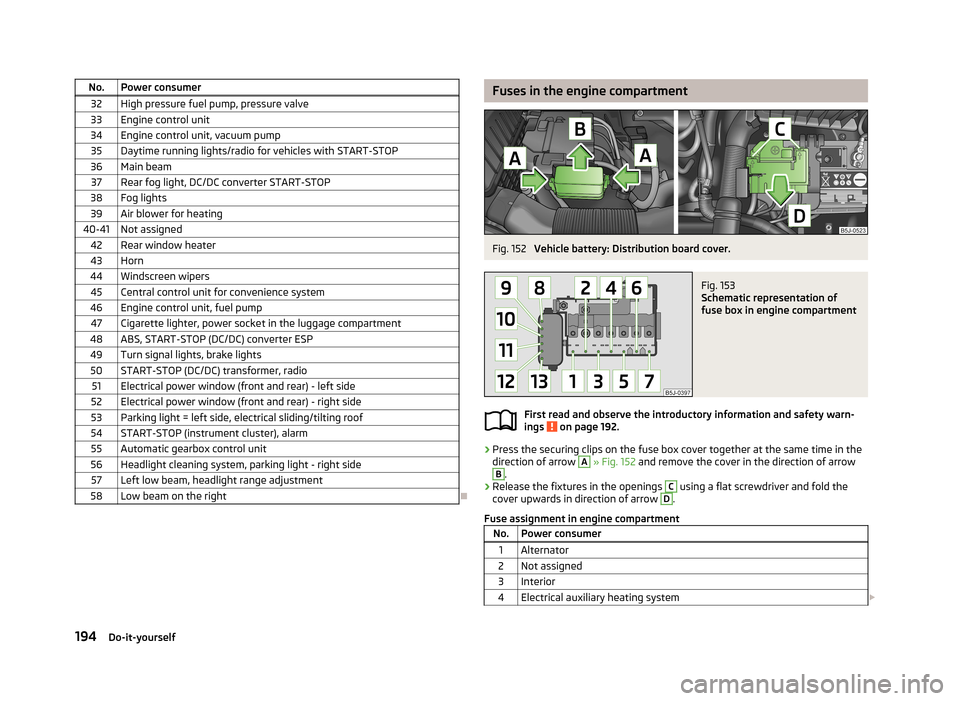
No.Power consumer32High pressure fuel pump, pressure valve33Engine control unit34Engine control unit, vacuum pump35Daytime running lights/radio for vehicles with START-STOP36Main beam37Rear fog light, DC/DC converter START-STOP38Fog lights39Air blower for heating40-41Not assigned42Rear window heater43Horn44Windscreen wipers45Central control unit for convenience system46Engine control unit, fuel pump47Cigarette lighter, power socket in the luggage compartment48ABS, START-STOP (DC/DC) converter ESP49Turn signal lights, brake lights50START-STOP (DC/DC) transformer, radio51Electrical power window (front and rear) - left side52Electrical power window (front and rear) - right side53Parking light = left side, electrical sliding/tilting roof54START-STOP (instrument cluster), alarm55Automatic gearbox control unit56Headlight cleaning system, parking light - right side57Left low beam, headlight range adjustment58Low beam on the right
Fuses in the engine compartmentFig. 152
Vehicle battery: Distribution board cover.
Fig. 153
Schematic representation of
fuse box in engine compartment
First read and observe the introductory information and safety warn-
ings on page 192.
› Press the securing clips on the fuse box cover together at the same time in the
direction of arrow
A
» Fig. 152 and remove the cover in the direction of arrow
B
.
› Release the fixtures in the openings
C
using a flat screwdriver and fold the
cover upwards in direction of arrow
D
.
Fuse assignment in engine compartment
No.Power consumer1Alternator2Not assigned3Interior4Electrical auxiliary heating system 194Do-it-yourself
Page 205 of 223
The operating weight also contains the weight of the driver (75 kg), the weight of
the operating fluids, the tool kit, and a fuel tank filled to 90 % capacity.
It is possible to calculate the approximate loading capacity from the difference
between the permissible total weight and the operating weight »
.
The payload consists of the following components: › Passengers
› All items of luggage and other loads
› Roof load including roof rack system
› Equipment not included in the operating weight
› Trailer drawbar load when towing a trailer (max. 50 kg).
Measuring the fuel consumption and CO 2 emissions according to the ECE
regulations and EU directives
The measurement of the intra-urban cycle begins with a cold start of the engine.
Afterwards urban driving is simulated.
In the extra-urban driving cycle, the vehicle is accelerated and decelerated in all gears, corresponding to daily routine driving conditions. The driving speed varies
between 0 and 120 km/h.
The calculation of the combined fuel consumption considers a weighting of about 37 % for the intra-urban cycle and 63 % for the extra-urban cycle.WARNINGDo not exceed the specified maximum permissible weights – there is the riskof an accident and damage.
Note
■ If required, you can find out the precise weight of your vehicle by contacting a
specialist garage.■
The fuel consumption and emission values have been determined in accordance
with rules and under conditions set out by legal or technical requirements for de-
termining operational and technical data for motor vehicles.
■
Depending on the range of equipment, style of driving, traffic situation, weather
influences and vehicle condition, consumption values may deviate from the indi-
cated values.
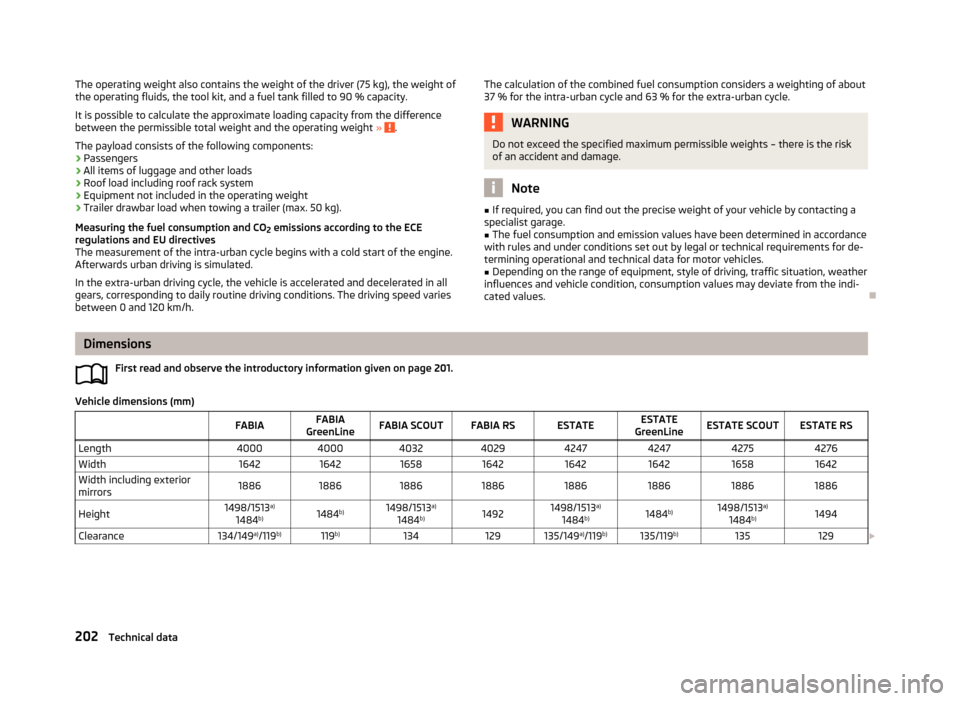
Dimensions
First read and observe the introductory information given on page 201.
Vehicle dimensions (mm)
FABIAFABIA
GreenLineFABIA SCOUTFABIA RSESTATEESTATE
GreenLineESTATE SCOUTESTATE RSLength40004000403240294247424742754276Width16421642165816421642164216581642Width including exterior
mirrors18861886188618861886188618861886Height1498/1513 a)
1484 b)1484 b)1498/1513 a)
1484 b)14921498/1513 a)
1484 b)1484b)1498/1513 a)
1484 b)1494Clearance134/149 a)
/119 b)119b)134129135/149 a)
/119 b)135/119 b)135129
202Technical data
Page 215 of 223
DisplayService interval16
Distance driven12
Door Child safety lock
29
Closing30
Door open warning light21
Opening30
Doors Emergency locking
31
Driving Abroad
109
Driving through water on streets109
Emissions201
Fuel consumption201
Maximum speed204
Driving economically Economical gear changing
105
Driving through water109
E
Economical and environmentally friendly driving 104
Economical driving Anticipation in driving
105
Ballast107
Driving at full throttle106
Idling106
Regular maintenance107
Saving energy107
Short distances106
Tyre pressure106
EDS112
Electrical power windows Button in the driver's door
38, 39
Button in the rear door39
Central locking system40
Electric power windows Operational faults
40
Electric sliding/tilting roof40
Electronic Differential Lock112
Electronic immobilizer97
Emergency Changing a wheel
181
Hazard warning light system47
Jump-starting187, 188
locking of the doors31
Selector lever-unlocking103
Sliding/tilting roof42
Towing the vehicle189
Towing the vehicle using the tow hitch190
Tyre repair185
Unlocking the boot lid38
Emergency equipment Fire extinguisher
180
First aid kit180
Jack181
Vehicle tool kit181
Warning triangle180
Emissions201
Engine Running in
104
Starting and stopping the engine96
Starting the engine97
Switching off the engine98
Engine compartment160
Brake fluid168
Coolant167
Overview163
Vehicle battery169
Engine oil164
Capacity164
Changing166
Checking165
Replenishing166
Specifications164
Warning light21
Engine revolutions counter11
Environment104
Environmental compatibility107
Environmentally friendly driving104
ESC Function111
warning light23
F
Films
153
Fire extinguisher180
First aid kit180
Flashers45
Fog lights46
Footmats100
see Footmats100
Front airbag135
Front seats54
Fuel158
Diesel160
Fuel gauge11
gauge11
refer to Fuel158
Refuelling158
Unleaded petrol159
Fuel consumption104
Fuses Assignment
192
Changing192
Colour coding192
G
Gear Recommended gear
13
Gearbox Display messages
19
Gear changing Gear stick
100
General view Cockpit
9
Glow plug system Warning light
24
GSM86
212Index
Page 217 of 223
N
N1
59
Net partition64
Behind the front seats65
Behind the rear seats64
Removing and refitting the housing65
O
Oil see Engine oil
165
Oil pressure Display messages
21
Onboard computer see Multifunction display
13
Operation in winter Diesel fuel
160
Vehicle battery171
Outside temperature15
Overview Engine compartment
163
warning lights20
P
Paintwork See Caring for paintwork
152
Parking Parking aid
113
Parking lights43
Part replacement147
Passive safety Before every journey
124
Driving safety125
Safety equipment124
Passive Safety124
Pedals100
Footmats100
Petrol refer to Fuel159
Polishing the paintwork See Vehicle care
152
Power steering95
Power window force limiter39
R
Radiator fan
163
Radio reception See windows
153
Raise vehicle184
Rear-view mirror Exterior mirrors
53
Manually dimmed rear-view mirror53
Rear fog light46
Rear window - Heating50
Recirculated air mode Manual air conditioning
82
Recommended gear13
Refuelling158
Fuel158
Remote control34
Synchronisation process35
Remote control key Replacing the battery
29
Repairs and technical alterations147
Replacing Vehicle battery
172
Windscreen wiper blades52
Replenishing Coolant
168
Engine oil166
Windscreen washer fluid163
Rims173
Roof luggage rack Attachment points
68
Roof rack system67
Roof load68
Running-in the first 1500 km103
Running in Brake pads
104
Engine104
Tyres104
S
SAFE see Safe securing
32
SAFELOCK see Safe securing
32
Safe securing32
Safety124
Child safety140
Child safety seats140
Correct seated position125
Head restraints57
ISOFIX143
TOP TETHER144
Save electricity104
Seals Vehicle care
153
Seat Adjusting
55
Seat belt warning light
21
Seat belt height adjuster131
Seat belts128
Belt tensioners131
Cleaning157
fastening and unfastening130
Height adjustment131
Seatbelts Inertia reels
131
Seat belts The physical principle of a frontal collision
129
Seats folding forward
56
Head restraints57
214Index
Page 218 of 223
Heating55
Removing the seats57
Seats and storage54
see Automatic gearbox Manual gear shifting on the multifunction steer- ing wheel
102
Selector lever see Using the selector lever
101
Service148
Service display16
Service intervals145
Setting Heating
79
Manual air conditioning system82
Manually dimmed rear-view mirror53
Setting the clock Clock
12
Shifting gears Driving and saving energy
105
Side airbag136
Sliding/tilting roof40
Comfort operation41
Emergency operation42
Opening and raising41
Operation41
Sliding/tilting sunroof Closing
41
Snow chains179
Spare wheel177
Speedometer11
Speed symbol see Wheels
176
Spoiler149
Stalk Main beam
45
Turn signals45
START-STOP116
Manually activating/deactivating the system117
Operating conditions for the system116
Starting/shutting down the engine116
Starting and stopping the engine96
Starting engine Jump-starting
187
Starting the engine97
Jump-starting188
START STOP Information messages
117
Jump-starting189
Steering force assistance95
Steering wheel95
Storage72
Storage Compartment Lighting
49
Storage compartments72
Sun visors50
Switching lights on and off43
Switching off the engine98
Synthetic leather156
T
Tailgate
37
Taking care of the vehicle Natural leather
155
Seat belts157
Taking care of your vehicle Automatic car wash system
151
Chrome parts153
Cleaning the wheels154
Door lock cylinders154
Headlight lenses154
High-pressure cleaner151
Plastic parts152
Washing by hand150
Wash system151
Technical data201
Telephone86
Temporary spare wheel177
Tiptronic102
Tools181
TOP TETHER144
Tourist lights46
Towing189
Towing a trailer118
Towing device Description
118
Drawbar load118
Use and care121
Towing eye Front
190
Rear190
Towing protection36
Traction Control System (ASR)112
Trailer118, 121
Loading121
Towing a trailer122
Transport Boot
58
Roof rack system67
Transporting children safely140
Turn signals45
Two-way radio systems86
Type plate201
Tyre load-bearing capacity see Wheels
175
Tyre pressure monitor Setting
176
Tyre repair Check pressure
187
Preparations186
Sealing and inflating the tyre186
Tyres173
New175
Pressure174
See Wheels175
Sizes174
Wear indicator174
215Index