winter tyres SKODA FABIA 2013 2.G / 5J Owner's Manual
[x] Cancel search | Manufacturer: SKODA, Model Year: 2013, Model line: FABIA, Model: SKODA FABIA 2013 2.G / 5JPages: 223, PDF Size: 12.77 MB
Page 7 of 223
Inspecting and replenishing158Fuel158
Engine compartment
160
Engine oil
164
Coolant
166
Brake fluid
168
Vehicle battery
169
Wheels
173
Tyres and rims
173
Winter use
179
Do-it-yourself
Emergency equipment, and self-help
180
Emergency equipment
180
Changing a wheel
181
Tyre repair
185
Jump-starting
187
Towing the vehicle
189
Fuses and light bulbs
192
Fuses
192
Bulbs
195
Technical data
Technical data
201
Vehicle data
201
Index
4Table of Contents
Page 22 of 223
Winter tyres
Here, you can set the speed at which an audible signal should sound. This func-
tion is, for example, used for winter tyres where the maximum permissible speed
is lower than the maximum speed of the vehicle.
The following is shown on the information display if this speed is exceeded: Winter tyres: maximum ... km/h.
Units of measurement
The units for the temperature, consumption and distance driven can be set here.
Alt. speed dis.
Display of the second speed in mph 1)
can be activated here.
Service
The days and kilometres remaining until the next service can be displayed here.
Factory setting
The display can be restored to its factory settings here.
Door, boot lid and bonnet warning
First read and observe the introductory information and safety warn-ings
on page 18.
If at least one door is open, or the boot or bonnet is open, the MAXI DOT display
shows the vehicle with the corresponding door or boot/bonnet open.
An audible signal also sounds if the vehicle is travelling at more than 6 km/h.
Auto Check Control
First read and observe the introductory information and safety warn-
ings
on page 18.
Vehicle condition
Certain functions and conditions of individual vehicle systems are checked contin-
uously when the ignition is switched on and also while driving.
Some error messages and other information are displayed in the MAXI DOT dis-
play. The messages are displayed simultaneously with the icons in the MAXI DOT
display or with the warning lights in the instrument cluster » page 20.
The Vehicle status menu item is shown in the main menu of the MAXI DOT dis-
play whenever at least one fault message is present. The first of the fault mes-
sages is displayed after this menu item is selected. Several error messages are
shown on the display under the message e.g. 1/3. This indicates that the first of a
total of three error messages is being displayed.
As long as the operational faults are not rectified, the symbols are always indica- ted again. After they are displayed for the first time, the symbols continue to be
indicated without any extra messages for the driver.
Warning symbolsEngine oil pressure too low» page 21Clutches in the automatic gearbox are too
hot» page 19Check engine oil level,
engine oil sensor defective» page 21
Clutches in the automatic gearbox are too hot
The
symbol in the MAXI DOT display indicates that the temperature of the au-
tomatic gearbox clutches is too high.
The following message is shown in the MAXI DOT display.
Gearbox overheating. Stop. Read manual.
Stop the vehicle, switch off the engine, and wait until the
icon goes out – there
is a risk of gearbox damage. You can continue your journey as soon as the icon
disappears.
WARNINGIf you have to stop for technical reasons, park the vehicle at a safe distance
from the traffic, switch off the engine and activate the hazard warning light
system » page 47 . 1)
On models on which the speedometer indicates mph, the second speed is displayed in km/h.
19Instruments and Indicator Lights
Page 108 of 223
The technical requirements for low fuel usage and economic efficiency of the ve-
hicle have already been built into the vehicle at the works. ŠKODA places a partic-
ular emphasis on minimising negative effects on the environment.
It is necessary to take note of the guidelines given in this chapter in order tomake best use of these characteristics and to maintain their effectiveness.
Fuel consumption, environmental pollution and the wear to the engine, brakes
and tyres depend essentially on the following three factors.
› Your personal driving style
› Operating conditions
› Technical requirements
The fuel economy by can be improved by 10 -15 % by always looking ahead and
driving in an economical way.
Fuel consumption is also be influenced by external factors which are beyond the
driver's control. Consumption increases during the winter or under difficult condi-
tions, on poor roads, etc.
Fuel consumption can vary considerably from the manufacturer's data, as a result
of outside temperatures, the weather and driving style.
The optimal engine speed should be maintained when accelerating, to avoid a
high fuel consumption and resonance of the vehicle.
CAUTION
All the speed and engine revolution figures apply only when the engine is at its
normal operating temperature.
Driving with anticipation
First read and observe the introductory information and safety warn-
ings
on page 104.
A vehicle's highest fuel consumption occurs when accelerating, therefore unnec-
essary accelerating and braking should be avoided. If looking ahead when driving,
less braking and consequently less accelerating are required.
If possible, let your vehicle coast to a stop, or use the engine brake, if you can see that the next set of traffic lights is on red, for example.
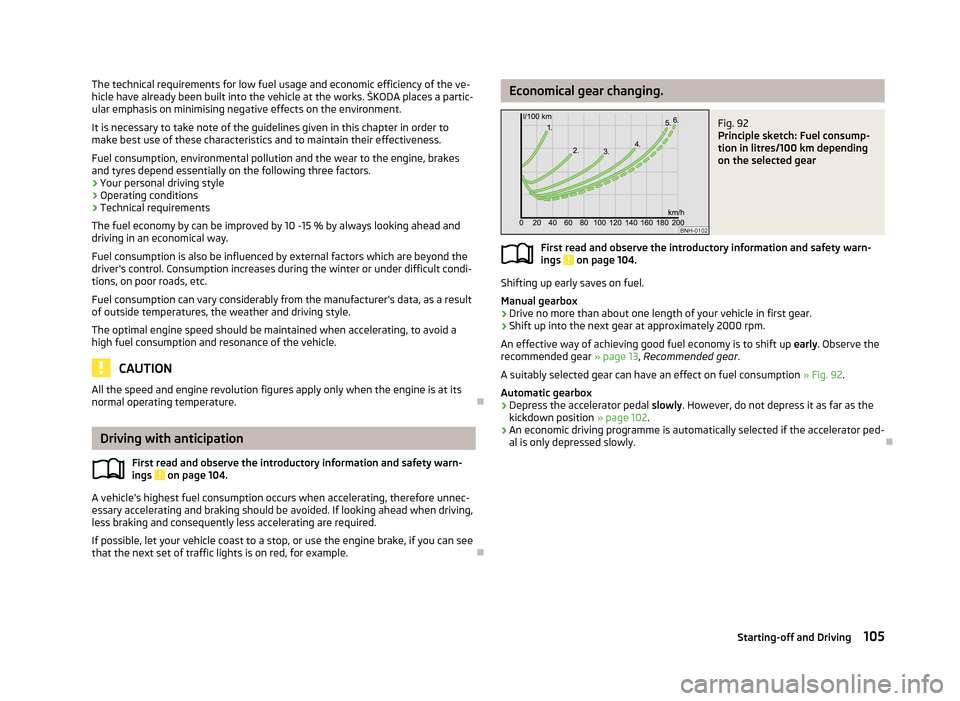
Economical gear changing.Fig. 92
Principle sketch: Fuel consump-
tion in litres/100 km depending
on the selected gear
First read and observe the introductory information and safety warn- ings on page 104.
Shifting up early saves on fuel.
Manual gearbox › Drive no more than about one length of your vehicle in first gear.
› Shift up into the next gear at approximately 2000 rpm.
An effective way of achieving good fuel economy is to shift up early. Observe the
recommended gear » page 13, Recommended gear .
A suitably selected gear can have an effect on fuel consumption » Fig. 92.
Automatic gearbox › Depress the accelerator pedal
slowly. However, do not depress it as far as the
kickdown position » page 102.
› An economic driving programme is automatically selected if the accelerator ped-
al is only depressed slowly.
105Starting-off and Driving
Page 109 of 223
Avoiding full throttleFig. 93
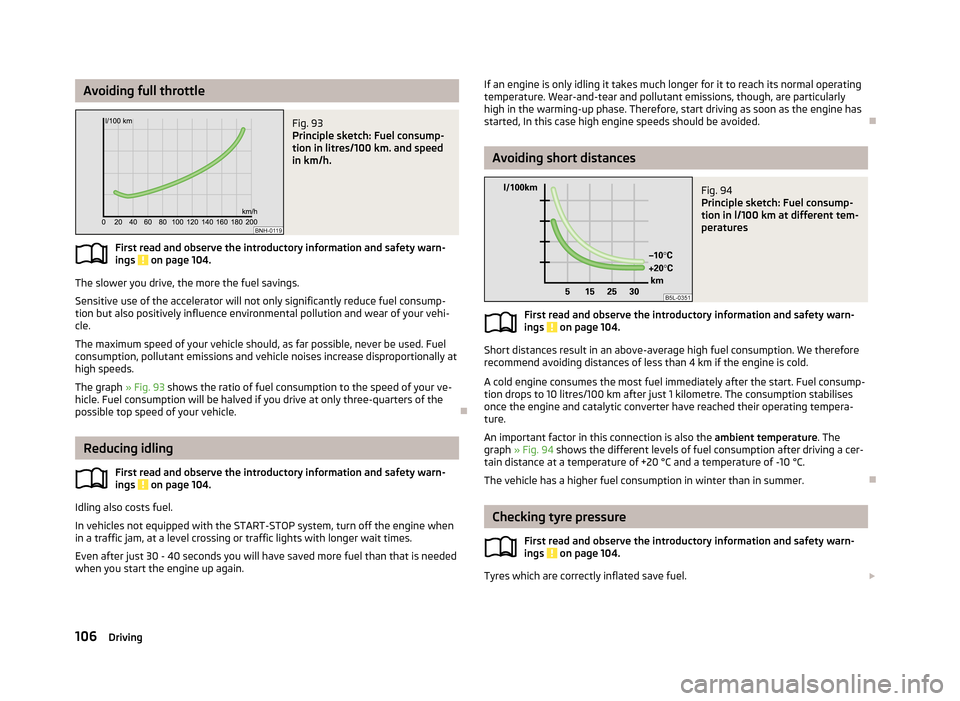
Principle sketch: Fuel consump-
tion in litres/100 km. and speed
in km/h.
First read and observe the introductory information and safety warn-
ings on page 104.
The slower you drive, the more the fuel savings.
Sensitive use of the accelerator will not only significantly reduce fuel consump-tion but also positively influence environmental pollution and wear of your vehi-
cle.
The maximum speed of your vehicle should, as far possible, never be used. Fuel
consumption, pollutant emissions and vehicle noises increase disproportionally at
high speeds.
The graph » Fig. 93 shows the ratio of fuel consumption to the speed of your ve-
hicle. Fuel consumption will be halved if you drive at only three-quarters of the
possible top speed of your vehicle.
Reducing idling
First read and observe the introductory information and safety warn-
ings
on page 104.
Idling also costs fuel.
In vehicles not equipped with the START-STOP system, turn off the engine when
in a traffic jam, at a level crossing or traffic lights with longer wait times.
Even after just 30 - 40 seconds you will have saved more fuel than that is needed
when you start the engine up again.
If an engine is only idling it takes much longer for it to reach its normal operating
temperature. Wear-and-tear and pollutant emissions, though, are particularly
high in the warming-up phase. Therefore, start driving as soon as the engine has
started, In this case high engine speeds should be avoided.
Avoiding short distances
Fig. 94
Principle sketch: Fuel consump-
tion in l/100 km at different tem-
peratures
First read and observe the introductory information and safety warn-
ings on page 104.
Short distances result in an above-average high fuel consumption. We therefore recommend avoiding distances of less than 4 km if the engine is cold.
A cold engine consumes the most fuel immediately after the start. Fuel consump-tion drops to 10 litres/100 km after just 1 kilometre. The consumption stabilises
once the engine and catalytic converter have reached their operating tempera-
ture.
An important factor in this connection is also the ambient temperature. The
graph » Fig. 94 shows the different levels of fuel consumption after driving a cer-
tain distance at a temperature of +20 °C and a temperature of -10 °C.
The vehicle has a higher fuel consumption in winter than in summer.
Checking tyre pressure
First read and observe the introductory information and safety warn-
ings
on page 104.
Tyres which are correctly inflated save fuel.
106Driving
Page 178 of 223
Always check the inflation pressure when the tyres are cold. Do not reduce the
higher pressure of warm tyres.
Adjust the tyre pressure accordingly if you are carrying a greater load.
Driving style
Fast cornering, sharp acceleration and braking increase the wear of your tyres.
Balancing wheels
The wheels of a new vehicle are balanced. There are a wide range of influences
when the car is being driven which may result in an imbalance. This may become
apparent by “vibration” in the steering.
Have the wheels rebalanced after replacing the tyres.
Wheel alignment errors
Incorrect wheel alignment at the front or rear leads to excess wear on the tyres.
Tyre damage
Drive over kerbs and other such obstacles slowly and at right angles wherever
possible in order to avoid damage to tyres and wheel trims.
We recommend checking your tyres and wheel rims for damage (punctures, cuts,
splits and bulges, etc.) on a regular basis. Remove foreign bodies (e.g. small
stones) from the tyre profile immediately.
Swapping wheels around
If significantly greater wear is present on the front tyres, we recommend swap-
ping the front wheels with the rear wheels as shown in the diagram » Fig. 133.
You will then obtain approximately the same life for all the tyres.
We recommend that you swap the tyres around every 10,000 km in order to ach-ieve even wear on all tyres and to obtain optimal tyre life.
Storing tyres
Mark the tyres as you remove them so that you are able to refit them to run in the
same direction.
Always store wheels or tyres in a cool, dry and, where possible, dark place. Tyres which are not fixed to a wheel trim should be stored upright.
Wear indicators
The base of the tread of the tyres has 1.6 mm high wear indicators installed.
These wear indicators are arranged evenly spaced around the circumference of
the tyre a number of times depending on the make » Fig. 132 -
. Markings on the
walls of the tyres through the letters “TWI”, triangular symbols or other symbols identify the position of the wear indicators.Tyre age
Tyres age losing their original characteristics, even if they are not used. There-
fore, we recommend that you do not use summer or winter tyres that are older
than 6 years or 4 years respectively.
New tyres
First read and observe the introductory information and safety warn-
ings
on page 173.
Only fit radial tyres of the same type, size (rolling circumference) and the same
tread pattern on one axle on all four wheels.
The tyre/wheel combinations which are approved for your vehicle are indicated in
your vehicle documents.
Where possible replace tyres by axle. Always fit the tyres with the deeper tread
depth to the front wheels.
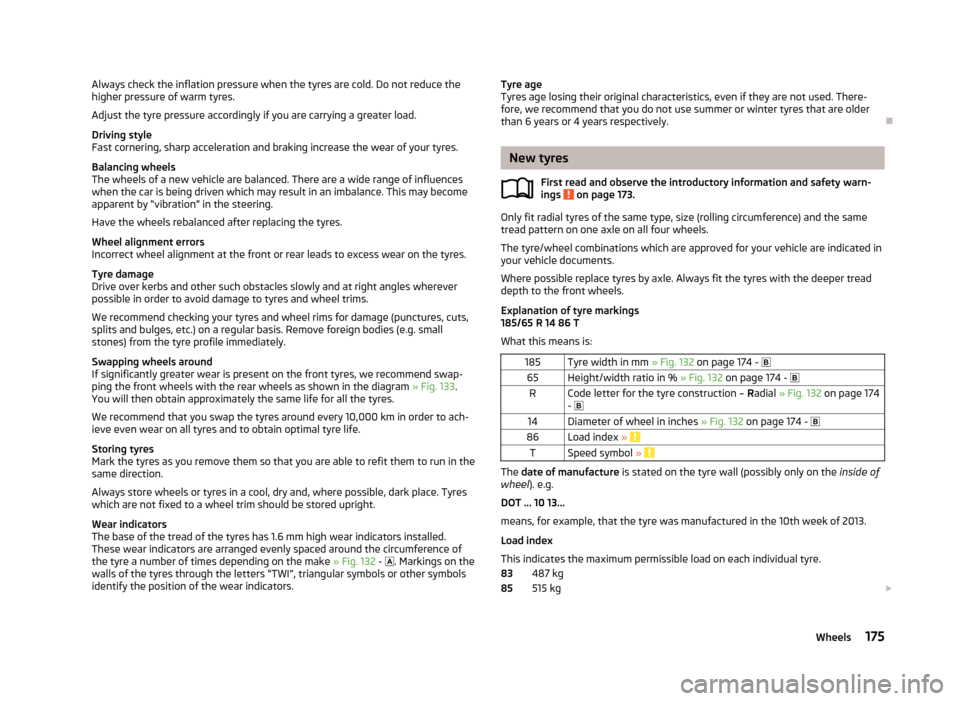
Explanation of tyre markings
185/65 R 14 86 T
What this means is:
185Tyre width in mm » Fig. 132 on page 174 - 65Height/width ratio in % » Fig. 132 on page 174 - RCode letter for the tyre construction – Radial » Fig. 132 on page 174
- 14Diameter of wheel in inches » Fig. 132 on page 174 - 86Load index » TSpeed symbol »
The date of manufacture is stated on the tyre wall (possibly only on the inside of
wheel ). e.g.
DOT ... 10 13...
means, for example, that the tyre was manufactured in the 10th week of 2013.
Load index
This indicates the maximum permissible load on each individual tyre. 487 kg
515 kg
8385175Wheels
Page 180 of 223
WARNING■When the warning light illuminates, immediately reduce the speed and
avoid sudden steering and brake manoeuvres. Stop the vehicle as soon as
possible and inspect the tyres and their inflation pressure.■
Under certain circumstances (e.g. sporty style of driving, wintry or unpaved
roads) the warning light can be delayed or does not light up at all.
CAUTION
■
The tyre control display does therefore not replace the regular tyre inflation
pressure control, as the system cannot detect an even loss of pressure.■
The system cannot warn in case of very rapid loss of tyre pressure, e.g. in the
event of a sudden puncture. In this case carefully bring the vehicle to a standstill without sudden steering movements or sharp braking.
■
The basic setting must be repeated every 10,000 km or once a year to ensure
proper functioning of the tyre pressure monitor.
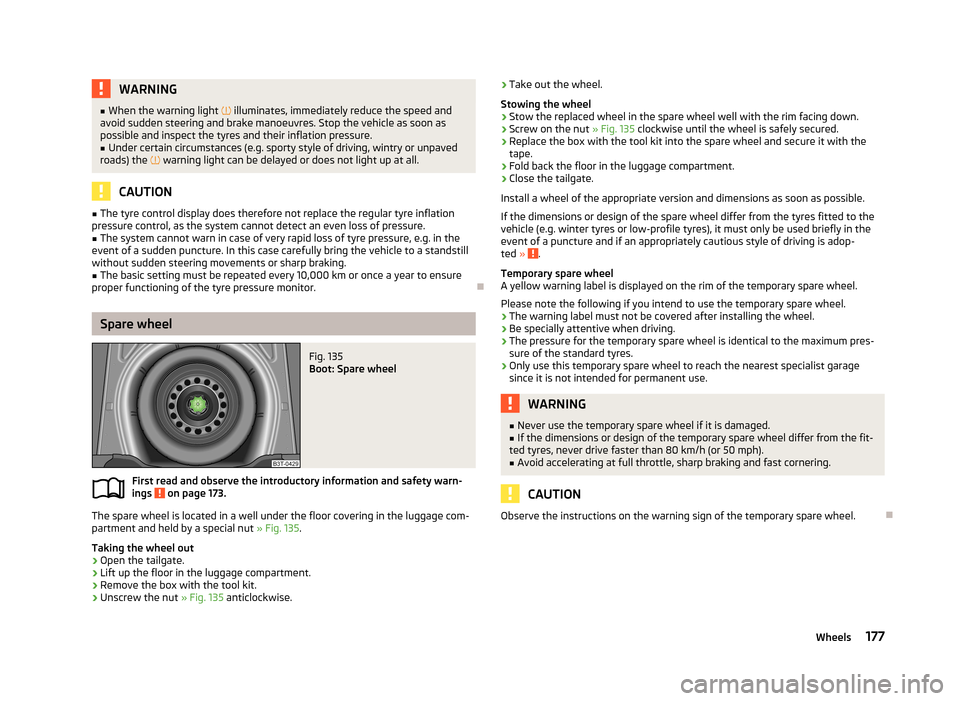
Spare wheel
Fig. 135
Boot: Spare wheel
First read and observe the introductory information and safety warn-
ings on page 173.
The spare wheel is located in a well under the floor covering in the luggage com-
partment and held by a special nut » Fig. 135.
Taking the wheel out
›
Open the tailgate.
›
Lift up the floor in the luggage compartment.
›
Remove the box with the tool kit.
›
Unscrew the nut » Fig. 135 anticlockwise.
›Take out the wheel.
Stowing the wheel›
Stow the replaced wheel in the spare wheel well with the rim facing down.
›
Screw on the nut » Fig. 135 clockwise until the wheel is safely secured.
›
Replace the box with the tool kit into the spare wheel and secure it with the
tape.
›
Fold back the floor in the luggage compartment.
›
Close the tailgate.
Install a wheel of the appropriate version and dimensions as soon as possible.
If the dimensions or design of the spare wheel differ from the tyres fitted to the
vehicle (e.g. winter tyres or low-profile tyres), it must only be used briefly in the
event of a puncture and if an appropriately cautious style of driving is adop-
ted »
.
Temporary spare wheel
A yellow warning label is displayed on the rim of the temporary spare wheel.
Please note the following if you intend to use the temporary spare wheel. › The warning label must not be covered after installing the wheel.
› Be specially attentive when driving.
› The pressure for the temporary spare wheel is identical to the maximum pres-
sure of the standard tyres.
› Only use this temporary spare wheel to reach the nearest specialist garage
since it is not intended for permanent use.
WARNING■ Never use the temporary spare wheel if it is damaged.■If the dimensions or design of the temporary spare wheel differ from the fit-
ted tyres, never drive faster than 80 km/h (or 50 mph).■
Avoid accelerating at full throttle, sharp braking and fast cornering.
CAUTION
Observe the instructions on the warning sign of the temporary spare wheel.
177Wheels
Page 182 of 223
Wheel boltsFirst read and observe the introductory information and safety warn-ings
on page 173.
Wheels and wheel bolts are matched to each other in terms of design. Whenever
you change the wheels fitted, e.g. light alloy wheels or wheels with winter tyres,
you must also use the matching wheel bolts of the correct length and shape of
bolt head. Correct fastening of the wheels depends on this.
Winter use
Introduction
This chapter contains information on the following subjects:
Winter tyres
179
Snow chains
179
Winter tyres
First read and observe the introductory information given on page 179.
The handling of your vehicle will be significantly improved when driving on wintry
roads if you fit winter tyres. Summer tyres have less grip on ice, snow and at tem- peratures below 7 °C. This is especially true of low-profile tyres or high-speed
tyres .
To achieve the best possible handling properties, winter tyres must be fitted on
all four wheels, the minimum tread depth must be 4 mm and tyres must be no
older than 4 years.
Winter tyres of a lower speed category can be used provided that the permissible
maximum speed of these tyres is not exceeded even if the possible maximum
speed of the vehicle is higher.
The speed limit for winter tyres can be set in the MAXI DOT display in the Winter
tyres menu item » page 18.
For the sake of the environmentRe-fit the summer tyres at an appropriate time as they provide better handling
properties, a shorter braking distance, less tyre noise, and reduced tyre wear on
roads which are free of snow and ice as well as at temperatures above 7 °C. The
fuel consumption is also lower.
Snow chains
First read and observe the introductory information given on page 179.
When driving on wintry roads, snow chains improve not only traction, but also the
braking performance.
Snow chains must only be mounted on the front wheels.
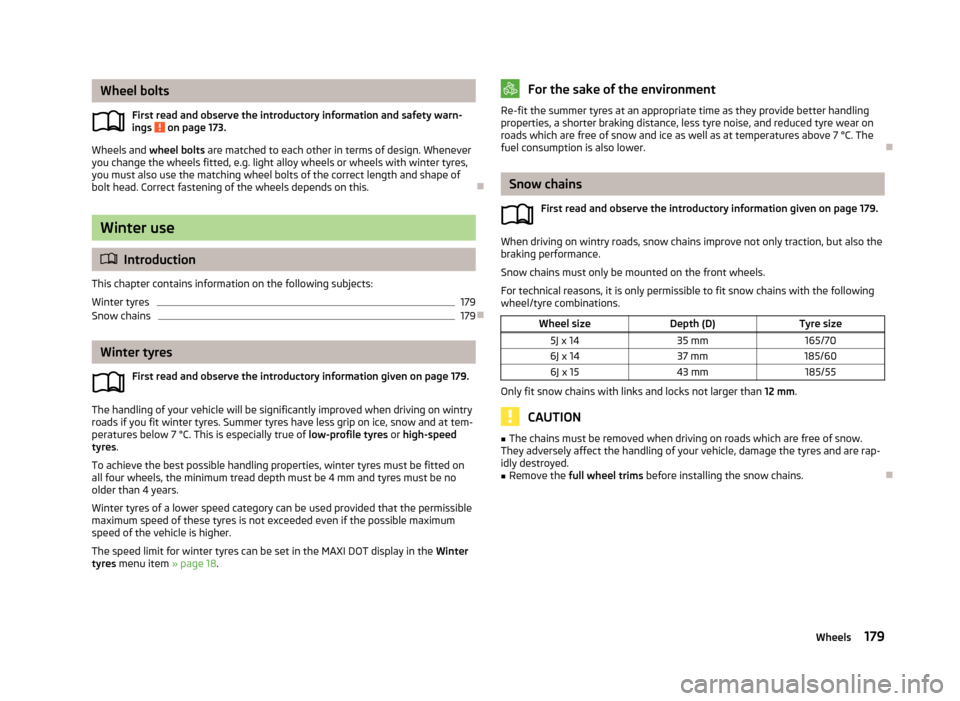
For technical reasons, it is only permissible to fit snow chains with the following wheel/tyre combinations.
Wheel sizeDepth (D)Tyre size5J x 1435 mm165/706J x 1437 mm185/606J x 1543 mm185/55
Only fit snow chains with links and locks not larger than 12 mm.
CAUTION
■
The chains must be removed when driving on roads which are free of snow.
They adversely affect the handling of your vehicle, damage the tyres and are rap-
idly destroyed.■
Remove the full wheel trims before installing the snow chains.
179Wheels
Page 217 of 223
N
N1
59
Net partition64
Behind the front seats65
Behind the rear seats64
Removing and refitting the housing65
O
Oil see Engine oil
165
Oil pressure Display messages
21
Onboard computer see Multifunction display
13
Operation in winter Diesel fuel
160
Vehicle battery171
Outside temperature15
Overview Engine compartment
163
warning lights20
P
Paintwork See Caring for paintwork
152
Parking Parking aid
113
Parking lights43
Part replacement147
Passive safety Before every journey
124
Driving safety125
Safety equipment124
Passive Safety124
Pedals100
Footmats100
Petrol refer to Fuel159
Polishing the paintwork See Vehicle care
152
Power steering95
Power window force limiter39
R
Radiator fan
163
Radio reception See windows
153
Raise vehicle184
Rear-view mirror Exterior mirrors
53
Manually dimmed rear-view mirror53
Rear fog light46
Rear window - Heating50
Recirculated air mode Manual air conditioning
82
Recommended gear13
Refuelling158
Fuel158
Remote control34
Synchronisation process35
Remote control key Replacing the battery
29
Repairs and technical alterations147
Replacing Vehicle battery
172
Windscreen wiper blades52
Replenishing Coolant
168
Engine oil166
Windscreen washer fluid163
Rims173
Roof luggage rack Attachment points
68
Roof rack system67
Roof load68
Running-in the first 1500 km103
Running in Brake pads
104
Engine104
Tyres104
S
SAFE see Safe securing
32
SAFELOCK see Safe securing
32
Safe securing32
Safety124
Child safety140
Child safety seats140
Correct seated position125
Head restraints57
ISOFIX143
TOP TETHER144
Save electricity104
Seals Vehicle care
153
Seat Adjusting
55
Seat belt warning light
21
Seat belt height adjuster131
Seat belts128
Belt tensioners131
Cleaning157
fastening and unfastening130
Height adjustment131
Seatbelts Inertia reels
131
Seat belts The physical principle of a frontal collision
129
Seats folding forward
56
Head restraints57
214Index
Page 219 of 223
U
Underbody protection
154
Underbody waxing154
Unleaded petrol109
unlock Central locking system
33
Unlocking Remote control
34
without central locking30
Unlocking and locking28
USB94
Useful equipment69
12-volt power outlet70
Ashtray69
Car park ticket holder71
Cigarette lighter70
Clothes hood71
Cupholders69
Using the selector lever101
V
Variable loading floor
62
Dividing the luggage compartment62
Removing and refitting63
Vehicle battery Automatic load deactivation
172
Charging171
Checking the electrolyte level171
Cover170
Disconnecting and reconnecting172
Operation in winter171
Replacing172
Safety instructions169
Vehicle care Alcantara
156
Care of the interior155
Decorative films153
Fabrics156
Polishing152
Rubber seals153
Seat covers157
Synthetic leather156
Underbody waxing154
Vehicle exterior care151
Waxing152
Vehicle data sticker201
Vehicle dimensions202
Vehicle identification number (VIN)201
Vehicle key28
Vehicle status see Auto Check Control
19
Vehicle tool kit181
Visors50
W
Warning lights
20
Warning symbols see warning lights
20
Warning triangle180
Warranty5
Washing145
Automatic car wash system151
by hand150
Chrome parts153
High-pressure cleaner151
Water Driving through
109
Waxing See Vehicle care
152
Weights201
Wheel bolts Anti-theft wheel bolt
184
Caps178
Loosening and tightening183
Wheels Bolts
179
Changing181
Full trim178
General information173
Load index175
Snow chains179
Spare wheel177
Speed symbol176
Storing wheels174
Swapping wheels around174
Temporary spare wheel177
Tyre pressure174
Tyre service life174
Tyre wear indicator174
Unidirectional tyres176
Wheel sizes174
Winter tyres179
Wheels and tyres Hubcaps
178
Window convenience operation40
Windows153
Deicing153
See Electrical power windows38
Window wipers Replacing the rear window wiper blade
52
Windscreen Deicing
153
Windscreen washer fluid Checking
163
Replenishing163
Warning light26
Winter163
Windscreen washer system163
Windscreen wash system Windscreen washer
51
Windscreen wiper Operate
51
Replacing the windscreen wiper blades52
Windscreen wipers Cleaning the windscreen wiper blades
52
Windscreen washer fluid163
Winter Deicing windows
153
216Index
Page 220 of 223
Winter operationSnow chains179
Winter tyres See Wheels
179
Winter use179
Winter tyres179
X
XDS
112
217Index