bonnet SKODA FABIA 2014 2.G / 5J User Guide
[x] Cancel search | Manufacturer: SKODA, Model Year: 2014, Model line: FABIA, Model: SKODA FABIA 2014 2.G / 5JPages: 197, PDF Size: 13.56 MB
Page 144 of 197
Diesel enginesa)SpecificationCapacity1.2 l/55 kW TDI CR DPFVW 507 004.31.6 l/55 kW TDI CR DPFVW 507 004.31.6 l/66 kW TDI CR DPFVW 507 004.31.6 l/77 kW TDI CR DPFVW 507 004.3a)
Engine oil VW 505 01 can optionally be used in diesel engines
without a DPF.
Specifications and capacity (in l) for vehicles with fixed service intervals
Petrol enginesSpecificationCapacity1.2 litres/44 kWVW 501 01, VW 502 002.81.2 l/51 kWVW 501 01, VW 502 002.81.4 l/63 kWVW 501 01, VW 502 003.21.6 l/77 kWVW 501 01, VW 502 003.61.4 l/132 kW TSIVW 502 003.61.2 l/63 kW TSIVW 502 003.91.2 l/77 kW TSIVW 502 003.9
If the oils specified above are not available, oils according to ACEA A2 or
ACEA A3 can be used once for refilling.
Diesel engines a)SpecificationCapacity1.2 l/55 kW TDI CR DPFVW 507 004.31.6 l/55 kW TDI CR DPFVW 507 004.31.6 l/66 kW TDI CR DPFVW 507 004.31.6 l/77 kW TDI CR DPFVW 507 004.3a)
Engine oil VW 505 01 can optionally be used in diesel engines
without DPF
If the oils specified above are not available, oils according to ACEA B3 or
ACEA B4 can be used once for refilling.
CAUTION
Only the above-mentioned oils can be used on vehicles with flexible service in-
tervals. We recommend always refilling with oil of the same specification since
this will maintain the properties of the oil. In exceptional cases, a maximum of
0.5 l of specification VW 502 00 (only for petrol engines) or specification
VW 505 01 (only for diesel engines) engine oil can be used to refill once. Other
engine oils must not be used - there is risk of engine damage.Checking the oil levelFig. 128
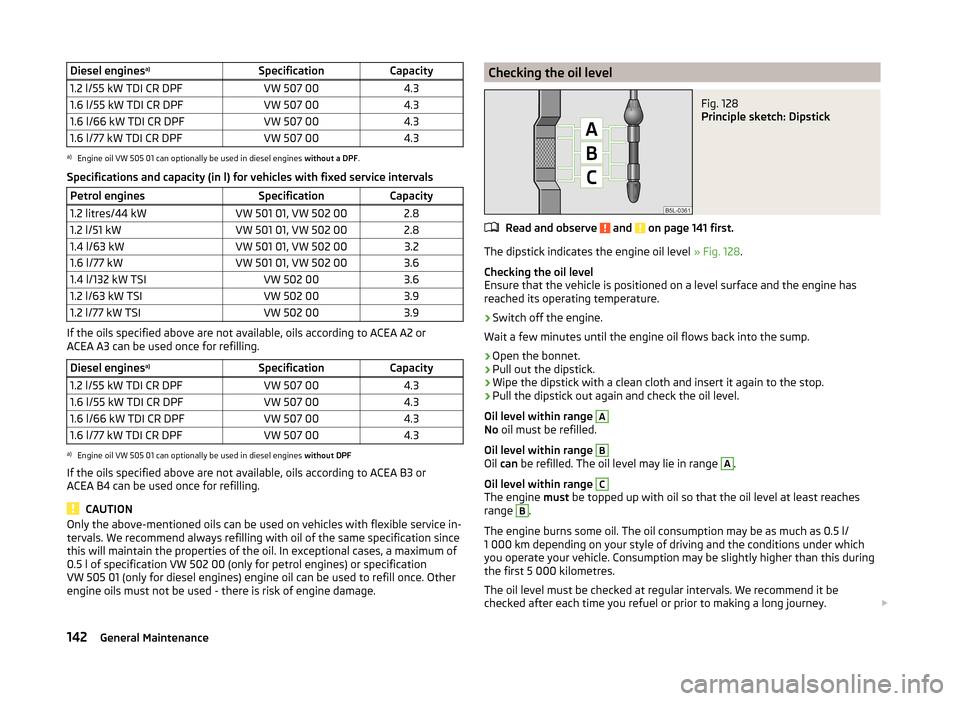
Principle sketch: Dipstick
Read and observe and on page 141 first.
The dipstick indicates the engine oil level » Fig. 128.
Checking the oil level
Ensure that the vehicle is positioned on a level surface and the engine has
reached its operating temperature.
›
Switch off the engine.
Wait a few minutes until the engine oil flows back into the sump.
›
Open the bonnet.
›
Pull out the dipstick.
›
Wipe the dipstick with a clean cloth and insert it again to the stop.
›
Pull the dipstick out again and check the oil level.
Oil level within range
A
No oil must be refilled.
Oil level within range
B
Oil can be refilled. The oil level may lie in range
A
.
Oil level within range
C
The engine must be topped up with oil so that the oil level at least reaches
range
B
.
The engine burns some oil. The oil consumption may be as much as 0.5 l/
1 000 km depending on your style of driving and the conditions under which
you operate your vehicle. Consumption may be slightly higher than this during
the first 5 000 kilometres.
The oil level must be checked at regular intervals. We recommend it be
checked after each time you refuel or prior to making a long journey.
142General Maintenance
Page 146 of 197
CapacityRead and observe
and on page 143 first.
Coolant capacity (in litres) 1)
Petrol enginesCapacity1.2 litres/44 kW5.51.2 l/51 kW5.51.2 l/63 kW TSI7.71.2 l/77 kW TSI7.71.4 l/63 kW5.51.4 l/132 kW TSI6.61.6 l/77 kW5.5Diesel enginesCapacity1.2 l/55 kW TDI CR DPF6.61.6 l/55 kW TDI CR DPF8.41.6 l/66 kW TDI CR DPF8.41.6 l/77 kW TDI CR DPF8.4
Checking the coolant level
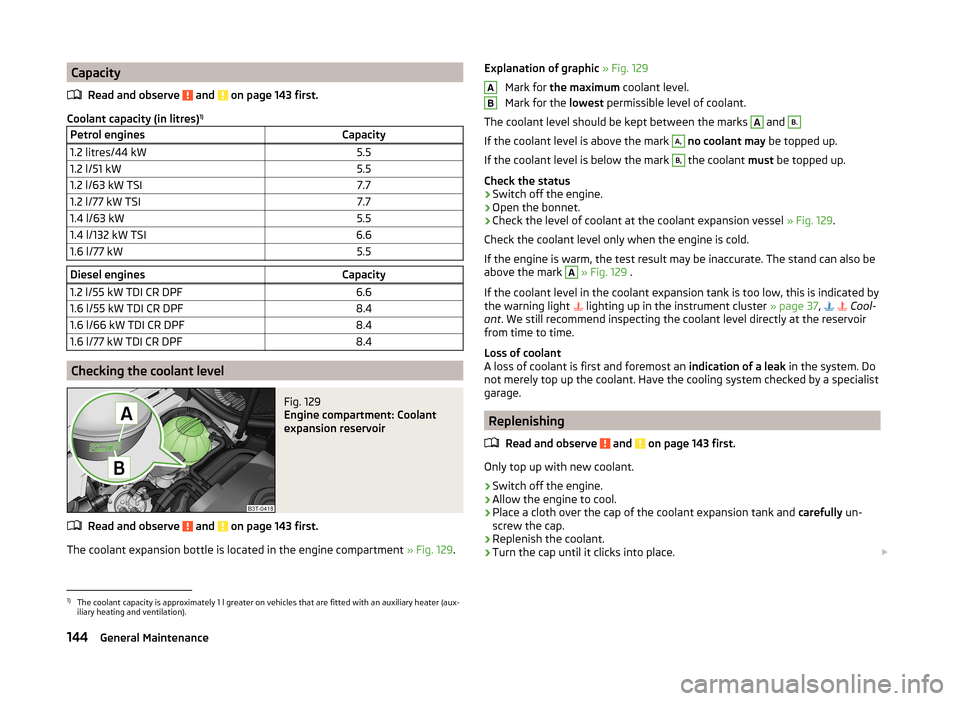
Fig. 129
Engine compartment: Coolant
expansion reservoir
Read and observe and on page 143 first.
The coolant expansion bottle is located in the engine compartment » Fig. 129.
Explanation of graphic » Fig. 129
Mark for the maximum coolant level.
Mark for the lowest permissible level of coolant.
The coolant level should be kept between the marks A
and
B.
If the coolant level is above the mark
A,
no coolant may be topped up.
If the coolant level is below the mark
B,
the coolant must be topped up.
Check the status
›
Switch off the engine.
›
Open the bonnet.
›
Check the level of coolant at the coolant expansion vessel » Fig. 129.
Check the coolant level only when the engine is cold.
If the engine is warm, the test result may be inaccurate. The stand can also be
above the mark
A
» Fig. 129 .
If the coolant level in the coolant expansion tank is too low, this is indicated by
the warning light lighting up in the instrument cluster
» page 37,
Cool-
ant . We still recommend inspecting the coolant level directly at the reservoir
from time to time.
Loss of coolant
A loss of coolant is first and foremost an indication of a leak in the system. Do
not merely top up the coolant. Have the cooling system checked by a specialist
garage.
Replenishing
Read and observe
and on page 143 first.
Only top up with new coolant.
›
Switch off the engine.
›
Allow the engine to cool.
›
Place a cloth over the cap of the coolant expansion tank and carefully un-
screw the cap.
›
Replenish the coolant.
›
Turn the cap until it clicks into place.
AB1)
The coolant capacity is approximately 1 l greater on vehicles that are fitted with an auxiliary heater (aux-
iliary heating and ventilation).
144General Maintenance
Page 147 of 197
Do not use an alternative additive if the specified coolant is not available in an
emergency. In this case, use just water and have the correct mixing ratio of
water and coolant additive restored by a specialist garage as soon as possible.
Brake fluid
Introduction
This chapter contains information on the following subjects:
Level check
145
Changing
145WARNING■ The engine compartment of your car is a hazardous area. While working in
the engine compartment, be sure to observe the following warn-
ings » page 138 .■
Do not continue your journey if the fluid level has fallen below the MIN
marking » Fig. 130 on page 145 - there is a risk of an accident. Seek help
from a specialist garage.
■
Do not use used brake fluid - the function of the brake system may be im-
paired – there is the risk of an accident.
CAUTION
Brake fluid damages the paintwork of the vehicle.
Note
■ The brake fluid is changed as part of a prescribed inspection service.■We recommend using oils from the ŠKODA Original Accessories range.
Level check
Fig. 130
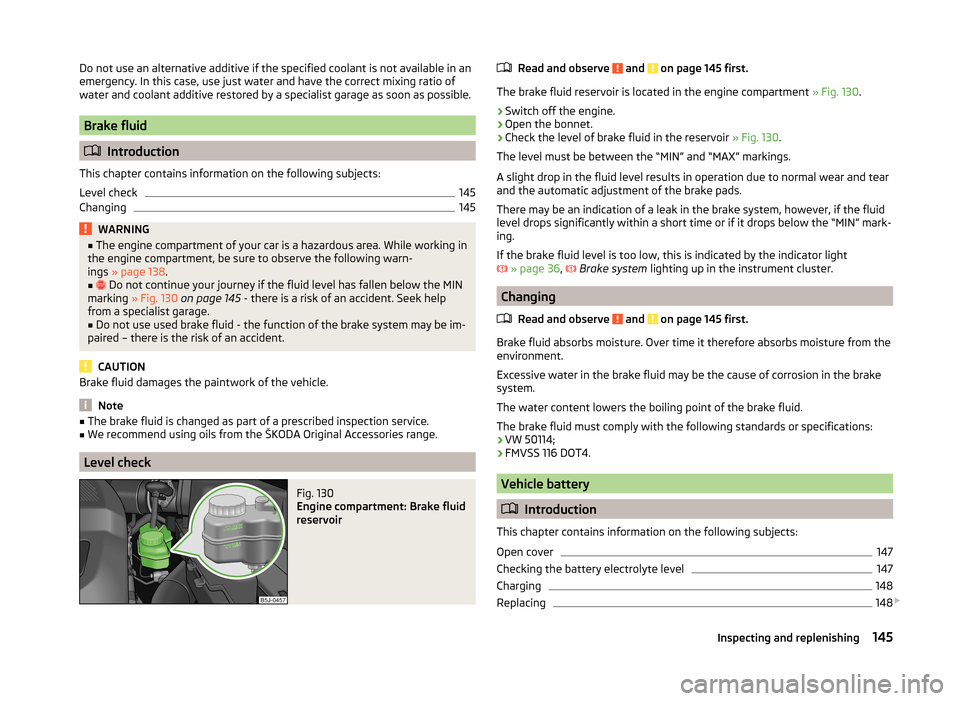
Engine compartment: Brake fluid
reservoir
Read and observe and on page 145 first.
The brake fluid reservoir is located in the engine compartment » Fig. 130.
›
Switch off the engine.
›
Open the bonnet.
›
Check the level of brake fluid in the reservoir » Fig. 130.
The level must be between the “MIN” and “MAX” markings.
A slight drop in the fluid level results in operation due to normal wear and tear
and the automatic adjustment of the brake pads.
There may be an indication of a leak in the brake system, however, if the fluid level drops significantly within a short time or if it drops below the “MIN” mark-
ing.
If the brake fluid level is too low, this is indicated by the indicator light
» page 36 ,
Brake system
lighting up in the instrument cluster.
Changing
Read and observe
and on page 145 first.
Brake fluid absorbs moisture. Over time it therefore absorbs moisture from theenvironment.
Excessive water in the brake fluid may be the cause of corrosion in the brake
system.
The water content lowers the boiling point of the brake fluid.
The brake fluid must comply with the following standards or specifications: › VW 50114;
› FMVSS 116 DOT4.
Vehicle battery
Introduction
This chapter contains information on the following subjects:
Open cover
147
Checking the battery electrolyte level
147
Charging
148
Replacing
148
145Inspecting and replenishing
Page 187 of 197
Index
A
Abroad Driving abroad
113
Unleaded petrol113
ABS115
warning light38
Accessories126
Adjusting Belt height
13
Exterior mirrors64
Head restraints68
Steering wheel8
Adjusting the seats7
Adjustment Headlight beam
56
Seats65
Adjustments and technical changes Spoiler
127
Adjustments and technical modifications Airbags
127
Aerial129
See windows131
Airbag14
Adjustments and impairment of the airbag sys- tem
127
Deactivating18
Deployment14
Front airbag15
Head airbag17
Side airbag16
Switching off the front passenger airbag18
Airbag system14
Air conditioning Operation
88
Air conditioning system Air outlets85
Climatronic90
Manual air conditioning system87
Air outlets85
Alarm49
Anti-theft alarm system49
Operation49
Trailer125
Antilock Braking System115
Armrest83
Ashtray78
ASR115
warning light38
Assist systems ABS
38, 115
ASR38, 115
Cruise control system117
EDS and XDS115
ESC38, 114
Parking aid116
START-STOP118
Auto Check Control34
Automatic gearbox Selector lever-emergency unlocking
108
Starting-off and driving107
Tiptronic106
Automatic load deactivation149
Automatic transmission105
Kickdown107
Malfunction107
Selector lever lock106
Using the selector lever105
AUX99
Avoiding damage to the vehicle Driving through water
112
Avoiding damage to your vehicle112
B
Back-up wheel
155
Ball head Check fitting
122
Fitting122
Ready position121
Removing123
Belts10
Belt tensioners13
Bicycle carrier75
Bonnet Closing
139
Opening139
Boot Cover
70
Emergency unlocking51
Fastening elements69
Fixing nets70
Folding hooks70
see Boot lid50
Unlocking the boot lid51
Boot lid50
automatic locking51
Brake assist114
Brake booster103
Brake fluid145
Changing145
Checking145
Display messages36
Brakes Brake booster
103
Brake fluid145
Handbrake104
Indicator light36
Running in109
Braking Information for braking
103
Breakdown kit163
185Index