check oil SKODA FABIA 2014 3.G / NJ User Guide
[x] Cancel search | Manufacturer: SKODA, Model Year: 2014, Model line: FABIA, Model: SKODA FABIA 2014 3.G / NJPages: 216, PDF Size: 30.7 MB
Page 148 of 216
CAUTION■Damage to the paint layer on the wheel rims must be touched up immediate-
ly.■
Severe layers of dirt on the wheels can also result in wheel imbalance. This
may show itself in the form of a wheel vibration which is transmitted to the
steering wheel which, in certain circumstances, can cause premature wear of
the steering. This means it is necessary to remove the dirt.
Towing device and mounting recess
Read and observe
and on page 142 first.
Close the mounting recess with the cap to prevent any ingress of dirt.
In the event of dirt, clean the inner surfaces of the mounting recess and treat
with a suitable preservative.
Before hitching a trailer check the ball head and apply a suitable grease where
necessary.
Fit the protective cap when stowing away the ball head to protect the luggage
compartment against dirt.
CAUTION
Apply grease to the inner part of the mounting recess. Make sure you do not
remove any grease.
Under-body protection
Read and observe
and on page 142 first.
The underside of your vehicle is already permanently protected by the factory
against chemical and mechanical influences.
Damage to the protective coating cannot be excluded when the vehicle is
driven.
We recommend that you have the protective coating under the body and on
the chassis inspected - preferably before the beginning and at the end of the
cold season.
WARNINGNever use additional underbody protection or anti-corrosion agents for ex-
haust pipes, catalytic converters, diesel particle filters or heat shields.
These substances could ignite when the engine reaches its operating tem-
perature - there is a risk of fire.
Wiper blades
Read and observe
and on page 142 first.
Clean the wiper blades regularly with a glass cleaner. The wiper blades should
be cleaned with a sponge or cloth if they are heavily soiled by insect residues,
for example.
The wiper blades can become soiled with wax residues after washing in auto-
matic vehicle wash systems for example » page 141.
Interior care
Introduction
This chapter contains information on the following subjects:
Natural leather
146
Artificial leather, materials and Alcantara ®
146
Seat covers
147
Safety belts
147
We recommend using care products from ŠKODA Original Accessories that are
available from ŠKODA Partners. The instructions for use on the package must
be observed.
WARNING■ Care products may be harmful to your health if not used according to the
instructions.■
Always keep the automobile care products safe from people who are not
completely independent, e.g. children - there is a danger of poisoning!
■
Air fresheners and scents can be hazardous to heath when the tempera-
ture inside the vehicle is high.
145Care and maintenance
Page 149 of 216
CAUTION■Be sure to check clothing for colourfastness to avoid any damage or visible
stains on the material (leather), panels and textiles.■
Remove fresh stains such as those from ball-point pens, ink, lipstick, shoe
polish, etc., from the material (leather), panels and textiles as quickly as possi-
ble.
■
Do not attach scents and air fresheners to the dashboard – risk of damage to
the dash panel.
■
Do not attach any stickers to the filaments or glass antenna - there is risk of
damage.
■
Do not clean the headlining with a brush – risk of damage to the lining sur-
face.
■
Cleaners containing solvents can damage the material being cleaned.
■
Apply only a small amount of the cleaning and care product.
For the sake of the environment
Used cans of vehicle care product represent hazardous waste that is harmful
to the environment. These must be disposed of in accordance with national
legislation.
Note
Because of the special tools and knowledge required, and to avoid any poten-
tial problems with the cleaning and care of the interior of your vehicle, we rec-
ommend that cleaning and care of the interior of your vehicle be carried out by
a ŠKODA Service Partner.
Natural leather
Read and observe
and on page 145 first.
The leather needs, depending on the strain placed on it, regular cleaning andmaintenance.
Dust and dirt in pores and creases cause abrasions on the surface and lead to
premature brittling of the leather surface. Therefore, they must be removed
regularly at short intervals with a cloth or vacuum cleaner.
Clean soiled leather surfaces with a cotton or woollen cloth lightly moistened
with water and then dry with a clean dry cloth »
.
Clean more severely soiled areas with a cloth soaked in a mild soap solution (2
tablespoons of natural soap to 1 litre of water).
To remove stains , use a cleaning agent specially designed for this purpose.
Treat the leather periodically with a suitable leather protector and use a skin
care cream with light blocker and impregnation after each cleaning.
CAUTION
■ Ensure that the leather is not soaked through at any point during cleaning
and that no water gets into the stitching of the seams. The leather would then
become brittle and cracked.■
Avoid leaving the vehicle for lengthy periods in bright sunlight to avoid the
leather from bleaching. If the vehicle is parked in the open for lengthy periods,
protect the leather from direct sunlight by covering it.
■
The use of an additional mechanical steering wheel lock may damage the
leather surface of the steering wheel.
■
Some clothing materials, such as dark denim, do not have sufficient colour
fastness. This can cause damage or clearly visible discolouration to seat covers
even when treated correctly. This is particularly true for light-coloured uphols-
tery. This is not a defect in the seat cover, but poor colour fastness of the
clothing textiles.
■
Sharp-edged objects on items of clothing such as zip fasteners, rivets, sharp-
edged belts etc. may leave permanent scratches or signs of rubbing on the
surface or damage these. Damage of this nature cannot later be recognized as
a justified complaint.
Note
During the life of the vehicle, minor visible changes can occur on the leather
parts of the covers (e. g wrinkles or creases as a result of the stress of the cov-
ers).
Artificial leather, materials and Alcantara ®
Read and observe
and on page 145 first.
Synthetic leather
Clean the synthetic leather with a damp cloth.
If the synthetic leather does not come completely clean with this method, a
mild soap solution or specific cleaning agent must be used.
Fabrics
Clean upholstery cover materials and cloth trims on doors, boot cover, etc. us-
ing specific cleaning agents, e.g., dry foam.
Use a soft sponge, brush, or commercially available microfibre cloth.
Use a cloth and special detergent to clean the headlining.
146General Maintenance
Page 155 of 216
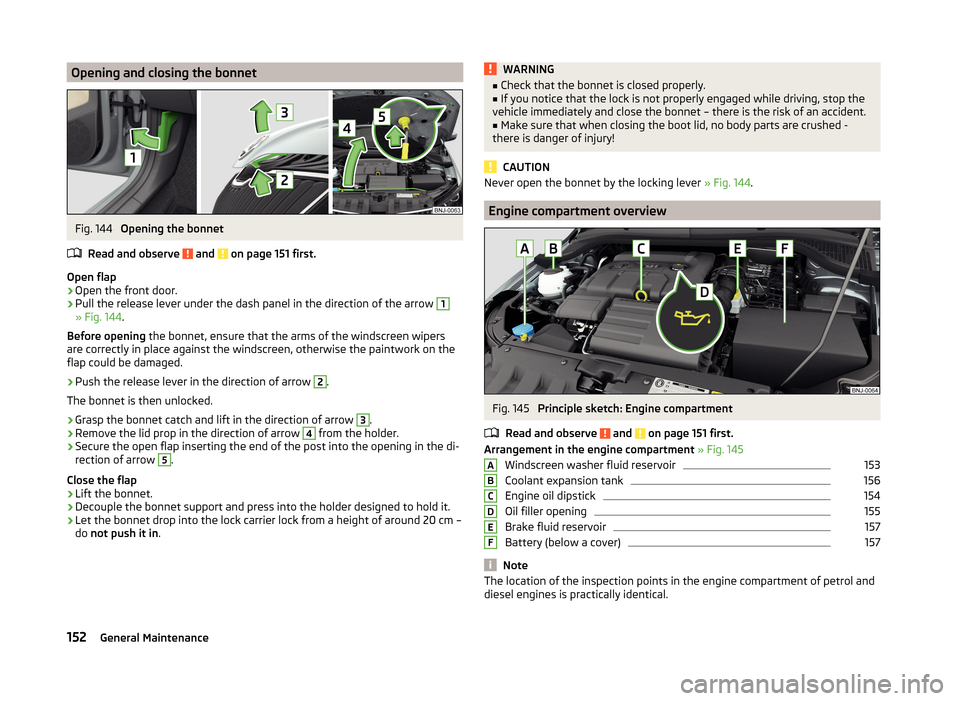
Opening and closing the bonnetFig. 144
Opening the bonnet
Read and observe
and on page 151 first.
Open flap
›
Open the front door.
›
Pull the release lever under the dash panel in the direction of the arrow
1
» Fig. 144 .
Before opening the bonnet, ensure that the arms of the windscreen wipers
are correctly in place against the windscreen, otherwise the paintwork on the
flap could be damaged.
›
Push the release lever in the direction of arrow
2
.
The bonnet is then unlocked.
›
Grasp the bonnet catch and lift in the direction of arrow
3
.
›
Remove the lid prop in the direction of arrow
4
from the holder.
›
Secure the open flap inserting the end of the post into the opening in the di-
rection of arrow
5
.
Close the flap
›
Lift the bonnet.
›
Decouple the bonnet support and press into the holder designed to hold it.
›
Let the bonnet drop into the lock carrier lock from a height of around 20 cm –
do not push it in .
WARNING■
Check that the bonnet is closed properly.■If you notice that the lock is not properly engaged while driving, stop the
vehicle immediately and close the bonnet – there is the risk of an accident.■
Make sure that when closing the boot lid, no body parts are crushed -
there is danger of injury!
CAUTION
Never open the bonnet by the locking lever » Fig. 144.
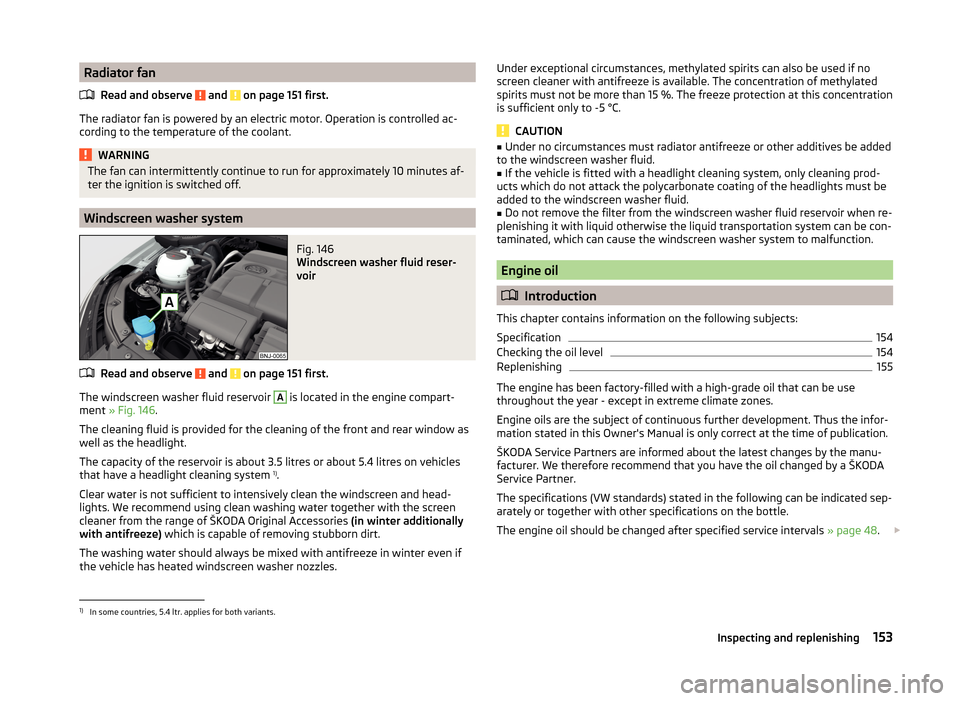
Engine compartment overview
Fig. 145
Principle sketch: Engine compartment
Read and observe
and on page 151 first.
Arrangement in the engine compartment » Fig. 145
Windscreen washer fluid reservoir
153
Coolant expansion tank
156
Engine oil dipstick
154
Oil filler opening
155
Brake fluid reservoir
157
Battery (below a cover)
157
Note
The location of the inspection points in the engine compartment of petrol and
diesel engines is practically identical.ABCDEF152General Maintenance
Page 156 of 216
Radiator fanRead and observe
and on page 151 first.
The radiator fan is powered by an electric motor. Operation is controlled ac-
cording to the temperature of the coolant.
WARNINGThe fan can intermittently continue to run for approximately 10 minutes af-
ter the ignition is switched off.
Windscreen washer system
Fig. 146
Windscreen washer fluid reser-
voir
Read and observe and on page 151 first.
The windscreen washer fluid reservoir
A
is located in the engine compart-
ment » Fig. 146 .
The cleaning fluid is provided for the cleaning of the front and rear window as
well as the headlight.
The capacity of the reservoir is about 3.5 litres or about 5.4 litres on vehicles
that have a headlight cleaning system 1)
.
Clear water is not sufficient to intensively clean the windscreen and head-
lights. We recommend using clean washing water together with the screen
cleaner from the range of ŠKODA Original Accessories (in winter additionally
with antifreeze) which is capable of removing stubborn dirt.
The washing water should always be mixed with antifreeze in winter even if
the vehicle has heated windscreen washer nozzles.
Under exceptional circumstances, methylated spirits can also be used if no
screen cleaner with antifreeze is available. The concentration of methylated
spirits must not be more than 15 %. The freeze protection at this concentration
is sufficient only to -5 °C.
CAUTION
■ Under no circumstances must radiator antifreeze or other additives be added
to the windscreen washer fluid.■
If the vehicle is fitted with a headlight cleaning system, only cleaning prod-
ucts which do not attack the polycarbonate coating of the headlights must be
added to the windscreen washer fluid.
■
Do not remove the filter from the windscreen washer fluid reservoir when re-
plenishing it with liquid otherwise the liquid transportation system can be con-
taminated, which can cause the windscreen washer system to malfunction.
Engine oil
Introduction
This chapter contains information on the following subjects:
Specification
154
Checking the oil level
154
Replenishing
155
The engine has been factory-filled with a high-grade oil that can be use
throughout the year - except in extreme climate zones.
Engine oils are the subject of continuous further development. Thus the infor-
mation stated in this Owner's Manual is only correct at the time of publication.
ŠKODA Service Partners are informed about the latest changes by the manu-
facturer. We therefore recommend that you have the oil changed by a ŠKODA
Service Partner.
The specifications (VW standards) stated in the following can be indicated sep-
arately or together with other specifications on the bottle.
The engine oil should be changed after specified service intervals » page 48.
1)
In some countries, 5.4 ltr. applies for both variants.
153Inspecting and replenishing
Page 157 of 216
WARNINGThe engine compartment of your car is a hazardous area. While working in
the engine compartment, be sure to observe the following warnings
» page 150 .
CAUTION
Do not pour any additives into the engine oil – there is a risk of serious engine
damage.
Note
■ Before a long drive we recommend that you purchase and carry with you en-
gine oil which complies with the specification for your vehicle.■
We recommend that you use oils from ŠKODA Original Accessories.
■
You must wash yourself thoroughly if your skin has come into contact with
oil.
Specification
Read and observe
and on page 154 first.
Vehicles with variable service intervals
Petrol enginesSpecification1.0 l/44, 55 kW MPIVW 504 001.2 l/66, 81 kW TSIVW 504 00Diesel engineSpecification1.4 l/66, 77 kW TDI CRVW 507 00
Vehicles with fixed service intervals
Petrol enginesSpecification1.0 l/44, 55 kW MPIVW 502 001.2 l/66, 81 kW TSIVW 502 00
CAUTION
■If the above engine oils are not available, a different engine oil can be used in
an emergency. To prevent damage to the engine, a maximum of 0.5 litres only
of the following engine oils may be used: ■ For petrol engine models: ACEA A3/ACEA B4 or API SN, (API SM);
■ for diesel engine models: ACEA C3 or API CJ-4.Checking the oil levelFig. 147
Principle sketch: Dipstick
Read and observe and on page 154 first.
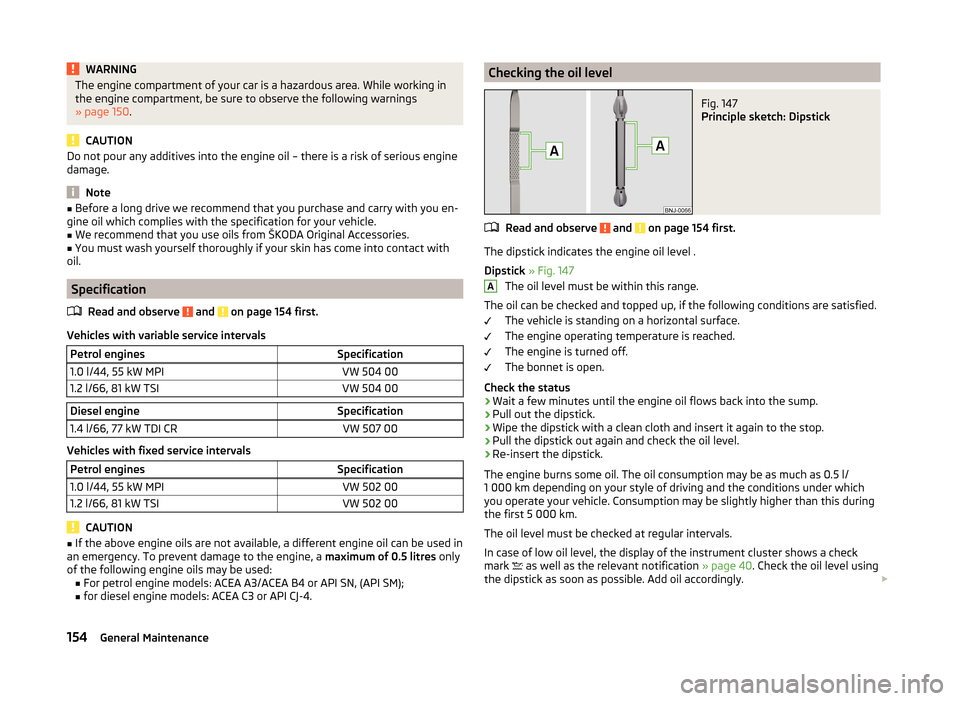
The dipstick indicates the engine oil level .
Dipstick » Fig. 147
The oil level must be within this range.
The oil can be checked and topped up, if the following conditions are satisfied. The vehicle is standing on a horizontal surface.
The engine operating temperature is reached.
The engine is turned off.
The bonnet is open.
Check the status
›
Wait a few minutes until the engine oil flows back into the sump.
›
Pull out the dipstick.
›
Wipe the dipstick with a clean cloth and insert it again to the stop.
›
Pull the dipstick out again and check the oil level.
›
Re-insert the dipstick.
The engine burns some oil. The oil consumption may be as much as 0.5 l/
1 000 km depending on your style of driving and the conditions under which
you operate your vehicle. Consumption may be slightly higher than this during
the first 5 000 km.
The oil level must be checked at regular intervals.
In case of low oil level, the display of the instrument cluster shows a check
mark as well as the relevant notification
» page 40. Check the oil level using
the dipstick as soon as possible. Add oil accordingly.
A154General Maintenance
Page 158 of 216
CAUTION■The oil level must never be above the range A » Fig. 147 - risk of damage to
the motor as well as the exhaust system!■
If for some reason, it is not possible to top up the engine oil under the cur-
rent circumstances,
do not continue driving! Switch off the engine and seek
assistance from a specialist garage.
■
If the oil level is above the range
A
,
do not continue to drive! Switch off
the engine and seek assistance from a specialist garage.
Replenishing
Read and observe
and on page 154 first.
›
Unscrew the cap of the engine oil filler opening » Fig. 145 on page 152 .
›
Replenish the oil in portions of 0.5 litres in accordance with the correct speci-
fications » page 154 .
›
Check the oil level » page 154.
›
Screw the lid of the engine oil filler closed carefully.
›
Pull the dipstick out as far as the stop.
Coolant
Introduction
This chapter contains information on the following subjects:
Checking the coolant level
156
Replenishing
156
The coolant provides cooling for the motor.
It consists of water and coolant additive with additives that protect the cooling
system against corrosion and prevents furring.
The coolant additive level in the coolant must amount to at least 40%.
The coolant additive may be increased to a maximum of 60%.
The correct mixing ratio of water and coolant additive is to be checked if nec-
essary by a specialist garage or is to be restored if necessary.
The description of the coolant is shown in the coolant expansion reservoir
» Fig. 148 on page 156 .
WARNINGThe engine compartment of your car is a hazardous area. While working in
the engine compartment, be sure to observe the following warnings
» page 150 .■
The coolant is harmful to health.
■
Avoid contact with the coolant.
■
Coolant vapours are harmful to health.
■
Never open the end cover of the coolant expansion reservoir while the
engine is still warm. The cooling system is pressurized!
■
When opening the end cover of the coolant expansion reservoir, cover it
with a cloth to protect your face, hands and arms from hot steam or hot
coolant.
■
If any coolant splashes into your eyes, immediately rinse out your eyes
with clear water and contact a doctor as soon as possible.
■
Always keep the coolant in the original container safe from people who
are not completely independent, especially children - there is a danger of
poisoning!
■
Consult a doctor immediately if coolant is swallowed.
■
Never spill operating fluids over the hot engine - risk of fire.
CAUTION
■ Do not continue if for some reason it is not possible to fill with coolant un-
der the current circumstances! Switch off the engine and seek assistance from
a specialist garage.■
With an empty expansion tank top up coolant. The system could ventilate -
there is a risk of engine damage,
not continue! Switch off the engine and
seek assistance from a specialist garage.
■
The amount of coolant additive in the coolant must never be allowed to fall
below 40 %.
■
Over 60 % coolant additive in the coolant reduces the antifreeze protection
and coolant effectiveness.
■
A coolant additive that does not comply with the correct specification can
significantly reduce the corrosion protection of the cooling system.
■
Any faults resulting from corrosion may cause a loss of coolant and can con-
sequently result in major engine damage!
■
Do not fill the coolant above the mark
A
» Fig. 148 on page 156 .
■
If an error occurs, leading to the engine overheating, the help of a professio-
nal garage is to be sought - there is a risk of serious engine damage occurring.
■
Additional headlights and other attached components in front of the air inlet
impair the cooling efficiency of the coolant.
■
Never cover the radiator - there is a risk of the engine overheating.
155Inspecting and replenishing
Page 160 of 216
Note■The brake fluid is changed as part of a prescribed inspection service.■We recommend using oils from the ŠKODA Original Accessories range.
Level check
Fig. 149
Brake fluid reservoir
Read and observe and on page 156 first.
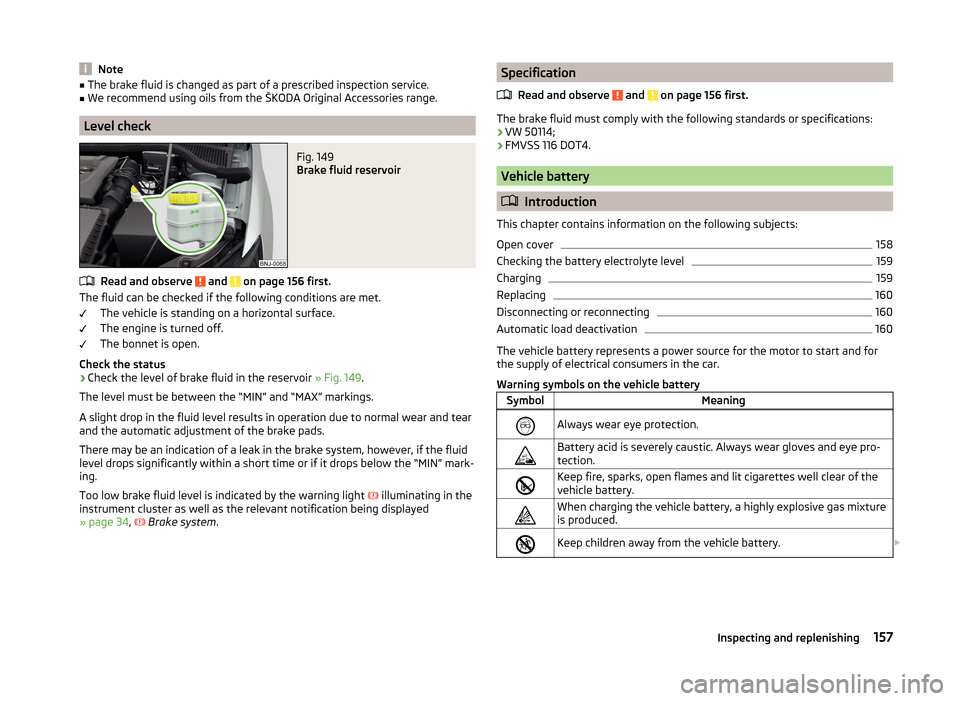
The fluid can be checked if the following conditions are met.
The vehicle is standing on a horizontal surface.
The engine is turned off.
The bonnet is open.
Check the status
›
Check the level of brake fluid in the reservoir » Fig. 149.
The level must be between the “MIN” and “MAX” markings.
A slight drop in the fluid level results in operation due to normal wear and tear
and the automatic adjustment of the brake pads.
There may be an indication of a leak in the brake system, however, if the fluid level drops significantly within a short time or if it drops below the “MIN” mark-
ing.
Too low brake fluid level is indicated by the warning light
illuminating in the
instrument cluster as well as the relevant notification being displayed
» page 34 ,
Brake system .
Specification
Read and observe
and on page 156 first.
The brake fluid must comply with the following standards or specifications:› VW 50114;
› FMVSS 116 DOT4.
Vehicle battery
Introduction
This chapter contains information on the following subjects:
Open cover
158
Checking the battery electrolyte level
159
Charging
159
Replacing
160
Disconnecting or reconnecting
160
Automatic load deactivation
160
The vehicle battery represents a power source for the motor to start and for
the supply of electrical consumers in the car.
Warning symbols on the vehicle battery
SymbolMeaningAlways wear eye protection.Battery acid is severely caustic. Always wear gloves and eye pro-
tection.Keep fire, sparks, open flames and lit cigarettes well clear of the
vehicle battery.When charging the vehicle battery, a highly explosive gas mixture
is produced.Keep children away from the vehicle battery. 157Inspecting and replenishing
Page 166 of 216
Wheel balance
The wheels of a new vehicle are balanced. There are a wide range of influen-
ces when the car is being driven which may result in an imbalance. This may
become apparent by “vibration” in the steering. If this is the case, the wheels
have to be balanced at specialist garage.
Also have the wheels rebalanced after replacing or repairing the tyres.
Adjustment of the vehicle geometry
Incorrect wheel alignment at the front or rear leads to excess wear of the tyres
and negatively affects the driving safety. With a distinctive tyre wear, we rec-
ommend that you check the setting of the vehicle geometry in a specialist
workshop.WARNING■ An incorrect wheel alignment at the front or rear impairs handling.■Unusual vibrations or pulling of the vehicle to one side could be a sign of
tyre damage. If there is any doubt that a wheel is damaged, immediately re-
duce your speed and stop! If no external tyre damage is evident, drive slow-
ly and carefully to the nearest specialist garage to have the vehicle
checked.
Tyre wear indicator and wheels exchange
Fig. 153
Principle sketch: Replace tyre tread with wear indicators /
wheels
Read and observe
on page 161 first.
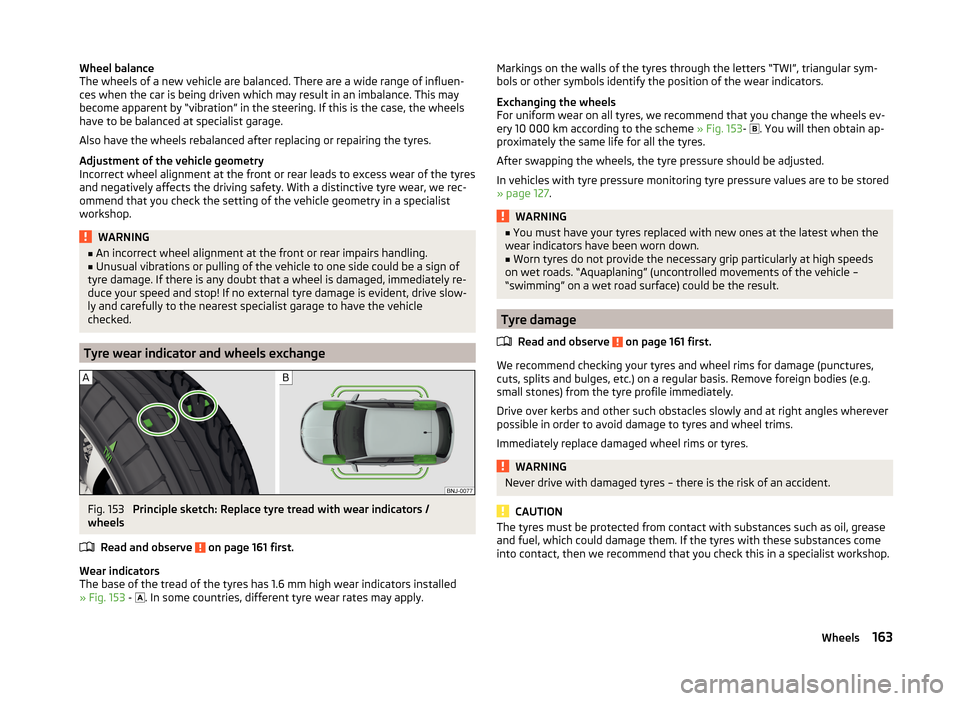
Wear indicators
The base of the tread of the tyres has 1.6 mm high wear indicators installed » Fig. 153 -
. In some countries, different tyre wear rates may apply.
Markings on the walls of the tyres through the letters “TWI”, triangular sym-
bols or other symbols identify the position of the wear indicators.
Exchanging the wheels
For uniform wear on all tyres, we recommend that you change the wheels ev-
ery 10 000 km according to the scheme » Fig. 153-
. You will then obtain ap-
proximately the same life for all the tyres.
After swapping the wheels, the tyre pressure should be adjusted.
In vehicles with tyre pressure monitoring tyre pressure values are to be stored
» page 127 .WARNING■
You must have your tyres replaced with new ones at the latest when the
wear indicators have been worn down.■
Worn tyres do not provide the necessary grip particularly at high speeds
on wet roads. “Aquaplaning” (uncontrolled movements of the vehicle –
“swimming” on a wet road surface) could be the result.
Tyre damage
Read and observe
on page 161 first.
We recommend checking your tyres and wheel rims for damage (punctures,
cuts, splits and bulges, etc.) on a regular basis. Remove foreign bodies (e.g.
small stones) from the tyre profile immediately.
Drive over kerbs and other such obstacles slowly and at right angles wherever
possible in order to avoid damage to tyres and wheel trims.
Immediately replace damaged wheel rims or tyres.
WARNINGNever drive with damaged tyres – there is the risk of an accident.
CAUTION
The tyres must be protected from contact with substances such as oil, grease
and fuel, which could damage them. If the tyres with these substances come
into contact, then we recommend that you check this in a specialist workshop.163Wheels
Page 174 of 216

CAUTION■Use the pressure of your hand only, do not strike the trim. The cover could be
damaged.■
If wheel trims are fitted, it must be ensured that an adequate flow of air is
assured to cool the brake system.
Note
We recommend that you use child seats from ŠKODA Original Accessories.
Wheel bolts
Fig. 160
Remove the cap
Before removing the wheel bolts the caps are to be removed.
Pulling off
›
Push the extraction pliers » page 168 sufficiently far onto the cap until the
inner catches of the pliers are positioned at the collar of the cap.
›
Remove the cap in the direction of the arrow » Fig. 160.
Fitting
›
Push the cap onto the wheel bolt up to the stop.
Changing a wheel
When changing a wheel, the following instructions must be followed.
›
Remove the full wheel trim or the caps of the wheel bolts.
›
First of all slacken the anti-theft wheel bolt and then the other wheel bolts.
›
Jack up the vehicle until the wheel that needs changing is clear of the
ground.
›
Unscrew the wheel bolts and place them on a clean surface (cloth, paper, etc.).
›
Remove the wheel carefully.
›
Attach the spare wheel and slightly screw on the wheel bolts.
› Lower the vehicle.›Tighten the opposite wheel bolts alternately (cross-wise) with the wheel
wrench. Tighten the anti-theft wheel bolt last.›
Replace the wheel trim or the caps.
When fitting unidirectional tyres, ensure that the direction of rotation is cor-
rect » page 164 .
WARNING■
Undo the wheel bolts only a little (about one turn) until the vehicle has
been jacked up. Otherwise the wheel could become loose and fall off.■
All bolts must be clean and must turn easily.
■
If it is established when changing a wheel that the wheel bolts are corro-
ded and difficult to move, then these must be replaced.
■
Under no circumstances grease or oil the wheel bolts!
Subsequent steps
After changing the wheel, the following work should be carried out.
›
Stow and attach the replaced wheel in the spare wheel well using a special
screw » page 169 , Reserve and temporary spare wheel .
›
Stow the tool kit in the space provided and secure using the strap.
›
Check the tyre pressure on the installed spare wheel as soon as possible.
›
Have the tightening torque of the wheel bolts checked with a torque
wrench as soon as possible.
After changing the wheel, the tyre pressure should be adjusted. In vehicles
with tyre pressure monitoring tyre pressure values are to be stored » page 127.
Change the damaged wheel or consult a specialist garage about repair possi-
bilities.
WARNINGInformation on the wheel bolts■The prescribed tightening torque of the wheel bolts for steel and light al-
loy wheels is 120 Nm.■
If the wheel bolts are tightened to a too low tightening torque, the rim
can come loose when the car is moving. A tightening torque which is too
high can damage the bolts and threads and this can result in permanent
deformation of the contact surfaces on the rim.
171Emergency equipment, and self-help
Page 204 of 216
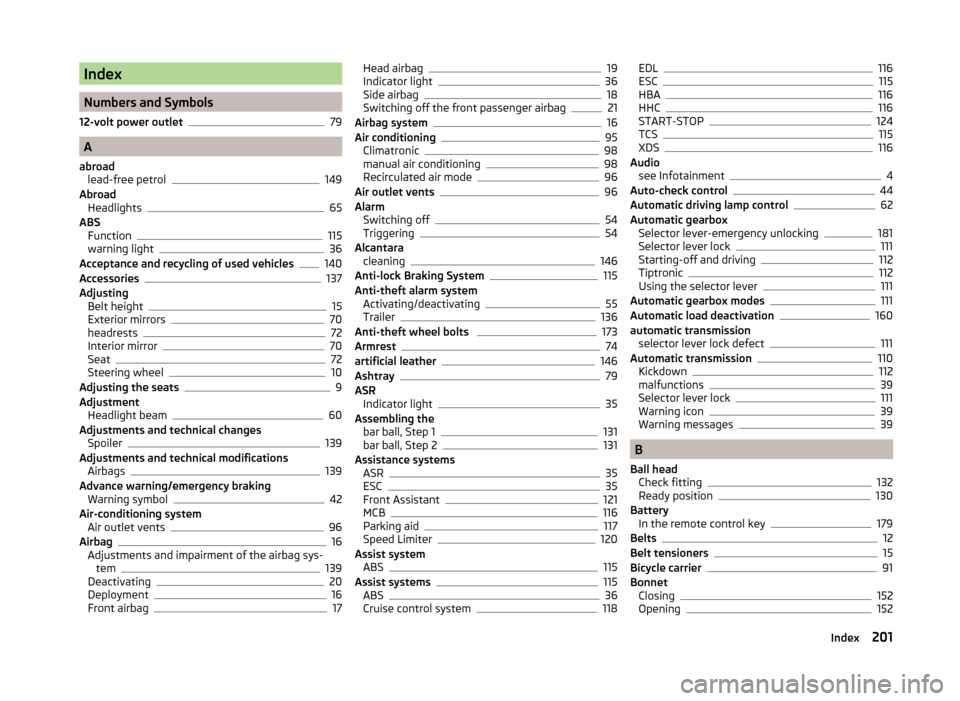
Index
Numbers and Symbols
12-volt power outlet
79
A
abroad lead-free petrol
149
Abroad Headlights
65
ABS Function
115
warning light36
Acceptance and recycling of used vehicles140
Accessories137
Adjusting Belt height
15
Exterior mirrors70
headrests72
Interior mirror70
Seat72
Steering wheel10
Adjusting the seats9
Adjustment Headlight beam
60
Adjustments and technical changes Spoiler
139
Adjustments and technical modifications Airbags
139
Advance warning/emergency braking Warning symbol
42
Air-conditioning system Air outlet vents
96
Airbag16
Adjustments and impairment of the airbag sys- tem
139
Deactivating20
Deployment16
Front airbag17
Head airbag19
Indicator light36
Side airbag18
Switching off the front passenger airbag21
Airbag system16
Air conditioning95
Climatronic98
manual air conditioning98
Recirculated air mode96
Air outlet vents96
Alarm Switching off
54
Triggering54
Alcantara cleaning
146
Anti-lock Braking System115
Anti-theft alarm system Activating/deactivating
55
Trailer136
Anti-theft wheel bolts 173
Armrest74
artificial leather146
Ashtray79
ASR Indicator light
35
Assembling the bar ball, Step 1
131
bar ball, Step 2131
Assistance systems ASR
35
ESC35
Front Assistant121
MCB116
Parking aid117
Speed Limiter120
Assist system ABS
115
Assist systems115
ABS36
Cruise control system118
EDL116
ESC115
HBA116
HHC116
START-STOP124
TCS115
XDS116
Audio see Infotainment
4
Auto-check control44
Automatic driving lamp control62
Automatic gearbox Selector lever-emergency unlocking
181
Selector lever lock111
Starting-off and driving112
Tiptronic112
Using the selector lever111
Automatic gearbox modes111
Automatic load deactivation160
automatic transmission selector lever lock defect
111
Automatic transmission110
Kickdown112
malfunctions39
Selector lever lock111
Warning icon39
Warning messages39
B
Ball head Check fitting
132
Ready position130
Battery In the remote control key
179
Belts12
Belt tensioners15
Bicycle carrier91
Bonnet Closing
152
Opening152
201Index