tow SKODA OCTAVIA 2005 1.G / (1U) Manual PDF
[x] Cancel search | Manufacturer: SKODA, Model Year: 2005, Model line: OCTAVIA, Model: SKODA OCTAVIA 2005 1.G / (1U)Pages: 315, PDF Size: 11.8 MB
Page 231 of 315
Towing a trailer
230
Distribution of the load
Distribute the load in the trailer in such a way that any heavy items are
located as close as possible to the axle. Secure the items to prevent them
slipping.
Tyre inflation pressure
Select the tyre inflation pressure on your vehicle for that of “fully laden”,
⇒ page 264. The inflation pressure of the tyres fitted to the trailer adjust in
accordance with the manufacturer's recommendation.
Exterior mirrors
You have to have additional exterior mirrors fitted if you are not able to see
the traffic behind the trailer with the standard rear-view mirrors. Both exte-
rior mirrors should be attached to folding arms. Adjust the mirrors so that
they provide you with an adequate field of view to the rear.
Headlights
Before starting off with a hitched trailer, also check the setting of the head-
lights. Alter the setting as necessary with the aid of the headlight beam
adjuster ⇒page 67.
Detachable ball head
The ball rod is detachable on vehicles which feature a factory-fitted towing
device. It is stowed together with separate fitting instructions in the spare
wheel well in the luggage compartment of the vehicle.
Further information on the towing device ⇒page 231.
Note
•We recommend that you also have your vehicle inspected between
service intervals if you tow a trailer frequently.
•The handbrake on the towing vehicle must be put on when coupling
and decoupling the trailer.
Driving Tips
Particular caution is required when towing a trailer.
– Do not, as far as possible, drive with your vehicle unladen and the trailer laden.
– Do not make full use of the legal maximum speeds. This applies in particular to downhill sections.
– Apply the brakes in good time.
– Keep a check on the coolant temperature gauge if the outside temperature is high.
Distribution of weight
The distribution of the weight is very poor if your vehicle is unladen and
the trailer is laden. Maintain a particularly low speed if you cannot avoid
driving with this combination.
Driving speed
Do not drive faster than 80 km/hour for safety reasons. This also applies
for countries in which higher speeds are allowed.
The fact that the driving stability of the vehicle + trailer combination
reduces with increasing speed means that the legally allowed speed
should not be used when there are unfavourable road, weather or wind
conditions, particularly near accident black spots.
You must always reduce your speed immediately as soon as you detect
even just the slightest swaying of the trailer. On no account attempt to
stop the trailer from “swaying” by accelerating.
Apply the brakes in good time! If the trailer is fitted with a trailer brake ,
apply the brakes gently at first, then brake firmly. This will avoid brake jolts
resulting from the trailer wheels locking. Shift down gears in good time
s24s.book Page 230 Thursday, November 24, 2005 12:27 PM
Page 232 of 315
Towing a trailer231
Using the systemSafetyDriving TipsGeneral MaintenanceBreakdown assistanceTechnical Data
before negotiating a downhill section to allow the engine to also act as a
brake.
Engine overheating
Please keep a check on the coolant temperature gauge if you have to
negotiate a lengthy slope in a low gear at a high engine speed when the
outside temperature is very high
⇒page 14.
If the needle of the coolant temperature gauge moves into the right-hand
area or even the red area of the scale, reduce your speed immediately.
Stop and switch off the engine if the warning light
in the instrument
cluster begins flashing. Wait a few minutes and check the level of coolant
in the coolant expansion bottle ⇒page 254, “Inspecting the coolant level”.
Please refer to the following guidelines ⇒page 35, “Coolant tempera-
ture/coolant level ”.
The coolant temperature can be reduced by switching on the heating.
Any increase in the cooling effect of the coolant fan through shifting down
a gear and increasing the engine speed is not possible since the fan
speed is independent of the engine speed. One should also not drop a
gear for this reason when towing a trailer as long as the engine can
manage the slope without any drop in speed.
Detachable ball head*
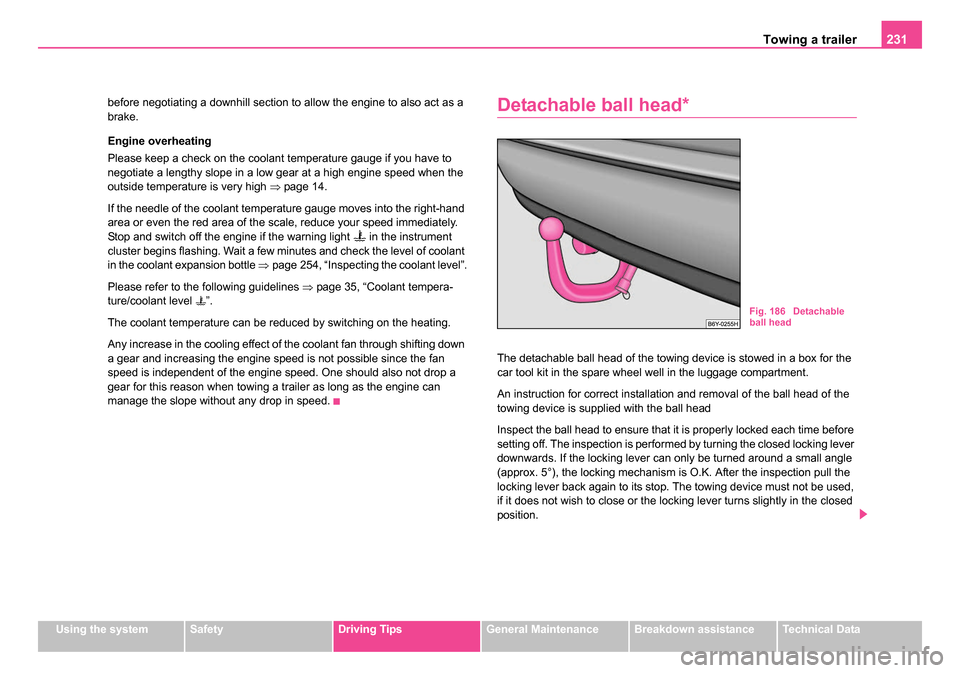
The detachable ball head of the towing device is stowed in a box for the
car tool kit in the spare wheel well in the luggage compartment.
An instruction for correct installation and removal of the ball head of the
towing device is supplied with the ball head
Inspect the ball head to ensure that it is properly locked each time before
setting off. The inspection is performed by turning the closed locking lever
downwards. If the locking lever can only be turned around a small angle
(approx. 5°), the locking mechanism is O.K. After the inspection pull the
locking lever back again to its stop. The towing device must not be used,
if it does not wish to close or the locking lever turns slightly in the closed
position.
Fig. 186 Detachable
ball head
s24s.book Page 231 Thursday, November 24, 2005 12:27 PM
Page 233 of 315

Towing a trailer
232
WARNING
Do not use any aids or tools for installing or removing the ball
head. This might result in damage to the locking mechanism to the
extent that the safety of the towing device is no longer assured -
risk of an accident.
Note
•Do not carry out any modifications or repairs to the ball head or to any
other components on the towing device.
•Contact a specialist garage if you encounter any problems using the
device.
•Never unlock the ball head with a trailer coupled to it.
•You should take off the ball head if you drive without towing a trailer.
Inspect whether the end cover properly seals off the mounting shaft.
•Remove the ball head beforehand if you wish to clean your vehicle
using a steam jet. Ensure that the end cover properly seals the mounting
shaft.
•It is recommended to wear gloves when installing and removing.
s24s.book Page 232 Thursday, November 24, 2005 12:27 PM
Page 253 of 315
Inspecting and Replenishing
252
Oil level within range
– You may top up the oil. It is possible that the oil level may then
be within range after doing this.
Oil level within range
– You must top up the oil ⇒page 252. It is sufficient, once this
is done, to keep the oil level is within range .
It is normal for the engine to consume oil. The oil consumption may be as
much as 0.5 l/1 000 km depending on your style of driving and the condi-
tions under which you operate your vehicle. The oil consumption may be
slightly higher than this during the first 5 000 kilometres.
One should therefore check the oil level at regular intervals, preferably
every time after the fuel tank is filled or after driving for long stretches.
We recommend maintaining the oil level within the range if the engine
has been operating at high loads, for example during a lengthy motorway
trip during the summer months, towing a trailer or negotiating a high
mountain pass, but not above this .
The warning light in the instrument cluster* will indicate ⇒page 38,
“Engine oil level* ” whether the oil level is too low. In this case, check
the oil level as soon as possible. Top up with an appropriate quantity of oil.
Caution
•The oil level must on no account extend beyond the range . Danger
of damaging the catalytic converter.
•Do not continue your journey if for some reason it is not possible
under the conditions prevailing to top up with oil. Switch of the engine
and contact and obtain professional assistance from a specialist
garage.
Replenishing engine oil
– Inspecting the engine oil level ⇒page 251.
– Unscrew the cap of the engine oil filler opening.
– Pour in a suitable grade of oil in portions of 0.5 litres ⇒page 250, “Engine oil specifications”.
– Inspect the oil level ⇒page 251.
– Carefully screw on the cap of the filler opening and push the dipstick in fully.
WARNING
•Avoid dripping oil onto hot parts of the engine when topping up
will oil - a risk of fire!
•Read and observe the warning notes ⇒ page 248, “Working in
the engine compartment” before working in the engine compart-
ment.
For the sake of the environment
The oil level must on no account be above the range ⇒page 251. Oil
will otherwise be drawn in through the crankcase ventilation and may pass
through the exhaust system to atmosphere. The oil may combust in the
catalytic converter and damage it.
Ab
Aa
Ac
Ab
Aa
Aa
Aa
s24s.book Page 252 Thursday, November 24, 2005 12:27 PM
Page 275 of 315
Breakdown assistance
274
compartment. You can open the compartment by turning the locks in the
direction of arrow ⇒fig. 203 .
If you wish to equip your vehicle additionally with a warning triangle,
please contact a specialist garage.
Note
Pay attention to the use-by-date of the contents of the first-aid box.
Fire extinguisher*
The fire extinguisher is attached with straps in a holder under the driver
seat.
Please read carefully the instructions which are attached to the fire
extinguisher.
The fire extinguisher must be checked by an authorised person or
company annually (please observe the differing legal equirements).
WARNING
If the fire extinguisher is not correctly attached, in case of sudden
manoeuvres or an accident it can be “thrown” through the interior
compartment and cause injuries.
Note
•The fire extinguisher must comply with the relevant and valid legal
requirements.
•Pay attention to the expiration date of the fire extinguisher. If the fire
extinguisher is used after the expiration date, its proper function is no
longer assured.
•The fire extinguisher is only supplied in certain countries within the
scope of delivery.
Vehicle tool kit
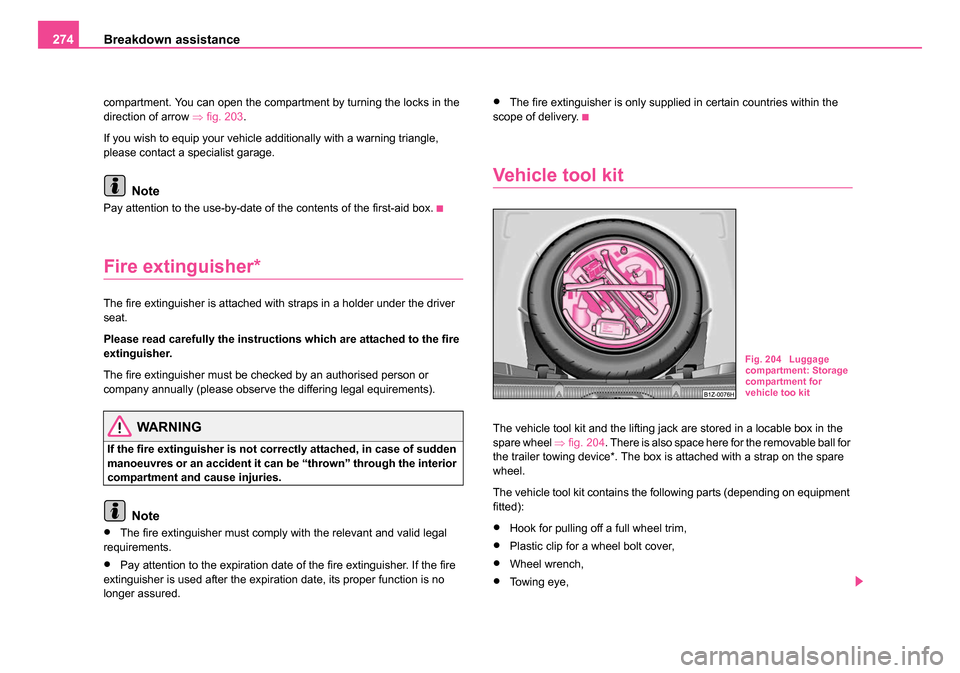
The vehicle tool kit and the lifting jack are stored in a locable box in the
spare wheel ⇒fig. 204 . There is also space here for the removable ball for
the trailer towing device*. The box is attached with a strap on the spare
wheel.
The vehicle tool kit contains the following parts (depending on equipment
fitted):
•Hook for pulling off a full wheel trim,
•Plastic clip for a wheel bolt cover,
•Wheel wrench,
•Towing eye,
Fig. 204 Luggage
compartment: Storage
compartment for
vehicle too kit
s24s.book Page 274 Thursday, November 24, 2005 12:27 PM
Page 276 of 315
Breakdown assistance275
Using the systemSafetyDriving TipsGeneral MaintenanceBreakdown assistanceTechnical Data
•Adapter for the wheel bolts lock,
After using the lifting jack, screw in the arm of the lifting jack fully before
placing it back in its stowage area.
WARNING
•The factory-supplied lifting jack is only intended for your model
of vehicle. On no account attempt to lift a heavier vehicle or other
loads - risk of injury!
•Ensure that the vehicle tool kit is safely attached in the luggage
compartment.
Note
Ensure that the box is always secured with the strap.
Tyre repair kit*
The tyre repair kit is intended for the repair of minor tyre defects. The tyre
repair kit contains a compressor, inflation bottle, operating instructions
and accessories.
The repair with the tyre repair kit is not at all intended to replace a
permanent repair on the tyre, this repair only serves to reach the next
specialist garage. The repair can be undertaken on the vehicle immedi-
ately. Please read the attached instructions carefully before the
repair.
The tyre repair kit is located in a well under the floor covering in the
luggage compartment.
Spare wheel
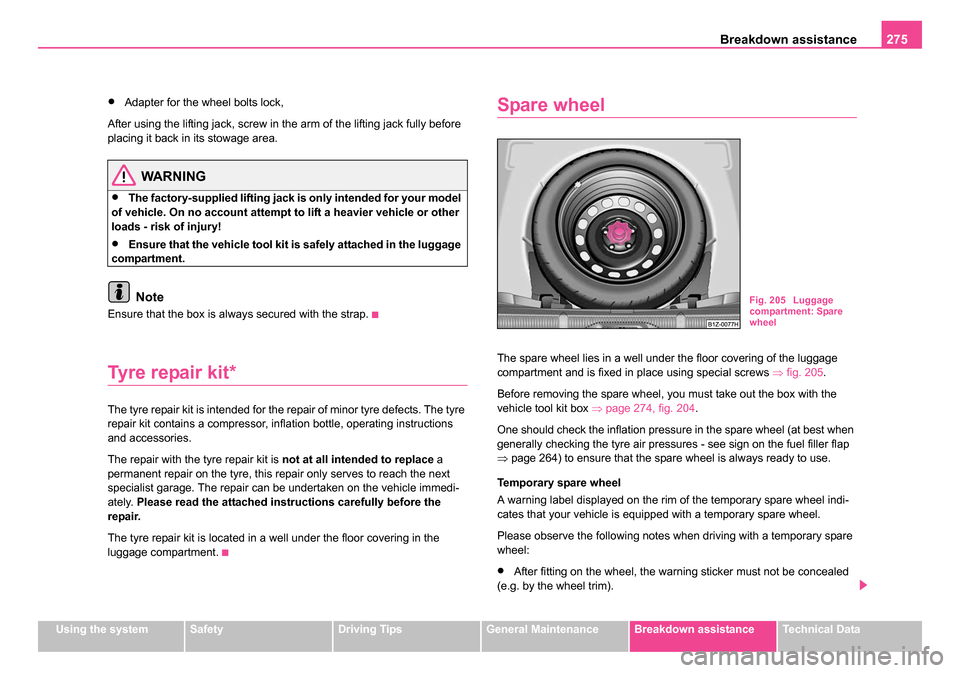
The spare wheel lies in a well under the floor covering of the luggage
compartment and is fixed in place using special screws ⇒fig. 205 .
Before removing the spare wheel, you must take out the box with the
vehicle tool kit box ⇒page 274, fig. 204 .
One should check the inflation pressure in the spare wheel (at best when
generally checking the tyre air pressures - see sign on the fuel filler flap
⇒ page 264) to ensure that the spare wheel is always ready to use.
Temporary spare wheel
A warning label displayed on the rim of the temporary spare wheel indi-
cates that your vehicle is equipped with a temporary spare wheel.
Please observe the following notes when driving with a temporary spare
wheel:
•After fitting on the wheel, the warning sticker must not be concealed
(e.g. by the wheel trim).
Fig. 205 Luggage
compartment: Spare
wheel
s24s.book Page 275 Thursday, November 24, 2005 12:27 PM
Page 278 of 315
Breakdown assistance277
Using the systemSafetyDriving TipsGeneral MaintenanceBreakdown assistanceTechnical Data
– Slacken the wheel bolts ⇒page 279.
– Jack up the vehicle until the wheel to be changed is clear of the ground ⇒page 280.
– Unscrew the wheel bolts and place them on a clean surface (cloth, paper etc.).
– Take off the wheel.
– Fit on the spare wheel and tighten the wheel bolts slightly.
– Lower the car.
– Tighten the wheel bolts firmly, alternately and diagonally using the wheel wrench ⇒page 279.
– Mount the full wheel trim/wheel trim cap or the caps.
Note
•All bolts must be clean and must turn easily.
•You must never grease or oil the wheel bolts!
•When fitting on unidirectional tyres, ensure that the tyres rotate in the
correct direction ⇒page 263.
Subsequent steps
After changing the wheel, you must perform the following steps.
– Stow and attach the replaced wheel in the spare wheel well.
– Stow the vehicle tool kit in the space provided. –
Check the tyre pressure on the spare wheel just mounted as
soon as possible.
– Have the tightening torque of the wheel bolts checked with
a torque wrench as soon as possible. Steel and light alloy
wheels must be tightened to a tightening torque of 120 Nm.
– Have the defective tyre repaired as soon as possible.
WARNING
It is necessary to observe the guidelines given on ⇒page 266, “New
tyres and wheels” if the vehicle is subsequently fitted with tyres
which are different to those it was fitted with at the works.
Note
•If you find, when changing the wheel, that the wheel bolts are corroded
and difficult to turn, the bolts must be replaced before checking the tight-
ening torque.
•Drive cautiously and only at a moderate speed to a workshop where
the tightening torque can be checked.
s24s.book Page 277 Thursday, November 24, 2005 12:27 PM
Page 282 of 315
Breakdown assistance281
Using the systemSafetyDriving TipsGeneral MaintenanceBreakdown assistanceTechnical Data
Securing wheels against being stolen*
You need a special adapter for slackening the safety
wheel bolts.
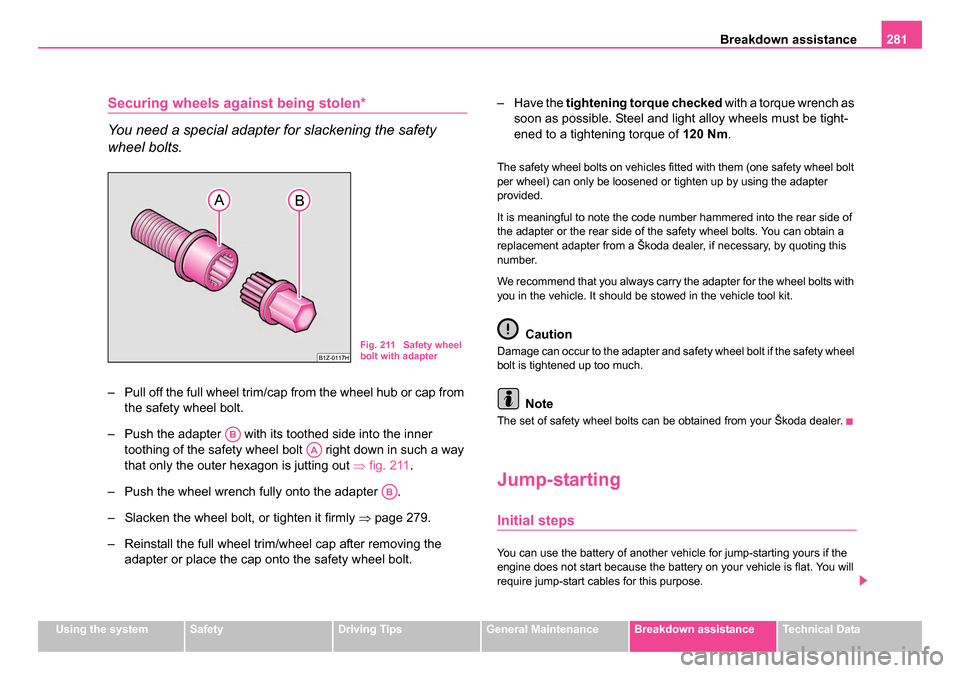
– Pull off the full wheel trim/cap from the wheel hub or cap from
the safety wheel bolt.
– Push the adapter with its toothed side into the inner toothing of the safety wheel bolt right down in such a way
that only the outer hexagon is jutting out ⇒fig. 211.
– Push the wheel wrench fully onto the adapter .
– Slacken the wheel bolt, or tighten it firmly ⇒page 279.
– Reinstall the full wheel trim/wheel cap after removing the adapter or place the cap onto the safety wheel bolt. – Have the
tightening torque checked with a torque wrench as
soon as possible. Steel and light alloy wheels must be tight-
ened to a tightening torque of 120 Nm.
The safety wheel bolts on vehicles fitted with them (one safety wheel bolt
per wheel) can only be loosened or tighten up by using the adapter
provided.
It is meaningful to note the code number hammered into the rear side of
the adapter or the rear side of the safety wheel bolts. You can obtain a
replacement adapter from a Škoda dealer, if necessary, by quoting this
number.
We recommend that you always carry the adapter for the wheel bolts with
you in the vehicle. It should be stowed in the vehicle tool kit.
Caution
Damage can occur to the adapter and safety wheel bolt if the safety wheel
bolt is tightened up too much.
Note
The set of safety wheel bolts can be obtained from your Škoda dealer.
Jump-starting
Initial steps
You can use the battery of another vehicle for jump-starting yours if the
engine does not start because the battery on your vehicle is flat. You will
require jump-start cables for this purpose.
Fig. 211 Safety wheel
bolt with adapter
AB
AA
AB
s24s.book Page 281 Thursday, November 24, 2005 12:27 PM
Page 284 of 315
Breakdown assistance283
Using the systemSafetyDriving TipsGeneral MaintenanceBreakdown assistanceTechnical Data
– Attach the other end to a solid metal part which is
connected firmly to the engine block, or to the engine block
itself.
Starting engine
– Start the engine of the vehicle providing current and run the engine at idling speed.
– Now start the engine of the vehicle with the discharged battery.
– Interrupt the attempt at starting an engine after 10 seconds if it does not start right away and wait for about 30 seconds
before repeating the attempt.
– Disconnect the cables on the engine in exactly the reverse
order they were connected up.
WARNING
•The non-insulated parts of the terminal clamps must never
make contact with each other. Furthermore, the cable connected to
the positive terminal of the battery must not come into contact with
electrically conducting parts of the vehicle - risk of a short circuit!
•Do not affix the jump starting cables to the negative terminal of
the discharged battery. There is the risk of detonating gas seeping
out the battery being ignited by the strong spark which results from
the engine being started.
•Run the jump-start cables so that they cannot be caught by any
rotating parts in the engine compartment.
•Do not bend over the batteries - risk of caustic burns!
•The vent screws of the battery cells must be tightened firmly.
•Keep any sources of ignition (naked flame, smouldering ciga-
rettes etc.) away from the battery - risk of an explosion!
Tow-starting and towing vehicle
General
Please pay attention to the following instructions if you are going
to use a tow rope:
Driver of the towing vehicle
– Do not drive off until the tow rope is taught.
– Release the clutch particularly gently when starting off or depress the accelerator particularly gently if your vehicle is
fitted with an automatic gearbox.
Driver of the towed vehicle
– Switch the ignition on so that the steering wheel is not blocked and you can also operate the turn signal lights, the headlight
flasher, the windscreen wipers and windscreen washer
system.
– Take the vehicle out of gear or move the selector lever into position N if your vehicle is fitted with an automatic gearbox.
A4WARNING (continued)
s24s.book Page 283 Thursday, November 24, 2005 12:27 PM
Page 285 of 315
Breakdown assistance
284
– Note that the brake servo unit and power steering only operate if the engine is running. You will require significantly greater
physical force to depress the brake pedal and to steer the
vehicle if the engine is not running.
– Ensure that the tow rope is always kept taught.
Tow rope or tow bar
A tow bar is safest way of towing a vehicle and also minimizes any
shocks. You can use a tow rope only if a suitable tow bar is not available.
The tow rope must be elastic to protect the vehicle. Thus one should only
use plastic fibre rope or a rope made out of a similarly elastic material.
Only attach the tow rope to the towing eyes provided for this purpose
⇒ page 285, “Front towing eye” and ⇒page 286, “Rear towing eye”.
Driving style
Towing another vehicle requires a certain amount of practice. Both drivers
should be familiar with the particular points about towing a vehicle.
Unskilled drivers should not attempt to tow in another vehicle or to be
towed in.
One should be constantly vigilant not to allow impermissibly high towing
forces or jerky loadings. There is always a risk of excessive stresses and
damage resulting at the points to which you attach the tow rope or tow bar
when you attempt to tow a vehicle which is not standing on a paved road.
Caution
If the gearbox of your vehicle no longer contains any oil because of a
defect, your vehicle must only be towed in with the driven wheels raised
clear of the ground, or on a special vehicle transporter or trailer.
Note
•Please comply with any legal requirements particularly regarding the
switched on signal systems, when towing in or tow-starting another
vehicle.
•The tow rope must not be twisted as it may in certain circumstances
result in the front towing eye being unscrewed out of your vehicle.
s24s.book Page 284 Thursday, November 24, 2005 12:27 PM