tow SKODA OCTAVIA 2005 1.G / (1U) Repair Manual
[x] Cancel search | Manufacturer: SKODA, Model Year: 2005, Model line: OCTAVIA, Model: SKODA OCTAVIA 2005 1.G / (1U)Pages: 315, PDF Size: 11.8 MB
Page 184 of 315
Seat belts183
Using the systemSafetyDriving TipsGeneral MaintenanceBreakdown assistanceTechnical Data
Seat belts
Why seat belts?
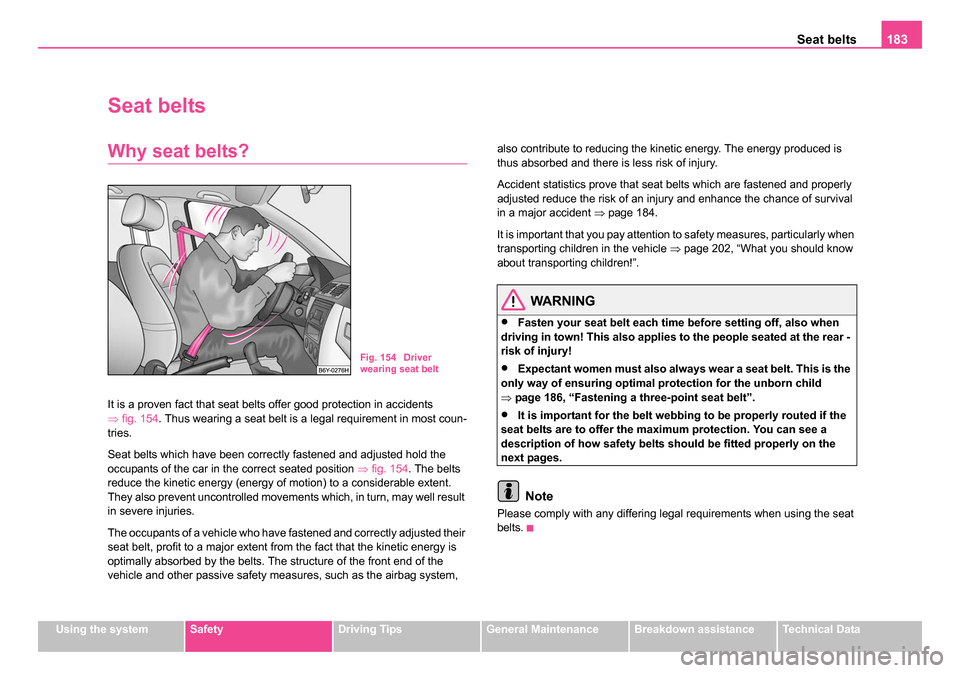
It is a proven fact that seat belts offer good protection in accidents
⇒fig. 154 . Thus wearing a seat belt is a legal requirement in most coun-
tries.
Seat belts which have been correctly fastened and adjusted hold the
occupants of the car in the correct seated position ⇒fig. 154 . The belts
reduce the kinetic energy (energy of motion) to a considerable extent.
They also prevent uncontrolled movements which, in turn, may well result
in severe injuries.
The occupants of a vehicle who have fastened and correctly adjusted their
seat belt, profit to a major extent from the fact that the kinetic energy is
optimally absorbed by the belts. The structure of the front end of the
vehicle and other passive safety measures, such as the airbag system, also contribute to reducing the kinetic energy. The energy produced is
thus absorbed and there is less risk of injury.
Accident statistics prove that seat belts which are fastened and properly
adjusted reduce the risk of an injury and enhance the chance of survival
in a major accident
⇒page 184.
It is important that you pay attention to safety measures, particularly when
transporting children in the vehicle ⇒page 202, “What you should know
about transporting children!”.
WARNING
•Fasten your seat belt each time before setting off, also when
driving in town! This also applies to the people seated at the rear -
risk of injury!
•Expectant women must also always wear a seat belt. This is the
only way of ensuring optimal protection for the unborn child
⇒ page 186, “Fastening a three-point seat belt”.
•It is important for the belt webbing to be properly routed if the
seat belts are to offer the maximum protection. You can see a
description of how safety belts should be fitted properly on the
next pages.
Note
Please comply with any differing legal requirements when using the seat
belts.
Fig. 154 Driver
wearing seat belt
s24s.book Page 183 Thursday, November 24, 2005 12:27 PM
Page 201 of 315
Airbag system
200
other legal regulations applying) ⇒page 202, “Important safety informa-
tion on using child safety seats”,
•you are not able to maintain the distance of at least 25 cm between
middle of steering wheel and chest, despite the driver seat being correctly
adjusted,
•special attachments are required in the area of the steering wheel
because of a physical disability,
•you have installed other seats (e.g. orthopaedic seats without side
airbags).
Monitoring the airbag system
The functionality of the airbag system is also monitored electronically,
when one airbag has been switched off
If the airbag was switched off using diagnostic equipment:
•The warning light for the airbag system lights up for 4 seconds after
switching on the ignition and then flashes for 12 seconds afterwards in 2
second intervals.
If the front passenger airbags were switched off using the switch for
front passenger airbags* in stowage compartment on the front
passenger side:
•The airbag warning light comes on in the instrument cluster for about
4 seconds each time the ignition is switched on.
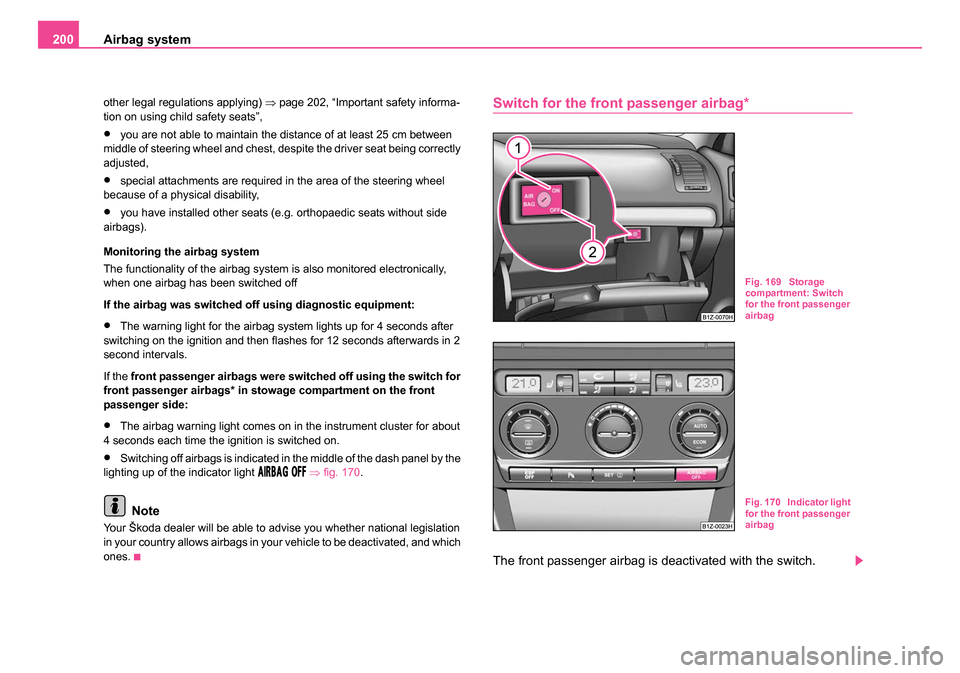
•Switching off airbags is indicated in the middle of the dash panel by the
lighting up of the indicator light ⇒ fig. 170 .
Note
Your Škoda dealer will be able to advise you whether national legislation
in your country allows airbags in your vehicle to be deactivated, and which
ones.
Switch for the front passenger airbag*
The front passenger airbag is deactivated with the switch.
Fig. 169 Storage
compartment: Switch
for the front passenger
airbag
Fig. 170 Indicator light
for the front passenger
airbag
s24s.book Page 200 Thursday, November 24, 2005 12:27 PM
Page 217 of 315
Intelligent Technology
216
The TCS warning light ⇒page 39 lights up in the instrument cluster when
there is a fault on the TCS.
Switching off
You can switch the TCS off and on again as you wish by pressing the
button ⇒page 215, fig. 181 . The TCS warning light ⇒page 39 lights up in
the instrument cluster when the TCS is switched off.
The TCS should normally always be switched on. It may be good practice
in certain exceptional cases, such as when you wish to have wheel slip,
to switch off the system.
Examples:
•when driving with snow chains
•when driving in deep snow or on a loose surface
•when it is necessary to rock a car free when it has become stuck
then you should switch on the TCS again.
WARNING
You should always adjust your style of driving to the conditions of
the road surface and the traffic situation. The increased safety
offered must not tempt you to take greater risks than otherwise -
risk of an accident!
Note
•All four wheels must be fitted with the same tyres in order to achieve
problem-free operation of the TCS. Differing rolling circumferences of the
tyres can lead to an undesirable reduction in the engine output.
•Changes to vehicle (e.g. on engine, on the brakes, on chassis or other
assignment of tyres and wheels) can influence the function of the TCS
⇒ page 270, “Accessories, changes and replacement of parts”.
Driver-steering recommendation*
The driver-steering recommendation is an additional function of the elec-
tronic stability programme (ESP). This function indicates to the driver in
critical situations by means of slight steering wheel impulses the direction
evaluated by the system, in which the vehicle must be steered, so that it
stabilizes. The driver-steering recommendation is active when braking
sharply on different road surfaces and on the right and left vehicle side.
WARNING
Even with this additional function the vehicle cannot be steered
automatically! The driver is furthermore fully reponsible for the
steering of the vehicle!
Brakes
What has a negative effect on braking efficiency?
Wear-and-tear
Wear-and-tear to the brake pads is greatly dependent on the operating
conditions of the vehicle and your style of driving. Particularly if you drive
a great deal in towns and over short distances or if you adopt a sporty style
of driving, it may be necessary to have the thickness of the brake pads
inspected at a specialist garage between the service inspections.
Wet roads or road salt
There may be a certain delay before the brakes take full effect under
certain conditions such as when driving through water, during heavy rain
showers or after the vehicle has been washed in an automatic vehicle
wash, since the brake discs and brake pads may be moist or even have a
coating of ice on them in winter. You should dry the brakes as soon as
s24s.book Page 216 Thursday, November 24, 2005 12:27 PM
Page 220 of 315
Intelligent Technology219
Using the systemSafetyDriving TipsGeneral MaintenanceBreakdown assistanceTechnical Data
The Brake Assist is activated by the very quick operation of the brake
pedal. In such cases, a much greater braking pressure exists than during
a normal brake application. This makes it possible, even with a relatively
low resistance of the brake pedal, to produce an adequate pressure in the
brake system in the shortest possible time, which is required for maximum
deceleration of the car. You must apply the brake pedal firmly and hold it
in this position in order to achieve the shortest possible braking distance.
The Brake Assist is able to help you achieve a shorter braking distance in
emergency situations by rapidly producing the pressure required in the
brake system. It fully exploits the attributes of the ABS. After you release
the brake pedal, the function of the Brake Assist is automatically switched
off and the brakes operate in the normal way.
The Brake Assist is part of the ESP system. If a fault occurs in the ESP,
the Brake Assist function is also not available. Further information on the
ESP
⇒page 213.
WARNING
•The Brake Assist is also not able to overcome the physical
limits of your car in terms of the braking distance required.
•Adapt your speed to the conditions of the road surface and to
the traffic situation.
•The increased safety offered by the Brake Assist must not tempt
you to take a greater safety risk than otherwise.
Uphill-Start off-Assist*
The uphill-start off-assist makes it much easier to start off on steep hills.
The system assists a start off by holding the brake pressure produced by
the brake pedal actuation for approx. 2 seconds after releasing the brake
pedal. The driver can therefore move his foot from the brake pedal to the accelerator pedal and start off on the slope, without having to actuate the
handbrake. The brake pressure drops gradually the more you operate the
accelerator pedal. If the vehicle does not start off within 2 seconds, it starts
to roll back.
The uphill-start off-assist is active in the event of a 5% slope, if the vehicle
door is closed. It is always active on slopes when in forward or reverse
start off. When driving downhill, it is inactive.
Electromechanical
power steering
The power steering enables you to steer the vehicle with less physical
force.
With the electromechanical power steering, the steering assist is automat-
ically adapted to the speed and to the steering angle.
It is still possible to fully steer the vehicle if the power steering fails or if the
engine is not running (vehicle being towed in). The only difference is that
greater physical effort is required.
If there is a fault in the power steering, a red or yellow warning light
lights up in the instrument cluster ⇒page 33.
WARNING
Contact your specialist garage if the power steering is defective.
s24s.book Page 219 Thursday, November 24, 2005 12:27 PM
Page 221 of 315
Intelligent Technology
220
Tyre inflation pressure-control system*
The tyre inflation pressure-control system compares with the aid of the
ABS sensors the speed and also the rolling circumference of the individual
wheels. If the rolling circumference of a wheel is changed, the warning
light
lights up in the dash panel insert ⇒page 38. The rolling circumfer-
ence of the tyre can change if:
•the tyre inflation pressure is too low,
•the structure of the tyre is damaged,
•the vehicle is loaded on one side,
•the wheels of an axle are loaded heavily (e.g. when towing a trailer or
when driving uphill or downhill),
•snow chains are mounted,
•the temporary spare wheel is mounted,
•one wheel per axle was changed. Basic setting of tyre inflation pressure-control system
After changing the tyre inflation pressures or after changing one or several
wheels, the button for the tyre inflation pressure-control system must be
pressed long enough until an acknowledegment tone sounds when the
ignition is switched on.
•Inflate all tyres to the specified inflation pressure
⇒page 264.
•Switch on the ignition.
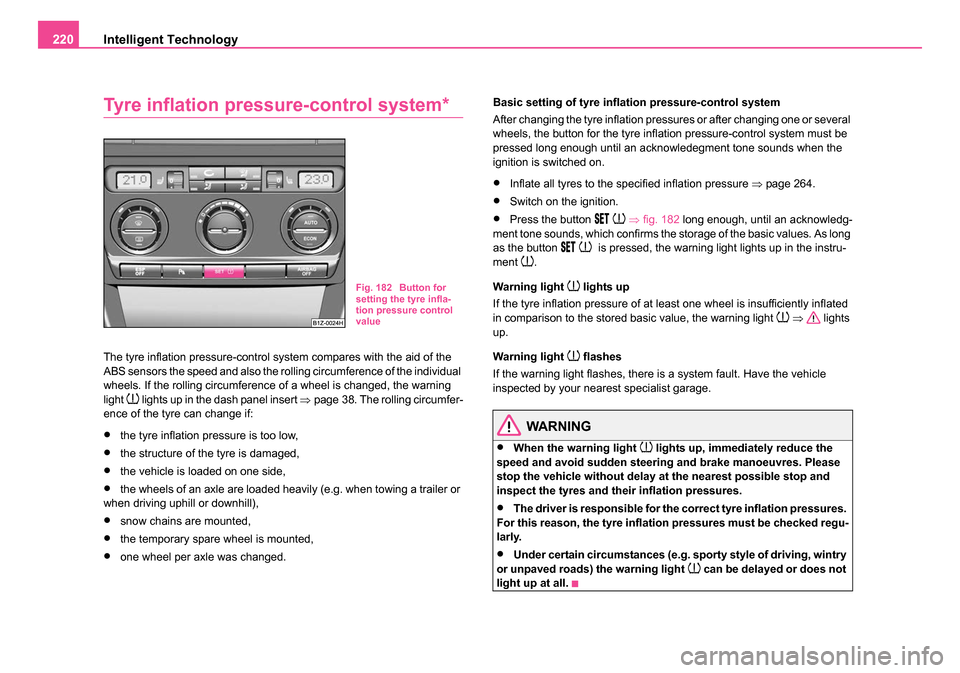
•Press the button ⇒ fig. 182 long enough, until an acknowledg-
ment tone sounds, which confirms the storage of the basic values. As long
as the button
is pressed, the warning light lights up in the instru-
ment .
Warning light
lights up
If the tyre inflation pressure of at least one wheel is insufficiently inflated
in comparison to the stored basic value, the warning light
⇒ lights
up.
Warning light
flashes
If the warning light flashes, there is a system fault. Have the vehicle
inspected by your nearest specialist garage.
WARNING
•When the warning light lights up, immediately reduce the
speed and avoid sudden steering and brake manoeuvres. Please
stop the vehicle without delay at the nearest possible stop and
inspect the tyres and their inflation pressures.
•The driver is responsible for the correct tyre inflation pressures.
For this reason, the tyre inflation pressures must be checked regu-
larly.
•Under certain circumstances (e.g. sporty style of driving, wintry
or unpaved roads) the warning light can be delayed or does not
light up at all.
Fig. 182 Button for
setting the tyre infla-
tion pressure control
value
s24s.book Page 220 Thursday, November 24, 2005 12:27 PM
Page 222 of 315
Driving and the Environment221
Using the systemSafetyDriving TipsGeneral MaintenanceBreakdown assistanceTechnical Data
Driving and the Environment
The first 1 500 kilometres and then
afterwards
A new engine
The engine has to be run in during the first 1 500 kilome-
tres.
Up to 1 000 kilometres
– Do not drive faster than 3/4 of the mamimum speed of the gear
in use, that is 3/4 of the maximum permissible engine speed.
– Do not use full throttle.
– Avoid high engine revolutions.
– Do not tow a trailer.
From 1 000 up to 1 500 kilometres
– Increase the power output of the engine gradually up to the
full speed of the gear engaged, that is up to the maximum
permissible engine revolutions.
During the first operating hours the engine has higher internal friction than
later until all of the moving parts have harmonized. The driving style which
you adopt during the first approx.1 500 kilometres plays a decisive part in
the success of running in your car.
You should not drive at unnecessarily high engine revolutions even
after the running-in period is complete. The maximum permissible engine speed is marked by the beginning of the red zone on the scale of the revo-
lutions counter. Shift up into the next higher gear on a vehicle fitted with
manual gearbox before the red zone is reached.
Extremely high engine
revolutions are automatically governed, by the way.
For a vehicle fitted with a manual gearbox the converse situation also
applies: Do not drive at engine revolutions which are too low. Shift down
as soon as the engine is no longer running smoothly.
Caution
All the speed and engine revolution figures apply only when the engine is
at its normal operating temperature. Never rev up an engine which is cold,
neither when the vehicle is stationary nor when driving in individual gears.
For the sake of the environment
Not driving at unnecessarily high engine revolutions and shifting to a
higher gear as early as possible are ways to minimise fuel consumption
and operating noise levels and protects the environment.
New tyres
New tyres have to be “run in” since they do not offer optimal grip at first.
You should take account of this fact for the first 500 kilometres and drive
particularly carefully.
s24s.book Page 221 Thursday, November 24, 2005 12:27 PM
Page 223 of 315
Driving and the Environment
222
New brake pads
Allow for the fact that new brake pads do not achieve their full braking effi-
ciency until approximately 200 kilometres. New brake pads must be first
“run in” before they develop their optimal friction force. You can, however,
compensate for this slightly reduced braking force by increasing the pres-
sure on the brake pedal.
This guideline also applies to any new brake pads installed at a future
date.
During the running-in period, you should avoid excessive stresses on the
brakes. This includes, for example, violent braking, particularly from very
high speeds, and also when crossing mountain passes.
Catalytic converter
Proper operation of the emission control system (catalytic
converter) is of major significance for driving your vehicle
in an environmentally conscious way.
Please refer to the following guidelines:
– For vehicles with petrol engine only refuel with unleaded petrol
⇒page 242, “Grades of petrol”.
– Never run the fuel tank completely empty.
– Do not switch off the ignition while you are driving the vehicle.
– Do not pour too much oil into the engine ⇒page 252, “Replen-
ishing engine oil”. – Do not tow-start the vehicle over a distance of more than 50
metres ⇒page 286, “Tow-starting a vehicle”.
If you drive your vehicle in a country in which unleaded petrol is not avail-
able, you must have the catalytic converter replaced later when driving the
vehicle into a country in which use of a catalytic converter is mandatory.
WARNING
•In view of the high temperatures which may be produced in the
catalytic converter, one should always park a vehicle in such a way
that the catalytic converter cannot come into contact with easily
flammable materials below the vehicle - a risk of fire!
•Never use additional underbody protection or corrosion-protec-
tion agents for the exhaust pipes, catalytic converters or heat
shields. Such substances might ignite when driving - risk of fire!
Caution
•Vehicles fitted with catalytic converter should never be allowed to let
the fuel tank to run completely empty. An irregular fuel supply can result
in poor ignition or misfiring. Unburnt fuel may get into the exhaust system
and damage the catalytic converter.
•Filling the tank even only once with leaded petrol will result in the cata-
lytic converter being destroyed.
•If you detect misfiring, a drop in performance or irregular engine
running when driving, reduce your speed immediately and have the
vehicle inspected by the nearest specialist garage. The symptoms
described may be caused by a fault in the ignition system. Unburnt fuel
may get into the exhaust system and damage the catalytic converter.
s24s.book Page 222 Thursday, November 24, 2005 12:27 PM
Page 224 of 315
Driving and the Environment223
Using the systemSafetyDriving TipsGeneral MaintenanceBreakdown assistanceTechnical Data
For the sake of the environment
Even if the exhaust system is operating properly, a sulphur-like exhaust
odour may be produced under certain operating conditions of the engine.
This depends on the sulphur content of the fuel. It is often sufficient to
refuel with unleaded premium-grade petrol of a different brand or at a
different filling station.
Driving in an economical and
environmentally conscious manner
General
Your personal style of driving is a major factor.
Your fuel consumption, any pollution of the environmental and the wear-
and-tear to the engine, brakes and tyres, depend essentially on three
factors:
•your personal style of driving,
•the conditions under which your vehicle is operated,
•technical aspects.
You can easily improve your fuel economy by 10 - 15 percent by driving
in an economical way with foresight. This section is intended to provide
you with a number of tips on how to protect the environment and at the
same time save money.
The fuel consumption can naturally also be influenced by factors which
are beyond the driver's control. It is, for example, normal for the fuel
consumption to increase in winter and under worsened conditions such as
poor road conditions, towing a trailer, etc. The technical requirements for low fuel usage and economic efficiency of
the vehicle have already been built into the vehicle at the works. Special
attention has been given to minimising negative effects on the environ-
ment. It is necessary to take note of the guidelines given in this chapter in
order to make best use of these characteristics and to maintain their
effectiveness.
Looking ahead when driving
A vehicle's highest fuel consumption occurs when it accel-
erates.
Avoid accelerating and braking unnecessarily. If you drive with forsight
you will not need to brake so often and will also then not have to accel-
erate so much. Let your vehicle coast to a stop, for example, if this is
possible, when you see that the next set of traffic lights is at red.
s24s.book Page 223 Thursday, November 24, 2005 12:27 PM
Page 227 of 315
Driving and the Environment
226
Avoid driving short distances
Short distances result in an above-average high fuel
consumption.
– Avoid driving a distance of no more than 4 km if the engine is
cold.
The engine and catalytic converter must first have reached their optimal
operating temperature in order to effectively reduce fuel consumption
and pollutant emissions.
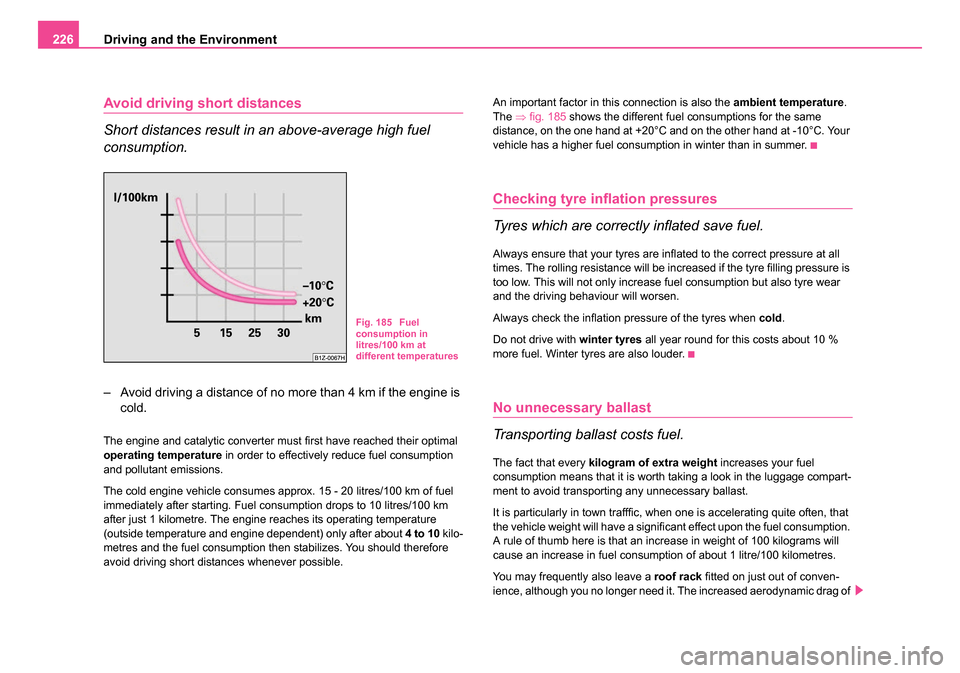
The cold engine vehicle consumes approx. 15 - 20 litres/100 km of fuel
immediately after starting. Fuel consumption drops to 10 litres/100 km
after just 1 kilometre. The engine reaches its operating temperature
(outside temperature and engine dependent) only after about 4 to 10 kilo-
metres and the fuel consumption then stabilizes. You should therefore
avoid driving short distances whenever possible. An important factor in this connection is also the
ambient temperature.
The ⇒fig. 185 shows the different fuel consumptions for the same
distance, on the one hand at +20°C and on the other hand at -10°C. Your
vehicle has a higher fuel consumption in winter than in summer.
Checking tyre inflation pressures
Tyres which are correctly inflated save fuel.
Always ensure that your tyres are inflated to the correct pressure at all
times. The rolling resistance will be increased if the tyre filling pressure is
too low. This will not only increase fuel consumption but also tyre wear
and the driving behaviour will worsen.
Always check the inflation pressure of the tyres when cold.
Do not drive with winter tyres all year round for this costs about 10 %
more fuel. Winter tyres are also louder.
No unnecessary ballast
Transporting ballast costs fuel.
The fact that every kilogram of extra weight increases your fuel
consumption means that it is worth taking a look in the luggage compart-
ment to avoid transporting any unnecessary ballast.
It is particularly in town trafffic, when one is accelerating quite often, that
the vehicle weight will have a significant effect upon the fuel consumption.
A rule of thumb here is that an increase in weight of 100 kilograms will
cause an increase in fuel consumption of about 1 litre/100 kilometres.
You may frequently also leave a roof rack fitted on just out of conven-
ience, although you no longer need it. The increased aerodynamic drag of
Fig. 185 Fuel
consumption in
litres/100 km at
different temperatures
s24s.book Page 226 Thursday, November 24, 2005 12:27 PM
Page 230 of 315
Towing a trailer229
Using the systemSafetyDriving TipsGeneral MaintenanceBreakdown assistanceTechnical Data
Towing a trailer
Towing a trailer
Technical requirements
The towing device must satisfy certain technical require-
ments.
Your vehicle is designed primarily for transporting persons and luggage.
It can, however, also be used for towing a trailer - provided certain tech-
nical equipment is fitted.
If your vehicle has already been supplied with a factory-fitted towing
device then everything that is necessary for towing a trailer in technical
terms, and in terms of the law, has already been taken into account.
Your vehicle is fitted with a 13-pin power socket for the electrical connec-
tion between the vehicle and trailer. If the trailer which you wish to tow has
a 7-pin connector , you can use a suitable adapter
10) from Škoda original
accessories.
This work must be carried out in accordance with the manufacturer's
specifications if a towing device is retrofitted.
Škoda dealers are familiar with details relating to retrofitting a towing
device and for any necessary modifications to the cooling system.
WARNING
We recommend that you have the towing device from Škoda orig-
inal accessories installed by a Škoda dealer. He is familiar with all
the relevant details relating to retrofitting such equipment. There is
a risk of an accident if the towing device is not properly fitted!
General Maintenance
There are a number of points to pay attention to when
towing a trailer.
Tr a i l e r l o a d
The permissible trailer load must on no account be exceeded.
You can negotiate appropriately steeper inclines and descents if you do
not make full use of the permissible trailer load.
The trailer loads specified only apply for altitudes up to 1 000 metres
above mean sea level. The fact that the engine power output drops with
increasing height due to a lowering of air pressure and thus the ability to
climb, means that the towed weight must be reduced by 10% for every
further increase of 1 000 metres in height above sea level. The towed
weight is the weight of the (laden) vehicle and the (laden) trailer together.
One should take this into account before driving up to higher altitudes.
The trailer and drawbar load information on the type plate of the
towing device are merely test data for the towing device The data
relating to your vehicle, which is often less than this test data, can
be found in your vehicle registration documents or in the brochure -
Technical Data .
10)In some countires the adapter is supplied with the towing device.
s24s.book Page 229 Thursday, November 24, 2005 12:27 PM