remove seats SKODA OCTAVIA 2005 1.G / (1U) Owner's Manual
[x] Cancel search | Manufacturer: SKODA, Model Year: 2005, Model line: OCTAVIA, Model: SKODA OCTAVIA 2005 1.G / (1U)Pages: 315, PDF Size: 11.8 MB
Page 89 of 315
Seats and Stowage
88
Removing and installi ng a head restraint
– Pull the head restraint up out of the backrest of the seat as far as the stop (on the rear head restraints fold forward the seat
backrest).
– Press the locking button in the direction of arrow ⇒ fig. 64 and
pull the head restraint out.
– To re-insert the head restraint, push it down into the backrest of the seat far enough until you hear the locking button
engage.
The head restraints of the front seats can be adjusted for angle and
height. The outer head restraints at the rear can only be adjusted for
height. The middle rear head restraint* is adjustable in two positions.
The head restraints must be adjusted to match the size of the seat occu-
pant. Correctly adjusted head restraints together with the seat belts offer
effective protection for the occupants ⇒page 179.
Active head restraints*
The front seats can be equipped with active head restraints, which protect
the occupants from injury to the cervical vertebra in the event of a rear
impact
WARNING
•The head restraints must be correctly adjusted in order to offer
effective protection for the occupants in the event of an accident.
•Do not drive under any circumstance with removed head
restraints - risk of injury!
•If the rear seats are occupied, the rear head restraint must not
be in the lower position.
Heating the front seats*
The seating and leaning surfaces of the front seats can be heated
when the ignition is switched on.
Front seats
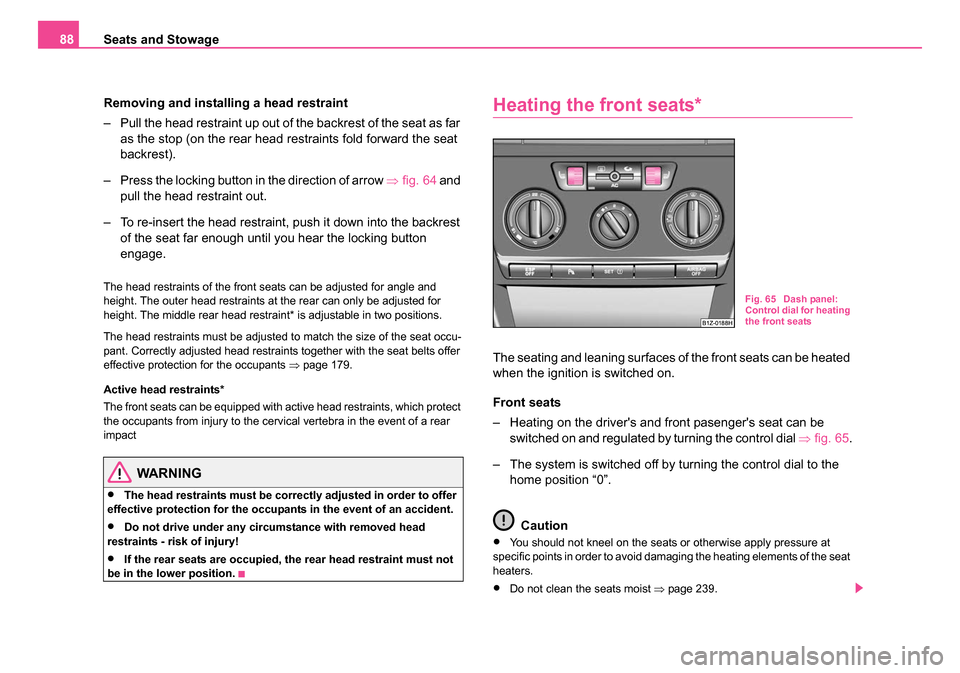
– Heating on the driver's and front pasenger's seat can be switched on and regulated by turning the control dial ⇒fig. 65.
– The system is switched off by turning the control dial to the home position “0”.
Caution
•You should not kneel on the seats or otherwise apply pressure at
specific points in order to avoid damaging the heating elements of the seat
heaters.
•Do not clean the seats moist ⇒page 239.
Fig. 65 Dash panel:
Control dial for heating
the front seats
s24s.book Page 88 Thursday, November 24, 2005 12:27 PM
Page 90 of 315
Seats and Stowage89
Using the systemSafetyDriving TipsGeneral MaintenanceBreakdown assistanceTechnical Data
Note
•The seat heating should only be switched on when the engine is
running. This has a significant effect of saving on the battery capacity.
•If the on-board voltage drops, the seat heating is switched off automat-
ically, in order to provide sufficient electrical energy for the engine
control.
Rear seats
Folding the rear seats forwards
To enlarge the luggage compartment, the rear seats can be
folded forwards, if necessary remove the rear seats. Both rear
seats can be folded forward individually on vehicles with divided
rear seats*.
Folding the rear seats forwards
– In order to avoid causing any damage when folding the rear seat forward it is important to adjust the front seats so that no
damage can occur when this is done.
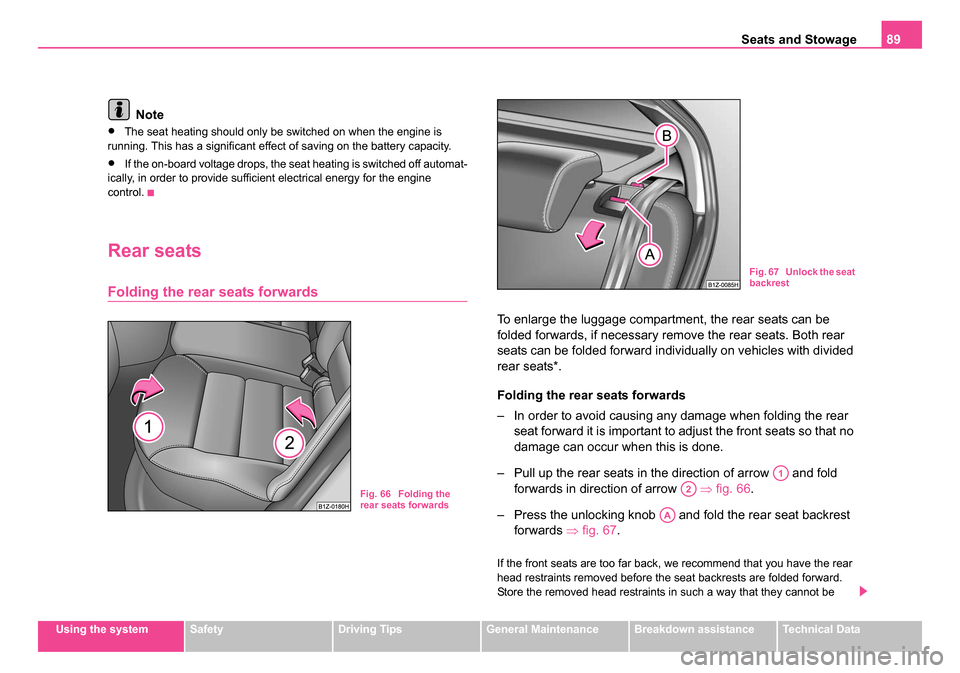
– Pull up the rear seats in the direction of arrow and fold forwards in direction of arrow ⇒ fig. 66.
– Press the unlocking knob and fold the rear seat backrest forwards ⇒fig. 67.
If the front seats are too far back, we recommend that you have the rear
head restraints removed before the seat backrests are folded forward.
Store the removed head restraints in such a way that they cannot be
Fig. 66 Folding the
rear seats forwards
Fig. 67 Unlock the seat
backrest
A1
A2
AA
s24s.book Page 89 Thursday, November 24, 2005 12:27 PM
Page 92 of 315
Seats and Stowage91
Using the systemSafetyDriving TipsGeneral MaintenanceBreakdown assistanceTechnical Data
Remove the rear seats
You can enlarge the luggage compartment on vehicles with
divided rear seats* by removing the rear seat.
Removing
– Fold the rear seats forwards completely
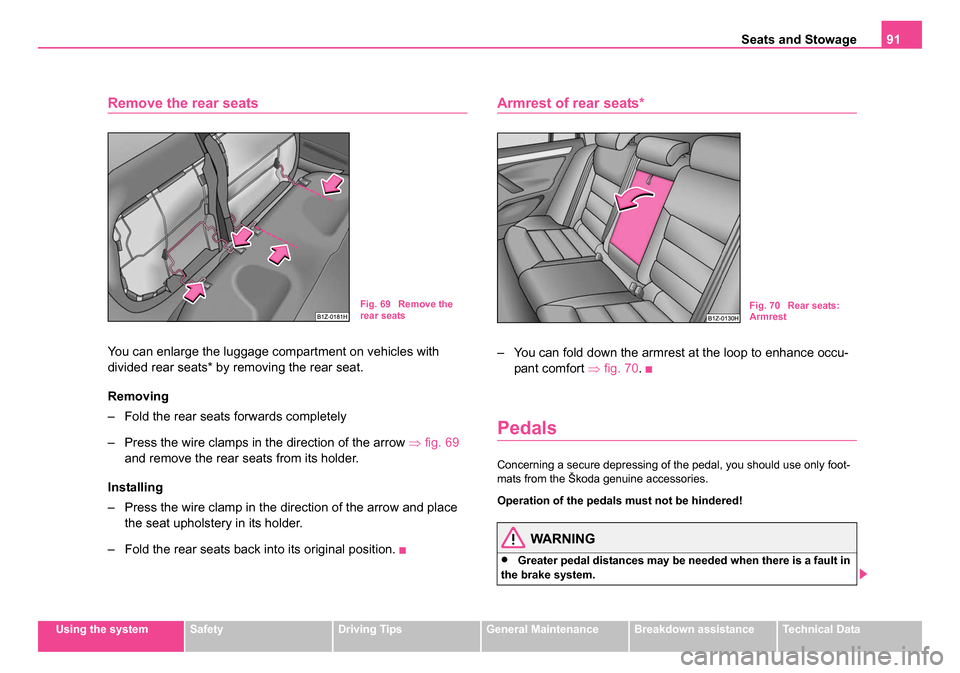
– Press the wire clamps in the direction of the arrow ⇒fig. 69
and remove the rear seats from its holder.
Installing
– Press the wire clamp in the direction of the arrow and place the seat upholstery in its holder.
– Fold the rear seats back into its original position.
Armrest of rear seats*
– You can fold down the armrest at the loop to enhance occu- pant comfort ⇒fig. 70 .
Pedals
Concerning a secure depressing of the pedal, you should use only foot-
mats from the Škoda genuine accessories.
Operation of the pedals must not be hindered!
WARNING
•Greater pedal distances may be needed when there is a fault in
the brake system.
Fig. 69 Remove the
rear seatsFig. 70 Rear seats:
Armrest
s24s.book Page 91 Thursday, November 24, 2005 12:27 PM
Page 98 of 315
Seats and Stowage97
Using the systemSafetyDriving TipsGeneral MaintenanceBreakdown assistanceTechnical Data
cover with a hook to the luggage compartment cover (Octavia)
⇒fig. 79 as
if one needs to reach the spare wheel or to the frame of the boot lid (estate
car) ⇒fig. 80 .
Luggage net* (Octavia)
The luggage net is designed for the tranportation of lighter objects.
WARNING
•In the luggage net you must only store objects (up to a total
weight of 1.5 kg). Heavy objects are not secured sufficiently - risk
of injury!
•No objects with sharp edges should be stored in the luggage
net, because they can damage the luggage net.
Luggage compartment cover* (Octavia)
You can use the luggage compartment cover behind the
head restraints for storing light and soft items.
The luggage compartment cover can be removed as required if
one must transport bulky goods.
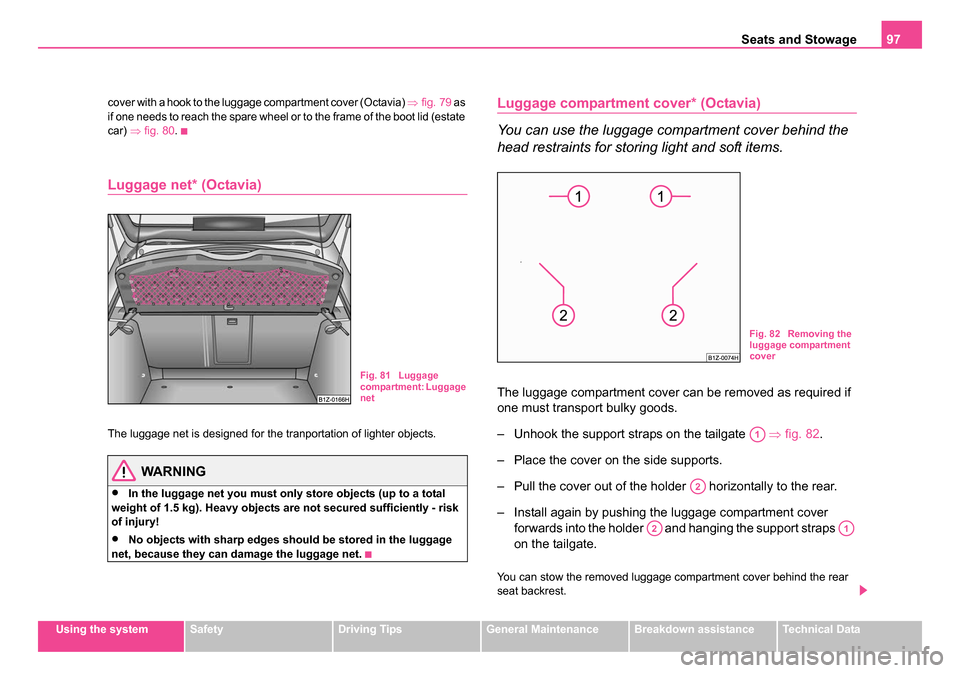
– Unhook the support straps on the tailgate ⇒fig. 82.
– Place the cover on the side supports.
– Pull the cover out of the holder horizontally to the rear.
– Install again by pushing the luggage compartment cover forwards into the holder and hanging the support straps
on the tailgate.
You can stow the removed luggage compartment cover behind the rear
seat backrest.
Fig. 81 Luggage
compartment: Luggage
net
Fig. 82 Removing the
luggage compartment
cover
A1
A2
A2A1
s24s.book Page 97 Thursday, November 24, 2005 12:27 PM
Page 99 of 315
Seats and Stowage
98
WARNING
No objects should be placed on the luggage compartment cover,
the vehicle occupants could be endangered if there is sudden
braking or the vehicle collides with something.
Caution
Please ensure that the heating elements of the rear window heater are not
damaged as a result of objects placed in this area.
Note
Opening the tailgate also lifts up the luggage compartment cover.
Luggage compartment cover (estate car)
Unrolling
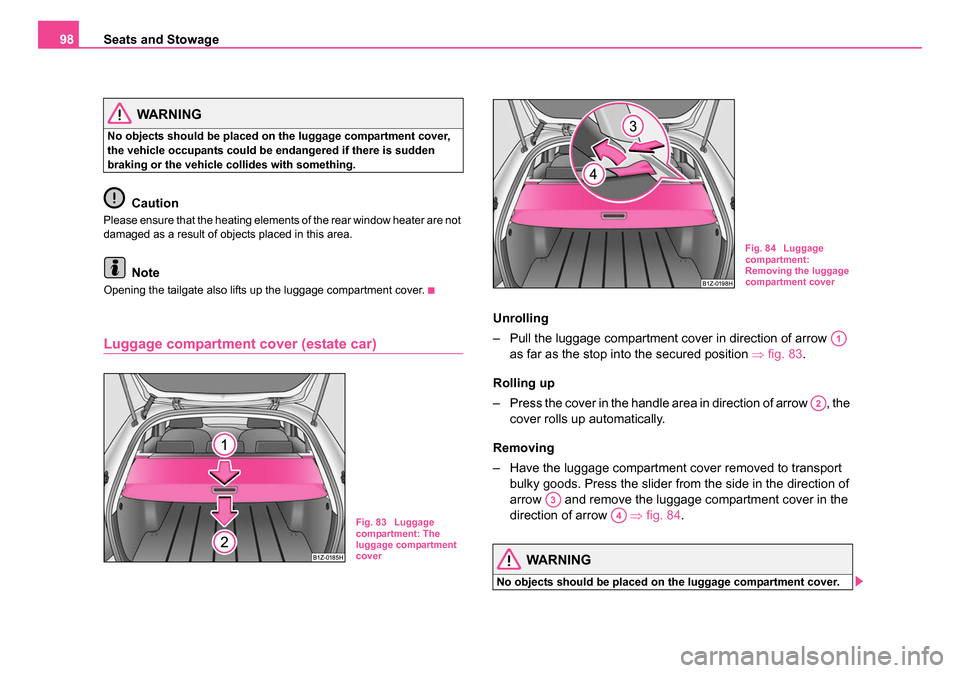
– Pull the luggage compartment cover in direction of arrow
as far as the stop into the secured position ⇒fig. 83.
Rolling up
– Press the cover in the handle area in direction of arrow , the cover rolls up automatically.
Removing
– Have the luggage compartment cover removed to transport bulky goods. Press the slider from the side in the direction of
arrow and remove the luggage compartment cover in the
direction of arrow ⇒fig. 84 .
WARNING
No objects should be placed on the luggage compartment cover.
Fig. 83 Luggage
compartment: The
luggage compartment
cover
Fig. 84 Luggage
compartment:
Removing the luggage
compartment cover
A1
A2
A3
A4
s24s.book Page 98 Thursday, November 24, 2005 12:27 PM
Page 101 of 315
Seats and Stowage
100
– Pull the cross rod back slightly, first on the one side then on the other side and take the cross rod out of the mount
⇒page 99, fig. 86 .
– Hold the cross rod in such a way that the net partition can roll
up slowly and without damage into housing .
– Fold the stowage compartment cover downwards.
If you wish to use the entire luggage compartment, you can remove the
luggage compartment cover ⇒ page 98, fig. 83.
WARNING
•First check for yourself that the cross road is inserted into the
mounts in the front position!
•Pay attention that the rear seat backrest is correctly interlocked.
It is only then that the three-point seat belt for the middle seat can
reliably fulfil its function.
Use behind the front seats
Unrolling
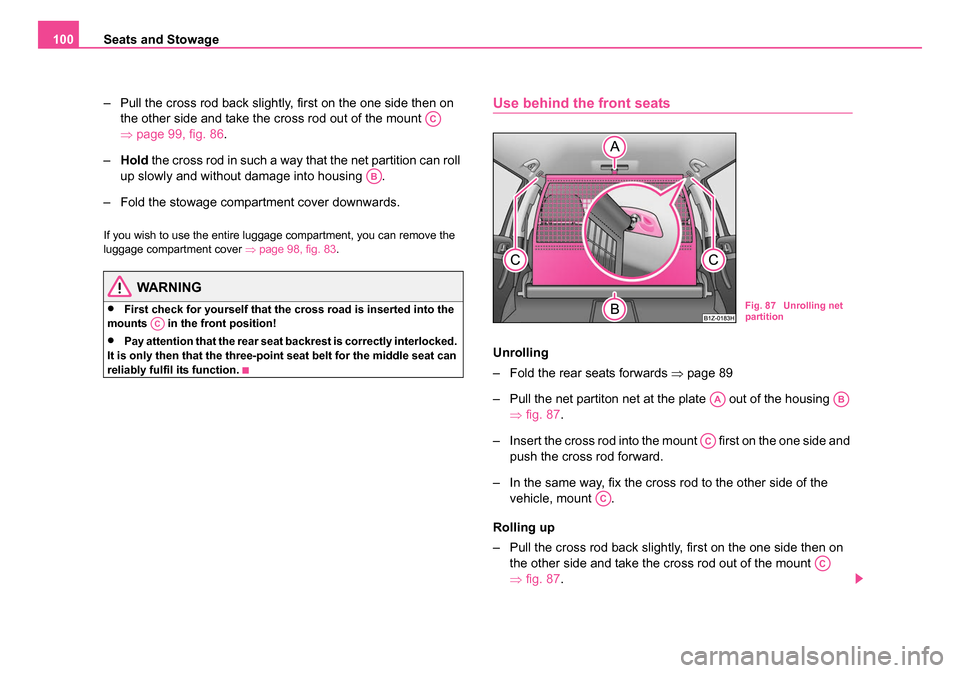
– Fold the rear seats forwards ⇒page 89
– Pull the net partiton net at the plate out of the housing ⇒fig. 87.
– Insert the cross rod into the mount first on the one side and push the cross rod forward.
– In the same way, fix the cross rod to the other side of the vehicle, mount .
Rolling up
– Pull the cross rod back slightly, first on the one side then on the other side and take the cross rod out of the mount
⇒fig. 87.
AC
AB
AC
Fig. 87 Unrolling net
partition
AAAB
AC
AC
AC
s24s.book Page 100 Thursday, November 24, 2005 12:27 PM
Page 105 of 315
Seats and Stowage
104
Cup holder in rear centre console*
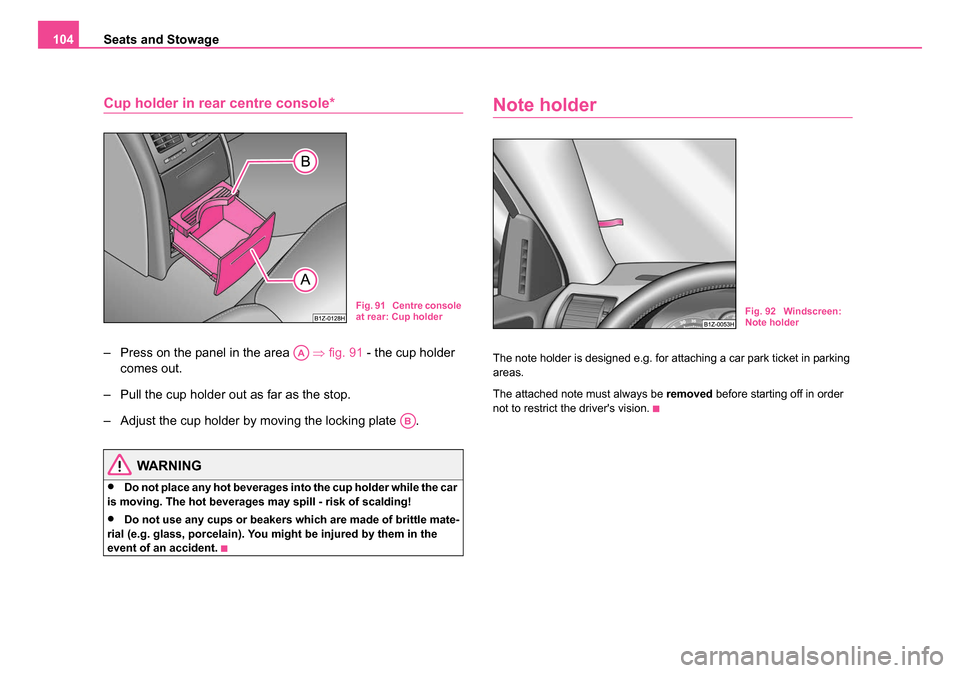
– Press on the panel in the area ⇒fig. 91 - the cup holder
comes out.
– Pull the cup holder out as far as the stop.
– Adjust the cup holder by moving the locking plate .
WARNING
•Do not place any hot beverages into the cup holder while the car
is moving. The hot beverages may spill - risk of scalding!
•Do not use any cups or beakers which are made of brittle mate-
rial (e.g. glass, porcelain). You might be injured by them in the
event of an accident.
Note holder
The note holder is designed e.g. for attaching a car park ticket in parking
areas.
The attached note must always be removed before starting off in order
not to restrict the driver's vision.
Fig. 91 Centre console
at rear: Cup holder
AA
AB
Fig. 92 Windscreen:
Note holder
s24s.book Page 104 Thursday, November 24, 2005 12:27 PM
Page 108 of 315
Seats and Stowage107
Using the systemSafetyDriving TipsGeneral MaintenanceBreakdown assistanceTechnical Data
Using the cigarette lighter
– Press in the button of the cigarette lighter ⇒page 106, fig. 96 .
– Wait until the button jumps forward.
– Remove the cigarette lighter immediately and use it.
– Insert the cigarette lighter again into the socket.
Using the power socket
– Take out the cigarette lighter.
– Insert the plug of the electrical appliance into the socket of the cigarette lighter.
The 12 volt power socket can also be used to supply power to electrical
accessories with a power uptake up to 180 watts.
WARNING
•Take care when using the cigarette lighter! Not paying proper
attention or incorrect use the cigarette lighter in an uncontrolled
manner may result in burns.
•The cigarette lighter and the power socket also operates when
the ignition is switched off or the ignition key withdrawn. You
should therefore never leave children unattended in the vehicle.
Caution
Always use matching plugs to avoid damaging the power sockets.
Note
•Connecting electrical components when the engine is not
running will drain the battery of the vehicle - risk of battery draining!
•Further information ⇒page 270, “Accessories, changes and replace-
ment of parts”.
Power socket in the luggag e compartment (estate car)
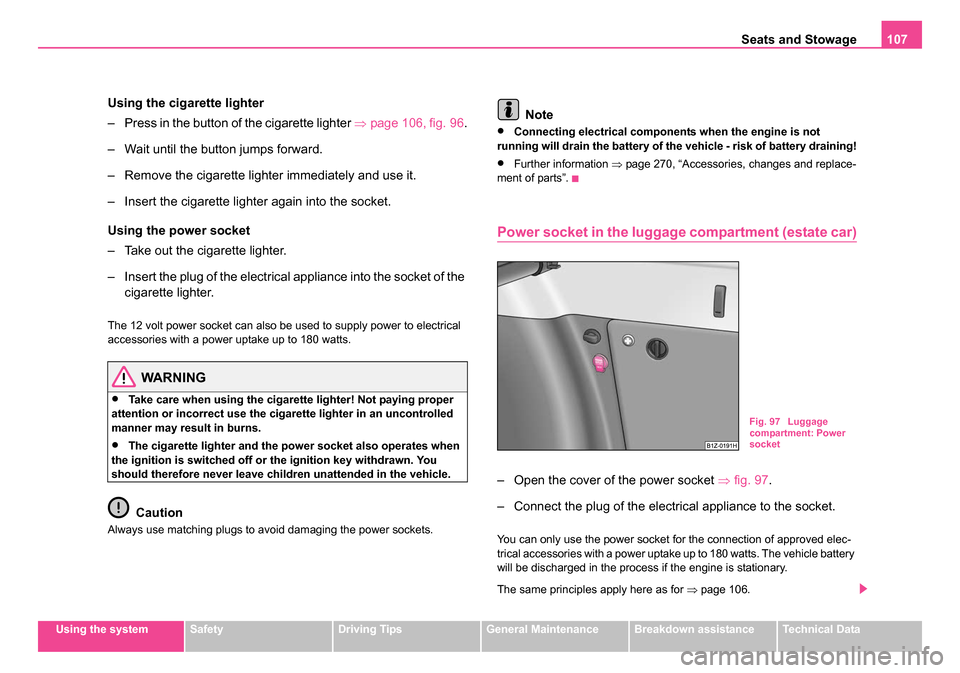
– Open the cover of the power socket ⇒fig. 97.
– Connect the plug of the electrical appliance to the socket.
You can only use the power socket for the connection of approved elec-
trical accessories with a power uptake up to 180 watts. The vehicle battery
will be discharged in the process if the engine is stationary.
The same principles apply here as for ⇒page 106.
Fig. 97 Luggage
compartment: Power
socket
s24s.book Page 107 Thursday, November 24, 2005 12:27 PM
Page 114 of 315
Seats and Stowage113
Using the systemSafetyDriving TipsGeneral MaintenanceBreakdown assistanceTechnical Data
Opening stowage compartment
– Open the lid of the armrest in the direction of arrow
⇒page 112, fig. 106 .
Closing stowage compartment
– Open the lid up to the stop, then you can fold it downwards.
Setting height
– First of all fold the lid to the bottom and lift it in the direction of arrow into one of the 4 fixed positions.
Adjusting in forward/back direction
– Push the lid into the desired position.
Opening air inlet
– Pull the lock in upward direction ⇒page 112, fig. 107 .
Closing air inlet
– Push the lock as far as the stop downwards.
On vehicles fitted with air conditioning, the storage compartment is
equipped with a lockable inlet for thermally treated (warmed-up) air.
At open air supply, air flows into the storage with a temperature which is
as high as the one out of the air outlet nozzles, depending on temperature
setting.
The air inlet in the storage compartment is connected to position
through adjustment of the control dial for air distribution. This position
causes the maximum amount of air to flow into the storage compartment
(depending on the rotary regulator position for the fan). You can use the storage compartment, for example, to temper drinks
cans, etc.
If you do not use the air inlet in the storage compartment, the end
cover should always be kept closed.
Note
Push the lid of the armrest up to stop to the rear before operating the
handbrake.
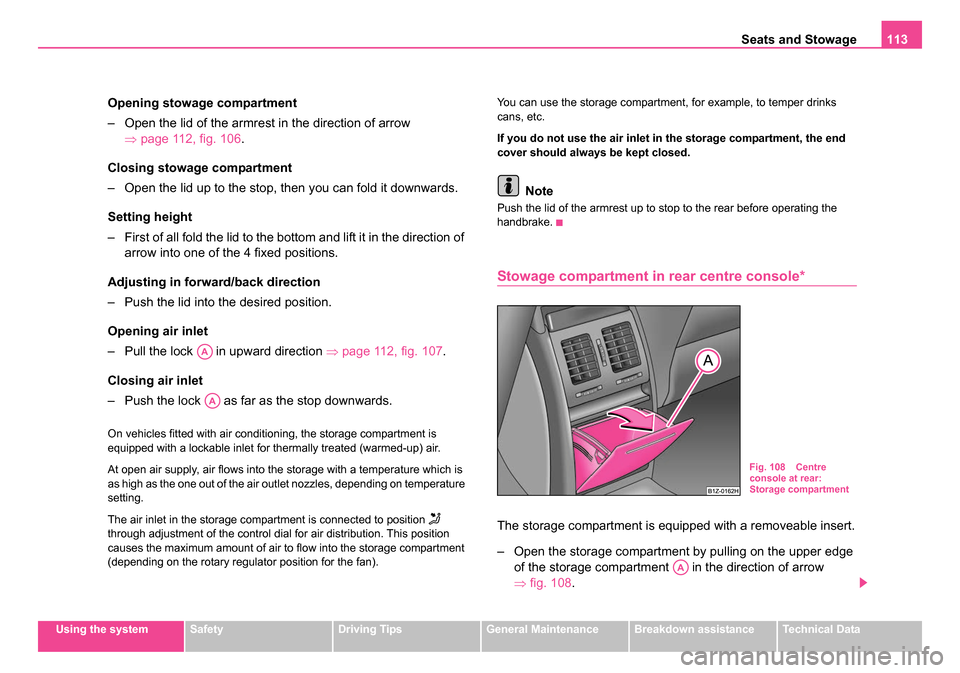
Stowage compartment in
rear centre console*
The storage compartment is equipped with a removeable insert.
– Open the storage compartment by pulling on the upper edge
of the storage compartment in the direction of arrow
⇒fig. 108.
AA
AA
Fig. 108 Centre
console at rear:
Storage compartment
AA
s24s.book Page 113 Thursday, November 24, 2005 12:27 PM
Page 118 of 315
Seats and Stowage117
Using the systemSafetyDriving TipsGeneral MaintenanceBreakdown assistanceTechnical Data
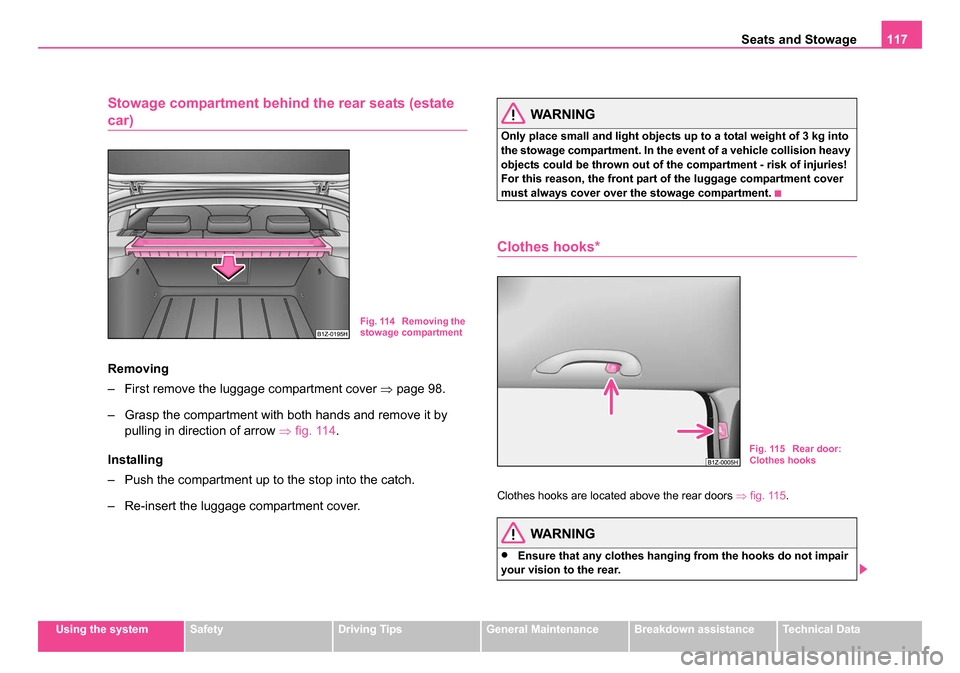
Stowage compartment behind the rear seats (estate
car)
Removing
– First remove the luggage compartment cover ⇒page 98.
– Grasp the compartment with both hands and remove it by pulling in direction of arrow ⇒fig. 114 .
Installing
– Push the compartment up to the stop into the catch.
– Re-insert the luggage compartment cover.
WARNING
Only place small and light objects up to a total weight of 3 kg into
the stowage compartment. In the event of a vehicle collision heavy
objects could be thrown out of th e compartment - risk of injuries!
For this reason, the front part of the luggage compartment cover
must always cover over the stowage compartment.
Clothes hooks*
Clothes hooks are located above the rear doors ⇒fig. 115 .
WARNING
•Ensure that any clothes hanging from the hooks do not impair
your vision to the rear.
Fig. 114 Removing the
stowage compartment
Fig. 115 Rear door:
Clothes hooks
s24s.book Page 117 Thursday, November 24, 2005 12:27 PM