fuel cap SKODA OCTAVIA 2006 Owner´s Manual
[x] Cancel search | Manufacturer: SKODA, Model Year: 2006, Model line: OCTAVIA, Model: SKODA OCTAVIA 2006Pages: 218, PDF Size: 5.48 MB
Page 189 of 218
Driver of the tow vehicle
›
Release the clutch particularly gently when starting off or depress the accelera-
tor particularly gently if the vehicle is fitted with an automatic gearbox.
› On vehicles with a manual transmission, only push down on the accelerator
pedal once the rope is taught.
The maximum towing speed is 50 km/h.
Driver of the towed vehicle
› Switch on the ignition so that the steering wheel is not blocked and so that the
turn signal lights, horn, windscreen wipers and windscreen washer system can
be switched on.
› Take the vehicle out of gear or move the selector lever into position
N if the
vehicle is fitted with an automatic gearbox.
Please note that the brake servo unit and power steering only operate if the en-
gine is running. If the engine is not running, significantly more physical force is re-
quired to depress the brake pedal and steer the vehicle.
If using a tow rope, ensure that it is always kept taught. CAUTION
■ Do not tow start the engine - danger of damaging the engine! On vehicles with
a catalytic converter, unburnt fuel may get into the catalytic converter where it
may ignite. This in turn may damage or destroy the catalytic converter. The bat-
tery from another vehicle can be used as a jump-start aid » page 185, Jump-start-
ing .
■ If the gearbox of your vehicle no longer contains any oil because of a defect,
your vehicle must only be towed in with the driven wheels raised clear of the
ground, or on a special vehicle transporter or trailer.
■ The vehicle must be transported on a special vehicle or trailer if it is not possible
to tow in the vehicle in the way described or if the towing distance is greater than
50 km. ■ To protect both vehicles when tow-starting or towing, the tow rope should be
elastic. Thus one should only use plastic fibre rope or a rope made out of a simi-
larly elastic material.
■ One should be constantly vigilant not to allow impermissibly high towing forces
or jerky loadings. There is always a risk of excessive stresses and damage result-
ing at the points to which you attach the tow rope or tow bar when you attempt
to tow a vehicle which is not standing on a paved road.
■ Attach the tow rope or the tow bar to the towing eyes or to the detachable ball
head of the towing device » page 187
or » page 188. Note
■ We recommend using a tow rope from
ŠKODA Original Accessories available
from a ŠKODA Service Partner. ■ Towing another vehicle requires a certain amount of practice. Both drivers
should be familiar with the particular points about towing a vehicle. Unskilled
drivers should not attempt to tow in another vehicle or to be towed in. ■ When towing, respect the national legal provisions, especially those which re-
late to the identification of the towing vehicle and the vehicle being towed. ■ The tow rope must not be twisted as it may in certain circumstances result in
the front towing eye being unscrewed out of your vehicle. Ð Front towing eye
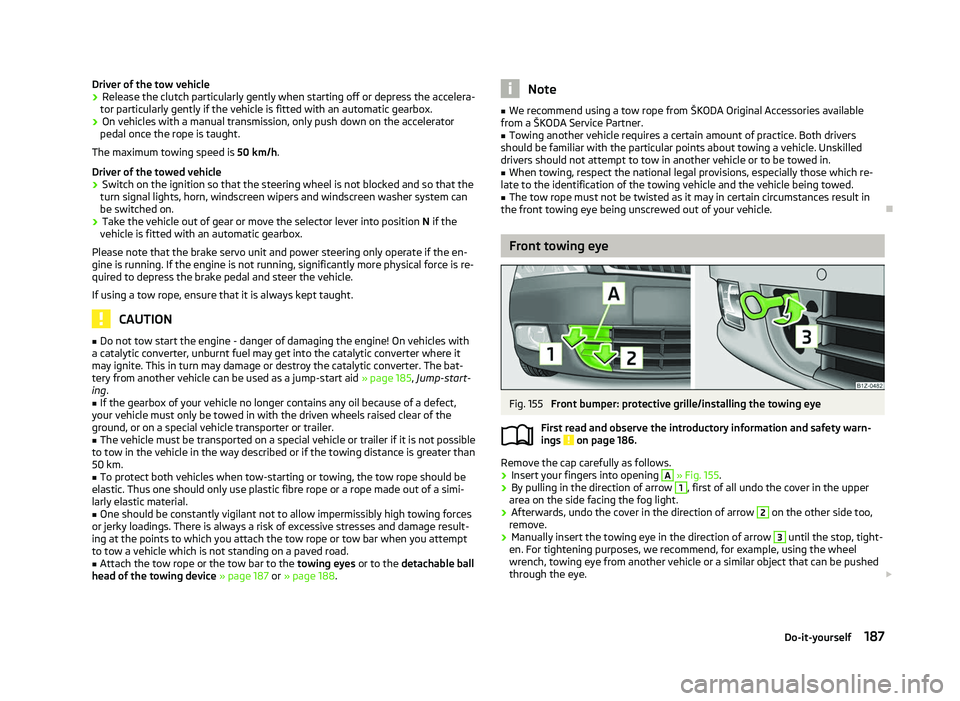
Fig. 155
Front bumper: protective grille/installing the towing eye
First read and observe the introductory information and safety warn-
ings on page 186.
Remove the cap carefully as follows.
›
Insert your fingers into opening A
» Fig. 155 .
› By pulling in the direction of arrow 1
, first of all undo the cover in the upper
area on the side facing the fog light.
› Afterwards, undo the cover in the direction of arrow 2
on the other side too,
remove.
› Manually insert the towing eye in the direction of arrow 3
until the stop, tight-
en. For tightening purposes, we recommend, for example, using the wheel
wrench, towing eye from another vehicle or a similar object that can be pushed
through the eye. £
ä
187
Do-it-yourself
Page 199 of 218
Technical data
Technical data
Introductory information
The details given in the vehicle's technical documentation always take prece-
dence over the details in the Owner's Manual. Please refer to the official vehicle
registration documents or consult a
ŠKODA Service Partner to determine which
engine your vehicle is equipped with.
The listed performance values were determined without performance-reducing
equipment, e.g. air conditioning system.
Vehicle identification number (VIN)
The vehicle identification number - VIN (vehicle body number) is stamped into the
engine compartment on the right hand suspension strut dome. This number is al-
so located on a sign on the lower left hand edge below the windscreen (together
with a VIN bar code).
Engine number
The engine number is stamped into the engine block. ÐData on the vehicle data sticker and the type plate
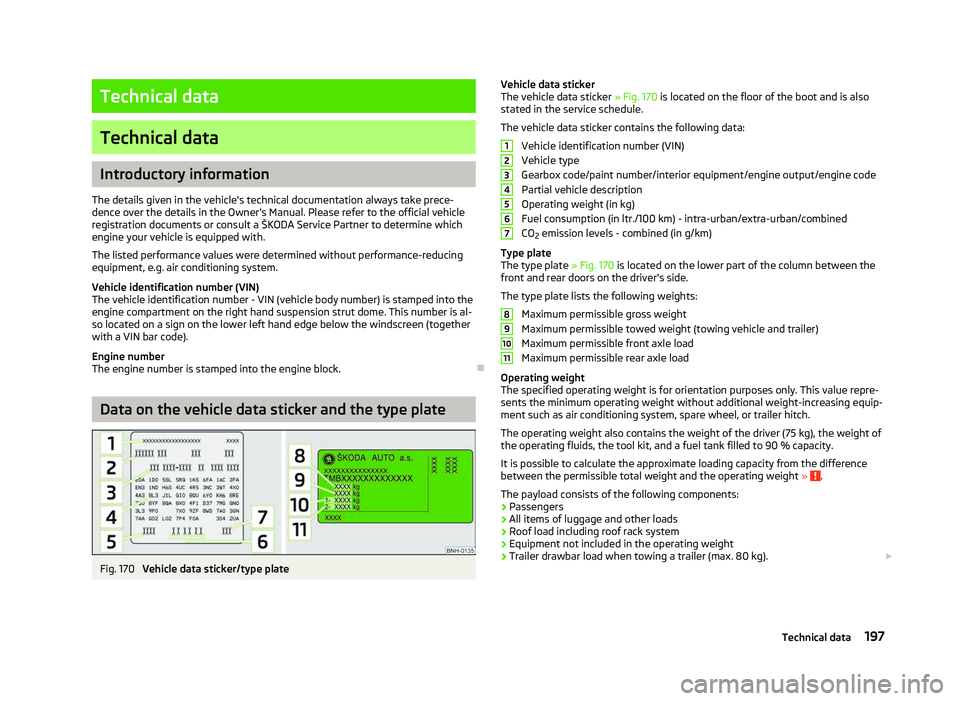
Fig. 170
Vehicle data sticker/type plate Vehicle data sticker
The vehicle data sticker
» Fig. 170 is located on the floor of the boot and is also
stated in the service schedule.
The vehicle data sticker contains the following data:
Vehicle identification number (VIN)
Vehicle type
Gearbox code/paint number/interior equipment/engine output/engine code
Partial vehicle description
Operating weight (in kg)
Fuel consumption (in ltr./100
km) - intra-urban/extra-urban/combined
CO 2 emission levels - combined (in g/km)
Type plate
The type plate » Fig. 170 is located on the lower part of the column between the
front and rear doors on the driver's side.
The type plate lists the following weights:
Maximum permissible gross weight
Maximum permissible towed weight (towing vehicle and trailer)
Maximum permissible front axle load
Maximum permissible rear axle load
Operating weight
The specified operating weight is for orientation purposes only. This value repre-
sents the minimum operating weight without additional weight-increasing equip-
ment such as air conditioning system, spare wheel, or trailer hitch.
The operating weight also contains the weight of the driver (75 kg), the weight of
the operating fluids, the tool kit, and a fuel tank filled to 90 % capacity.
It is possible to calculate the approximate loading capacity from the difference
between the permissible total weight and the operating weight » .
The payload consists of the following components:
› Passengers
› All items of luggage and other loads
› Roof load including roof rack system
› Equipment not included in the operating weight
› Trailer drawbar load when towing a trailer (max. 80 kg).
£ 1
2
3
4
5
6
7
8
9
10
11
197
Technical data
Page 202 of 218
Specifications and engine oil capacity
The engine has been factory-filled with a high-grade oil that can be use through-
out the year - except in extreme climate zones.
Various oils can be mixed together when refilling. However, this does not apply to
vehicles with flexible service intervals.
Engine oils are, of course, undergoing continuous further development. Thus the
information stated in this Owner's Manual is only correct at the time of publica-
tion.
ŠKODA Service Partners are informed about the latest changes by
ŠKODA. We
therefore recommend that the oil change is completed by a ŠKODA Service Part-
ner.
The specifications (VW standards) stated in the following can be indicated sepa-
rately or together with other specifications on the bottle.
The oil capacities include oil filter change. Check the oil level when filling; do not
over fill. The oil level must be between the markings » page 161.
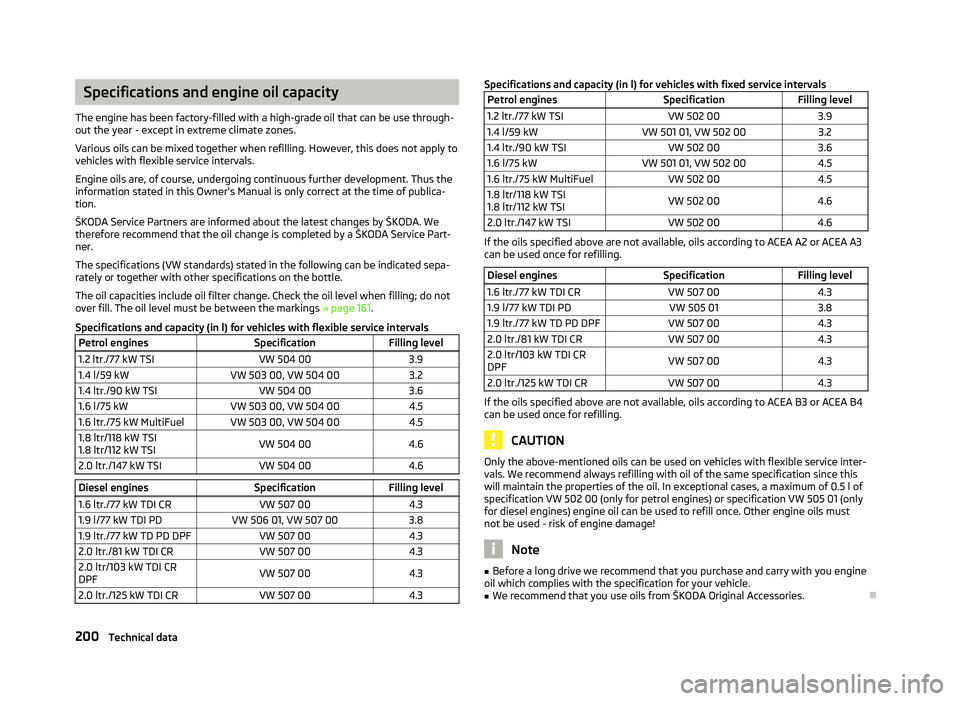
Specifications and capacity (in l) for vehicles with flexible service intervals Petrol engines SpecificationFilling level
1.2 ltr./77 kW TSI VW 504 003.9
1.4 l/59 kW VW 503 00, VW 504 00 3.2
1.4 ltr./90 kW TSI VW 504 003.6
1.6 l/75 kW VW 503 00, VW 504 00 4.5
1.6 ltr./75 kW MultiFuel VW 503 00, VW 504 00 4.5
1.8 ltr/118 kW TSI
1.8 ltr/112 kW TSI VW 504 00
4.6
2.0 ltr./147 kW TSI VW 504 004.6Diesel engines
SpecificationFilling level
1.6 ltr./77 kW TDI CR VW 507 004.3
1.9 l/77 kW TDI PD VW 506 01, VW 507 00 3.8
1.9 ltr./77 kW TD PD DPF VW 507 004.3
2.0 ltr./81 kW TDI CR VW 507 004.3
2.0 ltr/103 kW TDI CR
DPF VW 507 00
4.3
2.0 ltr./125 kW TDI CR VW 507 004.3 Specifications and capacity (in l) for vehicles with fixed service intervals
Petrol engines SpecificationFilling level
1.2 ltr./77 kW TSI VW 502 003.9
1.4 l/59 kW VW 501 01, VW 502 00 3.2
1.4 ltr./90 kW TSI VW 502 003.6
1.6 l/75 kW VW 501 01, VW 502 00 4.5
1.6 ltr./75 kW MultiFuel VW 502 004.5
1.8 ltr/118 kW TSI
1.8 ltr/112 kW TSI VW 502 00
4.6
2.0 ltr./147 kW TSI VW 502 004.6 If the oils specified above are not available, oils according to ACEA
A2 or ACEA A3
can be used once for refilling.
Diesel engines SpecificationFilling level
1.6 ltr./77 kW TDI CR VW 507 004.3
1.9 l/77 kW TDI PD VW 505 013.8
1.9 ltr./77 kW TD PD DPF VW 507 004.3
2.0 ltr./81 kW TDI CR VW 507 004.3
2.0 ltr/103 kW TDI CR
DPF VW 507 00
4.3
2.0 ltr./125 kW TDI CR VW 507 004.3 If the oils specified above are not available, oils according to ACEA
B3 or ACEA B4
can be used once for refilling. CAUTION
Only the above-mentioned oils can be used on vehicles with flexible service inter-
vals. We recommend always refilling with oil of the same specification since this
will maintain the properties of the oil. In exceptional cases, a maximum of 0.5
l of
specification VW 502 00 (only for petrol engines) or specification VW 505 01 (only
for diesel engines) engine oil can be used to refill once. Other engine oils must
not be used - risk of engine damage! Note
■ Before a long drive we recommend that you purchase and carry with you engine
oil which complies with the specification for your vehicle. ■ We recommend that you use oils from ŠKODA Original Accessories. Ð200
Technical data
Page 211 of 218
Checking
Battery electrolyte level 167
Brake fluid 164
Coolant level 163
Engine oil 161
Oil level 161
Windscreen washer fluid 165
Children and safety 135
Child safety Side airbag 136
Child safety lock 27
Child seat Classification 136
ISOFIX 137
on the front passenger seat 135
Suitability 137
TOP TETHER 137
Chrome parts refer to Taking care of your vehicle 150
Cigarette lighter 69
Cleaning 148
Artificial leather 153
Headlight lenses 151
Material coverings 153
Materials 153
Natural leather 153
Plastic parts 150
Wheels 152
Clock 11
Clothes hooks 77
Cockpit 12-volt power socket 70
Ashtray 68
Cigarette lighter 69
General view 7
Light 45
Storage compartments 70
Compartments 70
Computer see Multifunction display 12Coolant
Checking 163
Replenishing 163
Temperature gauge 9
Correct seated position 122
Counter for distance driven 10
Cruise control system (CCS) 99
D
Dash panel insert 8
Daylight driving light 40
Deactivating an airbag 133
Deactivating an airbag 133
Defrsoting rear window 47
Delayed locking of the boot lid see Boot lid 33
Diesel refer to Fuel 158
Diesel fuel Operation in winter 158
Diesel particulate filter 23
Digital clock 11
Dipstick 161
Display Coolant temperature 9
Service interval 10
Distance driven 10
Door Child safety lock 27
Warning light for an open door 20
Doors Emergency locking 32
Driving Abroad 143
Driving through water on the street 144
Emissions 197
Fuel consumption 197 E
Economical and environmentally friendly driving 140
EDS 97
Electrical power windows Button in the driver's door 34
Electric power windows Central locking system 36
Electric sliding/tilting roof 37
Electronic Differential Lock 97
Electronic immobiliser 92
Emergency Automatic gearbox 106
Changing a wheel 179
Hazard warning light system 44
Jump-starting 185
locking of the doors 32
Selector lever-unlocking 106
Sliding roof 38
Towing the vehicle 186
Tyre repair 182
Unlocking the boot lid 34
Emissions 197
Engine Running in 139
Starting and stopping the engine 91
Engine compartment Brake fluid 164
Coolant 162
Overview 160
Vehicle battery 165
Engine oil Capacity 200
Changing 162
Checking 161
Replenishing 161
Specification 200
Engine revolutions counter 9
Environment 140
Environmental compatibility 142
209
Index