fuel SKODA OCTAVIA 2006 Owner´s Manual
[x] Cancel search | Manufacturer: SKODA, Model Year: 2006, Model line: OCTAVIA, Model: SKODA OCTAVIA 2006Pages: 218, PDF Size: 5.48 MB
Page 145 of 218
›
The use of solvent-free adhesives.
› No CFCs used in the production process.
› Without use of mercury.
› Use of water-soluble paints.
Trade-in and recycling of old cars
ŠKODA
meets the requirements of the brand and its products with regard to pro-
tecting the environment and the preserving resources. All new ŠKODA vehicles
can be utilized up to 95 % and always 1)
be returned. In a lot of countries sufficient
trade-in networks have been created, where you can trade-in your vehicle. After
you trade-in your vehicle, you will receive a confirmation stating the recycling in
accordance with environmental regulations. Note
Detailed information about the trade-in and recycling of old cars is available from
a ŠKODA Service Partner. ÐDriving abroad
Introductory information
In certain countries it is also possible that the
ŠKODA Service Partner network is
limited or has not been established yet. This is the reason why procuring certain
spare parts may be somewhat complicated and specialist garages may only be
able to make limited repairs. ŠKODA in the Czech Republic and its importers are
happy to provide information about technical aspects of the vehicle, required
maintenance work and possibilities for getting repairs done. ÐUnleaded petrol
A vehicle fitted with a petrol engine must always be refuelled with unleaded pet-
rol » page 156, Unleaded petrol . Information regarding the locations of filling sta-
tions that offer unleaded petrol is, for example, provided by the automobile asso-
ciations. Ð Headlights
The low beam of your headlights is set asymmetrically. It illuminates the side of
the road on which the vehicle is being driven to a greater extent.
When driving in countries in which the traffic drives on the other side of the road
than in your home country, the asymmetrical low beam may dazzle oncoming
drivers. To prevent oncoming traffic from being dazzled, the headlights must be
adjusted by a
ŠKODA Service Partner.
Headlights with Xenon lights are adjusted in the menu of the information dis-
play » page 15, MAXI DOT (information display) . Note
Further information on adjusting the headlights is available from a ŠKODA Service
Partner. Ð Avoiding damage to your vehicle
To prevent damage to your vehicle, pay special attention: › When driving on poorly maintained roads and lanes
› When driving over kerb stones
› When driving up steep ramps
› So that any low-slung parts, such as the spoiler and exhaust, do not touch the
ground and get damaged
This particularly applies to models with a sport suspension and also when your
vehicle is fully laden. Ð1)
Subject to fulfilment of the national legal requirements.
143
Driving and the Environment
Page 157 of 218
Inspecting and replenishing
Fuel
ä
Introduction
This chapter contains information on the following subjects:
Refuelling 155
Unleaded petrol 156
Ethanol E85 157
Diesel fuel 158
The correct type of fuel for your vehicle and the tyre size and inflation pressure
are specified on the inside of the fuel filler flap » Fig. 129 on page 155 - . WARNING
The national legal requirements must be observed if carrying a spare canister
in the vehicle. We do not recommend carrying any fuel canisters in your vehi-
cle for safety reasons. In the event of an accident, the canister might be dam-
aged and fuel may leak out - risk of fire! CAUTION
■ Never drive until the fuel tank is completely empty! The irregular supply of fuel
can cause misfiring, which can result in considerable damage to parts of the en-
gine and exhaust system. ■ Immediately remove any fuel that has spilled onto the vehicle's paintwork - risk
of paint damage! Ð Refuelling
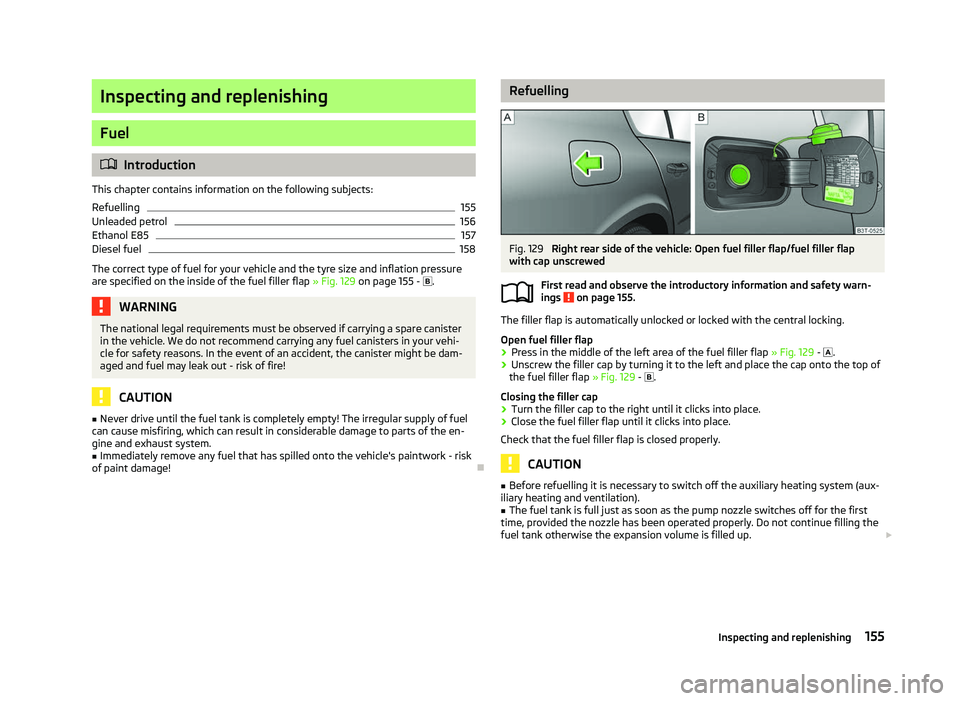
Fig. 129
Right rear side of the vehicle: Open fuel filler flap/fuel filler flap
with cap unscrewed
First read and observe the introductory information and safety warn-
ings on page 155.
The filler flap is automatically unlocked or locked with the central locking.
Open fuel filler flap
›
Press in the middle of the left area of the fuel filler flap
» Fig. 129 - .
› Unscrew the filler cap by turning it to the left and place the cap onto the top of
the fuel filler flap » Fig. 129 - .
Closing the filler cap
› Turn the filler cap to the right until it clicks into place.
› Close the fuel filler flap until it clicks into place.
Check that the fuel filler flap is closed properly. CAUTION
■ Before refuelling it is necessary to switch off the auxiliary heating system (aux-
iliary heating and ventilation).
■ The fuel tank is full just as soon as the pump nozzle switches off for the first
time, provided the nozzle has been operated properly. Do not continue filling the
fuel tank otherwise the expansion volume is filled up. £
ä
155
Inspecting and replenishing
Page 158 of 218
Note
The fuel tank has a capacity of about 55 litres or 60 litres1)
, containing a reserve of
approx. 7 litres . ÐUnleaded petrol
First read and observe the introductory information and safety warn-
ings on page 155.
Your vehicle can only be operated with
unleaded fuel that complies with the
standard EN 228 (in Germany: standard DIN 51626-1 or E10 for unleaded fuel with
an octane rating of 95 RON and 91 RON or DIN 51626-2 or E5 for unleaded fuel
with the octane rating 95 RON and 98 RON).
Prescribed fuel - unleaded fuel 95/91 RON
Use unleaded fuel with the octane rating 95 RON. Unleaded petrol 91 RON can al-
so be used but results in a slight loss in performance.
If, in an emergency, the vehicle has to be refuelled with petrol of a lower octane
number than the one prescribed, the journey must only be continued at medium
engine speeds and a low engine load. Driving at high engine revs or a high engine
load can severely damage the engine! Refuel using petrol of the prescribed oc-
tane number as soon as possible.
Prescribed fuel - unleaded petrol min. 95 RON
Use unleaded fuel with the octane rating 95 RON.
In case of necessity, you can refuel with petrol with the octane rating 91 RON if
petrol with the octane rating 95 RON is not available. The journey must only be
continued at medium engine speeds and a minimum engine load. Driving at high
engine revs or a high engine load can severely damage the engine! Refuel using
petrol of the prescribed octane number as soon as possible.
Even in the event of an emergency, petrol of a lower octane number than 91 RON
must not be used, otherwise the engine can be severely damaged!
Unleaded petrol with higher octane number
Unleaded petrol that has a higher octane number than that required by the en-
gine can be used without limitations.
ä
On vehicles with prescribed unleaded petrol
95/91 RON, the use of petrol with a
higher octane number than 95 RON does not result in a noticeable power in-
crease or a lower fuel consumption.
On vehicles using prescribed unleaded petrol of min. 95
RON, the use of petrol
with a higher octane number than 95 RON can increase the power and reduce
fuel consumption.
Prescribed fuel - unleaded petrol 98/(95) RON
Use unleaded fuel with the octane rating 98 RON. Unleaded petrol 95 RON can
also be used but results in a slight loss in performance.
In case of necessity, you can refuel with petrol with the octane rating 91 RON of
unleaded fuel with octane rating 98 RON or 95 RON is not available. The journey
must only be continued at medium engine speeds and a minimum engine load.
Driving at high engine revs or a high engine load can severely damage the engine!
Refuel using petrol of the prescribed octane number as soon as possible.
Even in the event of an emergency, petrol of a lower octane number than 91 RON
must not be used, otherwise the engine can be severely damaged!
Fuel additives
Only use unleaded petrol, which complies with the standard EN 228 (in Germany:
standard DIN 51626-1 or E10 for unleaded fuel with an octane rating of 95 RON
and 91 RON or DIN 51626-2 or E5 for unleaded fuel with an octane rating of
95 RON and 98 RON), as these meet all of the requirements for fault-free engine
operation. We therefore recommend that no fuel additives are used. CAUTION
■ All
ŠKODA vehicles with petrol engines must only be operated with unleaded
petrol. Just filling the tank with leaded petrol once will damage the exhaust sys-
tem!
■ Engine parts can be damaged if petrol with a lower octane number than the one
prescribed is used.
■ In no case may fuel additives with metal components be used, especially not
with manganese and iron content.
LRP (lead replacement petrol) fuels with met-
allic components may not be used. There is a risk of causing considerable damage
to parts of the engine or exhaust system! £1)
Valid for Octavia Combi 4x4 and Octavia Scout.
156 General Maintenance
Page 159 of 218

■
Fuels with metallic content may not be used. There is a risk of causing consider-
able damage to parts of the engine or exhaust system!
■ The use of unsuitable fuel additives can cause considerable damage to parts of
the engine or the exhaust system. ÐEthanol E85
Fig. 130
MultiFuel - power socket
First read and observe the introductory information and safety warn-
ings on page 155.
Only valid for vehicles with the 1.6/75°kW MultiFuel engine.
Biofuel Ethanol E85 consists of 85 % bioethanol and 15 % unleaded petrol com-
plying with the standard (DIN) EN°228.
Biofuel Ethanol E85 in accordance with the standard (DIN) EN
228 can be mixed in
any desired ratio with unleaded petrol.
Drive the vehicle for at least 5 minutes without interruption, if biofuel Ethanol
E85 has been refuelled, so that the engine control unit can determine the share
of the biofuel in the fuel. During this period do not drive at top speed of your ve-
hicle or high engine speeds and not at full throttle. During this process decrease
the idling speed.
Operation in winter
If you use biofuel Ethanol E85 at very low temperatures, it is necessary to preheat
the engine before an engine start.
The power socket for the engine preheating is located in the front bumper next
to the fog light » Fig. 130.
ä The outside temperature
Duration of engine preheating
Below -10 °C We recommend up to 1 hour
Below -15 ℃ at least 1 hours.
Below -25 °C at least 2 hours. If an engine preheating is not possible at outside temperatures below -10 °C, the
share of unleaded petrol complying with EN 228 must be as high as possible.
Thus the cold start property of the engine is clearly improved.
If there is biofuel Ethanol E85 in the tank and the engine is not preheated, it can
lead at temperatures below -15 °C to very poor or no starting of the engine. CAUTION
■ Just filling the tank once with diesel fuel that does not comply with the stand-
ard, can cause severe damage to parts of the engine, the fuel and exhaust sys-
tem!
■ If you park the car for a lengthy period, fill with petrol complying with (DIN) EN
°228, because Ethanol E85 can contain low quantities of impurities, which can
lead to corrosion. For the sake of the environment
■ If you use Ethanol E85, the CO
2 emission of your vehicle is lowered up to 5 %.
■ The use of engine preheating at temperatures below -10 °C has a positive effect
on the fuel consumption and thus on the environment. Note
■ When operating with Ethanol E85, the fuel consumption increases by approx 33
%, as a lower quantity of energy is contained in the bioethanol than in unleaded
petrol. ■ Biofuel Ethanol E85 contains only a low quantity of additives in contrast to un-
leaded petrol. Therefore we recommend to fill up the tank with unleaded petrol
complying with EN 228 every 15 000 km (e.g. before the oil change) and run it
empty, so that the engine remains clean.
■ The interval of 15 000 km applies for the oil change.
■ An extension cable used for connecting to the electrical network is located in
the luggage compartment. Ð
157
Inspecting and replenishing
Page 160 of 218
Diesel fuel
First read and observe the introductory information and safety warn-
ings on page 155.
Your vehicle can only be operated with
diesel fuel, which complies with the
standard EN
590 (standard DIN 51628 in Germany, standard ÖNORM C 1590 in
Austria, GOST R 52368-2005/EN 590:2004 in Russia).
Operation in winter - Winter-grade diesel fuel
In the winter, only use diesel fuel, which complies with the standard EN 590
(standard DIN 51628 in Germany, standard ÖNORM C 1590 in Austria,
GOST R 52368-2005/EN 590:2004 in Russia). “Winter-grade diesel fuel” will still
operate properly even at a temperature of -20 °C.
It is often the case in countries with different climatic conditions that diesel fuels
available have a different temperature characteristic. The ŠKODA Service Partners
and filling stations in the relevant country will be able to provide you with infor-
mation regarding the diesel fuels available.
Preheating fuel
The vehicle is fitted with a fuel filter preheating system. This secures operation of
a vehicle using diesel fuel down to an environmental temperature of -25 °C.
Fuel additives
Fuel additives, so-called “flow improvers” (petrol and similar products) must not
be added to the diesel fuel. CAUTION
■ Just filling the tank once with diesel fuel that does not comply with the stand-
ard, can cause severe damage to parts of the engine, the fuel and exhaust sys-
tem!
■ If a different fuel other than diesel fuel, which complies to the above mentioned
standards (e.g. petrol) is used by mistake do not start the engine or switch on the
ignition! Extensive damage to engine parts can occur! We recommend that the
fuel system is cleaned by a
ŠKODA Service Partner.
■ Water which has collected in the fuel filter can cause engine faults.
■ Your vehicle is not adapted for use of biofuel (RME), therefore this fuel must not
be refuelled and driven. The use of biofuel (RME) can cause considerable damage
to parts of the engine or fuel system. Ð
ä Engine compartment
ä
Introduction
This chapter contains information on the following subjects:
Opening and closing the bonnet 160
Engine compartment overview 160
Checking the engine oil level 161
Replenishing the engine oil 161
Changing engine oil 162
Coolant 162
Checking the coolant level 163
Replenishing the coolant 163
Radiator fan 164
Checking the brake fluid 164
Changing the brake fluid 164
Windscreen washer system 165
There is a risk of injuries, scalding, accidents and fire when working in the en-
gine compartment, e.g. inspecting and replenishing oil and other fluids. For this
reason, it is essential to comply with the warning instructions stated below and
with the general applicable rules of safety. The vehicle's engine compartment is
a hazardous area . WARNING
■ Never open the bonnet if you can see steam or coolant flowing out of the
engine compartment - risk of scalding! Wait until the steam or coolant has
stopped escaping.
■ Turn off the engine and withdraw the ignition key.
■ If the vehicle is fitted with a manual gearbox, move the gearshift lever into
Neutral, or if the vehicle is fitted with an automatic gearbox, move the selec-
tor lever into position P .
■ Firmly apply the handbrake.
■ Allow the engine to cool.
■ For safety reasons, the bonnet must always be properly closed when driving.
This is why after closing the bonnet, the lock must always be checked to en-
sure it has engaged properly. £
158 General Maintenance
Page 161 of 218
WARNING (Continued)
■ If you notice that the lock is not properly engaged while driving, stop the ve-
hicle immediately and close the bonnet - risk of an accident!
■ Keep children clear of the engine compartment.
■ Do not touch any hot engine parts - risk of burns!
■ Never spill fluids on the hot engine. Such fluids (e.g. the antifreeze con-
tained in the coolant) may ignite!
■ Avoid short circuits in the electrical system - particularly on the vehicle's
battery.
■ Never touch the radiator fan while the engine is still warm. The fan might
suddenly start running! ■ Never open the end cover of the coolant expansion reservoir while the en-
gine is still warm. The cooling system is pressurized!
■ When opening the end cover of the coolant expansion reservoir, cover it
with a cloth to protect your face, hands and arms from hot steam or hot cool-
ant.
■ Do not leave any items such as cloths or tools in the engine compartment.
■ If you wish to work under the vehicle, you must secure the vehicle from roll-
ing away and support it with suitable supporting blocks: the car jack is not
sufficient for this - risk of injury!
■ If any inspection work has to be carried out when the engine is running,
there is an additional risk from rotating parts (e.g. V-belt, alternator, radiator
fan) and the high-voltage ignition system. The following must also be ob-
served: ■Never touch the electric wiring on the ignition system.
■ Always make sure that no jewellery, loose clothing or long hair can get
caught in rotating engine parts - hazard! Always remove any jewellery, tie
back long hair and wear tight fitting clothing before completing any work.
■ Additionally, the following warning instructions must be observed if work
has to be carried out on the fuel or electrical system. ■Always disconnect the vehicle battery from the electrical system.
■ Do not smoke.
■ Never work near open flames.
■ Always have a functioning fire extinguisher nearby. CAUTION
■ Always top up using the correct specification of fluids. This may result in major
operating problems and also vehicle damage!
■ Never open the bonnet using the locking lever - danger of causing damage. For the sake of the environment
In view of the environmentally friendly disposal of fluids, the specials tools and
knowledge required for such work, we recommend that fluids are changed by a
Škoda
Service Partner as part of the inspection service. Note
■ If you have any questions regarding the fluids, visit a
ŠKODA Service Partner.
■ Fluids with the correct specifications can be purchased from ŠKODA Original Ac-
cessories. Ð
159
Inspecting and replenishing
Page 163 of 218

Checking the engine oil level
Fig. 134
Dipstick
First read and observe the introductory information and safety warn-
ings on page 158.
The dipstick indicates the level of oil in the engine
» Fig. 134.
Checking the oil level
› Ensure that the vehicle is positioned on a level surface and the engine has
reached its operating temperature.
› Switch off the engine.
› Open the bonnet.
› Wait a few minutes until the engine oil flows back into the oil sump and remove
the dipstick.
› Wipe the dipstick with a clean cloth and insert it again to the stop.
› Then pull the dipstick out again and check the oil level.
Oil level within range A
›
No oil must be refilled.
Oil level within range B
›
Oil can
be refilled. It is possible that the oil level may then be within range A
after doing this.
Oil level within range C
›
Oil must be refilled. It is sufficient, once this is done, to keep the oil level within
range B
.
It is normal for the engine to consume oil. The oil consumption may be as much as
0.5 l/1 000 km depending on your style of driving and the conditions under which
you operate your vehicle. Consumption may be slightly higher than this during the
first 5 000 kilometres. ä
One should therefore check the oil level at regular intervals, preferably every time
after the fuel tank is filled or after driving for long stretches.
We recommend maintaining the oil level within the range A
, but not above
, if
the engine has been operating at high loads, for example, during a lengthy motor-
way trip during the summer months, towing a trailer or negotiating a high moun-
tain pass.
The warning light in the instrument cluster will indicate whether the oil level is
too low » page 21, Engine oil . In this case, check the oil level with the dip-
stick, as soon as possible. Add oil accordingly. CAUTION
■ The oil level must on no account extend beyond the range A
» Fig. 134. Risk of
damaging the exhaust system!
■ Do not continue your journey if for some reason it is not possible to top up
the engine oil under the prevailing conditions! Switch off the engine and obtain
professional assistance from a
ŠKODA specialist garage, otherwise it could cause
severe engine damage. Note
Engine oil specifications » page 200, Specifications and engine oil capacity .Ð Replenishing the engine oil
First read and observe the introductory information and safety warn-
ings on page 158.
›
Check the engine oil level
» page 161.
› Unscrew the cap of the engine oil filler opening.
› Replenish the oil in portions of 0.5 litres in accordance with the correct specifi-
cations » page 200, Specifications and engine oil capacity .
› Check the oil level
» page 161.
› Carefully screw on the oil filler opening cap and push the dipstick in fully. Ð
ä
161
Inspecting and replenishing
Page 172 of 218

Wheels and Tyres
Tyres
ä
Introduction
This chapter contains information on the following subjects:
Service life of tyres 171
Handling wheels and tyres 172
New wheels and tyres 172
Unidirectional tyres 173
Spare wheel 173
Full wheel trim 174
Wheel bolts 174
Wheel trim caps 174
Tyre control display 175
Wheel bolts 176
Winter tyres 176
Snow chains 176
WARNING
■ During the first 500 km, new tyres do not offer optimum grip and appropri-
ate care should therefore be taken when driving - risk of accident!
■ Never drive with damaged tyres - risk of accident!
■ Only use those tyres or wheel rims which have been approved by ŠKODA for
your model of vehicle. Failure to observe this instruction will adversely affect
the road safety of your vehicle - risk of accident!
■ The maximum permissible speed for your tyres must not be exceeded under
any circumstances - risk of an accident resulting from tyre damage and loss of
control of the vehicle.
■ If the inflation pressure is too low, the tyre must perform a higher rolling re-
sistance. At higher speeds the tyre will warm up as a result of this. This can
result in tread separation and a tyre blowout. WARNING (Continued)
■ Do not, where possible, replace individual tyres but at least replace them on
both wheels of a given axle at the same time. Always fit the tyres with the
deeper tread depth to the front wheels.
■ Never use tyres if you do not know anything about the condition and age.
■ You must have your tyres replaced with new ones at the latest when the
wear indicators have been worn down.
■ Worn tyres do not provide the necessary adhesion to the road surface at
high speeds on wet roads. One could experience
“aquaplaning” (uncontrolled
movements of the vehicle - “swimming” on a wet road surface).
■ Immediately replace damaged wheel rims or tyres.
■ Do not use summer or winter tyres that are older than 6 years or 4 years re-
spectively.
■ The wheel bolts must be clean and must turn easily. However, they must
never be treated with grease or oil.
■ If the wheel bolts are tightened to a too low tightening torque, the rim can
come loose when the car is moving - risk of accident! A tightening torque
which is too high can damage the bolts and threads and this can result in per-
manent deformation of the contact surfaces on the rim.
■ In case of incorrect treatment of the wheel bolts, the wheel can loosen
when the car is moving - risk of accident!
■ Observe the national legal regulations relating to the use of tyres and snow
chains. CAUTION
■ If a spare wheel is used that is not identical to the fitted tyres, the following
must be observed » page 173, Spare wheel.
■ The prescribed tightening torque of the wheel bolts for steel and light alloy
wheels is 120 Nm.
■ Protect the tyres from contact with oil, grease and fuel.
■ Replace any lost valve caps immediately. For the sake of the environment
Tyres which are insufficiently inflated increase your fuel consumption. £
170 General Maintenance
Page 173 of 218
Note
■ We recommend that any work on the wheels or tyres is carried out by a ŠKODA
Service Partner. ■ We recommend that you use wheel rims, tyres, full wheel trims and snow chains
from
ŠKODA Original Accessories. ÐService life of tyres
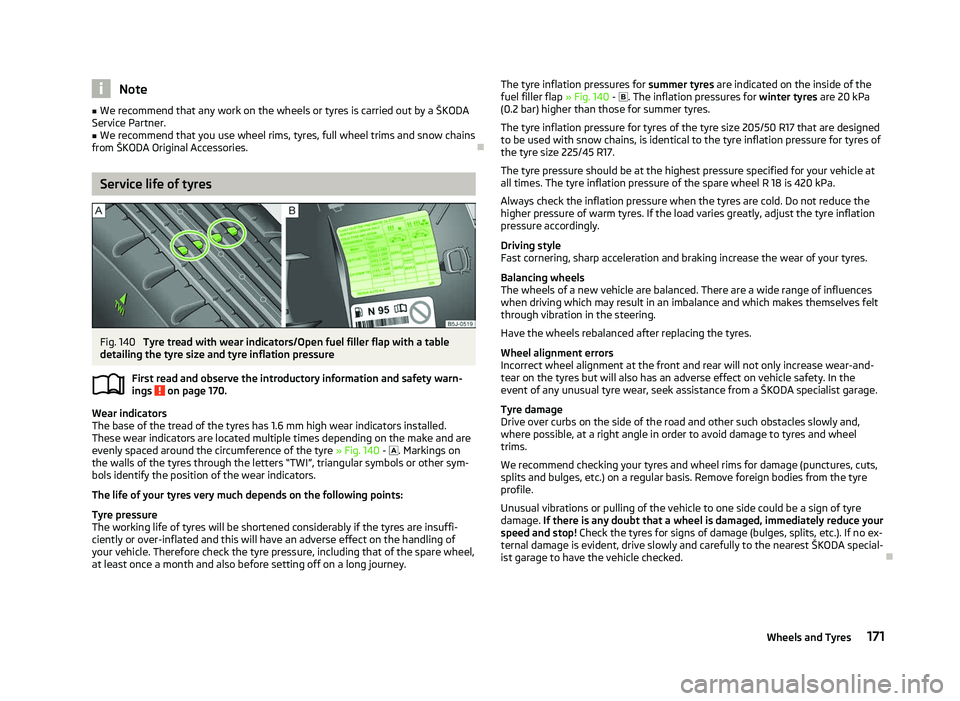
Fig. 140
Tyre tread with wear indicators/Open fuel filler flap with a table
detailing the tyre size and tyre inflation pressure
First read and observe the introductory information and safety warn-
ings on page 170.
Wear indicators
The base of the tread of the tyres has 1.6 mm high wear indicators installed.
These wear indicators are located multiple times depending on the make and are
evenly spaced around the circumference of the tyre » Fig. 140 - . Markings on
the walls of the tyres through the letters
“TWI”, triangular symbols or other sym-
bols identify the position of the wear indicators.
The life of your tyres very much depends on the following points:
Tyre pressure
The working life of tyres will be shortened considerably if the tyres are insuffi-
ciently or over-inflated and this will have an adverse effect on the handling of
your vehicle. Therefore check the tyre pressure, including that of the spare wheel,
at least once a month and also before setting off on a long journey.
ä The tyre inflation pressures for
summer tyres are indicated on the inside of the
fuel filler flap » Fig. 140 - . The inflation pressures for winter tyres are 20 kPa
(0.2
bar) higher than those for summer tyres.
The tyre inflation pressure for tyres of the tyre size 205/50 R17 that are designed
to be used with snow chains, is identical to the tyre inflation pressure for tyres of
the tyre size 225/45 R17.
The tyre pressure should be at the highest pressure specified for your vehicle at
all times. The tyre inflation pressure of the spare wheel R 18 is 420 kPa.
Always check the inflation pressure when the tyres are cold. Do not reduce the
higher pressure of warm tyres. If the load varies greatly, adjust the tyre inflation
pressure accordingly.
Driving style
Fast cornering, sharp acceleration and braking increase the wear of your tyres.
Balancing wheels
The wheels of a new vehicle are balanced. There are a wide range of influences
when driving which may result in an imbalance and which makes themselves felt
through vibration in the steering.
Have the wheels rebalanced after replacing the tyres.
Wheel alignment errors
Incorrect wheel alignment at the front and rear will not only increase wear-and-
tear on the tyres but will also has an adverse effect on vehicle safety. In the
event of any unusual tyre wear, seek assistance from a ŠKODA specialist garage.
Tyre damage
Drive over curbs on the side of the road and other such obstacles slowly and,
where possible, at a right angle in order to avoid damage to tyres and wheel
trims.
We recommend checking your tyres and wheel rims for damage (punctures, cuts,
splits and bulges, etc.) on a regular basis. Remove foreign bodies from the tyre
profile.
Unusual vibrations or pulling of the vehicle to one side could be a sign of tyre
damage. If there is any doubt that a wheel is damaged, immediately reduce your
speed and stop! Check the tyres for signs of damage (bulges, splits, etc.). If no ex-
ternal damage is evident, drive slowly and carefully to the nearest ŠKODA special-
ist garage to have the vehicle checked. Ð
171
Wheels and Tyres
Page 175 of 218
Unidirectional tyres
First read and observe the introductory information and safety warn-
ings on page 170.
The direction of rotation of the tyres is marked by arrows on the wall of the tyre
.
The so specified running direction must absolutely be complied with. Only then
are the tyres able to provide the optimal properties in terms of grip, low noise,
wear-and-tear and aquaplaning.
If, in the event of a puncture, it is necessary to fit a spare wheel with a tyre with-
out a dedicated running direction or the opposite running direction, drive carefully
as the optimum characteristics of the tyre are no longer applicable in this situa-
tion. ÐSpare wheel
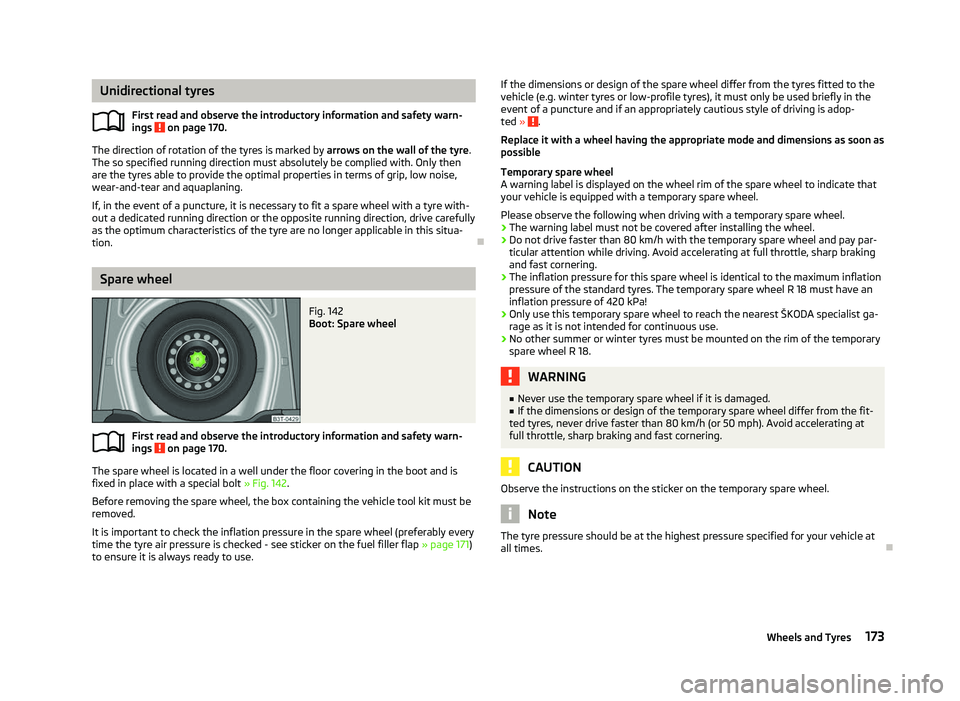
Fig. 142
Boot: Spare wheel
First read and observe the introductory information and safety warn-
ings on page 170.
The spare wheel is located in a well under the floor covering in the boot and is
fixed in place with a special bolt
» Fig. 142.
Before removing the spare wheel, the box containing the vehicle tool kit must be
removed.
It is important to check the inflation pressure in the spare wheel (preferably every
time the tyre air pressure is checked - see sticker on the fuel filler flap »
page 171)
to ensure it is always ready to use.
ä
ä
If the dimensions or design of the spare wheel differ from the tyres fitted to the
vehicle (e.g. winter tyres or low-profile tyres), it must only be used briefly in the
event of a puncture and if an appropriately cautious style of driving is adop-
ted » .
Replace it with a wheel having the appropriate mode and dimensions as soon as
possible
Temporary spare wheel
A warning label is displayed on the wheel rim of the spare wheel to indicate that
your vehicle is equipped with a temporary spare wheel.
Please observe the following when driving with a temporary spare wheel.
› The warning label must not be covered after installing the wheel.
› Do not drive faster than 80
km/h with the temporary spare wheel and pay par-
ticular attention while driving. Avoid accelerating at full throttle, sharp braking
and fast cornering.
› The inflation pressure for this spare wheel is identical to the maximum inflation
pressure of the standard tyres. The temporary spare wheel R 18 must have an
inflation pressure of 420 kPa!
› Only use this temporary spare wheel to reach the nearest ŠKODA specialist ga-
rage as it is not intended for continuous use.
› No other summer or winter tyres must be mounted on the rim of the temporary
spare wheel R 18. WARNING
■ Never use the temporary spare wheel if it is damaged.
■ If the dimensions or design of the temporary spare wheel differ from the fit-
ted tyres, never drive faster than 80
km/h (or 50 mph). Avoid accelerating at
full throttle, sharp braking and fast cornering. CAUTION
Observe the instructions on the sticker on the temporary spare wheel. Note
The tyre pressure should be at the highest pressure specified for your vehicle at
all times. Ð
173
Wheels and Tyres