boot SKODA OCTAVIA 2009 2.G / (1Z) User Guide
[x] Cancel search | Manufacturer: SKODA, Model Year: 2009, Model line: OCTAVIA, Model: SKODA OCTAVIA 2009 2.G / (1Z)Pages: 304, PDF Size: 19.56 MB
Page 52 of 304
Unlocking and locking
51
Using the system
Safety
Driving Tips
General Maintenance
Breakdown assistance
Technical Data
This means it is necessary to synchronise the code as follows:•
Press any button on the remote control.
•
Pressing of the button means that the
door will unlock with the key within 1
minute.Anti-theft alarm system*DescriptionThe anti-theft alarm system increases the le
vel of protection against people seeking
to break into the vehicle. The system tri
ggers audible and visual warning signals if
an attempt is made to break into the vehicle. How is the alarm system activated? The anti-theft alarm system is activated
automatically when th
e vehicle is locked
with the key on the closed driver's door or
by using the radio remote control. It is
activated 30 seconds after closing the door. How is the alarm system deactivated? The anti-theft alarm system is deactivated
if the vehicle is unlocked by only using
the radio remote control. The vehicle is au
tomatically locked agai
n if the vehicle is
not opened within 30 seconds after reac
tivating the anti-theft alarm system.
Once you unlock the vehicle by inserting the key into the driver door you then have to insert the key into the ignition lock an
d switch the ignition on within 15 seconds
after opening the door in order to deactivate the anti-theft alarm system. The alarm will be triggered
if you do
not switch on
the ignition within 15 seconds.
When is the alarm triggered? The following security areas of the locked vehicle are monitored:•
Bonnet,
•
Boot lid,
•
Doors,
•
Ignition lock,
•
Angle of the vehicle*
⇒page 51,
•
Vehicle interior*
⇒page 51,
•
A drop in voltage of the on-board power supply.
An alarm is immediately triggered if either of the two battery terminals is discon- nected while the anti-theft
alarm system is activated.
How is the alarm switched off? You switch the alarm off if you unlock the car with the radio remote control in the key or if you switch the ignition on.
Note
•
The working life of the alarm siren is 6 years. More detailed information is avail-
able by a specialist garage.•
Before leaving the car, check that all the doors, windows and the electric
sliding/tilting roof* are properly closed in order to ensure that the anti-theft alarm system is fully operational.•
Coding of the radio remote control and
the receptor part precludes the use of
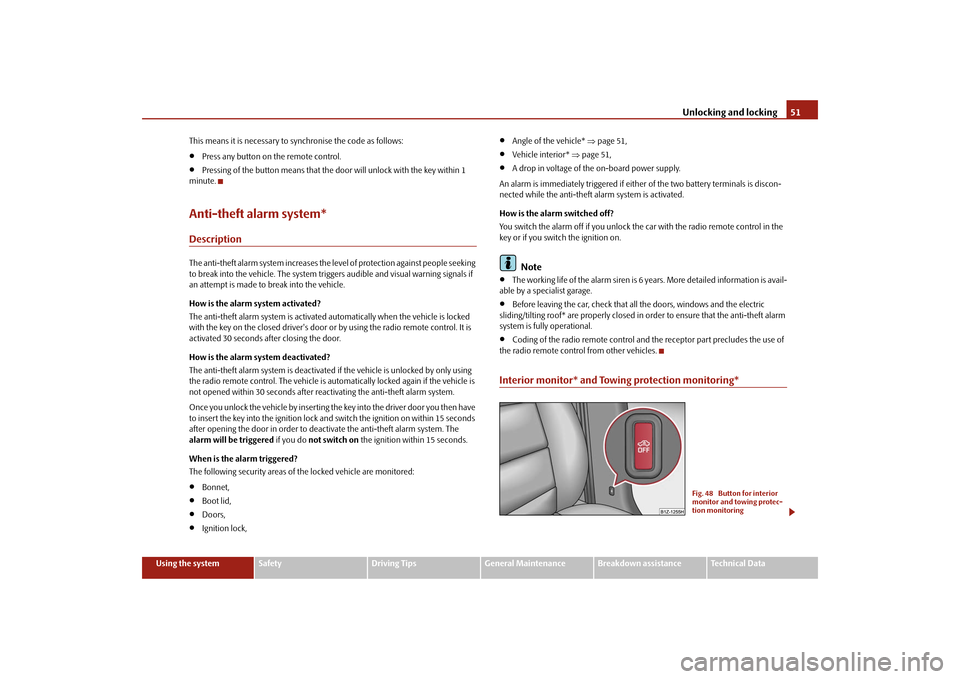
the radio remote control from other vehicles.Interior monitor* and Towing protection monitoring*
Fig. 48 Button for interior monitor and towing protec-tion monitoring
se0.1.book Page 51 Friday, April 10, 2009 3:19 PM
Page 61 of 304
Lights and Visibility
60
If the vehicle speed is below 65 km/h for at least 2 minutes, the lights are switched off. Rain lights If you switch on the windscreen wipe in
the operation rain sensor* for longer than
10 seconds or in the operation pe
rmanent wipe (position 2 or 3)
⇒page 69
switching on for longer than 15 seconds, th
e side lights and low beam are switched
on automatically. The light switches off if
the windscreen wipe is in operation rain
sensor* for more than 4 minutes or is no
t switched on in the operation permanent
wipe.
WARNING
The automatic light control only operat
es as a support. The driver is not
released from his responsibility to inspect the light and if necessary to switch on the light depending on the light
conditions. The light sensor cannot
detect for example rain or snow. Fo
r these conditions we recommend to
switch on the low beam
!
Note
•
Do not affix any stickers in front of the light sensor, so that you do not impair its
function or put it out of operation.•
The same principles as for using the au
tomatic light control also apply to the
light which is switched on manually
⇒page 58.
Cornering lights*The cornering lights are used to illuminate the curves by means of the cone of light swiveling together with the front headlight with Xenon lights*. This function is active when the speed of the car increases to more than 10km/h. The swiveling function of the headlights ca
n be switched off / on via the menu point
Assistant
in the main menu of the Information display*
⇒page 26.
WARNING
If the cornering lights are defectiv
e, the headlights are automatically
lowered to the emergency position, wh
ich prevents a possible dazzling of
oncoming traffic. Thus the illuminated length of the road is shortened. Drive carefully and have the car inspected
immediately by a specialist garage.
Coming Home FunctionThe function makes it possible to switch on the lights in the darkness for a short time after leaving the vehicle. Switching on Coming Home Function – The light switch is in the positi
on automatic driving lamp control
and the low beam illuminates.
– Switch off the ignition. – After opening the driver's door, the function Coming Home is
switched on.
– Close all the doors and the boot lid and lock the vehicle. After a short
time, switch all lights off.
Depending on equipment fitted the func
tion Coming Home switches on the
following lights:•
Parking lights,
•
Low beam,
•
Entry lighting in the exterior mirrors,
•
Licence plate light.
Coming Home Function The lights go out 10 seconds after closing all the doors and the boot lid. If a door or the boot lid re
mains open, the lights go ou
t 60 seconds after switching
off the ignition.
se0.1.book Page 60 Friday, April 10, 2009 3:19 PM
Page 67 of 304

Lights and Visibility
66
Reading lights* – Press on one of the switches in order to switch the right or left
reading light on or off.
The interior light comes on as soon as you unlock the car or open a door or when the ignition key has been removed. The li
ght goes out again about 30 seconds after
all the doors have been closed. The interior
lighting is switched off when you lock
the car or switch the ignition on. This on
ly applies when the switch for the corre-
sponding interior lights is stan
ding n the door contact setting.
The interior lighting goes off after about
10 minutes when a door has been left open
in order to avoid discharging the battery of the vehicle. If the switch is in the position
(permanent lights), the interior lighting goes off at
the latest after 10 minutes in order to avoid discharging the battery of the vehicle.
Note
We recommend having these bulbs re
placed by a specialist garage.
Lighting of the storage compartment on front passenger side*– When opening the flap of the st
orage compartment on the front
passenger side the lighting in the storage compartment comes on.
– The light switches on automatically
when the parking light is switched
on and goes out when the flap is closed.
Front door warning light*The warning light is located in the door trim panel below
⇒fig. 62
.
The warning light goes on every time the door is opened. The light goes out about 10 minutes after opening the d
oor in order to avoid discharging the battery of the
vehicle. There is a reflector installed on some vehicles instead of the warning light.Luggage compartment light*The lighting comes on automatically when
the boot lid is opened. The luggage
compartment lighting will switch off agai
n automatically if the boot lid remains
open for more than about 30 minutes.Entry lighting*The lighting is positioned on the bottom edge of the exterior mirror. The light beam is directed towards the entry area of the front door.The light comes on after the doors have been
locked or on opening the boot lid. The
light goes out after switching on the ignition
or up to 30 seconds after closing all the
doors, the bonnet and the boot lid.
AB
Fig. 62 Front door: Warning light
se0.1.book Page 66 Friday, April 10, 2009 3:19 PM
Page 68 of 304

Lights and Visibility
67
Using the system
Safety
Driving Tips
General Maintenance
Breakdown assistance
Technical Data
If a door, the bonnet or the boot lid re
mains open, the light goes out within 2
minutes if the ignition is switched off.
WARNING
If the entry light comes on, do not touch its cover - risk of burns!VisibilityRear window heater– You can switch the rear window heater on or off by pressing the switch
⇒
fig. 63
- the indicator light in the
switch comes on or goes out.
The rear window heater only oper
ates when the engine is running.
The rear window heater
switches
off automatically after 10 minutes.
For the sake of the environment
As soon as the window is de-iced or free from mist, the heating should be switched off. The reduced current consumption will have a favourable effect on fuel economy
⇒page 205, “Saving electricity”.
Note
•
The position and the shape of the switch can differ depending on equipment
installed in the vehicle.•
If the on-board voltage drops, the rear
window heater
is switched off automat-
ically, in order to provide sufficient electrical energy for the engine control.Sun visorsYou can pull the sun visor for the driver or
front passenger out of the fixture and
swivel it toward the door in the direction of the arrow
⇒fig. 64
.
Fig. 63 Switch for rear window heater
Fig. 64 Sun visor: swivelling outFig. 65 Double sun visorA1
se0.1.book Page 67 Friday, April 10, 2009 3:19 PM
Page 86 of 304

Seats and Stowage
85
Using the system
Safety
Driving Tips
General Maintenance
Breakdown assistance
Technical Data
•
Loose objects in the passenger compartment can be thrown forward
during a sudden manoeuvre or in case
of an accident and can injure the
occupants or other oncoming traffic. This risk is still increased, if the objects which are flying around are hit by a depl
oyed airbag. In this case, the objects
which are thrown back can injure the occupants - hazard.•
Please note that the handling properti
es of your vehicle may be affected
when transporting heavy objects as a result of the displacement of the centre of gravity. The speed and style
of driving must be adjusted accord-
ingly.•
The items carried in the luggage compar
tment should be stowed in such
a way that no objects are
able to slip forw
ard if there are any sudden driving
or braking manoeuvres undertaken - risk of injury!•
Never drive with the boot lid fully opened or slightly ajar otherwise
exhaust gases may get into the interior of the vehicle - risk of poisoning!•
On no account exceed the permissi
ble axle loads and the permissible
gross weight of the vehi
cle - risk of accident!
•
Never transport occupants in the luggage compartment!Caution
Please ensure that the heating elements of the rear window heater are not damaged as a result of objects sliding in this area.
Note
Tyre pressure must be adjusted to the load
⇒page 238.
Lashing eyesEyes are located on the sides of the lugg
age compartment for lashing the goods to
be loaded. You can also attach a floor fixing net*
to these eyes for lashing small objects.
The floor fixing net* together with the
installation instruction are stowed in a
container under the floor co
vering of the luggage comp
artment behind the spare
wheel.
WARNING (continued)
Fig. 87 Luggage compart- ment: Lashing eyes (Octavia)Fig. 88 Luggage compart-ment: Lashing eyes (Combi)
se0.1.book Page 85 Friday, April 10, 2009 3:19 PM
Page 89 of 304

Seats and Stowage
88
Folding hooks (Combi)Folding hooks for attaching small items of lu
ggage, such as bags etc., are provided
on both sides of the luggage compartment
⇒fig. 94
.
An item of luggage weighing up to
10 kg can be attached to the hook.
Fixing floor covering of the luggage compartment
There is a loop (Octavia) or there are h
ooks (Combi) located on the floor covering
of the luggage compartment. You can fix the raised floor cover with a hook to the luggage compartment cover (Octavia)
⇒page 88, fig. 95
as if one needs to reach
the spare wheel or to the frame of the boot lid (estate car)
⇒fig. 96
.
Luggage net* (Octavia)The luggage net is designed for the tranportation of lighter objects.
Fig. 94 Luggage compart- ment: folding hooksFig. 95 Luggage compart-ment: Fixing of the floor covering (Octavia)
Fig. 96 Luggage compart-ment: Fixing of the floor covering (Combi)Fig. 97 Luggage compart-ment: Luggage net
se0.1.book Page 88 Friday, April 10, 2009 3:19 PM
Page 90 of 304

Seats and Stowage
89
Using the system
Safety
Driving Tips
General Maintenance
Breakdown assistance
Technical Data
WARNING
•
In the storage net you must only stow objects (up to a total weight of 1.5
kg). Heavy objects are not secured sufficiently - risk of injury!•
No objects with sharp edges should
be stowed in the luggage net,
because they can damage the luggage net.Luggage compartment cover* (Octavia) You can use the luggage compartment cover behind the head restraints for storing
light and soft items.
The luggage compartment cover can be
removed as required if one must
transport bulky goods. – Unhook the support stra
ps on the boot lid
⇒
fig. 98
.
– Place the cover on the side supports. – Pull the cover out of the holder horizontally to the rear. – Install again by pushing the luggage
compartment cover forwards into
the holder and hanging the suppo
rt straps on the boot lid.
You can stow the removed luggage compartment cover behind the rear seat back- rest.
WARNING
No objects should be placed on the
luggage compartment cover, the vehicle
occupants could be endangered if th
ere is sudden braking or the vehicle
collides with something.
Caution
Please ensure that the heating elements of the rear window heater are not damaged as a result of obje
cts placed in this area.
Note
Opening the tailgate also lifts up the luggage compartment cover.Foldable luggage compartment cover (Combi)
Fig. 98 Removing the luggage compartment coverA1
A2
A2
A1
Fig. 99 Luggage compart-ment: Foldable luggage compartment cover
se0.1.book Page 89 Friday, April 10, 2009 3:19 PM
Page 94 of 304

Seats and Stowage
93
Using the system
Safety
Driving Tips
General Maintenance
Breakdown assistance
Technical Data
WARNING
•
The belt locks and the belts must be in their original position after folding
back the seat cushions and the seat backrests - they must be ready to use.•
The seat backrests must be securely interlocked in position so that no
objects in the luggage compartment can
slide forward if there is sudden
braking - risk of injury!•
Pay attention that the rear seat backrest is correctly interlocked. It is only
then that the three-point seat belt for the middle seat can reliably fulfil its function.•
First check for yourself that the cross road is inserted into the mounts
in the front position!Removing and installing net partition housingRemoving – Fold the rear seats forwards
⇒
page 81
– Open the right rear door. – Push the net partition housing
⇒
fig. 107
in the direction of arrow
and take it out of the mounts of the rear seats in the direction of
arrow .
Installing – Position the net partition housing into the mounts of the rear seat
backrests.
– Push the net partition housing in
the opposite direction of arrow
as far as the stop.
– Fold the rear seats back into its original position.The roof rack*DescriptionPay attention to the following points if yo
u wish to transport luggage or other items
on the roof of your vehicle:•
A special roof luggage rack system was
developed for the vehicle, that is why
you should only use a roof luggage rack
which has been released for use by Škoda
Auto.•
The base carrier is the basis for a comple
te roof luggage rack system. Separate
additional holders are required for safety reasons for transporting luggage, bikes, surfboards, skis and boats.•
The basic version of the roof luggage rack system and further components are
obtainable as accessories from the authorised Škoda Service Partners.
Caution
•
If you use other roof rack sy
stems or if the roof bars are not properly fitted, then
any damage which may result to your ca
r is not covered by the warranty agree-
ments. It is therefore essential to pay attention to the fitting instructions supplied with the roof luggage rack system.•
On models fitted with a power sliding/tilting roof, ensure that the opened
sliding/tilting roof does not strike any items of luggage transported on the roof.•
Ensure that the opened boot lid does not collide with the roof load.
AC
Fig. 107 Rear seats: Net partition housing
AA
A1
A2
A1
se0.1.book Page 93 Friday, April 10, 2009 3:19 PM
Page 107 of 304
Seats and Stowage
106
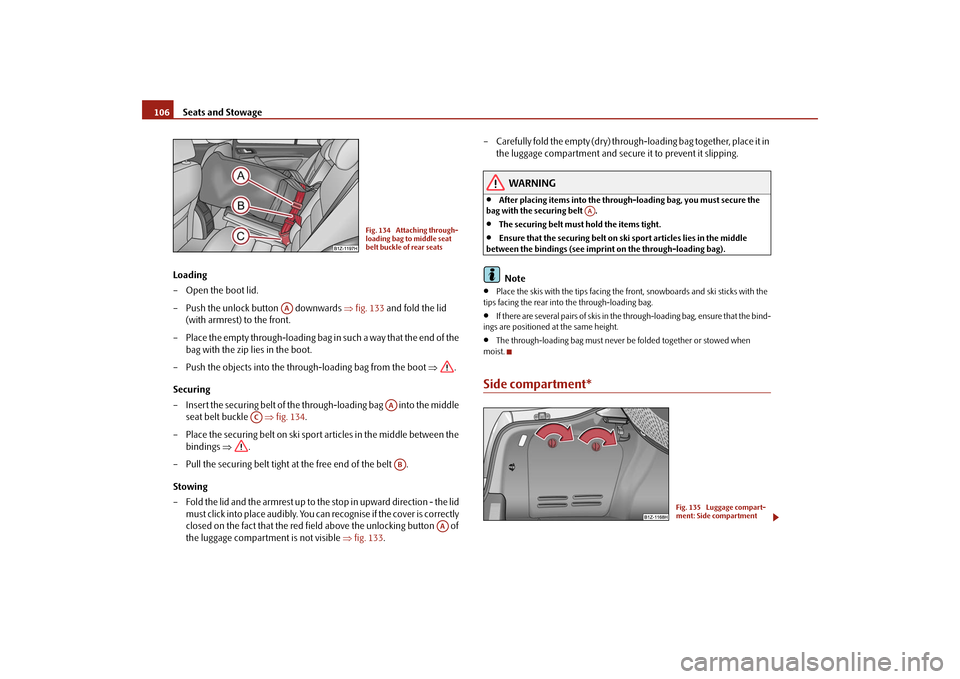
Loading – Open the boot lid. – Push the unlock button downwards
⇒
fig. 133
and fold the lid
(with armrest) to the front.
– Place the empty through-loading bag in such a way that the end of the
bag with the zip lies in the boot.
– Push the objects into the through-loading bag from the boot
⇒
.
Securing – Insert the securing belt of the th
rough-loading bag into the middle
seat belt buckle
⇒
fig. 134
.
– Place the securing belt
on ski sport articles in the middle between the
bindings
⇒
.
– Pull the securing belt tight at the free end of the belt . Stowing – Fold the lid and the armrest up to the stop in upward direction - the lid
must click into place audibly. You can recognise if the cover is correctly closed on the fact that the red fi
eld above the unlocking button of
the luggage compartment is not visible
⇒
fig. 133
.
– Carefully fold the empty (dry) throug
h-loading bag together, place it in
the luggage compartment and secure it to prevent it slipping.
WARNING
•
After placing items into the through-
loading bag, you must secure the
bag with the securing belt .•
The securing belt must hold the items tight.
•
Ensure that the securing belt on ski sport articles lies in the middle
between the bindings (see imprin
t on the through-loading bag).
Note
•
Place the skis with the tips facing the fr
ont, snowboards and ski sticks with the
tips facing the rear into the through-loading bag.•
If there are several pairs of skis in the through-loading bag, ensure that the bind-
ings are positioned at the same height.•
The through-loading bag must never be
folded together or stowed when
moist.Side compartment*
Fig. 134 Attaching through- loading bag to middle seat belt buckle of rear seats
AA
AA
AC
AB
AA
AA
Fig. 135 Luggage compart-ment: Side compartment
se0.1.book Page 106 Frida
y, April 10, 2009 3:19 PM
Page 215 of 304
Taking care of your vehicle and cleaning the vehicle
214
Plastic partsExternal plastic parts are cleaned by norm
al washing. Plastic
parts and synthetic
leather can also be treated with
special solvent-free plastic cleaning agents
if a
damp cloth is not sufficient. Paint care pr
oducts are not suitable for plastic parts.
Caution
Solvent-free cleaners attack th
e material and can damage it.
WindowsOnly use a plastic ice scraper for removing snow and ice from the windows and mirrors. You should not move the ice scraper forward and backward but in one direction on the window which you are clea
ning in order to avoid any damage to
the surface of the glass. You can best remove residues of rubber,
oil, grease, wax or
silicone by using a
special window cleaner or a special silicone remover. You should also clean the windows regularly from the inside.Do not use window leathers
which you have used to polish the vehicle body to dry
off the windows. Residues of preservati
ves in the window leather can dirty the
window and reduce visibility. Do not affix any stickers over the inside of the rear window to avoid damage to the heating elements of the rear window heater
.
We recommend using a preservative from
Škoda genuine accessories offered by
your Škoda dealer.
Caution
Never remove snow or ice from the glass
parts with warm or hot water - risk of
formation of cracks in the glass!
The headlight lensesPlease do not use any aggres
sive cleaning or
chemical solvent pr
oducts - risk of
damage to the plastic lenses
Please use
soap and clean warm water.
Caution
Never
wipe the headlights dry and do not
use any sharp objects for cleaning the
plastic lenses, this may result in damage
to the protective paintwork and conse-
quently in formation of cracks on the head
light lenses, e.g through effect of chem-
ical products.Door and window sealsThe rubber seals on the doors, boot lid,
bonnet and windows remain supple and
last longer if you treat them from time to
time with a rubber care product (e.g. with
a spray with silicone-free oil). You also avoid premature wear of the seals and prevent leakages in this way. It is also easier to open the doors. Rubber seals which are well cared for also do not stick together in cold winter weather.Locking cylinderWe recommend that you use the spray from Škoda original accessories with regreasing and anticorrosive effect
for de-icing lo
cking cylinders.
Note
When washing your vehicle, ensure that as
little water as possible gets into the
locks.
se0.1.book Page 214 Frida
y, April 10, 2009 3:19 PM