fuel consumption SKODA OCTAVIA 2009 2.G / (1Z) Owner's Guide
[x] Cancel search | Manufacturer: SKODA, Model Year: 2009, Model line: OCTAVIA, Model: SKODA OCTAVIA 2009 2.G / (1Z)Pages: 304, PDF Size: 19.56 MB
Page 220 of 304
Fuel
219
Using the system
Safety
Driving Tips
General Maintenance
Breakdown assistance
Technical Data
FuelPetrolGrades of petrolThere are various grades of petrol. Please read
⇒page 271, “Technical Data” in
order to know which grade of petrol your
vehicle requires. You will also find the
same information affixed to the inside of
the fuel filler flap of your vehicle
⇒ page 222, fig. 206
.
A distinction is made between unleaded an
d leaded petrol. All Škoda vehicles with
petrol engines are equipped with a catalyti
c converter and must therefore be only
driven with
unleaded petrol
. Unleaded petrol
complies with the
standard
DINEN228
.
The individual grades of petr
ol are distinguished by their
octane number
(RON).
Please adopt the following procedure if the grade of petrol which you normally use is not be available in
exceptional circumstances.
Engines which need
unleaded premium petrol 95 RON
can also be run on
unleaded regular petrol 91 RON. This does, however, result in a slight loss in performance. If, in an emergency, the only fuel availa
ble is one which has a lower octane number
than that required by the engine then only drive at medium engine speeds and lower engine loadings. You can make unlimited use of fuel whic
h has a higher octane
number than that
required by the engine. There will, howeve
r, be no advantages gained by this in
terms of engine performance and fuel consumption! The handling, performance and
life of your engine are determined to a significant
extent by the quality of the fuel.
Do not use any petrol additives.
Use a fuel
complying with
the standard.
You can find further information on refuelling
⇒page 222, “Refuelling”.
Caution
•
Filling the tank even only once with lead
ed petrol will result in the catalytic
converter being destroyed.•
Operating the engine with petrol of a lo
w octane number can result in engine
damage at high revolutions or severe engine loading.Biofuel Ethanol E85*Ethanol E85* Only valid for vehicles with
1.6/75°kW MultiFuel engine.
Biofuel Ethanol E85 consists of 85% bioethanol and 15% unleaded petrol complying with the standard (DIN) EN°228. Biofuel Ethanol E85 in accordance with th
e standard (DIN) EN 2
28 can be mixed in
any desired ratio with unleade
d petrol, see Owner's Manual.
Drive the vehicle for at leas
t 5 minutes without interrupti
on, if biofuel Ethanol E85
has been refuelled, so that the engine co
ntrol unit can determine the share of the
biofuel in the fuel. During this period do
not drive at top speed
of your vehicle or
high engine speeds and not at full throttle
. During this process
decrease the idling
speed.
WARNING
Pay attention to any legal requirements if you do carry a spare canister in the vehicle. We do not recommend carrying
any fuel canisters in your vehicle for
safety reasons. The canister can be da
maged in the event of an accident and
fuel may leak out.
se0.1.book Page 219 Frida
y, April 10, 2009 3:19 PM
Page 221 of 304
Fuel
220
Caution
•
Even inadvertently filling the fuel tank
with another biofuel such as Ethanol°E85
can result in damage to the fuel system.•
If you park the car for a lengthy period,
fill with petrol complying with (DIN)
EN°228, because Ethanol E85 can contain lo
w quantities of impurities, which can
lead to corrosion.
For the sake of the environment
If you use Ethanol E85, the CO
2 emission of your vehicl
e is lowered up to 5%.
Note
•
When operating with Ethanol E85, the
fuel consumption increases by approx
33%, as a lower quantity of energy is contained in the bioethanol than in unleaded petrol.•
Biofuel Ethanol E85 contains only a low
quantity of additives in contrast to
unleaded petrol. Therefore we recommend to
fill up the tank with unleaded petrol
complying with EN 228 every 15 000 km (e.g. before the oil change) and run it empty, so that the engine remains clean. Make sure not to use the whole content of the tank
⇒page 222, “Refuelling”.
•
The interval of 15 000 km applies for the oil change.
Operation in winterIf you use biofuel Ethanol E85 at very low
temperatures, it is necessary to preheat
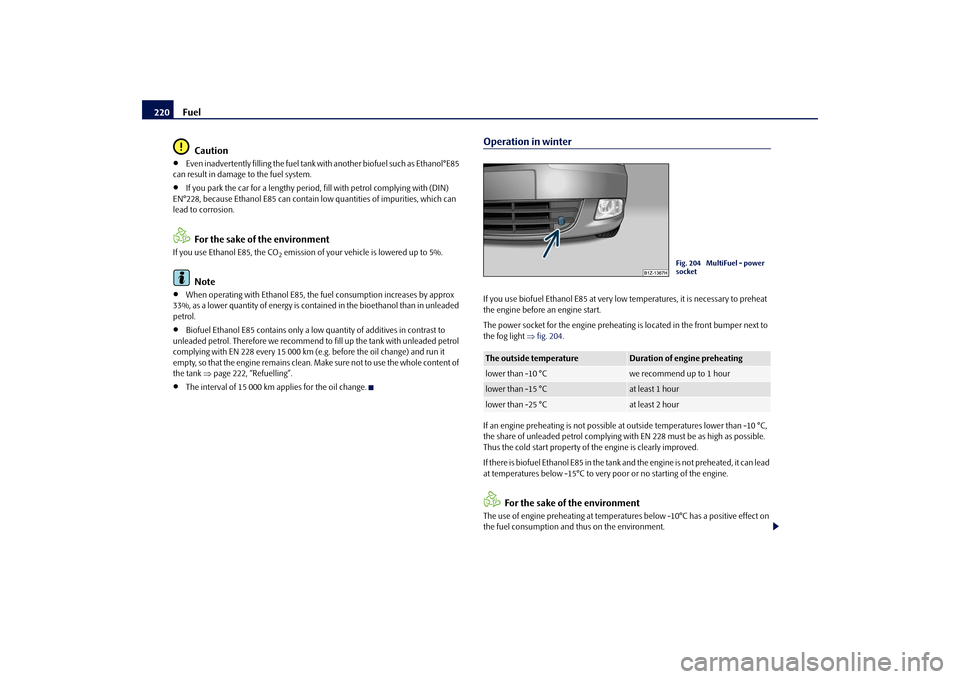
the engine before an engine start. The power socket for the engine preheating
is located in the front bumper next to
the fog light
⇒fig. 204
.
If an engine preheating is
not possible at outside temperatures lower than -10 °C,
the share of unleaded petrol complying with
EN 228 must be as high as possible.
Thus the cold start property of the engine is clearly improved. If there is biofuel Ethanol E
85 in the tank and the engine is not preheated, it can lead
at temperatures below -15°C to very poor or no starting of the engine.
For the sake of the environment
The use of engine preheating at temperatures below -10°C has a positive effect on the fuel consumption and thus on the environment.The outside temperature
Duration of engine preheating
lower than -10 °C
we recommend up to 1 hour
lower than -15 °C
at least 1 hour
lower than -25 °C
at least 2 hour
Fig. 204 MultiFuel - power socket
se0.1.book Page 220 Frida
y, April 10, 2009 3:19 PM
Page 228 of 304

Inspecting and replenishing
227
Using the system
Safety
Driving Tips
General Maintenance
Breakdown assistance
Technical Data
Engine oilCheck engine oil level The dipstick indicates the level of oil in the engine.Checking the oil level – Ensure that the vehicle is positioned on a level surface. – Switch the engine off. – Open the bonnet
⇒
in “Working in the engine compartment” on
page 225.
– Wait a few minutes and pull out the oil dipstick.– Wipe off the dipstick with a clea
n cloth and insert it again fully.
– Then withdraw the dipstick ag
ain and read off the oil level.
Oil level within range – You must
not
top up the oil.
Oil level within range –You
may
top up the oil. It is possible that the oil level may then be
within range after doing this.
Oil level within range –You
must
top up the oil
⇒
page 228. It is sufficient, once this is done,
to keep the oil level within range .
It is normal for the engine to consume oi
l. The oil consumption may be as much as
0.5 l/1 000 km depending on your style of driving and the conditions under which you operate your vehicle. The oil consumpt
ion may be slightly higher than this
during the first 5 000 kilometres. One should therefore check the oil level at regular intervals, preferably every time after the fuel tank is filled or after driving for long stretches. We recommend maintaining the oil level within the range -
but not above this
,
if the engine has been operating at hi
gh loads, for example during a lengthy
motorway trip during the summer months,
towing a trailer or negotiating a high
mountain pass. The warning light in the instrument cluster* will indicate
⇒page 35, “Engine oil
pressure
” whether the oil level is too low. In this case, check the oil level as soon
as possible. Top up with an appropriate quantity of oil.
Caution
•
The oil level must on no account ex
tend beyond the range . Danger of
damaging the cata
lytic converter.
•
Do not continue your journey
if for some reason it is not possible under the
conditions prev
ailing to top up with oil.
Switch of the engine and contact
and
obtain professional assistance from a specialist garage.
Note
Engine oil specifications
⇒page 271, “Technical Data”.
Fig. 211 Dipstick
AA
AB
AA
AC
AB
AA
AA
se0.1.book Page 227 Frida
y, April 10, 2009 3:19 PM
Page 240 of 304

Wheels and Tyres
239
Using the system
Safety
Driving Tips
General Maintenance
Breakdown assistance
Technical Data
setting off on a long trip. Please do not
forget the spare wheel when checking the
tyres. The tyre inflation pressures for
summer tyres
are indicated on the inside of the fuel
filler flap
⇒page 238, fig. 218
. The inflation pressures for
winter tyres
are 20 kPa
(0.2 bar) higher than those for summer tyres
⇒page 242.
The tyre pressure should be at the highest pressure specified for your vehicle at all times. The tyre inflation pressure of the emergency spare wheel R 18 is 420 kPa (4.2 bar).Always check the inflation pressure of ty
res when cold. Do not reduce the higher
pressure of warm tyres. Adapt the inflation pressure of the tyres accordingly if your vehicle is carrying a significantly higher payload. Driving style Fast cornering, sharp acceleration and braking (squealing tyres) increase wear-and- tear on your tyres. Balancing wheels The wheels of a new vehicle are balanced. There are a wide range of influences when driving which may result in an im
balance and which makes themselves felt
through vibration in the steering. You should have the wheels rebalanced since any imbalance increases wear-and- tear on the steering, the suspension and tyres. A wheel must also be rebalanced when a new tyre is fitted and each time a tyre is repaired. Wheel alignment errors Incorrect wheel alignment at the front and rear will not only increase wear-and-tear on the tyres but will also has an adverse effect on vehicle safety. Contact your specialist garage if you no
tice any unusual tyre wear.
WARNING
•
If the inflation pressure is too low,
the tyre must perform a greater flexing
work. At higher speeds the tyre will warm up as a result of this. This can result in tread separation and even a tyre blowout.•
Immediately replace the damaged rims or tyres.
•
Tyres which are 6 years old or more should only be fitted in exceptional
cases and when adopting an appropriately cautious style of driving.
For the sake of the environment
Tyres which are insufficiently inflated increase your fuel consumption.Wear indicatorsThe base of the tread of the original tyres has wear indicators 1.6 mm high, installed at right angles to the direction of travel. These wear indicators are located at 6 - 8 points depending on the make and are evenly spaced around the circumference of the tyre
⇒fig. 219
. Markings on the walls of the tyres through the letters “TWI”,
triangular symbols or other symbols identi
fy the position of the wear indicators.
A remaining tread of just 1.6 mm, measured in the grooves of the tread next to the wear indicators, means that your tyres have reached their legally permissible minimum tread depth.
WARNING (continued)
Fig. 219 Tyre tread with wear indicators
se0.1.book Page 239 Frida
y, April 10, 2009 3:19 PM
Page 243 of 304
Wheels and Tyres
242
•
The wheel bolts must be clean and must
turn easily. However, they must
never be treated with grease or oil.•
If the wheel bolts are tightened to a too low tightening torque, the rim
can lossen when the car is moving - risk of accident! A tightening torque which is too high can damage the bolts and threads and this can result in permanent deformation of the contact surfaces on the rims.
Caution
The prescribed tightening torque of the wheel bolts for steel and light alloy wheels is 120 Nm.Winter tyresThe handling of your vehicle will be signi
ficantly improved when driving on wintry
roads if you fit winter tyres. Summer tyres do not offer the same grip on ice, snow and at temperatures below 7 °C because of
their construction (width, rubber blend,
tread pattern). This particularly applie
s to vehicles which
are equipped with
low-
profile tyres
or high-speed tyres
(code index H or V on wall of tyre).
Winter tyres must be mounted on all four
wheels to obtain the
best handling char-
acteristics. You must only fit those types of winter tyre
which are approved for your vehicle. The
permissible
sizes of winter tyres
are stated in your vehicle documents. Approvals
may differ because of
national legislation.
Please remember that the tyres should be in
flated to 20 kPa (0.2 bar) more than is
the case for summer tyres
⇒page 238.
Winter tyres no longer offer the
same winter performance once the
tyre tread
has
worn down to a depth of about 4 mm. Ageing
a l s o c a u s e s w i n t e r t y re s t o l o s e m o s t
of their winter performance properties
- even in cases where the remaining tread depth is still clearly more than 4 mm. Speed restrictions
apply to winter tyres as
well as to summer tyres
⇒page 240,
⇒
.
You can fit winter tyres of a lower speed ca
tegory to your vehicle provided that you
also do not drive faster than the permissible maximum speed for such tyres, even if the possible maximum speed of your ve
hicle is higher. The
corresponding tyre
category can damage the tyres when ex
ceeding the permissible maximum speed.
Please pay attention to the notes if
you decide to fit winter tyres
⇒page 238.
You can also fit so-called “all-year tyres” instead of winter tyres.Please contact your specialist garage if there are any points which are not clear who will be able to provide you with information regarding the maximum speed for your tyres.
WARNING
You must on no account drive your car at more than the permissible maximum speed for your winter tyres -
risk of an accident resulting from
tyre damage and loss of control over your car.
For the sake of the environment
Fit your summer tyres on again in good time since summer tyres offer you better grip and handling on roads which are free of snow and ice as well as ar tempera- tures below 7 °C - the braking distance is shorter, there is less tyre noise, tyre wear is reduced and fuel consumption is reduced.
Note
Please observe the various differing legal requirements regarding tyres.Unidirectional tyres*The direction of rotation of the tyres is marked by
arrows on the wall of the tyre
.
This indicates the direction of
rotation of the tyre, and it is essential that the tyres
are fitted on to run in this direction. On
ly then are the tyres able to provide the
optimal properties in terms of grip, lo
w noise, wear-and-tear and aquaplaning.
Should it be necessary to fit on a spare
wheel in exceptional cases with a tyre not
dedicated to the running direction or in o
pposite running direct
ion, please adopt a
WARNING (continued)
se0.1.book Page 242 Frida
y, April 10, 2009 3:19 PM
Page 273 of 304

Technical Data
272
Identification detailsVehicle data sticker The vehicle data sticker
⇒fig. 256
is located on the floor of the luggage compart-
ment and is also stated in the Service schedule. The vehicle data sticker co
ntains the following data:
Vehicle identification number (VIN) Vehicle type Gearbox code, paint number, interior
equipment number, engine output,
engine code Partial description of the vehicle 7GG, 7MB, 7MG - vehicles with DPF
⇒page 200
Vehicle identification number (VIN) The vehicle identification num
ber - VIN (vehicle body number) is stamped into the
engine compartment on the right hand shoc
k absorber dome. This number is also
located on a sign on the lower left hand edge below the windscreen. Engine number The engine number is stamped into the engine block. Type plate (production plate) The type plate is located in the lower area of the left centre column.
Homologation sign The homologation sign is located on the in
side of the bonnet next to the lock. Vehi-
cles for certain countries do no
t have an homologation sign.
Sticker on inside of fuel filler flap The stickers are affixed to the inside of the fuel filler flap and contain the following information:•
The prescribed types of fuel,
•
Tyre s iz e ,
•
Tyre pressure.
Fuel consumption according to the regulations (99/100/EU)Depending on the range of the special equipment, style of driving, traffic situation, weather influences and vehi
cle condition, the consumpt
ion values which in prac-
tice result when using the vehicle ca
n deviate from the indicated values.
Urban traffic The consumption measurement in urban traf
fic begins with starting of the cold
engine. Afterwards the normal
urban traffic is simulated.
Non-urban traffic For the consumption measurement in non-ur
ban traffic the vehicle, as in daily
motoring, is accelerated and braked several times in all gears. The vehicle speed changes within the range from 0 to 120 km/h. Combined traffic The consumption value in the combined traf
fic consists of 37%
from the value for
the urban traffic and of 63% from
the value for the non-urban traffic.
Fig. 256 Vehicle data sticker
A1A2A3A4A5se0.1.book Page 272 Frida
y, April 10, 2009 3:19 PM
Page 277 of 304
Technical Data
276
1.4 ltr./59 kW - EU4Engine Performances Fuel consumption (in ltr./100°km) and CO
2 emission (in g/km)
Power output
kW per rpm
59/5000
Maximum torque
Nm per rpm
132/3800
Number of cylinders/Displacement (cm
3)
4/1390
Fuel - unleaded petrol min. RON
95
OCTAVIA M5
CO M B IM5
Maximum speed
km/h
173
172
Acceleration 0 - 100 km/h
s
14,2
14,3
OCTAVIAM5
COMBIM5
Urban
9,6
9,6
Non-urban
5,6
5,6
Combination
7,0
7,0
CO2 emission - combination
167
167
se0.1.book Page 276 Frida
y, April 10, 2009 3:19 PM
Page 279 of 304
Technical Data
278
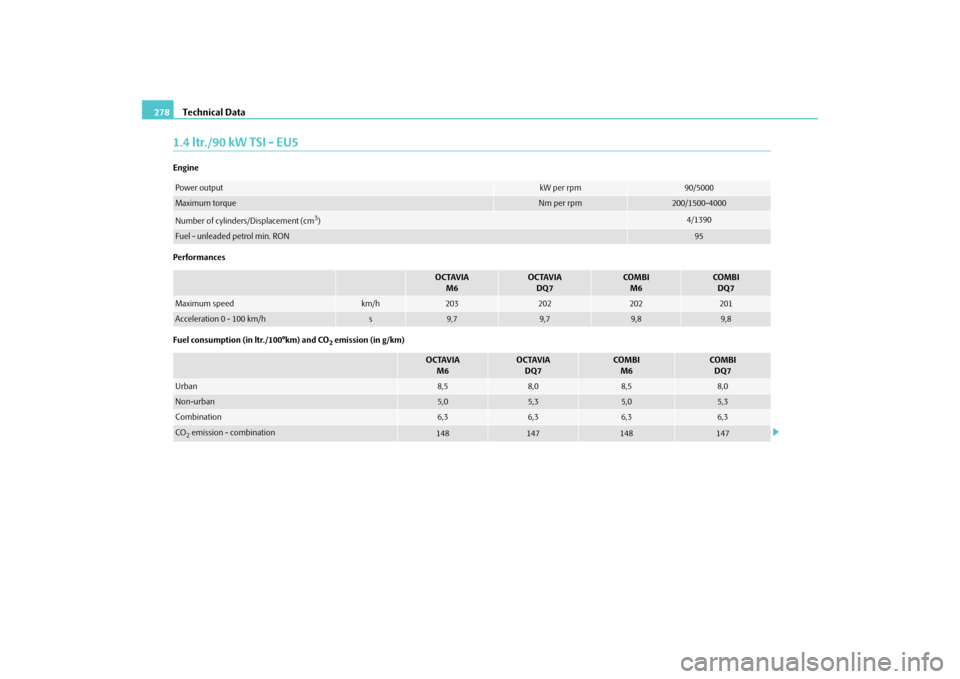
1.4 ltr./90 kW TSI - EU5Engine Performances Fuel consumption (in ltr./100°km) and CO
2 emission (in g/km)
Power output
kW per rpm
90/5000
Maximum torque
Nm per rpm
200/1500-4000
Number of cylinders/Displacement (cm
3)
4/1390
Fuel - unleaded petrol min. RON
95
OCTAVIA M6
OCTAVIADQ7
CO M B I M6
COMBIDQ7
Maximum speed
km/h
203
202
202
201
Acceleration 0 - 100 km/h
s
9,7
9,7
9,8
9,8
OCTAVIAM6
OCTAVIADQ7
COM B I M6
COMBIDQ7
Urban
8,5
8,0
8,5
8,0
Non-urban
5,0
5,3
5,0
5,3
Combination
6,3
6,3
6,3
6,3
CO2 emission - combination
148
147
148
147
se0.1.book Page 278 Frida
y, April 10, 2009 3:19 PM
Page 281 of 304
Technical Data
280
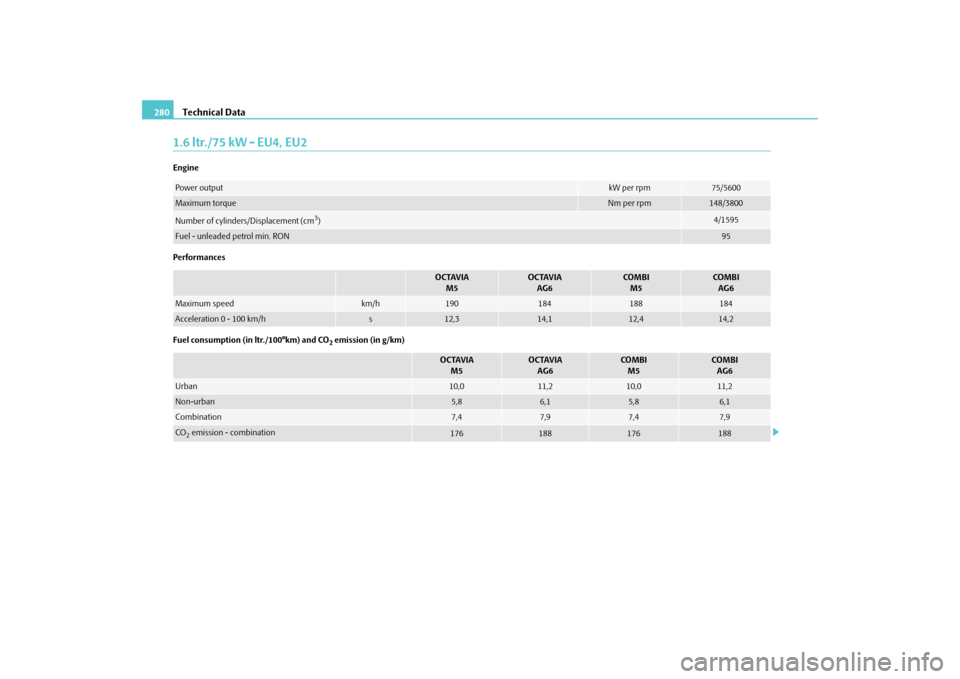
1.6 ltr./75 kW - EU4, EU2Engine Performances Fuel consumption (in ltr./100°km) and CO
2 emission (in g/km)
Power output
kW per rpm
75/5600
Maximum torque
Nm per rpm
148/3800
Number of cylinders/Displacement (cm
3)
4/1595
Fuel - unleaded petrol min. RON
95
OCTAVIA M5
OCTAVIAAG6
COMBIM5
COMBIAG6
Maximum speed
km/h
190
184
188
184
Acceleration 0 - 100 km/h
s
12,3
14,1
12,4
14,2
OCTAVIAM5
OCTAVIAAG6
COMBIM5
COMBIAG6
Urban
10,0
11,2
10,0
11,2
Non-urban
5,8
6,1
5,8
6,1
Combination
7,4
7,9
7,4
7,9
CO2 emission - combination
176
188
176
188
se0.1.book Page 280 Frida
y, April 10, 2009 3:19 PM
Page 283 of 304

Technical Data
282
1.8 ltr./118 kW TSI - EU5, EU2 DDK (1.8 ltr./112 kW TSI - EU5)Engine Performances Fuel consumption (in ltr./100°km) and CO
2 emission (in g/km)
Power output
kW per rpm
118/4500-6200 (112/4300-6200)
a)
a)1.8 ltr./112 kW TSIMaximum torque
Nm per rpm
250/1500-4500 (250/1500-4200)
a)
Number of cylinders/Displacement (cm
3)
4/1798
Fuel - unleaded petrol min. RON
95
OCTAVIA M6
OCTAVIADQ7
COM B I M6
COMBIDQ7
COMBI 4x4
M6
SCOUTM6
Maximum speed
km/h
223 (219)
a)
a)1.8 ltr./112 kW TSI
223 (219)
a)
222 (218)
a)
222 (218)
a)
218 (214)
a)
211 (208)
a)
Acceleration 0 - 100 km/h
s
7,8 (8,1)
a)
7,8 (8,1)
a)
7,9 (8,2)
a)
7,9 (8,2)
a)
8,1 (8,4)
a)
8,4 (8,7)
a)
OCTAVIA M6
OCTAVIADQ7
COM B I M6
COMBIDQ7
COMBI 4x4
M6
SCOUTM6
Urban
9,6
9,1
9,6
9,1
10,3
10,2
Non-urban
5,6
5,4
5,6
5,4
6,2
6,4
Combination
7,0
6,6
7,0
6,6
7,7
7,8
CO2 emission - combination
163
155
163
155
180
182
se0.1.book Page 282 Frida
y, April 10, 2009 3:19 PM