weight SKODA OCTAVIA 2011 2.G / (1Z) User Guide
[x] Cancel search | Manufacturer: SKODA, Model Year: 2011, Model line: OCTAVIA, Model: SKODA OCTAVIA 2011 2.G / (1Z)Pages: 248, PDF Size: 3.79 MB
Page 138 of 248
The speed of the vehicle is, nevertheless, the most important factor. Doubling the
speed of the vehicle from 25 km/h up to 50 km/hour increases the kinetic energy
four times.
The common opinion that it is possible to support your body in a minor accident
with your hands, is incorrect. Even in a collision at only a low speed, the forces
acting on the body are such that it is no longer possible to support your body.
Even if you only drive at a speed within the range from 30 km/hour to 50 km/hour,
the forces which are produced on your body in the event of an accident can easily
exceed 10
000 N (Newton). This equals a weight of one tonne (1 000 kg).
In the event of a frontal collision, occupants of the vehicle not wearing a seat belt,
are thrown forward and strike in an uncontrolled way parts of the interior of the
vehicle, such as steering wheel, dash panel, windscreen, ⇒ fig. 118 - left. The occu-
pants of a vehicle who have not fastened their seat belts may even be thrown out
of the vehicle. This can result in fatal injuries.
It is also important that rear seat occupants fasten their seat belts as they will
otherwise be thrown through the vehicle in an uncontrolled manner in the event
of an accident A rear seat passenger who has not fastened the seat belt is a dan-
ger not only to himself but also for those seated at the front ⇒ fig. 118 - right.
Important safety information regarding the use of
seat belts The correct use of the seat belts considerably reduces the risk of
injury! WARNING
● The belt webbing must not be jammed in-between at any point or twisted,
or chafe against any sharp edges.
● It is important that the belt webbing is properly routed if the seat belts are
to offer their maximum protection ⇒ page 137, How are seat belts correctly
fastened?
.
● No two persons (also not children) should ever use a single seat belt to-
gether.
● The maximum protection which seat belts can offer is only achieved if you
are correctly seated ⇒
page 132, Correct seated position. WARNING (Continued)
● The belt webbing must not run across solid or fragile objects (e.g. specta-
cles, ball-point pens, keys etc.) as this may be a cause of injuries.
● Many layers of clothing and loose clothing (e. g. a winter coat over a jacket)
do not allow you to be correctly seated and impairs proper operation of the
seat belts.
● It is prohibited to use clamps or other objects to adjust seat belts (e. g. for
shortening the belts for smaller persons).
● The lock tongue should only be inserted into the lock which is the correct
one for your seat. Wrong use of the safety belt will reduce its capacity to pro-
tect and the risk of injury increases.
● The seat backrests of the front seats must not be tilted too far to the rear
otherwise the seatbelts can lose their effectiveness.
● The three-point seat belt for the rear middle seat can only fulfil its func-
tion reliably when the backrests are correctly locked into position ⇒ page 64
.
● The belt webbing must always be kept clean. Soiled belt webbing may im-
pair proper operation of the inertia reel ⇒
page 175, Seat belts.
● The slot of the belt tongue must not be blocked by paper or similar objects
otherwise the belt tongue will not lock in place properly.
● Inspect the seat belts regularly to ensure they are in good condition. If you
find seat belts which have damage to the belt, the seat belt connections, to
the inertia reel or to the lock, the relevant seat belt must be replaced by a
specialist garage.
● The seat belts must not be removed or changed in any way. Do not make
an attempt to repair the seat belts yourself.
● Damaged seat belts which have been subjected to stress in an accident
and were therefore stretched, must be replaced - this is best done by a spe-
cialist garage. The anchorage points of the belts must also be inspected. The
anchorage points for the belts should also be checked.
● In certain countries it is possible to use seat belts which differ in terms of
their operation from the seat belts which are described on the pages which
follow. 136
Seat belts
Page 149 of 248

Transporting children safely
What you should know about transporting children! An introduction to the subject Accident statistics have revealed that children are generally more
safely transported on the rear seats than on the front passenger
seat.
Children who are less than 1.50 m in height and who weigh less than 36 kg should,
under normal circumstances, sit on the rear seat (take note of any national legal
provisions which differ from this). They should be secured there by means of a
child restraint system or by using the existing seat belts depending on their body
size and weight. The child seat should be mounted behind the front passenger
seat for safety reasons.
The physical principle of an accident does, of course, also apply to children
⇒
page 135, The physical principle of a frontal collision. They differ from adults in
that their muscles and bone structure of children are not yet fully developed. Thus
children are exposed to increased risk of injury.
Children should be transported by using special child safety seats in order to re-
duce this risk of injury.
Only use child safety seats which are officially approved, suitable for children and
which comply with the standard ECE-R 44, which classifies child safety seats into
5 groups ⇒ page 149, Classification of child seats into groups. Child restraint sys-
tems which have been tested for conformity to ECE-R 44 standard have a non-de-
tachable test seal (a large E within a circle and below this the test number) attach-
ed to the seat.
We recommend that you use child safety seats from the ŠKODA Original Accesso-
ries range. These child seats were developed and also tested for use in ŠKODA
vehicles. They fulfil the ECE-R 44 standard. WARNING
Always comply with national legal provisions and instructions from the rele-
vant child safety seat manufacturer when installing and using a child seat
⇒
page 147. Note
National legal provisions, which deviate from the information contained in these
operating instructions, take precedence over the information contained in the op-
erating instructions.
Important safety information regarding the use of child safety
seats Correct use of child safety seats considerably reduces the risk of in-
jury!
WARNING
● All the occupants of the car - in particular children - must wear a seat belt
when the car is moving.
● Children who are less than 1.50 m in height and who weigh less than 36 kg
must not use a normal seat belt without a child restraint system, otherwise
this may result in injuries to the stomach and neck areas. Comply with the na-
tional legal requirements.
● One should never carry children, and also not babies! - on one's lap.
● You can transport a child safely in a suitable child safety seat ⇒
page 149,
Child seat!
● Only one child may be fastened with a seat belt into a child safety seat.
● Never leave the child sitting unattended in the seat.
● Certain outside climatic conditions can cause life-threatening tempera-
tures in the vehicle.
● Never allow your child to be transported in a vehicle without the use of a
suitable restraint system.
● Children should also never stand up in a vehicle or kneel on the seats
when the vehicle is moving. In the event of an accident the child will be
thrown through the vehicle and may as a result suffer fatal injuries, and also
injure other occupants. £ 147
Transporting children safely Using the system Safety Driving Tips General Maintenance Breakdown assistance Technical data
Page 151 of 248
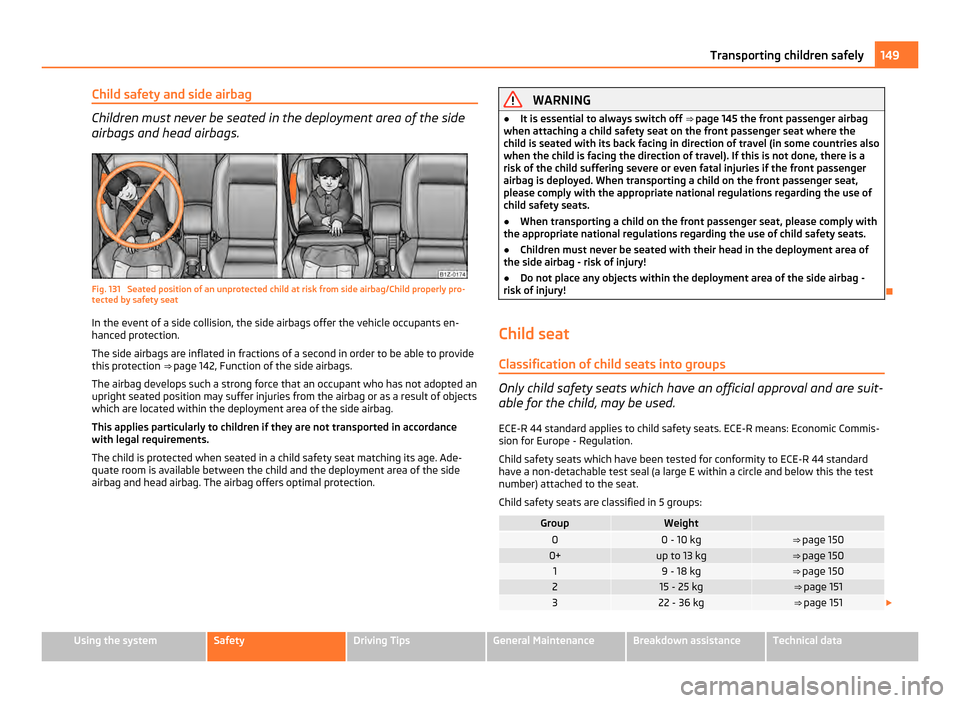
Child safety and side airbag
Children must never be seated in the deployment area of the side
airbags and head airbags.
Fig. 131 Seated position of an unprotected child at risk from side airbag/Child properly pro-
tected by safety seat
In the event of a side collision, the side airbags offer the vehicle occupants en-
hanced protection.
The side airbags are inflated in fractions of a second in order to be able to provide
this protection ⇒
page 142, Function of the side airbags.
The airbag develops such a strong force that an occupant who has not adopted an
upright seated position may suffer injuries from the airbag or as a result of objects
which are located within the deployment area of the side airbag.
This applies particularly to children if they are not transported in accordance
with legal requirements.
The child is protected when seated in a child safety seat matching its age. Ade-
quate room is available between the child and the deployment area of the side
airbag and head airbag. The airbag offers optimal protection. WARNING
● It is essential to always switch off ⇒ page 145
the front passenger airbag
when attaching a child safety seat on the front passenger seat where the
child is seated with its back facing in direction of travel (in some countries also
when the child is facing the direction of travel). If this is not done, there is a
risk of the child suffering severe or even fatal injuries if the front passenger
airbag is deployed. When transporting a child on the front passenger seat,
please comply with the appropriate national regulations regarding the use of
child safety seats.
● When transporting a child on the front passenger seat, please comply with
the appropriate national regulations regarding the use of child safety seats.
● Children must never be seated with their head in the deployment area of
the side airbag - risk of injury!
● Do not place any objects within the deployment area of the side airbag -
risk of injury!
Child seat Classification of child seats into groups Only child safety seats which have an official approval and are suit-
able for the child, may be used.
ECE-R 44 standard applies to child safety seats. ECE-R means: Economic Commis-
sion for Europe - Regulation.
Child safety seats which have been tested for conformity to ECE-R 44 standard
have a non-detachable test seal (a large E within a circle and below this the test
number) attached to the seat.
Child safety seats are classified in 5 groups: Group Weight
0 0 - 10 kg ⇒ page 150
0+ up to 13 kg ⇒ page 150
1 9 - 18 kg ⇒ page 150
2 15 - 25 kg ⇒
page 151 3 22 - 36 kg ⇒
page 151 £ 149
Transporting children safely Using the system Safety Driving Tips General Maintenance Breakdown assistance Technical data
Page 152 of 248
Children who are more than 1.50 m in height or who weigh more than 36 kg can
use normal seat belts without a seat bolster.
Use of child seats An overview of the usefulness of child seats on each of the seats according to the
ECE-R 44 standard: Child seat
of the group Front passenger
seat Rear seat
outside Rear seat
middle 0 U
+ U
+
T U
0+ U
+ U
+
T U
1 U
+ U
+
T U
2 and 3 U U U
Universal category - seat is suitable for all approved types of child safety
seats.
The seat can be fitted with fixing eyes for the
“ISOFIX ”system.
The divided rear seat - seat can be fitted with fixing eyes for the system “ Top
Tether” ⇒ page 153, Attaching child seat using the “Top Tether” system.
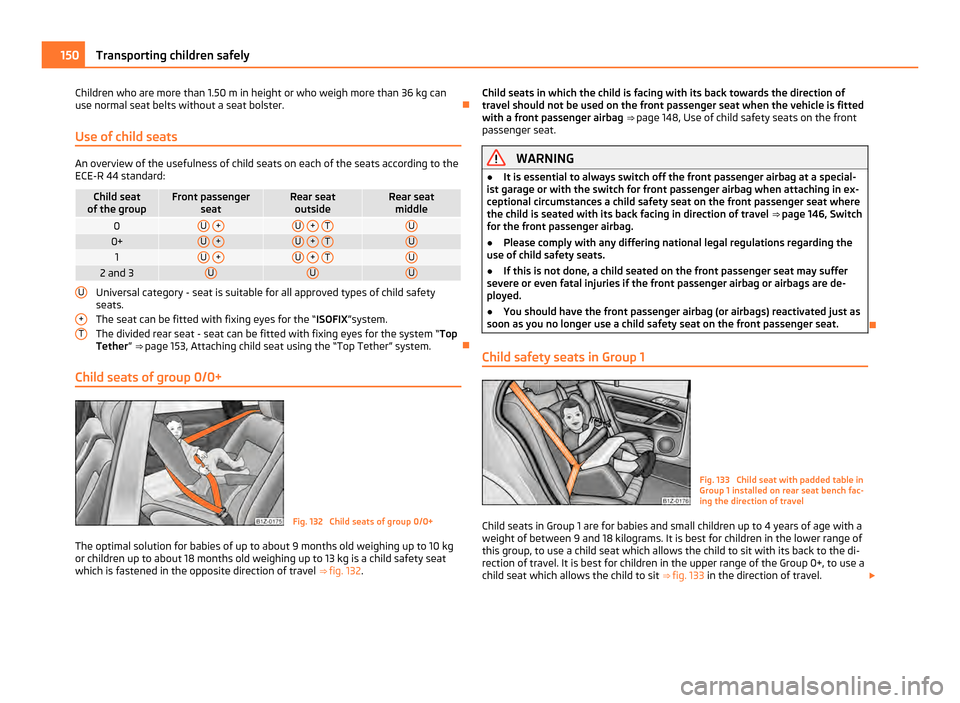
Child seats of group 0/0+ Fig. 132 Child seats of group 0/0+
The optimal solution for babies of up to about 9 months old weighing up to 10 kg
or children up to about 18 months old weighing up to 13 kg is a child safety seat
which is fastened in the opposite direction of travel ⇒
fig. 132.
U +
T Child seats in which the child is facing with its back towards the direction of
travel should not be used on the front passenger seat when the vehicle is fitted
with a front passenger airbag
⇒
page 148, Use of child safety seats on the front
passenger seat. WARNING
● It is essential to always switch off the front passenger airbag at a special-
ist garage or with the switch for front passenger airbag when attaching in ex-
ceptional circumstances a child safety seat on the front passenger seat where
the child is seated with its back facing in direction of travel ⇒
page 146, Switch
for the front passenger airbag.
● Please comply with any differing national legal regulations regarding the
use of child safety seats.
● If this is not done, a child seated on the front passenger seat may suffer
severe or even fatal injuries if the front passenger airbag or airbags are de-
ployed.
● You should have the front passenger airbag (or airbags) reactivated just as
soon as you no longer use a child safety seat on the front passenger seat.
Child safety seats in Group 1 Fig. 133 Child seat with padded table in
Group 1 installed on rear seat bench fac-
ing the direction of travel
Child seats in Group 1 are for babies and small children up to 4 years of age with a
weight of between 9 and 18 kilograms. It is best for children in the lower range of
this group, to use a child seat which allows the child to sit with its back to the di-
rection of travel. It is best for children in the upper range of the Group 0+, to use a
child seat which allows the child to sit ⇒ fig. 133 in the direction of travel. £150
Transporting children safely
Page 167 of 248
Do not drive with winter tyres all year round for this costs about 10 % more fuel.
Winter tyres are also louder.
No unnecessary ballast Transporting ballast costs fuel.
The fact that every kilogram of extra weight increases your fuel consumption
means that it is worth taking a look in the luggage compartment to avoid trans-
porting any unnecessary ballast.
It is particularly in town traffic, when one is accelerating quite often, that the vehi-
cle weight will have a significant effect upon the fuel consumption. A rule of
thumb here is that an increase in weight of 100 kilograms will cause an increase in
fuel consumption of about 1 litre/100 kilometres.
You may frequently also leave a roof rack fitted on just out of convenience, al-
though you no longer need it. The increased aerodynamic drag of your vehicle
causes it to use about 10 % more fuel than normal at a speed of 100 - 120 km/h,
even when you are not carrying a load on the roof.
Saving electricity Generating electricity costs fuel.
– Switch off electrical components as soon as you no longer need them.
When the engine is running, the alternator generates and supplies electrical pow-
er. If more electrical components of the electrical system are switched on, more
fuel is needed to operate the alternator.
Keeping a log of your fuel consumption If you really wish to keep a close check on your
fuel consumption, it is best to en-
ter the figures in a logbook. This does not take much time but is a very worthwhile
exercise. It enables you to detect any change (positive and negative) at an early
stage and to take any appropriate action.
If you find that your fuel consumption is too high, you should reflect on how,
where and in what conditions you have driven the vehicle since you last refuelled. Environmental compatibility Environmental protection has played a major role in the design, selection of mate-
rials and manufacture of your new ŠKODA. Particular emphasis has been paid to a
number of aspects, including:
Design measures
● Joints designed to be easily detached.
● Simplified disassembly due to the modular structure system.
● Improved purity of different classes of materials.
● Identification of all plastic parts in accordance with VDA Recommendation
°260.
● Reduced fuel consumption and exhaust emission CO
2.
● Minimum fuel leakage during accidents.
● Reduced noise.
Choice of materials
● Extensive use of recyclable material.
● Air conditioning filled with CFC-free refrigerant.
● No cadmium.
● No asbestos.
● Reduction in the “vaporisation” of plastics.
Manufacture
● Solvent-free cavity protection.
● Solvent-free protection of the vehicle for transportation from the production
plant to the customer.
● The use of solvent-free adhesives.
● No CFCs used in the production process.
● Without use of mercury.
● Use of water-soluble paints. £ 165
Driving and the Environment Using the system Safety Driving Tips General Maintenance Breakdown assistance Technical data
Page 170 of 248
Towing a trailer
Technical requirements Your vehicle is designed primarily for transporting persons and luggage. It can,
however, also be used for towing a trailer - provided certain technical equipment
is fitted.
If your vehicle has been
factory-fitted with a towing device or has a towing device
from ŠKODA Original Accessories, then the towing device satisfies all technical
and legal requirements.
Your vehicle is fitted with a 13-pin power socket for the electrical connection be-
tween the vehicle and trailer. If the trailer which you wish to tow has a 7-pin con-
nector, you can use a suitable adapter from
ŠKODA Original Accessories.
This work must be carried out in accordance with the manufacturer's specifica-
tions if a towing device is retrofitted.
Authorised ŠKODA Service Partners can provide detailed information about retro-
fitting a towing device and for any necessary modifications to the cooling system. WARNING
We recommend that you have the towing device from ŠKODA Original Acces-
sories installed by an authorised
ŠKODA Service Partner. He is familiar with all
the relevant details relating to retrofitting such equipment. There is a risk of
an accident if the towing device is not properly fitted!
General Maintenance Trailer load
The permissible trailer load must on no account be exceeded.
You can negotiate appropriately steeper inclines and descents if you do not make
full use of the permissible trailer load.
The trailer loads specified only apply for
altitudes up to 1000 metres above mean
sea level. The fact that the engine power output drops with increasing height due
to a lowering of air pressure and thus the ability to climb, means that the towed
weight must be reduced by 10 % for every further increase of 1 000 metres in height above sea level. The towed weight is the weight of the (laden) vehicle and
the (laden) trailer together. One should take this into account before driving up to
higher altitudes.
The trailer and drawbar load information on the type plate of the towing device
are merely test data for the towing device The data relating to your vehicle,
which is often less than this test data, can be found in your vehicle registration
documents.
Distribution of the load
Distribute the load in the trailer in such a way that any heavy items are located as
close as possible to the axle. Secure the items to prevent them slipping.
Tyre pressure
Correct the tyre inflation pressure on your vehicle for that of
“fully laden”
⇒ page 192. The inflation pressure of the tyres fitted to the trailer adjust in ac-
cordance with the manufacturer's recommendation.
Exterior mirrors
You have to have additional exterior mirrors fitted if you are not able to see the
traffic behind the trailer with the standard rear-view mirrors. Both exterior mirrors
should be attached to folding arms. Adjust the mirrors so that they provide you
with an adequate field of view to the rear.
Headlights
Before starting off with a hitched trailer, also check the setting of the headlights.
Alter the setting as necessary with the aid of the headlight beam adjuster
⇒ page 49.
Detachable ball head
The ball head is detachable on vehicles with towing device and can be obtained
from ŠKODA Original Accessories. It is stowed together with separate fitting in-
structions in the spare wheel well in the luggage compartment of the vehicle. Note
● We recommend that you also have your vehicle inspected between service in-
tervals if you tow a trailer frequently.
● The handbrake on the towing vehicle must be put on when coupling and de-
coupling the trailer. 168
Towing a trailer
Page 171 of 248
Driving Tips
–
Do not, as far as possible, drive with your vehicle unladen and the trailer laden.
– Do not make full use of the legal maximum speeds. This applies in particular to
downhill sections.
– Apply the brakes in good time.
– Keep a check on the coolant temperature gauge if the outside temperature is
high.
Distribution of weight
The distribution of the weight is very poor if your vehicle is unladen and the trailer
is laden. Maintain a particularly low speed if you cannot avoid driving with this
combination.
Driving speed
Do not drive faster than 80 km/hour for safety reasons. This also applies for coun-
tries in which higher speeds are allowed.
The fact that the driving stability of the vehicle + trailer combination reduces with
increasing speed means that the legally allowed speed should not be used when
there are unfavourable road, weather or wind conditions, particularly near acci-
dent black spots.
You must always reduce your speed immediately as soon as you detect even just
the slightest swaying of the trailer. On no account attempt to stop the trailer
from “swaying”
by accelerating.
Apply the brakes in good time! If the trailer is fitted with a trailer brake, apply the
brakes gently at first and then brake firmly. This will avoid brake jolts resulting
from the trailer wheels locking. Shift down gears in good time before negotiating
a downhill section to allow the engine to also act as a brake.
Engine overheating
Please keep a check on the coolant temperature gauge if you have to negotiate a
lengthy slope in a low gear at a high engine speed when the outside temperature
is very high ⇒ page 11, Coolant temperature gauge.
If the needle of the coolant temperature gauge moves into the right-hand area or
even the red area of the scale, reduce your speed immediately. Stop and switch
off the engine if the warning light in the instrument cluster begins flashing.
Wait a few minutes and check the level of coolant in the coolant expansion bottle
⇒ page 185, Inspecting the coolant level. Please refer to the following guidelines
⇒ page 25, Coolant temperature/ Coolant
quantity .
The coolant temperature can be reduced by switching on the heating.
Any increase in the cooling effect of the coolant fan through shifting down a gear
and increasing the engine speed is not possible since the fan speed is independ-
ent of the engine speed. One should also not drop a gear for this reason when
towing a trailer as long as the engine can manage the slope without any drop in
speed. 169
Towing a trailer Using the system Safety Driving Tips General Maintenance Breakdown assistance Technical data
Page 223 of 248
Technical data
Technical data General information The details given in the official vehicle registration documents always take prece-
dence over the details in the Owner's Manual. Please refer to the official vehicle
registration documents or consult an authorised
ŠKODA Service Partner concern-
ing the engine with which your vehicle is equipped.
Used abbreviations Abbreviation Description
kW Kilowatt, measuring unit for the engine output
rpm Engine revolutions per minute
Nm Newton meter, measuring unit for the engine torque
g/km discharged quantity of carbon dioxide in grams per driven
kilometre
TSI Petrol engine with a turbocharger and a direct fuel injec-
tion system TDI PD Diesel engine with turbocharger and injection system
unit injector
TDI CR Diesel engine with turbocharger and injection system
Common Rail
M5/M6 5-speed/6-speed manual gearbox
AQ6 6-speed automatic gearbox
DQ6/DQ7 6 speed-/7 speed automatic gearbox DSG
DPF Diesel particle filter
N1 The vehicles of this category are designed and construc-
ted for conveying goods with a maximum weight of
3.5
tons Performances The listed performance values were determined without performance-reducing
equipment, e.g. air conditioning system.
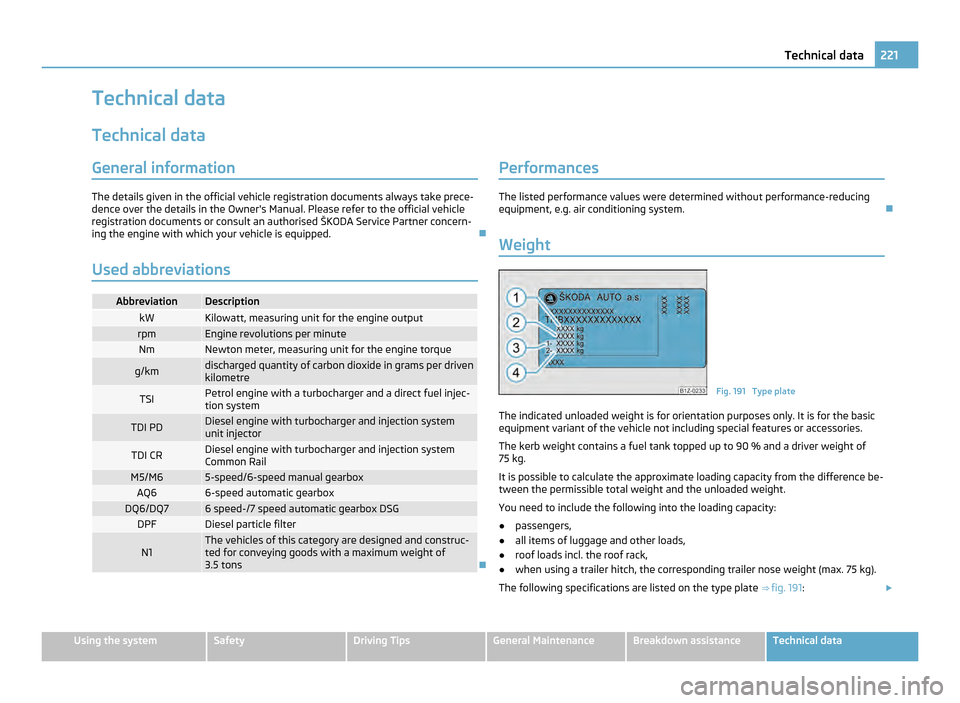
Weight Fig. 191 Type plate
The indicated unloaded weight is for orientation purposes only. It is for the basic
equipment variant of the vehicle not including special features or accessories.
The kerb weight contains a fuel tank topped up to 90 % and a driver weight of
75 kg.
It is possible to calculate the approximate loading capacity from the difference be-
tween the permissible total weight and the unloaded weight.
You need to include the following into the loading capacity:
● passengers,
● all items of luggage and other loads,
● roof loads incl. the roof rack,
● when using a trailer hitch, the corresponding trailer nose weight (max. 75 kg).
The following specifications are listed on the type plate ⇒
fig. 191 : £ 221
Technical data Using the system Safety Driving Tips General Maintenance Breakdown assistance Technical data
Page 224 of 248
Permissible gross weight
The permissible overall weight of the vehicle/trailer combination when the
vehicle is being operated with a trailer
Maximum permissible front axle load
Maximum permissible rear axle load
The type plate is fixed to the lower part of the columns on the driver's side, be-
tween the front and rear doors. WARNING
Do not exceed the permissible overall weight - risk of accident and damage to
the vehicle.
Identification details Fig. 192 Vehicle data sticker
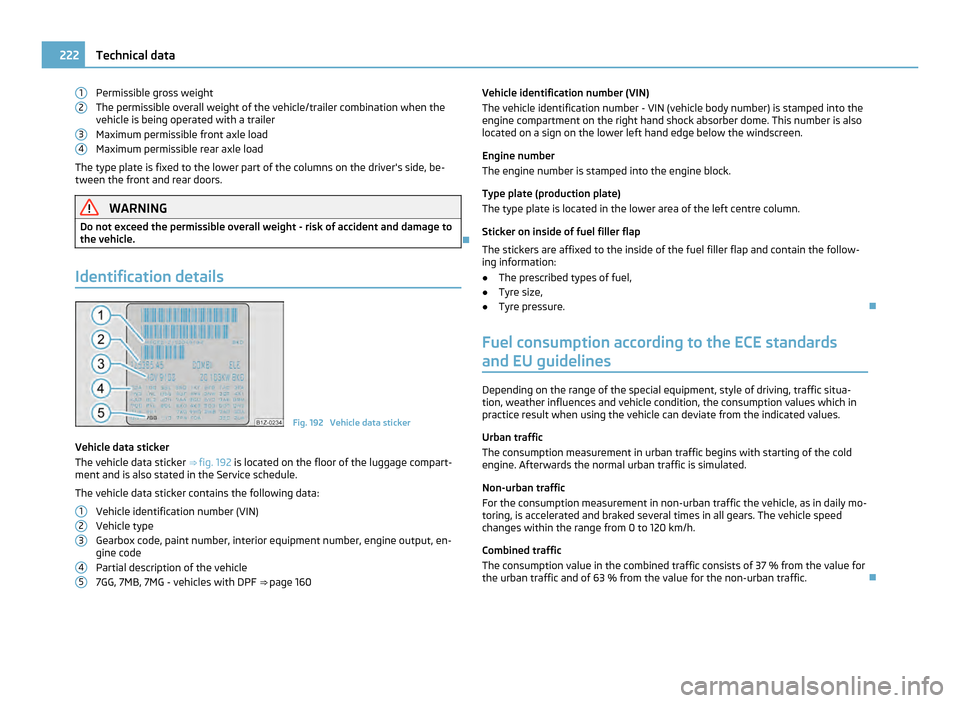
Vehicle data sticker
The vehicle data sticker ⇒ fig. 192 is located on the floor of the luggage compart-
ment and is also stated in the Service schedule.
The vehicle data sticker contains the following data:
Vehicle identification number (VIN)
Vehicle type
Gearbox code, paint number, interior equipment number, engine output, en-
gine code
Partial description of the vehicle
7GG, 7MB, 7MG - vehicles with DPF ⇒ page 160
1 2
3
4
1
2
3
4
5 Vehicle identification number (VIN)
The vehicle identification number - VIN (vehicle body number) is stamped into the
engine compartment on the right hand shock absorber dome. This number is also
located on a sign on the lower left hand edge below the windscreen.
Engine number
The engine number is stamped into the engine block.
Type plate (production plate)
The type plate is located in the lower area of the left centre column.
Sticker on inside of fuel filler flap
The stickers are affixed to the inside of the fuel filler flap and contain the follow-
ing information:
● The prescribed types of fuel,
● Tyre size,
● Tyre pressure.
Fuel consumption according to the ECE standards
and EU guidelines Depending on the range of the special equipment, style of driving, traffic situa-
tion, weather influences and vehicle condition, the consumption values which in
practice result when using the vehicle can deviate from the indicated values.
Urban traffic
The consumption measurement in urban traffic begins with starting of the cold
engine. Afterwards the normal urban traffic is simulated.
Non-urban traffic
For the consumption measurement in non-urban traffic the vehicle, as in daily mo-
toring, is accelerated and braked several times in all gears. The vehicle speed
changes within the range from 0 to 120 km/h.
Combined traffic
The consumption value in the combined traffic consists of 37 % from the value for
the urban traffic and of 63 % from the value for the non-urban traffic. 222
Technical data
Page 228 of 248
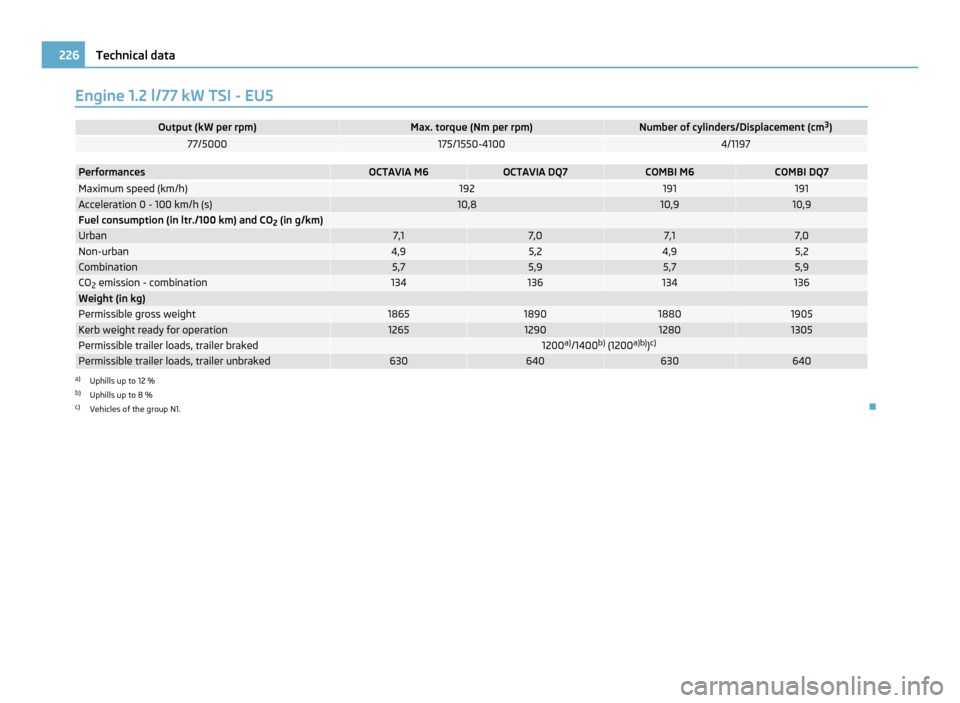
Engine 1.2 l/77 kW TSI - EU5
Output (kW per rpm) Max. torque (Nm per rpm) Number of cylinders/Displacement (cm
3
) 77/5000 175/1550-4100 4/1197
Performances OCTAVIA M6 OCTAVIA DQ7 COMBI M6 COMBI DQ7
Maximum speed (km/h) 192 191 191
Acceleration 0 - 100 km/h (s) 10,8 10,9 10,9
Fuel consumption (in ltr./100 km) and CO
2 (in g/km) Urban 7,1 7,0 7,1 7,0
Non-urban 4,9 5,2 4,9 5,2
Combination 5,7 5,9 5,7 5,9
CO
2 emission - combination 134 136 134 136
Weight (in kg)
Permissible gross weight 1865 1890 1880 1905
Kerb weight ready for operation 1265 1290 1280 1305
Permissible trailer loads, trailer braked 1200
a)
/1400 b)
(1200 a) b)
)c) Permissible trailer loads, trailer unbraked 630 640 630 640
a)
Uphills up to 12 %
b) Uphills up to 8 %
c) Vehicles of the group N1. 226
Technical data