height SKODA OCTAVIA 2012 3.G / (5E) User Guide
[x] Cancel search | Manufacturer: SKODA, Model Year: 2012, Model line: OCTAVIA, Model: SKODA OCTAVIA 2012 3.G / (5E)Pages: 222, PDF Size: 13.52 MB
Page 142 of 222
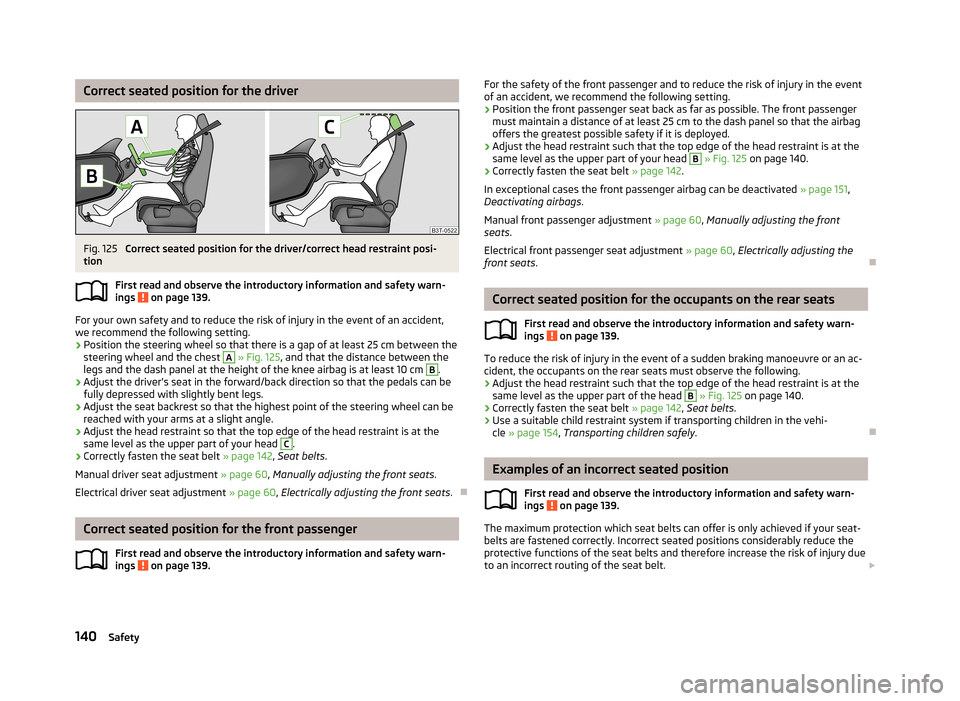
Correct seated position for the driverFig. 125
Correct seated position for the driver/correct head restraint posi-
tion
First read and observe the introductory information and safety warn-ings
on page 139.
For your own safety and to reduce the risk of injury in the event of an accident,we recommend the following setting.
› Position the steering wheel so that there is a gap of at least 25 cm between the
steering wheel and the chest
A
» Fig. 125 , and that the distance between the
legs and the dash panel at the height of the knee airbag is at least 10 cm
B
.
› Adjust the driver’s seat in the forward/back direction so that the pedals can be
fully depressed with slightly bent legs.
› Adjust the seat backrest so that the highest point of the steering wheel can be
reached with your arms at a slight angle.
› Adjust the head restraint so that the top edge of the head restraint is at the
same level as the upper part of your head
C
.
› Correctly fasten the seat belt
» page 142, Seat belts .
Manual driver seat adjustment » page 60, Manually adjusting the front seats .
Electrical driver seat adjustment » page 60, Electrically adjusting the front seats .
Correct seated position for the front passenger
First read and observe the introductory information and safety warn-ings
on page 139.
For the safety of the front passenger and to reduce the risk of injury in the event
of an accident, we recommend the following setting.
› Position the front passenger seat back as far as possible. The front passenger
must maintain a distance of at least 25 cm to the dash panel so that the airbag
offers the greatest possible safety if it is deployed.
› Adjust the head restraint such that the top edge of the head restraint is at the
same level as the upper part of your head B
» Fig. 125 on page 140.
› Correctly fasten the seat belt
» page 142.
In exceptional cases the front passenger airbag can be deactivated » page 151,
Deactivating airbags .
Manual front passenger adjustment » page 60, Manually adjusting the front
seats .
Electrical front passenger seat adjustment » page 60, Electrically adjusting the
front seats .
Correct seated position for the occupants on the rear seats
First read and observe the introductory information and safety warn-ings
on page 139.
To reduce the risk of injury in the event of a sudden braking manoeuvre or an ac-
cident, the occupants on the rear seats must observe the following.
› Adjust the head restraint such that the top edge of the head restraint is at the
same level as the upper part of the head
B
» Fig. 125 on page 140.
› Correctly fasten the seat belt
» page 142, Seat belts .
› Use a suitable child restraint system if transporting children in the vehi-
cle » page 154 , Transporting children safely .
Examples of an incorrect seated position
First read and observe the introductory information and safety warn-
ings
on page 139.
The maximum protection which seat belts can offer is only achieved if your seat-
belts are fastened correctly. Incorrect seated positions considerably reduce the protective functions of the seat belts and therefore increase the risk of injury dueto an incorrect routing of the seat belt.
140Safety
Page 144 of 222

Seat belts
Seat belts
Introduction
Fig. 126
Driver wearing seat belt
This chapter contains information on the following subjects:
The physical principle of a frontal collision
143
Fastening and unfastening seat belts
144
Seat belt height adjuster on the front seats
145
Intertia reel
145
Belt tensioners
145
Seat belts that are fastened correctly offer good protection in the event of an ac-
cident. They reduce the risk of an injury and increase the chance of survival in the
event of a major accident.
Correctly fastened seat belts hold occupants of the car in the correct seated posi-
tion » Fig. 126 .
The seat belts reduce the kinetic energy (energy of motion) to a considerable ex-
tent. They also prevent uncontrolled movements which, in turn, may well result in
severe injuries.
The occupants of a vehicle who have fastened and correctly adjusted their seat belt profit to a major extent from the fact that the kinetic energy is as much as
possible absorbed by the belts. The structure of the front end of the vehicle and
other passive safety measures, such as the airbag system, also contribute to re-
ducing the kinetic energy in the best possible way. The energy produced is thus
absorbed and there is less risk of injury.
Particular safety aspects must be observed when transporting children in the ve-
hicle » page 154 .WARNING■
Fasten your seat belt before each journey – even when driving in town! This
also applies to the people seated at the rear – risk of injury!■
Expectant women must also always wear a seat belt. This is the only way of
ensuring optimal protection for the unborn child » page 144, Fastening and
unfastening seat belts .
■
Adjust the height of the belt in such a way that the shoulder part of the belt
is roughly positioned across the middle of your shoulder – on no account
across your neck.
■
Always ensure that the webbing of the seat belts is properly routed. Seat
belts which are not correctly adjusted can themselves cause injuries even in
minor accidents.
■
The maximum protection which seat belts can offer is only achieved if you
are correctly seated » page 139, Correct seated position .
■
The seat backrests of the front seats must not be tilted too far to the rear
otherwise the seatbelts can lose their effectiveness.
■
The belt webbing must not be jammed in-between at any point or twisted,
or chafe against any sharp edges.
■
Make sure you do not catch the seat belt in the door when closing it.
■
A seat belt which is hanging too loose can result in injuries as your body is
moved forward by the kinetic energy produced in an accident and is then sud-
denly held firm by the belt.
■
The belt webbing must not run across solid or fragile objects (e.g. specta-
cles, ball-point pens, keys etc.) as this may be a cause of injuries.
■
Never use a seatbelt to secure two persons (not children either). The seat-
belt must not be placed over a child who is sat on the lap of an occupant ei- ther.
■
The lock tongue should only be inserted into the lock which is the correct
one for your seat. Wrong use of the safety belt will reduce its capacity to pro-
tect and the risk of injury increases.
■
The slot of the belt tongue must not be blocked otherwise the belt tongue
will not lock in place properly.
■
Many layers of clothing and loose clothing (e. g. a winter coat over a jacket)
do not allow you to be correctly seated and impairs proper operation of the
seat belts.
142Safety
Page 147 of 222
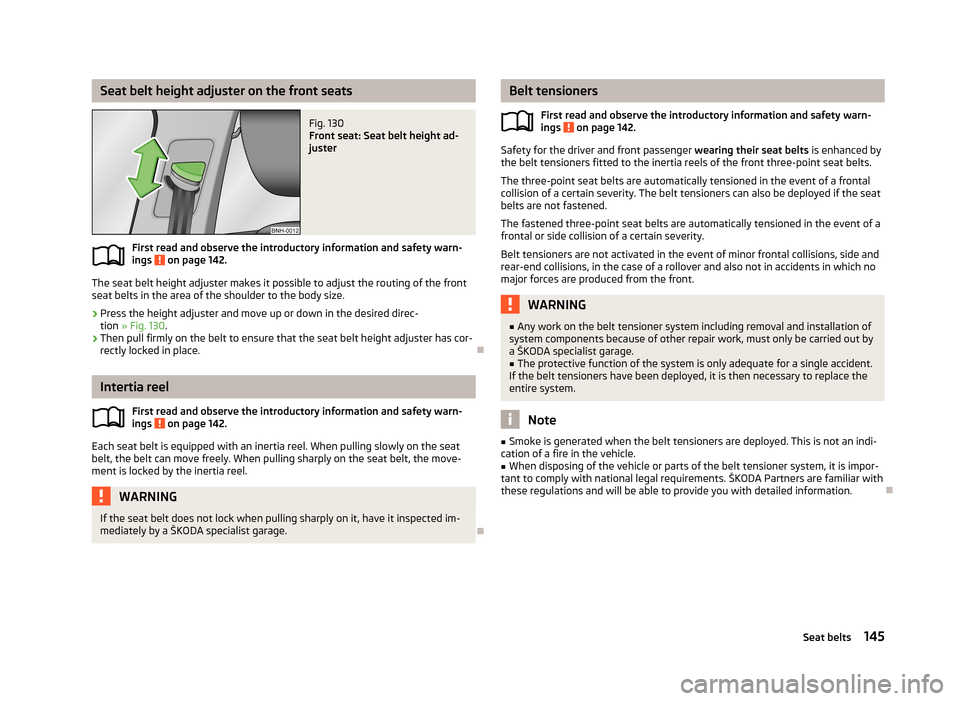
Seat belt height adjuster on the front seatsFig. 130
Front seat: Seat belt height ad-
juster
First read and observe the introductory information and safety warn-
ings on page 142.
The seat belt height adjuster makes it possible to adjust the routing of the front
seat belts in the area of the shoulder to the body size.
›
Press the height adjuster and move up or down in the desired direc- tion » Fig. 130 .
›
Then pull firmly on the belt to ensure that the seat belt height adjuster has cor-
rectly locked in place.
Intertia reel
First read and observe the introductory information and safety warn-ings
on page 142.
Each seat belt is equipped with an inertia reel. When pulling slowly on the seat
belt, the belt can move freely. When pulling sharply on the seat belt, the move-
ment is locked by the inertia reel.
WARNINGIf the seat belt does not lock when pulling sharply on it, have it inspected im-
mediately by a ŠKODA specialist garage.
Belt tensioners
First read and observe the introductory information and safety warn-
ings
on page 142.
Safety for the driver and front passenger wearing their seat belts is enhanced by
the belt tensioners fitted to the inertia reels of the front three-point seat belts.
The three-point seat belts are automatically tensioned in the event of a frontal
collision of a certain severity. The belt tensioners can also be deployed if the seat
belts are not fastened.
The fastened three-point seat belts are automatically tensioned in the event of a frontal or side collision of a certain severity.
Belt tensioners are not activated in the event of minor frontal collisions, side and
rear-end collisions, in the case of a rollover and also not in accidents in which no
major forces are produced from the front.
WARNING■ Any work on the belt tensioner system including removal and installation of
system components because of other repair work, must only be carried out by
a ŠKODA specialist garage.■
The protective function of the system is only adequate for a single accident.
If the belt tensioners have been deployed, it is then necessary to replace the
entire system.
Note
■ Smoke is generated when the belt tensioners are deployed. This is not an indi-
cation of a fire in the vehicle.■
When disposing of the vehicle or parts of the belt tensioner system, it is impor-
tant to comply with national legal requirements. ŠKODA Partners are familiar with
these regulations and will be able to provide you with detailed information.
145Seat belts
Page 155 of 222
Passenger protection system
Introductory information
The Passenger protection system helps you reduce the impact of a collision with a pedestrian.
The system is activated automatically in the event of a frontal collision with a pe-
destrian at speeds of 30-55 km/h. In the event of an impact, the rear section of
the bonnet is raised by approx. 55 mm thus creating a crumple zone above the
engine.
The system sensors are integrated in the front bumper.
The functional status of the system is indicated by the indicator light
in the in-
strument cluster » page 19.
In some cases, the system may be activated even if the vehicle did not collide
with a pedestrian, e.g.:
› in a frontal collision with a lamppost, a street light, column, etc.;
› in a frontal collision with an animal;
› when driving over a mound of snow;
› when the suspension comes into contact with the road;
› when driving over pronounced corrugations perpendicular to the direction of
travel.
We recommend that any modifications and repairs to the front bumper or body-
work be carried out by a ŠKODA Partner. Further information » page 165.
WARNING■
Work or technical modifications on your vehicle, which have been carried out
unprofessionally, can cause operational faults – risk of accident!■
Do not attach the front number plate in the holder. Instead, screw it onto
the bumper in the area provided. The attached number plate holder impairs
the functioning of the sensors and thus the assessment made to determine
whether to activate the system or not.
NoteWhen disposing of the vehicle or parts of the Passenger protection system, it is
important to comply with national legal requirements. ŠKODA Partners are famili-
ar with these regulations and will be able to provide you with detailed informa-
tion.
Activating the system
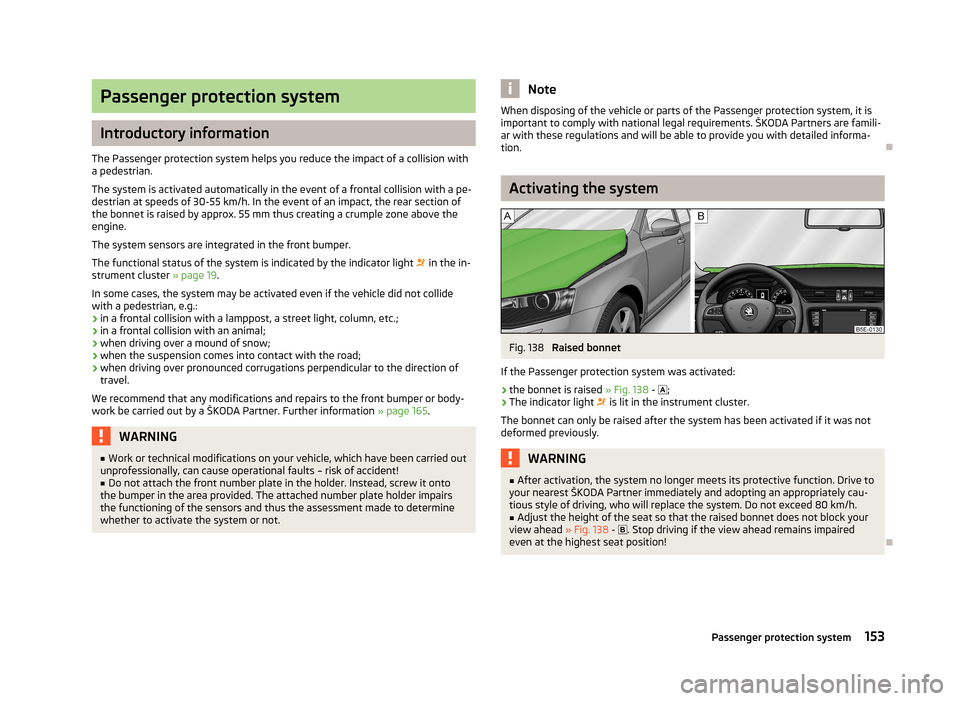
Fig. 138
Raised bonnet
If the Passenger protection system was activated:
› the bonnet is raised
» Fig. 138 -
;
› The indicator light
is lit in the instrument cluster.
The bonnet can only be raised after the system has been activated if it was not deformed previously.
WARNING■ After activation, the system no longer meets its protective function. Drive to
your nearest ŠKODA Partner immediately and adopting an appropriately cau-
tious style of driving, who will replace the system. Do not exceed 80 km/h.■
Adjust the height of the seat so that the raised bonnet does not block your
view ahead » Fig. 138 - . Stop driving if the view ahead remains impaired
even at the highest seat position!
153Passenger protection system
Page 157 of 222
Use of a child seat on the front passenger seat
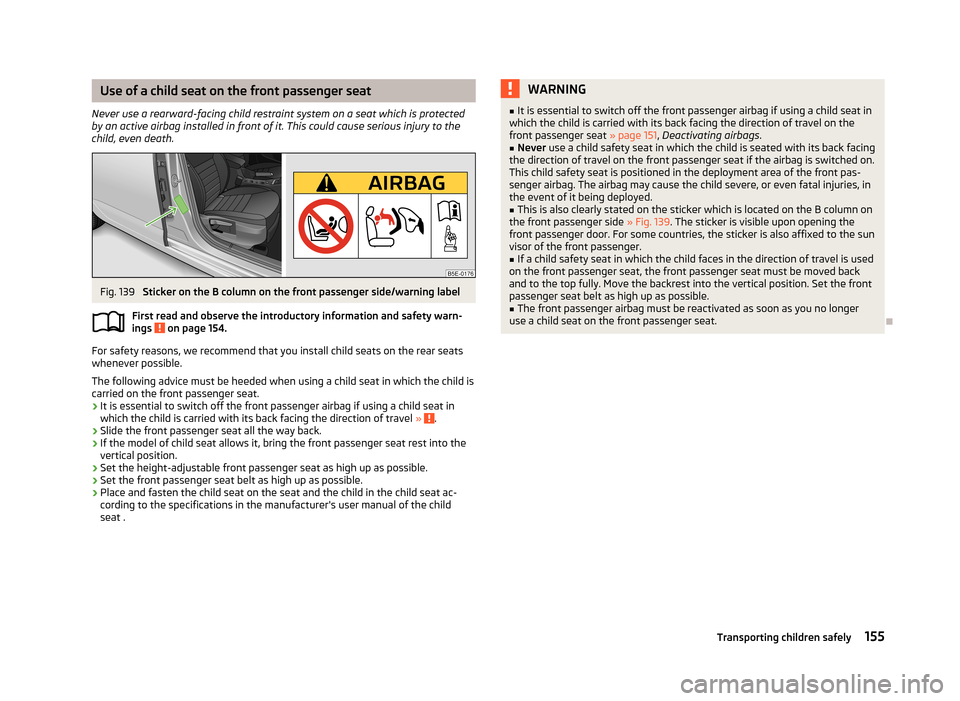
Never use a rearward-facing child restraint system on a seat which is protected by an active airbag installed in front of it. This could cause serious injury to the child, even death.Fig. 139
Sticker on the B column on the front passenger side/warning label
First read and observe the introductory information and safety warn- ings
on page 154.
For safety reasons, we recommend that you install child seats on the rear seats whenever possible.
The following advice must be heeded when using a child seat in which the child is
carried on the front passenger seat.
› It is essential to switch off the front passenger airbag if using a child seat in
which the child is carried with its back facing the direction of travel »
.
› Slide the front passenger seat all the way back.
› If the model of child seat allows it, bring the front passenger seat rest into the
vertical position.
› Set the height-adjustable front passenger seat as high up as possible.
› Set the front passenger seat belt as high up as possible.
› Place and fasten the child seat on the seat and the child in the child seat ac-
cording to the specifications in the manufacturer's user manual of the childseat .
WARNING■ It is essential to switch off the front passenger airbag if using a child seat in
which the child is carried with its back facing the direction of travel on the
front passenger seat » page 151, Deactivating airbags .■
Never use a child safety seat in which the child is seated with its back facing
the direction of travel on the front passenger seat if the airbag is switched on.
This child safety seat is positioned in the deployment area of the front pas-
senger airbag. The airbag may cause the child severe, or even fatal injuries, in
the event of it being deployed.
■
This is also clearly stated on the sticker which is located on the B column on
the front passenger side » Fig. 139. The sticker is visible upon opening the
front passenger door. For some countries, the sticker is also affixed to the sun
visor of the front passenger.
■
If a child safety seat in which the child faces in the direction of travel is used
on the front passenger seat, the front passenger seat must be moved back
and to the top fully. Move the backrest into the vertical position. Set the front
passenger seat belt as high up as possible.
■
The front passenger airbag must be reactivated as soon as you no longer
use a child seat on the front passenger seat.
155Transporting children safely
Page 173 of 222
Note■If there is anything you are not sure about concerning fluids, please consult a
ŠKODA Partner.■
Fluids with the correct specifications can be purchased from ŠKODA Original Ac-
cessories.
Opening and closing the bonnet
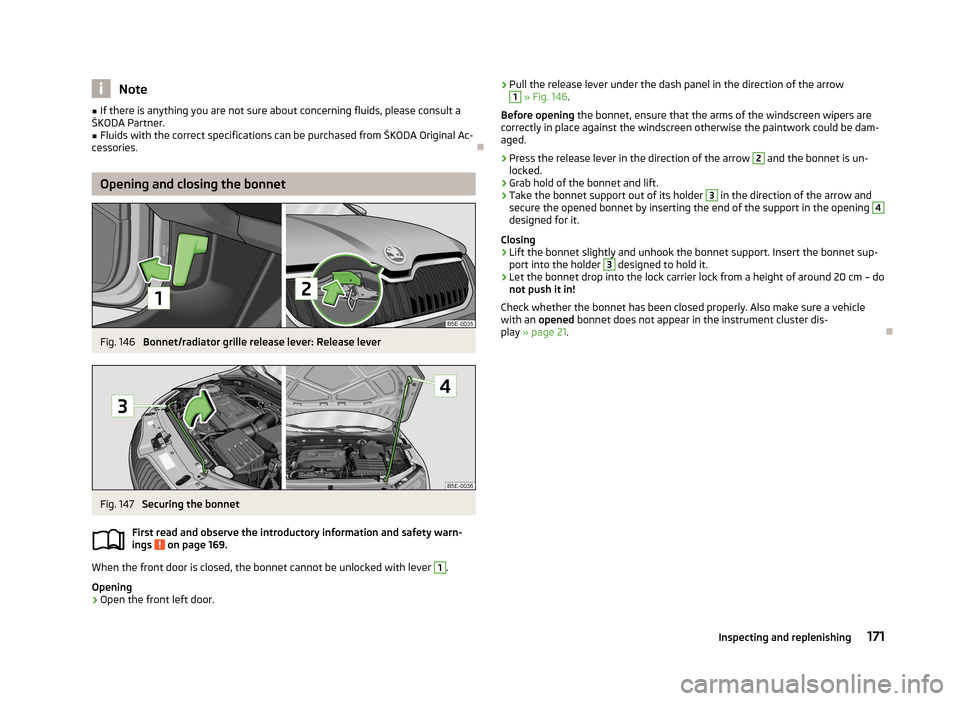
Fig. 146
Bonnet/radiator grille release lever: Release lever
Fig. 147
Securing the bonnet
First read and observe the introductory information and safety warn-
ings
on page 169.
When the front door is closed, the bonnet cannot be unlocked with lever
1
.
Opening
›
Open the front left door.
› Pull the release lever under the dash panel in the direction of the arrow1
» Fig. 146 .
Before opening the bonnet, ensure that the arms of the windscreen wipers are
correctly in place against the windscreen otherwise the paintwork could be dam- aged.›
Press the release lever in the direction of the arrow
2
and the bonnet is un-
locked.
›
Grab hold of the bonnet and lift.
›
Take the bonnet support out of its holder
3
in the direction of the arrow and
secure the opened bonnet by inserting the end of the support in the opening
4
designed for it.
Closing
›
Lift the bonnet slightly and unhook the bonnet support. Insert the bonnet sup-
port into the holder
3
designed to hold it.
›
Let the bonnet drop into the lock carrier lock from a height of around 20 cm – do not push it in!
Check whether the bonnet has been closed properly. Also make sure a vehicle
with an opened bonnet does not appear in the instrument cluster dis-
play » page 21 .
171Inspecting and replenishing
Page 185 of 222
Always check the inflation pressure when the tyres are cold. Do not reduce the
higher pressure of warm tyres.
With greater payload, adjust the tyre inflation pressure accordingly.
Driving style
Fast cornering, sharp acceleration and braking increase the wear of your tyres.
Balancing wheels
The wheels of a new vehicle are balanced. When driving, there are a wide range
of influences which may result in an imbalance. This may make itself felt by a vi-
bration in the steering.
Have the wheels rebalanced after replacing the tyres.
Wheel alignment errors
An incorrect wheel alignment at the front or rear leads to excess wear on the tyres.
Tyre damage
Drive over curbs and other such obstacles slowly and, where possible, at a right
angle in order to avoid damage to tyres and wheel trims.
We recommend checking your tyres and wheel rims for damage (punctures, cuts,
splits and bulges, etc.) on a regular basis. Remove foreign bodies (e.g. small
stones) from the tyre profile immediately.
Changing wheels around
If significantly greater wear is present on the front tyres, we recommend chang-
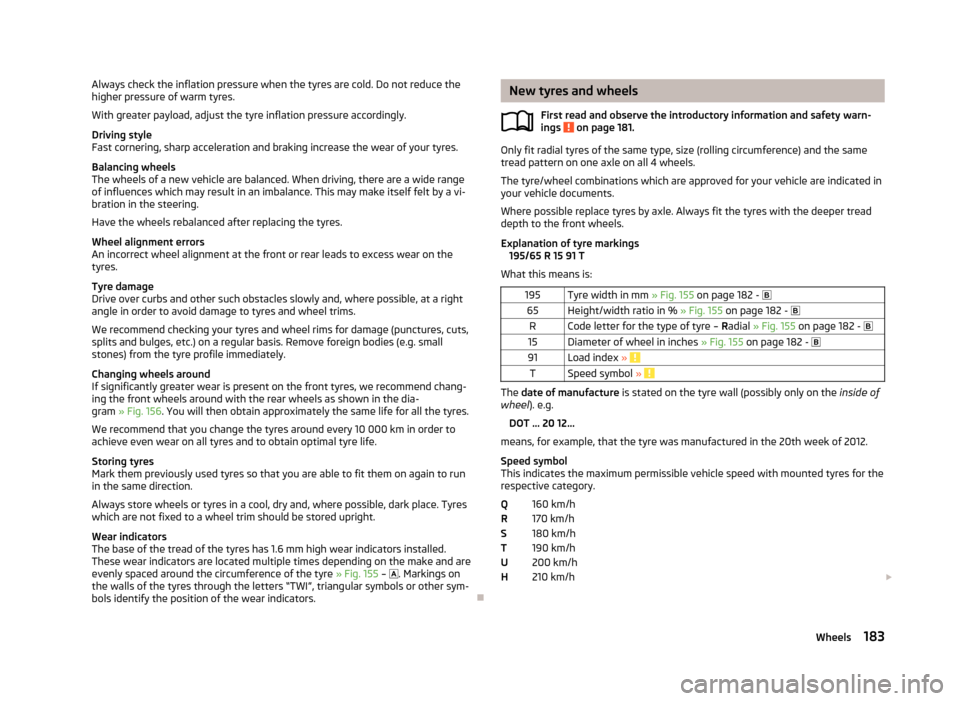
ing the front wheels around with the rear wheels as shown in the dia- gram » Fig. 156 . You will then obtain approximately the same life for all the tyres.
We recommend that you change the tyres around every 10 000 km in order to
achieve even wear on all tyres and to obtain optimal tyre life.
Storing tyres
Mark them previously used tyres so that you are able to fit them on again to run in the same direction.
Always store wheels or tyres in a cool, dry and, where possible, dark place. Tyres which are not fixed to a wheel trim should be stored upright.
Wear indicators
The base of the tread of the tyres has 1.6 mm high wear indicators installed.
These wear indicators are located multiple times depending on the make and are evenly spaced around the circumference of the tyre » Fig. 155 –
. Markings on
the walls of the tyres through the letters “TWI”, triangular symbols or other sym-
bols identify the position of the wear indicators.
New tyres and wheels
First read and observe the introductory information and safety warn-
ings
on page 181.
Only fit radial tyres of the same type, size (rolling circumference) and the same
tread pattern on one axle on all 4 wheels.
The tyre/wheel combinations which are approved for your vehicle are indicated in
your vehicle documents.
Where possible replace tyres by axle. Always fit the tyres with the deeper tread
depth to the front wheels.
Explanation of tyre markings 195/65 R 15 91 T
What this means is:
195Tyre width in mm » Fig. 155 on page 182 - 65Height/width ratio in % » Fig. 155 on page 182 - RCode letter for the type of tyre – Radial » Fig. 155 on page 182 - 15Diameter of wheel in inches » Fig. 155 on page 182 - 91Load index » TSpeed symbol »
The date of manufacture is stated on the tyre wall (possibly only on the inside of
wheel ). e.g.
DOT ... 20 12...
means, for example, that the tyre was manufactured in the 20th week of 2012.
Speed symbol
This indicates the maximum permissible vehicle speed with mounted tyres for the respective category.
160 km/h
170 km/h
180 km/h
190 km/h
200 km/h
210 km/h
QRSTUH183Wheels
Page 210 of 222
Fuel consumption according to the ECE standards and EU guidelinesThe measurement of the intra-urban cycle begins with a cold start of the engine.
Afterwards standard urban driving is simulated.
In the extra-urban driving cycle, the vehicle is accelerated and decelerated in all
gears, corresponding to daily routine driving conditions. The driving speed varies
between 0 and -120 km/h.
The calculation of the combined fuel consumption considers a weighting of about 37 % for the intra-urban cycle and 63 % for the extra-urban cycle.WARNINGDo not exceed the specified maximum permissible weights - risk of accident
and damage!
Note
■ If required, you can find out the precise weight of your vehicle by contacting a
ŠKODA Partner.■
Depending on the range of equipment, style of driving, traffic situation, weather
influences and vehicle condition, consumption values may deviate from the indi- cated values.
Dimensions
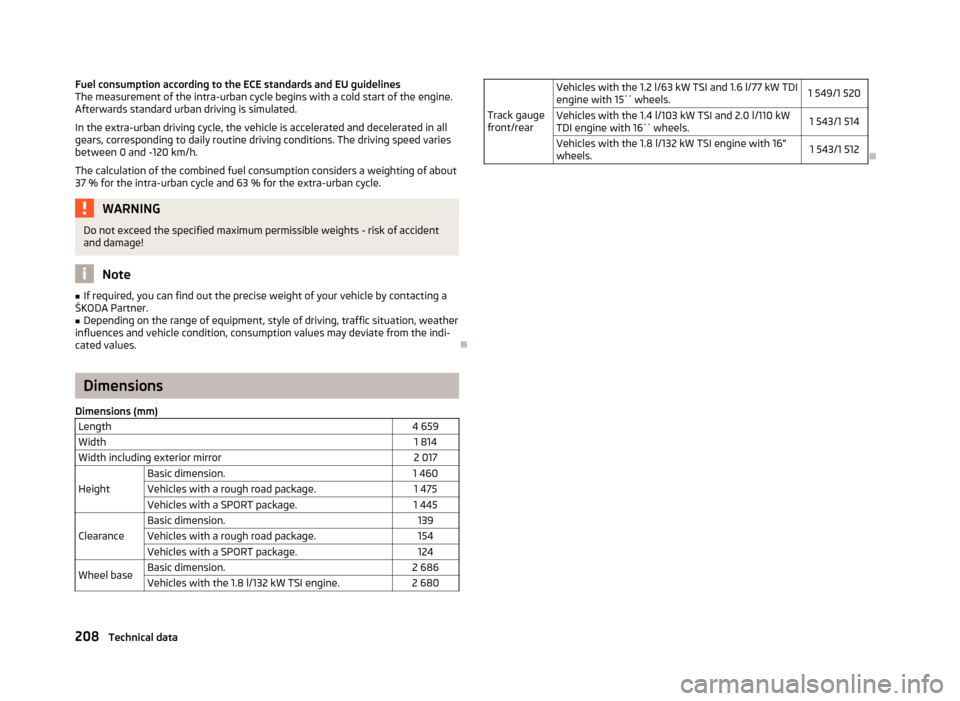
Dimensions (mm)
Length4 659Width1 814Width including exterior mirror2 017
Height
Basic dimension.1 460Vehicles with a rough road package.1 475Vehicles with a SPORT package.1 445
Clearance
Basic dimension.139Vehicles with a rough road package.154Vehicles with a SPORT package.124Wheel baseBasic dimension.2 686Vehicles with the 1.8 l/132 kW TSI engine.2 680
Track gauge
front/rear
Vehicles with the 1.2 l/63 kW TSI and 1.6 l/77 kW TDI
engine with 15´´ wheels.1 549/1 520Vehicles with the 1.4 l/103 kW TSI and 2.0 l/110 kW TDI engine with 16´´ wheels.1 543/1 514Vehicles with the 1.8 l/132 kW TSI engine with 16"
wheels.1 543/1 512
208Technical data
Page 218 of 222
ReplenishingCoolant175
Engine oil173
Windscreen washer fluid176
Roof luggage rack Attachment points
69
Roof rack system68
Roof load69
Running-in the first 1 500 km
100
Running in Brake pads
100
Engine100
Tyres100
S
Safe securing system
30
Safety138
Child safety154
Child safety seats154
Head restraints63
ISOFIX157
TOP TETHER158
Save electrical energy101
Seat Adjusting electrically
60
Manually adjusting60
Seat belt Warning light
14, 15
Seat belt height adjuster145
Seat belts Belt tensioners
145
Cleaning165
fastening and unfastening144
Height adjustment145
Seatbelts Inertia reels
145
Seatsfolding forward63
Head restraints63
Heating62
see automatic gearbox Manual shifting of gears on the multifunction steering wheel
131
Select driving mode124
Selector lever see selector lever positions
130
Selector lever positions130
Service display11
setting Auxiliary heating (auxiliary heating and ventila- tion)
90
Setting Manual air conditioning system
85
Steering wheel93
Setting the clock11
Shifting Diving economically
101
Gearshift lever99
Side airbag149
Sliding/tilting roof Closing
41
Opening and tilting41
Operating41
Snow chains186
Spare wheel184
Speedometer10
Speed symbol see Wheels
183
Stabilisation Control (ESC)112
START/STOP Function
121
Starting engine Jump-starting
195
Starting the engine92
START STOP Jump-starting
196
Steering force assistance93
Steering wheel93
Stopping off the engine92
Storage72
Storage compartments72
Sun screen53
Sun visors53
Switching lights on and off44
T
Tachometer see Speedometer
10
Taking care of the vehicle Material coverings
164
Natural leather164
Seat belts165
Taking care of your vehicle159
Automatic car wash system160
Chrome parts161
Cleaning the wheels163
Door lock cylinders163
Headlight lenses162
High-pressure cleaner161
Plastic parts162
Polishing the paintwork161
Preservation161
Rubber seals163
Washing160
Washing by hand160
Wash system160
TCS Function
113
Warning light16
Technical data207
Through-loading bag77
Through-loading channel77
Tiptronic131
Tool188
TOP TETHER158
216Index
Page 219 of 222
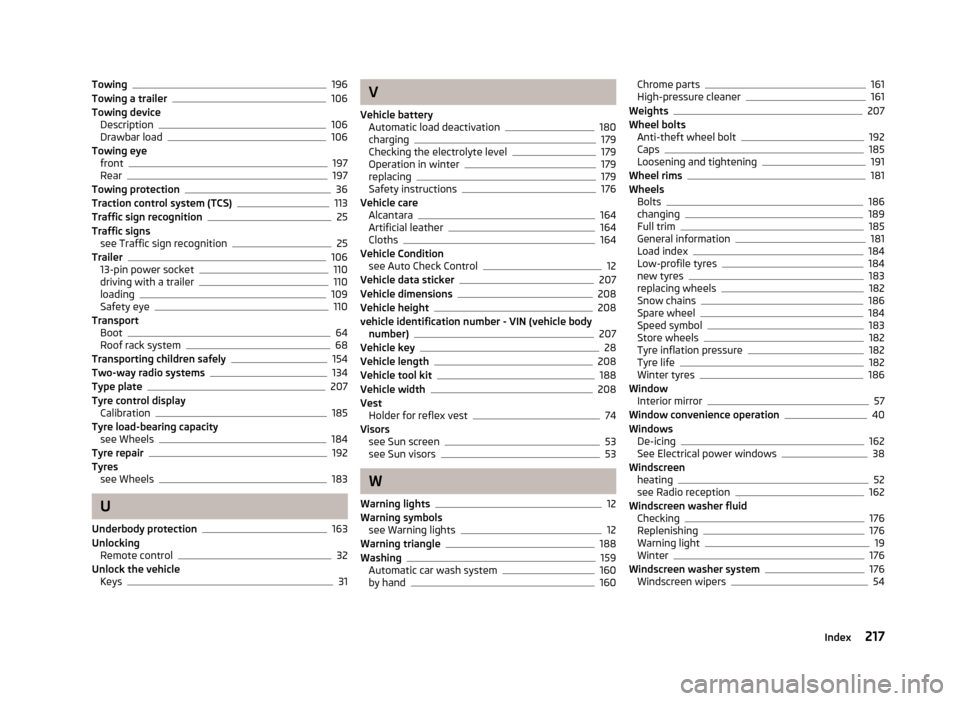
Towing196
Towing a trailer106
Towing device Description
106
Drawbar load106
Towing eye front
197
Rear197
Towing protection36
Traction control system (TCS)113
Traffic sign recognition25
Traffic signs see Traffic sign recognition
25
Trailer106
13-pin power socket110
driving with a trailer110
loading109
Safety eye110
Transport Boot
64
Roof rack system68
Transporting children safely154
Two-way radio systems134
Type plate207
Tyre control display Calibration
185
Tyre load-bearing capacity see Wheels
184
Tyre repair192
Tyres see Wheels
183
U
Underbody protection
163
Unlocking Remote control
32
Unlock the vehicle Keys
31
V
Vehicle battery Automatic load deactivation
180
charging179
Checking the electrolyte level179
Operation in winter179
replacing179
Safety instructions176
Vehicle care Alcantara
164
Artificial leather164
Cloths164
Vehicle Condition see Auto Check Control
12
Vehicle data sticker207
Vehicle dimensions208
Vehicle height208
vehicle identification number - VIN (vehicle body number)
207
Vehicle key28
Vehicle length208
Vehicle tool kit188
Vehicle width208
Vest Holder for reflex vest
74
Visors see Sun screen
53
see Sun visors53
W
Warning lights
12
Warning symbols see Warning lights
12
Warning triangle188
Washing159
Automatic car wash system160
by hand160
Chrome parts161
High-pressure cleaner161
Weights207
Wheel bolts Anti-theft wheel bolt
192
Caps185
Loosening and tightening191
Wheel rims181
Wheels Bolts
186
changing189
Full trim185
General information181
Load index184
Low-profile tyres184
new tyres183
replacing wheels182
Snow chains186
Spare wheel184
Speed symbol183
Store wheels182
Tyre inflation pressure182
Tyre life182
Winter tyres186
Window Interior mirror
57
Window convenience operation40
Windows De-icing
162
See Electrical power windows38
Windscreen heating
52
see Radio reception162
Windscreen washer fluid Checking
176
Replenishing176
Warning light19
Winter176
Windscreen washer system176
Windscreen wipers54
217Index