oil level SKODA OCTAVIA 2012 3.G / (5E) User Guide
[x] Cancel search | Manufacturer: SKODA, Model Year: 2012, Model line: OCTAVIA, Model: SKODA OCTAVIA 2012 3.G / (5E)Pages: 222, PDF Size: 13.52 MB
Page 175 of 222
We recommend maintaining the oil level within the range A, but not above , if
the engine has been operating at high loads, for example, during a lengthy motor-
way trip during the summer months, towing a trailer or negotiating a high moun- tain pass.
The warning light in the instrument cluster will indicate whether the oil level is too low » page 15 . Check the oil level using the dipstick as soon as possible. Add
oil accordingly.WARNINGDo not continue your journey if for some reason it is not possible to top up
the engine oil under the prevailing conditions! Switch off the engine and seek
assistance from a ŠKODA specialist garage.
CAUTION
The oil level must on no account extend beyond the range A » Fig. 149 - Risk of
damaging the exhaust system!
Replenishing the engine oil
First read and observe the introductory information and safety warn-
ings
on page 169.
›
Check the engine oil level » page 172.
›
Unscrew the cap of the engine oil filler opening » Fig. 148 on page 172.
›
Replenish the oil in portions of 0.5 litres in accordance with the correct specifi-
cations » page 209 .
›
Check the oil level » page 172.
›
Carefully screw on the oil filler opening cap and push the dipstick in fully.
Changing engine oil
First read and observe the introductory information and safety warn-
ings
on page 169.
The engine oil must be changed at the intervals stated in the Service schedule or
according to the service interval indicator » page 11.
CAUTION
Do not pour any additives into the engine oil - Risk of serious engine damage!
Damage, which results from such product, are excluded from the warranty.
Note
If your skin has come into contact with oil, it must be washed thoroughly.
Coolant
First read and observe the introductory information and safety warn-ings
on page 169.
The coolant consists of water with a concentration of coolant additive. This mix-
ture guarantees antifreeze protection, protects the cooling/heater system
against corrosion and prevents the formation of scale.
Vehicles exported to countries with a mild climate are already factory-filled with
a coolant which offers antifreeze protection down to about -25 ℃. In these coun-
tries the concentration of coolant additive should be at least 40 %.
Vehicles exported to countries with a cold climate are already factory-filled with a
coolant which offers antifreeze protection down to about -35 °C. In these coun-
tries the concentration of coolant additive should be at least 50 %.
If a higher concentration of antifreeze is required for climatic reasons, the amount
of coolant additive can only be increased up to a maximum of 60 % (antifreeze
protection down to approx. -40 °C).
When refilling, only use the same antifreeze written on the antifreeze expansion tank » Fig. 150 on page 174.
173Inspecting and replenishing
Page 178 of 222
Brake fluid changeFirst read and observe the introductory information and safety warn-
ings
on page 169.
Brake fluid absorbs moisture. Over time it therefore absorbs moisture from the
environment.
Excessive water in the brake fluid may be the cause of corrosion in the brake sys-
tem.
The water content lowers the boiling point of the brake fluid.
The brake fluid must comply with the following standards or specifications: › VW 50114;
› FMVSS 116 DOT4.
WARNINGDo not use used brake fluid - the function of the brake system may be im-
paired - risk of accident!
CAUTION
Brake fluid damages the paintwork of the vehicle.
Note
The brake fluid is replaced as part of a proscribed Inspection service carried out by
a ŠKODA Partner.
Windscreen washer system
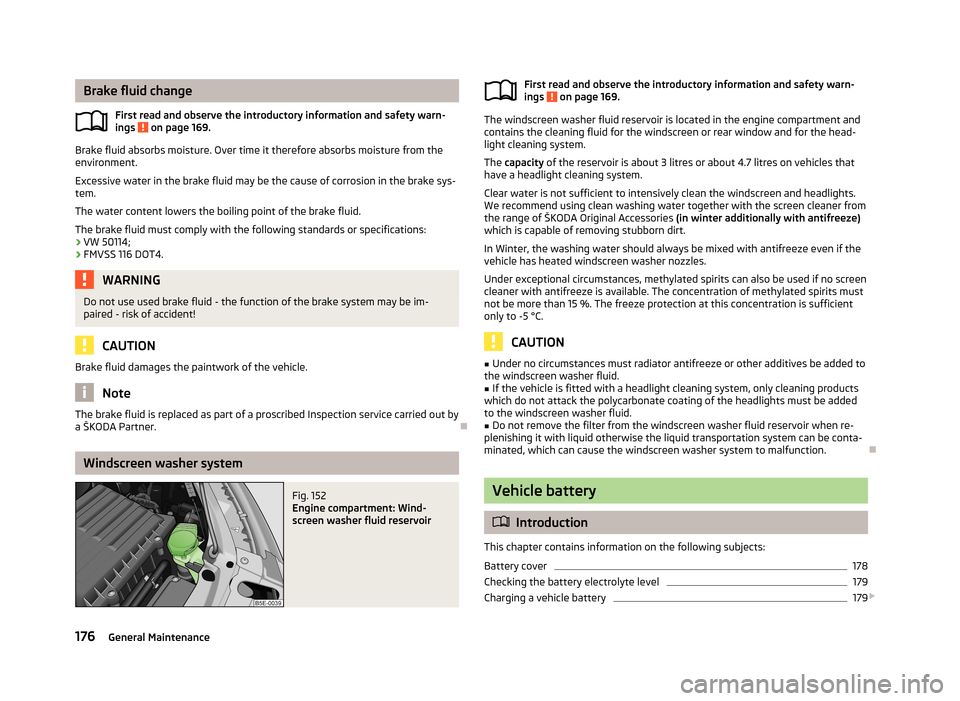
Fig. 152
Engine compartment: Wind-
screen washer fluid reservoirFirst read and observe the introductory information and safety warn-
ings on page 169.
The windscreen washer fluid reservoir is located in the engine compartment and
contains the cleaning fluid for the windscreen or rear window and for the head-
light cleaning system.
The capacity of the reservoir is about 3 litres or about 4.7 litres on vehicles that
have a headlight cleaning system.
Clear water is not sufficient to intensively clean the windscreen and headlights.
We recommend using clean washing water together with the screen cleaner from
the range of ŠKODA Original Accessories (in winter additionally with antifreeze)
which is capable of removing stubborn dirt.
In Winter, the washing water should always be mixed with antifreeze even if the
vehicle has heated windscreen washer nozzles.
Under exceptional circumstances, methylated spirits can also be used if no screen
cleaner with antifreeze is available. The concentration of methylated spirits must
not be more than 15 %. The freeze protection at this concentration is sufficient
only to -5 °C.
CAUTION
■ Under no circumstances must radiator antifreeze or other additives be added to
the windscreen washer fluid.■
If the vehicle is fitted with a headlight cleaning system, only cleaning products
which do not attack the polycarbonate coating of the headlights must be added
to the windscreen washer fluid.
■
Do not remove the filter from the windscreen washer fluid reservoir when re-
plenishing it with liquid otherwise the liquid transportation system can be conta-
minated, which can cause the windscreen washer system to malfunction.
Vehicle battery
Introduction
This chapter contains information on the following subjects:
Battery cover
178
Checking the battery electrolyte level
179
Charging a vehicle battery
179
176General Maintenance
Page 192 of 222
Note■The anti-theft wheel bolt set and adapter can be purchased from a ŠKODA Part-
ner.■
The national legal requirements must be observed when changing a wheel.
Preliminary work
First read and observe the introductory information and safety warn-ings
on page 189.
The following steps must be carried out before actually changing the wheel:
›
Park the vehicle as far away as possible from the flow of traffic. The place you choose should be level.
›
Let all of the occupants get out. While changing a tyre, the occupants of the
vehicle should not stand on the road (instead they should remain behind a crash
barrier).
›
Switch off the engine and move the gearshift lever into Neutral or move the se-
lector lever on the automatic gearbox into position P.
›
Firmly apply the handbrake.
›
If a trailer is connected, remove it.
›
Remove the vehicle tool kit » page 188 and the spare wheel » page 184 from
the luggage compartment.
Changing a wheel
First read and observe the introductory information and safety warn-
ings
on page 189.
Always change a wheel on a level surface as far as possible.
›
Remove the full wheel trim » page 185 or caps » page 185 .
›
First of all slacken the anti-theft wheel bolt and then the other wheel
bolts » page 191 .
›
Jack up the vehicle until the wheel that needs changing is clear of the
ground » page 191 .
›
Unscrew the wheel bolts and place them on a clean surface (cloth, paper, etc.).
›
Remove the wheel.
›
Attach the spare wheel and slightly screw on the wheel bolts.
›
Lower the vehicle.
›Alternately tighten the wheel bolts opposite each other using the wheel
wrench (crosswise) and then tighten the anti-theft wheel bolt » page 191.›
Replace the wheel trim or the caps.
Note
■
All bolts must be clean and must turn easily.■Under no circumstances grease or oil the wheel bolts!■
When fitting unidirectional tyres, ensure that the direction of rotation is cor-
rect » page 181 .
Subsequent steps
First read and observe the introductory information and safety warn-
ings
on page 189.
The following steps must also be performed after changing the wheel.
›
Stow and attach the replaced wheel in the spare wheel well using a special screw » page 184 .
›
Stow the vehicle tool kit in the space provided.
›
Check the tyre pressure on the installed spare wheel as soon as possible.
›
Have the tightening torque of the wheel bolts checked with a torque wrench
as soon as possible.
›
Change the damaged wheel or consult a ŠKODA specialist garage about repair
possibilities.
Note
■ If it is determined that the wheel bolts are corroded and difficult to turn when
changing the wheel, the bolts must be replaced before checking the tightening
torque.■
Drive cautiously and only at a moderate speed until the tightening torque has
been checked.
190Do-it-yourself
Page 211 of 222
Specifications and engine oil capacity
The engine has been factory-filled with a high-grade oil that can be use through-
out the year - except in extreme climate zones.
The engine oils are undergoing continuous further development. Thus the infor-
mation stated in this Owner's Manual is only correct at the time of publication.
ŠKODA Partners are informed about the latest changes by ŠKODA. We therefore
recommend that the oil change is completed by a ŠKODA Partner.
The specifications (VW standards) stated in the following can be indicated sepa-rately or together with other specifications on the bottle.
The oil capacities include oil filter change. Check the oil level when filling; do notover fill. The oil level must be between the markings » page 172.
Specifications and capacity (in l) for vehicles with flexible service intervalsPetrol enginesSpecificationCapacities (in li- tres)1.2 ltr./63 kW TSI
VW 504 004.01.4 ltr./103 kW TSI1.8 ltr./132 kW TSI5.2Diesel enginesSpecificationCapacities (in li-tres)1.6 ltr./77 kW TDIVW 507 004.62.0 ltr./110 kW TDI
Specifications and capacity (in l) for vehicles with fixed service intervals
Petrol enginesSpecificationCapacities (in li-tres)1.2 ltr./63 kW TSI
VW 502 004.01.4 ltr./103 kW TSI1.8 ltr./132 kW TSI5.2Diesel enginesSpecificationCapacities (in li-tres)1.6 ltr./77 kW TDIVW 507 004.62.0 ltr./110 kW TDICAUTION■If the above engine oils are not available, a different engine oil can be used in
an emergency. To prevent damage to the engine, a max. 0.5 l only of the follow-
ing engine oils may be used until the next oil change: ■ For petrol engine models: ACEA A3/ACEA B4 or API SN/API SM;
■ For diesel engine models: ACEA C3 or API CJ-4.
Note
■Before a long drive we recommend that you purchase and carry with you engine
oil which complies with the specification for your vehicle.■
We recommend that you use oils from ŠKODA Original Accessories.
209Technical data
Page 215 of 222
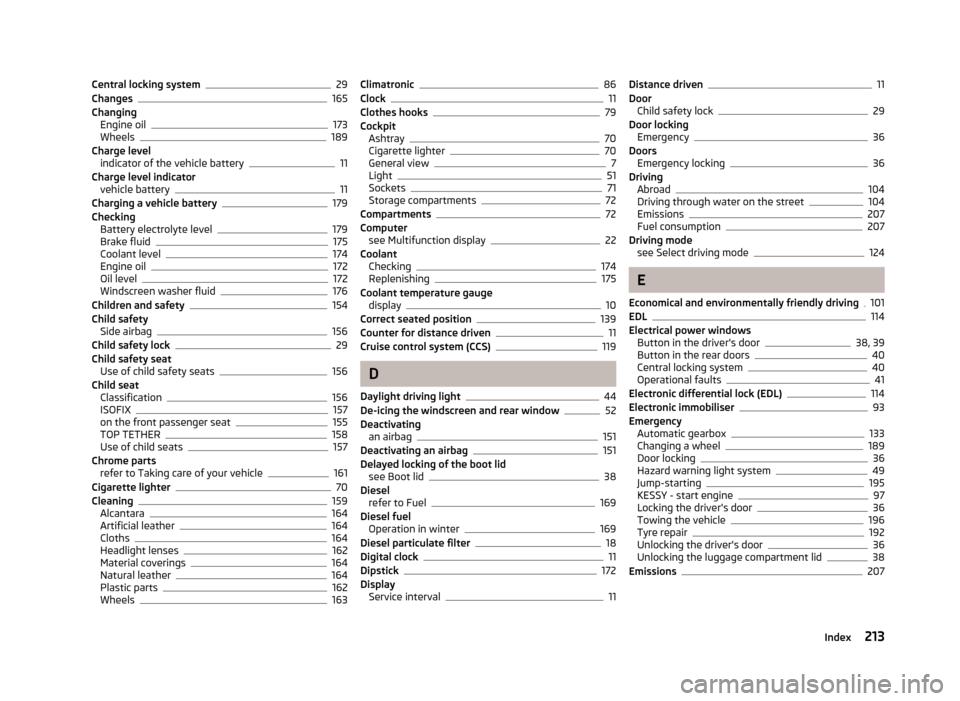
Central locking system29
Changes165
Changing Engine oil
173
Wheels189
Charge level indicator of the vehicle battery
11
Charge level indicator vehicle battery
11
Charging a vehicle battery179
Checking Battery electrolyte level
179
Brake fluid175
Coolant level174
Engine oil172
Oil level172
Windscreen washer fluid176
Children and safety154
Child safety Side airbag
156
Child safety lock29
Child safety seat Use of child safety seats
156
Child seat Classification
156
ISOFIX157
on the front passenger seat155
TOP TETHER158
Use of child seats157
Chrome parts refer to Taking care of your vehicle
161
Cigarette lighter70
Cleaning159
Alcantara164
Artificial leather164
Cloths164
Headlight lenses162
Material coverings164
Natural leather164
Plastic parts162
Wheels163
Climatronic86
Clock11
Clothes hooks79
Cockpit Ashtray
70
Cigarette lighter70
General view7
Light51
Sockets71
Storage compartments72
Compartments72
Computer see Multifunction display
22
Coolant Checking
174
Replenishing175
Coolant temperature gauge display
10
Correct seated position139
Counter for distance driven11
Cruise control system (CCS)119
D
Daylight driving light
44
De-icing the windscreen and rear window52
Deactivating an airbag
151
Deactivating an airbag151
Delayed locking of the boot lid see Boot lid
38
Diesel refer to Fuel
169
Diesel fuel Operation in winter
169
Diesel particulate filter18
Digital clock11
Dipstick172
Display Service interval
11
Distance driven11
Door Child safety lock
29
Door locking Emergency
36
Doors Emergency locking
36
Driving Abroad
104
Driving through water on the street104
Emissions207
Fuel consumption207
Driving mode see Select driving mode
124
E
Economical and environmentally friendly driving
101
EDL114
Electrical power windows Button in the driver's door
38, 39
Button in the rear doors40
Central locking system40
Operational faults41
Electronic differential lock (EDL)114
Electronic immobiliser93
Emergency Automatic gearbox
133
Changing a wheel189
Door locking36
Hazard warning light system49
Jump-starting195
KESSY - start engine97
Locking the driver's door36
Towing the vehicle196
Tyre repair192
Unlocking the driver's door36
Unlocking the luggage compartment lid38
Emissions207
213Index