ECU SKODA OCTAVIA 2014 3.G / (5E) User Guide
[x] Cancel search | Manufacturer: SKODA, Model Year: 2014, Model line: OCTAVIA, Model: SKODA OCTAVIA 2014 3.G / (5E)Pages: 280, PDF Size: 35.53 MB
Page 63 of 280
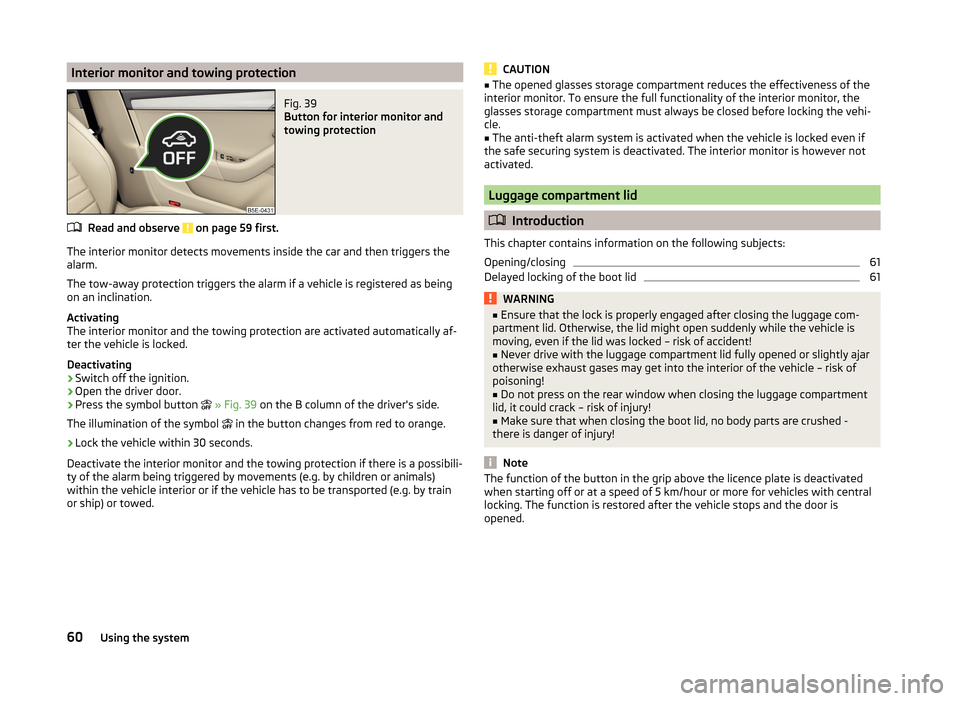
Interior monitor and towing protectionFig. 39
Button for interior monitor and
towing protection
Read and observe on page 59 first.
The interior monitor detects movements inside the car and then triggers the alarm.
The tow-away protection triggers the alarm if a vehicle is registered as being
on an inclination.
Activating
The interior monitor and the towing protection are activated automatically af-
ter the vehicle is locked.
Deactivating
›
Switch off the ignition.
›
Open the driver door.
›
Press the symbol button
» Fig. 39 on the B column of the driver's side.
The illumination of the symbol in the button changes from red to orange.
›
Lock the vehicle within 30 seconds.
Deactivate the interior monitor and the towing protection if there is a possibili-
ty of the alarm being triggered by movements (e.g. by children or animals)
within the vehicle interior or if the vehicle has to be transported (e.g. by train
or ship) or towed.
CAUTION■ The opened glasses storage compartment reduces the effectiveness of the
interior monitor. To ensure the full functionality of the interior monitor, the
glasses storage compartment must always be closed before locking the vehi-
cle.■
The anti-theft alarm system is activated when the vehicle is locked even if
the safe securing system is deactivated. The interior monitor is however not
activated.
Luggage compartment lid
Introduction
This chapter contains information on the following subjects:
Opening/closing
61
Delayed locking of the boot lid
61WARNING■ Ensure that the lock is properly engaged after closing the luggage com-
partment lid. Otherwise, the lid might open suddenly while the vehicle is
moving, even if the lid was locked – risk of accident!■
Never drive with the luggage compartment lid fully opened or slightly ajar
otherwise exhaust gases may get into the interior of the vehicle – risk of
poisoning!
■
Do not press on the rear window when closing the luggage compartment
lid, it could crack – risk of injury!
■
Make sure that when closing the boot lid, no body parts are crushed -
there is danger of injury!
Note
The function of the button in the grip above the licence plate is deactivated
when starting off or at a speed of 5 km/hour or more for vehicles with central
locking. The function is restored after the vehicle stops and the door is
opened.60Using the system
Page 65 of 280
CAUTION■Before opening or closing the lid, check if there are any objects in the open-
ing or closing range which could obstruct the movement (e.g. a load on the
roof rack or on the trailer, etc.) – risk of causing damage to the lid!■
Ensure that there is at least 10 cm of clearance above the opened lid (e.g. dis-
tance from the garage ceiling). Otherwise, it may happen that the clearance
above the opened lid is no longer sufficient after relieving the vehicle of a load
(e.g. after unloading) – risk of causing damage to the lid.
■
In certain circumstances, if the lid is loaded (e.g by a thick layer of snow), the
opening process of the lid can be interrupted. Remove the load on the lid to re-
enable the electrical operation.
■
If the lid closes automatically (e.g. under load of snow), you will hear an inter-
mittent beep.
■
Always close the sliding/tilting roof before disconnecting the battery.
Operating description
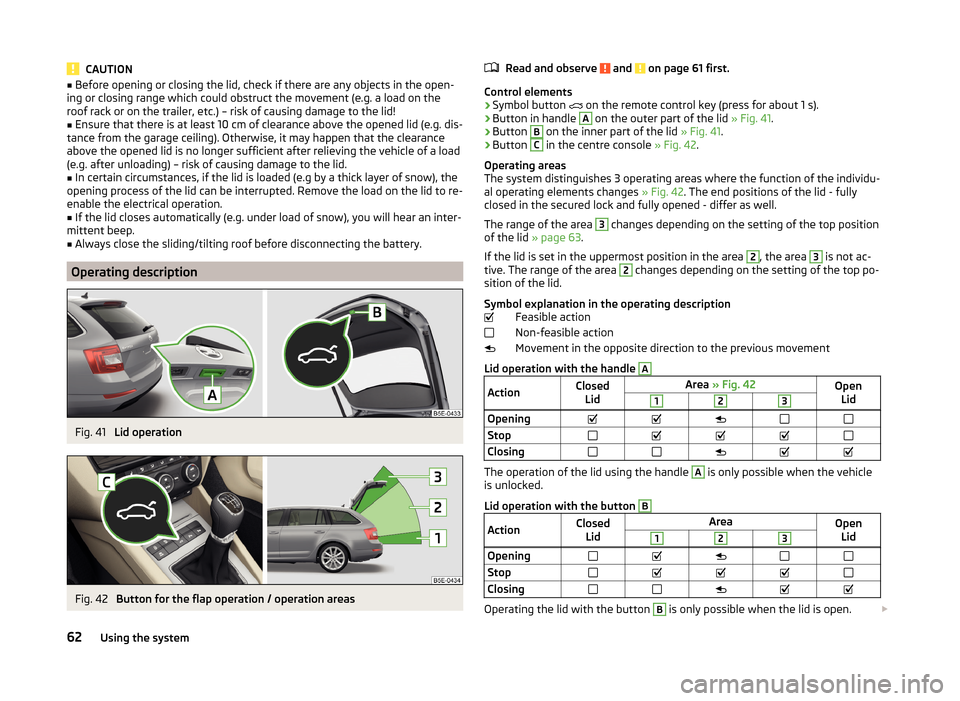
Fig. 41
Lid operation
Fig. 42
Button for the flap operation / operation areas
Read and observe and on page 61 first.
Control elements
› Symbol button
on the remote control key (press for about 1 s).
› Button in handle
A
on the outer part of the lid
» Fig. 41.
› Button
B
on the inner part of the lid
» Fig. 41.
› Button
C
in the centre console
» Fig. 42.
Operating areas
The system distinguishes 3 operating areas where the function of the individu-
al operating elements changes » Fig. 42. The end positions of the lid - fully
closed in the secured lock and fully opened - differ as well.
The range of the area
3
changes depending on the setting of the top position
of the lid » page 63 .
If the lid is set in the uppermost position in the area
2
, the area
3
is not ac-
tive. The range of the area
2
changes depending on the setting of the top po-
sition of the lid.
Symbol explanation in the operating description Feasible action
Non-feasible action
Movement in the opposite direction to the previous movement
Lid operation with the handle
AActionClosed LidArea » Fig. 42Open
Lid123OpeningStopClosing
The operation of the lid using the handle
A
is only possible when the vehicle
is unlocked.
Lid operation with the button
BActionClosed LidAreaOpenLid123OpeningStopClosing
Operating the lid with the button
B
is only possible when the lid is open.
62Using the system
Page 66 of 280
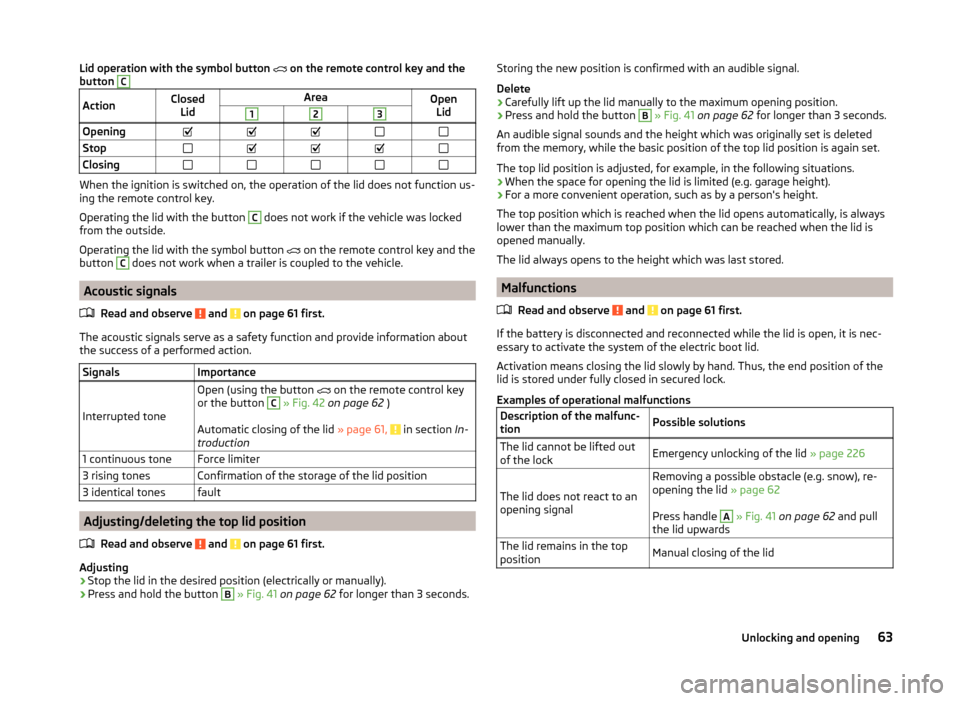
Lid operation with the symbol button on the remote control key and the
button CActionClosed LidAreaOpenLid123OpeningStopClosing
When the ignition is switched on, the operation of the lid does not function us-
ing the remote control key.
Operating the lid with the button
C
does not work if the vehicle was locked
from the outside.
Operating the lid with the symbol button on the remote control key and the
button
C
does not work when a trailer is coupled to the vehicle.
Acoustic signals
Read and observe
and on page 61 first.
The acoustic signals serve as a safety function and provide information about
the success of a performed action.
SignalsImportance
Interrupted tone
Open (using the button on the remote control key
or the button C
» Fig. 42 on page 62 )
Automatic closing of the lid » page 61,
in section In-
troduction
1 continuous toneForce limiter3 rising tonesConfirmation of the storage of the lid position3 identical tonesfault
Adjusting/deleting the top lid position
Read and observe
and on page 61 first.
Adjusting
›
Stop the lid in the desired position (electrically or manually).
›
Press and hold the button
B
» Fig. 41 on page 62 for longer than 3 seconds.
Storing the new position is confirmed with an audible signal.
Delete›
Carefully lift up the lid manually to the maximum opening position.
›
Press and hold the button
B
» Fig. 41 on page 62 for longer than 3 seconds.
An audible signal sounds and the height which was originally set is deleted
from the memory, while the basic position of the top lid position is again set.
The top lid position is adjusted, for example, in the following situations.
› When the space for opening the lid is limited (e.g. garage height).
› For a more convenient operation, such as by a person's height.
The top position which is reached when the lid opens automatically, is always
lower than the maximum top position which can be reached when the lid is
opened manually.
The lid always opens to the height which was last stored.
Malfunctions
Read and observe
and on page 61 first.
If the battery is disconnected and reconnected while the lid is open, it is nec-
essary to activate the system of the electric boot lid.
Activation means closing the lid slowly by hand. Thus, the end position of the
lid is stored under fully closed in secured lock.
Examples of operational malfunctions
Description of the malfunc-
tionPossible solutionsThe lid cannot be lifted out
of the lockEmergency unlocking of the lid » page 226The lid does not react to an
opening signal
Removing a possible obstacle (e.g. snow), re-
opening the lid » page 62
Press handle A
» Fig. 41 on page 62 and pull
the lid upwards
The lid remains in the top
positionManual closing of the lid63Unlocking and opening
Page 91 of 280
The adjusted driver's seat position can be set in the memory of the
seat » page 89 or the remote control key » page 89.
Note
If the setting procedure is interrupted, you will need to press the button again.
Head restraints - adjusting height
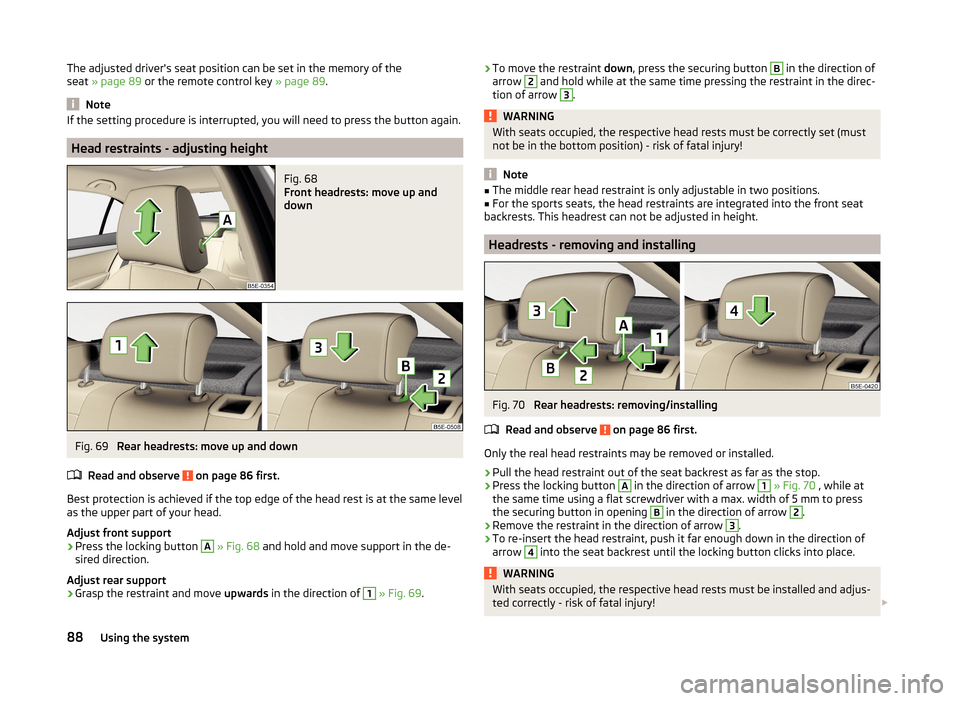
Fig. 68
Front headrests: move up and
down
Fig. 69
Rear headrests: move up and down
Read and observe
on page 86 first.
Best protection is achieved if the top edge of the head rest is at the same level as the upper part of your head.
Adjust front support
›
Press the locking button
A
» Fig. 68 and hold and move support in the de-
sired direction.
Adjust rear support
›
Grasp the restraint and move upwards in the direction of
1
» Fig. 69 .
›To move the restraint
down, press the securing button B in the direction of
arrow 2 and hold while at the same time pressing the restraint in the direc-
tion of arrow 3
.
WARNINGWith seats occupied, the respective head rests must be correctly set (must
not be in the bottom position) - risk of fatal injury!
Note
■ The middle rear head restraint is only adjustable in two positions.■For the sports seats, the head restraints are integrated into the front seat
backrests. This headrest can not be adjusted in height.
Headrests - removing and installing
Fig. 70
Rear headrests: removing/installing
Read and observe
on page 86 first.
Only the real head restraints may be removed or installed.
›
Pull the head restraint out of the seat backrest as far as the stop.
›
Press the locking button
A
in the direction of arrow
1
» Fig. 70 , while at
the same time using a flat screwdriver with a max. width of 5 mm to press
the securing button in opening
B
in the direction of arrow
2
.
›
Remove the restraint in the direction of arrow
3
.
›
To re-insert the head restraint, push it far enough down in the direction of
arrow
4
into the seat backrest until the locking button clicks into place.
WARNINGWith seats occupied, the respective head rests must be installed and adjus- ted correctly - risk of fatal injury! 88Using the system
Page 94 of 280

Pressing once switches the seat heating on at its maximum level.
With repeated pressing of the switch, the intensity of the heating is reduced
until it is switched off.
The level of the seat heating is indicated by the number of illuminated warning
lights underneath/in the switch.
If the engine is switched off and then turned on again within 10 mins with the
driver seat heating switched, then the driver's seat heating is automatically
turned on again.WARNINGIf, as a passenger, you have a subdued pain and/or temperature sensitivity,
e.g. through medication, paralysis or because of chronic illness (e.g. diabe-
tes), we recommend you do not use seat heating on the driver's or front
passenger seat. This can lead to burns on the back, the posterior and the
legs which are difficult to heal. If the seat heating is used, we recommend
to make regular breaks in your journey when driving long distances, so that
the body can recuperate from the stress of the journey. Please consult your
doctor, who can evaluate your specific condition.
CAUTION
■ Do not kneel on the seats or otherwise apply concentrated pressure to them.■The seat heating in the following cases will not turn on - there is a risk of
damaging the seat covers and seat heating. ■The seats are not occupied by people.
■ Items are fastened or stored items on the seats, such as a child seat, a bag
and the like.
■ Additional seat covers or protective covers are fixed to the seats.■
Clean the seat covers » page 187.
Note
If the on-board voltage drops, the heater switches off automatically, in order
to provide sufficient electrical energy for the engine control » page 203, Auto-
matic load deactivation .Front armrestFig. 73
Adjust armrest
The armrest is adjustable for height and length.
Setting the height
›
First of all, fold the armrest downwards and then lift it in the direction of the
arrow
A
» Fig. 73 to one of the 4 rest positions.
Move
›
Move the cover into the desired position in the direction of the arrow
B
» Fig. 73 .
The armrest includes a storage compartment underneath » page 99.
Note
Push the armrest cover all the way back to the stop before applying the hand-
brake.
Rear armrest
Fig. 74
Fold the armrest forwards
Folding forward
›
Pull on the loop
A
» Fig. 74 and fold the armrest forward in the direction of
the arrow.
91Seats and head restraints
Page 95 of 280
A cup holder may be located in the armrest » page 96.
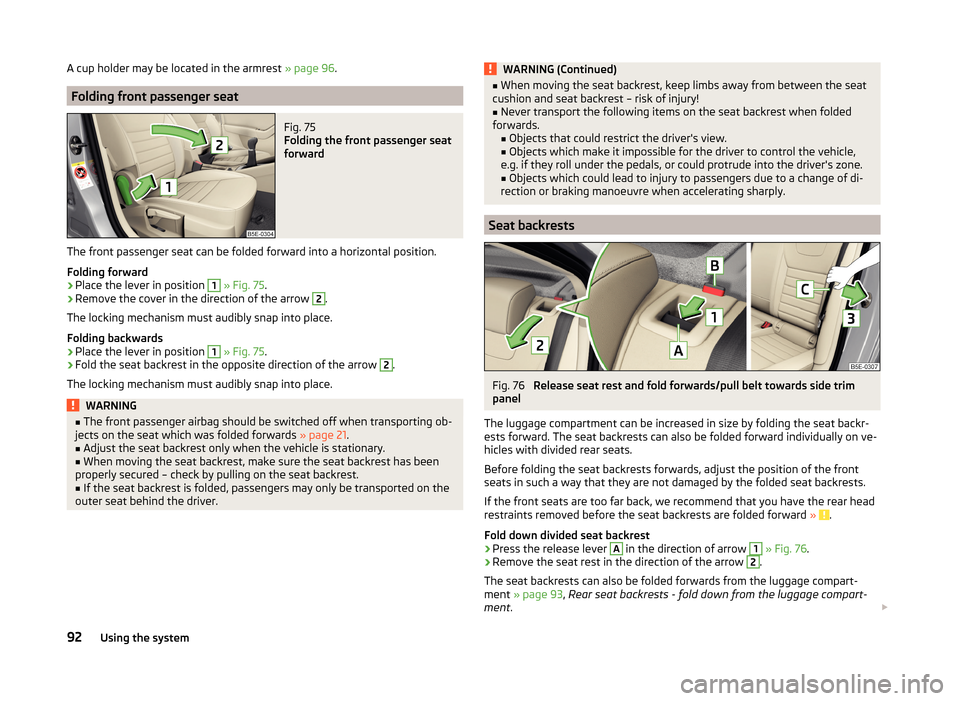
Folding front passenger seat
Fig. 75
Folding the front passenger seat
forward
The front passenger seat can be folded forward into a horizontal position.
Folding forward
›
Place the lever in position
1
» Fig. 75 .
›
Remove the cover in the direction of the arrow
2
.
The locking mechanism must audibly snap into place.
Folding backwards
›
Place the lever in position
1
» Fig. 75 .
›
Fold the seat backrest in the opposite direction of the arrow
2
.
The locking mechanism must audibly snap into place.
WARNING■ The front passenger airbag should be switched off when transporting ob-
jects on the seat which was folded forwards » page 21.■
Adjust the seat backrest only when the vehicle is stationary.
■
When moving the seat backrest, make sure the seat backrest has been
properly secured – check by pulling on the seat backrest.
■
If the seat backrest is folded, passengers may only be transported on the
outer seat behind the driver.
WARNING (Continued)■ When moving the seat backrest, keep limbs away from between the seat
cushion and seat backrest – risk of injury!■
Never transport the following items on the seat backrest when folded
forwards. ■ Objects that could restrict the driver's view.
■ Objects which make it impossible for the driver to control the vehicle,
e.g. if they roll under the pedals, or could protrude into the driver's zone.
■ Objects which could lead to injury to passengers due to a change of di-
rection or braking manoeuvre when accelerating sharply.
Seat backrests
Fig. 76
Release seat rest and fold forwards/pull belt towards side trim
panel
The luggage compartment can be increased in size by folding the seat backr-
ests forward. The seat backrests can also be folded forward individually on ve-
hicles with divided rear seats.
Before folding the seat backrests forwards, adjust the position of the front
seats in such a way that they are not damaged by the folded seat backrests.
If the front seats are too far back, we recommend that you have the rear head
restraints removed before the seat backrests are folded forward »
.
Fold down divided seat backrest
›
Press the release lever
A
in the direction of arrow
1
» Fig. 76 .
›
Remove the seat rest in the direction of the arrow
2
.
The seat backrests can also be folded forwards from the luggage compart-
ment » page 93 , Rear seat backrests - fold down from the luggage compart-
ment .
92Using the system
Page 96 of 280
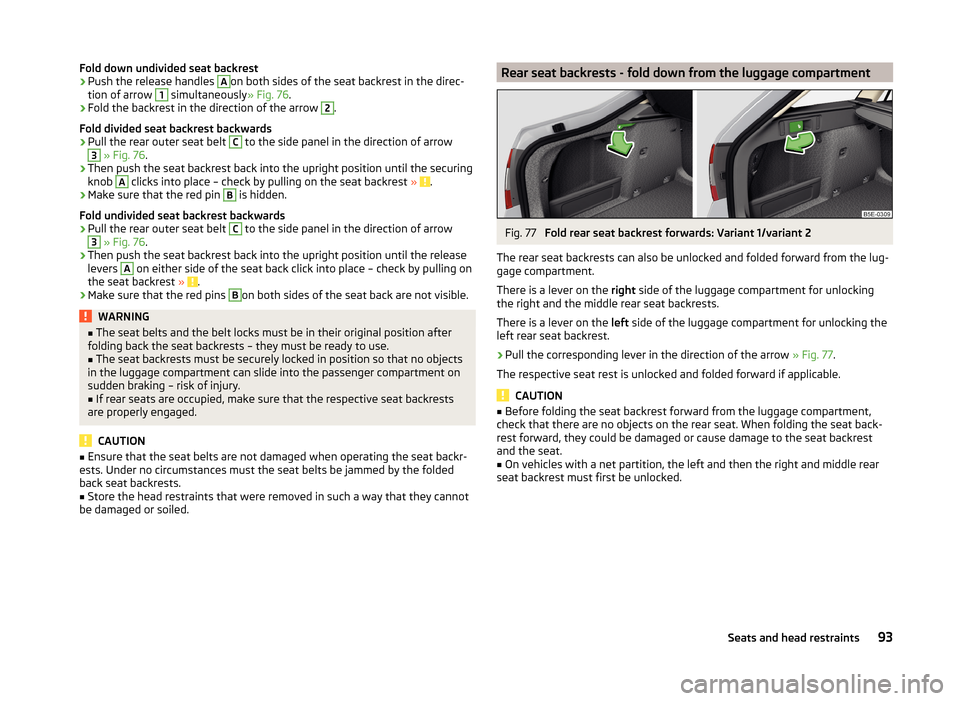
Fold down undivided seat backrest›Push the release handles Aon both sides of the seat backrest in the direc-
tion of arrow 1
simultaneously » Fig. 76.
›
Fold the backrest in the direction of the arrow
2
.
Fold divided seat backrest backwards
›
Pull the rear outer seat belt
C
to the side panel in the direction of arrow
3
» Fig. 76 .
›
Then push the seat backrest back into the upright position until the securing
knob
A
clicks into place – check by pulling on the seat backrest » .
›
Make sure that the red pin
B
is hidden.
Fold undivided seat backrest backwards
›
Pull the rear outer seat belt
C
to the side panel in the direction of arrow
3
» Fig. 76 .
›
Then push the seat backrest back into the upright position until the release
levers
A
on either side of the seat back click into place – check by pulling on
the seat backrest » .
›
Make sure that the red pins
B
on both sides of the seat back are not visible.
WARNING■
The seat belts and the belt locks must be in their original position after
folding back the seat backrests – they must be ready to use.■
The seat backrests must be securely locked in position so that no objects
in the luggage compartment can slide into the passenger compartment on
sudden braking – risk of injury.
■
If rear seats are occupied, make sure that the respective seat backrests
are properly engaged.
CAUTION
■ Ensure that the seat belts are not damaged when operating the seat backr-
ests. Under no circumstances must the seat belts be jammed by the folded
back seat backrests.■
Store the head restraints that were removed in such a way that they cannot
be damaged or soiled.
Rear seat backrests - fold down from the luggage compartmentFig. 77
Fold rear seat backrest forwards: Variant 1/variant 2
The rear seat backrests can also be unlocked and folded forward from the lug-
gage compartment.
There is a lever on the right side of the luggage compartment for unlocking
the right and the middle rear seat backrests.
There is a lever on the left side of the luggage compartment for unlocking the
left rear seat backrest.
›
Pull the corresponding lever in the direction of the arrow » Fig. 77.
The respective seat rest is unlocked and folded forward if applicable.
CAUTION
■ Before folding the seat backrest forward from the luggage compartment,
check that there are no objects on the rear seat. When folding the seat back-
rest forward, they could be damaged or cause damage to the seat backrest
and the seat.■
On vehicles with a net partition, the left and then the right and middle rear
seat backrest must first be unlocked.
93Seats and head restraints
Page 97 of 280
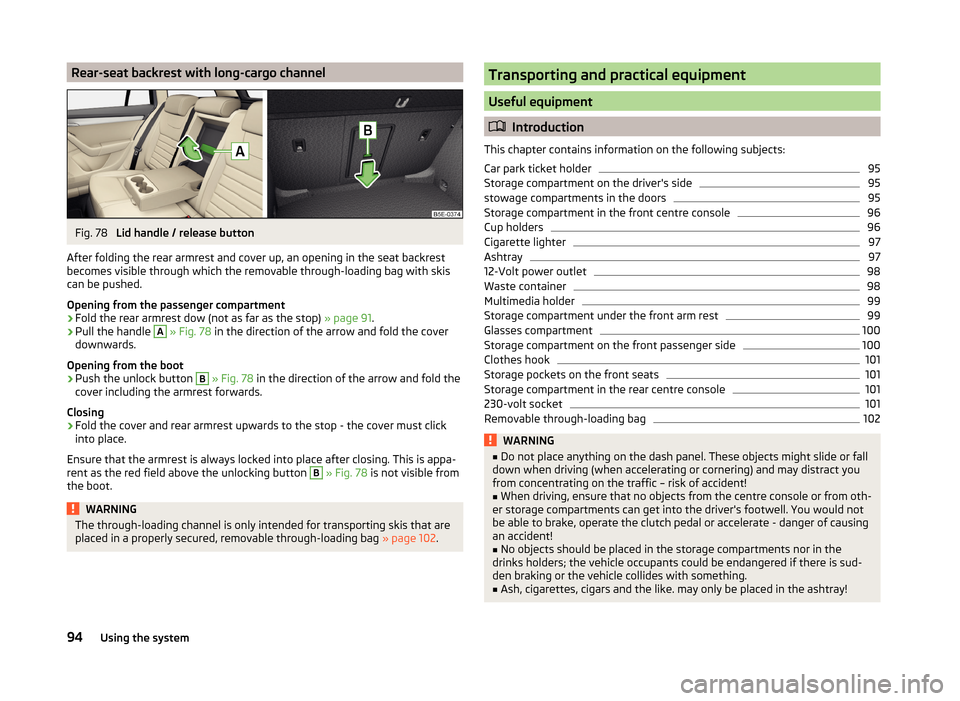
Rear-seat backrest with long-cargo channelFig. 78
Lid handle / release button
After folding the rear armrest and cover up, an opening in the seat backrest
becomes visible through which the removable through-loading bag with skis
can be pushed.
Opening from the passenger compartment
›
Fold the rear armrest dow (not as far as the stop) » page 91.
›
Pull the handle
A
» Fig. 78 in the direction of the arrow and fold the cover
downwards.
Opening from the boot
›
Push the unlock button
B
» Fig. 78 in the direction of the arrow and fold the
cover including the armrest forwards.
Closing
›
Fold the cover and rear armrest upwards to the stop - the cover must click
into place.
Ensure that the armrest is always locked into place after closing. This is appa- rent as the red field above the unlocking button
B
» Fig. 78 is not visible from
the boot.
WARNINGThe through-loading channel is only intended for transporting skis that are
placed in a properly secured, removable through-loading bag » page 102.Transporting and practical equipment
Useful equipment
Introduction
This chapter contains information on the following subjects:
Car park ticket holder
95
Storage compartment on the driver's side
95
stowage compartments in the doors
95
Storage compartment in the front centre console
96
Cup holders
96
Cigarette lighter
97
Ashtray
97
12-Volt power outlet
98
Waste container
98
Multimedia holder
99
Storage compartment under the front arm rest
99
Glasses compartment
100
Storage compartment on the front passenger side
100
Clothes hook
101
Storage pockets on the front seats
101
Storage compartment in the rear centre console
101
230-volt socket
101
Removable through-loading bag
102WARNING■ Do not place anything on the dash panel. These objects might slide or fall
down when driving (when accelerating or cornering) and may distract you
from concentrating on the traffic – risk of accident!■
When driving, ensure that no objects from the centre console or from oth-
er storage compartments can get into the driver's footwell. You would not
be able to brake, operate the clutch pedal or accelerate - danger of causing
an accident!
■
No objects should be placed in the storage compartments nor in the
drinks holders; the vehicle occupants could be endangered if there is sud-
den braking or the vehicle collides with something.
■
Ash, cigarettes, cigars and the like. may only be placed in the ashtray!
94Using the system
Page 98 of 280
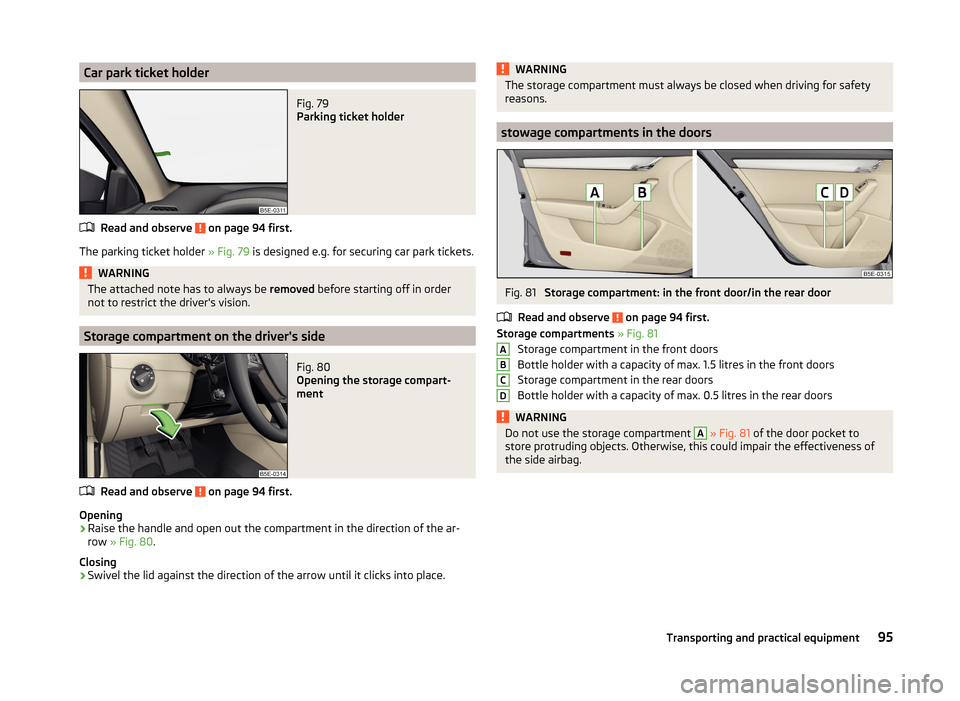
Car park ticket holderFig. 79
Parking ticket holder
Read and observe on page 94 first.
The parking ticket holder » Fig. 79 is designed e.g. for securing car park tickets.
WARNINGThe attached note has to always be removed before starting off in order
not to restrict the driver's vision.
Storage compartment on the driver's side
Fig. 80
Opening the storage compart-
ment
Read and observe on page 94 first.
Opening
›
Raise the handle and open out the compartment in the direction of the ar-
row » Fig. 80 .
Closing
›
Swivel the lid against the direction of the arrow until it clicks into place.
WARNINGThe storage compartment must always be closed when driving for safety
reasons.
stowage compartments in the doors
Fig. 81
Storage compartment: in the front door/in the rear door
Read and observe
on page 94 first.
Storage compartments » Fig. 81
Storage compartment in the front doors
Bottle holder with a capacity of max. 1.5 litres in the front doors
Storage compartment in the rear doors
Bottle holder with a capacity of max. 0.5 litres in the rear doors
WARNINGDo not use the storage compartment A » Fig. 81 of the door pocket to
store protruding objects. Otherwise, this could impair the effectiveness of
the side airbag.ABCD95Transporting and practical equipment
Page 105 of 280
The socket only works if the ignition is switched on.
Use›
Fold out the lid on the power socket in the direction of the arrow » Fig. 95.
›
Connect the plug for the electrical appliance to the socket.
The power socket can only be used when the ignition is switched on »
.
When the plug on the electrical appliance is inserted into the power socket,
the child safety lock is released, and the power socket is activated.
Warning light
› Permanent green light: The power socket is activated.
› Flashing red light: The power socket is temporarily deactivated.
The power socket is deactivated automatically when the amperage is too high,
the temperature is too high or the battery charge state is too low.
If disabling reasons no longer exist, the socket is automatically activated. Then
re-activate connected devices which are switched on »
.
WARNING■
The power socket can only be used for connecting approved electrical ac-
cessories with a two-pin 230V plug, with a total power uptake of up to
150 watt.■
Improper use can lead to serious injury or fire. Therefore, when leaving
the vehicle, never leave people who are not completely independent, such
as children, unattended in the vehicle.
■
Safely stow away all connected devices during the journey to prevent
them from being thrown around the interior in the event of a sudden brak-
ing manoeuvre or an accident – risk of death!
■
Do not pour liquids into the power socket – risk of death! If fluid does
manage to get into the power socket, completely dry out the socket before
reuse.
■
The connected devices may warm up during operation – risk of injury or
fire!
■
The child lock on the power socket is unlocked when using adapters and
extension cables which carry volts – risk of injury!
■
Do no insert any conductive objects into the contacts of the power sock-
et, e.g. knitting needs – risk of death!
CAUTION■ Place the connector on the electrical device into the power socket as far as it
can go to create a connection between the contacts.■
If the connector of the electrical device is not inserted fully into the power
socket, the child safety lock might release, and the power socket be activated.
The electrical device is still not supplied with power.
■
The socket is temporarily disabled at engine start-up and the indicator light
flashes red. After starting the engine, the power socket is re-activated auto-
matically.
■
Do not connect any lamps with neon filaments to the power socket - risk of
damaging the lamp.
■
A larger current surge may arise in some power supplies (e.g. for notebooks)
when connecting them to the power socket- this will automatically deactivate
the power socket. In this case, disconnect the power supply from the consum-
er and connect the power supply to the power socket first, followed by the
consumer.
■
The connected appliances may behave differently to when connected to the
mains.
■
Observe the operating instructions for the connected devices!
Removable through-loading bag
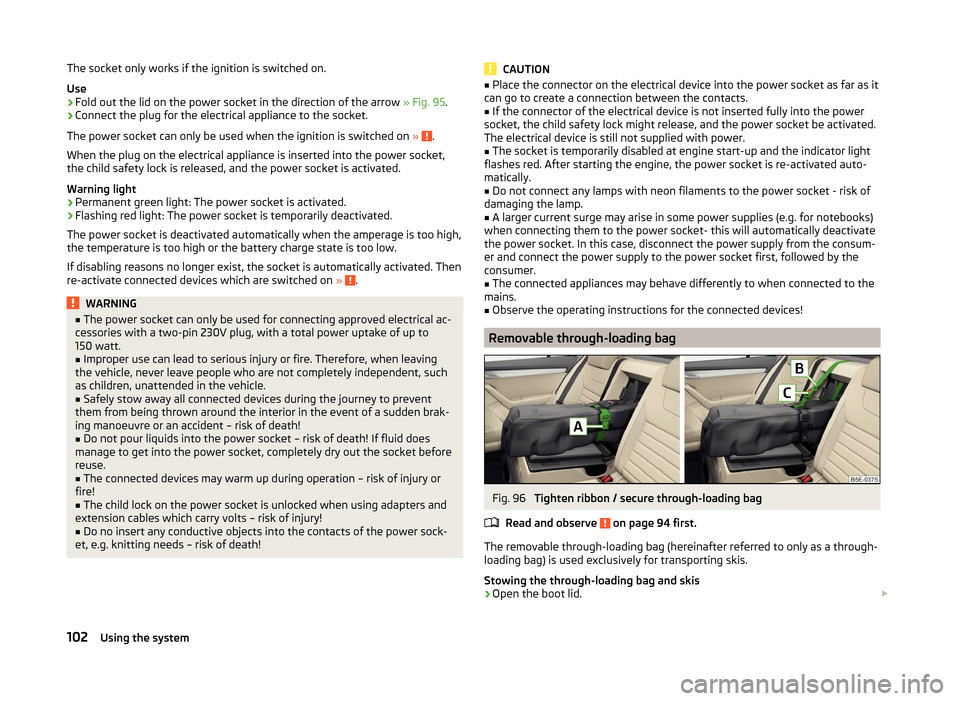
Fig. 96
Tighten ribbon / secure through-loading bag
Read and observe
on page 94 first.
The removable through-loading bag (hereinafter referred to only as a through-
loading bag) is used exclusively for transporting skis.
Stowing the through-loading bag and skis
›
Open the boot lid.
102Using the system