brake fluid change SKODA OCTAVIA 2014 3.G / (5E) Owner's Manual
[x] Cancel search | Manufacturer: SKODA, Model Year: 2014, Model line: OCTAVIA, Model: SKODA OCTAVIA 2014 3.G / (5E)Pages: 280, PDF Size: 35.53 MB
Page 196 of 280
WARNINGWhen working in the engine compartment, injuries, scolding, accident or
fire hazards may arise. For this reason, it is essential to comply with the
warning instructions stated below and with the general applicable rules of
safety. The engine compartment of your car is a hazardous area!WARNINGInstructions before beginning work in the engine compartment■Turn off the engine and withdraw the ignition key.■
Firmly apply the handbrake.
■
For vehicles with manual transmission the lever into the neutral position.
■
On vehicles with automatic transmission, shift the selector lever into the
P position.
■
Allow the engine to cool.
■
Never open the bonnet if you can see steam or coolant flowing out of the
engine compartment – risk of scalding! Wait until the steam or coolant has
stopped escaping.
WARNINGInformation for working in the engine compartment■Keep all people, especially children, away from the engine compartment.■
Never touch the radiator fan while the engine is still warm. The fan might
suddenly start running!
■
Do not touch any hot engine parts – risk of burns!
WARNINGInformation for working in the engine compartment with the engine run-
ning■
Pay particular attention to moving engine parts, e.g. V-ribbed belt, gener-
ator, radiator fan - danger to life!
■
Never touch the electric wiring on the ignition system.
■
Avoid short circuits in the electrical system – particularly on the vehicle's
battery.
■
Always make sure that no jewellery, loose clothing or long hair can get
caught in rotating engine parts – risk of death! Always remove any jewel-
lery, tie back long hair and wear tight fitting clothing before completing any
work.
WARNINGInformation for working on the fuel system or the electrical system■Always disconnect the vehicle battery from the electrical system.■
Do not smoke.
■
Never work near open flames.
■
Always have a functioning fire extinguisher nearby.
WARNING■ Read the information and warning instructions on the fluid containers.■Keep the working fluids in sealed original containers and safe from peo-
ple who are not completely independent, e.g. children.■
Never spill fluids over the hot engine - risk of fire.
■
If you wish to work under the vehicle, you must secure the vehicle from
rolling away and support it with suitable supporting blocks: the car jack is
not sufficient for this – risk of injury!
CAUTION
Always top up using the correct specification of fluids. This may result in major
operating problems and also vehicle damage!
For the sake of the environment
In view of the requirements for the environmentally friendly disposal of fluids and the special tools and knowledge required for such work, we recommend
that fluids be changed by a specialist garage.
Note
■ Please consult a specialist garage for any questions relating to fluids.■Fluids with the proper specifications can be purchased from the ŠKODA Origi-
nal Accessories or from the ŠKODA Genuine Parts ranges.193Inspecting and replenishing
Page 202 of 280
CAUTION■Only refill with new coolant.■Do not use an alternative additive if the specified coolant is not available. In
this case, use just water and have the correct mixing ratio of water and cool-
ant additive restored by a specialist garage as soon as possible.
Brake fluid
Introduction
This chapter contains information on the following subjects:
Checking the brake fluid level
199
Specification
199
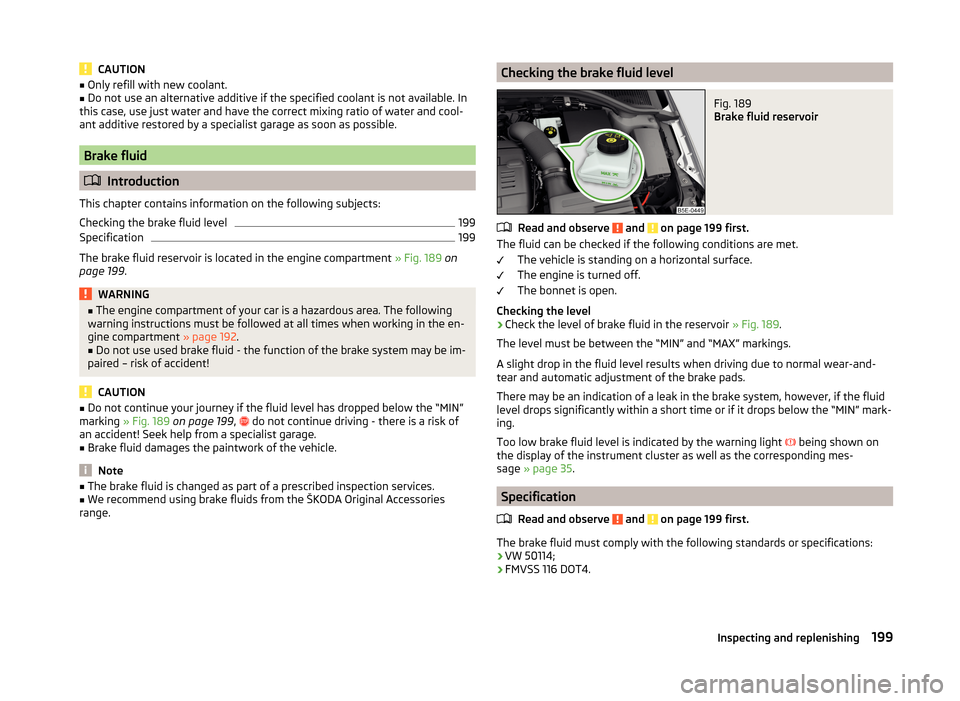
The brake fluid reservoir is located in the engine compartment » Fig. 189 on
page 199 .
WARNING■
The engine compartment of your car is a hazardous area. The following
warning instructions must be followed at all times when working in the en-
gine compartment » page 192.■
Do not use used brake fluid - the function of the brake system may be im-
paired – risk of accident!
CAUTION
■ Do not continue your journey if the fluid level has dropped below the “MIN”
marking » Fig. 189 on page 199 , do not continue driving - there is a risk of
an accident! Seek help from a specialist garage.■
Brake fluid damages the paintwork of the vehicle.
Note
■ The brake fluid is changed as part of a prescribed inspection services.■We recommend using brake fluids from the ŠKODA Original Accessories
range.Checking the brake fluid levelFig. 189
Brake fluid reservoir
Read and observe and on page 199 first.
The fluid can be checked if the following conditions are met.
The vehicle is standing on a horizontal surface.
The engine is turned off.
The bonnet is open.
Checking the level
›
Check the level of brake fluid in the reservoir » Fig. 189.
The level must be between the “MIN” and “MAX” markings.
A slight drop in the fluid level results when driving due to normal wear-and-
tear and automatic adjustment of the brake pads.
There may be an indication of a leak in the brake system, however, if the fluid
level drops significantly within a short time or if it drops below the “MIN” mark-
ing.
Too low brake fluid level is indicated by the warning light being shown on
the display of the instrument cluster as well as the corresponding mes-
sage » page 35 .
Specification
Read and observe
and on page 199 first.
The brake fluid must comply with the following standards or specifications:› VW 50114;
› FMVSS 116 DOT4.
199Inspecting and replenishing
Page 264 of 280
Automatic gearbox modes133
Automatic load deactivation203
automatic transmission selector lever lock defect
134
Automatic transmission Kickdown
135
Launch control135
Selector lever lock134
Automatic Transmission Malfunction
35
Warning light35
warning messages35
Auxiliary heating (auxiliary heating and ventila- tion)
121
Adjust122
Radio remote control123
Switching on/off122
B
Ball head Check fitting
172
Ready position170
Ball rod assembling, step 1
171
assembling, step 2171
Ready position170
removing, step 1172
removing, step 2173
Battery In the remote control key
224
Belts12
Belt tensioners15
Bonnet Closing
194
Opening194
Boot Class N1 vehicles
110
See Boot lid61
Boot lid automatic locking61
Closing61
Opening61
Brake information messages
35
warning light35
Brake booster131
brake fluid specification
199
Brake fluid199
Checking199
information messages35
Brake linings warning light
39
Brake pedal (automatic transmission) Indicator light
40
brakes Driving in
136
Brakes Brake booster
131
Brake fluid199
Braking and stabilisation systems138
Handbrake131
Brakes and parking130
Braking Information on braking
130
Break recommendation See Fatigue detection
166
Bulbs Replacing
231
Buttons in the door Power windows
64
C
Camera Lens care
184
Camera lens care
184
Car computersee multifunction display47
Care and maintenance177
cargo cover roll-up cargo cover
108
Cargo element108
Caring for the vehicle exterior Towing hitch
185
Car park132
Car park ticket holder95
Carrier Roof rack
113
Cavity protection184
Central locking54
Problems58
Central locking button58
Central warning light Indicator light
36
Change bulb for additional parking light
233
bulb for fog lights - Version 1234
bulb for fog lights - Version 2234
bulb for high beam233
bulb for the parking light233
bulb in the rear light - Version 1236
bulb in the rear light - Version 2237
daytime running light bulb233
light bulb in tail light235
Changing Engine oil
195
Wheels214
Changing a wheel Follow-up tasks
215
Preparation214
Removing and refitting a wheel215
Charging a vehicle battery202
Check Fit ball head properly
172
261Index
Page 266 of 280
Cruise Control System148
Cup holders96
D
DAY LIGHT see Daylight running lights
72
Daylight running lights72
De-icing windows
183
De-icing the windscreen and rear window80
Deactivating an airbag21
Decorative films183
Delayed locking of the boot lid see boot lid
61
Departure angle244, 245
Diesel refer to Fuel
190
Diesel fuel Operation in winter
190
Diesel particulate filter43
information messages43
Digital Clock Time
33
Dipstick196
Disconnecting and reconnecting vehicle battery
202
Display31
Compass points52
Coolant temperature32
Gear changes46
Natural gas reserve32
Petrol / Diesel reserve33
Service interval53
Disposal Acceptance and recycling of used vehicles
180
Distance driven33
Distance warning Warning symbol
44
DoorChild safety lock58
Closing56
Emergency locking226
Emergency locking the driver's door225
Opening56
Door warning47
double hooks105
Driver Steering Recommendation (DSR)139
Driving Driving through water
137
Emissions239
Fuel consumption239
off of made-up roads137
Driving in Brake linings
136
engine136
Tyres136
Driving mode160
driving mode select Normal mode
160
Driving Mode Selection160
Driving off of made-up roads137
Driving through water137
DSR139
E
ECO-TIP
52
Eco-tips52
Economical driving Tips
136
EDL139
Electrical power windows66
Operational faults66
Electric boot lid Force limit
61
Manual operation61
Electric luggage compartment lid Acoustic signals63
Adjusting the top lid position63
Deleting the top lid position63
Malfunctions63
Operating62
Electronic Differential Lock (EDL)139
Electronic immobilizer126
Electronic Stability Control (ESC)138
emergency replace battery in the remote control
225
Emergency Changing a wheel
214
Hazard warning light system77
Jump-starting220
Locking the door without a locking cylinder226
Locking the driver's door225
Selector lever-unlocking226
Switching off the engine by pressing a button 129
Towing the using the tow hitch
223
Towing the vehicle221
Tyre repair218
Unlocking the driver's door225
Unlocking the tailgate226
Emergency equipment Fire extinguisher
211
First-aid kit 211
Jack212
Reflective vest211
Vehicle tool kit212
Warning triangle211
Emergency spare wheel Changing
213
Emissions239
Engine Information messages
41
Engine compartment192
Brake fluid199
Overview194
Vehicle battery200
263Index