boot SKODA OCTAVIA 2015 3.G / (5E) User Guide
[x] Cancel search | Manufacturer: SKODA, Model Year: 2015, Model line: OCTAVIA, Model: SKODA OCTAVIA 2015 3.G / (5E)Pages: 268, PDF Size: 37.54 MB
Page 61 of 268
By disabling the interior monitoring and the anti-towing the safe lock is
switched off.
CAUTION
The opened glasses storage compartment reduces the effectiveness of the in-
terior monitor. To ensure the full functionality of the interior monitor, the
glasses storage compartment must always be closed before locking the vehi-
cle.
Luggage compartment lid
Introduction
This chapter contains information on the following subjects:
Boot lid opening/closing
59
Delayed locking of the boot lid
59
When closing the boot lid does do not press on the rear window.
Ensure that the lock is properly engaged after closing the luggage compart-
ment lid.
The function of the button in the grip above the licence plate is deactivated
when starting off or at a speed of 5 km/hour or more for vehicles with central
locking. The function is restored after the vehicle stops and the door is
opened.
WARNING■ Never drive with the luggage compartment lid fully opened or slightly ajar
otherwise exhaust gases may get into the interior of the vehicle – risk of
poisoning!■
Make sure that when closing the boot lid, no body parts are crushed -
there is danger of injury!
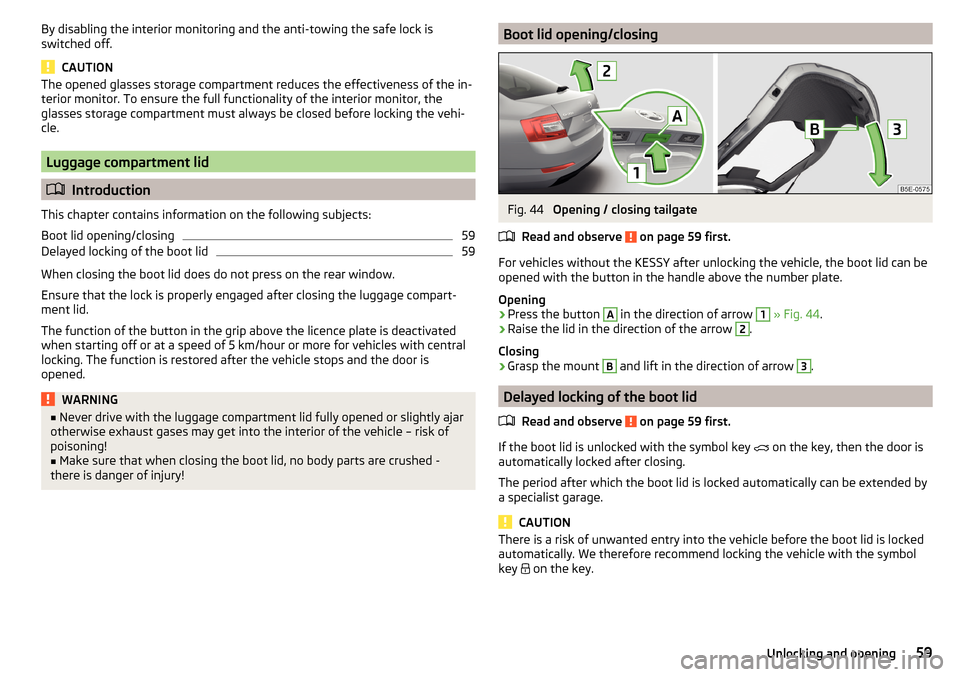
Boot lid opening/closingFig. 44
Opening / closing tailgate
Read and observe
on page 59 first.
For vehicles without the KESSY after unlocking the vehicle, the boot lid can be opened with the button in the handle above the number plate.
Opening
›
Press the button
A
in the direction of arrow
1
» Fig. 44 .
›
Raise the lid in the direction of the arrow
2
.
Closing
›
Grasp the mount
B
and lift in the direction of arrow
3
.
Delayed locking of the boot lid
Read and observe
on page 59 first.
If the boot lid is unlocked with the symbol key on the key, then the door is
automatically locked after closing.
The period after which the boot lid is locked automatically can be extended by
a specialist garage.
CAUTION
There is a risk of unwanted entry into the vehicle before the boot lid is locked
automatically. We therefore recommend locking the vehicle with the symbol
key
on the key.59Unlocking and opening
Page 62 of 268
Electric boot lid
Introduction
This chapter contains information on the following subjects:
Operating description
60
Set the top position of the lid
61
Malfunctions
61
The boot lid (hereinafter referred to as lid) can be operated electrically and
manually in the event of an emergency » page 61.
If the lid hits an obstacle when opening or closing, it stops and an audible sig-
nal sounds. When closing the flap is lifted additionally.
WARNING■ Ensure that the lock is properly engaged after closing the lid. Otherwise,
the lid might open suddenly while the vehicle is moving, even if the lid was
locked – risk of accident!■
Never drive with the lid open or unlatched, as otherwise exhaust gases
may get into the interior of the vehicle – risk of poisoning!
■
Only open and close the lid when there is no one in the opening/closing
range – risk of injury!
■
Make sure that when closing the lid, no body parts are crushed – risk of
injury!
CAUTION
Do not attempt to close the lid manually during an electrical closing process -
there is a risk of damaging the electric lid operation system.
CAUTION
■ Before opening or closing the lid, check if there are any objects in the open-
ing or closing range which could obstruct the movement (e.g. a load on the
roof rack or on the trailer, etc.) – risk of causing damage to the lid!■
In certain circumstances, if the lid is loaded (e.g by a thick layer of snow), the
opening process of the lid can be interrupted. Remove the snow from the lid to
re-enable the electrical operation.
■
If the lid closes automatically (e.g. under load of snow), you will hear an inter-
mittent beep.
■
Always close the flap before disconnecting the battery.
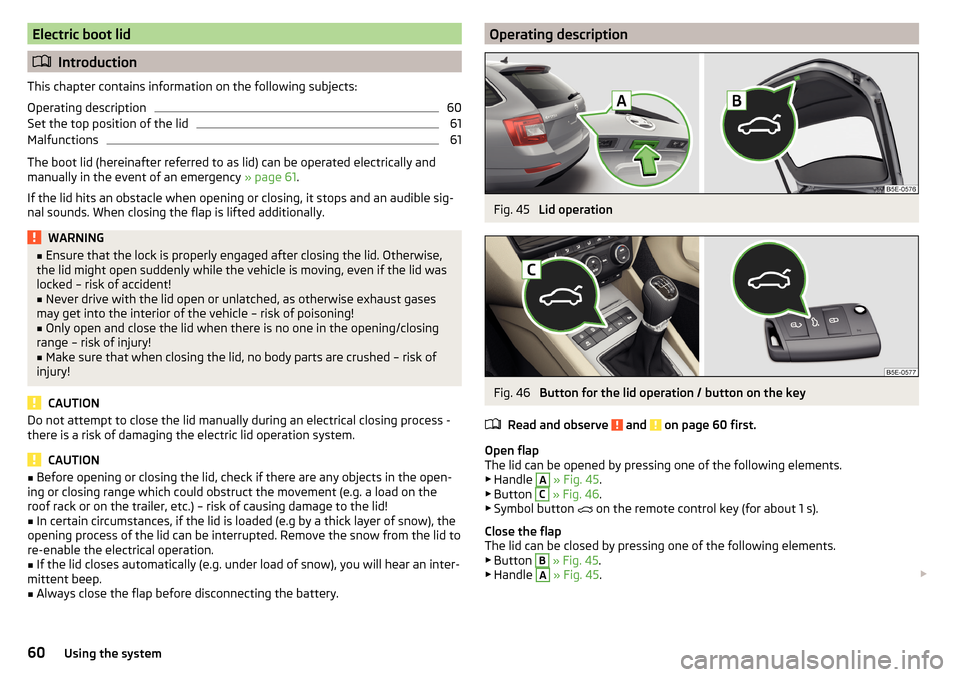
Operating descriptionFig. 45
Lid operation
Fig. 46
Button for the lid operation / button on the key
Read and observe
and on page 60 first.
Open flap
The lid can be opened by pressing one of the following elements. ▶ Handle
A
» Fig. 45 .
▶ Button
C
» Fig. 46 .
▶ Symbol button on the remote control key (for about 1 s).
Close the flap
The lid can be closed by pressing one of the following elements. ▶ Button
B
» Fig. 45 .
▶ Handle
A
» Fig. 45 .
60Using the system
Page 63 of 268
Stop lid movement
The lid movement can be stopped by pressing one of the following operating
elements. ▶ Button B
» Fig. 45 .
▶ Button
C
» Fig. 46 .
▶ Symbol button
on the remote control key (for about 1 s).
▶ Handle
A
» Fig. 45 .
When opening the lid using the symbol key
on the key or the button
C
» Fig. 46 an acoustic signal sounds.
Note
If you rapidly enter the vehicle during the opening or closing process of the
boot lid, the whole vehicle may jerk and as a result the movement of the lid
can be interrupted.
Set the top position of the lid
Read and observe
and on page 60 first.
If the space for opening the lid is restricted (e.g. height of garage) or for more
convenient operation (e.g. according to a person's height), it is possible to ad-
just the top position of the boot lid.
Adjusting
›
Stop the lid in the desired position (electrically or manually).
›
Press and hold the button
B
» Fig. 45 on page 60 for longer than 3 seconds.
The setting of the lid top position is confirmed by an acoustic signal.
Delete
›
Carefully raise the flap manually to the limit.
›
Press and hold the button
B
» Fig. 45 on page 60 for longer than 3 seconds.
An audible signal is emitted. The original position is deleted and the top lid po-
sition is set.
Note
The top position which is reached when the lid opens automatically, is always
lower than the maximum top position which can be reached when the lid is
opened manually.Malfunctions
Read and observe
and on page 60 first.
Examples of operational malfunctions
Description of the malfunc-
tionPossible solutionsThe lid cannot be openedUnlocking the lid » page 224
The lid does not react to an
opening signal
Removing a possible obstacle (e.g. snow), re-
opening the lid » page 60
Press handle A
» Fig. 45 on page 60 and pull
the lid upwards
The lid remains in the top
position
Manual closing of the lid
The lid is open and the bat-
tery was disconnected
Close manually
Close the door slowly and completely. It must be ensured that when pressing
the lid into the lock, pressure is applied to the centre edge of the lid above the
ŠKODA logo.
Window operations
Introduction
This chapter contains information on the following subjects:
Mechanical window lefter
62
Electric window lifters
62
Opening/closing the windows in the front passenger door and in the rear
doors
63
Force limit
63
Window convenience operation
64
Malfunctions
64
The windows can be operated mechanically by means of the handle attached
to the respective door panel.
61Unlocking and opening
Page 70 of 268
Note■The headlights may mist up temporarily. When the driving lights are switched
on, the light outlet surfaces are free from mist after a short period, although
the headlight lenses may still be misted up in the peripheral areas. This mist
has no influence on the life of the lighting system.■
If the visibility is poor and the lights are not on (except daytime running light)
the brightness of the instrument lighting reduces to alert the driver to switch
on the lights in due time.
■
The brightness of the instrument lighting with the lights on (except daytime
running lights) can be set in the Infotainment » Owner´s Manual Infotainment ,
chapter CAR - Vehicle Settings .
Operating the lights
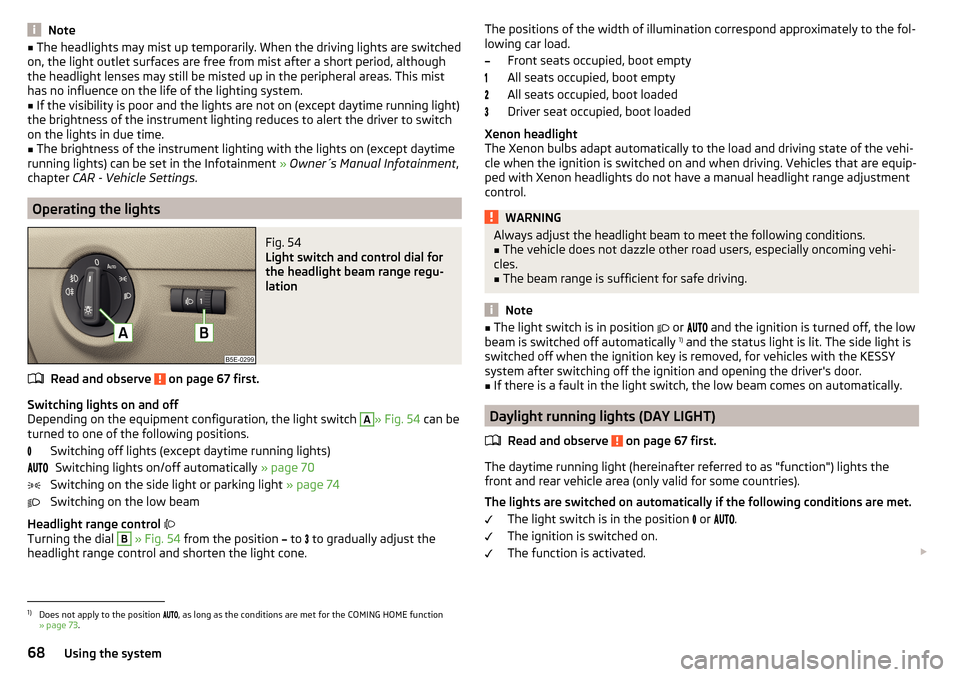
Fig. 54
Light switch and control dial for
the headlight beam range regu-
lation
Read and observe on page 67 first.
Switching lights on and off
Depending on the equipment configuration, the light switch
A
» Fig. 54 can be
turned to one of the following positions.
Switching off lights (except daytime running lights)Switching lights on/off automatically » page 70
Switching on the side light or parking light » page 74
Switching on the low beam
Headlight range control
Turning the dial
B
» Fig. 54 from the position
to
to gradually adjust the
headlight range control and shorten the light cone.
The positions of the width of illumination correspond approximately to the fol-
lowing car load.
Front seats occupied, boot empty
All seats occupied, boot empty
All seats occupied, boot loaded
Driver seat occupied, boot loaded
Xenon headlight
The Xenon bulbs adapt automatically to the load and driving state of the vehi-
cle when the ignition is switched on and when driving. Vehicles that are equip-
ped with Xenon headlights do not have a manual headlight range adjustment
control.WARNINGAlways adjust the headlight beam to meet the following conditions.■The vehicle does not dazzle other road users, especially oncoming vehi-
cles.■
The beam range is sufficient for safe driving.
Note
■ The light switch is in position or and the ignition is turned off, the low
beam is switched off automatically 1)
and the status light is lit. The side light is
switched off when the ignition key is removed, for vehicles with the KESSY
system after switching off the ignition and opening the driver's door.■
If there is a fault in the light switch, the low beam comes on automatically.
Daylight running lights (DAY LIGHT)
Read and observe
on page 67 first.
The daytime running light (hereinafter referred to as "function") lights the
front and rear vehicle area (only valid for some countries).
The lights are switched on automatically if the following conditions are met. The light switch is in the position
or
.
The ignition is switched on.
The function is activated.
1)
Does not apply to the position
, as long as the conditions are met for the COMING HOME function
» page 73 .
68Using the system
Page 79 of 268
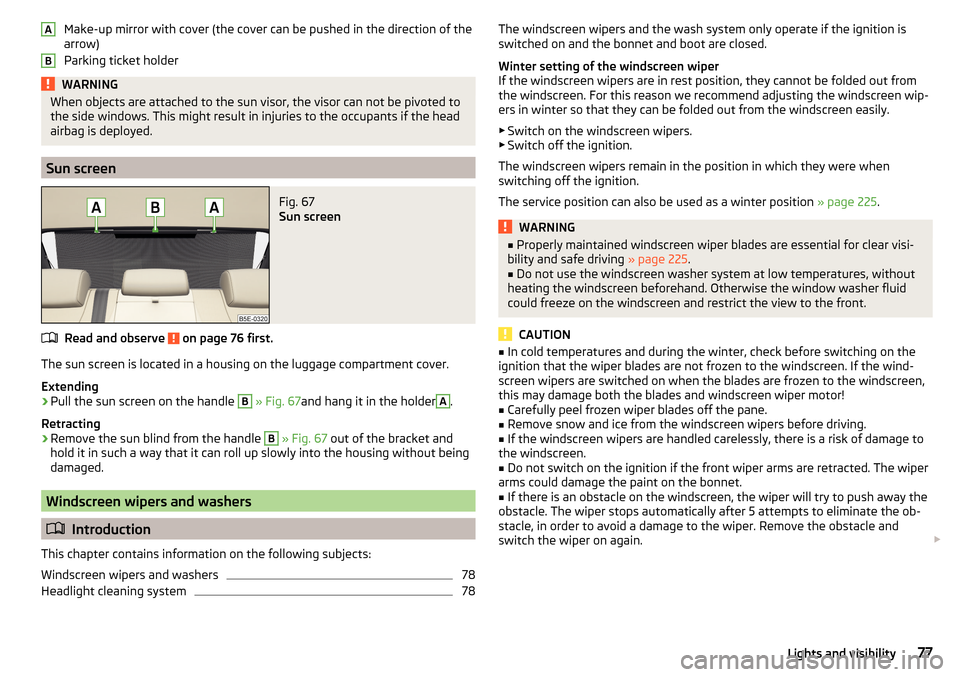
Make-up mirror with cover (the cover can be pushed in the direction of the
arrow)
Parking ticket holderWARNINGWhen objects are attached to the sun visor, the visor can not be pivoted to
the side windows. This might result in injuries to the occupants if the head
airbag is deployed.
Sun screen
Fig. 67
Sun screen
Read and observe on page 76 first.
The sun screen is located in a housing on the luggage compartment cover.
Extending
›
Pull the sun screen on the handle
B
» Fig. 67 and hang it in the holder
A
.
Retracting
›
Remove the sun blind from the handle
B
» Fig. 67 out of the bracket and
hold it in such a way that it can roll up slowly into the housing without being
damaged.
Windscreen wipers and washers
Introduction
This chapter contains information on the following subjects:
Windscreen wipers and washers
78
Headlight cleaning system
78ABThe windscreen wipers and the wash system only operate if the ignition is
switched on and the bonnet and boot are closed.
Winter setting of the windscreen wiper
If the windscreen wipers are in rest position, they cannot be folded out from
the windscreen. For this reason we recommend adjusting the windscreen wip-
ers in winter so that they can be folded out from the windscreen easily.
▶ Switch on the windscreen wipers.
▶ Switch off the ignition.
The windscreen wipers remain in the position in which they were when
switching off the ignition.
The service position can also be used as a winter position » page 225.WARNING■
Properly maintained windscreen wiper blades are essential for clear visi-
bility and safe driving » page 225.■
Do not use the windscreen washer system at low temperatures, without
heating the windscreen beforehand. Otherwise the window washer fluid
could freeze on the windscreen and restrict the view to the front.
CAUTION
■ In cold temperatures and during the winter, check before switching on the
ignition that the wiper blades are not frozen to the windscreen. If the wind-
screen wipers are switched on when the blades are frozen to the windscreen,
this may damage both the blades and windscreen wiper motor!■
Carefully peel frozen wiper blades off the pane.
■
Remove snow and ice from the windscreen wipers before driving.
■
If the windscreen wipers are handled carelessly, there is a risk of damage to
the windscreen.
■
Do not switch on the ignition if the front wiper arms are retracted. The wiper
arms could damage the paint on the bonnet.
■
If there is an obstacle on the windscreen, the wiper will try to push away the
obstacle. The wiper stops automatically after 5 attempts to eliminate the ob-
stacle, in order to avoid a damage to the wiper. Remove the obstacle and
switch the wiper on again.
77Lights and visibility
Page 90 of 268
›Fold the backrest in the direction of the arrow 2.
In the undivided seat back, press the release handles A
on both sides of the
seat back at the same time.
Folding forward from the luggage compartment
There is a lever on the left side of the luggage compartment for unlocking the
left rear seat backrest.
There is a lever on the right side of the luggage compartment for unlocking
the right and the middle rear seat backrests.
Before folding the seat backrest forward, check that there are no objects on
the rear seat.
On vehicles with a net partition, the left and then the right and middle rear
seat backrest must first be unlocked. The net partition must be rolled up in the
housing.
›
Pull the lever in the direction of the arrow » Fig. 82.
The respective seat rest is unlocked and folded forward if applicable.
Folding backwards
›
Pull the rear outer seat belt
C
to the side panel in the direction of arrow
3
» Fig. 81 .
›
Subsequently, fold back the backrest in the opposite direction of the arrow
2
until the release handle
A
clicks into place - by pulling on the seat back-
rest.
›
Make sure that the red pin
B
is hidden.
In the undivided seat back, pull the two outer belts to the side panel. The re-
lease handles
A
must be locked audibly on both sides of the seat backrest.
The red pen
B
should not be visible on any of the two sides of the seat back.
WARNING■ If rear seats are occupied, make sure that the respective seat backrests
are properly engaged.■
After folding back the seat back, the seat belts must be ready for use.
■
The seat backrests must be securely locked in position so that no objects
in the luggage compartment can slide into the passenger compartment on
sudden braking – risk of injury.
■
When transporting objects in the luggage compartment that has been en-
larged by folding the backrest forward, ensure the safety of the passengers
transported on the other rear seats.
CAUTION■ Ensure that the seat belts are not damaged when operating the seat backr-
ests. Under no circumstances must the rear seat belts be jammed by the fol-
ded back seat backrests.■
Before folding the seat back forward, check whether there are any objects
on the rear seat - there is a danger of damaging these items or the seat back
and the seat.
Long cargo channel in the rear seat backrest
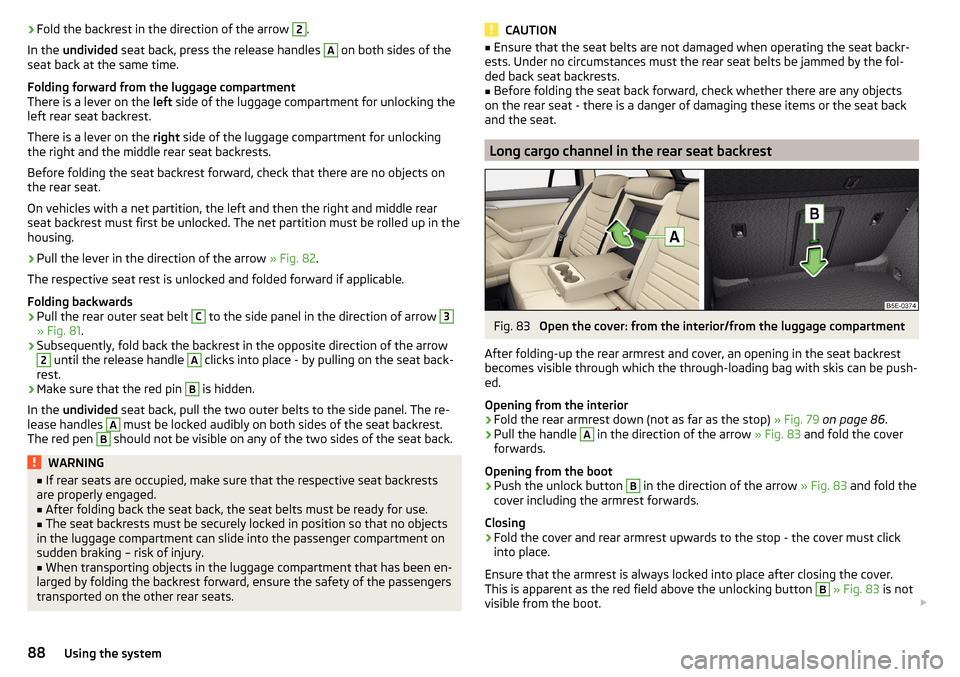
Fig. 83
Open the cover: from the interior/from the luggage compartment
After folding-up the rear armrest and cover, an opening in the seat backrest
becomes visible through which the through-loading bag with skis can be push-
ed.
Opening from the interior
›
Fold the rear armrest down (not as far as the stop) » Fig. 79 on page 86 .
›
Pull the handle
A
in the direction of the arrow » Fig. 83 and fold the cover
forwards.
Opening from the boot
›
Push the unlock button
B
in the direction of the arrow » Fig. 83 and fold the
cover including the armrest forwards.
Closing
›
Fold the cover and rear armrest upwards to the stop - the cover must click
into place.
Ensure that the armrest is always locked into place after closing the cover.
This is apparent as the red field above the unlocking button
B
» Fig. 83 is not
visible from the boot.
88Using the system
Page 95 of 268
The insertion of the insert and closing of the ashtray is carried out in reverse
order.WARNINGNever place hot or flammable objects in the ashtray – risk of fire!
12-Volt power outlet
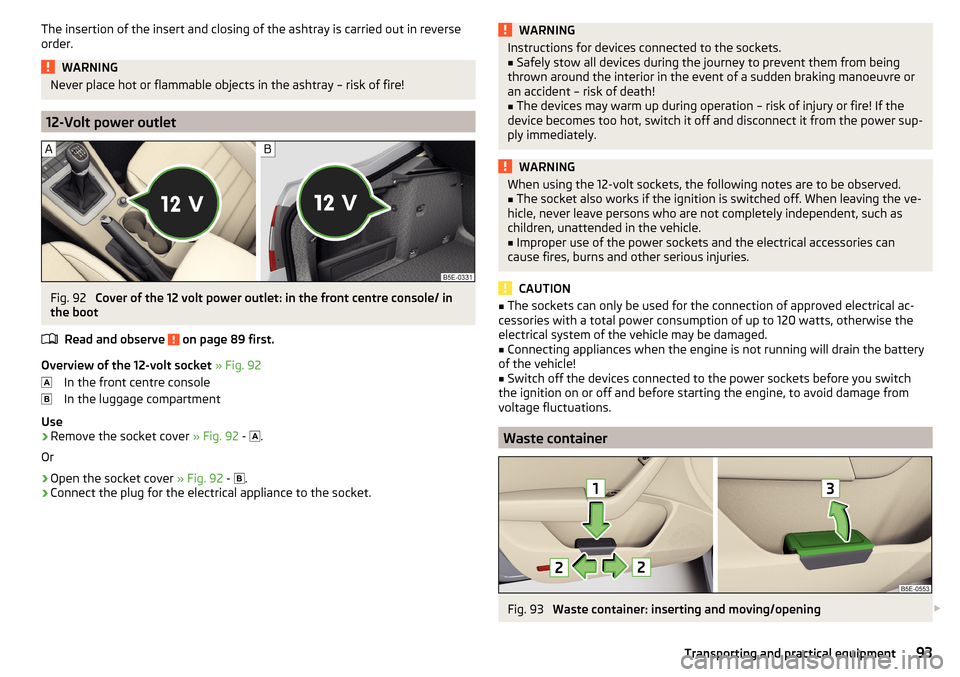
Fig. 92
Cover of the 12 volt power outlet: in the front centre console/ in
the boot
Read and observe
on page 89 first.
Overview of the 12-volt socket » Fig. 92
In the front centre console
In the luggage compartment
Use
›
Remove the socket cover » Fig. 92 -
.
Or
›
Open the socket cover » Fig. 92 -
.
›
Connect the plug for the electrical appliance to the socket.
WARNINGInstructions for devices connected to the sockets.■Safely stow all devices during the journey to prevent them from being
thrown around the interior in the event of a sudden braking manoeuvre or
an accident – risk of death!■
The devices may warm up during operation – risk of injury or fire! If the
device becomes too hot, switch it off and disconnect it from the power sup-
ply immediately.
WARNINGWhen using the 12-volt sockets, the following notes are to be observed.■The socket also works if the ignition is switched off. When leaving the ve-
hicle, never leave persons who are not completely independent, such as
children, unattended in the vehicle.■
Improper use of the power sockets and the electrical accessories can
cause fires, burns and other serious injuries.
CAUTION
■ The sockets can only be used for the connection of approved electrical ac-
cessories with a total power consumption of up to 120 watts, otherwise the
electrical system of the vehicle may be damaged.■
Connecting appliances when the engine is not running will drain the battery
of the vehicle!
■
Switch off the devices connected to the power sockets before you switch
the ignition on or off and before starting the engine, to avoid damage from
voltage fluctuations.
Waste container
Fig. 93
Waste container: inserting and moving/opening
93Transporting and practical equipment
Page 100 of 268
CAUTION■The power socket can only be used for connecting approved electrical acces-
sories with a two-pin 230V plug, with a total power uptake of up to 150 watt.■
Place the connector on the electrical device into the power socket as far as it
can go to create a connection between the contacts.
■
If the connector of the electrical device is not inserted fully into the power
socket, the child safety lock might release, and the power socket be activated.
The electrical device is still not supplied with power.
■
The socket is temporarily disabled at engine start-up and the indicator light
flashes red. After starting the engine, the power socket is re-activated auto-
matically.
■
Do not connect any lamps with neon filaments to the power socket - risk of
damaging the lamp.
■
A larger current surge may arise in some power supplies (e.g. for notebooks)
when connecting them to the power socket- this will automatically deactivate
the power socket. In this case, disconnect the power supply from the consum-
er and connect the power supply to the power socket first, followed by the
consumer.
■
The connected appliances may behave differently to when connected to the
mains.
Removable through-loading bag
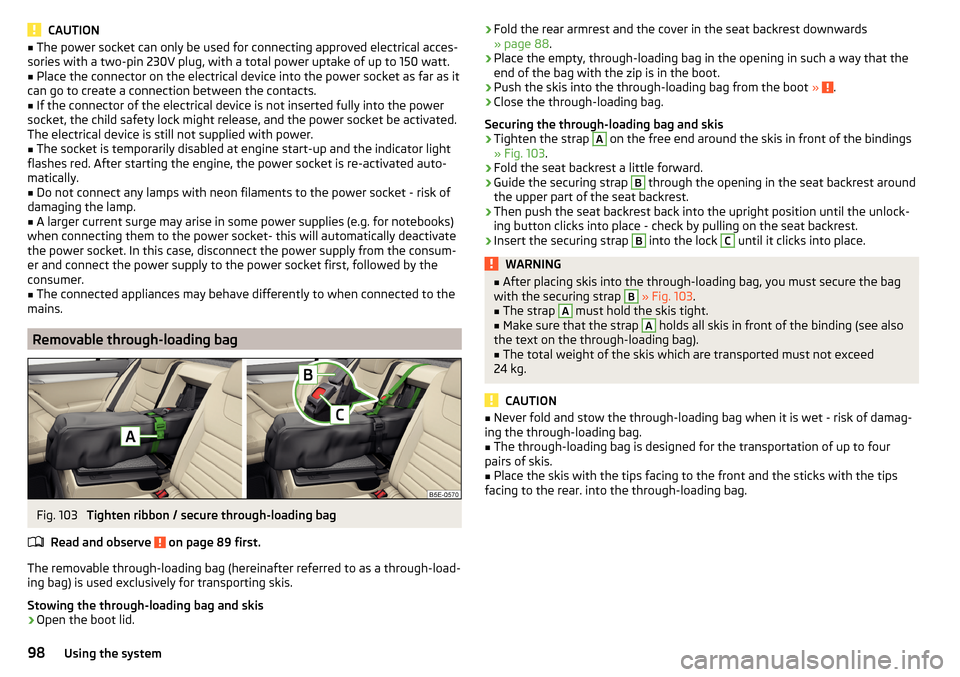
Fig. 103
Tighten ribbon / secure through-loading bag
Read and observe
on page 89 first.
The removable through-loading bag (hereinafter referred to as a through-load-
ing bag) is used exclusively for transporting skis.
Stowing the through-loading bag and skis
›
Open the boot lid.
› Fold the rear armrest and the cover in the seat backrest downwards
» page 88 .›
Place the empty, through-loading bag in the opening in such a way that the
end of the bag with the zip is in the boot.
›
Push the skis into the through-loading bag from the boot » .
›
Close the through-loading bag.
Securing the through-loading bag and skis
›
Tighten the strap
A
on the free end around the skis in front of the bindings
» Fig. 103 .
›
Fold the seat backrest a little forward.
›
Guide the securing strap
B
through the opening in the seat backrest around
the upper part of the seat backrest.
›
Then push the seat backrest back into the upright position until the unlock-
ing button clicks into place - check by pulling on the seat backrest.
›
Insert the securing strap
B
into the lock
C
until it clicks into place.
WARNING■ After placing skis into the through-loading bag, you must secure the bag
with the securing strap B » Fig. 103 .■
The strap
A
must hold the skis tight.
■
Make sure that the strap
A
holds all skis in front of the binding (see also
the text on the through-loading bag).
■
The total weight of the skis which are transported must not exceed
24 kg.
CAUTION
■ Never fold and stow the through-loading bag when it is wet - risk of damag-
ing the through-loading bag.■
The through-loading bag is designed for the transportation of up to four
pairs of skis.
■
Place the skis with the tips facing to the front and the sticks with the tips
facing to the rear. into the through-loading bag.
98Using the system
Page 103 of 268
The warning light turns off when the tailgate is closed.
If the boot lid is open and the ignition switched off, the light will extinguish
automatically after around 10 minutes.WARNING■ Never exceed the maximum permissible load of the respective fasteners,
nets, hooks etc. as heavy objects are not e sufficiently secured - there is a
risk of injury!■
If the cargo is tied down with unsuitable or damaged lashing straps, inju-
ries can occur in the event of braking manoeuvres or accidents.
■
Loose cargo can be thrown forward during a sudden manoeuvre or in case
of an accident and can injure the occupants or other road users.
■
Loose cargo could hit a deployed airbag and injure occupants – danger of
death!
CAUTION
■ Never exceed the maximum permissible load of the respective fasteners,
nets, hooks etc. - these could be damaged.■
Make sure that transported objects with sharp edges do not damage the
threads of the following devices. ■Rear window heater.
■ Rear window with an integrated antenna.
■ Integrated antenna in the rear side windows.
Fastening elements
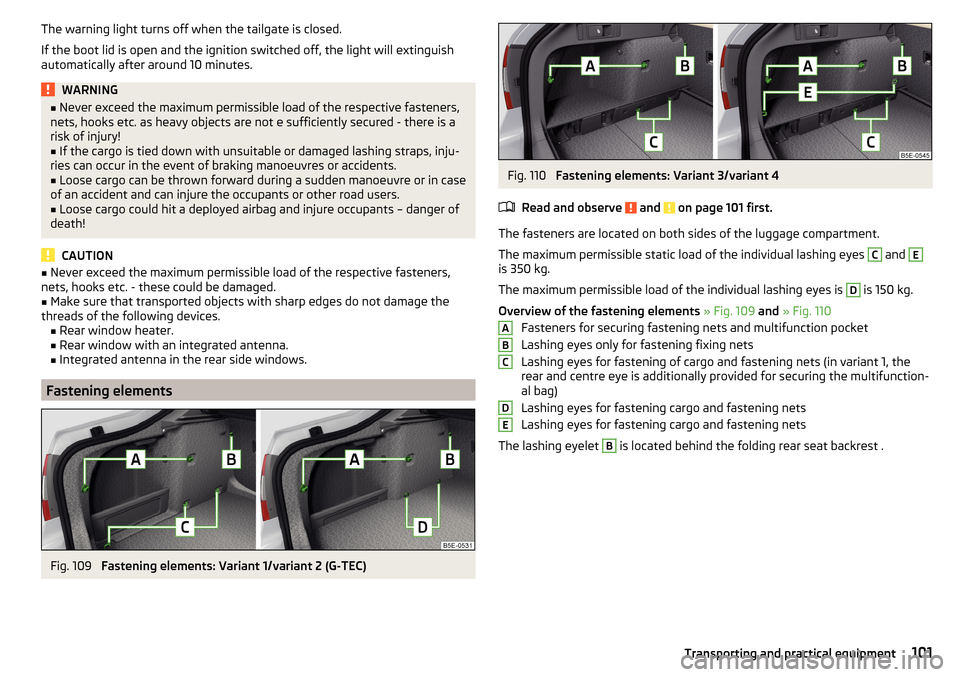
Fig. 109
Fastening elements: Variant 1/variant 2 (G-TEC)
Fig. 110
Fastening elements: Variant 3/variant 4
Read and observe
and on page 101 first.
The fasteners are located on both sides of the luggage compartment.
The maximum permissible static load of the individual lashing eyes
C
and
E
is 350 kg.
The maximum permissible load of the individual lashing eyes is
D
is 150 kg.
Overview of the fastening elements » Fig. 109 and » Fig. 110
Fasteners for securing fastening nets and multifunction pocket
Lashing eyes only for fastening fixing nets
Lashing eyes for fastening of cargo and fastening nets (in variant 1, the
rear and centre eye is additionally provided for securing the multifunction-
al bag)
Lashing eyes for fastening cargo and fastening nets
Lashing eyes for fastening cargo and fastening nets
The lashing eyelet
B
is located behind the folding rear seat backrest .
ABCDE101Transporting and practical equipment
Page 106 of 268
NoteFor easier turning of the covering, use the loop attached.
Luggage net
Fig. 117
Luggage net
Read and observe and on page 101 first.
The net at the bottom of the luggage compartment cover » Fig. 117 is provided
for transporting light and soft items.
The maximum permissible load of the net is 1.5 kg.
CAUTION
Do not place any sharp objects into the net – risk of net damage.
Luggage compartment cover
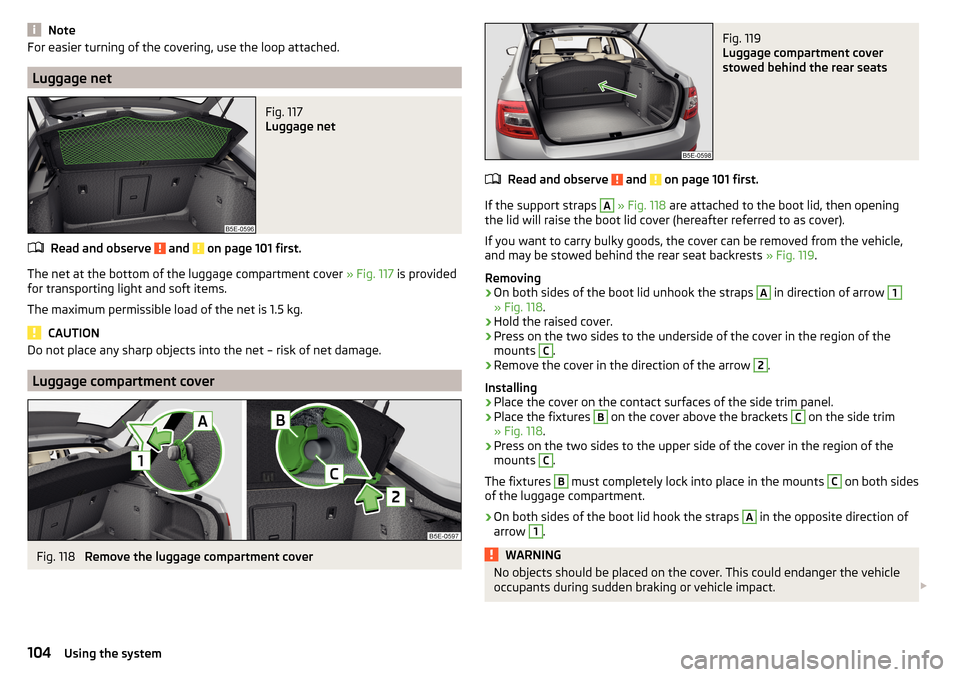
Fig. 118
Remove the luggage compartment cover
Fig. 119
Luggage compartment cover
stowed behind the rear seats
Read and observe and on page 101 first.
If the support straps
A
» Fig. 118 are attached to the boot lid, then opening
the lid will raise the boot lid cover (hereafter referred to as cover).
If you want to carry bulky goods, the cover can be removed from the vehicle, and may be stowed behind the rear seat backrests » Fig. 119.
Removing
›
On both sides of the boot lid unhook the straps
A
in direction of arrow
1
» Fig. 118 .
›
Hold the raised cover.
›
Press on the two sides to the underside of the cover in the region of the
mounts
C
.
›
Remove the cover in the direction of the arrow
2
.
Installing
›
Place the cover on the contact surfaces of the side trim panel.
›
Place the fixtures
B
on the cover above the brackets
C
on the side trim
» Fig. 118 .
›
Press on the two sides to the upper side of the cover in the region of the
mounts
C
.
The fixtures
B
must completely lock into place in the mounts
C
on both sides
of the luggage compartment.
›
On both sides of the boot lid hook the straps
A
in the opposite direction of
arrow
1
.
WARNINGNo objects should be placed on the cover. This could endanger the vehicle
occupants during sudden braking or vehicle impact. 104Using the system