steering wheel SKODA OCTAVIA 2015 3.G / (5E) Owner's Guide
[x] Cancel search | Manufacturer: SKODA, Model Year: 2015, Model line: OCTAVIA, Model: SKODA OCTAVIA 2015 3.G / (5E)Pages: 268, PDF Size: 37.54 MB
Page 164 of 268
The boundary lines are clearly visible (appropriate longitudinal markings).
The boundary line of at least one side of the lane is detected.
The driver's hands are on the steering wheel.
The lane is more than 2.5 m in width.
If the turn signal is switched on prior to driving over the boundary line (e.g.
when making a turn), no steering intervention takes place when the vehicle
approaches the boundary line. The system regards the situation as an inten-
ded lane change.
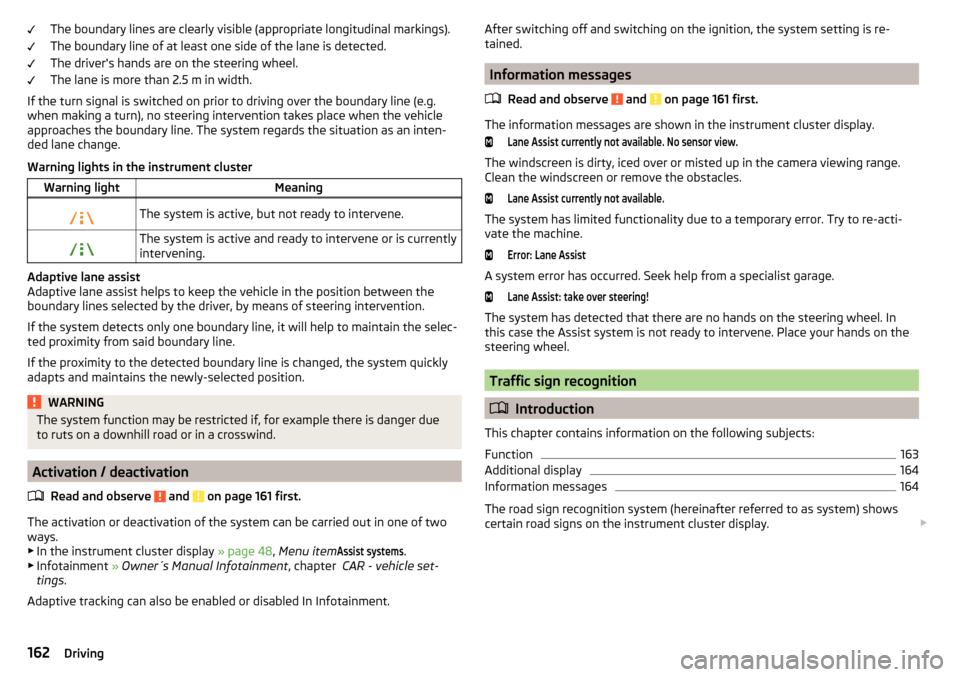
Warning lights in the instrument clusterWarning lightMeaningThe system is active, but not ready to intervene.The system is active and ready to intervene or is currently
intervening.
Adaptive lane assist
Adaptive lane assist helps to keep the vehicle in the position between the
boundary lines selected by the driver, by means of steering intervention.
If the system detects only one boundary line, it will help to maintain the selec-
ted proximity from said boundary line.
If the proximity to the detected boundary line is changed, the system quickly
adapts and maintains the newly-selected position.
WARNINGThe system function may be restricted if, for example there is danger due
to ruts on a downhill road or in a crosswind.
Activation / deactivation
Read and observe
and on page 161 first.
The activation or deactivation of the system can be carried out in one of two
ways. ▶ In the instrument cluster display » page 48, Menu item
Assist systems
.
▶ Infotainment » Owner´s Manual Infotainment , chapter CAR - vehicle set-
tings .
Adaptive tracking can also be enabled or disabled In Infotainment.
After switching off and switching on the ignition, the system setting is re-
tained.
Information messages
Read and observe
and on page 161 first.
The information messages are shown in the instrument cluster display.
Lane Assist currently not available. No sensor view.
The windscreen is dirty, iced over or misted up in the camera viewing range.
Clean the windscreen or remove the obstacles.
Lane Assist currently not available.
The system has limited functionality due to a temporary error. Try to re-acti-
vate the machine.
Error: Lane Assist
A system error has occurred. Seek help from a specialist garage.
Lane Assist: take over steering!
The system has detected that there are no hands on the steering wheel. In
this case the Assist system is not ready to intervene. Place your hands on the
steering wheel.
Traffic sign recognition
Introduction
This chapter contains information on the following subjects:
Function
163
Additional display
164
Information messages
164
The road sign recognition system (hereinafter referred to as system) shows
certain road signs on the instrument cluster display.
162Driving
Page 183 of 268
WARNING■No modifications of any kind must be made to parts of the airbag system.■Any work on the airbag system including the installation and removal of
system components due to other repair work (e.g. removal of the steering
wheel) must only be carried out by a specialist garage.■
Never make any changes to the front bumper or the bodywork.
■
It is prohibited to manipulate individual parts of the airbag system, as this
might result in the airbag being deployed.
■
The protective function of the airbag system is sufficient for only one ac-
cident. The airbag system must then be replaced if the airbag has been de-
ployed.
WARNINGThe airbag system operates using pressure sensors located in the front
doors. For this reason, no adjustments may be carried out to the doors or
door panels (e.g. installation of additional loudspeakers). Resulting damage
can have a negative impact on the function of the airbag system. Any work
on the front doors and their door panels must be carried out by a specialist
garage. The following guidelines must be observed.■
Never drive with inner door panels removed.
■
Never drive if parts of the inner door panel have been removed and the
resulting openings have not been properly sealed.
■
Never drive if the loudspeakers in the doors have been removed, unless
the loudspeaker openings have been properly sealed.
■
Always make sure that the openings are covered or filled if additional
loudspeakers or other equipment parts have been installed in the inner
door panels.
Acceptance and recycling of used vehicles
Read and observe
on page 178 first.
ŠKODA meets the requirements of the brand and its products with regard to
protecting the environment and the preserving resources. All new ŠKODA ve-
hicles are 95% recyclable.
Note
You can find more detailed information about the trade-in and recycling of old
cars from a specialist garage.Washing vehicle
Introduction
This chapter contains information on the following subjects:
Washing by hand
181
Automatic car wash systems
182
Washing with a high-pressure cleaner
182
The best way to protect your vehicle against harmful environmental influences
is frequent washing.
The longer insect residues, bird droppings, road salt and other aggressive de-
posits remain on the paintwork of your vehicle, the more detrimental their de-
structive effect can be. High temperatures, such as those caused by intensive
sun's rays, accentuate this caustic effect.
It is essential to also thoroughly clean the underside of the vehicle at the end
of the winter.
WARNINGWhen washing your vehicle in the winter: Water and ice in the braking sys-
tem can affect the braking efficiency – risk of accident!
CAUTION
The temperature of the water used for cleaning must not exceed 60 °C – risk
of damaging the vehicle.
For the sake of the environment
Only wash the vehicle at washing bays intended for this purpose.
Washing by hand
Read and observe
and on page 181 first.
Soak the dirt with plenty of water and rinse as well as possible.
Clean the vehicle with a soft sponge, a washing glove or a washing brush.
Work from the top to the bottom – starting with the roof.
For stubborn dirt, agents specifically intended for this purpose are to be used. Wash out the sponge or washing glove thoroughly at short intervals.
181Care and maintenance
Page 188 of 268
Regularly remove salt and brake abrasion, otherwise the rim material will be
corroded.
Light alloy wheels
After washing thoroughly and treat the wheel rims with a protective product
for light alloy wheels.
For the treatment of wheel rims do not use products which may cause damage
to the paint on the rims.
CAUTION
■ Damage to the paint layer on the wheel rims must be touched up immediate-
ly.■
Severe layers of dirt on the wheels can also result in wheel imbalance. This
may show itself in the form of a wheel vibration which is transmitted to the
steering wheel which, in certain circumstances, can cause premature wear of
the steering. This means it is necessary to remove the dirt.
Towing hitch and mounting recess
Read and observe
and on page 183 first.
Seal the mounting recess with the cap to prevent any ingress of dirt.
In the event of dirt, clean the interior surfaces of the mounting recess and
treat with a suitable preservative.
Always check the ball head before attaching a trailer. Apply suitable grease
where necessary.
Include the protective cap when stowing away the ball rod to protect the boot
from getting contaminated.
CAUTION
Apply grease to the inner part of the mounting recess. Make sure you do not
remove any grease.
Under-body protection
Read and observe
and on page 183 first.
The underside of your vehicle is already permanently protected by the factory
against chemical and mechanical influences.
It is not possible to guarantee that the protective coating will not suffer any
damage as the vehicle is driven.
We recommend having the protective coating underneath the vehicle and the
chassis checked — preferably before the beginning of winter and at the end of winter.WARNINGNever use additional underbody protection or anti-corrosion agents for ex-
haust pipes, catalytic converters, diesel particle filters or heat shields.
When the engine reaches its operating temperature, these substances
might ignite - risk of fire!
Wiper blades
Read and observe
and on page 183 first.
Clean the wiper blades regularly with a glass cleaner. The wiper blades should
be cleaned with a sponge or cloth if they are heavily soiled by insect residues,
for example.
The wiper blades can become soiled with wax residues after washing in auto-
matic vehicle wash systems for example.
Interior care
Introduction
This chapter contains information on the following subjects:
Natural leather
187
Artificial leather, materials and Alcantara ®
187
Seat covers
188
Safety belts
188
We recommend using vehicle care products from ŠKODA Original Accessories.
These are available from ŠKODA Partners. The usage instructions on the pack-
age must be observed.
186General Maintenance
Page 189 of 268
WARNING■Vehicle care products may be harmful to your health if not used according
to the instructions.■
Always keep the vehicle care products safe from people who are not com-
pletely independent, e.g. children - there is a danger of poisoning!
■
Air fresheners and scents can be hazardous to heath when the tempera-
ture inside the vehicle is high.
CAUTION
■ Be sure to check clothing for colour-fastness to avoid any damage or visible
stains on the material (leather), panels and textiles.■
Remove fresh stains such as those from ball-point pens, ink, lipstick, shoe
polish, etc., from the material (leather), panels and textiles as quickly as possi-
ble.
■
Do not attach scents or air fresheners to the dash panel – there is a risk of
damage to the dash panel.
■
Do not attach any stickers to the filaments or glass antenna - there is risk of
damage.
■
Do not clean the roof panelling with a brush – risk of damage to the surface
of the panelling.
■
Cleaner that contain solvents can damage the material being cleaned.
■
Apply only a small amount of the cleaning and care product.
Note
Due to the special tools and knowledge required, and to avoid any potential
problems with the cleaning and care of the interior of your vehicle, we recom-
mend that cleaning and care of the interior of your vehicle be carried out by a
ŠKODA service partner.
Natural leather
Read and observe
and on page 187 first.
The leather needs, depending on the strain placed on it, regular cleaning andmaintenance.
Dust and dirt in pores and creases cause abrasions on the surface and lead to
premature embrittlement of the leather surface. Therefore, they must be re-
moved regularly at short intervals with a cloth or vacuum cleaner.
Clean soiled leather surfaces with a water-dampened cotton or woollen cloth
and then dry with a clean, dry cloth »
.
Clean severely soiled areas with a cloth soaked in a mild soap solution (2 ta-
blespoons of neutral soap to 1 litre of water).
To remove stains , use a cleaning agent specially designed for this purpose.
Treat the leather periodically with a suitable leather protector and use a skin care cream with light blocker and impregnation after each cleaning.
CAUTION
■ Ensure that no part of the leather is soaked through during cleaning and that
no water gets into the seams. Otherwise, the leather could become brittle or
cracked.■
Avoid leaving the vehicle for lengthy periods in bright sunlight to avoid the
leather from bleaching. If the vehicle is parked in the open for lengthy periods,
protect the leather from direct sunlight by covering it.
■
The use of an additional mechanical steering wheel lock may damage the
leather surface of the steering wheel.
■
Some clothing materials, e.g. dark denim, do not have sufficient colour fast-
ness. This can cause damage or clearly visible discolouration to seat covers,
even when used correctly. This applies particularly to light-coloured seat cov-
ers. This does not relate to a fault in the seat cover, but rather to poor colour
fastness of the clothing textiles.
■
Sharp-edged objects on items of clothing such as zip fasteners, rivets, sharp-
edged belts etc may leave permanent scratches or signs of rubbing on the sur-
face or damage these. Such damage cannot be subsequently recognised as a
justified complaint.
Note
During the use of the vehicle, minor visible changes can occur on the leather
parts of the covers (e. g wrinkles or creases as a result of the stress of the cov-
ers).
Artificial leather, materials and Alcantara ®
Read and observe
and on page 187 first.
Artificial leather
Clean artificial leather with a damp cloth.
If this method does not completely clean the artificial leather, use a mild soap solution or cleaning products specially designed for this purpose.
187Care and maintenance
Page 208 of 268
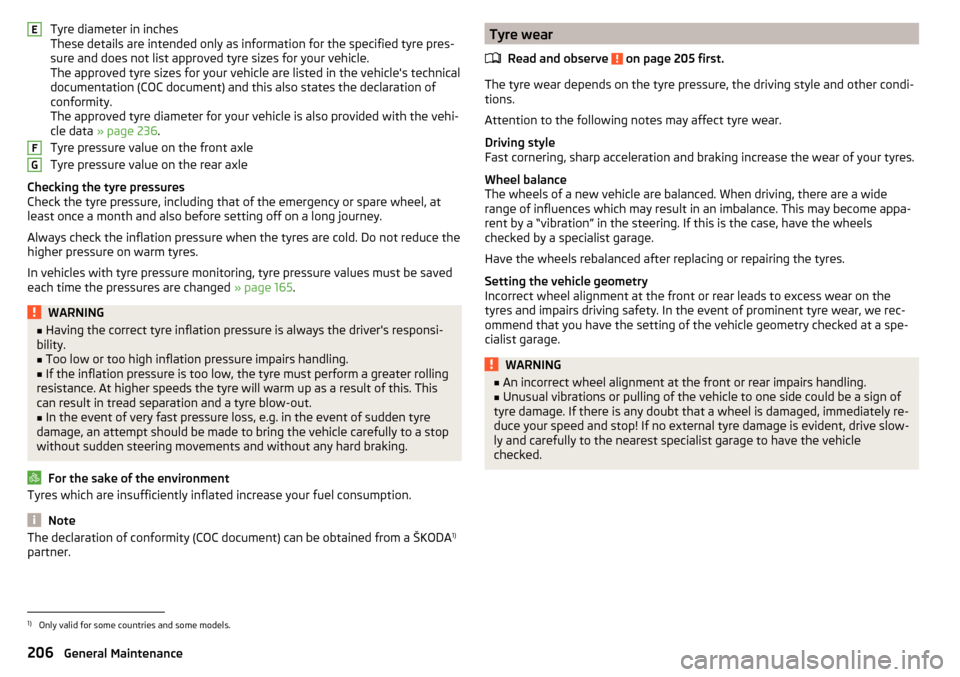
Tyre diameter in inches
These details are intended only as information for the specified tyre pres-
sure and does not list approved tyre sizes for your vehicle.
The approved tyre sizes for your vehicle are listed in the vehicle's technical
documentation (COC document) and this also states the declaration of
conformity.
The approved tyre diameter for your vehicle is also provided with the vehi-
cle data » page 236 .
Tyre pressure value on the front axle
Tyre pressure value on the rear axle
Checking the tyre pressures
Check the tyre pressure, including that of the emergency or spare wheel, at
least once a month and also before setting off on a long journey.
Always check the inflation pressure when the tyres are cold. Do not reduce the
higher pressure on warm tyres.
In vehicles with tyre pressure monitoring, tyre pressure values must be saved
each time the pressures are changed » page 165.WARNING■
Having the correct tyre inflation pressure is always the driver's responsi-
bility.■
Too low or too high inflation pressure impairs handling.
■
If the inflation pressure is too low, the tyre must perform a greater rolling
resistance. At higher speeds the tyre will warm up as a result of this. This
can result in tread separation and a tyre blow-out.
■
In the event of very fast pressure loss, e.g. in the event of sudden tyre
damage, an attempt should be made to bring the vehicle carefully to a stop
without sudden steering movements and without any hard braking.
For the sake of the environment
Tyres which are insufficiently inflated increase your fuel consumption.
Note
The declaration of conformity (COC document) can be obtained from a ŠKODA 1)
partner.EFGTyre wear
Read and observe
on page 205 first.
The tyre wear depends on the tyre pressure, the driving style and other condi-
tions.
Attention to the following notes may affect tyre wear.
Driving style
Fast cornering, sharp acceleration and braking increase the wear of your tyres.
Wheel balance
The wheels of a new vehicle are balanced. When driving, there are a wide
range of influences which may result in an imbalance. This may become appa-
rent by a “vibration” in the steering. If this is the case, have the wheels
checked by a specialist garage.
Have the wheels rebalanced after replacing or repairing the tyres.
Setting the vehicle geometry
Incorrect wheel alignment at the front or rear leads to excess wear on the
tyres and impairs driving safety. In the event of prominent tyre wear, we rec-
ommend that you have the setting of the vehicle geometry checked at a spe-
cialist garage.
WARNING■ An incorrect wheel alignment at the front or rear impairs handling.■Unusual vibrations or pulling of the vehicle to one side could be a sign of
tyre damage. If there is any doubt that a wheel is damaged, immediately re-
duce your speed and stop! If no external tyre damage is evident, drive slow-
ly and carefully to the nearest specialist garage to have the vehicle
checked.1)
Only valid for some countries and some models.
206General Maintenance
Page 223 of 268
Vehicles with automatic transmission may be towed in with a tow bar or a tow
rope or with the front wheels raised. If the vehicle is raised at rear, the auto-
matic gearbox is damaged! If possible, the vehicle should be towed with the
engine running or at least with the ignition on.
Driver of the tow vehicle›
Engage the clutch gently when starting off or depress the accelerator partic-
ularly gently if the vehicle is fitted with an automatic gearbox.
›
Only then approach correctly when the rope is taut.
The maximum towing speed is 50 km/h.
Driver of the towed vehicle
›
Switch on the ignition so that the steering wheel is not locked and so that
the turn signal lights, windscreen wipers and windscreen washer system can
be used.
›
Take the vehicle out of gear or move the selector lever into position N if the
vehicle is fitted with an automatic gearbox.
Please note that the brake servo unit and power steering only operate if the
engine is running. If the engine is not running, significantly more physical force
is required to depress the brake pedal and steer the vehicle.
If using a tow rope, ensure that it is always kept taught.
General information for the towing process
Both drivers should be familiar with the problems which might possibly occur while a vehicle is being towed. Unskilled drivers should not attempt to tow in
another vehicle or to be towed in.
The vehicle must be transported on a special breakdown vehicle or trailer if it
is not possible to tow in the vehicle in the way described or if the towing dis-
tance is greater than 50 km.
If the gearbox no longer contains any oil, your vehicle must only be towed with
the front axle raised clear of the ground or on a breakdown vehicle or trailer.
To protect both vehicles when tow-starting or towing, the tow rope should be
elastic. Thus one should only use plastic fibre rope or a rope made out of a
similarly elastic material.
Attach the tow rope or the tow bar to the towing eyes » page 221 or
» page 222 to the detachable ball head of the towing equipment » page 167 .
WARNING■
When towing, exercise increased caution.■Spiral tow ropes must not be used for towing » Fig. 226- , the towing
eye may unscrew out of the vehicle - risk of accident.■
The tow rope should not be twisted - risk of accident.
CAUTION
■ Do not start engine by towing - there is a risk of damaging the engine parts.
The battery from another vehicle can be used as a jump-start aid » page 219,
Jump-starting .■
There is always a risk of excessive stresses and damage resulting at the
points to which you attach the tow rope or tow bar when you attempt to tow a
vehicle which is not standing on a paved road.
Note
We recommend using a tow rope from ŠKODA Original Accessories available
from a ŠKODA Partner.
Front towing eye
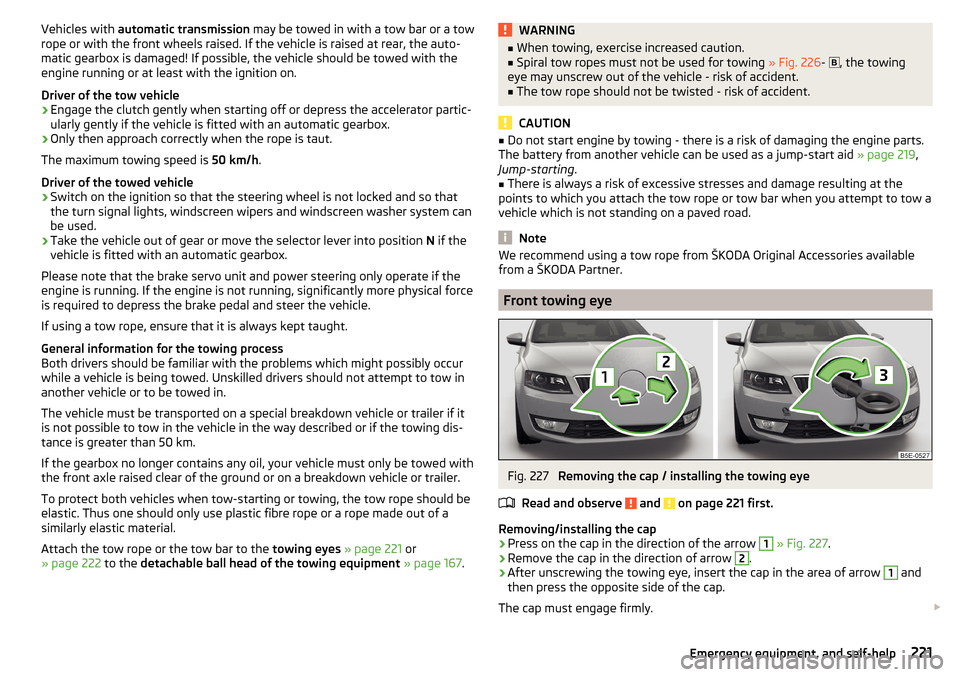
Fig. 227
Removing the cap / installing the towing eye
Read and observe
and on page 221 first.
Removing/installing the cap
›
Press on the cap in the direction of the arrow
1
» Fig. 227 .
›
Remove the cap in the direction of arrow
2
.
›
After unscrewing the towing eye, insert the cap in the area of arrow
1
and
then press the opposite side of the cap.
The cap must engage firmly.
221Emergency equipment, and self-help
Page 230 of 268
›Insert a new fuse.›Replace the bracket at the original position.
Installing the storage compartment›
Move the stop buffer
B
of the storage compartment behind the brackets
C
» Fig. 239 .
›
Push in the storage compartment in the opposite direction of the arrow
5
.
›
Insert the brake rod and lock it against the arrow
4
with a screwdriver.
›
Push in the side cover against the direction of the arrow
2
.
›
Press the side cover fully against the direction of the arrow
1
.
›
Close the storage compartment.
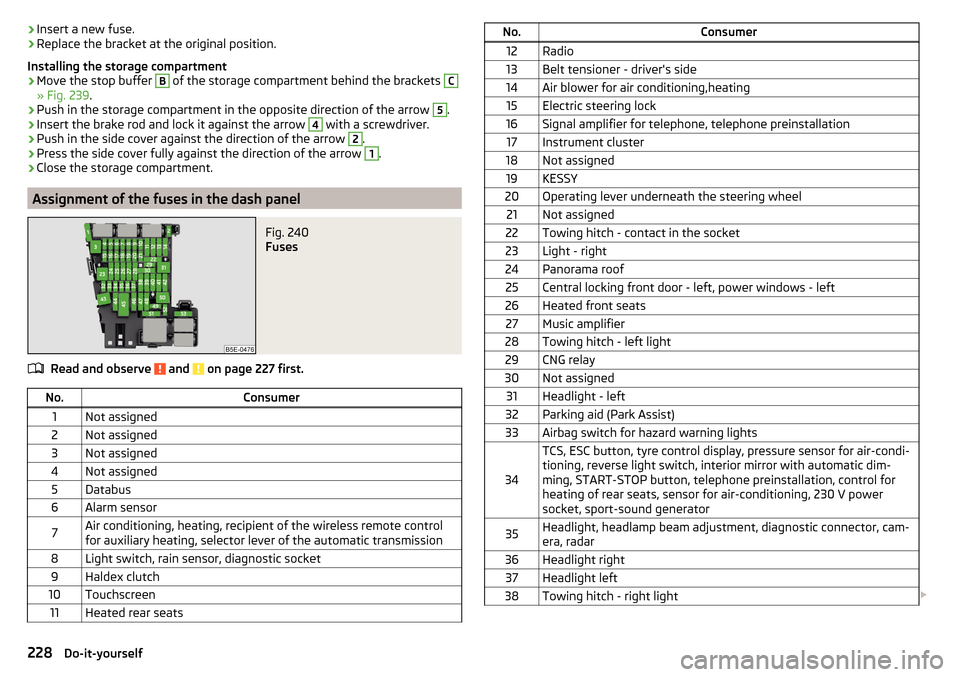
Assignment of the fuses in the dash panel
Fig. 240
Fuses
Read and observe and on page 227 first.
No.Consumer1Not assigned2Not assigned3Not assigned4Not assigned5Databus6Alarm sensor7Air conditioning, heating, recipient of the wireless remote control
for auxiliary heating, selector lever of the automatic transmission8Light switch, rain sensor, diagnostic socket9Haldex clutch10Touchscreen11Heated rear seatsNo.Consumer12Radio13Belt tensioner - driver's side14Air blower for air conditioning,heating15Electric steering lock16Signal amplifier for telephone, telephone preinstallation17Instrument cluster18Not assigned19KESSY20Operating lever underneath the steering wheel21Not assigned22Towing hitch - contact in the socket23Light - right24Panorama roof25Central locking front door - left, power windows - left26Heated front seats27Music amplifier28Towing hitch - left light29CNG relay30Not assigned31Headlight - left32Parking aid (Park Assist)33Airbag switch for hazard warning lights
34
TCS, ESC button, tyre control display, pressure sensor for air-condi-
tioning, reverse light switch, interior mirror with automatic dim-
ming, START-STOP button, telephone preinstallation, control for
heating of rear seats, sensor for air-conditioning, 230 V power
socket, sport-sound generator35Headlight, headlamp beam adjustment, diagnostic connector, cam-
era, radar36Headlight right37Headlight left38Towing hitch - right light 228Do-it-yourself
Page 251 of 268
Index
A
abroad lead-free petrol
190
Abroad Headlights
74
ABS Operation
136
Warning light34
ACC150
Control symbol32
Warning lights40
Acceptance and recycling of used vehicles181
Accessories178
Adaptive cruise control automatic stop-start
151
Information messages155
Operation150
Operation Overview152
Set/change the desired speed.153
special driving conditions154
Start control152
Stop/resume control152
Adaptive Cruise Control150
Radar sensor135
Set the clearance level153
Warning lights40
Adaptive headlight see xenon headlight
70
Adjust Auxiliary heating (auxiliary heating and ventila-tion)
118
Adjusting Exterior mirrors
80
head restraints82
seats82
Steering wheel9
the seats electronically82
Adjusting the seats8
Adjusting the seats electronically82
Adjustment Headlight beam
68
Advance warning/emergency braking Warning light
40
AHL see xenon headlight
70
Air-conditioning system Air outlet vents
116
Airbag14
Deactivating19
Deactivating the front passenger airbag19
Deployment15
Front airbag15
Head airbag18
Knee airbag17
Modifications and damage to the airbag system 180
Side airbag
17
Warning light35
Airbag system14
Air conditioning112
Air distribution control115
Climatronic114
Manual air conditioning113
Air distribution control115
Air outlet vents116
Alarm Enable/disable
58
Switch off58
Trailer177
Triggering58
Alcantara cleaning
187
Anodized parts Refer to vehicle maintenance
184
Anti-lock braking system (ABS)136
Anti-theft alarm system Enable/disable
58
Trailer177
Anti-theft wheel bolts214
Armrest Front
86
Rear86
artificial leather187
Ashtray92
Assembling the bar ball, Step 1
169
bar ball, Step 2169
Assistance systems OFF ROAD-mode
138
Assistance Systems High-beam assistant
71
Assist systems135
Auto-check control40
Automatic driving lamp control70
Automatic gearbox129
Selector lever-emergency unlocking225
Selector lever lock130
Starting-off and driving131
Tiptronic130
Using the selector lever129
Automatic gearbox modes129
Automatic load deactivation204
automatic transmission selector lever lock defect
130
Automatic transmission Kickdown
131
Launch control131
Malfunction37
Selector lever lock130
Warning light37
Warning messages37
AUX99
Auxiliary heating (auxiliary heating and ventila- tion)
117
Adjust118
Switching on/off118
Auxiliary heating (heating and ventilation) Radio remote control
119
249Index
Page 254 of 268
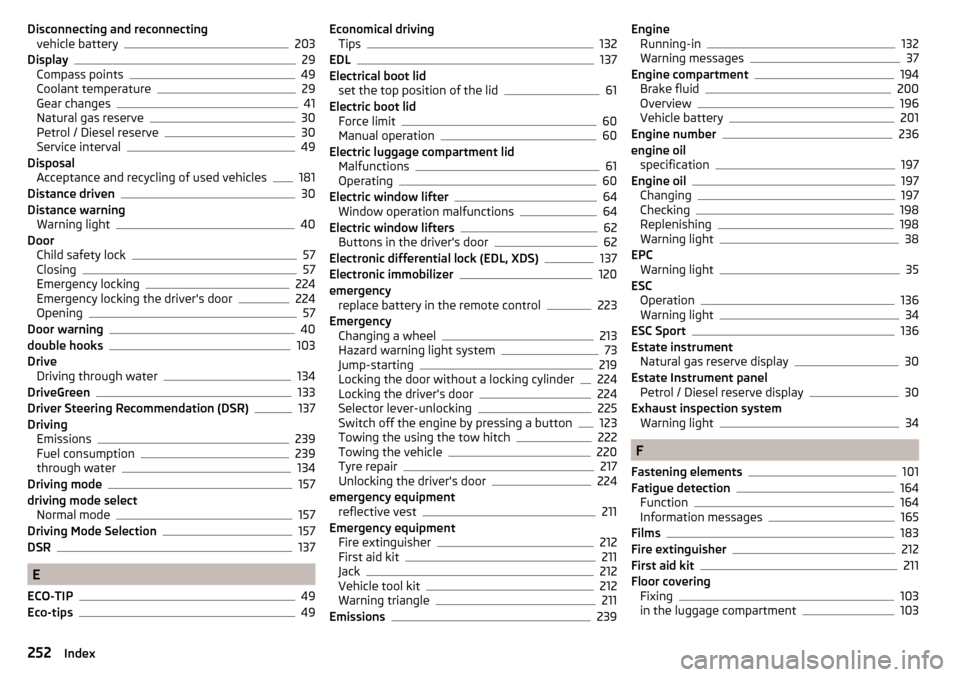
Disconnecting and reconnectingvehicle battery203
Display29
Compass points49
Coolant temperature29
Gear changes41
Natural gas reserve30
Petrol / Diesel reserve30
Service interval49
Disposal Acceptance and recycling of used vehicles
181
Distance driven30
Distance warning Warning light
40
Door Child safety lock
57
Closing57
Emergency locking224
Emergency locking the driver's door224
Opening57
Door warning40
double hooks103
Drive Driving through water
134
DriveGreen133
Driver Steering Recommendation (DSR)137
Driving Emissions
239
Fuel consumption239
through water134
Driving mode157
driving mode select Normal mode
157
Driving Mode Selection157
DSR137
E
ECO-TIP
49
Eco-tips49
Economical driving Tips132
EDL137
Electrical boot lid set the top position of the lid
61
Electric boot lid Force limit
60
Manual operation60
Electric luggage compartment lid Malfunctions
61
Operating60
Electric window lifter64
Window operation malfunctions64
Electric window lifters62
Buttons in the driver's door62
Electronic differential lock (EDL, XDS)137
Electronic immobilizer120
emergency replace battery in the remote control
223
Emergency Changing a wheel
213
Hazard warning light system73
Jump-starting219
Locking the door without a locking cylinder224
Locking the driver's door224
Selector lever-unlocking225
Switch off the engine by pressing a button123
Towing the using the tow hitch222
Towing the vehicle220
Tyre repair217
Unlocking the driver's door224
emergency equipment reflective vest
211
Emergency equipment Fire extinguisher
212
First aid kit211
Jack212
Vehicle tool kit212
Warning triangle211
Emissions239
Engine Running-in132
Warning messages37
Engine compartment194
Brake fluid200
Overview196
Vehicle battery201
Engine number236
engine oil specification
197
Engine oil197
Changing197
Checking198
Replenishing198
Warning light38
EPC Warning light
35
ESC Operation
136
Warning light34
ESC Sport136
Estate instrument Natural gas reserve display
30
Estate Instrument panel Petrol / Diesel reserve display
30
Exhaust inspection system Warning light
34
F
Fastening elements
101
Fatigue detection164
Function164
Information messages165
Films183
Fire extinguisher212
First aid kit211
Floor covering Fixing
103
in the luggage compartment103
252Index
Page 257 of 268
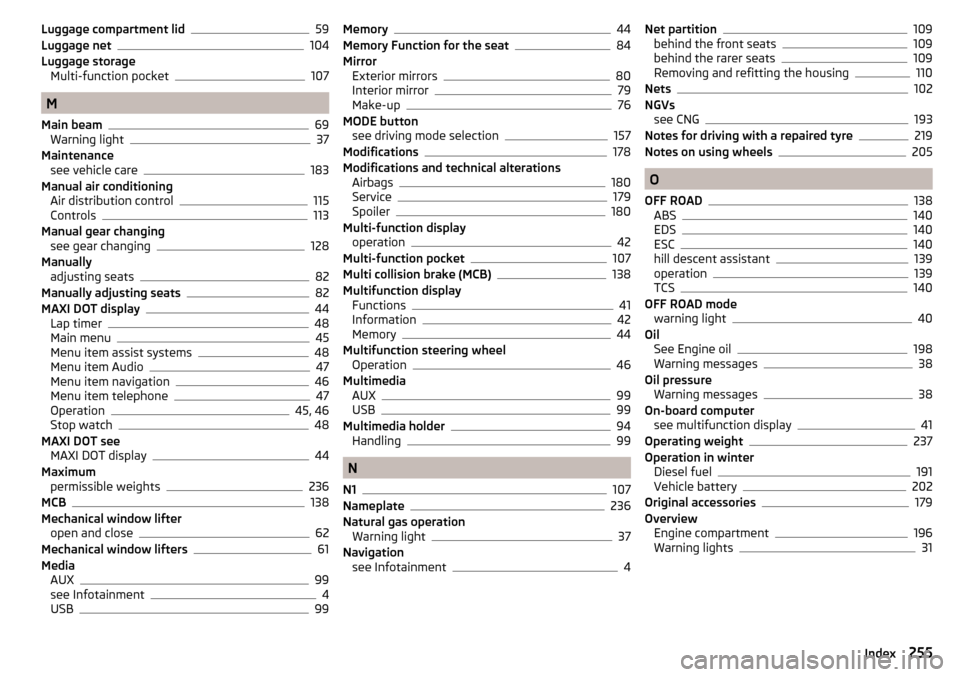
Luggage compartment lid59
Luggage net104
Luggage storage Multi-function pocket
107
M
Main beam
69
Warning light37
Maintenance see vehicle care
183
Manual air conditioning Air distribution control
115
Controls113
Manual gear changing see gear changing
128
Manually adjusting seats
82
Manually adjusting seats82
MAXI DOT display44
Lap timer48
Main menu45
Menu item assist systems48
Menu item Audio47
Menu item navigation46
Menu item telephone47
Operation45, 46
Stop watch48
MAXI DOT see MAXI DOT display
44
Maximum permissible weights
236
MCB138
Mechanical window lifter open and close
62
Mechanical window lifters61
Media AUX
99
see Infotainment4
USB99
Memory44
Memory Function for the seat84
Mirror Exterior mirrors
80
Interior mirror79
Make-up76
MODE button see driving mode selection
157
Modifications178
Modifications and technical alterations Airbags
180
Service179
Spoiler180
Multi-function display operation
42
Multi-function pocket107
Multi collision brake (MCB)138
Multifunction display Functions
41
Information42
Memory44
Multifunction steering wheel Operation
46
Multimedia AUX
99
USB99
Multimedia holder94
Handling99
N
N1
107
Nameplate236
Natural gas operation Warning light
37
Navigation see Infotainment
4
Net partition109
behind the front seats109
behind the rarer seats109
Removing and refitting the housing110
Nets102
NGVs see CNG
193
Notes for driving with a repaired tyre219
Notes on using wheels205
O
OFF ROAD
138
ABS140
EDS140
ESC140
hill descent assistant139
operation139
TCS140
OFF ROAD mode warning light
40
Oil See Engine oil
198
Warning messages38
Oil pressure Warning messages
38
On-board computer see multifunction display
41
Operating weight237
Operation in winter Diesel fuel
191
Vehicle battery202
Original accessories179
Overview Engine compartment
196
Warning lights31
255Index