brake SKODA OCTAVIA TOUR 2011 2.G / (1Z) Owner's Guide
[x] Cancel search | Manufacturer: SKODA, Model Year: 2011, Model line: OCTAVIA TOUR, Model: SKODA OCTAVIA TOUR 2011 2.G / (1Z)Pages: 183, PDF Size: 11.13 MB
Page 109 of 183
Intelligent Technology
108
Low brake fluid level
An insufficient level of brake fluid may result in problems in the brake system. The
level of the brake fluid is monitored electronically page 27, “Brake system ”.
WARNING
•
Only apply the brakes for the purpose of drying and cleaning the brake discs
if the traffic conditions permit this. Do not place any other road users in jeop-
ardy.
•
When retrospectively mounting a front spoiler, solid wheel hubs etc. one
must ensure that the air supply to the front wheel brakes is not reduced other-
wise the braking system could run too hot.
•
Allow for the fact that new brake pads do not achieve their full braking effi-
ciency until after the first 200 kilometres. New brake pads must be first “run in”
before they develop their optimal friction force. You can, however, compensate
for this slightly reduced braking force by increasing the pressure on the brake
pedal. This guideline also applies to an y new brake pads installed at a future
date.Caution
•
Never allow the brakes to rub by applying slight pressure if you do not wish to
brake the vehicle. This causes the brakes to overheat and can also result in a longer
braking distance and excessive wear.
•
Before negotiating a steep downhill section, reduce your speed, shift down into
the next lower gear. This enables you to ma ke full use of the braking power of the
vehicle and reduces the strain on the brakes. Any additional braking should be done
intermittently, no t continuously.Note
The brake light flashes automatically in ca se of an emergency braking at speeds
greater than 60 km/h or with the interven tion of the ABS, which lasts longer than
1.5 seconds. After the speed was reduced below 10 km/h or the vehicle was stopped,
the brake light stops flashing and the hazard warning light system switches on. The
hazard warning light system is switched off automatically after accelerating or
driving off again.Brake boosterThe brake booster boosts the pressure wh ich you generate with the brake pedal.
The necessary pressure is only generated when the engine is running.
WARNING
•
Never switch off the engine be fore the vehicle is stationary.
•
The brake booster only operates when the engine is running. Greater phys-
ical effort for braking is required when en gine is switched off. Because if you do
not stop as normal, this can caus e an accident and severe injuries.
Antilock brake system (ABS)ABS prevents the wheels locking when braking.General
The ABS contributes significantly to enhancing the active safety of your vehicle.
Compared to a vehicle not fitted with ABS, you are able to retain optimal steering
ability even during a full brake application on a slippe ry road surface because the
wheels do not lock up.
You must not expect, however, that the braking distance will be shorter under all
circumstances as a result of the ABS. The braking distance for example on gravel
and fresh snow, when you should anyway be driving slowly and cautiously, will be
longer.
Operating principle
The brake pressure will be reduced on a wheel which is rotating at a speed which is
too low for the speed of the vehicle and tending to lock. This control cycle is notice-
able from a pulsating movement of the brake pedal which is accompanied by
noises. This is consciously intended to pr ovide the driver with the information that
the wheels are tending to lock (ABS control range). You must always keep the brake
pedal depressed to enable the ABS to optimally control the brake application in this
braking range. Never interrupt the application of the brakes!
WARNING
•
The ABS can also not overcome the physical limits of your vehicle. Please do
not forget this, particularly when driving on icy or wet road surfaces. If the ABS
is operating within the control range, adapt your speed immediately to the
conditions of the road surface and the traffic situation. The increased safety
offered by the ABS must not tempt you to take greater risks than otherwise -
risk of an accident!
•
The normal braking system is still fully functional if there is an ABS fault.
Visit a specialist garage as quickly as poss ible and adjust your style of driving to
s2lk.2.book Page 108 Monday, April 18, 2011 7:41 AM
Page 110 of 183
Intelligent Technology109
Using the system
Safety
Driving Tips
General Maintenance
Breakdown assistance
Technical Data
take account of the ABS fault in the meantime since you will not know the
extent of the fault and in how far
the braking efficiency is affected.
Note
•
A warning light comes on if a fault occurs in the ABS system
page 26.
•
Changes to vehicle (e.g. on engine, on the brakes, on chassis or another combi-
nation of tyres and wheels) can influence the function of the ABS page 146,
“Accessories, changing and replacing parts”.
Brake Assist*During a severe brake application (e.g. if a hazard exists), the Brake Assist increases
the braking force and thus makes it possible to rapidly produce the pressure
required in the brake system.
The majority of drivers do apply the brakes in good time in dangerous situations, but
do not depress the brake pedal with sufficient pressure. Consequently, it is not
possible for the vehicle to achieve its maximum deceleration and the vehicle covers
a greater distance than necessary.
The Brake Assist is activated by the very quick operation of the brake pedal. In such
cases, a much greater braking pressure exists than during a normal brake applica-
tion. This makes it possible, even with a relatively low resistance of the brake pedal,
to produce an adequate pressure in the brake system in the shortest possible time,
which is required for maximum deceleration of the car. You must apply the brake
pedal firmly and hold it in this position in order to achieve the shortest possible
braking distance.
The Brake Assist is able to help you achi eve a shorter braking distance in emergency
situations by rapidly producing the pressure required in the brake system. It fully
exploits the attributes of the ABS. After you release the brake pedal, the function
of the Brake Assist is automatically swit ched off and the brakes operate in the
normal way.
The Brake Assist is part of the ESP system. If a fault occurs in the ESP, the Brake
Assist function is also not availa ble. Further information on the ESP page 105.
WARNING
•
The Brake Assist is also not able to overcome the physical limits of your
vehicle in terms of the braking distance required.
•
Adapt your speed to the conditions of th e road surface and to the traffic situ-
ation.
•
The increased safety offered by the Brake Assist must not tempt you to take
a greater safety risk than otherwise.
Electromechanical power steeringThe power steering enables you to steer the vehicle with less physical force.
With the electromechanical power steering, the steering assist is automatically
adapted to the speed and to the steering angle.
It is still possible to fully steer the vehicle if the power steering fails or if the engine
is not running (vehicle being towed in). The only difference is that greater physical
effort is required.
If there is a fault in the power steering, the warning light
or lights up in the
instrument cluster page 24.
WARNING
Contact your specialist garage if the power steering is defective.Tyre inflation pressure-control system*The tyre inflation pressure-control system compares with the aid of the ABS
sensors the speed and also the rolling circumference of the individual wheels. If the
rolling circumference of a wheel is changed, the warning light
lights up in the
WARNING (continued)
WARNING (continued)
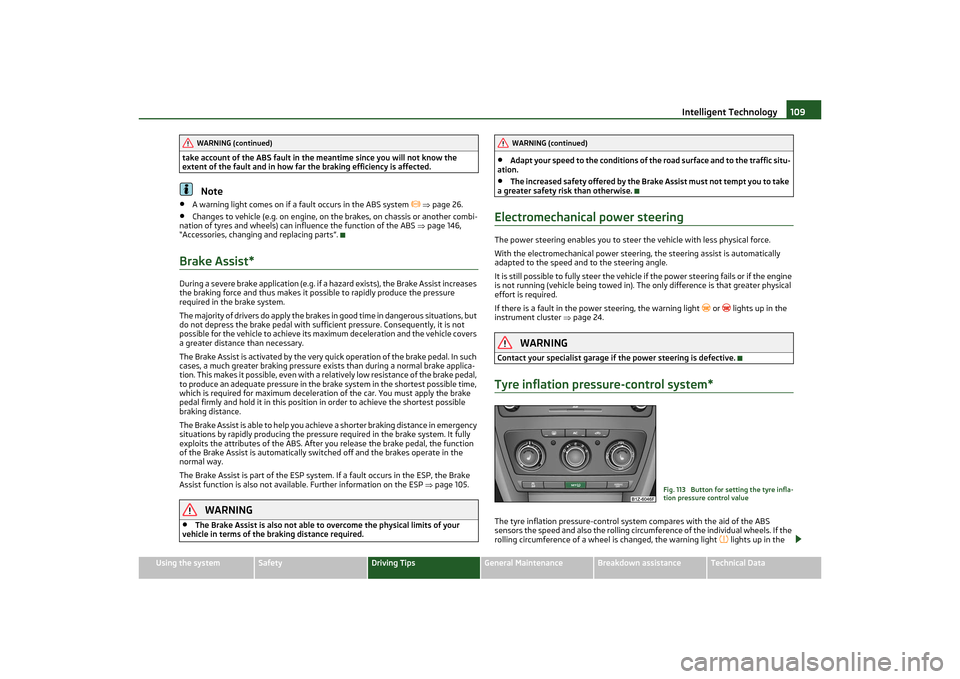
Fig. 113 Button for setting the tyre infla-
tion pressure control value
s2lk.2.book Page 109 Monday, April 18, 2011 7:41 AM
Page 111 of 183
Intelligent Technology
110
instrument cluster page 26 and an audibl e signal sounds. The rolling circumfer-
ence of the tyre can change if:•
the tyre inflation pressure is too low,
•
the structure of the tyre is damaged,
•
the vehicle is loaded on one side,
•
the wheels of an axle are loaded heavil y (e.g. when towing a trailer or when
driving uphill or downhill),
•
snow chains are mounted,
•
the temporary spare wheel is mounted,
•
one wheel per axle was changed.
Basic setting of tyre inflation pressure-control system
After changing the tyre inflation pressures, after changing one or several wheels,
the position of a wheel on the vehicle (e.g. exchanging the wheels between the
axles) or when the warning light lights up while driving, a basic setting of the
system must be carried out as follows.
•
Inflate all tyres to the specified inflation pressure page 141.
•
Switch on the ignition.
•
Press button page 109, fig. 113 for more than 2 seconds. While pressing
the button, the warning light
lights up. At the same time the memory of the
system is erased and the new calibration is started, which is confirmed with an
audible signal and then the warning light
goes out.
•
If the warning light
does not go out after the basic setting, there is a fault in
the system. Have the vehicle inspected by your nearest specialist garage.
Warning light
lights up
If the tyre inflation pressure of at least one wheel is insufficiently inflated in
comparison to the stored basic value, the warning light
lights up.
Warning light
flashes
If the warning light flashes, there is a system fault. Have the vehicle inspected by
your nearest specialist garage.
WARNING
•
When the warning light
lights up, immediately reduce the speed and
avoid sudden steering and brake manoeu vres. Please stop the vehicle without
delay at the nearest possible stop and inspect the tyres and their inflation pres-
sures.
•
The driver is responsible for the correct tyre inflation pressure. For this
reason, the tyre inflation pressu res must be checked regularly.
•
Under certain circumstances (e.g. sporty style of driving, wintry or unpaved
roads) the warning light
can be delayed or does not light up at all.
•
The tyre inflation pressure-control syst em does not take away the responsa-
bility from the driver for the correct tyre inflation pressure.Note
The tyre inflation pres sure-control system:•
does not replace the regular tyre inflatio n pressure control, because the system
cannot detect an even pressure loss,
•
cannot warn in case of very rapid tyre inflation pressure loss, e.g. in case of
sudden tyre damage. In this case carefull y bring the vehicle to a standstill without
sudden steering movements and without sharp braking.
•
In order to ensure a proper functioning of the tyre inflation pressure-control
system, it is necessary to carry out the basic setting again every 10 000 km or 1x a
year.
WARNING (continued)
s2lk.2.book Page 110 Monday, April 18, 2011 7:41 AM
Page 112 of 183
Driving and the Environment111
Using the system
Safety
Driving Tips
General Maintenance
Breakdown assistance
Technical Data
Driving and the EnvironmentThe first 1 500 kilometres and then afterwardsA new engine
The engine has to be run in during the first 1 500 kilometres.Up to 1 000 kilometres– Do not drive faster than 3/4 of the maximum speed of the gear in use, that is 3/4
of the maximum permissible engine speed.
– Do not use full throttle.
– Avoid high engine revolutions.
– Do not tow a trailer.From 1 000 up to 1 500 kilometres– Increase the power output of the engine gradually up to the full speed of the
gear engaged, that is up to the maximum permissible engine revolutions.
During the first operating hours the engine has higher internal friction than later
until all of the moving parts have harmonized. The driving style which you adopt
during the first approx.1 500 kilometres plays a decisive part in the success of
running in your vehicle.
You should not drive at unnecessarily high engine revolutions even after the
running-in period is complete. The maximum permissible engine speed is marked by
the beginning of the red zone on the sc ale of the revolutions counter. Before
reaching the red zone at the latest, shift up into the next highest gear. Extremely
high engine revolutions are auto matically governed, by the way.
Do not drive at engine revolutions which are too low. Shift down as soon as the
engine is no longer running smoothly.
Caution
All the speed and engine revolution figures apply only when the engine is at its
normal operating temperature. Never rev up an engine which is cold, neither when
the vehicle is stationary nor when driving in individual gears.
For the sake of the environment
Not driving at unnecessarily high engine revo lutions and shifting to a higher gear as
early as possible are ways to minimise fu el consumption and operating noise levels
and protects the environment.New tyresNew tyres have to be “run in” since they do not offer optimal grip at first. You should
take account of this fact for the firs t 500 kilometres and drive particularly
carefully.New brake padsAllow for the fact that new brake pads do not achieve their full braking efficiency
until after the first 200 kilometres. New br ake pads must be first “run in” before
they develop their optimal friction force. You can, however, compensate for this
slightly reduced braking force by increasing the pressure on the brake pedal.
This guideline also applies to any new brake pads installed at a future date.
During the running-in period, you should avoid excessive stresses on the brakes.
This includes, for example, violent braking, particularly from very high speeds, and
also when crossing mountain passes.Catalytic converterProper operation of the emission control system (catalytic converter)
is of major significance for driving your vehicle in an environmentally
conscious way.Please refer to the following guidelines:
– For vehicles with petrol engine only refuel with unleaded petrol page 127,
“Grades of petrol”.
– Never run the fuel tank completely empty.
– Do not switch off the ignition while you are driving the vehicle.
– Do not pour too much engine oil into the engine page 132, “Replenishing
engine oil”.
s2lk.2.book Page 111 Monday, April 18, 2011 7:41 AM
Page 113 of 183
Driving and the Environment
112
– Do not tow-start the vehicle over a distance of more than 50 metres
page 154, “Tow-starting and towing vehicle”.
If you drive your vehicle in a country in wh ich unleaded petrol is not available, you
must have the catalytic converter replaced later when driving the vehicle into a
country in which use of a cata lytic converter is mandatory.
WARNING
•
In view of the high temperatures which may be produced in the catalytic
converter, one should always park a vehicle in such a way that the catalytic
converter cannot come into contact with easily flammable materials below the
vehicle - a risk of fire!
•
Never use additional underbody protection or corrosion-protection agents
for the exhaust pipes, catalytic converters or heat shields. Such substances
might ignite when driving - risk of fire!Caution
•
Vehicles fitted with cataly tic converter should never be allowed to let the fuel
tank to run completely empty. An irregular fuel supply can result in poor ignition or
misfiring. Unburnt fuel may get into the exhaust system and damage the catalytic
converter.
•
Filling the tank even only once with leaded petrol will result in the catalytic
converter being destroyed.
•
If you detect misfiring, a drop in performance or irregular engine running when
driving, reduce your speed immediately and have the vehicle inspected by the
nearest specialist garage. The symptoms described may be caused by a fault in the
ignition system. Unburnt fuel may get into the exhaust system and damage the
catalytic converter.For the sake of the environment
Even if the exhaust system is operating properly, a sulphur-like exhaust odour may
be produced under certain operating conditions of the engine. This depends on the
sulphur content of the fuel. It is often su fficient to refuel with unleaded premium-
grade petrol of a different brand or at a different filling station.
Driving in an economical and environmentally
conscious mannerGeneral
Your personal style of driving is a major factor.Your fuel consumption, any pollution of the environmental and the wear-and-tear
to the engine, brakes and tyres, depend essentially on three factors:•
your personal style of driving,
•
the conditions under which your vehicle is operated,
•
technical aspects.
You can easily improve your fuel economy by 10 - 15 percent by driving in an econom-
i c a l w a y w i t h f o r e s i g h t . T h i s s e c t i o n i s i n t e n d e d t o p r o v i d e y o u w i t h a n u m b e r o f t i p s
on how to protect the environment and at the same time save money.
The fuel consumption can naturally also be influenced by factors which are beyond
the driver's control. It is, for example, normal for the fuel consumption to increase
in winter and under worsened conditions such as poor road conditions, towing a
trailer, etc.
The technical requirements for low fuel usage and economic efficiency of the
vehicle have already been built into the vehicle at the works. Special attention has
been given to minimising negative effects on the environment. It is necessary to
take note of the guidelines given in this chapter in order to make best use of these
characteristics and to main tain their effectiveness.
The optimal engine speed should be obtain ed when accelerating, in order to avoid
a high fuel consumption and resonance of the vehicle.
Looking ahead when driving
A vehicle's highest fuel consumption occurs it accelerates.Avoid accelerating and braking unnecessarily. If you drive with forsight you will not
need to brake so often and wi ll also then not have to accelerate so much. Let your
vehicle coast to a stop, for example, if this is possible, when you see that the next
set of traffic lights is at red.
s2lk.2.book Page 112 Monday, April 18, 2011 7:41 AM
Page 117 of 183
Driving and the Environment
116Note
Detailed information about the trade-in and recycling of old cars is available from a
Škoda Service Partner.Motoring abroadGeneral
Other circumstances may exist abroad.It is possible, in certain countries, that the Škoda Service Partner network is limited
or has not been established yet. This is the reason why obtaining certain spare parts
may be somewhat complicated and specialist garage personnel may only be able to
make limited repairs. Škoda Auto in the Czech Republic and relevant importers are
happy to provide information about technical aspects of the vehicle, required main-
tenance work and possibilities for getting repairs done.Unleaded petrolA vehicle fitted with a petrol engine must always be refuelled with unleaded petrol
page 111. The automobile associations can provide you with information
regarding the locations of filling stations which offer unleaded petrol.HeadlightThe low beam of your headlights is set asy mmetrically. It illuminates the side of the
road on which you are driving to a greater extent. If you drive abroad on the other
side of the road, you will dazzle oncoming traffic.
In order to prevent the dazzling of oncoming traffic, it is necessary that an adjust-
ment of the headlights is carried out by your authorised Škoda Service Partner.Avoiding damage to your vehicleWhen driving on poor roads and lanes or when driving over kerbstones, steep ramps
etc., you must pay particular attention to ensuring that any low-slung parts of the
vehicle, such as spoiler and exhaust, do not touch the ground and get damaged.
This particularly applies to models with a lowered suspension (sport suspension)
and also when your vehicle is fully laden.
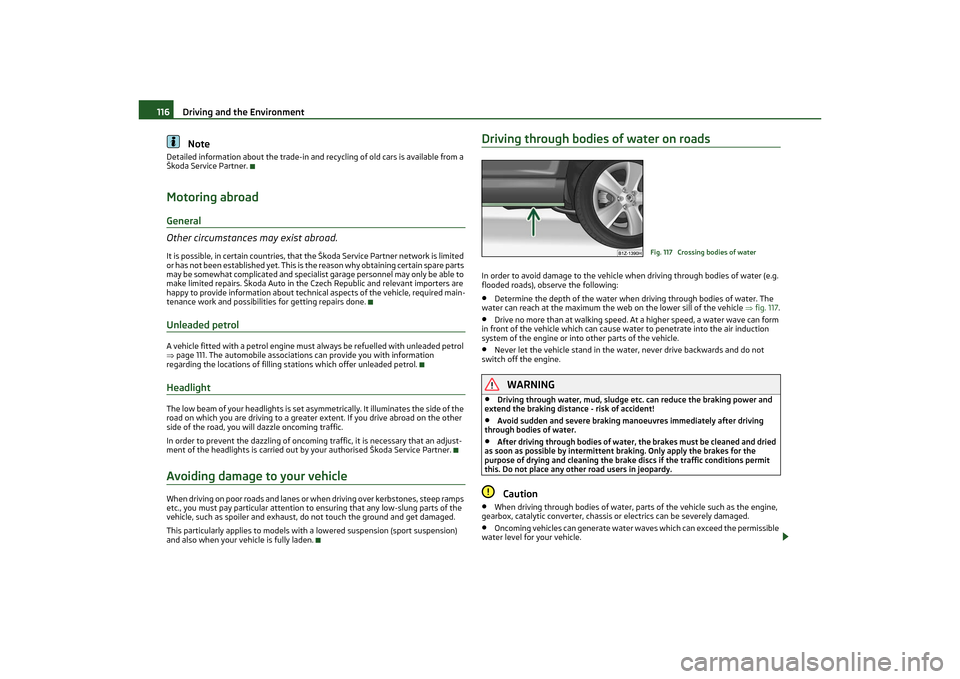
Driving through bodies of water on roadsIn order to avoid damage to the vehicle when driving through bodies of water (e.g.
flooded roads), observe the following:•
Determine the depth of the water when driving through bodies of water. The
water can reach at the maximum the web on the lower sill of the vehicle fig. 117 .
•
Drive no more than at walking speed. At a higher speed, a water wave can form
in front of the vehicle which can cause water to penetrate into the air induction
system of the engine or into other parts of the vehicle.
•
Never let the vehicle stand in the water, never drive backwards and do not
switch off the engine.
WARNING
•
Driving through water, mud, sludge etc. can reduce the braking power and
extend the braking distance - risk of accident!
•
Avoid sudden and severe braking m anoeuvres immediately after driving
through bodies of water.
•
After driving through bodies of water, the brakes must be cleaned and dried
as soon as possible by intermittent braking. Only apply the brakes for the
purpose of drying and cleaning the brake discs if the traffic conditions permit
this. Do not place any other road users in jeopardy.Caution
•
When driving through bodies of water, parts of the vehicle such as the engine,
gearbox, catalytic converter, chassis or electrics can be severely damaged.
•
Oncoming vehicles can generate water waves which can exceed the permissible
water level for your vehicle.
Fig. 117 Crossing bodies of water
s2lk.2.book Page 116 Monday, April 18, 2011 7:41 AM
Page 119 of 183
Towing a trailer
118
Towing a trailerTowing a trailerTechnical requirementsYour vehicle is designed primarily for tr ansporting persons and luggage. It can,
however, also be used for towing a trailer - provided certain technical equipment is
fitted.
If your vehicle has already been supplied with a factory-fitted towing device then
everything that is necessary for towing a tr ailer in technical terms, and in terms of
the law, has already been taken into account.
Your vehicle is fitted with a 13-pin power socket for the electrical connection
between the vehicle and trailer. If th e trailer which you wish to tow has a 7-pin
connector , you can use a suitable adapter
6) from Škoda original accessories.
This work must be carried out in accordance with the manufacturer's specifications
if a towing device is retrofitted.
Authorised Škoda Service Partners can pr ovide information about retrofitting a
towing device and for any necessary modifications to the cooling system.
WARNING
We recommend that you have the towing de vice from Škoda original accessories
installed by an authorised Škoda Service Partner. He is familiar with all the rele-
vant details relating to retrofitting such equipment. There is a risk of an accident
if the towing device is not properly fitted!General MaintenanceTrailer load
The permissible trailer load must on no account be exceeded.
You can negotiate appropriately steeper inclines and descents if you do not make
full use of the permissible trailer load.
The trailer loads specified only apply for altitudes up to 1 000 metres above mean
sea level. The fact that the engine power output drops with increasing height due
to a lowering of air pressure and thus th e ability to climb, means that the towed w e i g h t m u s t b e r e d u c e d b y 1 0 % f o r e v e r y f u r t h e r i n c r e a s e o f 1 0 0 0 m e t r e s i n h e i g h t
above sea level. The towed weight is the weight of the (laden) vehicle and the
(laden) trailer together. One should take
this into account before driving up to
higher altitudes.
The trailer and drawbar load information on the type plate of the towing device
are merely test data for the towing device The data relating to your vehicle, which
is often less than this test data, can be found in your vehicle registration docu-
ments.
Distribution of the load
Distribute the load in the trailer in such a way that any heavy items are located as
close as possible to the axle. Secure the items to prevent them slipping.
Tyre inflation pressure
Select the tyre inflation pressure on your vehicle for that of “fully laden”,
page 141. The inflation pressure of the tyre s fitted to the trailer adjust in accord-
ance with the manufacturer's recommendation.
Exterior mirrors
You have to have additional exterior mirr ors fitted if you are not able to see the
traffic behind the trailer with the standard rear-view mirrors. Both exterior mirrors
should be attached to folding arms. Adjust the mirrors so that they provide you with
an adequate field of view to the rear.
Headlights
Before starting off with a hitched trailer, also check the setting of the headlights.
Alter the setting as necessary with th e aid of the headlight beam adjuster
page 41.
Detachable ball head
The ball rod is detachable on vehicles wh ich feature a factory-fitted towing device.
Further information on the towing device page 119.
Note
•
We recommend that you also have your vehicle inspected between service
intervals if you tow a trailer frequently.
•
The handbrake on the towing vehicle must be put on when coupling and decou-
pling the trailer.
6)In some countries the adapter is supplied with the towing device.s2lk.2.book Page 118 Monday, April 18, 2011 7:41 AM
Page 120 of 183
Towing a trailer119
Using the system
Safety
Driving Tips
General Maintenance
Breakdown assistance
Technical Data
Driving Tips
Particular caution is required when towing a trailer.– Do not, as far as possible, drive with your vehicle unladen and the trailer laden.
– Do not make full use of the legal maximum speeds. This applies in particular to downhill sections.
– Apply the brakes in good time.
– Keep a check on the coolant temperatur e gauge if the outside temperature is
high.
Distribution of weight
The distribution of the weight is very poor if your vehicle is unladen and the trailer
is laden. Maintain a particularly low speed if you cannot avoid driving with this
combination.
Driving speed
Do not drive faster than 80 km/hour for sa fety reasons. This also applies for coun-
tries in which higher speeds are allowed.
The fact that the driving stability of the vehicle + trailer combination reduces with
increasing speed means that the legally allowed speed should not be used when
there are unfavourable road, weather or wind conditions, particularly near accident
black spots.
You must always reduce your speed immedi ately as soon as you detect even just
the slightest swaying of the trailer. On no account attempt to stop the trailer from
“swaying” by accelerating.
Apply the brakes in good time! If the trailer is fitted with a trailer brake, apply the
brakes gently at first and then brake firmly . This will avoid brake jolts resulting from
the trailer wheels locking. Shift down gears in good time before negotiating a
downhill section to allow the engine to also act as a brake.
Engine overheating
Please keep a check on the coolant temper ature gauge if you have to negotiate a
lengthy slope in a low gear at a high engine speed when the outside temperature is
very high page 16, “Engine coolant temperature Display”.
If the needle of the coolant temperature gauge moves into the right-hand area or
even the red area of the scale, reduce yo ur speed immediately. Stop and switch off
the engine if the warning light
in the instrument cluster begins flashing. Wait a
few minutes and check the level of coolant in the coolant expansion bottle
page 134, “Inspecting the coolant level”. Please refer to the following guidelines
page 25, “Coolant temperature/coolant
level ”.
The coolant temperature can be reduced by switching on the heating.
Any increase in the cooling effect of the coolant fan through shifting down a gear
and increasing the engine speed is not possible since the fan speed is independent
of the engine speed. One should also not drop a gear for this reason when towing a
trailer as long as the engine can manage the slope without any drop in speed.
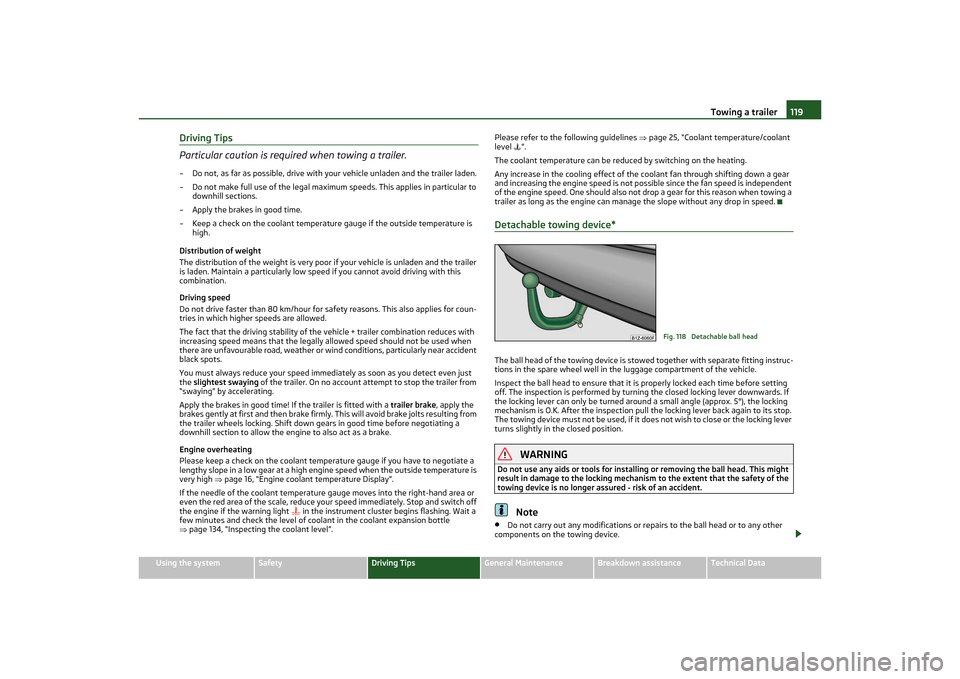
Detachable towing device*The ball head of the towing device is stow ed together with separate fitting instruc-
tions in the spare wheel well in the luggage compartment of the vehicle.
Inspect the ball head to ensure that it is properly locked each time before setting
off. The inspection is performed by turning the closed locking lever downwards. If
the locking lever can only be turned around a small angle (approx. 5°), the locking
mechanism is O.K. After the inspection pull the locking lever back again to its stop.
The towing device must not be used, if it does not wish to close or the locking lever
turns slightly in the closed position.
WARNING
Do not use any aids or tools for installing or removing the ball head. This might
result in damage to the locking mechanism to the extent that the safety of the
towing device is no longer assured - risk of an accident.
Note
•
Do not carry out any modifications or re pairs to the ball head or to any other
components on the towing device.
Fig. 118 Detachable ball head
s2lk.2.book Page 119 Monday, April 18, 2011 7:41 AM
Page 122 of 183
Taking care of your vehicle and cleaning the vehicle121
Using the system
Safety
Driving Tips
General Maintenance
Breakdown assistance
Technical Data
General MaintenanceTaking care of your vehicle and cleaning the vehicleGeneralProper care retains the value of your vehicle.Regular and proper care retains the value of your vehicle. It may also be one of the
requirements for the acceptance of warran ty claims relating to corrosion damage
and paint defects on the bodywork.
We recommend using a preservative from Škoda genuine accessories offered by
your Škoda dealer. Please follow the instructions for use on the package.
WARNING
•
Care products may be harmful to your health if not used according to the
instructions.
•
Always store care products in a safe plac e, out of the reach of children - risk
of poisoning!For the sake of the environment
•
Always select environmentally-friendly products when purchasing vehicle care
products.
•
Do not dispose of the packages with residues of care products in domestic
waste.
Care of the exterior of vehicleWashing the vehicle
Frequent washing protects your vehicle.The best protection for your vehicle against harmful environmental influences is
frequent washing and wax treatment. How of ten you should wash your vehicle
depends on a wide range of factors, such as:•
Frequency of use,
•
The parking situation (gar age, below trees etc.),
•
Season of the year,
•
Weather conditions,
•
Environmental influences.
The longer insect residues, bird droppings, tree sap, road and industrial dust, tar,
soot particles, road salt and other aggressive deposits remain adhering to the paint-
work of your vehicle, the more detrimen tal their destructive effect can be. High
temperatures, such as those caused by inte nsive sun's rays, accentuate this caustic
effect.
It may therefore be necessary, in certain circumstances, to wash the car once a
week . It may also be sufficient, however, to wash the car once a month followed by
appropriate wax treatment.
It is essential to also thoroughly wash the underside of your vehicle at the end of
the winter road salting and gritting period.
WARNING
When washing your vehicle in the winter: Water and ice in the brake system can
affect the braking efficiency - risk of accident!Automatic vehicle wash systemsThe paintwork of the vehicle is sufficiently resistant that the vehicle can be washed
normally in automatic vehicle wash plants without any problem. The actual stress
to which the paintwork is subjected, however, depends greatly on the design of the
vehicle wash system, the filtering of the water and the type of washing and care
products used. If the paintwork of your vehicle appears mat after being washed or
even has scratches, point this out to the operator of the vehicle wash plant. Use a
different vehicle wash plant, if necessary.
There are no particular points to note before washing your vehicle in an automatic
vehicle wash system other than the usua l precautionary measures (closing the
windows and the sliding/tilting roof etc.).
s2lk.2.book Page 121 Monday, April 18, 2011 7:41 AM
Page 125 of 183
Taking care of your vehicle and cleaning the vehicle
124Caution
Never wipe the headlights dry and do not use any sharp objects for cleaning the
plastic lenses, this may result in damage to the protective paintwork and conse-
quently in formation of cracks on the head light lenses, e.g. through effect of chem-
ical products.Door and window sealsThe rubber seals on the doors, boot lid, bonnet and windows remain supple and last
longer if you treat them from time to ti me with a rubber care product (e.g. with a
spray with silicone-free oil). You also avoi d premature wear of the seals and prevent
leakages in this way. It is also easier to open the doors. Rubber seals which are well
cared for also do not stick together in cold winter weather.Locking cylinderWe recommend that you use the spray from Škoda original accessories with
regreasing and anticorrosive effect for de-icing locking cylinders.
Note
When washing your vehicle, ensure that as little water as possible gets into the
locking cylinders.WheelsSteel wheels
You should also thoroughly wash the wheels and wheel trims when giving your
vehicle its regular wash. This prevents any brake dust, dirt and road salt from
sticking to the wheel hubs. You can remove stubborn brake abrasion adhering to
the wheels with an industrial cleaner. Touch up any damage to the paintwork on the
wheels before rust is able to form.
Light alloy wheels
Regular care of light alloy wheels is nece ssary in order to retain their decorative
appearance over long periods. It is part icularly important to remove regularly any
road salt and brake abrasion from light alloy wheels, otherwise the light metal will
suffer. Wash thoroughly and then treat the wheels with a protective product for
light alloy wheels which does not contai n any acidic components. We recommend
to apply a hard wax layer onto the wheel hubs every three months. You must not use any products which cause abrasion when treating the wheel hubs. Any damage
to the paint layer on the wheel hubs must be touched up immediately.
We recommend using a preservative from
Škoda genuine accessories offered by
your Škoda dealer.
WARNING
One should remember when cleaning the wh eels that moisture, ice and road salt
may adversely affect braking efficiency - risk of an accident!
Note
Severe layers of dirt on the wheels can also result in wheel imbalance. This may
show itself in the form of a wheel vibrat ion which is transmitted to the steering
wheel which, in certain circumstances, can cause premature wear of the steering.
This means it is necessary to remove the dirt.Underbody protectionThe underside of your vehicle is protected for life against chemical and mechanical
influences.
One cannot, however, completely rule out damage to the protective layer when
driving so we recommend that you inspect the protective layer on the underside of
your vehicle and on the chassi s at certain intervals - this is best done at the begin-
ning and end of the winter - and to touch up any damaged areas.
The authorised Škoda Service Partners have suitable spray products available as
well as the necessary equipment and are famili ar with the instructions for use. It is
therefore best to have such touch-up work or additional corrosion protection meas-
ures carried out by an authorised Škoda Service Partner.
WARNING
Never use additional underbody protection or corrosion-protection agents for
the exhaust pipes, catalytic converters or heat shields. When the engine reaches
its operating temperature, these subst ances might ignite - risk of fire!Protection of hollow spacesAll the cavities of your vehicle which are at risk from corrosion are protected for life
by a layer of protective wax applied in the factory.
s2lk.2.book Page 124 Monday, April 18, 2011 7:41 AM