maintenance SKODA RAPID 2012 1.G User Guide
[x] Cancel search | Manufacturer: SKODA, Model Year: 2012, Model line: RAPID, Model: SKODA RAPID 2012 1.GPages: 180, PDF Size: 4.36 MB
Page 130 of 180

Opening and closing the bonnet
Fig. 96
Bonnet/radiator grille release lever: Release lever Fig. 97
Securing the bonnet
First read and observe the introductory information and safety warn-
ings on page 126.
Opening
›
Open the front left door.
› Pull the release lever under the dash panel 1
» Fig. 96
in the direction of the
arrow.
Before opening the bonnet, ensure that the arms of the windscreen wipers are
correctly in place against the windscreen otherwise the paintwork could be dam-
aged.
› Press the release lever in the direction of the arrow 2
» Fig. 96
and the bonnet
is unlocked.
› Grab hold of the bonnet and lift.
ä ›
Take the bonnet support out of its holder 3
in the direction of the ar-
row » Fig. 97 and secure the opened bonnet by inserting the end of the support
in the opening 4
in the bonnet.
Closing
› Lift the bonnet slightly and unhook the bonnet support. Press the bonnet sup-
port into the holder 3
designed to hold it.
› Let the bonnet drop into the lock carrier lock from a height of around 20 cm –
do not push it in .
› Check that the bonnet is closed properly. Ð Engine compartment overview
Fig. 98
1.2 ltr./63 kW TSI petrol engine
First read and observe the introductory information and safety warn-
ings on page 126.
Coolant expansion reservoir 130
Windscreen washer fluid reservoir 132
Engine oil filler opening 129
Engine oil dipstick 129
Brake fluid reservoir 132
Vehicle battery 133
£
ä 1
2
3
4
5
6
128
General Maintenance
Page 132 of 180
Changing engine oil
First read and observe the introductory information and safety warn-
ings on page 126.
The engine oil must be changed at the intervals stated in the Service schedule or
according to the service interval indicator
» page 10, Service Interval Display.CAUTION
Additives must not be added to the engine oil – risk of causing considerable dam-
age to parts of the engine! Damage, which results from such product, are exclu-
ded from the warranty. Note
If your skin has come into contact with oil, it must be washed thoroughly. ÐCoolant
First read and observe the introductory information and safety warn-
ings on page 126.
The cooling system is filled with a coolant in the factory.
The coolant consists of water with a concentration of coolant additive of 40 %.
This mixture provides antifreeze protection down to -25
°C and also protects the
cooling and heating system from corrosion. It also prevents the formation of scale
and significantly increases the boiling point of the coolant.
The concentration of coolant must therefore not be reduced by adding water dur-
ing the summer months or in countries with a warm climate. The concentration of
coolant additive in the coolant must be at least 40 %.
If a higher concentration of antifreeze is required for climatic reasons, the amount
of coolant additive can only be increased up to 60 % (antifreeze protection down
to approx. -40 °C). The antifreeze protection tails off above that concentration.
Vehicles exported to countries with a cold climate are already factory-filled with a
coolant which offers antifreeze protection down to about -35 °C. In these coun-
tries the concentration of coolant additive should be at least 50 %.
When refilling, we only recommend you use the same antifreeze written on the
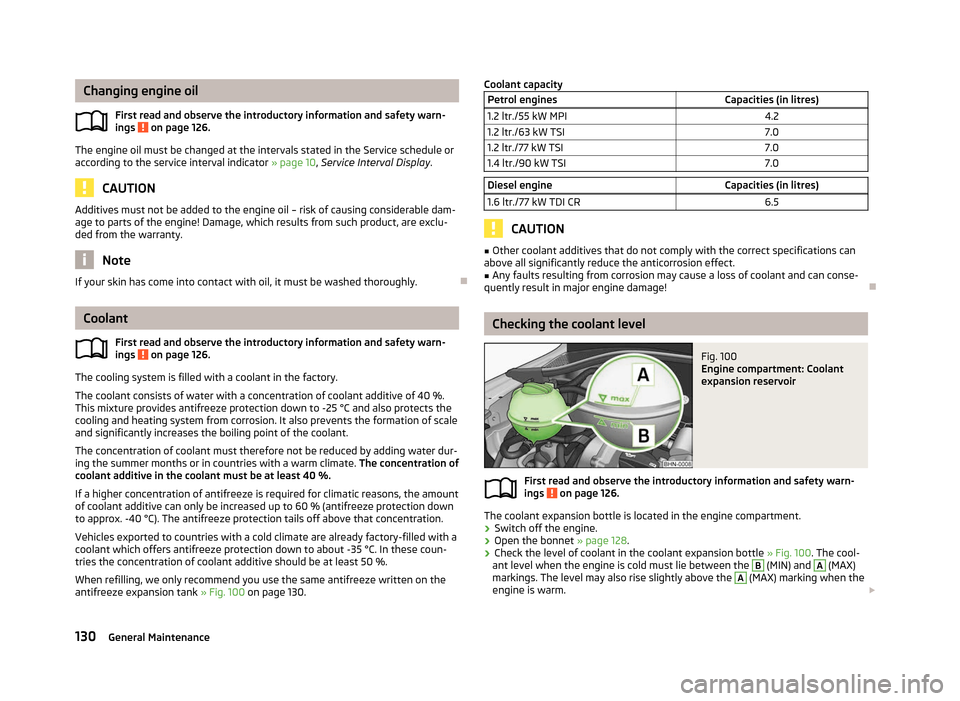
antifreeze expansion tank » Fig. 100 on page 130.
ä
ä Coolant capacity
Petrol engines Capacities (in litres)
1.2 ltr./55 kW MPI 4.2
1.2 ltr./63 kW TSI 7.0
1.2 ltr./77 kW TSI 7.0
1.4 ltr./90 kW TSI 7.0 Diesel engine
Capacities (in litres)
1.6 ltr./77 kW TDI CR 6.5 CAUTION
■ Other coolant additives that do not comply with the correct specifications can
above all significantly reduce the anticorrosion effect.
■ Any faults resulting from corrosion may cause a loss of coolant and can conse-
quently result in major engine damage! Ð Checking the coolant level
Fig. 100
Engine compartment: Coolant
expansion reservoir
First read and observe the introductory information and safety warn-
ings on page 126.
The coolant expansion bottle is located in the engine compartment.
›
Switch off the engine.
› Open the bonnet
» page 128.
› Check the level of coolant in the coolant expansion bottle
» Fig. 100. The cool-
ant level when the engine is cold must lie between the B
(MIN) and A
(MAX)
markings. The level may also rise slightly above the A
(MAX) marking when the
engine is warm. £
ä
130 General Maintenance
Page 134 of 180

Checking the brake fluid
Fig. 101
Engine compartment: Brake fluid
reservoir
First read and observe the introductory information and safety warn-
ings on page 126.
The brake fluid reservoir is located in the engine compartment.
›
Switch off the engine.
› Open the bonnet
» page 128.
› Check the level of brake fluid in the reservoir
» Fig. 101. The level must be be-
tween the “MIN” and “MAX” markings.
When driving, a slight drop in the fluid level is caused by the wear-and-tear and
automatic adjustment of the brake pads, and is therefore perfectly normal.
There may be an indication of a leak in the brake system, however, if the fluid lev-
el drops significantly within a short time or if it drops below the “MIN” marking. If
the brake fluid level is too low, this is indicated by the warning light lighting up
in the instrument cluster » page 17, Brake system . WARNING
If the fluid level has dropped below the MIN marking, do not continue your
journey – risk of accident! Seek help from a
ŠKODA specialist garage.ÐBrake fluid change
First read and observe the introductory information and safety warn-
ings on page 126.ä
ä Brake fluid absorbs moisture. Over time it therefore absorbs moisture from the
environment. Excessive water in the brake fluid may be the cause of corrosion in
the brake system. The water content also lowers the boiling point of the brake
fluid.
The brake fluid must comply with the following standards or specifications:
› VW 50114;
› FMVSS 116 DOT4. WARNING
Using old brake fluid can result in severe stress on the brakes because of the
formation of vapour bubbles in the brake system. This greatly impairs the
braking efficiency and thus also the safety of your vehicle. CAUTION
Brake fluid damages the paintwork of the vehicle. Ð Windscreen washer system
Fig. 102
Engine compartment: Wind-
screen washer fluid reservoir
First read and observe the introductory information and safety warn-
ings on page 126.
The windscreen washer fluid reservoir contains the cleaning fluid for the wind-
screen or rear window and for the headlight cleaning system. The windscreen
washer fluid reservoir is located in the engine compartment.
The capacity of the reservoir is about 3.5 litres or about 5.4
litres on vehicles that
have a headlight cleaning system. £
ä
132 General Maintenance
Page 136 of 180
WARNING (Continued)
■ Splashes of acid on your skin or clothes should be neutralised as soon as
possible using soap suds and then rinsed with plenty of water. If acid was
swallowed, seek immediate medical attention.
■ Keep children away from the vehicle battery.
■ When you charge a battery, hydrogen is released, and a highly explosive gas
mixture is also produced. An explosion can be caused through sparkling over
during unclamping or loosening of the cable plug while the ignition is on. ■ Bridging of the poles will create a short circuit (e.g. through metal objects,
cables). Possible consequences of a short circuit: Melting of lead struts, explo-
sion and burning of the battery, jets of acid spurting out.
■ It is prohibited to work with a naked flame and light, to smoke or to carry
out any activities which produce sparks. Avoid creating sparks when working
with cables and electrical devices. Strong sparking represents a risk of injury. ■ Before carrying out any work on the electrical system, switch off the engine,
the ignition and all of the electrical components and disconnect the negative
terminal
(-) on the battery. If you wish to replace a bulb it suffices to switch off
the relevant light.
■ Never charge a frozen or thawed vehicle battery – risk of explosion and
caustic burns! Replace a frozen vehicle battery.
■ Never jump-start vehicle batteries with an electrolyte level that is too low –
risk of explosion and caustic burns.
■ Never use a damaged vehicle battery – risk of explosion! Replace a damaged
vehicle battery immediately. CAUTION
■ The vehicle battery must only be disconnected if the ignition is switched off,
otherwise the vehicle's electrical system (electronic components) can be dam-
aged. When disconnecting the battery from the electrical system, first of all dis-
connect the negative terminal
(-) of the battery. Then disconnect the positive ter-
minal (+).
■ When connecting the battery to the electrical system, first connect the positive
terminal (+) of the battery. Then connect the negative terminal
(-). Under no cir-
cumstances must the battery cables be connected incorrectly – risk of a cable fire.
■ Ensure that battery acid does not come into contact with the bodywork – risk of
damage to the paintwork.
■ Do not place the battery in direct daylight in order to protect the vehicle battery
housing from the effects of ultra-violet light. ■
If the vehicle has not been driven for more than 3 to 4 weeks, the battery will
discharge. This is because certain electrical components consume electricity (e.
g.
control units) also in idle state. Prevent the battery from discharging by discon-
necting the battery's negative terminal or continuously charging the battery with
a very low charging current.
■ If the vehicle is frequently used for making short trips, the vehicle battery will
not have time to charge up sufficiently and may discharge. For the sake of the environment
A vehicle battery that has been removed is a special type of hazardous waste.
These must be disposed of in accordance with national legal regulations. Note
You should replace batteries older than 5 years. Ð Battery cover
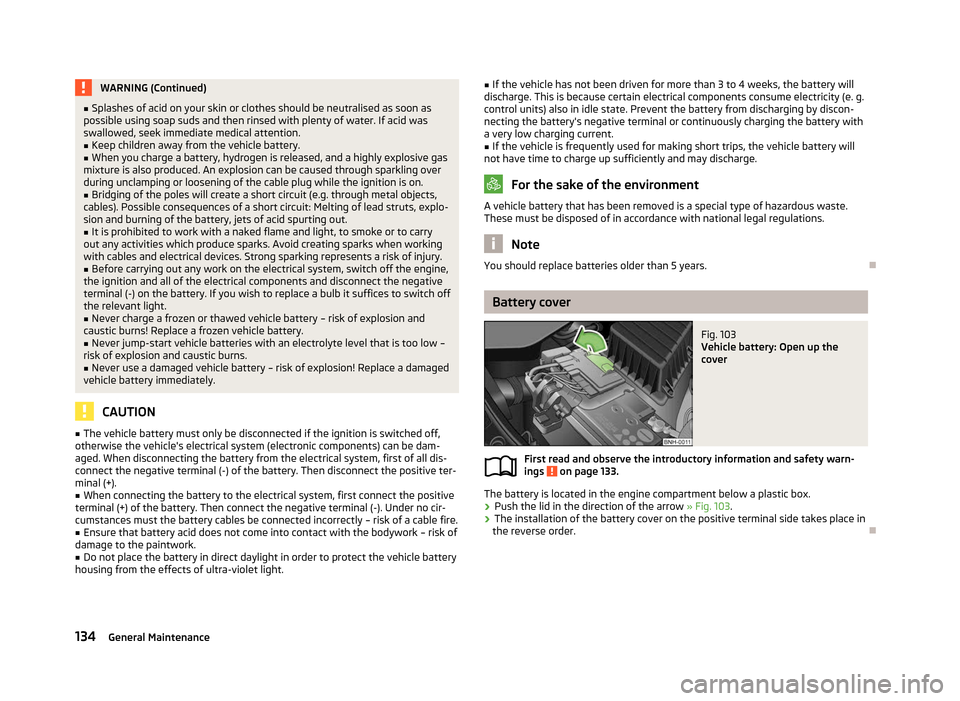
Fig. 103
Vehicle battery: Open up the
cover
First read and observe the introductory information and safety warn-
ings on page 133.
The battery is located in the engine compartment below a plastic box.
› Push the lid in the direction of the arrow
» Fig. 103.
› The installation of the battery cover on the positive terminal side takes place in
the reverse order. Ð
ä
134 General Maintenance
Page 138 of 180

“Quick-charging” the vehicle battery is
dangerous and requires a special charger
and specialist knowledge. We therefore recommend having the quick charging of
vehicle batteries undertaken by a
ŠKODA specialist garage.
The vent plugs of the vehicle battery should not be opened for charging. CAUTION
On vehicles with the START/STOP system, the pole terminal of the charger must
not be connected directly to the negative terminal of the vehicle battery, but only
to the engine earth » page 153, Jump-starting in vehicles with the
START-STOP
system . ÐDisconnecting and reconnecting the vehicle battery
First read and observe the introductory information and safety warn-
ings on page 133.
On disconnecting and reconnecting the vehicle battery the following functions
are initially deactivated or are no longer able to operate fault-free:
Operation Operating measure
Enter the radio/navigation system code num-
ber » User manual of the radio
or » user manual of the naviga-
tion system
Setting the clock » page 11
Data in the multifunction display are deleted. » page 11Note
We recommend having the vehicle checked by a ŠKODA Service Partner to ensure
the full functionality of all electrical systems. ÐReplacing the vehicle battery
First read and observe the introductory information and safety warn-
ings on page 133.
When replacing a battery, the new vehicle battery must have the same capacity,
voltage, amperage and be the same size. Suitable types of vehicle batteries can
be purchased from a
ŠKODA Service Partner.
ä
ä We recommend that the battery is replaced by a ŠKODA Service Partner, where
the new vehicle battery will be installed properly and the original battery will be
disposed of in accordance with national regulations.
Ð Automatic load deactivation
First read and observe the introductory information and safety warn-
ings on page 133.
An intelligent vehicle power management system automatically takes various
measures at high loads on the vehicle battery to prevent discharging of the bat-
tery: This manifests itself by the following:
› The idling speed is raised to allow the generator to deliver more electricity to
the electrical system.
› Where appropriate large consumers of power, e.g. seat heaters, rear window
heaters, voltage supply to the 12V power socket, have their power limited or in
case of emergency shut off completely. Note
Despite such intervention by the vehicle electric system management, the vehicle
battery may be drained. For example, when the ignition is switched on a long time
with the engine turned off or the side or parking lights are turned on during lon-
ger parking. Driving comfort is not put at risk by any shutting off of consumers.
Often the driver is not aware of it having taken place. Ð ä
136 General Maintenance
Page 140 of 180

Service life of tyres
Fig. 105
Tyre tread with wear indicators/Open fuel filler flap with a table de-
tailing the tyre size and tyre inflation pressure
First read and observe the introductory information and safety warn-
ings on page 137.
Wear indicators
The base of the tread of the tyres has 1.6 mm high wear indicators installed.
These wear indicators are located multiple times depending on the make and are
evenly spaced around the circumference of the tyre » Fig. 105 – . Markings on
the walls of the tyres through the letters
“TWI”, triangular symbols or other sym-
bols identify the position of the wear indicators.
The life of your tyres very much depends on the following points:
Tyre pressure
The working life of tyres will be shortened considerably if the tyres are insuffi-
ciently or over-inflated and this will have an adverse effect on the handling of
your vehicle. Therefore check the tyre pressure, including that of the spare wheel,
at least once a month and also before setting off on a long journey.
The tyre inflation pressures for summer tyres are indicated on the inside of the
fuel filler flap » Fig. 105 – . The inflation pressures for winter tyres are 20 kPa
(0.2 bar) higher than those for summer tyres.
Always check the inflation pressure when the tyres are cold. Do not reduce the
higher pressure of warm tyres. If the load varies greatly, adjust the tyre inflation
pressure accordingly.
Driving style
Fast cornering, sharp acceleration and braking increase the wear of your tyres.
ä
Balancing wheels
The wheels of a new vehicle are balanced. There are a wide range of influences
when driving which may result in an imbalance and which makes themselves felt
through vibration in the steering.
Have the wheels rebalanced after replacing the tyres.
Wheel alignment errors
Incorrect wheel alignment at the front and rear will not only increase wear-and-
tear on the tyres but will also has an adverse effect on vehicle safety. In the
event of any unusual tyre wear, seek assistance from a
ŠKODA specialist garage.
Tyre damage
Drive over curbs on the side of the road and other such obstacles slowly and,
where possible, at a right angle in order to avoid damage to tyres and wheel
trims.
We recommend checking your tyres and wheel rims for damage (punctures, cuts,
splits and bulges, etc.) on a regular basis. Remove foreign bodies from the tyre
profile.
Unusual vibrations or pulling of the vehicle to one side could be a sign of tyre
damage. If there is any doubt that a wheel is damaged, immediately reduce your
speed and stop! Check the tyres for signs of damage (bulges, splits, etc.). If no ex-
ternal damage is evident, drive slowly and carefully to the nearest ŠKODA special-
ist garage to have the vehicle checked. Ð
138 General Maintenance
Page 142 of 180
Unidirectional tyres
First read and observe the introductory information and safety warn-
ings on page 137.
The direction of rotation of the tyres is marked by arrows on the wall of the tyre
.
The so specified running direction must absolutely be complied with. Only then
are the tyres able to provide the optimal properties in terms of grip, low noise,
wear-and-tear and aquaplaning.
If, in the event of a puncture, it is necessary to fit a spare wheel with a tyre with-
out a dedicated running direction or the opposite running direction, drive carefully
as the optimum characteristics of the tyre are no longer applicable in this situa-
tion. ÐSpare wheel
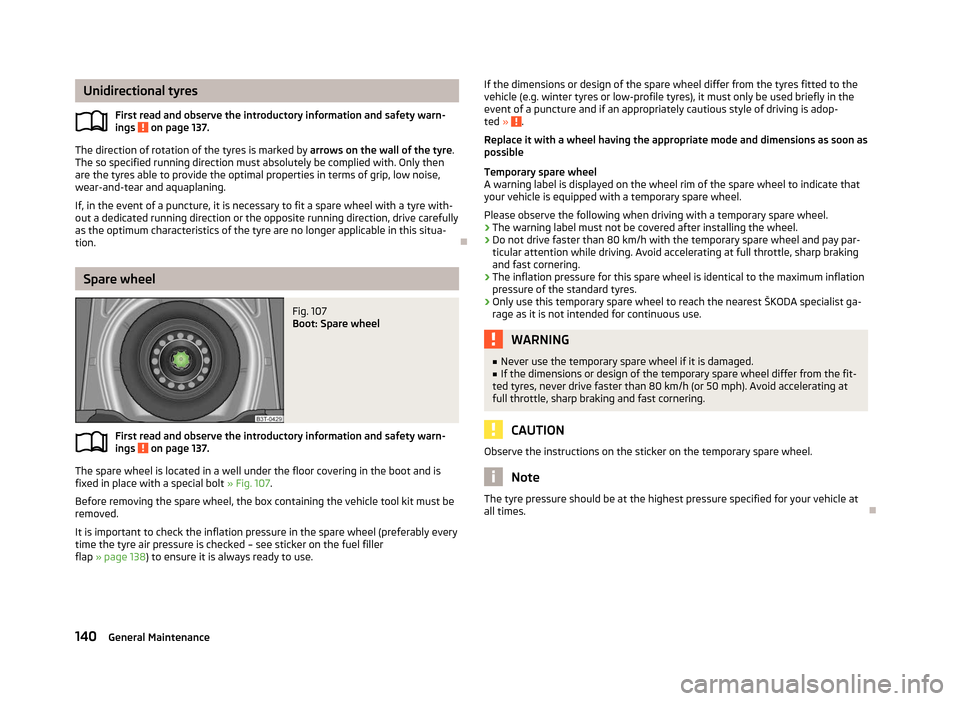
Fig. 107
Boot: Spare wheel
First read and observe the introductory information and safety warn-
ings on page 137.
The spare wheel is located in a well under the floor covering in the boot and is
fixed in place with a special bolt
» Fig. 107.
Before removing the spare wheel, the box containing the vehicle tool kit must be
removed.
It is important to check the inflation pressure in the spare wheel (preferably every
time the tyre air pressure is checked – see sticker on the fuel filler
flap » page 138) to ensure it is always ready to use. ä
ä If the dimensions or design of the spare wheel differ from the tyres fitted to the
vehicle (e.g. winter tyres or low-profile tyres), it must only be used briefly in the
event of a puncture and if an appropriately cautious style of driving is adop-
ted
» .
Replace it with a wheel having the appropriate mode and dimensions as soon as
possible
Temporary spare wheel
A warning label is displayed on the wheel rim of the spare wheel to indicate that
your vehicle is equipped with a temporary spare wheel.
Please observe the following when driving with a temporary spare wheel.
› The warning label must not be covered after installing the wheel.
› Do not drive faster than 80
km/h with the temporary spare wheel and pay par-
ticular attention while driving. Avoid accelerating at full throttle, sharp braking
and fast cornering.
› The inflation pressure for this spare wheel is identical to the maximum inflation
pressure of the standard tyres.
› Only use this temporary spare wheel to reach the nearest ŠKODA specialist ga-
rage as it is not intended for continuous use. WARNING
■ Never use the temporary spare wheel if it is damaged.
■ If the dimensions or design of the temporary spare wheel differ from the fit-
ted tyres, never drive faster than 80
km/h (or 50 mph). Avoid accelerating at
full throttle, sharp braking and fast cornering. CAUTION
Observe the instructions on the sticker on the temporary spare wheel. Note
The tyre pressure should be at the highest pressure specified for your vehicle at
all times. Ð
140 General Maintenance
Page 144 of 180

Basic setting of the system
After changing the tyre inflation pressure, after changing one or several wheels,
the position of a wheel on the vehicle (e.g. exchanging the wheels between the
axles) or when the warning light lights up while driving, a basic setting of the sys-
tem must be carried out as follows:
› Inflate all of the tyres to the specified inflation pressure
» page 138, Service life
of tyres.
› Switch on the ignition.
› Press and hold the button
» Fig. 109
for longer than 2 seconds. While
pressing the button, the warning light illuminates. At the same time the sys-
tem memory is erased and the new calibration is started, which is confirmed
with an audible signal and then the warning light goes out.
› If the warning light
does not go out after the basic setting, this indicates a
system fault. Seek help from a ŠKODA specialist garage.
The warning light is lit
If the tyre inflation pressure of at least one wheel is insufficiently inflated in com-
parison to the stored basic value, the warning light » lights up.
The warning light flashes
If the warning light flashes, there is a system fault. Seek help from a
ŠKODA spe-
cialist garage to correct the fault. WARNING
■ When the warning light illuminates, immediately reduce the speed and
avoid sudden steering and brake manoeuvres. Stop the vehicle as soon as
possible and inspect the tyres and their inflation pressure.
■ Under certain circumstances (e.g. sporty style of driving, wintry or unpaved
roads) the warning light can be delayed or does not light up at all.
■ The tyre control display does not absolve the driver of the responsibility to
ensure the correct tyre inflation pressure. For this reason, the tyre inflation
pressure must be checked regularly. Note
■ The tyre control display does therefore not replace the regular tyre inflation
pressure control, as the system cannot detect an even loss of pressure. ■ The tyre control display cannot provide a warning in the event of very rapid tyre
inflation pressure loss, e.g. in the case of sudden tyre damage. In this case care-
fully bring the vehicle to a standstill without sudden steering movements or
sharp braking.
■ To ensure a proper functioning of the tyre control display, it is necessary to re-
peat the basic setting every 10 000 km or once a year. Ð Wheel bolts
First read and observe the introductory information and safety warn-
ings on page 137.
Wheels and
wheel bolts are matched to each other in terms of design. Each time
you fit other wheels, e.g. light alloy wheels or wheels with winter tyres, you must
therefore also use the matching wheel bolts of the correct length and shape of
spherical cap. This is essential to ensure that the wheels are tightly fitted and
that the brake system operates properly. Ð Winter tyres
First read and observe the introductory information and safety warn-
ings on page 137.
The handling of your vehicle will be significantly improved when driving on wintry
roads if you fit winter tyres. Summer tyres do not offer the same grip on ice, snow
and at temperatures below 7 °C because of their construction (width, rubber
blend, tread pattern). This particularly applies to vehicles which are equipped with
low-profile tyres
or high-speed tyres (code index H or V on wall of tyre).
To achieve the best possible handling properties, winter tyres must be fitted on
all 4 wheels, the minimum tread depth must be 4
mm and tyres must be no older
than 4 years.
Winter tyres of a lower speed category can be used provided that the permissible
maximum speed of these tyres is not exceeded even if the possible maximum
speed of the vehicle is higher. £
ä
ä
142 General Maintenance
Page 146 of 180

Accessories, changes and replacement of
parts Introductory information
If you want to retrofit the vehicle with accessories, if a vehicle part is to be re-
placed with a new one, or when needing to make technical changes, the follow-
ing instructions must be observed.
› Always seek advice from a
ŠKODA Service Partner before purchasing any acces-
sories or parts and before making any technical changes » .
› The guidelines and instructions issued by
ŠKODA must be observed when mak-
ing technical changes.
Adhering to the prescribed procedures will prevent any kind of damage to the ve-
hicle, and its travelling and operating safety will be maintained. The vehicle also
complies with German road transport regulations (StVZO). More information is
available from a ŠKODA Service Partner who can also perform the necessary work
correctly.
Vehicles with special built-on types
Technical documents regarding changes carried out on the vehicle must be kept
by the vehicle user, in order to hand over later to the old car user. This ensures
the recycling in accordance with environmental regulations.
Interference on the electronic components and their software can lead to opera-
tional faults. This interference can also impair not directly affected systems be-
cause of the networking of the electronic components. In other words, the vehi-
cle's roadworthiness may be put at risk and increased wear on parts may arise.
Any damage caused by technical changes made without consent by ŠKODA is ex-
cluded from the warranty – see the warranty certificate. WARNING
■ Work or modifications on your vehicle, which have been carried out unpro-
fessionally, can cause operational faults – risk of accident!
■ We advise you, in your own interest, to only use ŠKODA Original Accessories
and ŠKODA
Original Parts which have been expressly approved for use on
your vehicle. Reliability, safety and suitability have been established for
ŠKODA Original Accessories and ŠKODA Original Parts.
■ Although we constantly monitor the market, we are not able to assess or
warrant the parts even though in some instances such parts may have a type
approval or may have been approved by a nationally recognised testing labo-
ratory. Note
ŠKODA Original Accessories and ŠKODA Original Parts can be purchased from
ŠKODA
Service Partners who will also professionally undertake the assembly of
the purchased parts. Ð Changes and impairments of the airbag system
Repairs and technical modifications must comply with
ŠKODA guidelines.
We recommend that any modifications and repairs to the front bumper, doors,
front seats, headliner or bodywork be carried out by a ŠKODA Service Partner.
These vehicle parts may include system components for the airbag system. WARNING
■ Airbag modules can not be repaired, but must be replaced.
■ Never install any airbag parts into the vehicle that have been removed from
old cars or have been recycled. ■ A modification to the suspension of the vehicle including the use of non-ap-
proved rim-tyre combinations can alter the functioning of the airbag and in-
crease the risk of serious or fatal injuries in an accident.
■ Parts of the airbag system may be damaged when working on the airbag
system or removing and installing system parts due to other repairs. This may
mean that the airbags will not deploy properly or not at all in the event of an
accident. Ð
144 General Maintenance