radio SKODA RAPID 2012 1.G User Guide
[x] Cancel search | Manufacturer: SKODA, Model Year: 2012, Model line: RAPID, Model: SKODA RAPID 2012 1.GPages: 180, PDF Size: 4.36 MB
Page 91 of 180
Multimedia
Music playback via Bluetooth
®
The universal telephone preinstallation GSM II makes it possible to play back mu-
sic via Bluetooth ®
from the devices such as MP3 player, mobile phone or note-
book.
To ensure the music can be played back via Bluetooth ®
, it is necessary to connect
the terminal device with the hands-free system in the menu Phone – Bluetooth –
Media player. The music playback process is performed on the connected device.
The universal telephone preinstallation GSM
II ensures that the music played back
via the hands-free system can be controlled with the remote control » page 88,
Voice commands . Note
The device being connected must support the Bluetooth ®
A2DP profile; refer to
the operating instructions for the relevant device being connected. ÐOperating the radio and navigation system on the multifunction steering wheel
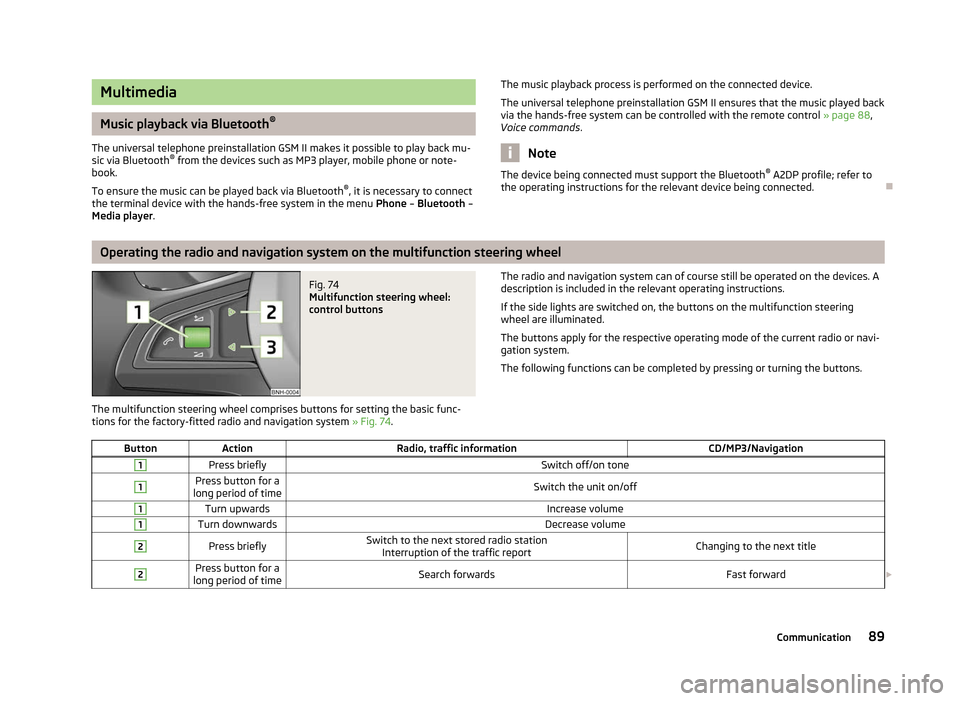
Fig. 74
Multifunction steering wheel:
control buttons
The multifunction steering wheel comprises buttons for setting the basic func-
tions for the factory-fitted radio and navigation system » Fig. 74. The radio and navigation system can of course still be operated on the devices. A
description is included in the relevant operating instructions.
If the side lights are switched on, the buttons on the multifunction steering
wheel are illuminated.
The buttons apply for the respective operating mode of the current radio or navi-
gation system.
The following functions can be completed by pressing or turning the buttons.
Button Action Radio, traffic information CD/MP3/Navigation1
Press briefly
Switch off/on tone1 Press button for a
long period of time Switch the unit on/off1
Turn upwards
Increase volume1
Turn downwards
Decrease volume2
Press briefly
Switch to the next stored radio station
Interruption of the traffic report Changing to the next title2 Press button for a
long period of time Search forwards
Fast forward£ 89
Communication
Page 92 of 180

Button
Action Radio, traffic information CD/MP3/Navigation3
Press briefly
Switch to the previous stored radio station
Interruption of the traffic report Changing to the previous title3 Press button for a
long period of time Search backwards
Fast rewindNote
■ The functions of button 1
are different for vehicles fitted with a universal tele-
phone preinstallation GSM
II » page 85.
■ The loudspeakers in the vehicle are adjusted to the power output of the radio
and navigation system of 4x20°W. ÐAUX-IN und MDI input ports
Fig. 75
AUX input/MDI input
For a description of use, refer to the operating instructions for the relevant radio
or navigation system.
AUX input
The AUX input is located in the following places:
› Between the front seats in the centre console
» Fig. 75 – ;
› Above the storage box of the front centre console
» Fig. 75 – ;
› On the front of the Amundsen+ navigation system.
The AUX input is used to connect external audio sources (e.g. iPod or mp3 player)
via the factory-fitted radio or navigation system. Multi-Device Interface (MDI) input
The MDI input is located above the storage box of the front centre con-
sole » Fig. 75 –
.
The MDI input comprises AUX and MDI inputs.
The MDI input is used to connect external audio sources (e.g. iPod or mp3 player)
and to play back audio from these devices via the factory-fitted radio or naviga-
tion system.
You need to use the correct adapter, available from
ŠKODA Original Accessories,
to connect audio sources e.g., iPod.
USB input
You can also use the USB input » Fig. 75 – to connect e.g., a USB stick contain-
ing audio files. Audio play back starts as soon as you connect the USB stick. Ð
90 Using the system
Page 119 of 180

General Maintenance
Taking care of and cleaning the vehicle
Taking care of your vehicle
ä
Introduction
This chapter contains information on the following subjects:
Washing the vehicle 118
Automatic car wash systems 118
Washing by hand 118
Washing with a high-pressure cleaner 118
Preserving and polishing the vehicle paintwork 119
Chrome parts 119
Paint damage 119
Plastic parts 119
De-icing windows and exterior mirrors 120
Radio reception and aerial 120
Headlight lenses 120
Rubber seals 120
Door lock cylinders 120
Wheels 121
Underbody protection 121
Protection of hollow spaces 121
Artificial leather and materials 122
Fabric covers on electrically heated seats 122
Natural leather 122
Seat belts 123
Regular and proper care help to retain the efficiency and value of your vehicle. It
may also be one of the requirements for the acceptance of warranty claims relat-
ing to corrosion damage and paint defects on the bodywork.
We recommend using care products from
ŠKODA Original Accessories that are
available from ŠKODA Service Partners. The instructions for use on the package
must be observed. WARNING
■ Care products may be harmful to your health if not used according to the in-
structions.
■ Always store care products in a safe place, out of the reach of children – risk
of poisoning! ■ When washing your vehicle in the winter: Water and ice in the brake system
can affect the braking efficiency – risk of accident! ■ Only wash the vehicle when the ignition is switched off – risk of accident!
■ Protect your hands and arms from sharp-edged metal parts when cleaning
the underfloor, the inside of the wheel housings or the wheel trims – risk of
cuts!
■ Air fresheners and scents can be hazardous to heath when the temperature
inside the vehicle is high. CAUTION
■ Be sure to check clothing for colourfastness to avoid any damage or visible
stains on the material (leather), panels and textiles.
■ Cleaners containing solvents can damage the material being cleaned.
■ Do not wash your vehicle in bright sunlight – risk of paint damage.
■ If washing the vehicle in the winter using a hose or high-pressure cleaner, en-
sure that the jet of water is not aimed directly at the locking cylinders or the
door/panel joints – risk of freezing!
■ Do not use any insect sponges, rough kitchen sponges or similar cleaning prod-
ucts – risk of damaging the surface of paintwork. ■ Do not stick any stickers on the inside of the rear windows, in the vicinity of the
heating elements or near the window aerial. These may get damaged. With re-
gard to the antenna, they may interfere with the radio or navigation system.
■ Do not clean the inside of the windows with sharp-edged objects or corrosive
and acidic cleaning agents – risk of damaging the heating elements or window
aerial.
■ Do not attach scents and air fresheners to the dashboard – risk of damage to
the dashboard.
■ To avoid damaging the parking aid sensors while cleaning with high-pressure
cleaners or steam jets, the sensors must only be directly sprayed for short periods
while a minimum distance of 10 cm must be observed.
■ Do not clean the roof trim with a brush – risk of damage to the trim surface. £
117
Taking care of and cleaning the vehicle
Page 120 of 180

For the sake of the environment
■ Used cans of vehicle care products represent a special type of hazardous waste.
These must be disposed of in accordance with national legal regulations. ■ Only wash the vehicle at washing bays intended for this purpose. Note
■ Remove fresh stains such as those from ball-point pens, ink, lipstick, shoe pol-
ish, etc., from the material (leather), panels and textiles as quickly as possible. ■ Due to possible issues with the cleaning and care of the interior of your vehicle,
the special tools and knowledge required, we recommend that this is completed
by a
ŠKODA Service Partner. ÐWashing the vehicle
First read and observe the introductory information and safety warn-
ings on page 117.
The best protection for your vehicle against harmful environmental influences is
frequent washing and wax treatment. How often the vehicle should be washed
depends on a wide range of factors, such as:
›
Frequency of use;
› The parking situation (garage, below trees etc.);
› Season of the year;
› Weather conditions;
› Environmental influences.
The longer insect residues, bird droppings, tree sap, road and industrial dust, tar,
soot particles, road salt and other aggressive deposits remain adhering to the
paintwork of your vehicle, the more detrimental their destructive effect can be.
High temperatures, such as those caused by intensive sun's rays, accentuate this
caustic effect.
It is essential to also thoroughly clean the underside of the vehicle at the end of
the winter. ÐAutomatic car wash systems
First read and observe the introductory information and safety warn-
ings on page 117.ä
ä Your vehicle can be washed in automatic car wash systems.
Take the usual precautionary measures before washing the vehicle in an auto-
matic car wash system. (Close the windows etc.)
If your vehicle is fitted with any particular attached parts, such as a spoiler, roof
luggage rack, two-way radio aerial – it is best to consult the operator of the car
wash system beforehand.
It is important to degrease the lips of the windscreen wiper rubbers after passing
through the automatic vehicle wash system. Ð Washing by hand
First read and observe the introductory information and safety warn-
ings on page 117.
When washing by hand, first soften the dirt with plenty of water and rinse off as
much as possible.
Clean the vehicle with a soft
sponge, a washing glove or a washing brush. Work
from the top to the bottom – starting with the roof. Only apply slight pressure
when cleaning the vehicle's paintwork. Only use a car shampoo for stubborn dirt.
Wash out the sponge or washing glove thoroughly at short intervals.
Clean wheels, door sills and similar parts last. Use a second sponge for such
areas.
Give the vehicle a good rinse after washing it and dry it off using a chamois leath-
er. Ð Washing with a high-pressure cleaner
First read and observe the introductory information and safety warn-
ings on page 117.
When washing the vehicle with a high-pressure cleaner, the instructions for use
of the equipment must be observed. This applies in particular to the
pressure
used and to the spraying distance. Maintain a sufficiently large distance to the
parking aid sensors and soft materials such as rubber hoses or insulation materi-
al. £
ä
ä
118 General Maintenance
Page 122 of 180

De-icing windows and exterior mirrors
First read and observe the introductory information and safety warn-
ings on page 117.
Use a plastic ice scraper for removing snow and ice from the windows and mir-
rors. The ice scraper should not be moved forward and backward but in one direc-
tion to avoid any damage to the surface of the glass.
Clean the windows from the inside on a regular basis.
Dry the glass surfaces with a clean chamois leather or a cloth intended for this
purpose.
When drying the windows after washing the vehicle, do not use window leathers
that have been used to polish the bodywork. Residues of preservatives in the
window leather can dirty the window and reduce visibility. CAUTION
■ Never remove snow or ice from glass parts using warm or hot water – risk of
formation of cracks in the glass!
■ When removing snow or ice from windows and mirror lenses ensure that the
paintwork of the vehicle is not to damage.
■ Snow or ice that is contaminated with coarse dirt such as fine gravel, sand, and
salt must not be removed from the window glass and mirrors – risk of damage to
the surface of the windows and mirrors. ÐRadio reception and aerial
First read and observe the introductory information and safety warn-
ings on page 117.
Car parks, tunnels, tall buildings or mountains can disrupt the radio signal even
causing it to fail completely.
With factory-fitted radios and navigation systems, the aerial for the radio recep-
tion can be installed at different locations in the vehicle:
› on the inside of the rear window along with the rear window heater;
› on the roof. Ð
ä
ä Headlight lenses
First read and observe the introductory information and safety warn-
ings on page 117.
Use soap and clean water to clean the plastic headlight lenses.
CAUTION
■ Never wipe the headlights dry and do not use any sharp objects to clean the
plastic lenses, this may damage the protective paintwork and consequently cause
the formation of cracks on the headlight lenses.
■ Do not use any aggressive cleaning or chemical solvent products to clean the
headlights – risk of damaging the headlight lenses. Ð Rubber seals
First read and observe the introductory information and safety warn-
ings on page 117.
The rubber seals on doors and other windows remain smoother and last longer if
the seals are treated regularly with a suitable rubber care product. This helps to
prevent leakages and premature wear of the seals. Rubber seals which are well
cared for also do not stick together in cold winter weather.
Ð Door lock cylinders
First read and observe the introductory information and safety warn-
ings on page 117.
Specific products must be used for de-icing door lock cylinders.
Note
■ When washing your vehicle, ensure as little water as possible gets into the lock-
ing cylinders. ■ We recommend that suitable materials from ŠKODA Original Accessories are
used for maintaining the door lock cylinders. Ð
ä
ä
ä
120 General Maintenance
Page 138 of 180

“Quick-charging” the vehicle battery is
dangerous and requires a special charger
and specialist knowledge. We therefore recommend having the quick charging of
vehicle batteries undertaken by a
ŠKODA specialist garage.
The vent plugs of the vehicle battery should not be opened for charging. CAUTION
On vehicles with the START/STOP system, the pole terminal of the charger must
not be connected directly to the negative terminal of the vehicle battery, but only
to the engine earth » page 153, Jump-starting in vehicles with the
START-STOP
system . ÐDisconnecting and reconnecting the vehicle battery
First read and observe the introductory information and safety warn-
ings on page 133.
On disconnecting and reconnecting the vehicle battery the following functions
are initially deactivated or are no longer able to operate fault-free:
Operation Operating measure
Enter the radio/navigation system code num-
ber » User manual of the radio
or » user manual of the naviga-
tion system
Setting the clock » page 11
Data in the multifunction display are deleted. » page 11Note
We recommend having the vehicle checked by a ŠKODA Service Partner to ensure
the full functionality of all electrical systems. ÐReplacing the vehicle battery
First read and observe the introductory information and safety warn-
ings on page 133.
When replacing a battery, the new vehicle battery must have the same capacity,
voltage, amperage and be the same size. Suitable types of vehicle batteries can
be purchased from a
ŠKODA Service Partner.
ä
ä We recommend that the battery is replaced by a ŠKODA Service Partner, where
the new vehicle battery will be installed properly and the original battery will be
disposed of in accordance with national regulations.
Ð Automatic load deactivation
First read and observe the introductory information and safety warn-
ings on page 133.
An intelligent vehicle power management system automatically takes various
measures at high loads on the vehicle battery to prevent discharging of the bat-
tery: This manifests itself by the following:
› The idling speed is raised to allow the generator to deliver more electricity to
the electrical system.
› Where appropriate large consumers of power, e.g. seat heaters, rear window
heaters, voltage supply to the 12V power socket, have their power limited or in
case of emergency shut off completely. Note
Despite such intervention by the vehicle electric system management, the vehicle
battery may be drained. For example, when the ignition is switched on a long time
with the engine turned off or the side or parking lights are turned on during lon-
ger parking. Driving comfort is not put at risk by any shutting off of consumers.
Often the driver is not aware of it having taken place. Ð ä
136 General Maintenance
Page 159 of 180
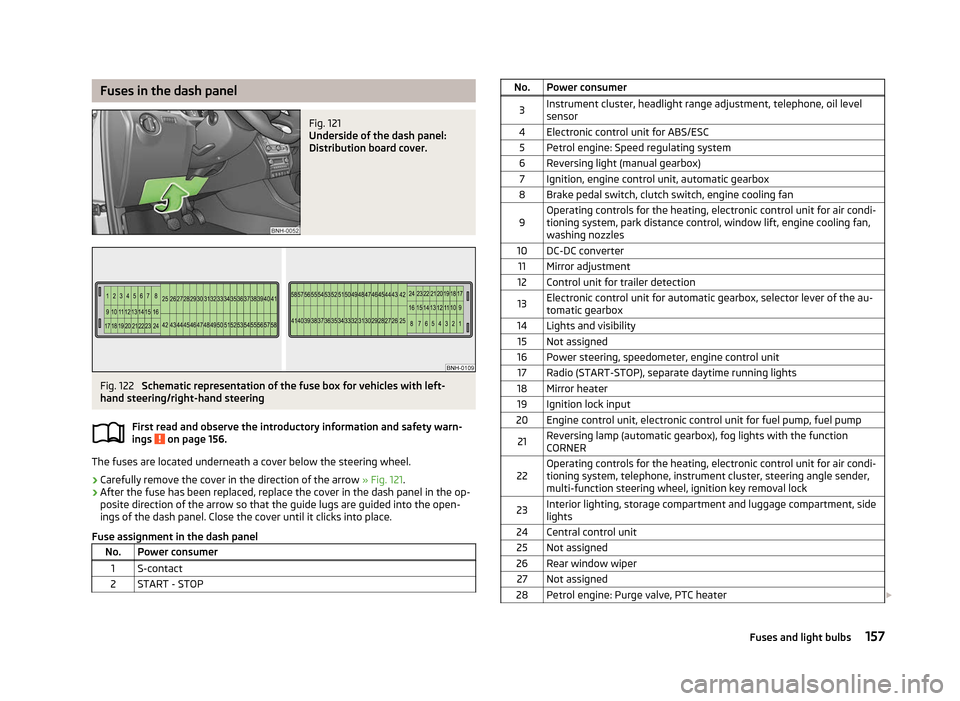
Fuses in the dash panel
Fig. 121
Underside of the dash panel:
Distribution board cover. Fig. 122
Schematic representation of the fuse box for vehicles with left-
hand steering/right-hand steering
First read and observe the introductory information and safety warn-
ings on page 156.
The fuses are located underneath a cover below the steering wheel.
› Carefully remove the cover in the direction of the arrow
» Fig. 121.
› After the fuse has been replaced, replace the cover in the dash panel in the op-
posite direction of the arrow so that the guide lugs are guided into the open-
ings of the dash panel. Close the cover until it clicks into place.
Fuse assignment in the dash panel No. Power consumer
1 S-contact
2 START - STOP ä No. Power consumer
3 Instrument cluster, headlight range adjustment, telephone, oil level
sensor
4 Electronic control unit for ABS/ESC 5 Petrol engine: Speed regulating system
6 Reversing light (manual gearbox) 7 Ignition, engine control unit, automatic gearbox
8 Brake pedal switch, clutch switch, engine cooling fan
9 Operating controls for the heating, electronic control unit for air condi-
tioning system, park distance control, window lift, engine cooling fan,
washing nozzles
10 DC-DC converter 11 Mirror adjustment
12 Control unit for trailer detection
13 Electronic control unit for automatic gearbox, selector lever of the au-
tomatic gearbox
14 Lights and visibility 15 Not assigned
16 Power steering, speedometer, engine control unit 17 Radio (START-STOP), separate daytime running lights
18 Mirror heater 19 Ignition lock input
20 Engine control unit, electronic control unit for fuel pump, fuel pump
21 Reversing lamp (automatic gearbox), fog lights with the function
CORNER
22 Operating controls for the heating, electronic control unit for air condi-
tioning system, telephone, instrument cluster, steering angle sender,
multi-function steering wheel, ignition key removal lock
23 Interior lighting, storage compartment and luggage compartment, side
lights
24 Central control unit 25 Not assigned
26 Rear window wiper 27 Not assigned
28 Petrol engine: Purge valve, PTC heater £ 157
Fuses and light bulbs
Page 160 of 180
No. Power consumer
29 Injection, coolant pump
30 Fuel pump, ignition system, cruise control 31 Lambda probe
32 High pressure fuel pump, pressure valve
33 Engine control unit
34 Engine control unit, vacuum pump
35 Switch illumination, number plate light, parking light, headlamp washer
system
36 Main beam 37 Rear fog light, DC-DC converter
38 Fog lights 39 Air blower for heating
40 Not assigned 41 Heated front seats
42 Rear window heater
43 Horn
44 Windscreen wipers 45 Boot lid lock, central locking system
46 Alarm 47 Cigarette lighter, power socket in the luggage compartment
48 ABS 49 Turn signal lights, brake lights50 DC-DC converter, radio 51 Electric windows (driver's window and rear left window)
52 Electric windows (front passenger's window and rear right)
53 Windscreen washer
54 START-STOP instrument cluster, steering wheel module, multi-function
steering wheel
55 Control unit for automatic gearbox
56 Headlight cleaning system 57 Low beam on the left
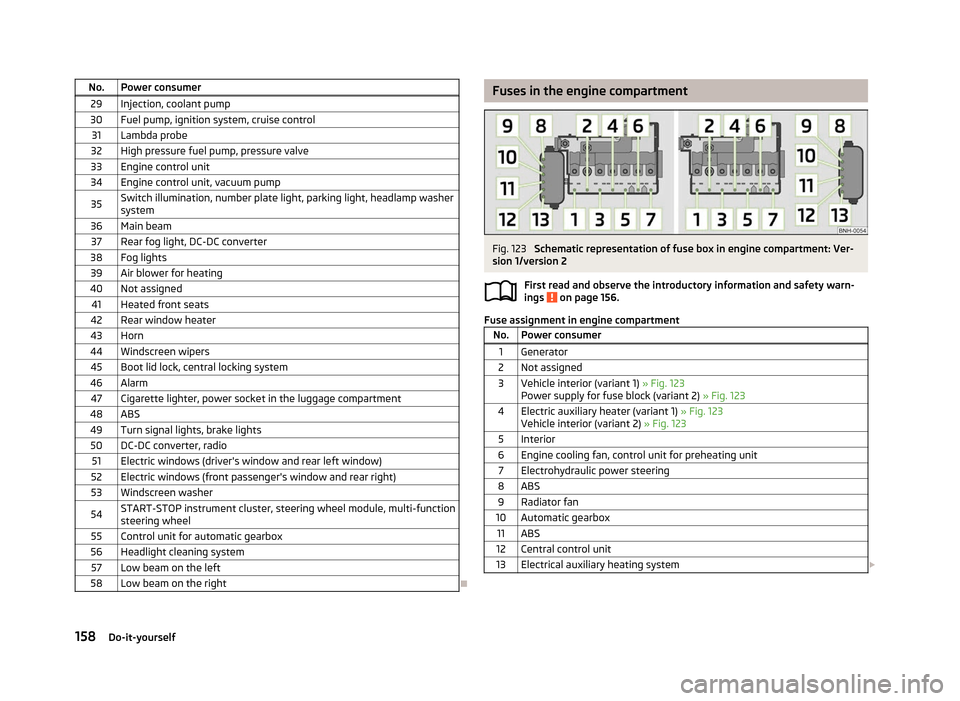
58 Low beam on the right Ð Fuses in the engine compartment
Fig. 123
Schematic representation of fuse box in engine compartment: Ver-
sion
1/version 2
First read and observe the introductory information and safety warn-
ings on page 156.
Fuse assignment in engine compartment
No. Power consumer
1 Generator
2 Not assigned
3 Vehicle interior (variant 1) » Fig. 123 Power supply for fuse block (variant
2) » Fig. 123
4 Electric auxiliary heater (variant 1) » Fig. 123 Vehicle interior (variant
2) » Fig. 123
5 Interior
6 Engine cooling fan, control unit for preheating unit 7 Electrohydraulic power steering
8 ABS 9 Radiator fan
10 Automatic gearbox 11 ABS
12 Central control unit
13 Electrical auxiliary heating system £ ä
158 Do-it-yourself
Page 172 of 180
Index
A
ABS 73
Warning light 20
Accessories 144
Adjusting Exterior mirror 42
Adjusting seats 92
Adjustment Seat 45
Aerial 118
see Radio reception 120
Airbag 99
Deployment 99
Front airbag 100
Head airbag 102
Side airbag 101
Airbag system 99
Air conditioning system Air outlet vents 60
Climatronic 65
Manual air conditioning system 62
Alarm 29
Anti-theft alarm system 29
Antilock brake system 73
Armrest 45
rear 48
Ashtray 53
ASR 73
Assist systems ABS 20, 73
ASR 73
Cruise control systems (CCS) 75
EDL 73
ESC 19, 72
Parking aid 74START/STOP 77
TCS 20
Auto Check Control 16
Automatic gearbox 79
Dynamic shift programme 82
Emergency programme 82
Information for driving 79
Kickdown 82
Manual shifting of gears 81
Parking 80
Selector lever-emergency unlocking 83
Selector lever lock 81
Selector lever positions 80
Starting off 80
Stopping 80
Tiptronic 81
Automatic load deactivation 136
AUX-IN 90
Avoiding damage to your vehicle 113
B
Before setting off 91
Belts 95
Belt tensioners 98
Bonnet Closing 128
Opening 128
Boot Class
N1 vehicles 49
Cover 50
Emergency unlocking 31
Fastening elements 49
Fixing nets 50
Hooks 50
Light 49
see Boot lid 31
Unlocking the boot lid 31
Boot lid 31
Automatic locking 31
Brake assist 72Brake booster 72
Brake fluid Checking 132
Brakes Brake booster 72
Handbrake 72
Running in 109
Warning light 17
Braking Brake fluid 132
Breakdown kit 149
Bulbs Replacing 159
Button in the driver's door Electrical power windows 31
C
Car computer see Multifunction display 11
Car jack 145
Carrier 51
Catalytic converter 109
Central locking button 27
Central locking system 25
lock 27
unlock 26
Changes 144
Changing Engine oil 130
Wheel 146
Charging a vehicle battery 135
Checking Battery electrolyte level 135
Brake fluid 132
Coolant level 130
Engine oil 129
Oil level 129
Windscreen washer fluid 132
Children and safety 105
170 Index
Page 175 of 180

O
Oil refer to Engine oil 129
Onboard computer see Multifunction display 11
Operation in winter De-icing windows 120
Diesel fuel 126
Vehicle battery 135
Outside temperature 13
Overview Engine compartment 128
Warning lights 16
P
Paint see Paint damage 119
Paint damage 119
Parking Parking aid 74
Parking ticket holder 58
Passive Safety 91
Periodic wiping 40
Petrol refer to Fuel 125
Polishing the paintwork refer to Taking care of your vehicle 119
Power steering 69
Preservation refer to Taking care of your vehicle 119
R
Radiator fan 131
Radio reception Aerial 120
Functional fault 120
Raise vehicle 148Rear mirror
Exterior mirror 42
Manual dimming interior mirror 42
Recirculated air mode Manual air conditioning system 64
Recommended gear 11
Refuelling 124
Fuel 124
Regulation Headlamp range 36
Remote control 27
Synchronisation process 28
Remote control key Replacing the battery 24
Replacement of parts 144
Replacing bulbs 159
Fuses 156
Vehicle battery 136
Wiper blades 41, 42
Replenishing Coolant 131
Engine oil 129
Windscreen washer fluid 132
Roof luggage rack Attachment points 52
Roof rack system Roof load 52
Running in Brake pads 109
Engine 109
The first 1 500 km 109
Tyres 109
S
Safe securing system 26
Safety 91
Child safety 105
Child safety seats 105
Head restraints 46ISOFIX 107
TOP TETHER 108
Save electrical energy 110
Seat Adjusting 45
Seat belt Warning light 18
Seat belt height adjuster 98
Seat belts 95
Cleaning 123
fastening and unfastening 97
Height adjustment 98
Seats folding forward 47
Head restraints 46
Heating 46
Selector lever see selector lever positions 80
Selector lever positions 80
Service display 10
Setting Manual air conditioning system 64
Manual dimming interior mirror 42
Steering wheel 69
Setting temperature Heating 60
Setting the clock Clock 11
Shifting Diving economically 110
Gearshift lever 74
Side airbag 101
Snow chains 143
Spare wheel 140
Speedometer 9
START/STOP Function 77
Starting engine 70
Jump-starting 152
173
Index