wheel SKODA RAPID 2012 1.G Owner's Guide
[x] Cancel search | Manufacturer: SKODA, Model Year: 2012, Model line: RAPID, Model: SKODA RAPID 2012 1.GPages: 180, PDF Size: 4.36 MB
Page 90 of 180

›
It is recommended to speak louder at higher speeds, so that the tone of your
voice is louder than the increased surrounding noise.
› During the dialogue, limit additional noise in the vehicle, e.g. passengers talking
at the same time.
› Do not speak, if the system makes an announcement.
The microphone for voice control is inserted in the moulded headliner and direc-
ted to the driver and front passenger. Therefore the driver and the front passen-
ger can operate the equipment.
Entering a phone number
The telephone number can be entered as a continuous series of individually spo-
ken digits (the whole number at once) or in the form of digital blocks (separated
by short pauses). After each order of digits (separation through brief voice pause)
all of the digits detected up to now are repeated by the system.
The digits 0 – 9, symbols +, , # are permitted. The system detects no continuous
digit combinations such as twenty-three, but only individually spoken digits (two,
three).
Switching on voice control
By briefly pressing the button 2
on the multi-function steering wheel
» page 85,
Operating the phone on the multifunction steering wheel .
Switching off voice control
If the system is currently playing a message, you will need to end the message
currently being played by briefly pressing the button 2
on the multi-function
steering wheel.
If the system expects a voice command, you can end the dialogue yourself:
› with the
CANCEL voice command;
› by briefly pressing the button 2
on the multifunction steering wheel.
Note
■ The dialogue of an incoming call is immediately interrupted.
■ The voice control is only possible in vehicles fitted with a multi-function steer-
ing wheel with telephone control. Ð Voice commands
Basic voice commands Voice command Action
HELP After this command the system repeats all possible
commands.
CALL XYZ This command calls up the contact from the phone
book.
PHONE BOOK After this command, for example, the phone book
can be repeated back to you, a voice entry for the
contact can be updated or deleted, etc.
CALL HISTORY Lists of dialled numbers, missed calls, etc.
DIAL NUMBER After this command, a telephone number can be en-
tered to establish a connection with the requested
party.
REDIAL After this command the system calls the last dialled
number.
MUSIC a)
Play music from the mobile phone or another paired
device.
FURTHER OPTIONS After this command the system offers additional
context-dependent commands.
SETTINGS Selection for setting Bluetooth ®
, dialogue etc.
CANCEL The dialogue is ended. a)
On vehicles fitted with the Amundsen+ navigation system, this function can be accessed via the navi-
gation system menu; refer to the operating instructions for the Amundsen+ navigation system.
If a voice command is not detected, the system answers with
“Sorry?” and a new
entry can be completed. After the 2nd error the system repeats the aid. After the
3rd error the answer “Cancelled ” is given and the dialogue is ended.
Store voice recording of a contact
If automatic name recognition does not work reliably for some contacts, you can
choose to save your own voice entry for the contact in the menu Phone book –
Voice Tag – Record .
Your own voice entry can also be saved using the voice control in the menu FUR-
THER OPTIONS . Ð
88 Using the system
Page 91 of 180
Multimedia
Music playback via Bluetooth
®
The universal telephone preinstallation GSM II makes it possible to play back mu-
sic via Bluetooth ®
from the devices such as MP3 player, mobile phone or note-
book.
To ensure the music can be played back via Bluetooth ®
, it is necessary to connect
the terminal device with the hands-free system in the menu Phone – Bluetooth –
Media player. The music playback process is performed on the connected device.
The universal telephone preinstallation GSM
II ensures that the music played back
via the hands-free system can be controlled with the remote control » page 88,
Voice commands . Note
The device being connected must support the Bluetooth ®
A2DP profile; refer to
the operating instructions for the relevant device being connected. ÐOperating the radio and navigation system on the multifunction steering wheel
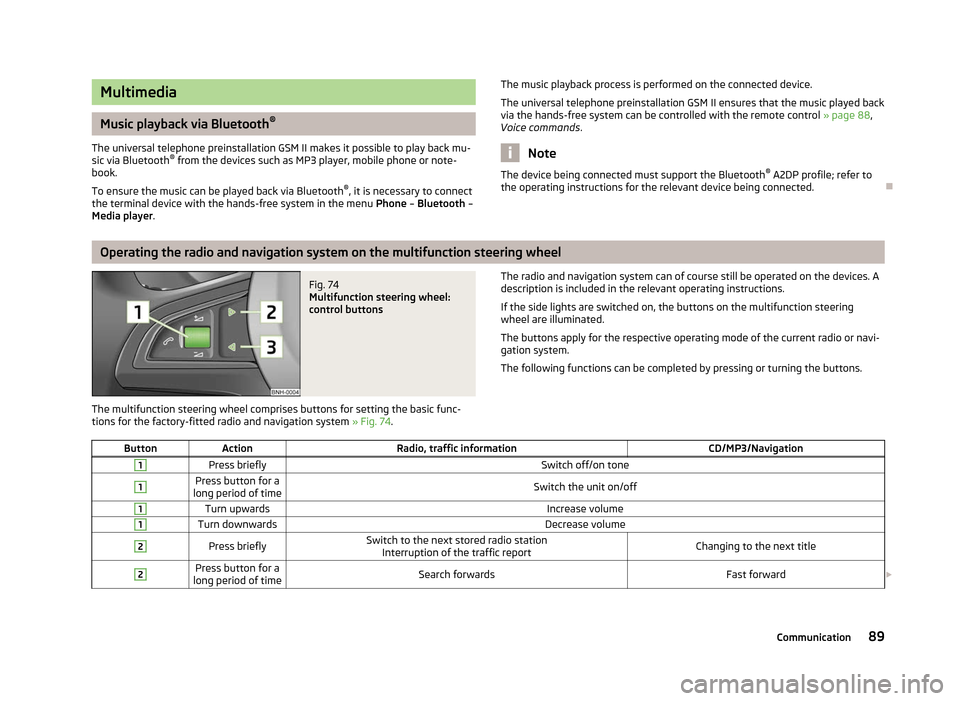
Fig. 74
Multifunction steering wheel:
control buttons
The multifunction steering wheel comprises buttons for setting the basic func-
tions for the factory-fitted radio and navigation system » Fig. 74. The radio and navigation system can of course still be operated on the devices. A
description is included in the relevant operating instructions.
If the side lights are switched on, the buttons on the multifunction steering
wheel are illuminated.
The buttons apply for the respective operating mode of the current radio or navi-
gation system.
The following functions can be completed by pressing or turning the buttons.
Button Action Radio, traffic information CD/MP3/Navigation1
Press briefly
Switch off/on tone1 Press button for a
long period of time Switch the unit on/off1
Turn upwards
Increase volume1
Turn downwards
Decrease volume2
Press briefly
Switch to the next stored radio station
Interruption of the traffic report Changing to the next title2 Press button for a
long period of time Search forwards
Fast forward£ 89
Communication
Page 94 of 180
What influences the driving safety?
First read and observe the introductory information and safety warn-
ings on page 91.
The driver is fully responsible for himself and his occupants. If your driving safety
is effected, you place yourself and the oncoming traffic at risk.
The following guidelines must therefore be observed. › Do not get distracted from concentrating on the traffic situation, e.g. by your
passengers or mobile phone calls.
› Never drive when your driving ability is impaired, e.g. through medication, alco-
hol, drugs.
› Keep to the traffic regulations and the permissible speed limit.
› Always adjust the driving speed to the road, traffic and weather conditions.
› Take regular breaks on long journeys – at least every two hours. ÐCorrect seated position
ä
Introduction
This chapter contains information on the following subjects:
Correct seated position for the driver 93
Correct seated position for the front passenger 93
Correct seated position for the occupants on the rear seats 93
Examples of an incorrect seated position 94
WARNING
■ The front seats and the head restraints must always be adjusted to match
the body size of the seat occupant as well as the seat belts must always be
correctly fastened in order to provide an optimal protection for you and your
occupants.
■ Always assume the correct seated position before setting off and do not
change this position while driving. Also advise your passengers to adopt the
correct seated position and not to change this position while the car is mov-
ing.
ä WARNING (Continued)
■ If the occupant adopts an incorrect seated position, he is exposed to life-
threatening injuries, in case he is hit by a deployed airbag.
■ If the occupants on the rear seats are not sitting upright, the risk of injury is
increased due to incorrect routing of the seat belt.
■ The driver must maintain a distance of at least 25 cm to the steering wheel.
The front passenger must maintain a distance of at least 25 cm to the dash
panel. Not maintaining this minimum distance will mean that the airbag sys-
tem will not be able to properly protect you – hazard!
■ When driving, hold the steering wheel with both hands firmly on the outer
edge in the 9 o'clock and 3
o'clock position. Never hold the steering wheel in
the 12 o'clock position or in any other way (e.g. in the middle or inner edge of
the steering wheel). In such cases, you could severely injure the arms, hands
and head when the driver airbag is deployed.
■ The seat backrests must not be angled too far back when driving otherwise
this will affect proper operation of the seat belts and of the airbag system –
risk of injury!
■ Ensure that there are no objects in the driver's footwell as they may get
caught behind the pedals when driving or applying the braking. You would
then no longer be able to operate the clutch, brake or accelerate.
■ Always keep your feet in the footwell when the car is being driven – never
place your feet on the instrument panel, out of the window or on the surfaces
of the seats. You will be exposed to increased risk of injury if it becomes nec-
essary to apply the brake or in the event of an accident. If an airbag is de-
ployed, you may suffer fatal injuries when adopting an incorrect seated posi-
tion! Ð
92 Safety
Page 95 of 180

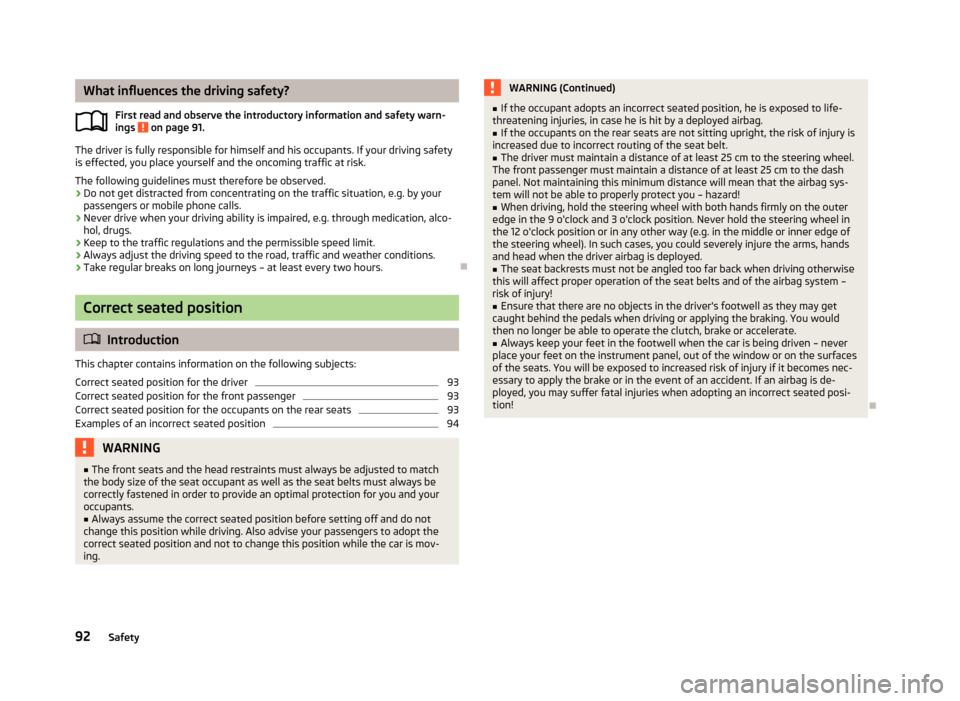
Correct seated position for the driver
Fig. 76
The correct distance of the driver to the steering wheel/The correct
head restraint adjustment
First read and observe the introductory information and safety warn-
ings on page 92.
For your own safety and to reduce the risk of injury in the event of an accident,
we recommend the following setting.
› Adjust the steering wheel so that the distance A
» Fig. 76 between the steer-
ing wheel and your chest is at least 25 cm.
› Adjust the driver’s seat in the forward/back direction so that the pedals can be
fully depressed with slightly bent legs.
› Adjust the seat backrest so that the highest point of the steering wheel can be
reached with your arms at a slight angle.
› Adjust the head restraint so that the top edge B
of the head restraint is at the
same level as the upper part of your head 1)
.
› Correctly fasten the seat belt
» page 95, Seat belts.
Driver seat adjustment » page 45, Adjusting the front seats .ÐCorrect seated position for the front passenger
First read and observe the introductory information and safety warn-
ings on page 92.ä
ä For the safety of the front passenger and to reduce the risk of injury in the event
of an accident, we recommend the following setting.
› Position the front passenger seat back as far as possible. The front passenger
must maintain a distance of at least 25 cm to the dash panel so that the airbag
offers the greatest possible safety if it is deployed.
› Adjust the head restraint so that the top edge B
» Fig. 76 on
page 93 » page 93 of the head restraint is at the same level as the upper part of
your head 1)
.
› Correctly fasten the seat belt
» page 95, Seat belts.
In exceptional cases the front passenger airbag can be deactivated » page 103,
Deactivating airbags .
Front passenger adjustment » page 45, Adjusting the front seats .Ð Correct seated position for the occupants on the rear seats
First read and observe the introductory information and safety warn-
ings on page 92.
To reduce the risk of injury in the event of a sudden braking manoeuvre or an ac-
cident, the occupants on the rear seats must observe the following.
› Adjust the head restraint so that the top edge B
» Fig. 76 on
page 93 » page 93 of the head restraint is at the same level as the upper part of
your head.
› Correctly fasten the seat belt
» page 95, Seat belts.
› Use a suitable child restraint system if transporting children in the vehi-
cle » page 105, Transporting children safely .Ð
ä
1)
Not valid for sports seat.
93
Passive Safety
Page 98 of 180

WARNING (Continued)
■ The seat belts for the rear seats can only fulfil their function reliably when
the seat backrests are correctly locked into position » page 47.
■ The belt webbing must always be kept clean. Soiled belt webbing may im-
pair proper operation of the inertia reel » page 123.
■ The seat belts must not be removed or changed in any way. Do not attempt
to repair the seat belts yourself. ■ Check the condition of all the seat belts on a regular basis. If any damage to
the seat belts, seat belt tongue, inertia reel or the lock is detected, the rele-
vant seat belt must be replaced by a specialist garage.
■ Damaged seat belts which have been subjected to stress in an accident and
were therefore stretched, must be replaced – this is best done by a specialist
garage. The anchorage points of the belts must also be inspected. The an-
chorage points for the belts should also be checked. Note
The national legal requirements must be observed when using seat belts. ÐThe physical principle of a frontal collision
Fig. 78
Driver without a fastened seat belt/rear seat passenger without a
fastened seat belt
First read and observe the introductory information and safety warn-
ings on page 95.
The physical principle of a frontal collision can be explained quite simply.
ä As soon as the vehicle is moving, so-called kinetic energy (the energy of motion)
is produced both in terms of the car as well as in terms of the occupants. The
magnitude of this kinetic energy depends essentially on the speed at which the
vehicle is travelling and on the weight of the vehicle including the occupants. The
greater the speed and weight increase, the greater the amount of energy which
has to be absorbed in the event of an accident.
The speed of the vehicle is, nevertheless, the most important factor. Doubling the
speed of the vehicle from 25
km/h up to 50 km/hour increases the kinetic energy
four times.
The common opinion that it is possible to support your body in a minor accident
with your hands, is incorrect. Even in a collision at only a low speed, the forces
acting on the body are such that it is no longer possible to support your body.
Even if you only drive at a speed of 30 km/h to 50 km/h, the forces that your body
is exposed to in the event of an accident can exceed a tonne (1 000 kg).
In the event of a frontal collision, occupants of the car not wearing a seat belt, are
thrown forward and strike in an uncontrolled way parts of the interior of the car,
such as steering wheel, dash panel or windscreen » Fig. 78 – . In certain circum-
stances you could even be thrown out of the vehicle, which could cause life
threatening or even fatal injuries.
It is also important that rear seat occupants fasten their seat belts as they will
otherwise be thrown through the vehicle in an uncontrolled manner in the event
of an accident A rear seat passenger who has not fastened the seat belt is a dan-
ger not only to himself but also for those seated at the front » Fig. 78 – . Ð
96 Safety
Page 101 of 180

Airbag system
Description of the airbag system
Introductory information
The operational readiness of the airbag system is monitored electronically. The
airbag warning light comes on for a few seconds each time the ignition is
switched on »
page 22.
The airbags inflate in fractions of a second and at a high speed to offer additional
protection in the event of an accident.
The airbag system (according to vehicle equipment) consists of: › an electronic control unit;
› Front airbags for the driver and front seat passenger
» page 100;
› side airbags » page 101;
› head airbags
» page 102;
› an airbag warning light in the instrument cluster
» page 22;
› a key switch for the front seat passenger airbag
» page 103;
› an warning light in the middle of the dash panel to indicate the front seat pas-
senger airbag is switched off » page 103.
A fault in the airbag system exists if:
› the warning light
does not illuminate when the ignition is switched on;
› the warning light
does not go out 4 seconds after the ignition is switched on;
› the warning light
goes out and comes on again after the ignition is switched
on;
› the warning light
comes on or flashes when driving;
› the warning light in the middle of the dash panel for the deactivated front seat
passenger airbag flashes. WARNING
■ The airbag is not a substitute for the seat belt, but instead forms part of the
complete passive vehicle safety concept. Please note that an airbag can only
offer you optimal protection in combination with a seat belt which is fas-
tened.
■ To ensure passengers are protected with the greatest possible effect when
the airbag is deployed, the front seats must be correctly adjusted to match
the body size »
page 92, Correct seated position .
■ If you do not fasten the seat belts when driving, lean too far forward or
adopt an incorrect seated position, you are exposing yourself to increased risk
of injury in the event of an accident. ■ If there is a fault, have the airbag system checked immediately by a ŠKODA
specialist garage. Otherwise, there is a risk of the airbag not being activated in
the event of an accident. ■ No modifications of any kind must be made to parts of the airbag system.
Any work on the airbag system including the installation and removal of sys-
tem components due to other repair work (e.g. removal of the steering wheel)
must only be carried out by a
ŠKODA specialist garage.
■ Never make any changes to the front bumper or bodywork.
■ It is prohibited to manipulate individual parts of the airbag system as this
might result in the airbag being deployed. ■ The protective function of the airbag system is sufficient for only one acci-
dent. The airbag system must then be replaced if the airbag has been de-
ployed.
■ The airbag system needs no maintenance during its working life.
■ If you sell your vehicle, provide the complete vehicle documentation to the
new owner. Please note that the information relating to the possibility of de-
activating the front passenger airbag must be included! ■ When disposing of vehicle or parts of the airbag system, it is important to
comply with the national legal requirements. Ð When are the airbags deployed?
The airbag system is only functional when the ignition is switched on.
In certain accident situations, the several airbags may be deployed simultaneous-
ly.
The airbags are not deployed in the case of minor frontal and side collisions, rear-
end collisions, tilting of the vehicle and vehicle rollover. £
99
Airbag system
Page 102 of 180

Deployment factors
It is not possible to generally determine which deployment conditions apply to
the airbag system in every situation. An important role is played by factors such
as the type of object that the vehicle hits (hard, soft), the impact angle, vehicle
speed, etc.
A decisive factor for the deployment of the airbags is the deceleration which oc-
curs. The control unit analyses the nature of the collision and activates the rele-
vant restraint system. If the vehicle deceleration which occurs and is measured
during the collision remains below the prescribed reference values specified in
the control unit, the airbags are not deployed although the vehicle may well suf-
fer severe damage to the bodywork as a consequence of the accident.
The following will be deployed in the event of a severe frontal collision:
› driver’s front airbag;
› passenger’s front airbag.
The following will be deployed in the event of a severe side collision: › front side airbag on the side of the accident;
› head airbags on the side of the accident.
In the event of an accident in which the airbags are deployed:
› the interior lighting comes on (if the switch for the interior light is in the door
contact position),
› the hazard warning light is switched on;
› all the doors are unlocked;
› the fuel supply to the engine is interrupted. Note
A grey white or red, non-harmful gas is released when the airbag is inflated. This
is perfectly normal and is not an indication of a fire in the vehicle. Ð Front airbags
Fig. 82
Driver airbag in the steering wheel/front passenger airbag in the
dashboard Fig. 83
Safe distance to steering wheel/inflated airbags.
In the event of a severe frontal collision, the front airbag system offers additional
protection for the head and chest area of the driver and front passenger.
The front airbag for the driver is housed in the steering wheel » Fig. 82 – .
The front airbag for the front seat passenger is located in the dash panel above
the stowage compartment
– » Fig. 82.
If the airbags are deployed, the airbags are filled with a propellant gas and infla-
ted in front of the driver and front passenger » Fig. 83 – . The forward move-
ment of the driver and of the front passenger is cushioned when they make con-
tact with the fully inflated airbag and the risk of injury to head and chest is thus
reduced. £
100 Safety
Page 103 of 180
The airbag allows the gas to flow out of the inflated airbag in a controlled manner
(depending on the load of the particular car occupant) in order to cushion head
and chest areas. The airbag then deflates subsequently to such an extent, after
an accident, to again provide a clear view forward.
WARNING
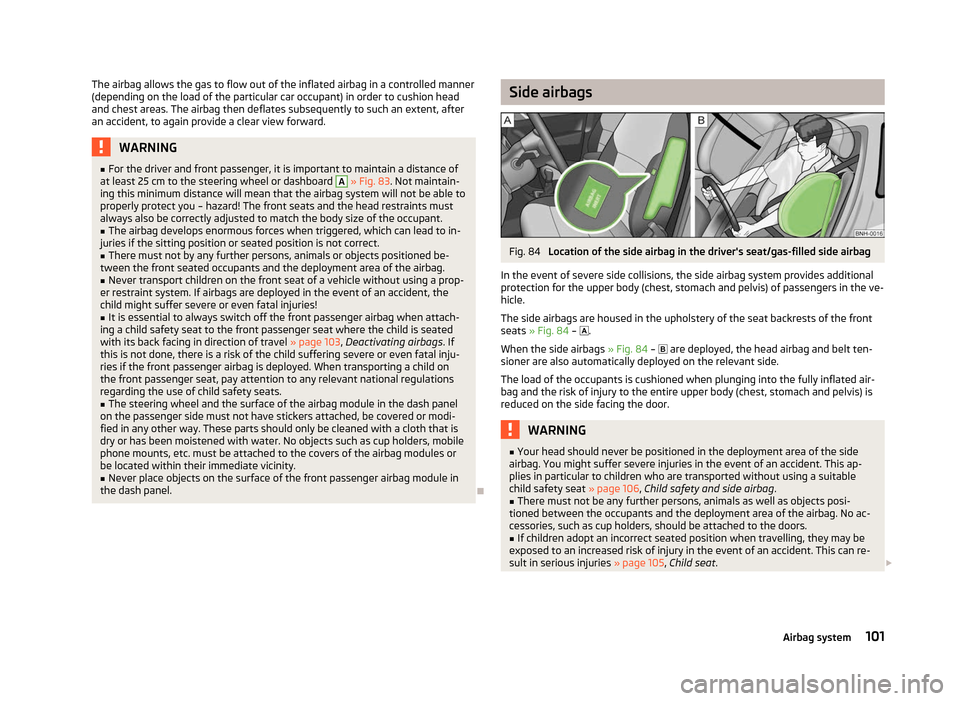
■ For the driver and front passenger, it is important to maintain a distance of
at least 25 cm to the steering wheel or dashboard A
» Fig. 83. Not maintain-
ing this minimum distance will mean that the airbag system will not be able to
properly protect you – hazard! The front seats and the head restraints must
always also be correctly adjusted to match the body size of the occupant.
■ The airbag develops enormous forces when triggered, which can lead to in-
juries if the sitting position or seated position is not correct.
■ There must not by any further persons, animals or objects positioned be-
tween the front seated occupants and the deployment area of the airbag. ■ Never transport children on the front seat of a vehicle without using a prop-
er restraint system. If airbags are deployed in the event of an accident, the
child might suffer severe or even fatal injuries!
■ It is essential to always switch off the front passenger airbag when attach-
ing a child safety seat to the front passenger seat where the child is seated
with its back facing in direction of travel » page 103, Deactivating airbags. If
this is not done, there is a risk of the child suffering severe or even fatal inju-
ries if the front passenger airbag is deployed. When transporting a child on
the front passenger seat, pay attention to any relevant national regulations
regarding the use of child safety seats.
■ The steering wheel and the surface of the airbag module in the dash panel
on the passenger side must not have stickers attached, be covered or modi-
fied in any other way. These parts should only be cleaned with a cloth that is
dry or has been moistened with water. No objects such as cup holders, mobile
phone mounts, etc. must be attached to the covers of the airbag modules or
be located within their immediate vicinity.
■ Never place objects on the surface of the front passenger airbag module in
the dash panel. Ð Side airbags
Fig. 84
Location of the side airbag in the driver's seat/gas-filled side airbag
In the event of severe side collisions, the side airbag system provides additional
protection for the upper body (chest, stomach and pelvis) of passengers in the ve-
hicle.
The side airbags are housed in the upholstery of the seat backrests of the front
seats » Fig. 84 – .
When the side airbags » Fig. 84 – are deployed, the head airbag and belt ten-
sioner are also automatically deployed on the relevant side.
The load of the occupants is cushioned when plunging into the fully inflated air-
bag and the risk of injury to the entire upper body (chest, stomach and pelvis) is
reduced on the side facing the door. WARNING
■ Your head should never be positioned in the deployment area of the side
airbag. You might suffer severe injuries in the event of an accident. This ap-
plies in particular to children who are transported without using a suitable
child safety seat » page 106, Child safety and side airbag .
■ There must not be any further persons, animals as well as objects posi-
tioned between the occupants and the deployment area of the airbag. No ac-
cessories, such as cup holders, should be attached to the doors. ■ If children adopt an incorrect seated position when travelling, they may be
exposed to an increased risk of injury in the event of an accident. This can re-
sult in serious injuries » page 105, Child seat. £
101
Airbag system
Page 105 of 180

Deactivating airbags
Deactivating airbags
Deactivation of airbags is envisaged only for particular instances, such as if:
› using a child seat on the front passenger seat, in which the child has its back to
the vehicle's direction of travel (in some countries this must be in the direction
of travel due to different legal regulations applying) » page 105, Child seat ;
› not being able to maintain a distance of at least 25
cm between the middle of
the steering wheel and chest, despite the driver's seat being correctly adjusted;
› special attachments are required in the area of the steering wheel because of a
physical disability;
› other seats have been installed (e.g. orthopaedic seats without side airbags).
The front passenger airbag can be switched off with the key-operated
switch » page 103.
We recommend that you ask a ŠKODA Service Partner to switch off any other air-
bags.
Monitoring the airbag system
The functionality of the airbag system is also monitored electronically when one
airbag has been switched off.
If the airbag was switched off using diagnostic equipment:
› The airbag indicator light
lights up for around 4 seconds after the ignition is
switched on and then flashes for around 12 seconds.
If the airbag was switched off using the key switch on the side of the dash pan-
el:
› The airbag warning light
comes on for around 4 seconds after the ignition is
switched on;
› Airbags that are switched off are indicated in the middle of the dashboard by
the indicator light
in the display » Fig. 86 on page 103 3
.
Note
■ The national regulations for switching off airbags must be observed.
■ A ŠKODA Service Partner will be able to inform you which airbags in your vehicle
can/must be deactivated. Ð Key switch for the front seat passenger airbag
Fig. 86
Key-operated switch for the front passenger airbag/warning light
for front seat passenger airbag deactivation
Only the front passenger airbag is deactivated with the key switch.
Deactivating an airbag › Switch off the ignition.
› Open the storage box on the front passenger's side.
› Use the key to turn the slot of the key switch into position 2
» Fig. 86 OFF.
› Check whether the airbag indicator light 3
in the display
in the middle of the dash panel lights up when the ignition is turned on.
Activating an airbag
› Switch off the ignition.
› Use the key to turn the slot of the key switch into position 1
» Fig. 86 ON
.
› Close the storage box on the front passenger's side.
› Check whether the airbag indicator light 3
in the display
in the middle of the dash panel does not light up when the ignition is turned
on.
Indicator light in the display (front passenger airbag
switched off)
In cases where the front passenger airbag is switched off the airbag indicator
light comes on for a few seconds after switching on the ignition, goes out for
about a second and then comes on again.
There is a system fault in the deactivated airbag » if the airbag warning light
flashes. Immediately visit a ŠKODA specialist garage. £
103
Airbag system
Page 117 of 180

Towing a trailer
Towing a trailer
Technical requirements
If your vehicle has already been factory-fitted with a towing device or is fitted
with a towing device from ŠKODA Original Accessories, then it meets all of the
technical requirements and national legal provisions for towing a trailer.
On vehicles with a towing device, the ball rod is detachable and is stowed togeth-
er with separate operating instructions in the spare wheel well or in the compart-
ment for the spare wheel within the boot » page 145, Vehicle tool kit .
Your vehicle is fitted with a 13-pin power socket for the electrical connection be-
tween the vehicle and trailer. If the trailer that is to be towed has a 7-pin connec-
tor, you can use a suitable adapter from
ŠKODA Original Accessories.
If a towing device is retrofitted, it must be completed in accordance with the
manufacturer's specifications. Note
If you have any questions, please contact a ŠKODA Service Partner. ÐLoading a trailer
Loading a trailer
The vehicle/trailer combination must be balanced, whereby the maximum permis-
sible drawbar load must be utilised. If the drawbar load is too low, it jeopardises
the performance of the vehicle/trailer combination.
Distribution of the load
Distribute the load in the trailer in such a way that heavy items are located as
close to the axle as possible. Secure the items from slipping.
The distribution of the weight is very poor if your vehicle is unladen and the trail-
er is laden. Maintain a particularly low speed if you cannot avoid driving with this
combination. Tyre pressure
Correct the tyre inflation pressure on your vehicle for a
“full load” » page 138 ,
Service life of tyres.
Trailer load
The permissible trailer load must not be exceeded under any circumstan-
ces » page 164 , Technical data .
The trailer loads specified apply only to altitudes up to 1 000 metres above mean
sea level. As the engine output drops at an increasing altitude due to the declin-
ing air pressure and therefore the climbing ability is also reduced, this means that
the maximum permissible towed weight must be reduced by 10 % for every fur-
ther increase of 1 000 m in height. The towed weight comprises the actual weight
of the (loaded) towing vehicle and the (loaded) trailer. Always drive particularly
carefully with the trailer.
The trailer and drawbar load information on the type plate of the towing device
are merely test data for the towing device The vehicle-specific values are detailed
in the vehicle documents. WARNING
■ If the maximum permissible axle and drawbar load and the maximum per-
missible total or towed weight of the vehicle and the trailer are exceeded this
can cause accidents and serious injuries.
■ Slipping loads can significantly affect the stability and safety of the vehicle/
trailer combination, causing accidents and serious injuries. Ð Towing a trailer
Exterior mirrors
You have to have additional exterior mirrors fitted if you are not able to see the
traffic behind the trailer with the standard rear-view mirrors. The national legal
requirements must be observed.
Headlights
The headlight settings must be checked before starting a journey with a coupled
trailer. If necessary, adjust the settings with the headlight beam adjust-
ment » page 36 , Headlamp range adjustment .
Driving speed
For safety reasons, do not drive faster than the maximum permissible speed indi-
cated on the trailer. £
115
Towing a trailer