lock SKODA RAPID 2012 1.G Repair Manual
[x] Cancel search | Manufacturer: SKODA, Model Year: 2012, Model line: RAPID, Model: SKODA RAPID 2012 1.GPages: 180, PDF Size: 4.36 MB
Page 153 of 180

›
Use the valve remover 1
to unscrew the valve core and place it on a clean sur-
face (rag, paper, etc.). ÐSealing and inflating tyres
First read and observe the introductory information and safety warn-
ings on page 149.
Sealing
›
Forcefully shake the tyre inflator bottle 10
» Fig. 116 on page 150 several times.
› Firmly screw the inflation hose 3
onto the tyre inflator bottle 10
in a clockwise
direction. The film on the cap is pierced automatically.
› Remove the plug from the inflation hose 3
and plug the open end fully onto
the tyre valve.
› Hold the bottle 10
with the bottom facing upwards and fill all of the sealing
agent from the tyre inflator bottle into the tyre.
› Remove the empty tyre inflator bottle from the valve.
› Screw the valve core back into the tyre valve using the valve remover 1
.
Inflating
› Screw the tyre inflation hose 5
» Fig. 116 on page 150 of the air compressor
firmly onto the tyre valve.
› Check that the air release valve 7
is closed.
› Start the engine and run it in idle.
› Plug the connector 9
into 12 Volt socket »
page 54, 12-volt power socket.
› Switch on the air compressor with the ON and OFF switch 8
.
› Allow the air compressor to run until a pressure of 2.0 - 2.5 bar is achieved.
Maximum run time of 8 minutes » !
› Switch off the air compressor.
› If you cannot reach an air pressure of 2.0 – 2.5 bar, unscrew the tyre inflation
hose 5
from the tyre valve.
› Drive the vehicle 10 metres forwards or backwards to allow the sealing agent to
“distribute” in the tyre.
› Firmly screw the tyre inflation hose 5
back onto the tyre valve and repeat the
inflation process.
› If you cannot reach the required tyre inflation pressure here either, this means
the tyre has sustained too much damage. You cannot seal with tyre with the
breakdown kit » .
› Switch off the air compressor.
› Remove the tyre inflation hose 5
from the tyre valve.
Once a tyre inflation pressure of 2.0
– 2.5 bar is achieved, continue the journey at
a maximum speed of 80 km/h (50 mph). ä
Check the tyre inflation pressure after driving for 10 minutes
» page 151. WARNING
■ During inflation, the tyre inflation hose and air compressor may get hot- risk
of injury! ■ Do not place the hot tyre inflation hose or hot air compressor on flammable
materials – risk of fire!
■ If you cannot inflate the tyre to at least 2.0 bar, this means the damage sus-
tained was too serious. The sealing agent cannot be used to seal the tyre.
Do not drive the vehicle. Get professional assistance! CAUTION
Switch off the air compressor after running 8 minutes at the latest – danger of
overheating! Allow the air compressor to cool a few minutes before switching it
on again. Ð Check after driving for 10 minutes
First read and observe the introductory information and safety warn-
ings on page 149.
Check the tyre inflation pressure after driving for 10 minutes!
If the tyre inflation pressure is 1.3 bar or less:
›
Do not drive the vehicle! You cannot properly seal with tyre with the break-
down kit.
› Get professional assistance.
If the tyre inflation pressure is 1.3 bar or more:
› Adjust the tyre inflation pressure to the correct value (see inside of fuel filler
cap).
› Continue driving carefully to the nearest ŠKODA specialist garage at a maxi-
mum speed of 80 km/h (50 mph). Ð
ä
151
Do-it-yourself
Page 154 of 180

Jump-starting
ä
Introduction
This chapter contains information on the following subjects:
Jump-starting 152
Jump-starting in vehicles with the START-STOP system 153
The battery of another vehicle can be used to jump-start your vehicle if the en-
gine will not start because the battery is flat. Jump-start cables are required for
this purpose.
Both batteries must have a rated voltage of 12 V. The capacity (Ah) of the battery
supplying the power must not be significantly less than the capacity of the dis-
charged battery in your vehicle.
Jump-start cables
Only use jump-start cables which have an adequately large cross-section and in-
sulated terminal clamps. Observe the manufacturer's instructions.
Positive cable – colour coding in the majority of cases is red.
Negative cable – colour coding in the majority of cases is black.WARNING
■ A discharged vehicle battery may already freeze at temperatures just below
0 °C. In case of frozen battery carry out no jump-starting – risk of explosion!
■ Pay attention to the warning instructions relating to working in the engine
compartment » page 126, Engine compartment .
■ The non-insulated parts of the terminal clamps must never make contact
with each other. In addition, the jump-start cable connected to the positive
terminal of the battery must not come into contact with electrically conduct-
ing parts of the vehicle – risk of short circuit!
■ Do not clamp the jump-start cable to the negative terminal of the dis-
charged battery. There is the risk of detonating gas seeping out the battery
being ignited by the strong spark which results from the engine being started. ■ Route the jump-start cables so that they cannot be caught by any rotating
parts in the engine compartment. ■ Do not bend over the battery – risk of caustic burns!
■ The vent screws of the battery cells must be tightened firmly. WARNING (Continued)
■ Keep any sources of ignition (naked flame, smouldering cigarettes, etc.)
away from the battery – risk of an explosion!
■ Never jump-start vehicle batteries with an electrolyte level that is too low –
risk of explosion and caustic burns. Note
■ There must not be any contact between the two vehicles otherwise current
may flow as soon as the negative terminals are connected. ■ The discharged battery must be properly connected to the system of the vehi-
cle. ■ We recommend you buy jump-start cables from a car battery specialist. Ð Jump-starting
Fig. 117
Jump-starting using the battery
from another vehicle: A – flat ve-
hicle battery, B – battery provid-
ing current
First read and observe the introductory information and safety warn-
ings on page 152.
The jump-start cables must be attached in the following sequence.
Connecting positive terminals
›
Attach one end 1
» Fig. 117 to the positive terminal of the discharged battery
A
.
› Attach the other end 2
to the positive terminal of the battery supplying the
power B
.
Connecting negative terminal and engine block
› Attach one end 3
»
Fig. 117 to the negative terminal of the battery supplying
the power B
.
£
ä
152 Do-it-yourself
Page 155 of 180

›
Attach the other end 4
to a solid metal part which is connected firmly to the
engine block, or to the engine block itself.
Starting engine
› Start the engine on the vehicle providing the power and allow it to idle.
› Now start the engine of the vehicle with the discharged battery.
› If the engine does not start, terminate the attempt to start the engine after
10 seconds and wait for about 30 seconds before repeating the process.
› Disconnect the cables in exactly the
reverse order to the one described above. ÐJump-starting in vehicles with the START-STOP system
Fig. 118
Jump-starting – START-STOP system
First read and observe the introductory information and safety warn-
ings on page 152.
On vehicles with the START-STOP system, the jump-start cable of the charger
must never be connected directly to the negative pole of the vehicle battery, but
only to the engine earth.
› 1.2 ltr./63
kW TSI and 1.2 ltr./77 kW TSI engines » Fig. 118 -
› 1.4 ltr./90 kW engine
» Fig. 118 -
› 1.6 ltr./77 kW TDI CR engine
» Fig. 118 - Ð
ä Towing the vehicle
ä
Introduction
This chapter contains information on the following subjects:
Front towing eye 154
Rear towing eye 155
Vehicles with manual transmission can be towed in with a tow bar or a tow rope
or with the front or rear wheels raised.
Vehicles with automatic transmission can be towed in with a tow bar or a tow
rope or with the front wheels raised. If the vehicle is raised at rear, the automatic
gearbox is damaged!
A tow bar is the safest way of towing a vehicle and also minimises any shocks.
Only use a tow rope if a suitable tow bar is not available.
When towing, the following guidelines must be observed.
Driver of the tow vehicle
› Release the clutch particularly gently when starting off or depress the accelera-
tor particularly gently if the vehicle is fitted with an automatic gearbox.
› On vehicles with a manual transmission, only push down on the accelerator
pedal once the rope is taught.
The maximum towing speed is 50 km/h.
Driver of the towed vehicle
› Switch on the ignition so that the steering wheel is not blocked and so that the
turn signal lights, horn, windscreen wipers and windscreen washer system can
be switched on.
› Take the vehicle out of gear or move the selector lever into position
N if the
vehicle is fitted with an automatic gearbox.
Please note that the brake servo unit and power steering only operate if the en-
gine is running. If the engine is not running, significantly more physical force is re-
quired to depress the brake pedal and steer the vehicle.
If using a tow rope, ensure that it is always kept taught. £
153
Do-it-yourself
Page 159 of 180
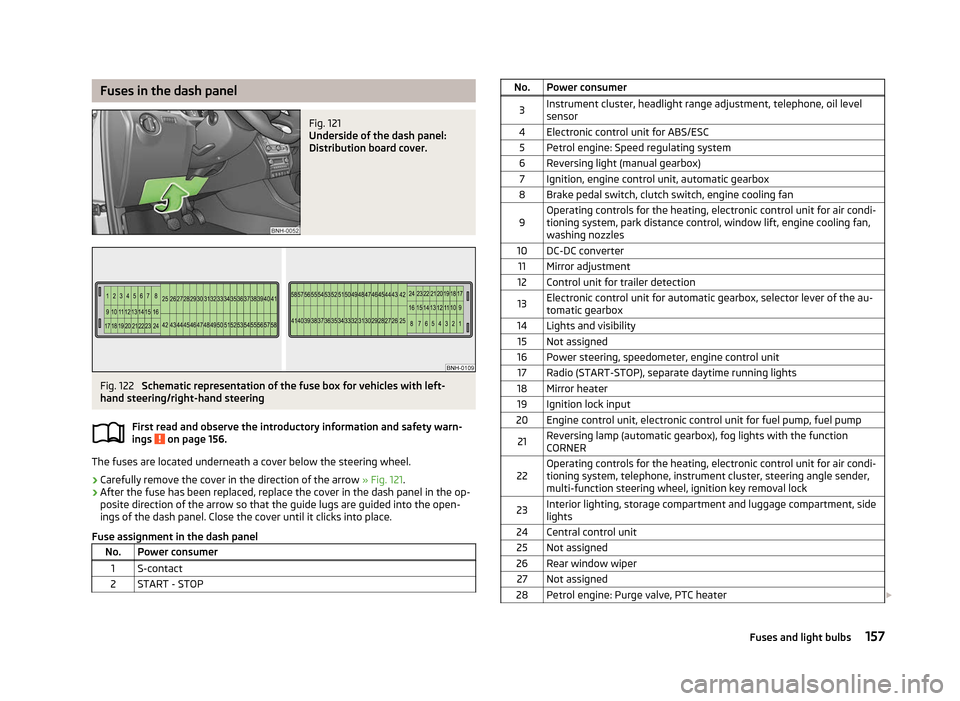
Fuses in the dash panel
Fig. 121
Underside of the dash panel:
Distribution board cover. Fig. 122
Schematic representation of the fuse box for vehicles with left-
hand steering/right-hand steering
First read and observe the introductory information and safety warn-
ings on page 156.
The fuses are located underneath a cover below the steering wheel.
› Carefully remove the cover in the direction of the arrow
» Fig. 121.
› After the fuse has been replaced, replace the cover in the dash panel in the op-
posite direction of the arrow so that the guide lugs are guided into the open-
ings of the dash panel. Close the cover until it clicks into place.
Fuse assignment in the dash panel No. Power consumer
1 S-contact
2 START - STOP ä No. Power consumer
3 Instrument cluster, headlight range adjustment, telephone, oil level
sensor
4 Electronic control unit for ABS/ESC 5 Petrol engine: Speed regulating system
6 Reversing light (manual gearbox) 7 Ignition, engine control unit, automatic gearbox
8 Brake pedal switch, clutch switch, engine cooling fan
9 Operating controls for the heating, electronic control unit for air condi-
tioning system, park distance control, window lift, engine cooling fan,
washing nozzles
10 DC-DC converter 11 Mirror adjustment
12 Control unit for trailer detection
13 Electronic control unit for automatic gearbox, selector lever of the au-
tomatic gearbox
14 Lights and visibility 15 Not assigned
16 Power steering, speedometer, engine control unit 17 Radio (START-STOP), separate daytime running lights
18 Mirror heater 19 Ignition lock input
20 Engine control unit, electronic control unit for fuel pump, fuel pump
21 Reversing lamp (automatic gearbox), fog lights with the function
CORNER
22 Operating controls for the heating, electronic control unit for air condi-
tioning system, telephone, instrument cluster, steering angle sender,
multi-function steering wheel, ignition key removal lock
23 Interior lighting, storage compartment and luggage compartment, side
lights
24 Central control unit 25 Not assigned
26 Rear window wiper 27 Not assigned
28 Petrol engine: Purge valve, PTC heater £ 157
Fuses and light bulbs
Page 160 of 180
No. Power consumer
29 Injection, coolant pump
30 Fuel pump, ignition system, cruise control 31 Lambda probe
32 High pressure fuel pump, pressure valve
33 Engine control unit
34 Engine control unit, vacuum pump
35 Switch illumination, number plate light, parking light, headlamp washer
system
36 Main beam 37 Rear fog light, DC-DC converter
38 Fog lights 39 Air blower for heating
40 Not assigned 41 Heated front seats
42 Rear window heater
43 Horn
44 Windscreen wipers 45 Boot lid lock, central locking system
46 Alarm 47 Cigarette lighter, power socket in the luggage compartment
48 ABS 49 Turn signal lights, brake lights50 DC-DC converter, radio 51 Electric windows (driver's window and rear left window)
52 Electric windows (front passenger's window and rear right)
53 Windscreen washer
54 START-STOP instrument cluster, steering wheel module, multi-function
steering wheel
55 Control unit for automatic gearbox
56 Headlight cleaning system 57 Low beam on the left
58 Low beam on the right Ð Fuses in the engine compartment
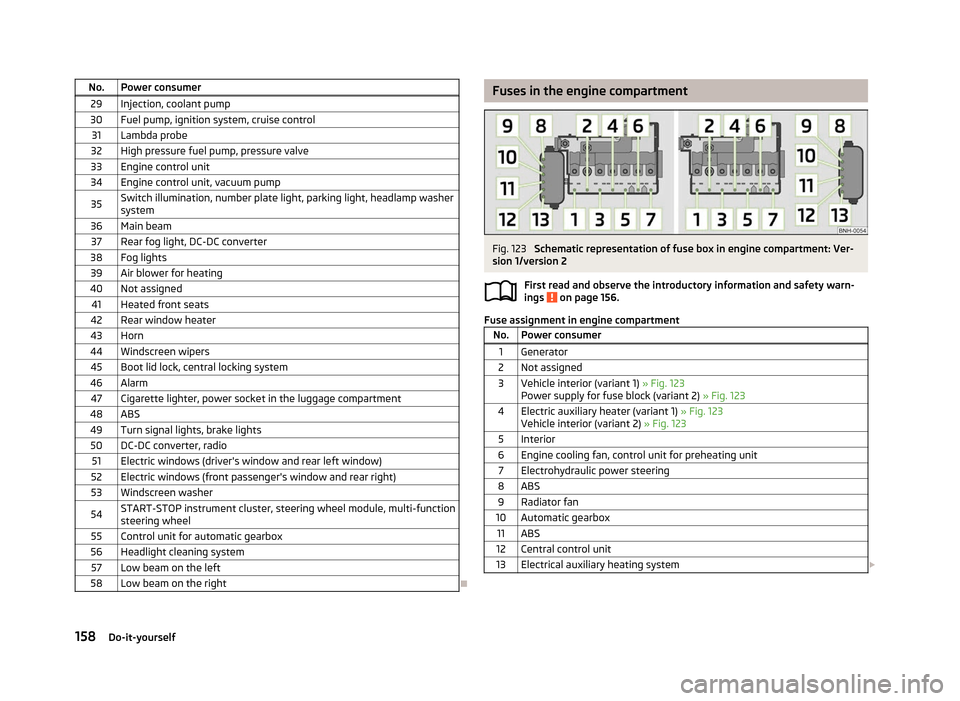
Fig. 123
Schematic representation of fuse box in engine compartment: Ver-
sion
1/version 2
First read and observe the introductory information and safety warn-
ings on page 156.
Fuse assignment in engine compartment
No. Power consumer
1 Generator
2 Not assigned
3 Vehicle interior (variant 1) » Fig. 123 Power supply for fuse block (variant
2) » Fig. 123
4 Electric auxiliary heater (variant 1) » Fig. 123 Vehicle interior (variant
2) » Fig. 123
5 Interior
6 Engine cooling fan, control unit for preheating unit 7 Electrohydraulic power steering
8 ABS 9 Radiator fan
10 Automatic gearbox 11 ABS
12 Central control unit
13 Electrical auxiliary heating system £ ä
158 Do-it-yourself
Page 161 of 180
Note
Fuses 1 - 7 are replaced by a specialist ŠKODA garage. ÐReplacing the fuses in the engine compartment
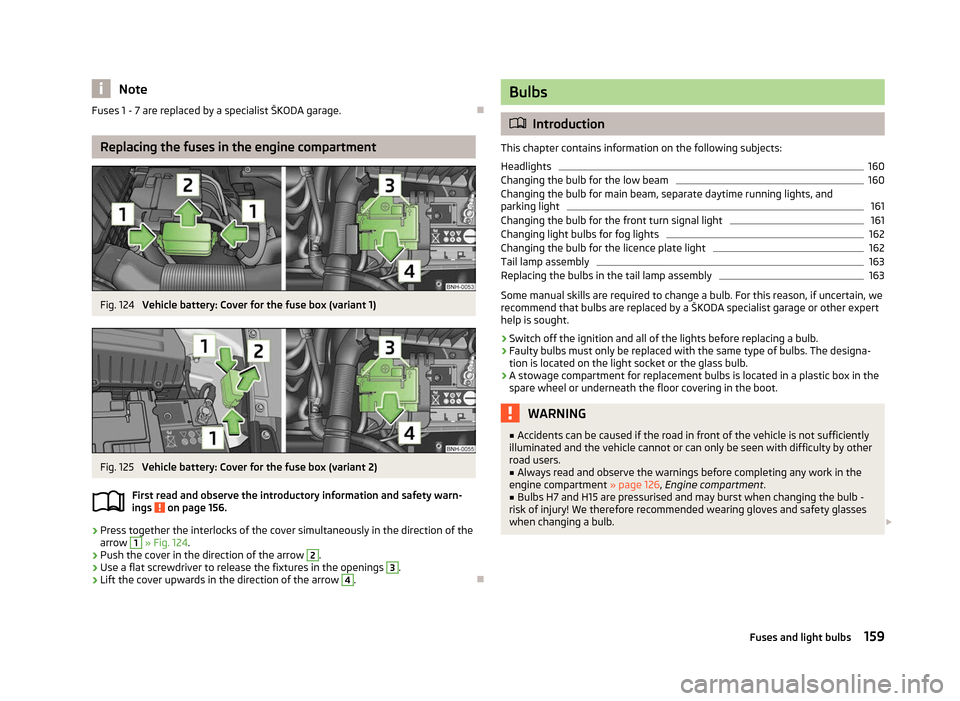
Fig. 124
Vehicle battery: Cover for the fuse box (variant 1) Fig. 125
Vehicle battery: Cover for the fuse box (variant 2)
First read and observe the introductory information and safety warn-
ings on page 156.
›
Press together the interlocks of the cover simultaneously in the direction of the
arrow 1
» Fig. 124.
› Push the cover in the direction of the arrow 2
.
› Use a flat screwdriver to release the fixtures in the openings 3
.
› Lift the cover upwards in the direction of the arrow 4
.
Ð
ä Bulbs
ä
Introduction
This chapter contains information on the following subjects:
Headlights 160
Changing the bulb for the low beam 160
Changing the bulb for main beam, separate daytime running lights, and
parking light 161
Changing the bulb for the front turn signal light 161
Changing light bulbs for fog lights 162
Changing the bulb for the licence plate light 162
Tail lamp assembly 163
Replacing the bulbs in the tail lamp assembly 163
Some manual skills are required to change a bulb. For this reason, if uncertain, we
recommend that bulbs are replaced by a ŠKODA specialist garage or other expert
help is sought.
› Switch off the ignition and all of the lights before replacing a bulb.
› Faulty bulbs must only be replaced with the same type of bulbs. The designa-
tion is located on the light socket or the glass bulb.
› A stowage compartment for replacement bulbs is located in a plastic box in the
spare wheel or underneath the floor covering in the boot. WARNING
■ Accidents can be caused if the road in front of the vehicle is not sufficiently
illuminated and the vehicle cannot or can only be seen with difficulty by other
road users.
■ Always read and observe the warnings before completing any work in the
engine compartment »
page 126, Engine compartment .
■ Bulbs H7 and H15 are pressurised and may burst when changing the bulb -
risk of injury! We therefore recommended wearing gloves and safety glasses
when changing a bulb. £
159
Fuses and light bulbs
Page 163 of 180

Changing the bulb for main beam, separate daytime running
lights, and parking light
Fig. 128
Changing the bulb for main beam, separate daytime running lights,
and parking light
First read and observe the introductory information and safety warn-
ings on page 159.
Removing and replacing the bulb for main beam and separate daytime running
lights
›
Remove the rubber cover B
» Fig. 126 on page 160
» page 160.
› Turn the bulb holder A
» Fig. 128 anti-clockwise
up to the stop and remove.
› Replace the bulb, insert the bulb holder with the new bulb and turn in a
clock-
wise direction to the stop.
› Insert the rubber cover.
Removing and replacing the bulb for the parking light
› Remove the rubber cover B
» Fig. 126 on page 160
» page 160.
› Remove the socket C
» Fig. 128
together with the bulb with loosening move-
ments.
› Remove the faulty bulb from the bulb holder C
in the direction of the arrow.
› Insert a new bulb in the bulb holder up to the stop.
› Replace the bulb holder in the headlamp with the bulb.
› Insert the rubber cover. Ð
ä Changing the bulb for the front turn signal light
Fig. 129
Changing the bulb for the turn
signal light
First read and observe the introductory information and safety warn-
ings on page 159.
›
Turn the socket with the bulb
» Fig. 129 anti-clockwise up to the stop and re-
move.
› Replace the bulb, insert the socket with the new bulb and turn
clockwise up to
the stop. Ð
ä
161
Fuses and light bulbs
Page 164 of 180
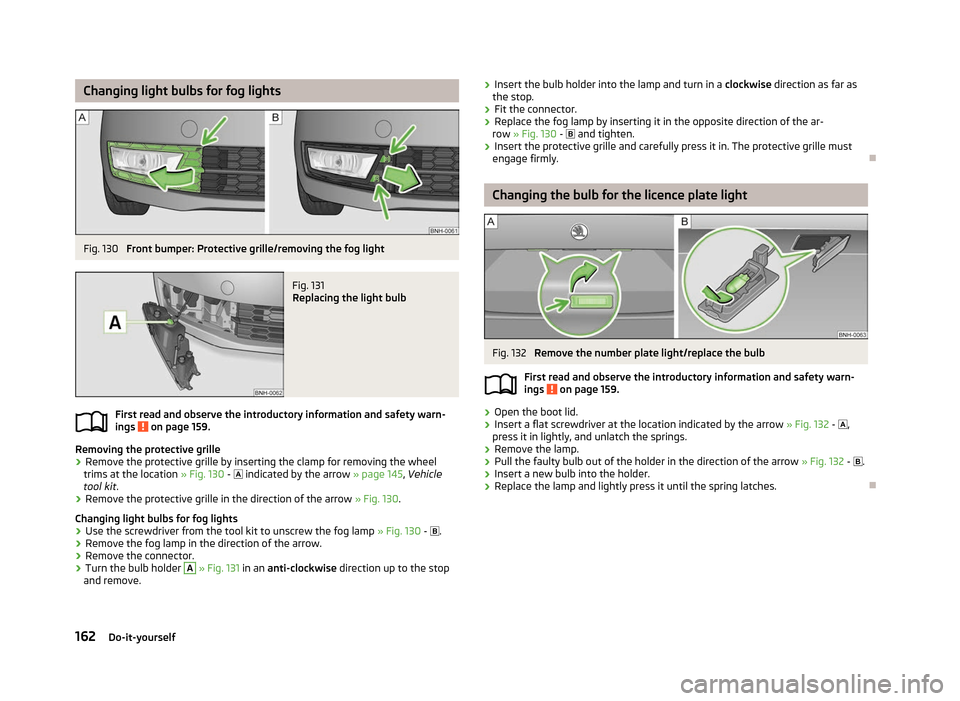
Changing light bulbs for fog lights
Fig. 130
Front bumper: Protective grille/removing the fog light Fig. 131
Replacing the light bulb
First read and observe the introductory information and safety warn-
ings on page 159.
Removing the protective grille
›
Remove the protective grille by inserting the clamp for removing the wheel
trims at the location » Fig. 130 - indicated by the arrow » page 145, Vehicle
tool kit .
› Remove the protective grille in the direction of the arrow
» Fig. 130.
Changing light bulbs for fog lights
› Use the screwdriver from the tool kit to unscrew the fog lamp
» Fig. 130 -
.
› Remove the fog lamp in the direction of the arrow.
› Remove the connector.
› Turn the bulb holder A
» Fig. 131 in an anti-clockwise
direction up to the stop
and remove.
ä ›
Insert the bulb holder into the lamp and turn in a
clockwise direction as far as
the stop.
› Fit the connector.
› Replace the fog lamp by inserting it in the opposite direction of the ar-
row » Fig. 130 - and tighten.
› Insert the protective grille and carefully press it in. The protective grille must
engage firmly. Ð Changing the bulb for the licence plate light
Fig. 132
Remove the number plate light/replace the bulb
First read and observe the introductory information and safety warn-
ings on page 159.
›
Open the boot lid.
› Insert a flat screwdriver at the location indicated by the arrow
» Fig. 132 - ,
press it in lightly, and unlatch the springs.
› Remove the lamp.
› Pull the faulty bulb out of the holder in the direction of the arrow
» Fig. 132 - .
› Insert a new bulb into the holder.
› Replace the lamp and lightly press it until the spring latches. Ð
ä
162 Do-it-yourself
Page 165 of 180
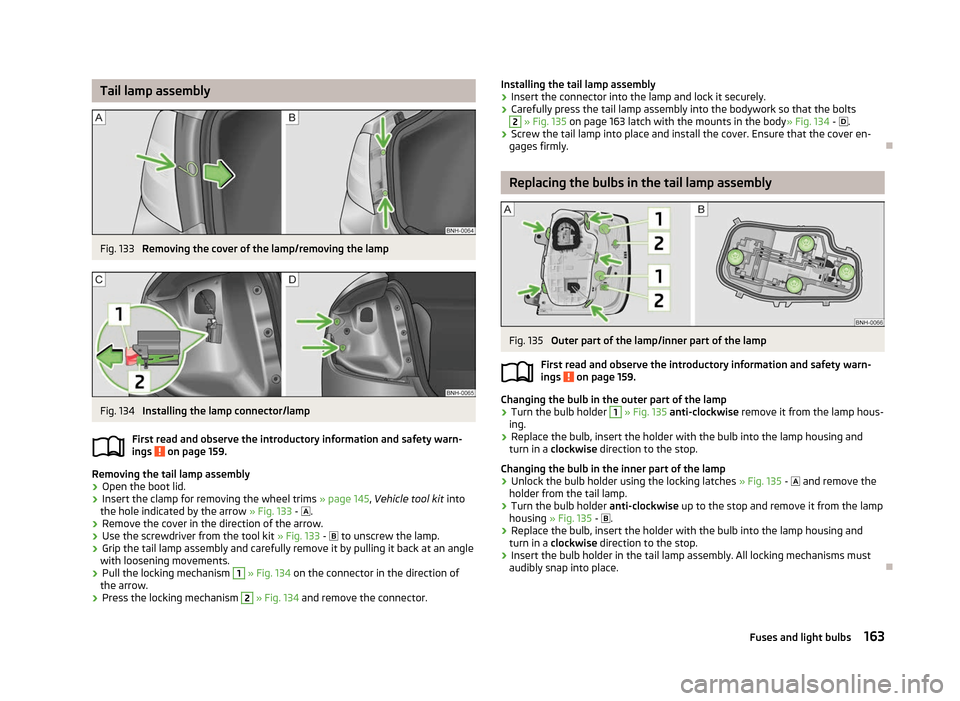
Tail lamp assembly
Fig. 133
Removing the cover of the lamp/removing the lamp Fig. 134
Installing the lamp connector/lamp
First read and observe the introductory information and safety warn-
ings on page 159.
Removing the tail lamp assembly
›
Open the boot lid.
› Insert the clamp for removing the wheel trims
» page 145, Vehicle tool kit into
the hole indicated by the arrow » Fig. 133 - .
› Remove the cover in the direction of the arrow.
› Use the screwdriver from the tool kit
» Fig. 133 - to unscrew the lamp.
› Grip the tail lamp assembly and carefully remove it by pulling it back at an angle
with loosening movements.
› Pull the locking mechanism 1
» Fig. 134 on the connector in the direction of
the arrow.
› Press the locking mechanism 2
» Fig. 134 and remove the connector.
ä Installing the tail lamp assembly
› Insert the connector into the lamp and lock it securely.
› Carefully press the tail lamp assembly into the bodywork so that the bolts 2
» Fig. 135 on page 163 latch with the mounts in the body
» Fig. 134 - .
› Screw the tail lamp into place and install the cover. Ensure that the cover en-
gages firmly. Ð Replacing the bulbs in the tail lamp assembly
Fig. 135
Outer part of the lamp/inner part of the lamp
First read and observe the introductory information and safety warn-
ings on page 159.
Changing the bulb in the outer part of the lamp
›
Turn the bulb holder 1
» Fig. 135 anti-clockwise
remove it from the lamp hous-
ing.
› Replace the bulb, insert the holder with the bulb into the lamp housing and
turn in a clockwise direction to the stop.
Changing the bulb in the inner part of the lamp
› Unlock the bulb holder using the locking latches
» Fig. 135 - and remove the
holder from the tail lamp.
› Turn the bulb holder
anti-clockwise up to the stop and remove it from the lamp
housing » Fig. 135 - .
› Replace the bulb, insert the holder with the bulb into the lamp housing and
turn in a clockwise direction to the stop.
› Insert the bulb holder in the tail lamp assembly. All locking mechanisms must
audibly snap into place. Ð
ä
163
Fuses and light bulbs
Page 166 of 180

Technical data
Technical data
Introductory information
The details given in the vehicle's technical documentation always take prece-
dence over the details in the Owner's Manual. Please refer to the official vehicle
registration documents or consult a
ŠKODA Service Partner to determine which
engine your vehicle is equipped with.
The listed performance values were determined without performance-reducing
equipment, e.g. air conditioning system.
Vehicle identification number (VIN)
The vehicle identification number - VIN (vehicle body number) is stamped into the
engine compartment on the right hand suspension strut dome. This number is al-
so located on a sign on the lower left hand edge below the windscreen (together
with a VIN bar code).
Engine number
The engine number is stamped into the engine block. ÐData on the vehicle sticker and the type plate
Fig. 136
Vehicle data sticker/type plate Vehicle data sticker
The vehicle data sticker » Fig. 136 is located on the floor of the boot and is also
stated in the service schedule.
The vehicle data sticker contains the following data:
Vehicle identification number (VIN)
Vehicle type
Gearbox code/paint number/interior equipment/engine output/engine code
Partial vehicle description
Operating weight (in
kg)
Fuel consumption (in ltr./100 km) - intra-urban/extra-urban/combined
CO 2 emission levels - combined (in g/km)
Type plate
The type plate » Fig. 136 is located on the lower part of the column between the
front and rear doors on the driver's side.
The type plate lists the following weights:
Maximum permissible gross weight
Maximum permissible towed weight (towing vehicle and trailer)
Maximum permissible front axle load
Maximum permissible rear axle load
Operating weight
The specified operating weight is for orientation purposes only. This value repre-
sents the minimum operating weight without additional weight-increasing equip-
ment such as air conditioning system, spare wheel, or trailer hitch.
The operating weight also contains the weight of the driver (75 kg), the weight of
the operating fluids, the tool kit, and a fuel tank filled to 90 % capacity.
It is possible to calculate the approximate loading capacity from the difference
between the permissible total weight and the operating weight » .
The payload consists of the following components:
› Passengers
› All items of luggage and other loads
› Roof load including roof rack system
› Equipment not included in the operating weight
› Trailer drawbar load when towing a trailer (max. 50 kg).
£ 1
2
3
4
5
6
7
8
9
10
11
164
Technical data