key SKODA RAPID 2013 1.G Owner's Guide
[x] Cancel search | Manufacturer: SKODA, Model Year: 2013, Model line: RAPID, Model: SKODA RAPID 2013 1.GPages: 226, PDF Size: 15.16 MB
Page 122 of 226
Towing a trailer
Towing device
Introduction
This chapter contains information on the following subjects:
Description
119
Adjusting the ready position
120
Fitting the ball head
121
Check proper fitting
121
Removing the ball head
122
Use and care
122
If your vehicle has already been factory-fitted with a towing device or is fitted
with a towing device from ŠKODA Original Accessories, then it meets all of the
technical requirements and national legal regulations for towing a trailer.
Your vehicle is fitted with a 13-pin power socket for the electrical connection be-
tween the vehicle and trailer. If the trailer that is to be towed has a 7-pin connec-
tor , you can use a suitable adapter from ŠKODA Original Accessories.
The maximum trailer drawbar load is 50 kg.
WARNING■
Check that the tow bar is seated correctly and is secured in the mounting
recess before the start of every journey.■
Do not use the tow bar if it is not correctly inserted and secured in the
mounting recess.
■
Do not use the towing device if it is damaged or if there are parts missing.
■
Do not modify or adapt the towing device in any way.
■
Never release the tow bar while the trailer is still coupled.
CAUTION
Take care when handling the tow bar so as to avoid damaging the paintwork on
the bumper.
DescriptionFig. 104
Carrier for the towing device/tow bar
First read and observe the introductory information and safety warn-
ings
on page 119.
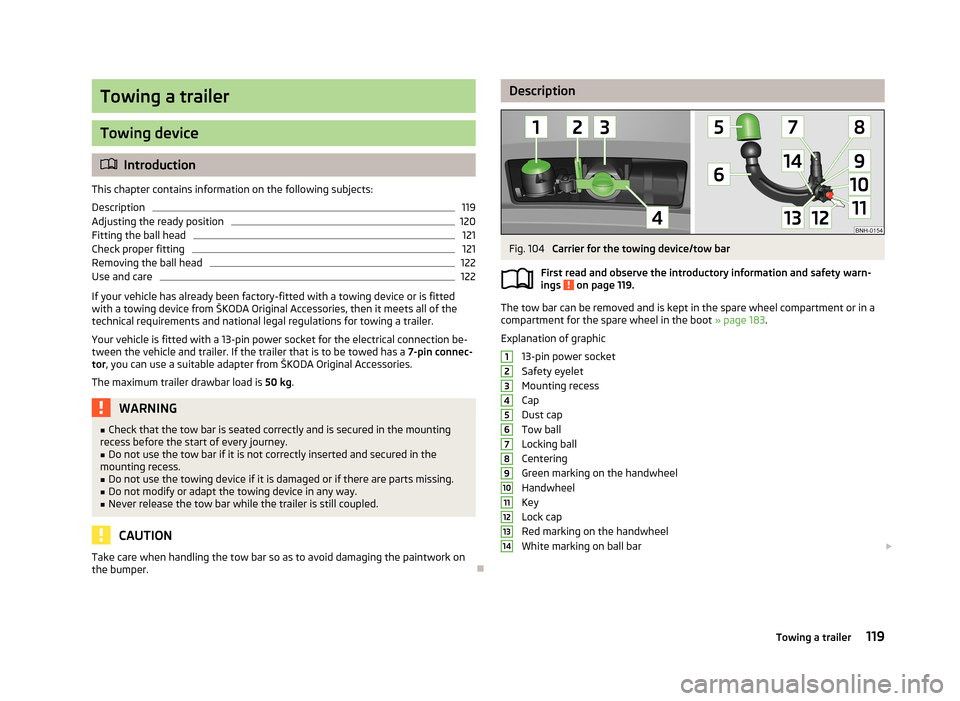
The tow bar can be removed and is kept in the spare wheel compartment or in a
compartment for the spare wheel in the boot » page 183.
Explanation of graphic 13-pin power socket
Safety eyelet
Mounting recess
Cap
Dust cap
Tow ball
Locking ball
Centering
Green marking on the handwheel
Handwheel
Key
Lock cap
Red marking on the handwheel
White marking on ball bar
1234567891011121314119Towing a trailer
Page 123 of 226
NoteOn the bottom of the key is a code number. If you lose a key, please contact a
specialist garage, who will be able to use this code number to provide you with a new one.
Adjusting the ready position
Fig. 105
Setting the ready position
Fig. 106
Ready position
First read and observe the introductory information and safety warn-
ings
on page 119.
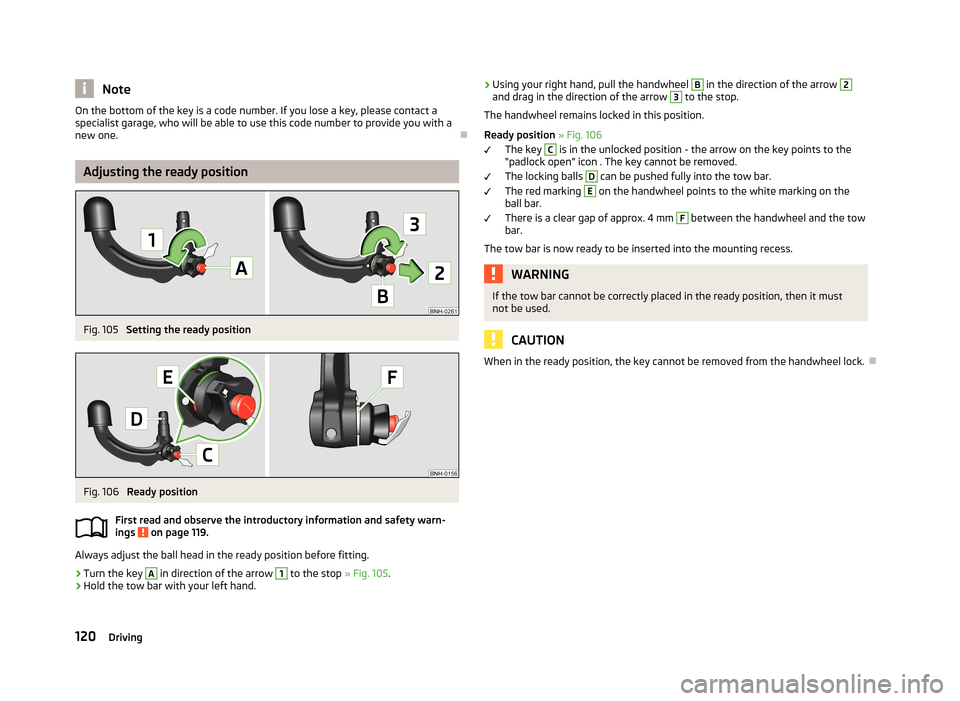
Always adjust the ball head in the ready position before fitting.
›
Turn the key
A
in direction of the arrow
1
to the stop » Fig. 105.
›
Hold the tow bar with your left hand.
›Using your right hand, pull the handwheel B in the direction of the arrow 2and drag in the direction of the arrow 3 to the stop.
The handwheel remains locked in this position.
Ready position » Fig. 106
The key C
is in the unlocked position - the arrow on the key points to the
“padlock open” icon . The key cannot be removed.
The locking balls
D
can be pushed fully into the tow bar.
The red marking
E
on the handwheel points to the white marking on the
ball bar.
There is a clear gap of approx. 4 mm
F
between the handwheel and the tow
bar.
The tow bar is now ready to be inserted into the mounting recess.
WARNINGIf the tow bar cannot be correctly placed in the ready position, then it must
not be used.
CAUTION
When in the ready position, the key cannot be removed from the handwheel lock.120Driving
Page 124 of 226
Fitting the ball headFig. 107
Insert the ball bar/lock the lock and remove the key
Fig. 108
Fit the lock cap
First read and observe the introductory information and safety warn-
ings on page 119.
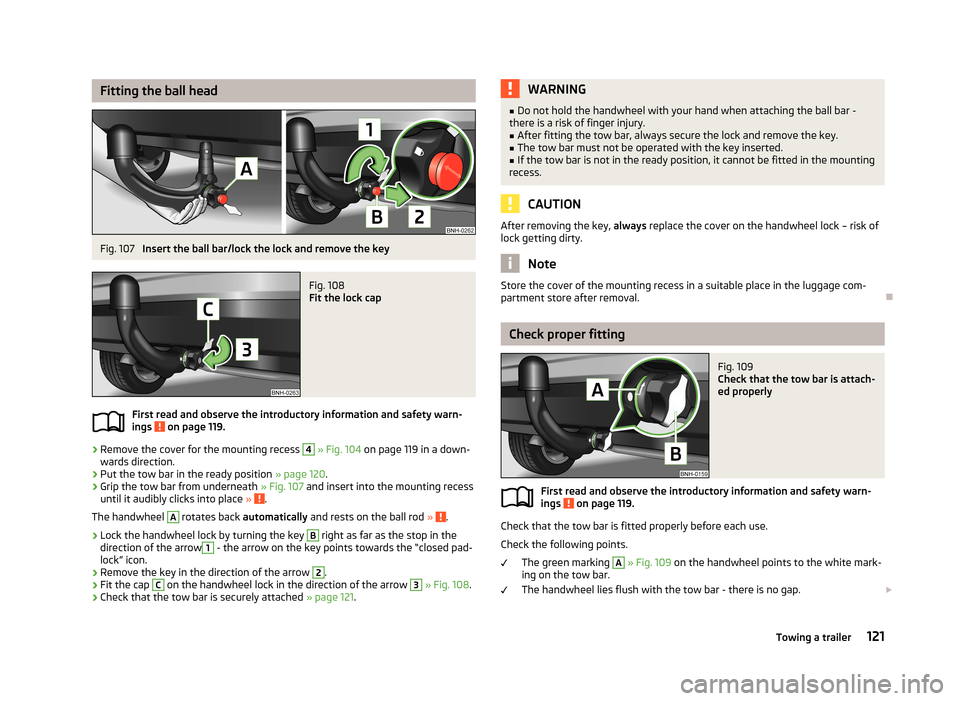
›
Remove the cover for the mounting recess
4
» Fig. 104 on page 119 in a down-
wards direction.
›
Put the tow bar in the ready position » page 120.
›
Grip the tow bar from underneath » Fig. 107 and insert into the mounting recess
until it audibly clicks into place » .
The handwheel
A
rotates back automatically and rests on the ball rod » .
›
Lock the handwheel lock by turning the key
B
right as far as the stop in the
direction of the arrow
1
- the arrow on the key points towards the “closed pad-
lock” icon.
›
Remove the key in the direction of the arrow
2
.
›
Fit the cap
C
on the handwheel lock in the direction of the arrow
3
» Fig. 108 .
›
Check that the tow bar is securely attached » page 121.
WARNING■
Do not hold the handwheel with your hand when attaching the ball bar -
there is a risk of finger injury.■
After fitting the tow bar, always secure the lock and remove the key.
■
The tow bar must not be operated with the key inserted.
■
If the tow bar is not in the ready position, it cannot be fitted in the mounting
recess.
CAUTION
After removing the key, always replace the cover on the handwheel lock – risk of
lock getting dirty.
Note
Store the cover of the mounting recess in a suitable place in the luggage com-
partment store after removal.
Check proper fitting
Fig. 109
Check that the tow bar is attach-
ed properly
First read and observe the introductory information and safety warn-
ings on page 119.
Check that the tow bar is fitted properly before each use.
Check the following points. The green marking
A
» Fig. 109 on the handwheel points to the white mark-
ing on the tow bar.
The handwheel lies flush with the tow bar - there is no gap.
121Towing a trailer
Page 125 of 226
The handwheel is locked and the key is removed.
The cap B
is on the handwheel.
The tow bar does not come out of the mounting recess even after heavy
“shaking”.WARNINGDo not use the towing device unless the tow bar has been properly locked!
Removing the ball head
Fig. 110
Removing the lock cover/releasing the lock
Fig. 111
Release ball bar
First read and observe the introductory information and safety warn-
ings on page 119.
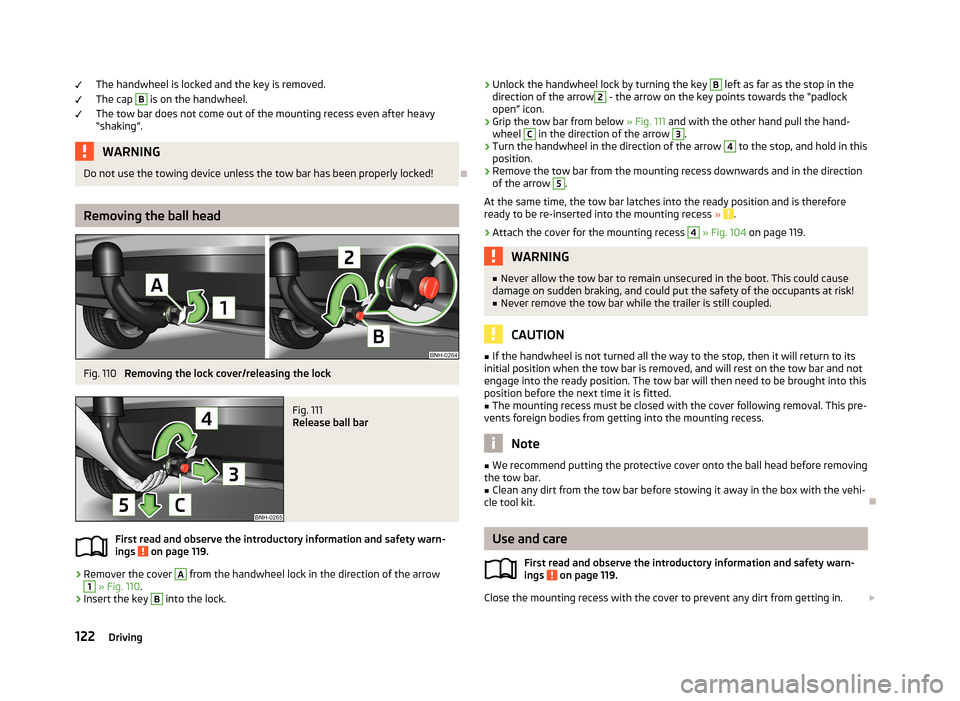
›
Remover the cover
A
from the handwheel lock in the direction of the arrow
1
» Fig. 110 .
›
Insert the key
B
into the lock.
›
Unlock the handwheel lock by turning the key B left as far as the stop in the
direction of the arrow2 - the arrow on the key points towards the “padlock
open” icon.›
Grip the tow bar from below » Fig. 111 and with the other hand pull the hand-
wheel
C
in the direction of the arrow
3
.
›
Turn the handwheel in the direction of the arrow
4
to the stop, and hold in this
position.
›
Remove the tow bar from the mounting recess downwards and in the direction
of the arrow
5
.
At the same time, the tow bar latches into the ready position and is therefore
ready to be re-inserted into the mounting recess »
.
›
Attach the cover for the mounting recess
4
» Fig. 104 on page 119.
WARNING■
Never allow the tow bar to remain unsecured in the boot. This could cause
damage on sudden braking, and could put the safety of the occupants at risk!■
Never remove the tow bar while the trailer is still coupled.
CAUTION
■ If the handwheel is not turned all the way to the stop, then it will return to its
initial position when the tow bar is removed, and will rest on the tow bar and not
engage into the ready position. The tow bar will then need to be brought into this position before the next time it is fitted.■
The mounting recess must be closed with the cover following removal. This pre-
vents foreign bodies from getting into the mounting recess.
Note
■ We recommend putting the protective cover onto the ball head before removing
the tow bar.■
Clean any dirt from the tow bar before stowing it away in the box with the vehi-
cle tool kit.
Use and care
First read and observe the introductory information and safety warn-
ings
on page 119.
Close the mounting recess with the cover to prevent any dirt from getting in.
122Driving
Page 128 of 226
■Contact between the breakaway cable and the safety eyelet can result in me-
chanical wear on the surface protection of the eyelet. Such wear does not impair
the functioning of the safety eyelet and does not constitute a fault. It is excluded from the warranty coverage.■
If you tow a trailer frequently, you should also have your vehicle inspected be-
tween service intervals.
■
The handbrake on the towing vehicle must be applied when coupling and un-
coupling the trailer.
Anti-theft alarm system
First read and observe the introductory information and safety warn-
ings
on page 123.
When the vehicle is locked, the alarm is activated when the electrical connection
to the trailer is interrupted.
Always switch off the anti-theft alarm system before a trailer is coupled or uncou- pled » page 36 .
Conditions for including a trailer in the anti-theft alarm system. The vehicle is factory-fitted with an anti-theft alarm system and towing de-
vice.
The trailer is electrically connected to the towing vehicle via the trailer sock-
et.
The electrical system of the vehicle and trailer is functional.
The vehicle is locked with the vehicle key and the anti-theft alarm system is
activated.
Note
For technical reasons, trailers with rear LED lights cannot be connected to the an-
ti-theft alarm system.
125Towing a trailer
Page 133 of 226
Seat belts
Using seat belts
Introduction
Fig. 114
Driver wearing seat belt
This chapter contains information on the following subjects:
The physical principle of a frontal collision
131
Fastening and unfastening seat belts
132
Belt height adjustment on the front seats
133
Seat belts that are fastened correctly offer good protection in the event of an ac-
cident. They reduce the risk of an injury and increase the chance of survival in the
event of a major accident.
Correctly fastened seat belts hold occupants of the car in the correct seated posi-
tion » Fig. 114 .
The seat belts reduce the kinetic energy (energy of motion) to a considerable ex-
tent. They also prevent uncontrolled movements which, in turn, may well result in
severe injuries.
Occupants of a vehicle who have correctly fastened their seat belts have the ma-
jor benefit of the fact that the kinetic energy is absorbed as effectively as possi-
ble by the belts.
The structure of the front end of the vehicle and other passive safety measures,
such as the airbag system, also contribute to the kinetic energy being reduced as
effectively as possible. The energy produced is thus absorbed and there is less
risk of injury.
Particular safety aspects must be observed when transporting children in the ve-
hicle » page 142 , Transporting children safely .WARNING■
Fasten your seat belt before each journey – even when driving in town! This
also applies to the passengers seated at the rear – risk of injury!■
Expectant women must also always wear a seat belt. This is the only way of
ensuring optimal protection for the unborn child » page 132, Fastening and
unfastening seat belts .
■
Maximum seat belt protection is only achieved if you are correctly seat-
ed » page 127 , Correct seated position .
■
The seat backrests of the front seats must not be tilted too far to the rear
otherwise the seatbelts can lose their effectiveness.
WARNINGObserve the following instructions for the correct routing of the seat belt.■Always ensure that the webbing of the seat belts is properly routed. Seat
belts which are not correctly adjusted can themselves cause injuries even in
minor accidents.■
Adjust the height of the belt in such a way that the shoulder part of the belt
is roughly positioned across the middle of your shoulder – on no account
across your neck.
■
A seat belt which is hanging too loose can result in injuries as your body is
moved forward by the kinetic energy produced in an accident and is then sud-
denly held firm by the belt.
■
The belt webbing must not run across solid or fragile objects (e.g. specta-
cles, ball-point pens, bunches of keys etc.). Such objects can cause injury.
WARNINGObserve the following instructions for handling the seat belts.■The belt webbing must not be jammed in-between at any point or twisted,
or chafe against any sharp edges.■
Make sure you do not catch the seat belt in the door when closing it.
130Safety
Page 138 of 226
Airbag system
Description of the airbag system
Introduction
This chapter contains information on the following subjects:
System description
135
Airbag deployment
135WARNING■ An airbag can only offer you optimal protection in combination with a fas-
tened seat belt .■
The airbag is not a substitute for the seat belt, but instead forms part of the
complete passive vehicle safety concept.
■
To ensure passengers are protected with the greatest possible effect when
the airbag is deployed, the front seats must be correctly adjusted to match
the body size » page 127, Correct seated position .
■
If you do not fasten the seat belts when driving, lean too far forward or
adopt an incorrect seated position, you are exposing yourself to increased risk
of injury in the event of an accident.
WARNINGObserve the following instructions for handling the airbag system.■If there is a fault, the airbag system must be checked by a specialist garage
immediately. Otherwise, there is a risk of the airbag not being activated in the
event of an accident.■
No modifications of any kind must be made to parts of the airbag system.
■
Any work on the airbag system including the installation and removal of sys-
tem components due to other repair work (e.g. removal of the steering wheel) must only be carried out by a specialist garage.
■
Never make any changes to the front bumper or bodywork.
■
It is prohibited to manipulate individual parts of the airbag system as this
might result in the airbag being deployed.
■
The protective function of the airbag system is sufficient for only one acci-
dent. The airbag system must then be replaced if the airbag has been de-
ployed.
System description
First read and observe the introductory information and safety warn-ings
on page 135.
The functional status of the airbag system is indicated by the indicator light in
the instrument cluster » page 20.
When the airbags are deployed, they fill with gas and inflate.
A grey white or red, non-harmful gas is released when the airbag is inflated. This
is perfectly normal and is not an indication of a fire in the vehicle.
Depending on the vehicle equipment, the airbag system consists of the
following modules.
› Electronic control unit.
› Front airbag for the driver and the front passenger
» page 137.
› Side airbags
» page 138.
› Head airbags
» page 139.
› Airbag warning light in the instrument cluster
» page 20.
› Key switch for the front passenger airbag
» page 140.
› Warning light for the front passenger airbag deactivation/activation in the mid-
dle of the dash panel » page 140.
Note
■
The airbag system needs no maintenance during its working life.■If you sell your vehicle, provide the complete vehicle documentation to the new
owner. Please note that the information relating to the possibility of deactivating
the front passenger airbag must be included!■
When disposing of vehicle or parts of the airbag system, it is important to com-
ply with the national legal requirements.
Airbag deployment
First read and observe the introductory information and safety warn-
ings
on page 135.
The airbags inflate in fractions of a second and at a high speed in order to be able
to offer additional protection in the event of an accident.
The airbag system is only functional when the ignition is switched on.
135Airbag system
Page 143 of 226
Deactivating airbagsFirst read and observe the introductory information given on page 139.
Deactivating an airbag should be considered in cases such as the ones below.› If using a rear-facing child seat on the front passenger seat (due to different le-
gal regulations, the airbag must be deactivated if using a forwards-facing child
seat in some countries) » page 142, Transporting children safely .
› If it is not possible to maintain a distance of at least 25 cm between the middle
of the steering wheel and chest, despite the driver's seat being correctly adjus-
ted.
› If special attachments are required in the area of the steering wheel because of
a physical disability.
› If different seats have been fitted (e.g. orthopaedic seats without side airbags).
The front passenger airbag can be switched off with the key-operated
switch » page 140 .
We recommend that you ask a ŠKODA service partner to deactivate any other air- bags.
Monitoring the airbag system
The operational capability of the airbag system is monitored electronically, includ-
ing when one of the airbags is switched off.
Airbag deactivated using diagnostic equipment
› The warning light
lights up for approximately 4 seconds after the ignition is
switched on and then flashes again for approximately 12 seconds.
Front passenger airbag deactivated using the key switch in the storage com-
partment
› The warning light
lights up for approximately 3 seconds after the ignition is
switched on.
› The indicator light
3
» Fig. 123 on page 140 lights up after the ignition is
switched on.
Note■ The national regulations for switching off airbags must be observed.■A ŠKODA service partner will be able to inform you which, if any, of your vehi-
cle's airbags can or must be deactivated.
Deactivating the front passenger airbag
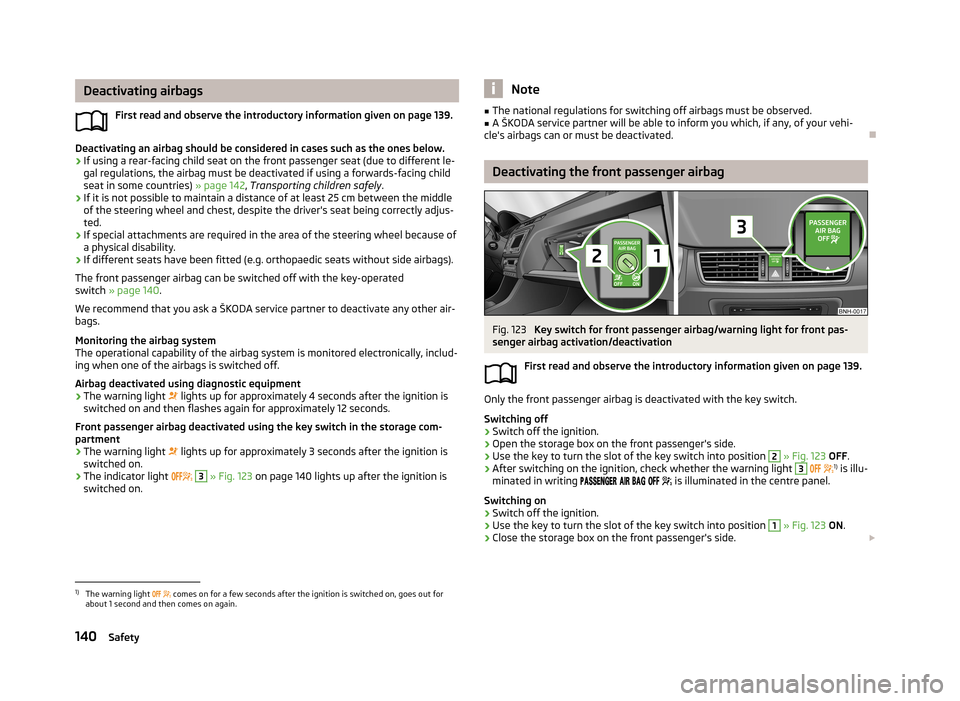
Fig. 123
Key switch for front passenger airbag/warning light for front pas-
senger airbag activation/deactivation
First read and observe the introductory information given on page 139.
Only the front passenger airbag is deactivated with the key switch.
Switching off
›
Switch off the ignition.
›
Open the storage box on the front passenger's side.
›
Use the key to turn the slot of the key switch into position
2
» Fig. 123 OFF .
›
After switching on the ignition, check whether the warning light
3
1)
is illu-
minated in writing
is illuminated in the centre panel.
Switching on
›
Switch off the ignition.
›
Use the key to turn the slot of the key switch into position
1
» Fig. 123 ON .
›
Close the storage box on the front passenger's side.
1)
The warning light
comes on for a few seconds after the ignition is switched on, goes out for
about 1 second and then comes on again.
140Safety
Page 163 of 226
Inspecting and replenishing
Fuel
Introduction
This chapter contains information on the following subjects:
Refuelling
160
Unleaded petrol
161
Diesel fuel
162
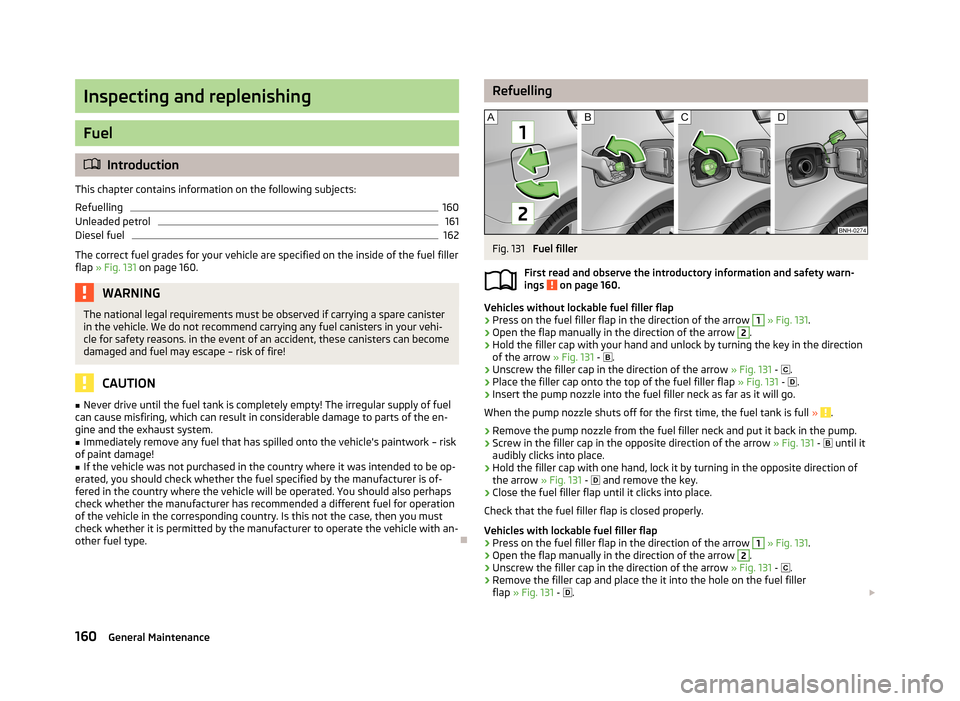
The correct fuel grades for your vehicle are specified on the inside of the fuel filler
flap » Fig. 131 on page 160.
WARNINGThe national legal requirements must be observed if carrying a spare canister
in the vehicle. We do not recommend carrying any fuel canisters in your vehi-
cle for safety reasons. in the event of an accident, these canisters can become
damaged and fuel may escape – risk of fire!
CAUTION
■ Never drive until the fuel tank is completely empty! The irregular supply of fuel
can cause misfiring, which can result in considerable damage to parts of the en-
gine and the exhaust system.■
Immediately remove any fuel that has spilled onto the vehicle's paintwork – risk
of paint damage!
■
If the vehicle was not purchased in the country where it was intended to be op-
erated, you should check whether the fuel specified by the manufacturer is of-
fered in the country where the vehicle will be operated. You should also perhaps
check whether the manufacturer has recommended a different fuel for operation
of the vehicle in the corresponding country. Is this not the case, then you must
check whether it is permitted by the manufacturer to operate the vehicle with an-
other fuel type.
RefuellingFig. 131
Fuel filler
First read and observe the introductory information and safety warn- ings
on page 160.
Vehicles without lockable fuel filler flap
›
Press on the fuel filler flap in the direction of the arrow
1
» Fig. 131 .
›
Open the flap manually in the direction of the arrow
2
.
›
Hold the filler cap with your hand and unlock by turning the key in the direction
of the arrow » Fig. 131 -
.
›
Unscrew the filler cap in the direction of the arrow » Fig. 131 -
.
›
Place the filler cap onto the top of the fuel filler flap » Fig. 131 -
.
›
Insert the pump nozzle into the fuel filler neck as far as it will go.
When the pump nozzle shuts off for the first time, the fuel tank is full »
.
›
Remove the pump nozzle from the fuel filler neck and put it back in the pump.
›
Screw in the filler cap in the opposite direction of the arrow » Fig. 131 -
until it
audibly clicks into place.
›
Hold the filler cap with one hand, lock it by turning in the opposite direction of the arrow » Fig. 131 -
and remove the key.
›
Close the fuel filler flap until it clicks into place.
Check that the fuel filler flap is closed properly.
Vehicles with lockable fuel filler flap
›
Press on the fuel filler flap in the direction of the arrow
1
» Fig. 131 .
›
Open the flap manually in the direction of the arrow
2
.
›
Unscrew the filler cap in the direction of the arrow » Fig. 131 -
.
›
Remove the filler cap and place the it into the hole on the fuel filler
flap » Fig. 131 -
.
160General Maintenance
Page 166 of 226
WARNINGInjuries or scolding or risks of accident or fire may occur when working in the
engine compartment. For this reason, it is essential to comply with the warn- ing instructions outlined below and with the general applicable safety rules.
The engine compartment of your car is a hazardous area!WARNINGThe following instructions must be followed before starting work in the en-
gine compartment.■
Turn off the engine and withdraw the ignition key.
■
Firmly apply the handbrake.
■
If the vehicle is fitted with a manual gearbox, move the gearshift lever into
Neutral, or if the vehicle is fitted with an automatic gearbox, move the selec-
tor lever into position P.
■
Allow the engine to cool.
■
Never open the bonnet if you can see steam or coolant escaping from the
engine compartment – risk of scalding! Wait until no more steam or coolant is escaping.
WARNINGThe following instructions must be followed when working in the engine com-
partment.■
Keep children clear of the engine compartment.
■
Never touch the radiator fan while the engine is still warm. The fan might
suddenly start running!
■
Do not touch any hot engine parts – risk of burns!
■
The coolant additive and thus all of the coolant is harmful to your health.
■
Avoid contact with the coolant.
■
Coolant vapours are harmful to health.
■
Never open the end cover of the coolant expansion reservoir while the en-
gine is still warm. The cooling system is pressurized!
■
When opening the end cover of the coolant expansion reservoir, cover it
with a cloth to protect your face, hands and arms from hot steam or hot cool-
ant.
■
If any coolant splashes into your eyes, immediately rinse out your eyes with
clear water and contact a doctor as soon as possible.
WARNING (Continued)■ Always store the coolant additive securely in its original container, and in
particular out of the reach of children – risk of poisoning!■
If coolant is swallowed, consult a doctor immediately.
■
Do not leave any items (e.g. cloths or tools) in the engine compartment.
■
Never spill fluids on the hot engine. Such fluids (e.g. the antifreeze con-
tained in the coolant) may ignite!
WARNINGThe following warning instructions must be observed at all times when work-
ing in the engine compartment while the engine is running.■
Pay particular attention to rotating engine parts (e.g. V-ribbed belt, genera-
tor, radiator fan) and the high-voltage ignition system – risk to life!
■
Never touch the electric wiring on the ignition system.
■
Avoid short circuits in the electrical system – particularly on the vehicle's
battery.
■
Always make sure that no jewellery, loose clothing or long hair can get
caught in rotating engine parts – risk to life! Always remove any jewellery, tie
back long hair and wear tight fitting clothing before completing any work.
WARNINGThe following warning instructions must be observed if work has to be carried
out on the fuel or electrical systems.■
Always disconnect the vehicle battery from the electrical system.
■
Do not smoke.
■
Never work near open flames.
■
Always have a functioning fire extinguisher nearby.
WARNING■ Read and observe the information and warning instructions on the fluid con-
tainers.■
Keep fluids in their original containers and keep securely out of the reach of
children!
163Inspecting and replenishing