mirror SKODA RAPID 2013 1.G Owner's Manual
[x] Cancel search | Manufacturer: SKODA, Model Year: 2013, Model line: RAPID, Model: SKODA RAPID 2013 1.GPages: 226, PDF Size: 15.16 MB
Page 6 of 226
Table of Contents
Materials defect liability and ŠKODA warranty for
new cars5
Mobility warranty and ŠKODA extended
warranty
6
Abbreviations
Using the system
Cockpit
9
Overview
8
Instruments and Indicator Lights
10
Instrument cluster
10
Indicator lights
14
Information system
22
Driver information system
22
Multifunction display (MFD)
25
MAXI DOT display
27
Service interval display
28
Unlocking and opening
31
Unlocking and locking
31
Anti-theft alarm system
36
Luggage compartment lid
37
Electrical power windows
38
Lights and visibility
41
Lights
41
Interior lighting
45
Visibility
46
Windscreen wipers and washers
48
Rear mirror
49Seats and useful equipment52Adjusting the seats52
Seat features
54
Practical equipment
56
Luggage compartment
64
Variable loading floor in the luggage
compartment (Rapid Spaceback)
70
Roof rack system
74
Heating and air-conditioning
76
Heating, ventilation, cooling
76
Heating
77
Air conditioning system (manual air conditioning system)
79
Climatronic (automatic air conditioning
system)
82
Communication and multimedia
85
Universal telephone installation GSM II
85
Voice control
90
Multimedia
92
Driving
Starting-off and Driving
96
Steering
96
Starting and stopping the engine
97
Brakes
99
Manual gear changing and pedals
101
Automatic transmission
101
Running in
104
Economical driving and environmental
sustainability
105
Avoiding damage to your vehicle
109
Driving abroad
110
Assist systems
111
Brake assist systems
111
Parking aid
113Cruise Control System114START-STOP116
Towing a trailer
119
Towing device
119
Trailer
123
Safety
Passive Safety
126
General information
126
Correct seated position
127
Seat belts
130
Using seat belts
130
Inertia reels and belt tensioners
133
Airbag system
135
Description of the airbag system
135
Airbag overview
136
Deactivating airbags
139
Transporting children safely
142
Child seat
142
Fastening systems
145
General Maintenance
Vehicle care
147
Service intervals
147
Service work, adjustments and technical alterations
149
Washing your car
152
Taking care of your vehicle exterior
153
Taking care of the interior
157
Inspecting and replenishing
160
Fuel
160
Engine compartment
162
Engine oil
166
Coolant
1683Table of Contents
Page 12 of 226
Using the system
Cockpit
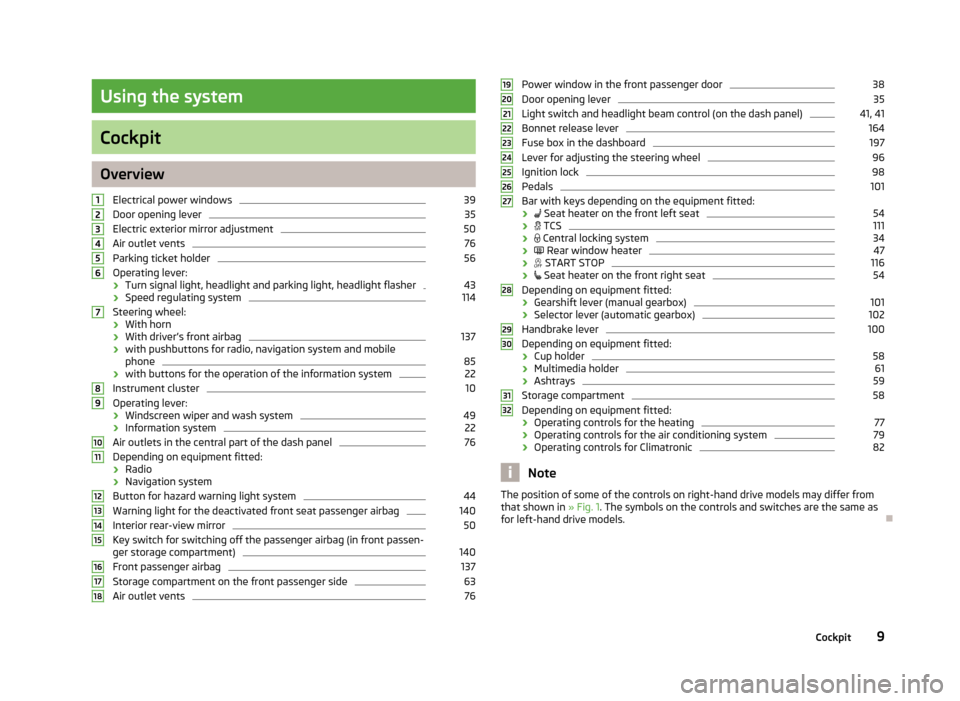
OverviewElectrical power windows
39
Door opening lever
35
Electric exterior mirror adjustment
50
Air outlet vents
76
Parking ticket holder
56
Operating lever:
› Turn signal light, headlight and parking light, headlight flasher
43
›
Speed regulating system
114
Steering wheel:
› With horn
› With driver’s front airbag
137
›with pushbuttons for radio, navigation system and mobile
phone
85
› with buttons for the operation of the information system
22
Instrument cluster
10
Operating lever:
› Windscreen wiper and wash system
49
›
Information system
22
Air outlets in the central part of the dash panel
76
Depending on equipment fitted:
› Radio
› Navigation system
Button for hazard warning light system
44
Warning light for the deactivated front seat passenger airbag
140
Interior rear-view mirror
50
Key switch for switching off the passenger airbag (in front passen-
ger storage compartment)
140
Front passenger airbag
137
Storage compartment on the front passenger side
63
Air outlet vents
76123456789101112131415161718Power window in the front passenger door38Door opening lever35
Light switch and headlight beam control (on the dash panel)
41, 41
Bonnet release lever
164
Fuse box in the dashboard
197
Lever for adjusting the steering wheel
96
Ignition lock
98
Pedals
101
Bar with keys depending on the equipment fitted:
›
Seat heater on the front left seat
54
›
TCS
111
›
Central locking system
34
›
Rear window heater
47
›
START STOP
116
›
Seat heater on the front right seat
54
Depending on equipment fitted:
› Gearshift lever (manual gearbox)
101
›Selector lever (automatic gearbox)
102
Handbrake lever
100
Depending on equipment fitted:
› Cup holder
58
›
Multimedia holder
61
›Ashtrays
59
Storage compartment
58
Depending on equipment fitted:
› Operating controls for the heating
77
›
Operating controls for the air conditioning system
79
›Operating controls for Climatronic
82
Note
The position of some of the controls on right-hand drive models may differ from
that shown in » Fig. 1. The symbols on the controls and switches are the same as
for left-hand drive models.19202122232425262728293031329Cockpit
Page 38 of 226
WARNING■Doors locked from the inside make it difficult for rescuers to get into the ve-
hicle in an emergency – risk to life!■
Never leave children in the vehicle unattended.
Note
If the safelock system is switched on » page 33, the door opening lever and the
central locking buttons do not work.
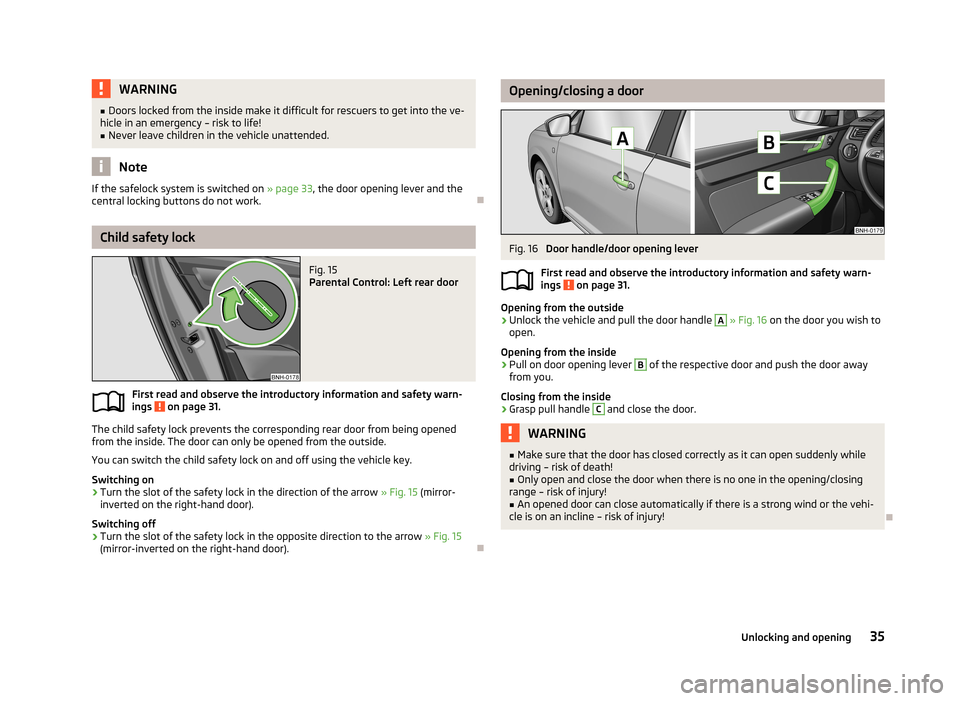
Child safety lock
Fig. 15
Parental Control: Left rear door
First read and observe the introductory information and safety warn-
ings on page 31.
The child safety lock prevents the corresponding rear door from being opened
from the inside. The door can only be opened from the outside.
You can switch the child safety lock on and off using the vehicle key.
Switching on
›
Turn the slot of the safety lock in the direction of the arrow » Fig. 15 (mirror-
inverted on the right-hand door).
Switching off
›
Turn the slot of the safety lock in the opposite direction to the arrow » Fig. 15
(mirror-inverted on the right-hand door).
Opening/closing a doorFig. 16
Door handle/door opening lever
First read and observe the introductory information and safety warn- ings
on page 31.
Opening from the outside
›
Unlock the vehicle and pull the door handle
A
» Fig. 16 on the door you wish to
open.
Opening from the inside
›
Pull on door opening lever
B
of the respective door and push the door away
from you.
Closing from the inside
›
Grasp pull handle
C
and close the door.
WARNING■ Make sure that the door has closed correctly as it can open suddenly while
driving – risk of death!■
Only open and close the door when there is no one in the opening/closing
range – risk of injury!
■
An opened door can close automatically if there is a strong wind or the vehi-
cle is on an incline – risk of injury!
35Unlocking and opening
Page 42 of 226
WARNING■Ensure that no persons are still left in the vehicle when locking it. In an
emergency, it will no longer be possible to open the windows from the inside.■
It is recommended to deactivate the electrically operated power windows in
the rear doors (safety switch)
S
if there are children in the rear seats » Fig. 20
on page 39.
■
The electrical power windows are fitted with a force limiter » page 40. If
there is an obstacle, the closing process is stopped and the window goes
down by several centimetres. However, the windows should be closed care-
fully – risk of injury!
CAUTION
■ Keep the windows clean to ensure the correct functionality of the electric win-
dows.■
In the event that the windows are frozen, first of all eliminate the
ice » page 155 , Windows and exterior mirrors and only then operate the electrical
power windows. Otherwise, the window sealing and the electrical power window mechanism could be damaged.
■
Make sure that the windows are closed whenever you leave the locked vehicle.
For the sake of the environment
At high speeds, you should keep the windows closed to prevent unnecessarily
high fuel consumption.
Note
When driving always use the existing heating, air conditioning and ventilation
system for ventilating the interior of the vehicle. If the windows are opened, dust
as well as other dirt can get into the vehicle and in addition the wind noise is
more at certain speeds.
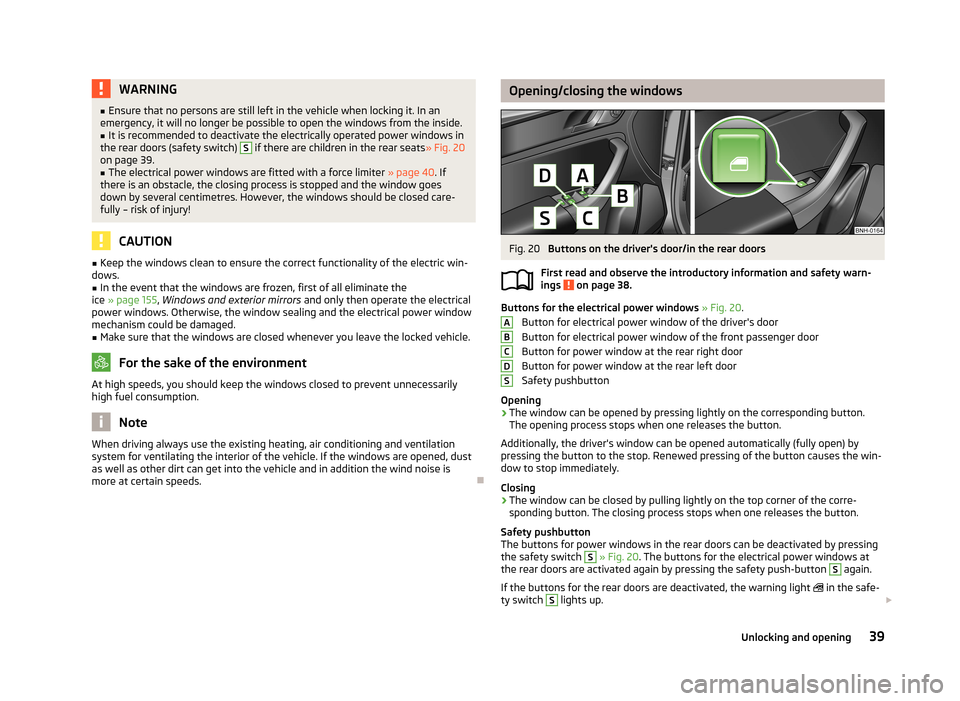
Opening/closing the windowsFig. 20
Buttons on the driver's door/in the rear doors
First read and observe the introductory information and safety warn-
ings
on page 38.
Buttons for the electrical power windows » Fig. 20 .
Button for electrical power window of the driver's door
Button for electrical power window of the front passenger door
Button for power window at the rear right door
Button for power window at the rear left door
Safety pushbutton
Opening
›
The window can be opened by pressing lightly on the corresponding button. The opening process stops when one releases the button.
Additionally, the driver's window can be opened automatically (fully open) by
pressing the button to the stop. Renewed pressing of the button causes the win-
dow to stop immediately.
Closing
›
The window can be closed by pulling lightly on the top corner of the corre- sponding button. The closing process stops when one releases the button.
Safety pushbutton
The buttons for power windows in the rear doors can be deactivated by pressing
the safety switch
S
» Fig. 20 . The buttons for the electrical power windows at
the rear doors are activated again by pressing the safety push-button
S
again.
If the buttons for the rear doors are deactivated, the warning light
in the safe-
ty switch
S
lights up.
ABCDS39Unlocking and opening
Page 50 of 226
Rear window heaterFig. 29
Dash panel: Button for rear win-
dow heater
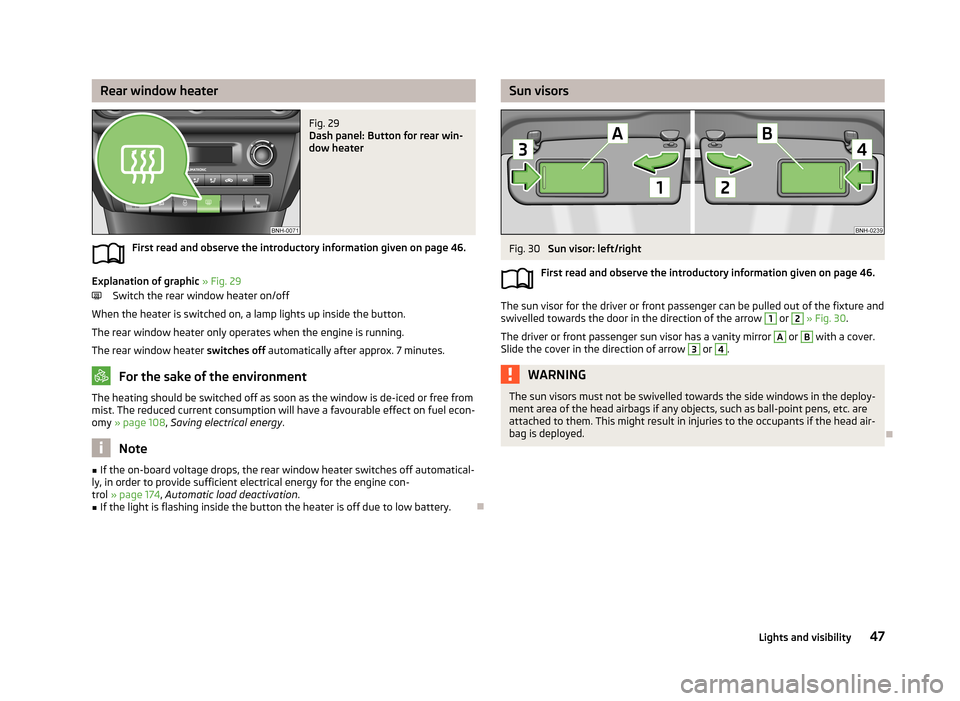
First read and observe the introductory information given on page 46.
Explanation of graphic » Fig. 29
Switch the rear window heater on/off
When the heater is switched on, a lamp lights up inside the button.
The rear window heater only operates when the engine is running.
The rear window heater switches off automatically after approx. 7 minutes.
For the sake of the environment
The heating should be switched off as soon as the window is de-iced or free from
mist. The reduced current consumption will have a favourable effect on fuel econ-
omy » page 108 , Saving electrical energy .
Note
■
If the on-board voltage drops, the rear window heater switches off automatical-
ly, in order to provide sufficient electrical energy for the engine con-
trol » page 174 , Automatic load deactivation .■
If the light is flashing inside the button the heater is off due to low battery.
Sun visorsFig. 30
Sun visor: left/right
First read and observe the introductory information given on page 46.
The sun visor for the driver or front passenger can be pulled out of the fixture and
swivelled towards the door in the direction of the arrow
1
or
2
» Fig. 30 .
The driver or front passenger sun visor has a vanity mirror
A
or
B
with a cover.
Slide the cover in the direction of arrow
3
or
4
.
WARNINGThe sun visors must not be swivelled towards the side windows in the deploy-
ment area of the head airbags if any objects, such as ball-point pens, etc. are attached to them. This might result in injuries to the occupants if the head air-
bag is deployed.
47Lights and visibility
Page 52 of 226
Activating the windscreen wipers and washersFig. 32
Operating lever: Windscreen
wipers and washer settings
First read and observe the introductory information and safety warn-
ings on page 48.
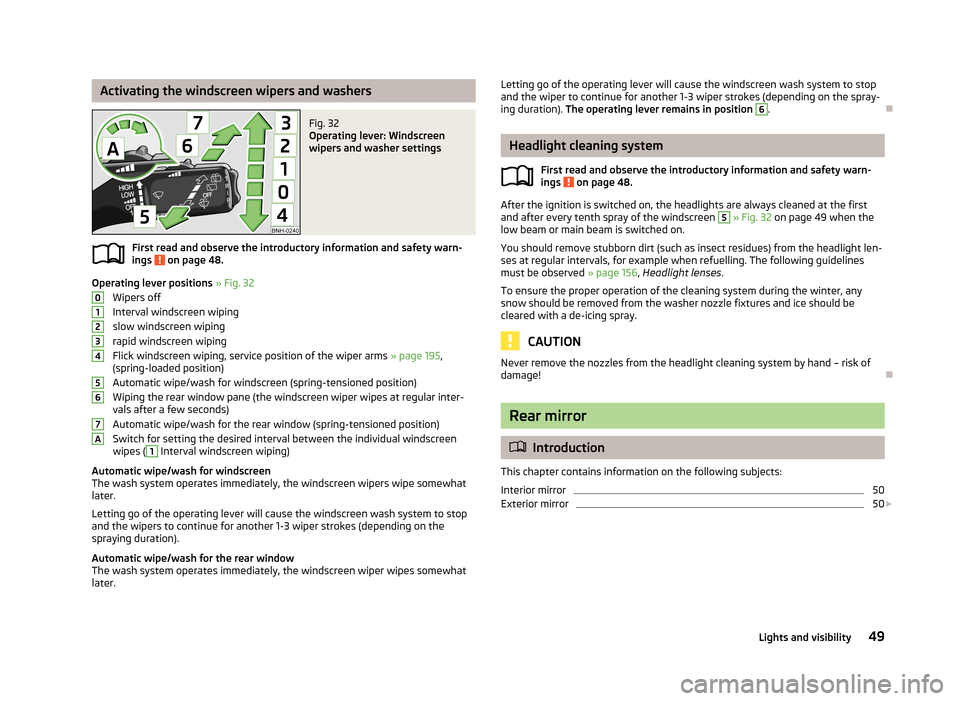
Operating lever positions » Fig. 32
Wipers off
Interval windscreen wiping
slow windscreen wiping
rapid windscreen wiping
Flick windscreen wiping, service position of the wiper arms » page 195,
(spring-loaded position)
Automatic wipe/wash for windscreen (spring-tensioned position) Wiping the rear window pane (the windscreen wiper wipes at regular inter- vals after a few seconds)
Automatic wipe/wash for the rear window (spring-tensioned position)
Switch for setting the desired interval between the individual windscreen wipes (
1
Interval windscreen wiping)
Automatic wipe/wash for windscreen
The wash system operates immediately, the windscreen wipers wipe somewhat
later.
Letting go of the operating lever will cause the windscreen wash system to stop
and the wipers to continue for another 1-3 wiper strokes (depending on the
spraying duration).
Automatic wipe/wash for the rear window The wash system operates immediately, the windscreen wiper wipes somewhatlater.
01234567ALetting go of the operating lever will cause the windscreen wash system to stop
and the wiper to continue for another 1-3 wiper strokes (depending on the spray-
ing duration). The operating lever remains in position 6
.
Headlight cleaning system
First read and observe the introductory information and safety warn-
ings
on page 48.
After the ignition is switched on, the headlights are always cleaned at the first
and after every tenth spray of the windscreen
5
» Fig. 32 on page 49 when the
low beam or main beam is switched on.
You should remove stubborn dirt (such as insect residues) from the headlight len-
ses at regular intervals, for example when refuelling. The following guidelines
must be observed » page 156, Headlight lenses .
To ensure the proper operation of the cleaning system during the winter, any
snow should be removed from the washer nozzle fixtures and ice should be
cleared with a de-icing spray.
CAUTION
Never remove the nozzles from the headlight cleaning system by hand – risk of
damage!
Rear mirror
Introduction
This chapter contains information on the following subjects:
Interior mirror
50
Exterior mirror
50
49Lights and visibility
Page 53 of 226
WARNING■Make sure that the mirror is not covered by ice, snow, mist or other objects.■Convex (curved outward) or aspheric exterior mirrors increase the field of vi-
sion. They do, however, make objects appear smaller in the mirror. These mir-
rors are therefore only of limited use for estimating distances to the following
vehicles.■
Whenever possible use the interior mirror for estimating the distances to
the following vehicles.
Note
■ The exterior mirror heater only operates when the engine is running.■Do not touch the surface of the exterior mirrors if the exterior mirror heater is
switched on.■
If the electrical exterior mirror setting fails at any time, the mirrors can be adjus-
ted by hand by pressing on the edge of the mirror surface.
■
Contact a specialist garage if there is a fault with the power setting function for
the exterior mirrors.
Interior mirror
Fig. 33
Interior mirror
First read and observe the introductory information and safety warn-
ings on page 49.
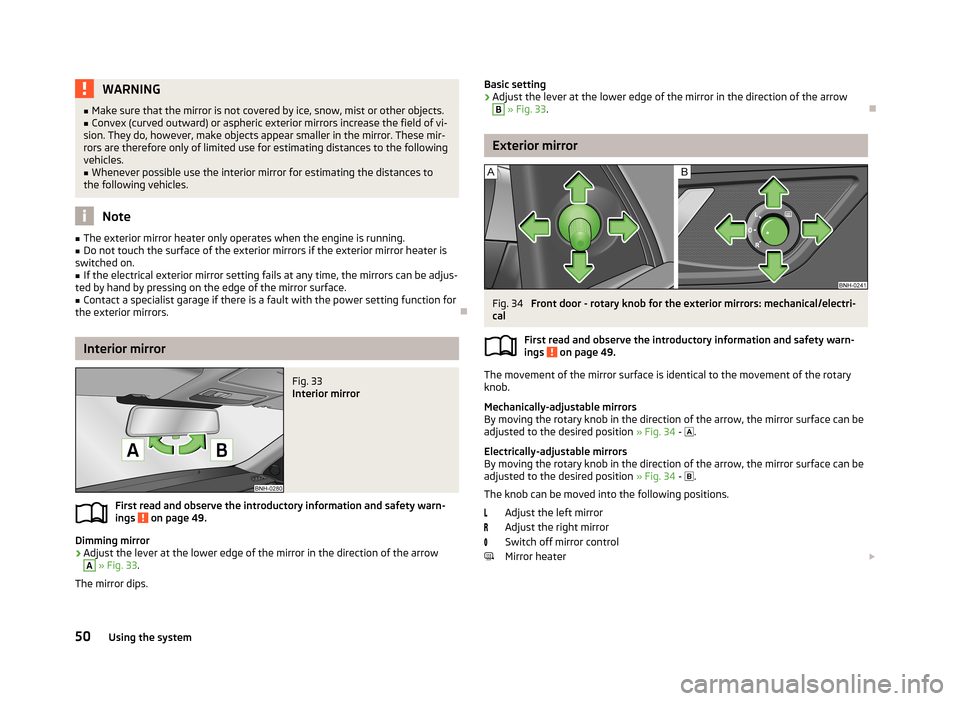
Dimming mirror
›
Adjust the lever at the lower edge of the mirror in the direction of the arrow
A
» Fig. 33 .
The mirror dips.
Basic setting›Adjust the lever at the lower edge of the mirror in the direction of the arrowB
» Fig. 33 .
Exterior mirror
Fig. 34
Front door - rotary knob for the exterior mirrors: mechanical/electri-
cal
First read and observe the introductory information and safety warn-
ings
on page 49.
The movement of the mirror surface is identical to the movement of the rotary
knob.
Mechanically-adjustable mirrors
By moving the rotary knob in the direction of the arrow, the mirror surface can be
adjusted to the desired position » Fig. 34 -
.
Electrically-adjustable mirrors
By moving the rotary knob in the direction of the arrow, the mirror surface can be
adjusted to the desired position » Fig. 34 -
.
The knob can be moved into the following positions. Adjust the left mirror
Adjust the right mirror
Switch off mirror control
Mirror heater
50Using the system
Page 54 of 226
Folding in the exterior mirrors
The whole exterior mirror can be manually folded towards the side windows. To
put it back into its original position, it should be folded back from the side window until it audibly clicks into place.
51Lights and visibility
Page 127 of 226
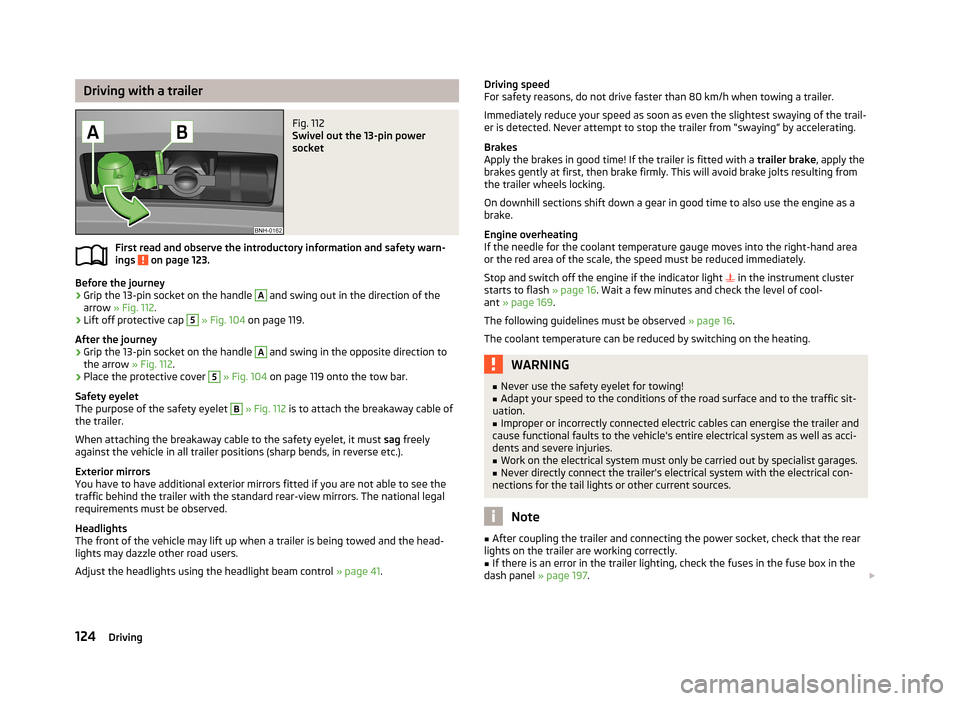
Driving with a trailerFig. 112
Swivel out the 13-pin power
socket
First read and observe the introductory information and safety warn-
ings on page 123.
Before the journey
›
Grip the 13-pin socket on the handle
A
and swing out in the direction of the
arrow » Fig. 112 .
›
Lift off protective cap
5
» Fig. 104 on page 119.
After the journey
›
Grip the 13-pin socket on the handle
A
and swing in the opposite direction to
the arrow » Fig. 112.
›
Place the protective cover
5
» Fig. 104 on page 119 onto the tow bar.
Safety eyelet
The purpose of the safety eyelet
B
» Fig. 112 is to attach the breakaway cable of
the trailer.
When attaching the breakaway cable to the safety eyelet, it must sag freely
against the vehicle in all trailer positions (sharp bends, in reverse etc.).
Exterior mirrors
You have to have additional exterior mirrors fitted if you are not able to see the
traffic behind the trailer with the standard rear-view mirrors. The national legal requirements must be observed.
Headlights
The front of the vehicle may lift up when a trailer is being towed and the head-
lights may dazzle other road users.
Adjust the headlights using the headlight beam control » page 41.
Driving speed
For safety reasons, do not drive faster than 80 km/h when towing a trailer.
Immediately reduce your speed as soon as even the slightest swaying of the trail-
er is detected. Never attempt to stop the trailer from “swaying” by accelerating.
Brakes
Apply the brakes in good time! If the trailer is fitted with a trailer brake, apply the
brakes gently at first, then brake firmly. This will avoid brake jolts resulting from
the trailer wheels locking.
On downhill sections shift down a gear in good time to also use the engine as a brake.
Engine overheating
If the needle for the coolant temperature gauge moves into the right-hand area
or the red area of the scale, the speed must be reduced immediately.
Stop and switch off the engine if the indicator light
in the instrument cluster
starts to flash » page 16. Wait a few minutes and check the level of cool-
ant » page 169 .
The following guidelines must be observed » page 16.
The coolant temperature can be reduced by switching on the heating.WARNING■ Never use the safety eyelet for towing!■Adapt your speed to the conditions of the road surface and to the traffic sit-
uation.■
Improper or incorrectly connected electric cables can energise the trailer and
cause functional faults to the vehicle's entire electrical system as well as acci-
dents and severe injuries.
■
Work on the electrical system must only be carried out by specialist garages.
■
Never directly connect the trailer's electrical system with the electrical con-
nections for the tail lights or other current sources.
Note
■ After coupling the trailer and connecting the power socket, check that the rear
lights on the trailer are working correctly.■
If there is an error in the trailer lighting, check the fuses in the fuse box in the
dash panel » page 197.
124Driving
Page 130 of 226
›Adjust the mirrors, the front seat and head restraint to your body size.
› Advise your passengers to adjust the head restraints to their body size.
› Protect children in suitable child seats with correctly fastened seat
belts » page 142 , Transporting children safely .
› Adopt the correct seated position
» page 127. Tell your passengers to assume
the correct seated position.
› Correctly fasten the seat belt. Also inform passengers to fasten the seat belt
correctly » page 130 .
What influences the driving safety?
First read and observe the introductory information and safety warn-ings
on page 126.
The driver is fully responsible for himself and his occupants. If your driving safety
is effected, you place yourself and the oncoming traffic at risk.
The following guidelines must therefore be observed. › Do not become distracted from concentrating on the traffic situation, e.g. by
your passengers or mobile phone calls.
› Never drive when your driving ability is impaired, e.g. due to medication, alcohol
or drugs.
› Keep to the traffic regulations and the permissible speed limit.
› Always adjust the driving speed to the road, traffic and weather conditions.
› Take regular breaks on long journeys – at least every two hours.
Correct seated position
Introduction
This chapter contains information on the following subjects:
Correct seated position for the driver
128
Correct seated position for the front passenger
128
Correct seated position for the passengers in the rear seats
128
Examples of incorrect seated positions
129WARNINGGeneral information■The front seats and head restraints must be adjusted to match the body
size at all times and the seat belt must always be fastened properly to provide the most effective levels of protection to the passengers.■
If the occupant adopts an incorrect seated position, he is exposed to life-
threatening injuries, in case he is hit by a deployed airbag.
■
If the occupants on the rear seats are not sitting upright, the risk of injury is
increased due to incorrect routing of the seat belt.
■
The seat backrests must not be tilted too far back when driving, as this will
impair the function of the seat belts and of the airbag system – risk of injury!
WARNINGInformation for the driver■Always assume the correct seated position before setting off and do not
change this position while driving. Also advise your passengers to adopt the
correct seated position and not to change this position while the car is mov-
ing.■
Maintain a distance of at least 25 cm to the steering wheel. Not maintaining
this minimum distance will mean that the airbag system will not be able to
properly protect you - hazard!
■
When driving, hold the steering wheel with both hands firmly on the outer
edge in the 9 o'clock and 3 o'clock position. Never hold the steering wheel in
the 12 o'clock position or in any other way (e.g. in the middle or inner edge of
the steering wheel). In such cases, you could severely injure the arms, hands
and head when the driver airbag is deployed.
■
Ensure that there are no objects in the driver's footwell as they may get
caught behind the pedals when driving or applying the braking. You would then no longer be able to operate the clutch, brake or accelerate.
127Passive Safety