mirror SKODA RAPID 2013 1.G User Guide
[x] Cancel search | Manufacturer: SKODA, Model Year: 2013, Model line: RAPID, Model: SKODA RAPID 2013 1.GPages: 226, PDF Size: 15.16 MB
Page 156 of 226
CAUTION■When washing the car by hand, protect your hands and arms from sharp-edged
metal parts (e.g. when cleaning the underfloor, the inside of the wheel housings
or the wheel trims, etc.) - There is a risk of cuts!■
Only apply slight pressure when cleaning the vehicle's paintwork.
Automatic car wash systems
First read and observe the introductory information and safety warn-
ings
on page 152.
The usual precautionary measures must be taken before washing the vehicle in
an automatic car wash system (e.g. closing the windows and the sliding/tilting
roof etc.).
If your vehicle is fitted with any particular attached parts, such as a spoiler, roof
rack system, two-way radio aerial etc., it is best to consult the operator of the car
wash system beforehand.
After an automatic wash with wax treatment, the lips of the wipers should be cleaned with cleaning agents specially designed for the purpose, and then de-
greased.
WARNINGFold in the exterior mirrors to prevent damage before washing the vehicle in
an automatic car wash system.
Washing with a high-pressure cleaner
First read and observe the introductory information and safety warn-
ings
on page 152.
When washing the vehicle with a high-pressure cleaner, the instructions for use
of the equipment must be observed. This applies in particular to the pressure
used and to the spraying distance .
Maintain a sufficiently large distance to the parking aid sensors and soft materials
such as rubber hoses or insulation material.
WARNINGNever use circular spray nozzles or dirt cutters!
CAUTION
■ If washing the vehicle in the winter using a hose or high-pressure cleaner, en-
sure that the jet of water is not aimed directly at the locking cylinders or the
door/panel joints – risk of freezing!■
To avoid damaging the parking aid sensors while cleaning with high-pressure
cleaners or steam jets, the sensors must only be directly sprayed for short periods
while a minimum distance of 10 cm must be observed.
■
The temperature of the water used for cleaning must not exceed 60 °C – risk of
damaging the vehicle.
■
See also Washing cars with decorative films using a high-pressure clean-
er » page 155 .
Taking care of your vehicle exterior
Introduction
This chapter contains information on the following subjects:
Taking care of your vehicle's paintwork
154
Plastic parts
154
Rubber seals
155
Chrome parts
155
Decorative films
155
Windows and exterior mirrors
155
Headlight lenses
156
Door lock cylinders
156
Cavity protection
156
Wheels
156
Underbody protection
157
Regular and proper care help to retain the efficiency and value of your vehicle. It
may also be one of the requirements for the acceptance of warranty claims relat- ing to corrosion damage and paint defects on the bodywork.
153Vehicle care
Page 158 of 226
Rubber sealsFirst read and observe the introductory information and safety warn-
ings
on page 153.
All door seals and window guides are factory-treated with a colourless matt var- nish layer to prevent the freezing of painted body parts and to protect against
driving noise.
Do not treat the door seals and window guides with any products whatsoever.
CAUTION
Applying additional treatments to the seals can corrode the protective coating,
and driving noise may occur.
Chrome parts
First read and observe the introductory information and safety warn-ings
on page 153.
First clean the chrome parts with a damp cloth and then polish them with a soft,dry cloth.
If this method does not completely clean chrome parts, use a specific chrome care product.
CAUTION
Do not polish the chrome parts in a dusty environment - risk of surface scratches.
Decorative films
First read and observe the introductory information and safety warn-
ings
on page 153.
Wash the films with a mild soap solution and clean, warm water. Never use harsh
cleaning products or chemical solvents, as this could damage the films.
The following instructions must be followed when washing the vehicle with a high-pressure cleaner.
› The minimum distance between the nozzle and the vehicle body should be 50
cm.
› Keep jet perpendicular to the film surface.
› The maximum water temperature is 50 °C.
› The maximum water pressure is 80 bar.
CAUTION
In the winter months, do not use an ice scraper to remove ice and snow from the
areas with films. Do not use any other objects to remove frozen layers of snow or
ice – risk of film damage.
Windows and exterior mirrors
Fig. 130
Fuel filler flap: Ice scraper
First read and observe the introductory information and safety warn- ings on page 153.
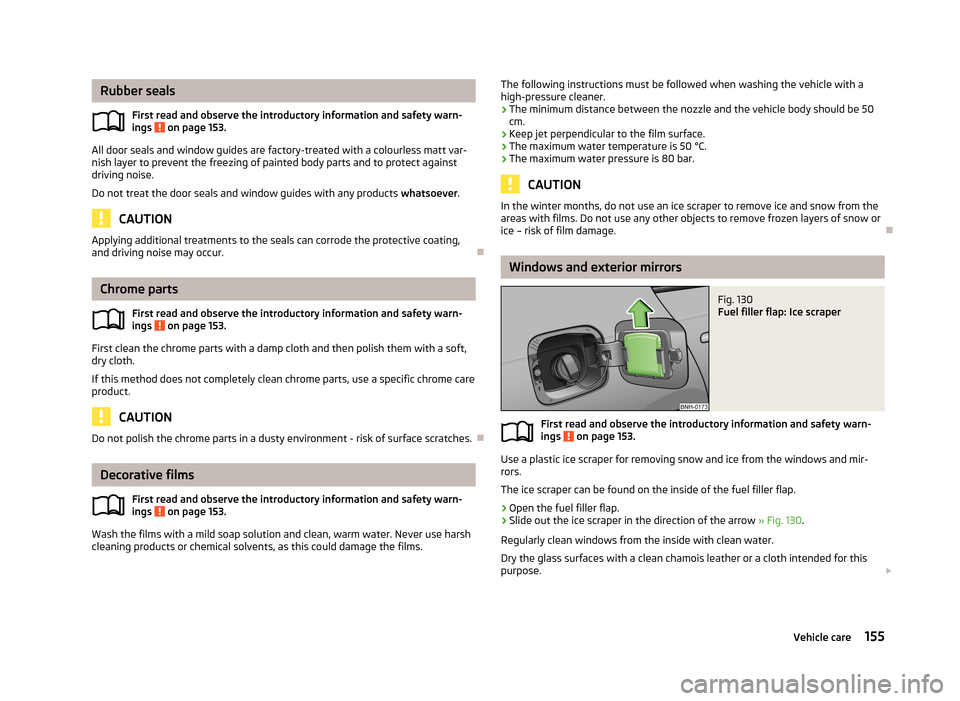
Use a plastic ice scraper for removing snow and ice from the windows and mir-rors.
The ice scraper can be found on the inside of the fuel filler flap.
›
Open the fuel filler flap.
›
Slide out the ice scraper in the direction of the arrow » Fig. 130.
Regularly clean windows from the inside with clean water. Dry the glass surfaces with a clean chamois leather or a cloth intended for this
purpose.
155Vehicle care
Page 159 of 226
When drying the windows after washing the vehicle, do not use window leathers
that have been used to polish the bodywork. Residues of preservatives in the
window leather can make the window dirty and reduce visibility.
CAUTION
■ The ice scraper should not be moved forward and backward but in one direction
to avoid any damage to the surface of the glass.■
Snow or ice that is contaminated with coarse dirt such as fine gravel, sand or
salt must not be removed from the windows and mirrors – there is a risk of dam-
age to the surface of the windows and mirrors.
■
Do not remove snow or ice from glass parts using warm or hot water – risk of
cracks forming in the glass.
■
When removing snow or ice from windows and mirror lenses ensure that the
paintwork of the vehicle is not to damage.
■
Do not clean the inside of the windows with sharp-edged objects or corrosive
and acidic cleaning agents – there is a risk of damaging the heating elements or
window aerial.
Headlight lenses
First read and observe the introductory information and safety warn-ings
on page 153.
Clean plastic front headlight lenses using clean, warm water and soap.
CAUTION
■ Never wipe headlights with a dry cloth.■Do not use any sharp objects to clean the plastic lenses, as this may damage
the protective paintwork and consequently cause cracks to form on the headlight
lenses.■
Do not use any harsh cleaning products or chemical solvents to clean the head-
lights, as this could damage the headlight lenses.
Door lock cylinders
First read and observe the introductory information and safety warn-
ings
on page 153.
Specific products must be used for de-icing door lock cylinders.
CAUTIONWhen washing your vehicle, ensure as little water as possible gets into the lock-
ing cylinders.
Cavity protection
First read and observe the introductory information and safety warn-
ings
on page 153.
All the cavities of your vehicle which are at risk from corrosion are protected for
life by a layer of protective wax applied in the factory.
This wax protection does not need to be inspected or re-applied. If any small amount of wax flow out of the cavities at high temperatures, thesemust be removed with a plastic scraper and the stains cleaned using a petroleum
cleaner.
WARNINGSafety regulations should be observed when using petroleum cleaner to re-
move wax – risk of fire!
Wheels
First read and observe the introductory information and safety warn-
ings
on page 153.
Wheel rims
Also thoroughly wash the wheel rims when washing the vehicle on a regular ba-
sis.
Regularly remove salt and brake abrasion, otherwise the rim material will be cor-
roded.
Damage to the paint layer on the wheel rims must be touched up immediately.
Light alloy wheels
After washing thoroughly and treat the wheel rims with a protective product for
light alloy wheels. Products which cause abrasion must not be used to treat the
wheel rims.
156General Maintenance
Page 197 of 226
Synchronising the remote controlFirst read and observe the introductory information and safety warn-
ings
on page 193.
If the vehicle does not unlock when pressing the remote control, the key may not
be synchronised. This can occur when the buttons on the remote control key are actuated a number of times outside of the operative range of the equipment or
the battery in the remote control key was replaced.
Synchronise the key as follows.
›
Press any button on the remote control key.
›
Pressing of the button means that the door will unlock with the key within 1 mi-
nute.
Emergency unlocking/locking
Introduction
This chapter contains information on the following subjects:
Locking a door
194
Unlocking the tailgate
194
Selector lever-emergency unlocking
195
Locking a door
Fig. 160
Left rear door: Emergency lock-
ingFirst read and observe the introductory information given on page 194.
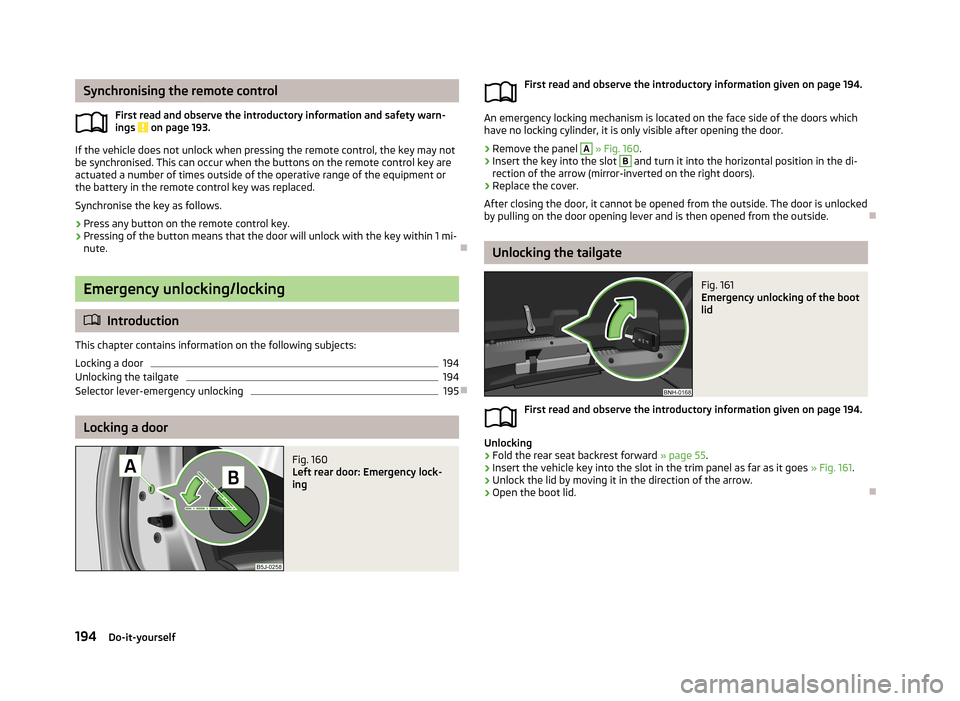
An emergency locking mechanism is located on the face side of the doors which
have no locking cylinder, it is only visible after opening the door.
›
Remove the panel
A
» Fig. 160 .
›
Insert the key into the slot
B
and turn it into the horizontal position in the di-
rection of the arrow (mirror-inverted on the right doors).
›
Replace the cover.
After closing the door, it cannot be opened from the outside. The door is unlocked by pulling on the door opening lever and is then opened from the outside.
Unlocking the tailgate
Fig. 161
Emergency unlocking of the boot
lid
First read and observe the introductory information given on page 194.
Unlocking
›
Fold the rear seat backrest forward » page 55.
›
Insert the vehicle key into the slot in the trim panel as far as it goes » Fig. 161
.
›
Unlock the lid by moving it in the direction of the arrow.
›
Open the boot lid.
194Do-it-yourself
Page 201 of 226
›Reinsert the cover into the dash panel in the opposite direction to the arrow
such that the guide pins are guided into the dash panel openings.
Carefully push the cover in.
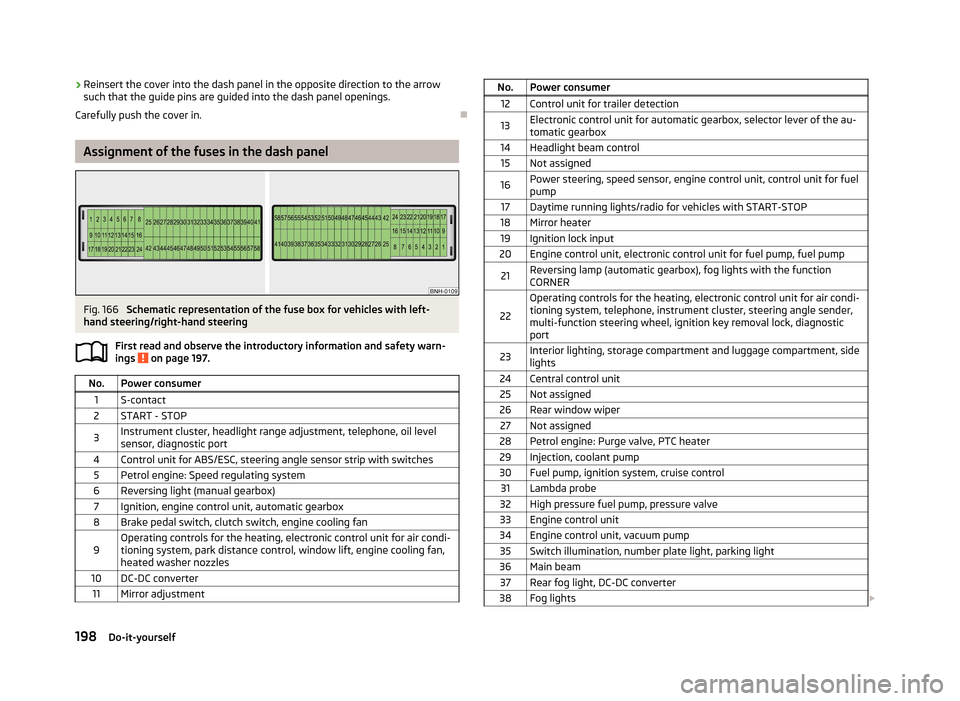
Assignment of the fuses in the dash panel
Fig. 166
Schematic representation of the fuse box for vehicles with left-
hand steering/right-hand steering
First read and observe the introductory information and safety warn-ings
on page 197.
No.Power consumer1S-contact2START - STOP3Instrument cluster, headlight range adjustment, telephone, oil level
sensor, diagnostic port4Control unit for ABS/ESC, steering angle sensor strip with switches5Petrol engine: Speed regulating system6Reversing light (manual gearbox)7Ignition, engine control unit, automatic gearbox8Brake pedal switch, clutch switch, engine cooling fan9Operating controls for the heating, electronic control unit for air condi-
tioning system, park distance control, window lift, engine cooling fan, heated washer nozzles10DC-DC converter11Mirror adjustmentNo.Power consumer12Control unit for trailer detection13Electronic control unit for automatic gearbox, selector lever of the au-tomatic gearbox14Headlight beam control15Not assigned16Power steering, speed sensor, engine control unit, control unit for fuel
pump17Daytime running lights/radio for vehicles with START-STOP18Mirror heater19Ignition lock input20Engine control unit, electronic control unit for fuel pump, fuel pump21Reversing lamp (automatic gearbox), fog lights with the function
CORNER
22
Operating controls for the heating, electronic control unit for air condi- tioning system, telephone, instrument cluster, steering angle sender,
multi-function steering wheel, ignition key removal lock, diagnostic
port23Interior lighting, storage compartment and luggage compartment, side
lights24Central control unit25Not assigned26Rear window wiper27Not assigned28Petrol engine: Purge valve, PTC heater29Injection, coolant pump30Fuel pump, ignition system, cruise control31Lambda probe32High pressure fuel pump, pressure valve33Engine control unit34Engine control unit, vacuum pump35Switch illumination, number plate light, parking light36Main beam37Rear fog light, DC-DC converter38Fog lights 198Do-it-yourself
Page 211 of 226
The operating weight also contains the weight of the driver (75 kg), the weight ofthe operating fluids, the tool kit, and a fuel tank filled to 90 % capacity.
It is possible to calculate the approximate loading capacity from the differencebetween the permissible total weight and the operating weight »
.
The payload consists of the following components: › Passengers
› All items of luggage and other loads
› Roof load including roof rack system
› Equipment not included in the operating weight
› Trailer drawbar load when towing a trailer (max. 50 kg).
Fuel consumption and CO 2 emissions according to ECE regulations and EU
directives
The measurement of the intra-urban cycle begins with a cold start of the engine. Afterwards standard urban driving is simulated.
In the extra-urban driving cycle, the vehicle is accelerated and decelerated in all
gears, corresponding to daily routine driving conditions. The driving speed varies
between 0 and 120 km/h.
The calculation of the combined fuel consumption considers a weighting of about 37 % for the intra-urban cycle and 63 % for the extra-urban cycle.
WARNINGDo not exceed the specified maximum permissible weights – risk of accident
and damage!
Note
■ If required, you can find out the precise weight of your vehicle at a specialist ga-
rage.■
The fuel consumption and emission values have been determined in accordance
with rules and under conditions set out by legal or technical requirements for de-
termining operational and technical data for motor vehicles.
■
Depending on the range of equipment, style of driving, traffic situation, weather
influences and vehicle condition, consumption values may deviate from the indi-
cated values.
Dimensions
First read and observe the introductory information given on page 207.
Vehicle dimensions (mm)
RapidRapid SpacebackLength44834304Width17061706Width including exterior mirror19401940Height1461/1488 a)
(1474/1500 a)
) b)1459/1471 a)
(1472/1484 a)
) b)Clearance136/143 b)134/141b)Wheel base26022602Track gauge front/rear1457/1494
(1463/1500) c)1457/1494
(1463/1500) c)a)
Valid for vehicles with the Amundsen+ navigation system.
b)
Applies to vehicles with a rough road package.
c)
Applies to cars fitted with the 1.2 l/55 kW MPI and 1.2 l/63 kW TSI engines and 14" wheel rims.
208Technical data
Page 215 of 226
Index
A
Abroad Driving abroad
110
Unleaded petrol110
ABS Function
112
Warning light18
Accessories149
Adjusting Belt height
133
Exterior mirror50
Head restraints53
Interior mirror50
Manual air conditioning81
Seat53
Seats52
Steering wheel96
Adjusting the seats52, 127
Adjustment Beam range
41
Aerial153
Airbag135
Deactivating140
Deactivating the front passenger airbag140
Deployment135
Front airbag137
Head airbag139
Indicator light20
Modifications and damage to the airbag system151
Side airbag138
Airbag system135
Air conditioning system Air outlets
76
Climatronic82
Manual air conditioning system79
Air outlets76
Alarm Switching off36
Triggering36
Anti-theft alarm system Activating/deactivating
36
Trailer125
Antilock Braking System112
Armrest Front
55
Rear55
Artificial leather158
Ashtray59
ASR warning light
17
Assist system ABS
112
Assist systems111
ABS18
ASR17
Cruise Control System114
EDL112
ESC17, 111
HBA112
HHC112
Parking aid113
START-STOP116
TCS112
Auto Check Control13
Automatic gearbox Selector lever-emergency unlocking
195
Starting-off and driving103
Tiptronic103
Automatic load deactivation174
Automatic transmission101
Kickdown104
Malfunction104
Selector lever lock103
Using the selector lever102
AUX95
Avoiding damage to the vehicle Driving through water
109
Avoiding damage to your vehicle109
B
Ball head Check fitting
121
Fitting121
Ready position120
Removing122
Battery In the remote control key
193
Belts130
Belt tensioners133
Bonnet Closing
164
Opening164
Boot Class N1 vehicles
65
Double-sided floor covering70
Flexible storage compartment69
Hooks66
Meshed pocket for storage70
See Boot lid38
Storage compartments in the boot69
Boot cover Parking position
68
Boot lid Automatic locking
38
Closing38
Opening38
Brake booster100
Brake fluid170
Changing171
Checking170
Information messages15
Brakes Brake assist systems
111
Brake booster100
Brake fluid170
Handbrake100
212Index
Page 218 of 226
Fuel reserveIndicator light19
Fuses Assignment
197
Assignment of fuses in the dash panel198
Colour coding197
Fuse assignment in the engine compartment200
Replacing197
Fuses in the engine compartment Assignment
200
G
Gearbox Information messages
13
Gear change Gear recommendation
24
Information on the selected gear24
Gear changing Gear stick
101
General view Cockpit
9
Generator Indicator light
15
Glasses storage box62
Glow plug system Warning light
18
GSM85
H
Handbrake
100
Indicator light14
Hazard warning light system44
HBA112
Head airbag139
Headlight cleaning system Headlight cleaning system
49
HeadlightsBulb arrangement201
Driving abroad110
Headlight cleaning system49
Head restraint53
Heating Defrosting windows
78
Exterior mirror50
operating77
Rear window47
Recirculated air mode79
Seats54
Heating and air-conditioning76
Heating rear window47
HHC112
Hill Hold Control (HHC)112
Hooks66
Horn9
Hydraulic Brake Assist (HBA)112
I
Ice-scraper
155
Ice warning23
Ignition98
Immobiliser98
Indicator lights14
Individual settings Locking
34
Unlocking34
Inertia reels133
Information system22
Compass point display24
Door warning24
Gear recommendation24
Ice warning23
MAXI DOT display27
Multifunction display25
Operation22
Service interval display28
Instrument cluster10
Counter for distance driven12
Display11
Fuel gauge12
Indicator lights14
Overview10
Revolution counter11
Speedometer11
Temperature gauge11
Interior monitor36
ISOFIX145
J
Jack
183
Jacking points Raise vehicle
186
Jump-starting189, 190
K
Key Locking
32
Starting the engine98
Unlocking32
L
Lever Main beam
43
Turn signal43
Windscreen wipers49
Light Daytime running lights
42
Fog lights with CORNER function43
Parking light45
Replacing bulbs200
Light bulbs Rear light (Rapid)
204
Lighting Luggage compartment
64
215Index
Page 219 of 226
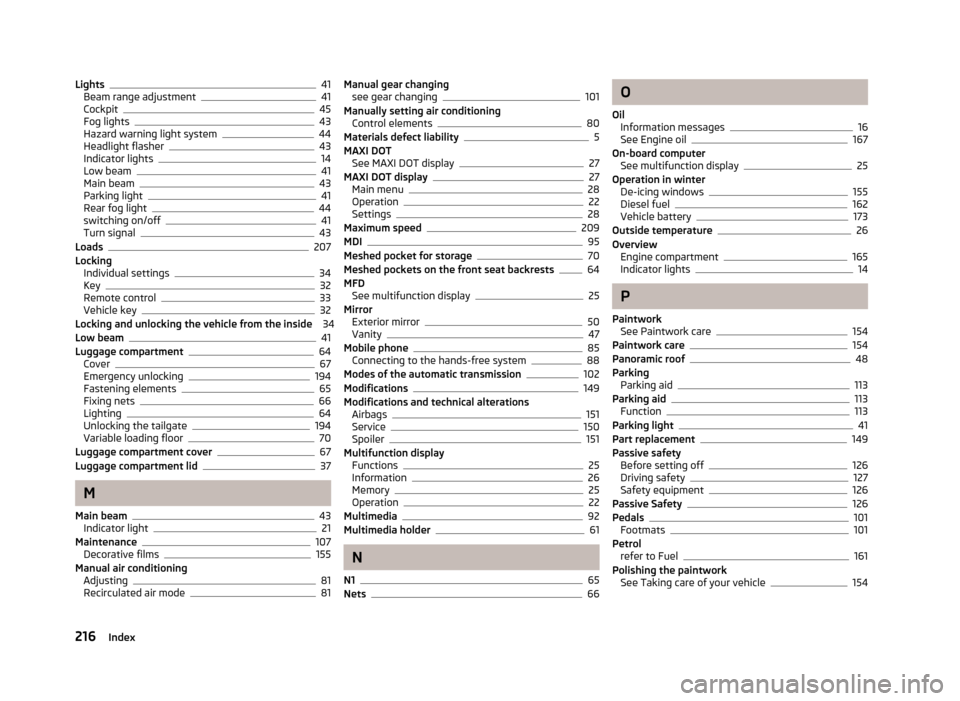
Lights41
Beam range adjustment41
Cockpit45
Fog lights43
Hazard warning light system44
Headlight flasher43
Indicator lights14
Low beam41
Main beam43
Parking light41
Rear fog light44
switching on/off41
Turn signal43
Loads207
Locking Individual settings
34
Key32
Remote control33
Vehicle key32
Locking and unlocking the vehicle from the inside 34
Low beam
41
Luggage compartment64
Cover67
Emergency unlocking194
Fastening elements65
Fixing nets66
Lighting64
Unlocking the tailgate194
Variable loading floor70
Luggage compartment cover67
Luggage compartment lid37
M
Main beam
43
Indicator light21
Maintenance107
Decorative films155
Manual air conditioning Adjusting
81
Recirculated air mode81
Manual gear changing see gear changing101
Manually setting air conditioning Control elements
80
Materials defect liability5
MAXI DOT See MAXI DOT display
27
MAXI DOT display27
Main menu28
Operation22
Settings28
Maximum speed209
MDI95
Meshed pocket for storage70
Meshed pockets on the front seat backrests64
MFD See multifunction display
25
Mirror Exterior mirror
50
Vanity47
Mobile phone85
Connecting to the hands-free system88
Modes of the automatic transmission102
Modifications149
Modifications and technical alterations Airbags
151
Service150
Spoiler151
Multifunction display Functions
25
Information26
Memory25
Operation22
Multimedia92
Multimedia holder61
N
N1
65
Nets66
O
Oil Information messages
16
See Engine oil167
On-board computer See multifunction display
25
Operation in winter De-icing windows
155
Diesel fuel162
Vehicle battery173
Outside temperature26
Overview Engine compartment
165
Indicator lights14
P
Paintwork See Paintwork care
154
Paintwork care154
Panoramic roof48
Parking Parking aid
113
Parking aid113
Function113
Parking light41
Part replacement149
Passive safety Before setting off
126
Driving safety127
Safety equipment126
Passive Safety126
Pedals101
Footmats101
Petrol refer to Fuel
161
Polishing the paintwork See Taking care of your vehicle
154
216Index
Page 220 of 226
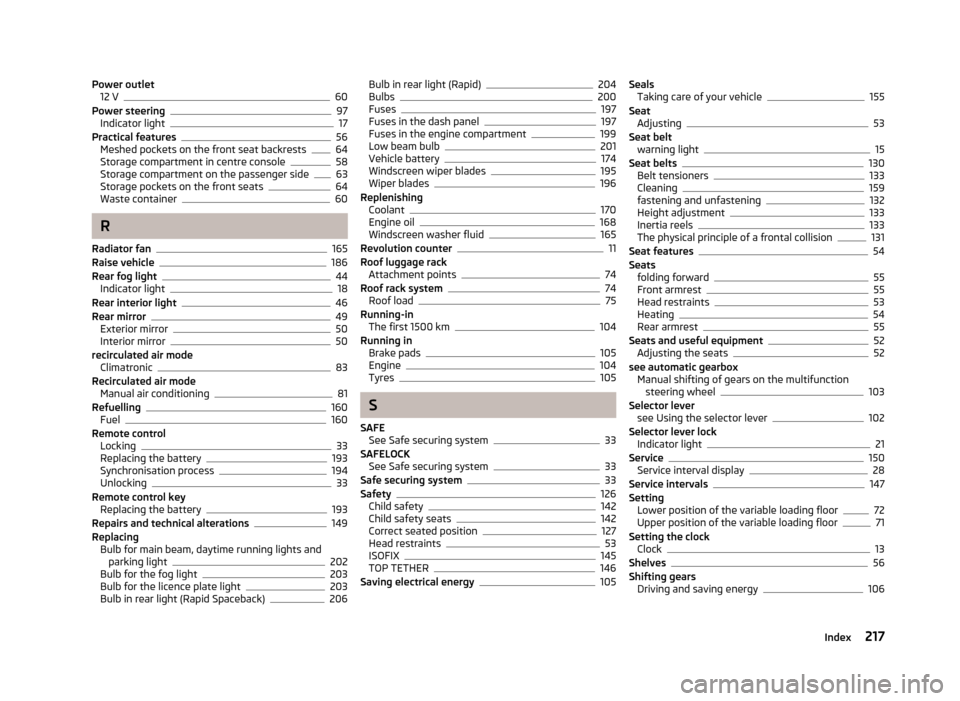
Power outlet12 V60
Power steering97
Indicator light17
Practical features56
Meshed pockets on the front seat backrests64
Storage compartment in centre console58
Storage compartment on the passenger side63
Storage pockets on the front seats64
Waste container60
R
Radiator fan
165
Raise vehicle186
Rear fog light44
Indicator light18
Rear interior light46
Rear mirror49
Exterior mirror50
Interior mirror50
recirculated air mode Climatronic
83
Recirculated air mode Manual air conditioning
81
Refuelling160
Fuel160
Remote control Locking
33
Replacing the battery193
Synchronisation process194
Unlocking33
Remote control key Replacing the battery
193
Repairs and technical alterations149
Replacing Bulb for main beam, daytime running lights andparking light
202
Bulb for the fog light203
Bulb for the licence plate light203
Bulb in rear light (Rapid Spaceback)206
Bulb in rear light (Rapid)204
Bulbs200
Fuses197
Fuses in the dash panel197
Fuses in the engine compartment199
Low beam bulb201
Vehicle battery174
Windscreen wiper blades195
Wiper blades196
Replenishing Coolant
170
Engine oil168
Windscreen washer fluid165
Revolution counter11
Roof luggage rack Attachment points
74
Roof rack system74
Roof load75
Running-in The first 1500 km
104
Running in Brake pads
105
Engine104
Tyres105
S
SAFE See Safe securing system
33
SAFELOCK See Safe securing system
33
Safe securing system33
Safety126
Child safety142
Child safety seats142
Correct seated position127
Head restraints53
ISOFIX145
TOP TETHER146
Saving electrical energy105
Seals Taking care of your vehicle155
Seat Adjusting
53
Seat belt warning light
15
Seat belts130
Belt tensioners133
Cleaning159
fastening and unfastening132
Height adjustment133
Inertia reels133
The physical principle of a frontal collision131
Seat features54
Seats folding forward
55
Front armrest55
Head restraints53
Heating54
Rear armrest55
Seats and useful equipment52
Adjusting the seats52
see automatic gearbox Manual shifting of gears on the multifunction
steering wheel
103
Selector lever see Using the selector lever
102
Selector lever lock Indicator light
21
Service150
Service interval display28
Service intervals147
Setting Lower position of the variable loading floor
72
Upper position of the variable loading floor71
Setting the clock Clock
13
Shelves56
Shifting gears Driving and saving energy
106
217Index