roof rack SKODA RAPID 2013 1.G Owner's Manual
[x] Cancel search | Manufacturer: SKODA, Model Year: 2013, Model line: RAPID, Model: SKODA RAPID 2013 1.GPages: 226, PDF Size: 15.16 MB
Page 6 of 226
Table of Contents
Materials defect liability and ŠKODA warranty for
new cars5
Mobility warranty and ŠKODA extended
warranty
6
Abbreviations
Using the system
Cockpit
9
Overview
8
Instruments and Indicator Lights
10
Instrument cluster
10
Indicator lights
14
Information system
22
Driver information system
22
Multifunction display (MFD)
25
MAXI DOT display
27
Service interval display
28
Unlocking and opening
31
Unlocking and locking
31
Anti-theft alarm system
36
Luggage compartment lid
37
Electrical power windows
38
Lights and visibility
41
Lights
41
Interior lighting
45
Visibility
46
Windscreen wipers and washers
48
Rear mirror
49Seats and useful equipment52Adjusting the seats52
Seat features
54
Practical equipment
56
Luggage compartment
64
Variable loading floor in the luggage
compartment (Rapid Spaceback)
70
Roof rack system
74
Heating and air-conditioning
76
Heating, ventilation, cooling
76
Heating
77
Air conditioning system (manual air conditioning system)
79
Climatronic (automatic air conditioning
system)
82
Communication and multimedia
85
Universal telephone installation GSM II
85
Voice control
90
Multimedia
92
Driving
Starting-off and Driving
96
Steering
96
Starting and stopping the engine
97
Brakes
99
Manual gear changing and pedals
101
Automatic transmission
101
Running in
104
Economical driving and environmental
sustainability
105
Avoiding damage to your vehicle
109
Driving abroad
110
Assist systems
111
Brake assist systems
111
Parking aid
113Cruise Control System114START-STOP116
Towing a trailer
119
Towing device
119
Trailer
123
Safety
Passive Safety
126
General information
126
Correct seated position
127
Seat belts
130
Using seat belts
130
Inertia reels and belt tensioners
133
Airbag system
135
Description of the airbag system
135
Airbag overview
136
Deactivating airbags
139
Transporting children safely
142
Child seat
142
Fastening systems
145
General Maintenance
Vehicle care
147
Service intervals
147
Service work, adjustments and technical alterations
149
Washing your car
152
Taking care of your vehicle exterior
153
Taking care of the interior
157
Inspecting and replenishing
160
Fuel
160
Engine compartment
162
Engine oil
166
Coolant
1683Table of Contents
Page 77 of 226
CAUTION■The variable loading floor can only be set to the “parking position” when in the
lower position.■
If the variable loading floor is in the “parking position”, the “parking position” on
the luggage compartment cover cannot be set » page 68.
Roof rack system
Introduction
This chapter contains information on the following subjects:
Attachment points
74
Roof load
75WARNING■ The transported items on the roof rack must be securely attached – risk of
accident!■
Always secure the load with appropriate and undamaged lashing straps or
tensioning straps.
■
Distribute the load evenly over the roof rack system.
■
When transporting heavy objects or objects which take up a large area on
the roof rack system, handling of the car may change as a result of the dis-
placement of the centre of gravity. The style of driving and speed must there-
fore be adapted to the current circumstances.
■
Avoid abrupt and sudden driving/braking manoeuvres.
■
Adjust the speed and driving style to the visibility, weather, road and traffic
conditions.
■
The permissible roof load, permissible axle loads and permissible total vehi-
cle weight must not be exceeded under any circumstance – risk of accident!
CAUTION
■ Only use roof rack systems approved by ŠKODA AUTO a.s.■When dealing with roof rack systems, the installation instructions supplied with
the roof luggage rack system must be observed.■
On models fitted with a power sliding/tilting roof, ensure that the extended
sliding/tilting roof does not hit any items of luggage transported on the roof.
■
Ensure that the boot lid does not hit the roof load when opened.
■ The height of the vehicle changes after mounting a roof luggage rack system
and the load that is secured to it. Compare the vehicle height with available clear- ances, such as underpasses and garage doors.■
Always remove the roof luggage rack system before entering an automated car
wash.
■
Ensure the roof aerial is not impaired by the secured load.
For the sake of the environment
The increased aerodynamic drag results in a higher fuel consumption.
Attachment points
Fig. 76
Attachment points for roof bars
First read and observe the introductory information and safety warn- ings
on page 74.
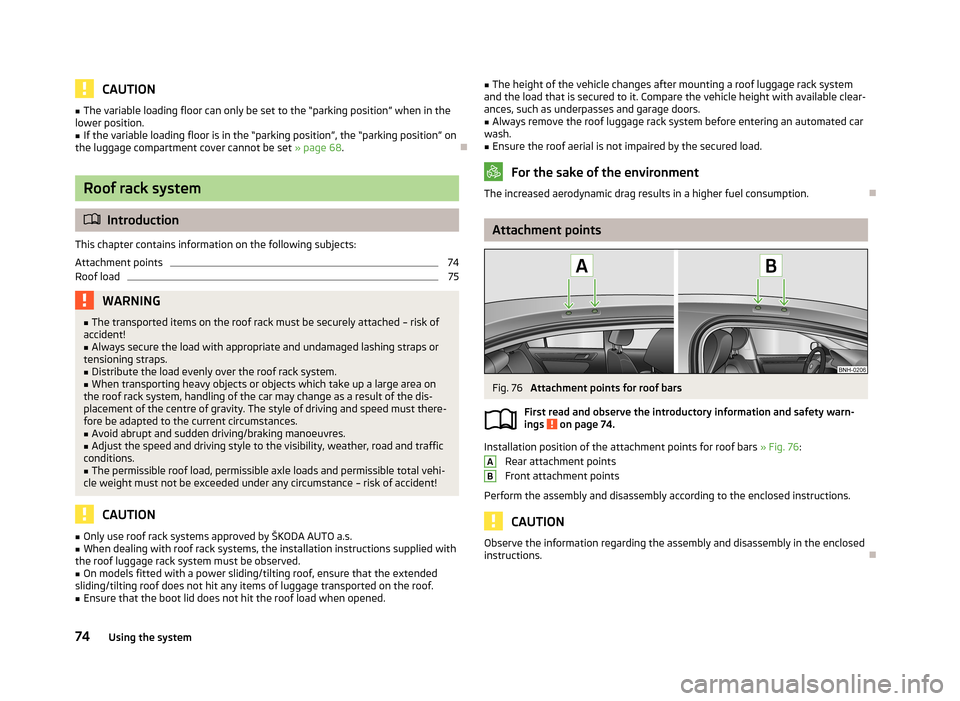
Installation position of the attachment points for roof bars » Fig. 76:
Rear attachment points
Front attachment points
Perform the assembly and disassembly according to the enclosed instructions.
CAUTION
Observe the information regarding the assembly and disassembly in the enclosed
instructions.
AB74Using the system
Page 78 of 226
Roof loadFirst read and observe the introductory information and safety warn-
ings
on page 74.
The maximum permissible roof load (including roof rack system) of 75 kg and the
maximum permissible total weight of the vehicle should not be exceeded.
The full permissible roof load cannot be used if a roof rack system with a lower
load carrying capacity is used. In this case, the roof rack system must only be loa-
ded up to the maximum weight limit specified in the fitting instructions.
75Seats and useful equipment
Page 110 of 226
In vehicles not equipped with the START-STOP system, turn off the engine when
in a traffic jam, at a level crossing or traffic lights with longer wait times.
Even after just 30 – 40 seconds you will have saved more fuel than that is needed
when you start the engine up again.
If an engine is only idling it takes much longer for it to reach its normal operating
temperature. Wear-and-tear and pollutant emissions, though, are particularly
high in the warming-up phase. Therefore, start driving as soon as the engine has
started, though high engine speeds should be avoided.
Avoiding short distances
Fig. 98
Principle sketch: Fuel consump-
tion in l/100 km at different tem-
peratures
First read and observe the introductory information and safety warn-
ings on page 105.
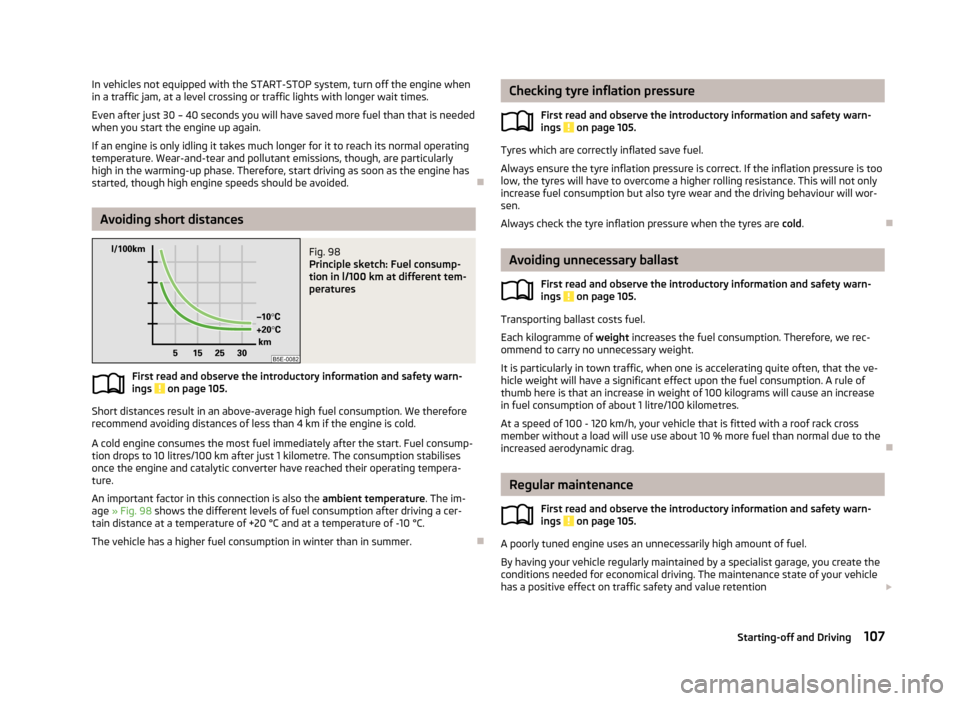
Short distances result in an above-average high fuel consumption. We therefore
recommend avoiding distances of less than 4 km if the engine is cold.
A cold engine consumes the most fuel immediately after the start. Fuel consump-tion drops to 10 litres/100 km after just 1 kilometre. The consumption stabilises
once the engine and catalytic converter have reached their operating tempera- ture.
An important factor in this connection is also the ambient temperature. The im-
age » Fig. 98 shows the different levels of fuel consumption after driving a cer-
tain distance at a temperature of +20 °C and at a temperature of -10 °C.
The vehicle has a higher fuel consumption in winter than in summer.
Checking tyre inflation pressure
First read and observe the introductory information and safety warn-ings
on page 105.
Tyres which are correctly inflated save fuel.
Always ensure the tyre inflation pressure is correct. If the inflation pressure is too
low, the tyres will have to overcome a higher rolling resistance. This will not only increase fuel consumption but also tyre wear and the driving behaviour will wor-
sen.
Always check the tyre inflation pressure when the tyres are cold.
Avoiding unnecessary ballast
First read and observe the introductory information and safety warn-
ings
on page 105.
Transporting ballast costs fuel.
Each kilogramme of weight increases the fuel consumption. Therefore, we rec-
ommend to carry no unnecessary weight.
It is particularly in town traffic, when one is accelerating quite often, that the ve-
hicle weight will have a significant effect upon the fuel consumption. A rule of
thumb here is that an increase in weight of 100 kilograms will cause an increase in fuel consumption of about 1 litre/100 kilometres.
At a speed of 100 - 120 km/h, your vehicle that is fitted with a roof rack crossmember without a load will use use about 10 % more fuel than normal due to the
increased aerodynamic drag.
Regular maintenance
First read and observe the introductory information and safety warn-
ings
on page 105.
A poorly tuned engine uses an unnecessarily high amount of fuel.
By having your vehicle regularly maintained by a specialist garage, you create the conditions needed for economical driving. The maintenance state of your vehicle has a positive effect on traffic safety and value retention
107Starting-off and Driving
Page 156 of 226
CAUTION■When washing the car by hand, protect your hands and arms from sharp-edged
metal parts (e.g. when cleaning the underfloor, the inside of the wheel housings
or the wheel trims, etc.) - There is a risk of cuts!■
Only apply slight pressure when cleaning the vehicle's paintwork.
Automatic car wash systems
First read and observe the introductory information and safety warn-
ings
on page 152.
The usual precautionary measures must be taken before washing the vehicle in
an automatic car wash system (e.g. closing the windows and the sliding/tilting
roof etc.).
If your vehicle is fitted with any particular attached parts, such as a spoiler, roof
rack system, two-way radio aerial etc., it is best to consult the operator of the car
wash system beforehand.
After an automatic wash with wax treatment, the lips of the wipers should be cleaned with cleaning agents specially designed for the purpose, and then de-
greased.
WARNINGFold in the exterior mirrors to prevent damage before washing the vehicle in
an automatic car wash system.
Washing with a high-pressure cleaner
First read and observe the introductory information and safety warn-
ings
on page 152.
When washing the vehicle with a high-pressure cleaner, the instructions for use
of the equipment must be observed. This applies in particular to the pressure
used and to the spraying distance .
Maintain a sufficiently large distance to the parking aid sensors and soft materials
such as rubber hoses or insulation material.
WARNINGNever use circular spray nozzles or dirt cutters!
CAUTION
■ If washing the vehicle in the winter using a hose or high-pressure cleaner, en-
sure that the jet of water is not aimed directly at the locking cylinders or the
door/panel joints – risk of freezing!■
To avoid damaging the parking aid sensors while cleaning with high-pressure
cleaners or steam jets, the sensors must only be directly sprayed for short periods
while a minimum distance of 10 cm must be observed.
■
The temperature of the water used for cleaning must not exceed 60 °C – risk of
damaging the vehicle.
■
See also Washing cars with decorative films using a high-pressure clean-
er » page 155 .
Taking care of your vehicle exterior
Introduction
This chapter contains information on the following subjects:
Taking care of your vehicle's paintwork
154
Plastic parts
154
Rubber seals
155
Chrome parts
155
Decorative films
155
Windows and exterior mirrors
155
Headlight lenses
156
Door lock cylinders
156
Cavity protection
156
Wheels
156
Underbody protection
157
Regular and proper care help to retain the efficiency and value of your vehicle. It
may also be one of the requirements for the acceptance of warranty claims relat- ing to corrosion damage and paint defects on the bodywork.
153Vehicle care
Page 161 of 226
Natural leatherFirst read and observe the introductory information and safety warn-
ings
on page 157.
Leather is a natural material with specific properties, and requires regular clean-
ing and maintenance.
The leather should be cleaned on a regular basis depending on the amount of
wear-and-tear.
Dust and dirt in the pores and folds act as abrasive materials. This leads to severe corrosion and the premature brittleness of the leather surface.
We recommend that you remove dust regularly and at short intervals using a
cloth or vacuum cleaner.
Clean soiled leather surfaces with a water-dampened cotton or woollen cloth and
then dry with a clean, dry cloth »
.
Clean severely soiled areas with a cloth soaked in a mild soap solution (2 table-
spoons of neutral soap to 1 litre of water).
To remove stains , use a cleaning agent specially designed for this purpose.
Treat the leather regularly and at suitable intervals using a suitable leather care
product.
CAUTION
■ Ensure that no part of the leather is soaked through during cleaning and that
no water gets into the seams. Otherwise, the leather could become brittle or
cracked.■
Avoid leaving the vehicle for lengthy periods in bright sunlight to avoid the
leather from bleaching. If the vehicle is parked in the open for lengthy periods, protect the leather from direct sunlight by covering it.
■
Sharp-edged objects on items of clothing such as zip fasteners, rivets, sharp-
edged belts, jewellery and pendants may leave permanent scratches or signs of
rubbing on the surface. Such damage cannot be subsequently recognised as a
justified complaint.
■
The use of a mechanical steering wheel lock may damage the leather surface of
the steering wheel.
■ Use a care cream with light blocker and impregnation effect on a regular basis
and each time after cleaning. The cream nourishes the leather, allows it to
breathe and keeps it supple and also provides moisture. It also creates surface
protection.■
Some clothing materials, e.g. dark denim, do not have sufficient colour fastness.
This can cause damage or clearly visible discolouration to seat covers, even when used correctly. This applies particularly to light-coloured seat covers. This does
not relate to a fault in the seat cover, but rather to poor colour fastness of the
clothing textiles.
Note
When using the vehicle, minor visible changes may occur to the leather parts of
the covers (e.g. wrinkles or creases) as a result of the stress applied to the covers.
Artificial leather, cloths and Alcantara ®
First read and observe the introductory information and safety warn- ings
on page 157.
Artificial leather
Clean artificial leather with a damp cloth.
If this method does not completely clean the artificial leather, use a mild soap sol- ution or cleaning products specially designed for this purpose.
Fabric
Clean upholstery cover materials and cloth trims on doors, boot cover, etc. using
specific cleaning agents, e.g., dry foam.
Use a soft sponge, brush, or commercially available microfibre cloth.
Use a cloth and a cleaning agent specifically designed for this purpose to clean
the roof trim.
Remove any lumps on the cover fabric and any fabric residue using a brush.
Remove stubborn hair using a “cleaning glove”.
Alcantara ®
Dust and fine dirt particles in pores, creases and seams may chafe and damage the surface.
If you leave your vehicle parked in the open for lengthy periods, protect the Al-
cantara ®
seat covers from the direct rays of the sun to prevent fading.
158General Maintenance
Page 211 of 226
The operating weight also contains the weight of the driver (75 kg), the weight ofthe operating fluids, the tool kit, and a fuel tank filled to 90 % capacity.
It is possible to calculate the approximate loading capacity from the differencebetween the permissible total weight and the operating weight »
.
The payload consists of the following components: › Passengers
› All items of luggage and other loads
› Roof load including roof rack system
› Equipment not included in the operating weight
› Trailer drawbar load when towing a trailer (max. 50 kg).
Fuel consumption and CO 2 emissions according to ECE regulations and EU
directives
The measurement of the intra-urban cycle begins with a cold start of the engine. Afterwards standard urban driving is simulated.
In the extra-urban driving cycle, the vehicle is accelerated and decelerated in all
gears, corresponding to daily routine driving conditions. The driving speed varies
between 0 and 120 km/h.
The calculation of the combined fuel consumption considers a weighting of about 37 % for the intra-urban cycle and 63 % for the extra-urban cycle.
WARNINGDo not exceed the specified maximum permissible weights – risk of accident
and damage!
Note
■ If required, you can find out the precise weight of your vehicle at a specialist ga-
rage.■
The fuel consumption and emission values have been determined in accordance
with rules and under conditions set out by legal or technical requirements for de-
termining operational and technical data for motor vehicles.
■
Depending on the range of equipment, style of driving, traffic situation, weather
influences and vehicle condition, consumption values may deviate from the indi-
cated values.
Dimensions
First read and observe the introductory information given on page 207.
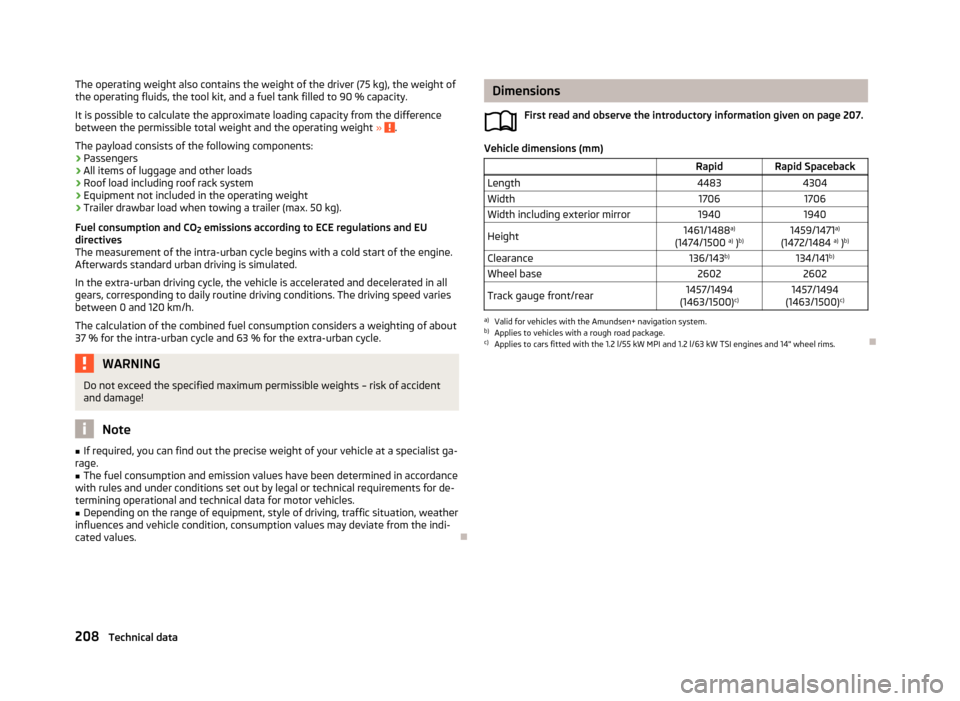
Vehicle dimensions (mm)
RapidRapid SpacebackLength44834304Width17061706Width including exterior mirror19401940Height1461/1488 a)
(1474/1500 a)
) b)1459/1471 a)
(1472/1484 a)
) b)Clearance136/143 b)134/141b)Wheel base26022602Track gauge front/rear1457/1494
(1463/1500) c)1457/1494
(1463/1500) c)a)
Valid for vehicles with the Amundsen+ navigation system.
b)
Applies to vehicles with a rough road package.
c)
Applies to cars fitted with the 1.2 l/55 kW MPI and 1.2 l/63 kW TSI engines and 14" wheel rims.
208Technical data
Page 220 of 226
Power outlet12 V60
Power steering97
Indicator light17
Practical features56
Meshed pockets on the front seat backrests64
Storage compartment in centre console58
Storage compartment on the passenger side63
Storage pockets on the front seats64
Waste container60
R
Radiator fan
165
Raise vehicle186
Rear fog light44
Indicator light18
Rear interior light46
Rear mirror49
Exterior mirror50
Interior mirror50
recirculated air mode Climatronic
83
Recirculated air mode Manual air conditioning
81
Refuelling160
Fuel160
Remote control Locking
33
Replacing the battery193
Synchronisation process194
Unlocking33
Remote control key Replacing the battery
193
Repairs and technical alterations149
Replacing Bulb for main beam, daytime running lights andparking light
202
Bulb for the fog light203
Bulb for the licence plate light203
Bulb in rear light (Rapid Spaceback)206
Bulb in rear light (Rapid)204
Bulbs200
Fuses197
Fuses in the dash panel197
Fuses in the engine compartment199
Low beam bulb201
Vehicle battery174
Windscreen wiper blades195
Wiper blades196
Replenishing Coolant
170
Engine oil168
Windscreen washer fluid165
Revolution counter11
Roof luggage rack Attachment points
74
Roof rack system74
Roof load75
Running-in The first 1500 km
104
Running in Brake pads
105
Engine104
Tyres105
S
SAFE See Safe securing system
33
SAFELOCK See Safe securing system
33
Safe securing system33
Safety126
Child safety142
Child safety seats142
Correct seated position127
Head restraints53
ISOFIX145
TOP TETHER146
Saving electrical energy105
Seals Taking care of your vehicle155
Seat Adjusting
53
Seat belt warning light
15
Seat belts130
Belt tensioners133
Cleaning159
fastening and unfastening132
Height adjustment133
Inertia reels133
The physical principle of a frontal collision131
Seat features54
Seats folding forward
55
Front armrest55
Head restraints53
Heating54
Rear armrest55
Seats and useful equipment52
Adjusting the seats52
see automatic gearbox Manual shifting of gears on the multifunction
steering wheel
103
Selector lever see Using the selector lever
102
Selector lever lock Indicator light
21
Service150
Service interval display28
Service intervals147
Setting Lower position of the variable loading floor
72
Upper position of the variable loading floor71
Setting the clock Clock
13
Shelves56
Shifting gears Driving and saving energy
106
217Index
Page 221 of 226
Side airbag138
Snow chains181
Spare wheel179
Speedometer11
See speedometer11
Speed symbol See Wheels
178
Spoiler151
START-STOP116
Manually activating/deactivating the system117
Operating conditions of the system117
Starting/shutting down the engine116
Starting and stopping the engine with the key97
Starting engine Jump-starting
189
Starting the engine Jump-starting
190
Key98
START STOP Information messages
118
Jump-starting191
Steering force assistance97
Steering wheel96
Storage compartment in centre console58
Storage compartment on the passenger side63
Storage compartments56
Storage compartments in the boot69
Storage compartments in the doors57
Storage pockets on the front seats64
sun roof48
sunshade48
Sun visors47
Switch See Ignition
98
Switching off the engine99
Switch light on/off41
T
Taking care of the vehicle Natural leather
158
Seat belts159
Taking care of your vehicle Automatic car wash system
153
Cavity protection156
Chrome parts155
Cleaning the wheels156
Decorative films155
Door lock cylinders156
Headlight lenses156
High-pressure cleaner153
Plastic parts154
Polishing the paintwork154
Rubber seals155
Taking care of the interior157
Taking care of your vehicle exterior153
Washing152
Washing by hand152
Wash system153
Wax treatment154
Taking care of your vehicles Fabric covers
159
TCS Operation
112
Technical data207
Telephone85
Temporary spare wheel179
Tiptronic103
Tools183
TOP TETHER146
Towing191
Towing a trailer119
Towing device Description
119
Drawbar load119
Use and care122
Towing eye Front192
Rear192
Towing protection36
Traction Control System (TCS)112
Trailer119, 123
13-pin power socket124
driving with a trailer124
Loading123
Safety eye124
Transport Luggage compartment
64
Roof rack system74
Transporting children safely142
Turn signal43
Turn signal system Indicator light
20
two-way radio systems85
Type plate207
Tyre inflation pressure Indicator light
20
Tyre load-bearing capacity See Wheels
177
Tyre pressure monitor Setting
178
Tyre repair Check pressure
189
Preparations188
Sealing and inflating the tyre188
Tyres175
Inflation pressure176
New177
See Wheels177
Sizes176
Tyre wear indicator176
U
Underbody protection
157
Unleaded petrol110
218Index