steering SKODA RAPID 2015 1.G Owner's Guide
[x] Cancel search | Manufacturer: SKODA, Model Year: 2015, Model line: RAPID, Model: SKODA RAPID 2015 1.GPages: 204, PDF Size: 27.52 MB
Page 154 of 204
NoteThe declaration of conformity (COC document), can be obtained from a ŠKODA1)
partner.
Tyre wear
Read and observe
on page 150 first.
Tyre wear depends on the pressure, driving style, and other circumstances.
Attention to the following notes may affect tyre wear.
Driving style
Fast cornering, sharp acceleration and braking increase the wear of your tyres.
Wheel balance
The wheels of a new vehicle are balanced. When driving, however, there are a
range of factors that may result in an imbalance. This may become apparent by
a “vibration” in the steering. If this is the case, have the wheels checked by a
specialist garage.
Have the wheels likewise rebalanced after replacing the tyres.
Setting the vehicle geometry
Incorrect wheel alignment at the front or rear leads to excess wear on the
tyres and impairs driving safety. With a distinctive tyre wear, we recommend
that you check the setting of the vehicle geometry in a specialist workshop.
WARNING■ An incorrect wheel alignment at the front or rear impairs handling.■Unusual vibrations or pulling of the vehicle to one side could be a sign of
tyre damage. If there is any doubt that a wheel is damaged, immediately re-
duce your speed and stop! If no external tyre damage is evident, drive slow-
ly and carefully to the nearest specialist garage to have the vehicle
checked.Tyre wear indicator and wheels exchangeFig. 152
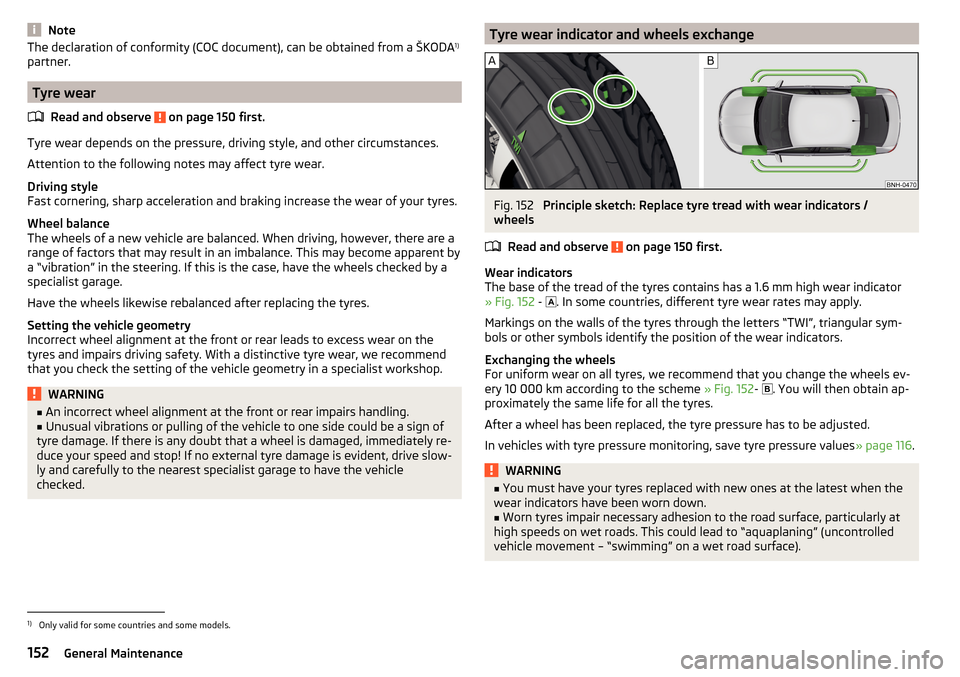
Principle sketch: Replace tyre tread with wear indicators /
wheels
Read and observe
on page 150 first.
Wear indicators
The base of the tread of the tyres contains has a 1.6 mm high wear indicator » Fig. 152 -
. In some countries, different tyre wear rates may apply.
Markings on the walls of the tyres through the letters “TWI”, triangular sym-
bols or other symbols identify the position of the wear indicators.
Exchanging the wheels
For uniform wear on all tyres, we recommend that you change the wheels ev-
ery 10 000 km according to the scheme » Fig. 152-
. You will then obtain ap-
proximately the same life for all the tyres.
After a wheel has been replaced, the tyre pressure has to be adjusted.
In vehicles with tyre pressure monitoring, save tyre pressure values » page 116.
WARNING■
You must have your tyres replaced with new ones at the latest when the
wear indicators have been worn down.■
Worn tyres impair necessary adhesion to the road surface, particularly at
high speeds on wet roads. This could lead to “aquaplaning” (uncontrolled vehicle movement – “swimming” on a wet road surface).
1)
Only valid for some countries and some models.
152General Maintenance
Page 168 of 204

›Only then approach correctly when the rope is taut.
The maximum towing speed is 50 km/h.
Driver of the towed vehicle›
Switch on the ignition so that the steering wheel is not locked and so that
the turn signal lights, windscreen wipers and windscreen washer system can
be used.
›
Take the vehicle out of gear or move the selector lever into position N if the
vehicle is fitted with an automatic gearbox.
Please note that the brake servo unit and power steering only operate if the
engine is running. If the engine is not running, significantly more physical force
is required to depress the brake pedal and steer the vehicle.
If using a tow rope, ensure that it is always kept taught.
General information for the towing process
Both drivers should be familiar with the problems which might possibly occur while a vehicle is being towed. Unskilled drivers should not attempt to tow an-
other vehicle or to be towed.
The vehicle must be transported on a special breakdown vehicle or trailer if it
is not possible to tow the vehicle in the way described or if the towing dis-
tance is greater than 50 km.
If the gearbox no longer contains any oil, your vehicle must only be towed with
the front axle raised clear of the ground or on a breakdown vehicle or trailer.
To protect both vehicles when tow-starting or towing, the tow rope should be
elastic. Thus only plastic fibre rope or a rope made out of a similarly elastic ma-
terial should be used.
Attach the tow rope or the tow bar to the towing eyes » page 166 or
» page 167 to the detachable ball head of the towing equipment » page 117 .
WARNING■
When towing, exercise increased caution.■For towing no spiral tow rope is to be used » Fig. 166- , the towing eye
may unscrew out of the vehicle - there is a risk of accidents.■
The tow rope should not be twisted - there is a risk of accidents.
CAUTION■ Do not start engine by towing - there is a risk of damaging the engine parts.
The battery from another vehicle can be used as a jump-start aid » page 164,
Jump-starting .■
There is always a risk of excessive stresses and damage resulting at the
points to which you attach the tow rope or tow bar when you attempt to tow a
vehicle which is not standing on a paved road.
Note
We recommend using a tow rope from ŠKODA Original Accessories, which is
available from a ŠKODA Partner.
Front towing eye
Fig. 167
Removing the cap/installing the towing eye
Read and observe
and on page 166 first.
Removing/installing the cap
›
Press on the cap in the direction of the arrow
1
» Fig. 167 .
›
Remove the cap in the direction of the arrow
2
.
›
After unscrewing the cap of the towing eye, insert the cap in the region of
the arrow
1
and then press the opposite side of the cap.
The cap must engage firmly.
Removing/installing the towing eye
›
Manually screw the towing eye as far as it will go in the direction of the ar-
row
3
» Fig. 167 » .
For tightening purposes, we recommend, for example, using the wheel
wrench, towing eye from another vehicle or a similar object that can be pushed through the eye.
166Do-it-yourself
Page 173 of 204
CAUTION■“Never repair” fuses, and do not replace them with fuses of a higher amper-
age – risk of fire! This may also cause damage at other points in the electrical
system.■
If a newly inserted fuse blows again after a short time, have the electrical
system checked as quickly as possible by a specialist garage.
■
A blown fuse is recognisable by the molten metal strip. Replace the faulty
fuse with a new one of the same amperage.
Note
■
We recommend always carrying replacement fuses in the vehicle. A box of
replacement fuses and bulbs can be purchased from ŠKODA Original Accesso-
ries.■
There can be several power consuming devices for one fuse.
■
Multiple fuses may exist for a single power consuming device.
Fuses in the dash panel
Fig. 175
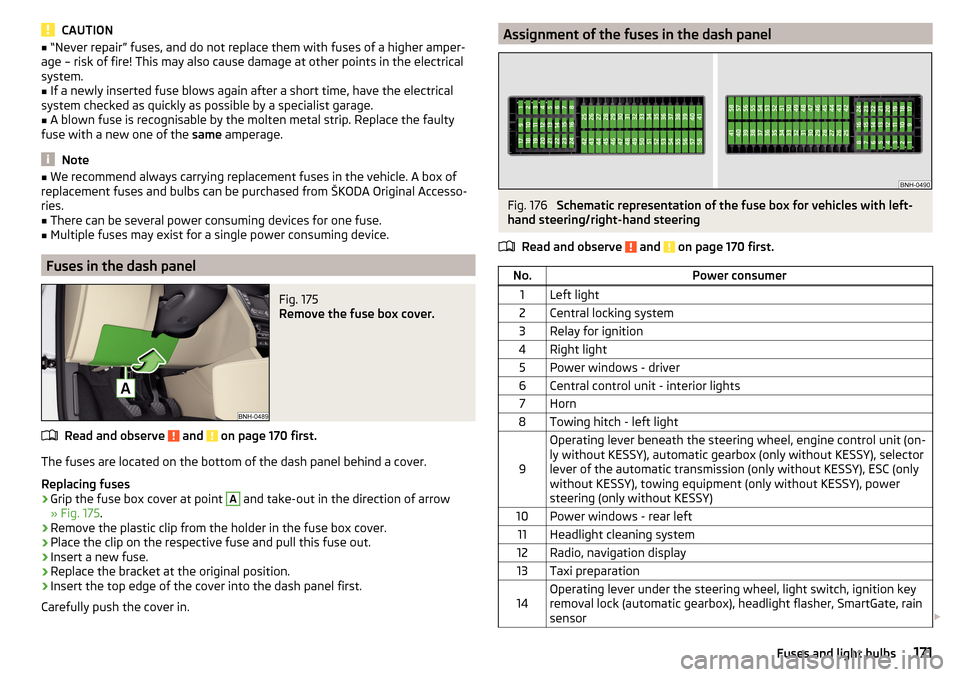
Remove the fuse box cover.
Read and observe and on page 170 first.
The fuses are located on the bottom of the dash panel behind a cover.
Replacing fuses
›
Grip the fuse box cover at point
A
and take-out in the direction of arrow
» Fig. 175 .
›
Remove the plastic clip from the holder in the fuse box cover.
›
Place the clip on the respective fuse and pull this fuse out.
›
Insert a new fuse.
›
Replace the bracket at the original position.
›
Insert the top edge of the cover into the dash panel first.
Carefully push the cover in.
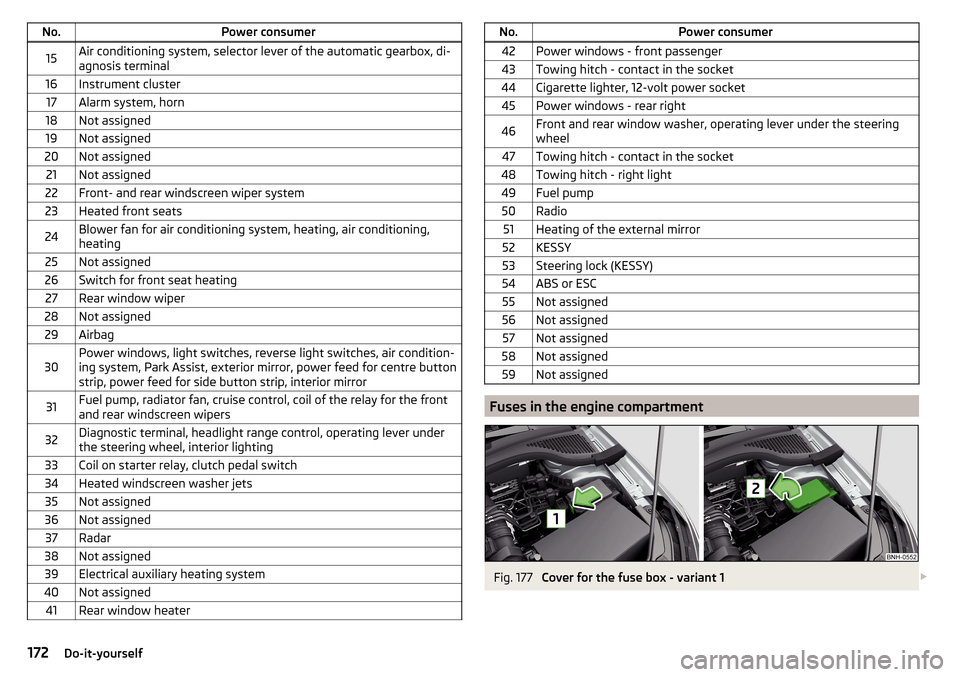
Assignment of the fuses in the dash panelFig. 176
Schematic representation of the fuse box for vehicles with left-
hand steering/right-hand steering
Read and observe
and on page 170 first.
No.Power consumer1Left light2Central locking system3Relay for ignition4Right light5Power windows - driver6Central control unit - interior lights7Horn8Towing hitch - left light
9
Operating lever beneath the steering wheel, engine control unit (on-
ly without KESSY), automatic gearbox (only without KESSY), selector
lever of the automatic transmission (only without KESSY), ESC (only
without KESSY), towing equipment (only without KESSY), power
steering (only without KESSY)10Power windows - rear left11Headlight cleaning system12Radio, navigation display13Taxi preparation14Operating lever under the steering wheel, light switch, ignition key
removal lock (automatic gearbox), headlight flasher, SmartGate, rain
sensor 171Fuses and light bulbs
Page 174 of 204
No.Power consumer15Air conditioning system, selector lever of the automatic gearbox, di-
agnosis terminal16Instrument cluster17Alarm system, horn18Not assigned19Not assigned20Not assigned21Not assigned22Front- and rear windscreen wiper system23Heated front seats24Blower fan for air conditioning system, heating, air conditioning,
heating25Not assigned26Switch for front seat heating27Rear window wiper28Not assigned29Airbag30Power windows, light switches, reverse light switches, air condition-
ing system, Park Assist, exterior mirror, power feed for centre button
strip, power feed for side button strip, interior mirror31Fuel pump, radiator fan, cruise control, coil of the relay for the front
and rear windscreen wipers32Diagnostic terminal, headlight range control, operating lever under
the steering wheel, interior lighting33Coil on starter relay, clutch pedal switch34Heated windscreen washer jets35Not assigned36Not assigned37Radar38Not assigned39Electrical auxiliary heating system40Not assigned41Rear window heaterNo.Power consumer42Power windows - front passenger43Towing hitch - contact in the socket44Cigarette lighter, 12-volt power socket45Power windows - rear right46Front and rear window washer, operating lever under the steering
wheel47Towing hitch - contact in the socket48Towing hitch - right light49Fuel pump50Radio51Heating of the external mirror52KESSY53Steering lock (KESSY)54ABS or ESC55Not assigned56Not assigned57Not assigned58Not assigned59Not assigned
Fuses in the engine compartment
Fig. 177
Cover for the fuse box - variant 1
172Do-it-yourself
Page 189 of 204
Index
A
abroad lead-free petrol
137
Abroad Headlights
63
ABS Operation
106
Warning light33
Acceptance and recycling of used vehicles129
Accessories126
Adjusting Exterior mirror
67
head restraints69
Seat68
Steering wheel9
Adjusting the seats8
Adjustment Beam range
59
Advance warning/emergency braking Warning light
38
Air-conditioning system Air outlet vents
90
Airbag14
Deactivating18
Deactivating the front passenger airbag18
Deployment15
Front airbag15
Head airbag17
Modifications and damage to the airbag system 128
Side airbag
16
Warning light34
Airbag system14
Air conditioning86
Air distribution control89
Climatronic88
Manual air conditioning87
Air distribution control89
Air outlet vents90
Alarm Enable/disable
54
Switch off54
Trailer124
Triggering54
Alcantara cleaning
135
Anodized parts Refer to vehicle maintenance
132
Anti-lock braking system (ABS)106
Anti-theft alarm system Enable/disable
54
Trailer124
Anti-theft wheel bolts159
Armrest Front
71
Rear71
artificial leather135
Ashtray75
Assembling the bar ball, Step 1
119
bar ball, Step 2120
Assist systems105
Auto-check control39
Automatic driving lamp control61
Automatic gearbox100
Selector lever-emergency unlocking168
Selector lever lock101
Starting-off and driving102
Tiptronic101
Using the selector lever100
Automatic gearbox modes100
Automatic load deactivation149
automatic transmission selector lever lock defect
101
Automatic transmission Kick-down
102
Malfunction36
Selector lever lock101
Warning light36
Warning messages36
AUX79
Avoiding damage to your vehicle104
B
Bags on the backs of the front seats
78
on the inner sides of the front seats79
Ball head Check fitting
120
Ready position118, 119
Battery In the remote control key
167
Belts11
Belt tensioners13
Bonnet Closing
140
Opening140
Boot Cargo element
84
Class N1 vehicles85
Hooks82
See Boot lid55
Storage compartments84
Boot cover Parking position
83
Boot lid automatic locking
55
Closing55
Opening55
Brake Assist (HBA)107
Brake booster98
brake fluid specification
146
Brake fluid145
Checking146
Information messages32
187Index
Page 194 of 204

M
Main beam
60
Warning light36
Maintenance see vehicle care
131
Manual air conditioning Air distribution control
89
Controls87
Manual gear changing see gear changing
99
MAXI DOT See MAXI DOT display
42
MAXI DOT display42
Main menu42
Menu item assist systems45
Menu item Audio44
Menu item navigation44
Menu item telephone45
Operation43
Maximum permissible weights
179
Maximum speed184
MCB107
MDI79
Mechanical window lifter open and close
56
Mechanical window lifters56
Media see Infotainment
4
Mirror Exterior mirror
67
Interior mirror67
Make-up65
Modifications126
Modifications and technical alterations Airbags
128
Service127
Spoiler128
Multi-function display operation40
Multi collision brake (MCB)107
Multifunction display Functions
40
Information40
Memory42
Multifunction pocket82
Multifunction steering wheel Operation
43
Multimedia AUX
79
USB79
Multimedia holder76
Handling79
N
N1
85
Nameplate179
Navigation see Infotainment
4
Nets82
Notes for driving with tyre repaired163
Notes on using wheels150
O
Oil See Engine oil
143
Warning messages37
Oil pressure Warning messages
37
On-board computer see multifunction display
40
Operating weight180
Operation in winter Diesel fuel
138
Vehicle battery148
Original accessories127
Overview Engine compartment141
Indicator lights31
P
Parking
99
Parking assistance108
Parking aid Automatic system activation when moving for- ward
110
Function108
Parking assistance108
Activation / deactivation109
Display in the Infotainment display109
Parking light59
Park Pilot108
Park the vehicle see Parking
99
Part replacement126
Passive safety Before setting off
8
Driving safety8
Passive Safety8
Pedals99
Footmats99
Petrol see fuel
137
Phone see Infotainment
4
Plastic parts131
Pocket in the luggage compartment
82
Polishing vehicle paint work see vehicle care
131
Power outlet 12 V
75
Power steering/steering lock (KESSY system) Warning light
32
192Index
Page 196 of 204

SmartGateConnection by searching for a Wi-Fi network47
introductory information47
Password/PIN code change48
Setting48
Wi-Fi Direct48
SmartLink see Infotainment
4
Snow chains155
Spare wheel153
Remove158
stow158
Speed control system110
Speed symbol See Wheels
154
Spoiler128
Stabilisation system105
Stability Control (ESC)106
Staring engine Jump-starting
164
START-STOP95
Jump-starting164
Manually deactivating/activating the system97
operation96
Warning light38
START-STOP system95
Starter button Problems with the engine start
95
Steering column lock locking93
Steering column lock unlocking93
Switching off the engine94
Switch off the ignition94
Switch on the ignition94
Starting and stopping the engine at the push of the button
93
Starting and stopping the engine using the key 91
Starting engine Jump-starting
164
Starting the engine Starter button
94
START STOPInformation messages97
Start the engine Key
92
Steering column lock locking Starter button
93
Steering column lock unlocking Starter button
93
Steering lock locking Key
92
Steering lock unlocking Key
92
Steering wheel correct posture
9
setting9
Stop see Parking
99
Stopping the engine Key
92
Storage72
Storage compartment Glasses compartment
77
in the boot84
in the centre console73
in the front arm rest77
on the front passenger side77
Storage compartments72
Stowage compartments in the doors
73
Sun visors65
Switching off the engine Starter button
94
Switch light on/off59
Switch off the ignition Key
92
Starter button94
Switch on the ignition Key
92
Starter button94
T
Tablet holder Behind the headrests
80
Taking care of your vehicle Automatic car wash system
130
High-pressure cleaner130
Washing by hand129
Wash system130
TCS Operation
106
Warning light33
Technical data179
Time31
Tiptronic101
Tools157
TOP TETHER24
Towing165
Towing a trailer124
Towing device Accessories
122
Description118
Operation and maintenance133
Towing eye Front
166
Rear167
Towing protection54
Towing the vehicle165
Traction control (TCS)106
Trailer122
13-pin socket123
connection and disconnection123
Load124
Loading123
Safety eye123
Towing a trailer124
Trailer operation117
Trailer stabilization system (TSA)107
Transmission Warning messages
36
194Index