height SKODA RAPID SPACEBACK 2013 1.G User Guide
[x] Cancel search | Manufacturer: SKODA, Model Year: 2013, Model line: RAPID SPACEBACK, Model: SKODA RAPID SPACEBACK 2013 1.GPages: 193, PDF Size: 14.8 MB
Page 85 of 193
Roof rack system
Introduction
This chapter contains information on the following subjects:
fixing points for base support
83
Roof load
83WARNING■ The transported items on the roof rack must be securely attached – risk
of accident!■
Always secure the load with appropriate and undamaged lashing straps
or tensioning straps.
■
Distribute the load evenly over the roof rack system.
■
When transporting heavy objects or objects which take up a large area on
the roof rack system, handling of the car may change as a result of the dis-
placement of the centre of gravity. The style of driving and speed must
therefore be adapted to the current circumstances.
■
Avoid abrupt and sudden driving/braking manoeuvres.
■
The permissible roof load, permissible axle loads and permissible total ve-
hicle weight must not be exceeded under any circumstance – risk of acci-
dent!
CAUTION
■ Only roof racks from the ŠKODA Original Accessories range should be used.■When dealing with roof rack systems, the installation instructions supplied
with the roof luggage rack system must be observed.■
On models fitted with a power sliding/tilting roof, ensure that the extended
sliding/tilting roof does not hit any items of luggage transported on the roof.
■
Ensure that the boot lid does not hit the roof load when opened.
■
The height of the vehicle changes after mounting a roof luggage rack system
and the load that is secured to it. Compare the vehicle height with available
clearances, such as underpasses and garage doors.
■
Always remove the roof luggage rack system before entering an automated
car wash.
■
Ensure the roof aerial is not impaired by the secured load.
For the sake of the environment
The increased aerodynamic drag results in a higher fuel consumption.fixing points for base supportFig. 89
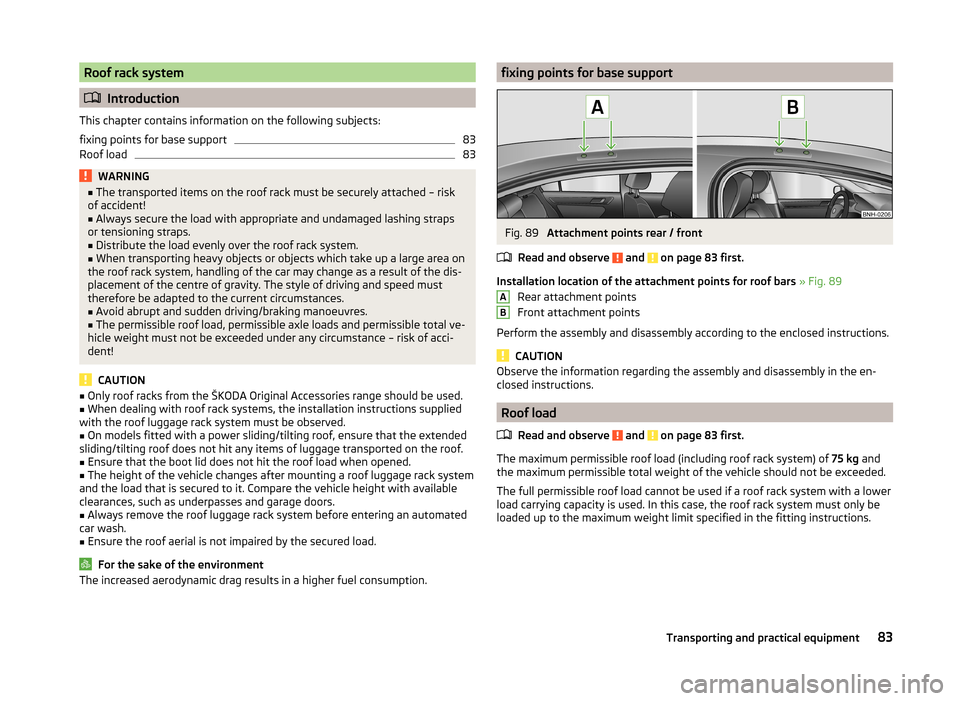
Attachment points rear / front
Read and observe
and on page 83 first.
Installation location of the attachment points for roof bars » Fig. 89
Rear attachment points
Front attachment points
Perform the assembly and disassembly according to the enclosed instructions.
CAUTION
Observe the information regarding the assembly and disassembly in the en-
closed instructions.
Roof load
Read and observe
and on page 83 first.
The maximum permissible roof load (including roof rack system) of 75 kg and
the maximum permissible total weight of the vehicle should not be exceeded.
The full permissible roof load cannot be used if a roof rack system with a lower
load carrying capacity is used. In this case, the roof rack system must only be
loaded up to the maximum weight limit specified in the fitting instructions.
AB83Transporting and practical equipment
Page 87 of 193

Air outlet ventsFig. 90
Air outlet vents
Read and observe
and on page 84 first.
Warmed, not warmed fresh or cooled air will flow out of the opened air outlet
vents according to the setting of the control and the outside atmospheric con-
ditions.
The direction of airflow can be adjusted using the air outlet vents 3 and
4 » Fig. 90 and the outlets can also be opened and closed individually.
Changing the air flow direction
›
To change the height of the air flow, turn the horizontal fins upward or
downward using the movable adjuster
A
» Fig. 90 .
›
To adjust the lateral direction of the air flow, turn the vertical fins with the
movable adjuster
A
to the left or to the right.
Open/close
›
Turn the regulator
B
» Fig. 90 upwards or downwards.
An overview of the available settings for adjusting the direction of the air
outlet.Set the direction of the air outletActive air outlet vents1, 2 , 41, 2 , 4 , 54 , 53 , 4
Note
Do not cover the air outlet vents with objects of any kind.
Air distribution control
Read and observe
and on page 84 first.
Recirculated air mode mostly prevents polluted air outside the vehicle from
getting into the vehicle, for example when driving through a tunnel or when
standing in a traffic jam.
In recirculated air mode air is sucked out of the interior of the vehicle and then
fed back into the interior.
Heating and air conditioning (manual air conditioning)
To turn the recirculation mode on or off, press the Symbol key
.
The air recirculation mode is automatically turned off by turning the air distri-
bution control
C
to position
» Fig. 91 on page 86 or » Fig. 92 on page 86 .
Recirculated air mode can be switched on again from this setting by repeatedly
pressing the symbol button .
Climatronic (automatic air conditioning)
To switch on press the Symbol key
. The symbol
(pos.
7
» Fig. 93 on
page 87 ) appears in the display.
To switch off press the symbol key
again. The
symbol in the display
goes out.
85Heating and air conditioning
Page 118 of 193
Trailer
Introduction
This chapter contains information on the following subjects:
Loading a trailer
116
Driving with a trailer
116
Anti-theft alarm system
117WARNINGAlways drive particularly carefully with the trailer.
Loading a trailer
Read and observe
on page 116 first.
The vehicle/trailer combination must be balanced. Whereby the maximum per-missible draw bar load must be utilised. If the draw bar load is too low, it jeop-
ardises the performance of the vehicle/trailer combination.
Distribution of the load
Distribute the load in the trailer in such a way that heavy items are located as
close to the axle as possible. Secure the items from slipping.
The distribution of the weight is very poor if your vehicle is unladen and the
trailer is laden. Maintain a particularly low speed if you cannot avoid driving
with this combination.
Tyre pressure
Correct the tyre inflation pressure on your vehicle for a “full load” » page 143,
Service life of tyres .
Towing capacity and trailer weight
The permissible trailer load must not be exceeded under any circumstan-
ces » page 172 , Technical data .
The details given in the vehicle's technical documentation always take prece-
dence over the details in the Owner's Manual.
The trailer loads specified apply only to altitudes up to 1,000 metres above
mean sea level.
The engine output falls as altitude increases, as does the vehicle's climbing
power. Therefore, for every additional 1,000 m in height (or part), the maximum
permissible towed weight must be reduced by 10%.
The towed weight is made up of the actual weights of the loaded towing vehi-
cle and the loaded trailer.
The trailer and draw bar load information on the type plate of the towing de-
vice is merely a test value for the towing device. The vehicle-specific values
are detailed in the vehicle documents.WARNING■ Do not exceed the maximum permissible axle and draw bar load and the
maximum permissible total or towed weight of the vehicle and the trailer -
risk of accident and serious injuries!■
A sliding cargo can adversely affect stability and driving safety significant-
ly - there is a risk of accident!
Driving with a trailer
Fig. 118
Swivel out the 13-pin power
socket
Read and observe on page 116 first.
Before starting off
›
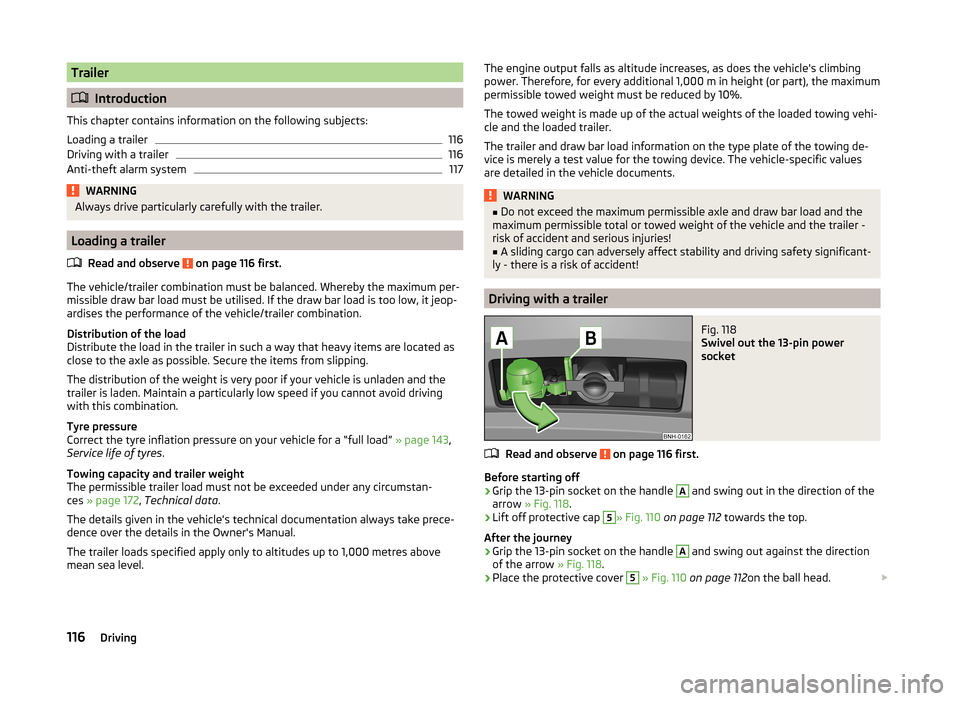
Grip the 13-pin socket on the handle
A
and swing out in the direction of the
arrow » Fig. 118 .
›
Lift off protective cap
5
» Fig. 110 on page 112 towards the top.
After the journey
›
Grip the 13-pin socket on the handle
A
and swing out against the direction
of the arrow » Fig. 118.
›
Place the protective cover
5
» Fig. 110 on page 112 on the ball head.
116Driving
Page 135 of 193
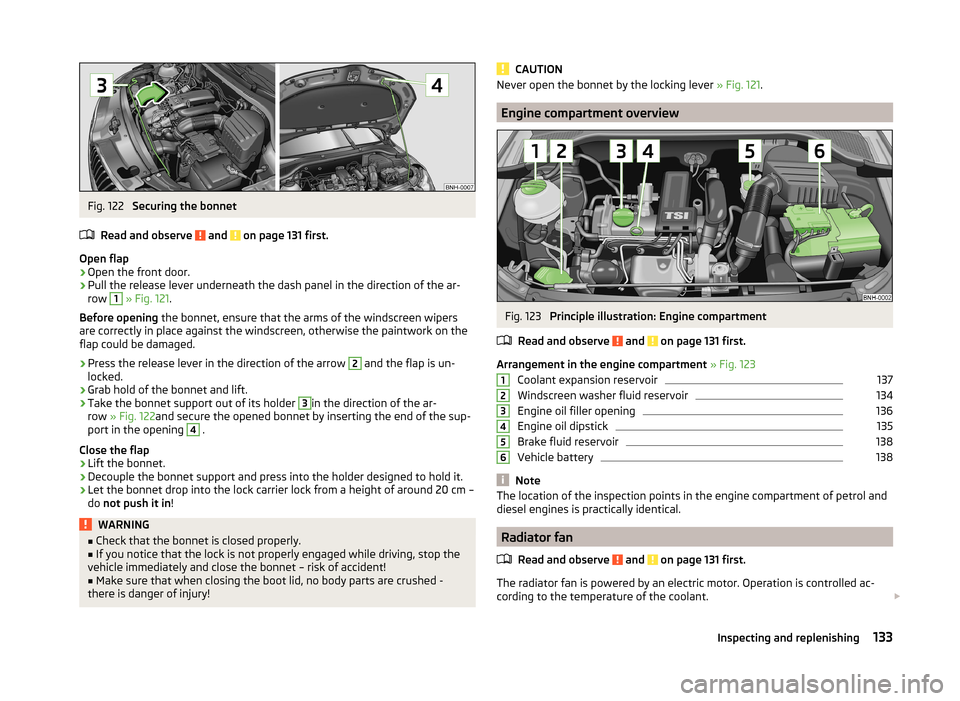
Fig. 122
Securing the bonnet
Read and observe
and on page 131 first.
Open flap
›
Open the front door.
›
Pull the release lever underneath the dash panel in the direction of the ar-
row
1
» Fig. 121 .
Before opening the bonnet, ensure that the arms of the windscreen wipers
are correctly in place against the windscreen, otherwise the paintwork on the
flap could be damaged.
›
Press the release lever in the direction of the arrow
2
and the flap is un-
locked.
›
Grab hold of the bonnet and lift.
›
Take the bonnet support out of its holder
3
in the direction of the ar-
row » Fig. 122 and secure the opened bonnet by inserting the end of the sup-
port in the opening
4
.
Close the flap
›
Lift the bonnet.
›
Decouple the bonnet support and press into the holder designed to hold it.
›
Let the bonnet drop into the lock carrier lock from a height of around 20 cm –
do not push it in !
WARNING■
Check that the bonnet is closed properly.■If you notice that the lock is not properly engaged while driving, stop the
vehicle immediately and close the bonnet – risk of accident!■
Make sure that when closing the boot lid, no body parts are crushed -
there is danger of injury!
CAUTIONNever open the bonnet by the locking lever » Fig. 121.
Engine compartment overview
Fig. 123
Principle illustration: Engine compartment
Read and observe
and on page 131 first.
Arrangement in the engine compartment » Fig. 123
Coolant expansion reservoir
137
Windscreen washer fluid reservoir
134
Engine oil filler opening
136
Engine oil dipstick
135
Brake fluid reservoir
138
Vehicle battery
138
Note
The location of the inspection points in the engine compartment of petrol and
diesel engines is practically identical.
Radiator fan
Read and observe
and on page 131 first.
The radiator fan is powered by an electric motor. Operation is controlled ac-
cording to the temperature of the coolant.
123456133Inspecting and replenishing
Page 146 of 193
Always check the inflation pressure when the tyres are cold. Do not reduce the
higher pressure on warm tyres.
With greater additional load, adjust the tyre inflation pressure accordingly.
Driving style
Fast cornering, sharp acceleration and braking increase the wear of your tyres.
Balancing wheels
The wheels of a new vehicle are balanced. When driving, however, there are a
range of factors that may result in an imbalance. This may become apparent by
a “vibration” in the steering.
Have the wheels re-balanced after replacing the tyres.
Wheel alignment errors
Incorrect wheel alignment at the front or rear leads to excess wear of the
tyres.
Tyre damage
Drive over kerbs and other such obstacles slowly and at right angles wherever
possible in order to avoid damage to tyres and wheel trims.
We recommend checking your tyres and wheel rims for damage (punctures,
cuts, splits and bulges, etc.) on a regular basis. Remove foreign bodies (e.g.
small stones) from the tyre tread immediately.
Replacing wheels
If significantly greater wear is present on the front tyres, we recommend
swapping the front wheels with the rear wheels as shown in the dia-
gram » Fig. 130 -
. You will then obtain approximately the same life for all the
tyres.
We recommend that you swap the tyres every 10,000 km in order to achieve
even wear on all tyres and to ensure optimal service life for the tyres.
Storing tyres
Identify disassembled tyres so that the previous direction of rotation can be maintained if the tyres are reassembled.
Always store wheels or tyres in a cool, dry place that is as dark as possible.
Tyres which are not fixed to a wheel trim should be stored upright.Wear indicators
The base of the tread of the tyres has 1.6 mm high wear indicators installed.
These wear indicators are evenly spaced around the circumference of the tyre,
depending on the make » Fig. 130-
. Markings on the walls of the tyres
through the letters “TWI”, triangular symbols or other symbols identify the po-
sition of the wear indicators.
Tyre age
Tyres age and lose their original characteristics, even if they are not being
used. Therefore, we recommend not using summer or winter tyres older than 6
or 4 years old respectively.
New tyres
Read and observe
and on page 142 first.
Only use radial tyres of the same type, size (rolling circumference) and tread
pattern on one axle on all four wheels.
The tyre/wheel combinations which are approved for your vehicle are indica-
ted in your vehicle documents.
Where possible, replace tyres by axle. Always fit the tyres with the deeper
tread depth to the front wheels.
Explanation of tyre markings
195/55 R 15 85 H
What this means is:
195Tyre width in mm » Fig. 131 on page 14365Height/width ratio in % » Fig. 131 on page 143RCode letter for the type of tyre – Radial » Fig. 131 on page 14315Diameter of wheel in inches » Fig. 131 on page 14385Load index » HSpeed symbol »
The date of manufacture is stated on the tyre wall (possibly on the inside). e.g.
DOT ... 11 14...
means, for example, that the tyre was manufactured in the week 11 of 2014.
144General Maintenance
Page 176 of 193

DimensionsFig. 170
Principle sketch: Vehicle dimensions
Vehicle dimensions (mm)
» Fig. 170SpecificationValueAHeightBasic dimension1459/1471 a)Vehicles with a rough road package.1472/1484 a)B
Front track
Basic dimension1457For vehicles fitted with the 1.2 l/55 kW MPI and 1.2 l/63 kW TSI engines and 14"
wheel rims.1463CWidth1706D
Rear track
Basic dimension1494For vehicles fitted with the 1.2 l/55 kW MPI and 1.2 l/63 kW TSI engines and 14"
wheel rims.1500EWidth including exterior mirror1940FClearanceBasic dimension134Vehicles with a rough road package.141GWheel base2602HLength4304a)
Valid for vehicles with the Amundsen+ navigation system.
174Technical data
Page 182 of 193
Index
A
abroad lead-free petrol
130
Abroad Headlights
58
ABS Function
106
Warning light33
Acceptance and recycling of used vehicles121
Accessories119
Adjusting Belt height
13
Exterior mirror63
head restraints65
Interior mirror62
Seat64
Steering wheel8
Adjusting the seats7
Adjustment Beam range
53
Air-conditioning system Air outlet vents
85
Airbag14
Deactivating18
Deactivating the front passenger airbag18
Deployment14
Front airbag15
Head airbag17
Indicator light35
Modifications and damage to the airbag system 121
Side airbag
16
Airbag system14
Air conditioning84
Air distribution control85
Climatronic87
manual air conditioning86
Air distribution control85
Air outlet vents85
Alarm Switching off
49
Triggering49
Alcantara cleaning
128
Anti-lock Braking System106
Anti-theft alarm system Activating/deactivating
50
Trailer117
Armrest Front
67
Rear67
artificial leather128
Ashtray71
ASR Warning light
33
Assist system ABS
106
Assist systems106
ABS33
ASR33
Cruise Control System108
EDL107
ESC32, 106
HBA107
HHC107
Parking aid107
START-STOP109
TCS106
Auto Check Control29
Automatic driving lamp control55
Automatic gearbox101
Manual shifting of gears103
Selector lever-emergency unlocking162
Selector lever lock102
Starting-off and driving103
Tiptronic103
Using the selector lever102
Automatic gearbox modes102
Automatic load deactivation141
automatic transmission selector lever lock defect
103
Automatic transmission Kickdown
103
Selector lever lock103
AUX96
B
Ball head Check fitting
114
Fitting113
Ready position113
Removing115
Battery In the remote control key
161
Belts10
Belt tensioners13
Bonnet Closing
132
Opening132
Boot Class N1 vehicles
79
Double-sided floor covering79
Hooks77
See Boot lid51
Storage compartments in the boot78
Boot cover Parking position
78
Boot lid automatic locking
51
Closing51
Opening51
Brake Warning light
31
Brake booster99
brake fluid specification
138
180Index
Page 185 of 193
Emergency equipmentFire extinguisher150
First aid kit149
Jack150
Vehicle tool kit150
Warning triangle149
emergency wheel146
Emissions173
Engine Switching off the engine
98
Engine compartment131
Brake fluid138
Overview133
Vehicle battery138
Engine number172
engine oil specification
135
Engine oil134
change134
Checking135
Information messages31
Replenishing136
Warning light31
Environment104
EPC Warning light
34
ESC Function
106
Warning light32
Exhaust inspection system Warning light
34
F
Fastening elements
76
Films124
Fire extinguisher150
First aid kit149
Flashing55
Flexible storage compartment79
Fog lights56
Warning light36
Fog lights with CORNER function56
Footmats101
refer to footmats101
Force limit Power windows
52
Front airbag15
Front interior light58
fuel lead-free petrol
130
Fuel129
Diesel131
Fuel gauge28
refer to Fuel129
Refuelling129
Fuel consumption104, 173
Fuel reserve Warning light
35
Fuses Assignment
163
Assignment of fuses in the dash panel164
Colour coding163
Fuse assignment in the engine compartment166
Replacing163
Fuses in the engine compartment Assignment
166
G
Gearbox Warning messages
29
Gear change Gear recommendation
38
Information on the selected gear38
Gear changing Gear stick
101
gears spare
147
General viewCockpit25
Generator Indicator light
31
Genuine parts120
Glasses compartment73
Glow plug system Warning light
34
GSM89
H
Handbrake
100
Warning light30
Hazard warning light system57
HBA107
Head airbag17
Headlight cleaning system Headlight cleaning system
62
Headlights Bulb arrangement
167
Driving abroad58
Headlight cleaning system62
Headrest removing and installing
65
Head restraints65
Adjust height65
Heating84
Air distribution control85
Control elements86
Exterior mirror63
Rear window59
Seats66
Heating rear window59
HHC107
Hill Hold Control (HHC)107
Hitch112
Drawback load112
Hooks77
Horn25
183Index
Page 188 of 193
Bulb for the licence plate light169
Bulb in rear light170
Bulbs166
Fuses163
Fuses in the dash panel164
Fuses in the engine compartment165
Low beam bulb167
Vehicle battery141
Windscreen wiper blades162
Wiper blades163
Replenishing Coolant
137
Engine oil136
Windscreen washer fluid134
Revolution counter27
Roof Load
83
Roof rack mounting points
83
Roof load83
Roof rack system83
Rubber seals124
S
SAFE See Safe securing system
47
SAFELOCK See Safe securing system
47
Safe securing system47
Safety6
Child safety20
Child safety seats20
Correct seated position7
Head restraints65
ISOFIX22
TOP TETHER23
Saving electrical energy104
Seals Vehicle care
124
SeatAdjusting64
Seat belt Warning light
31
Seat belts10
Belt tensioners13
fastening and unfastening12
Height adjustment13
Inertia reels13
The physical principle of a frontal collision11
Seat features66
Seats Front armrest
67
Head restraints65
Heating66
Rear armrest67
Seat backrests67
Seats and head restraint64
Selector lever Refer to Selector lever
102
Service120
Service interval display43
Setting29
Lower position of the variable loading floor81
seats and head restraints64
Upper position of the variable loading floor80
Setting the29
Side airbag16
Snow chains148
Spare change
147
spare wheel146
change147
instructions147
Speedometer27
See speedometer27
Speed symbol Refer to Wheels
145
Spoiler121
START-STOP109
Manually deactivating/activating the system111
Operating conditions of the system110
operation in vehicles with automatic gearbox110
operation in vehicles with manual gearbox110
system-related automatic start-up111
Starting engine Jump-starting
157
Starting the engine Jump-starting
158
START STOP Information messages
111
Jump-starting158
Start the engine98
Stating and turning off the engine97
Steering wheel8
Stopping100
Storage68
Storage compartment Glasses compartment
73
in the centre console69
in the front arm rest73
on the front passenger side73
Storage compartments68
Storage compartments in the boot78
Storage net bag79
Storage pockets on the front seats74
Stowage compartments in the doors
69
Sun visors60
Switching off the engine98
Switch light on/off53
T
Taking care of your vehicle Automatic car wash system
122
High-pressure cleaner123
Washing by hand122
Wash system122
186Index
Page 189 of 193
TCSOperation106
Technical data172
Telephone89
Tiptronic103
Tools150
TOP TETHER23
Towing158
Towing device Description
112
Use and care115
Towing eye Front
159
Rear160
Towing protection50
Traction Control System (TCS)106
Trailer116
13-pin power socket116
driving with a trailer116
Loading116
Safety eyelet116
Trailer operation112
Transport Luggage compartment
75
Roof rack system83
Transporting68
Transporting children safely20
Turn signal55
Turn signal system Warning light
36
two-way radio systems89
Tyre inflation pressure Warning light
35
Tyre load-bearing capacity Refer to Wheels
145
tyre pressure monitor display
146
setting146
Tyre repair Check pressure157
Preparations156
Sealing and inflating the tyre156
Tyres142
Inflation pressure143
new104
New144
Refer to Wheels144
Sizes143
Tyre wear indicator143
U
Under-body Vehicle care
126
Under-body protection126
Unlocking Individual settings
47
Key47
Remote control46
Unlocking and locking45
USB96
Used vehicles Acceptance and recycling
121
Useful equipment Ashtray
71
Car park ticket holder69
Cigarette lighter70
Clothes hook74
Cup holders70
Glasses compartment73
Multimedia holder72
Storage compartment68
Using the information system37
Using the selector lever102
V
Variable loading floor
80
Folding up82
Inserting81
Lower position81
Parking position82
Removing81
Upper position80
Vehicle battery Automatic load deactivation
141
charging140
Checking the battery electrolyte level140
Cover139
Operation in winter140
Replacing141
Safety instructions138
vehicle care chrome parts
124
Vehicle care Alcantara
128
Artificial leather128
Cavity protection125
Cleaning vehicle exterior123
Cleaning wheels126
Decorative films124
Door locking cylinder125
Headlight glasses125
Interior care126
Maintenance123
Materials128
Natural leather127
Plastic parts124
Polishing vehicle paint work123
Rubber seals124
Safety belt128
Seat covers128
Under-body protections126
washing122
Vehicle Condition see Auto Check Control
29
Vehicle data sticker172
Vehicle data sticker and nameplate Vehicle data sticker and nameplate
172
Vehicle dimensions174
Vehicle height174
187Index