heating SKODA RAPID SPACEBACK 2013 1.G Owner's Guide
[x] Cancel search | Manufacturer: SKODA, Model Year: 2013, Model line: RAPID SPACEBACK, Model: SKODA RAPID SPACEBACK 2013 1.GPages: 193, PDF Size: 14.8 MB
Page 119 of 193
Safety eyelet
The safety eyelet B» Fig. 118 serves to attach the breakaway cable of the
trailer.
When attaching the breakaway cable to the safety eyelet, it must sag freely
against the vehicle in all trailer positions (sharp bends, in reverse etc.) sag .
Exterior mirrors
You can have additional exterior mirrors fitted if you are not able to see the
traffic behind the trailer with the standard rear-view mirrors. The national legal
requirements must be observed.
Headlights
The front of the vehicle may lift up when a trailer is being towed and the head- lights may dazzle other road users.
Adjust the headlights using the headlight beam control » page 54.
Driving speed
For safety reasons, do not drive faster than 80 km/h when towing a trailer.
Immediately reduce your speed as soon as even the slightest swaying of the
trailer is detected. Never attempt to stop the trailer from “swaying” by acceler-
ating.
Brakes
Apply the brakes in good time! If the trailer is fitted with a trailer brake, apply
the brakes gently at first, then brake firmly. This will avoid brake jolts resulting
from the trailer wheels locking.
On downhill sections shift down a gear in good time to also use the engine as
a brake.
Engine overheating
If the needle for the coolant temperature gauge moves into the right-hand
area or the red area of the scale, the speed must be reduced immediately.
Stop and switch off the engine if the warning light lights up and/or starts to
blink in the instrument » page 32cluster. Wait a few minutes and check the
level of coolant » page 137.
The following guidelines must be observed » page 32.
The coolant temperature level can be reduced by switching on the heating.WARNING■ Never use the safety eyelet for towing!■Adapt your speed to the conditions of the road surface and to the traffic
situation.■
Improper or incorrectly connected electrical installations can energise the
trailer and cause functional faults to the vehicle's entire electrical system
as well as accidents and severe injuries.
■
Works on the electrical system must only be carried out by specialist ga-
rages.
■
Never directly connect the trailer's electrical system with the electrical
connections for the tail lights or other current sources.
■
After coupling the trailer and connecting the power socket, check that
the rear lights on the trailer are working correctly.
Note
■ If there is an error in the trailer lighting, check the fuses in the fuse box in
the dash panel » page 164.■
Contact between the breakaway cable and the safety eyelet can result in
mechanical wear on the surface protection of the eyelet. Such wear does not
impair the functioning of the safety eyelet and does not constitute a fault. It is
excluded from the warranty coverage.
■
If you tow a trailer frequently, you should also have your vehicle inspected
between service intervals.
■
The handbrake on the towing vehicle must be applied when coupling and un-
coupling the trailer.
Anti-theft alarm system
Read and observe
on page 116 first.
When the vehicle is locked, the alarm is activated when the electrical connec-tion to the trailer is interrupted.
Always switch off the anti-theft alarm system before a trailer is coupled or un-
coupled » page 49 .
Conditions for including a trailer in the anti-theft alarm system. The vehicle is factory-fitted with an anti-theft alarm system and towing
device.
The trailer is electrically connected to the towing vehicle via the trailer
socket.
117Hitch and trailer
Page 127 of 193
Windows and external mirrorsFig. 119
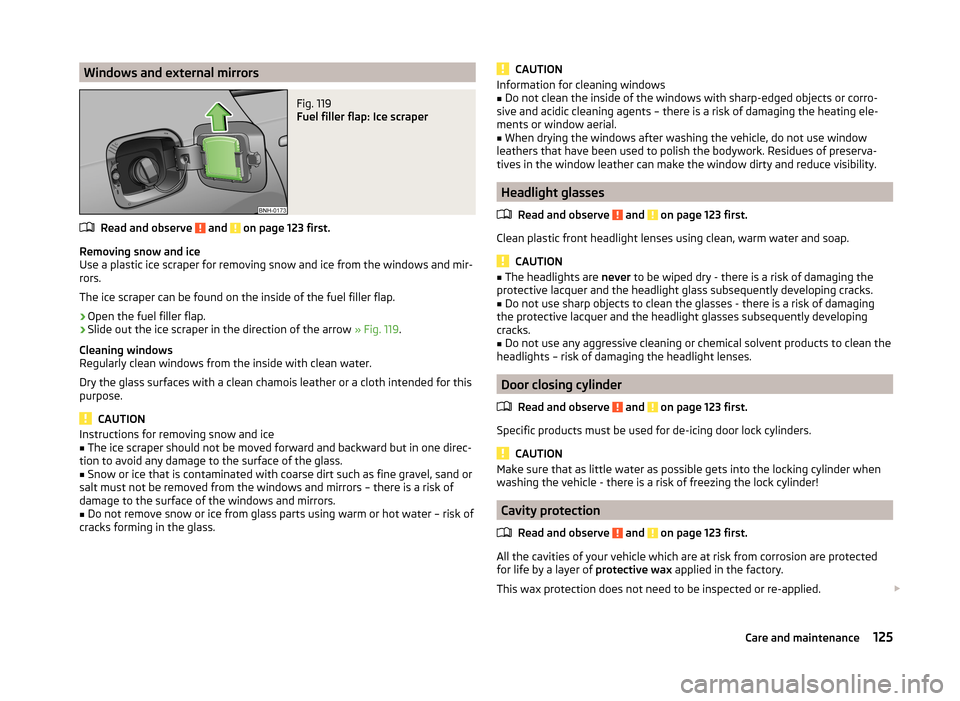
Fuel filler flap: Ice scraper
Read and observe and on page 123 first.
Removing snow and ice
Use a plastic ice scraper for removing snow and ice from the windows and mir-
rors.
The ice scraper can be found on the inside of the fuel filler flap.
›
Open the fuel filler flap.
›
Slide out the ice scraper in the direction of the arrow » Fig. 119.
Cleaning windows
Regularly clean windows from the inside with clean water.
Dry the glass surfaces with a clean chamois leather or a cloth intended for this
purpose.
CAUTION
Instructions for removing snow and ice■The ice scraper should not be moved forward and backward but in one direc-
tion to avoid any damage to the surface of the glass.■
Snow or ice that is contaminated with coarse dirt such as fine gravel, sand or
salt must not be removed from the windows and mirrors – there is a risk of
damage to the surface of the windows and mirrors.
■
Do not remove snow or ice from glass parts using warm or hot water – risk of
cracks forming in the glass.
CAUTIONInformation for cleaning windows■Do not clean the inside of the windows with sharp-edged objects or corro-
sive and acidic cleaning agents – there is a risk of damaging the heating ele-
ments or window aerial.■
When drying the windows after washing the vehicle, do not use window
leathers that have been used to polish the bodywork. Residues of preserva-
tives in the window leather can make the window dirty and reduce visibility.
Headlight glasses
Read and observe
and on page 123 first.
Clean plastic front headlight lenses using clean, warm water and soap.
CAUTION
■The headlights are never to be wiped dry - there is a risk of damaging the
protective lacquer and the headlight glass subsequently developing cracks.■
Do not use sharp objects to clean the glasses - there is a risk of damaging
the protective lacquer and the headlight glasses subsequently developing
cracks.
■
Do not use any aggressive cleaning or chemical solvent products to clean the
headlights – risk of damaging the headlight lenses.
Door closing cylinder
Read and observe
and on page 123 first.
Specific products must be used for de-icing door lock cylinders.
CAUTION
Make sure that as little water as possible gets into the locking cylinder when
washing the vehicle - there is a risk of freezing the lock cylinder!
Cavity protection
Read and observe
and on page 123 first.
All the cavities of your vehicle which are at risk from corrosion are protectedfor life by a layer of protective wax applied in the factory.
This wax protection does not need to be inspected or re-applied.
125Care and maintenance
Page 130 of 193
Artificial leather, materials and Alcantara®
Read and observe
and on page 127 first.
Artificial leather
Clean artificial leather with a damp cloth.
If this method does not completely clean the artificial leather, use a mild soap
solution or cleaning products specially designed for this purpose.
Fabric
Clean upholstery cover materials and cloth trims on doors, boot cover, etc. us-
ing specific cleaning agents, e.g., dry foam.
Use a soft sponge, brush, or commercially available microfibre cloth.
Use a cloth and a cleaning agent specifically designed for this purpose to clean
the roof trim.
Remove any lumps on the cover fabric and any fabric residue using a brush.
Remove stubborn hair using a “cleaning glove”.
Alcantara ®
Dust and dirt in pores, creases and seams may chafe and damage the surface.
Therefore, they must be removed regularly at short intervals with a cloth or
vacuum cleaner.
Minor changes in colour caused by use are normal.
CAUTION
■ For Alcantara ®
seat covers, do not use any solvents, floor wax, shoe cream,
stain remover, leather cleaners or similar agents.■
Avoid leaving the vehicle in bright sunlight for long periods of time in order
to stop the artificial leather, materials or Alcantara ®
from bleaching. During ex-
tended periods of standing outdoors, protect artificial leather, fabrics or Alcan-
tara ®
by covering.
■
Some clothing materials, e.g. dark denim, do not have sufficient colour fast-
ness. This can cause damage or clearly visible discolouration to seat covers,
even when used correctly. This applies particularly to light-coloured seat cov-
ers. This does not relate to a fault in the seat cover, but rather to poor colour
fastness of the clothing textiles.
Seat covers
Read and observe
and on page 127 first.
Electrically heated seats
Use a specific cleaning agent for cleaning the covers e.g. dry foam among oth-
ers »
.
Seats without seat heating
Thoroughly vacuum the seat covers with a vacuum cleaner before cleaning.
Clean the seat covers with a damp cloth or cleaning products specially de-
signed for this purpose.
Indented points arising on the fabrics by everyday use, can be removed by
brushing against the direction of hair with a damp brush.
Always clean all parts of the covers, so that there are no visible edges. Then
allow the seat to dry completely.
CAUTION
■ Do not clean the covers of electrically heated seats either with water or with
other liquids - there is a risk of damaging the seat heating system.■
Regularly remove dust from the seat covers using a vacuum cleaner.
■
Electrically heated seats must not be dried after cleaning by switching on the
heater.
■
Do not sit on wet seats - risk of seat deformation.
■
Always clean the seats “from seam to seam”.
Safety belts
Read and observe
and on page 127 first.
Wash dirty seat belts with mild soapy water.
Remove coarse dirt with a soft brush.
WARNING■ The seat belts must not be removed for cleaning.■Never clean the seat belts chemically as chemical cleaning products could
destroy the fabric.■
The seat belts must not be allowed to come into contact with corrosive
liquids (e.g. acids).
■
The seat belts must be fully dried before being rolled up.
128General Maintenance
Page 139 of 193
■Any faults resulting from corrosion may cause a loss of coolant and can con-
sequently result in major engine damage!■
Do not fill the coolant above the mark
A
. » Fig. 126 on page 137
■
If an error occurs, leading to the engine overheating, the help of a professio-
nal garage is to be sought - there is a risk of serious engine damage occurring.
■
Additional headlights and other attached components in front of the air inlet
impair the cooling efficiency of the coolant.
■
Never cover the radiator - there is a risk of the engine overheating.
Checking the coolant level
Fig. 126
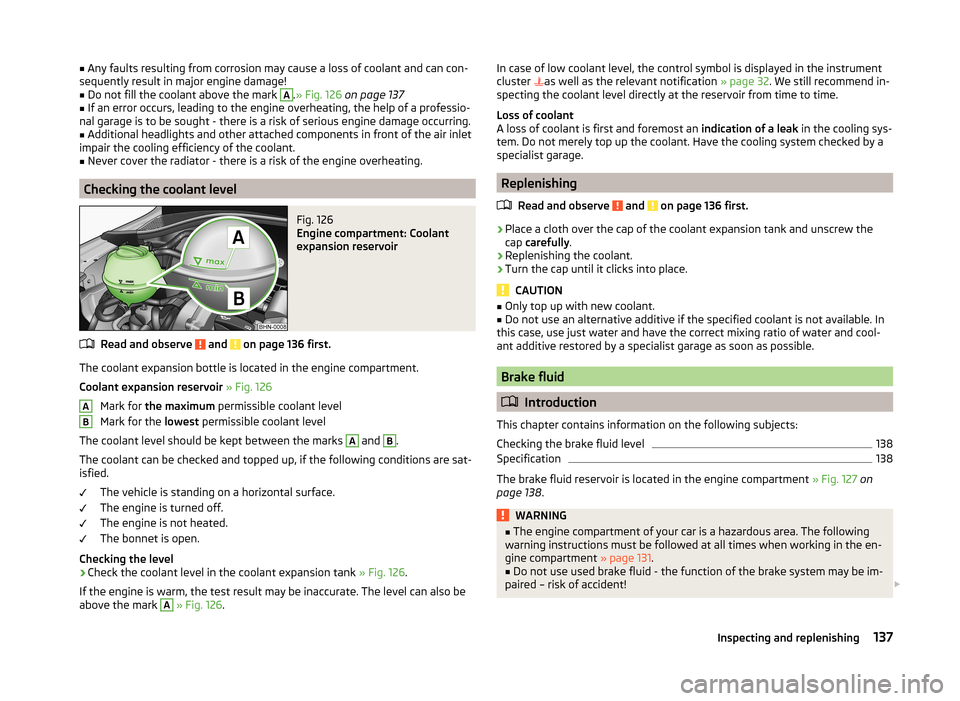
Engine compartment: Coolant
expansion reservoir
Read and observe and on page 136 first.
The coolant expansion bottle is located in the engine compartment.
Coolant expansion reservoir » Fig. 126
Mark for the maximum permissible coolant level
Mark for the lowest permissible coolant level
The coolant level should be kept between the marks
A
and
B
.
The coolant can be checked and topped up, if the following conditions are sat-
isfied.
The vehicle is standing on a horizontal surface.
The engine is turned off.
The engine is not heated.
The bonnet is open.
Checking the level
›
Check the coolant level in the coolant expansion tank » Fig. 126.
If the engine is warm, the test result may be inaccurate. The level can also be
above the mark
A
» Fig. 126 .
ABIn case of low coolant level, the control symbol is displayed in the instrument
cluster as well as the relevant notification » page 32. We still recommend in-
specting the coolant level directly at the reservoir from time to time.
Loss of coolant
A loss of coolant is first and foremost an indication of a leak in the cooling sys-
tem. Do not merely top up the coolant. Have the cooling system checked by a
specialist garage.
Replenishing
Read and observe
and on page 136 first.
›
Place a cloth over the cap of the coolant expansion tank and unscrew the
cap carefully .
›
Replenishing the coolant.
›
Turn the cap until it clicks into place.
CAUTION
■
Only top up with new coolant.■Do not use an alternative additive if the specified coolant is not available. In
this case, use just water and have the correct mixing ratio of water and cool-
ant additive restored by a specialist garage as soon as possible.
Brake fluid
Introduction
This chapter contains information on the following subjects:
Checking the brake fluid level
138
Specification
138
The brake fluid reservoir is located in the engine compartment » Fig. 127 on
page 138 .
WARNING■
The engine compartment of your car is a hazardous area. The following
warning instructions must be followed at all times when working in the en-
gine compartment » page 131.■
Do not use used brake fluid - the function of the brake system may be im-
paired – risk of accident!
137Inspecting and replenishing
Page 159 of 193

WARNING■If you cannot inflate the tyre to at least 2.0 bar, this means the damage
sustained was too serious. The sealing agent cannot be used to seal the
tyre.
Do not drive the vehicle! Seek help from a specialist garage.■
During inflation, the tyre inflation hose and air compressor may get hot.
■
Do not place the hot tyre inflation hose or hot air compressor on flamma-
ble materials – there is a risk of fire!
CAUTION
Switch off the air compressor after running 8 minutes at the latest – there is a
risk of overheating! Allow the air compressor to cool a few minutes before
switching it on again.
Check after 10 minutes' driving
Read and observe
on page 155 first.
Check the tyre inflation pressure after driving for 10 minutes!
If the tyre pressure is 1.3 bar or less
›
Do not drive the vehicle! You cannot properly seal with tyre with the
breakdown kit.
If the tyre pressure is 1.3 bar or more
›
Adjust the tyre inflation pressure to the correct value (see inside of fuel filler
cap).
›
Continue driving carefully to the nearest specialist garage at a maximum speed of 80 km/h (50 mph).
Jump-starting
Introduction
This chapter contains information on the following subjects:
Jump-starting using the battery from another vehicle
158
Jump-starting in vehicles with the START-STOP system
158
The battery of another vehicle can be used to jump-start your vehicle if the en-
gine will not start because the battery is flat.
WARNING■ A discharged vehicle battery may already freeze at temperatures just be-
low 0 °C. If the battery is frozen, do not jump start with the battery of an-
other vehicle – there is a risk of explosion!■
Pay attention to the warning instructions relating to working in the en-
gine compartment » page 131.
■
The non-insulated parts of the terminal clamps must never touch each
other – there is a risk of short circuit!
■
The jump-start cable connected to the positive terminal of the battery
must not come into contact with electrically conducting parts of the vehicle
– there is a risk of short circuit!
■
Do not clamp the jump-start cable to the negative terminal of the dis-
charged battery. There is the risk of detonating gas seeping out of the bat-
tery being ignited by the strong spark resulting from the engine being star-
ted.
■
Route the jump-start cables so that they cannot be caught by any rotat-
ing parts in the engine compartment.
■
Do not bend over the battery – there is a risk of caustic burns!
■
The vent screws of the battery cells must be tightened firmly.
■
Keep any sources of ignition (naked flame, smouldering cigarettes, etc.)
away from the battery – risk of explosion!
■
Never jump-start vehicle batteries with insufficient acid levels – risk of
explosion and chemical burns.
■
There must not be any contact between the two vehicles, otherwise cur-
rent may flow as soon as the negative terminals are connected.
CAUTION
■ The discharged battery must be properly connected to the system of the ve-
hicle.■
We recommend you buy jump-start cables from a car battery specialist.
157Emergency equipment and self-help
Page 166 of 193
CAUTION■“Never repair” fuses, and do not replace them with fuses of a higher amper-
age – risk of fire! This may also cause damage at other points in the electrical
system.■
If a newly inserted fuse blows again after a short time, have the electrical
system checked as quickly as possible by a specialist garage.
■
A blown fuse is recognisable by the molten metal strip. Replace the faulty
fuse with a new one of the same amperage.
Note
■
We recommend always carrying replacement fuses in the vehicle. A box of
replacement fuses can be purchased from ŠKODA Original Accessories.■
There can be several power-consuming devices for one fuse.
■
Multiple fuses may exist for a single power-consuming device.
Fuses in the dash panel
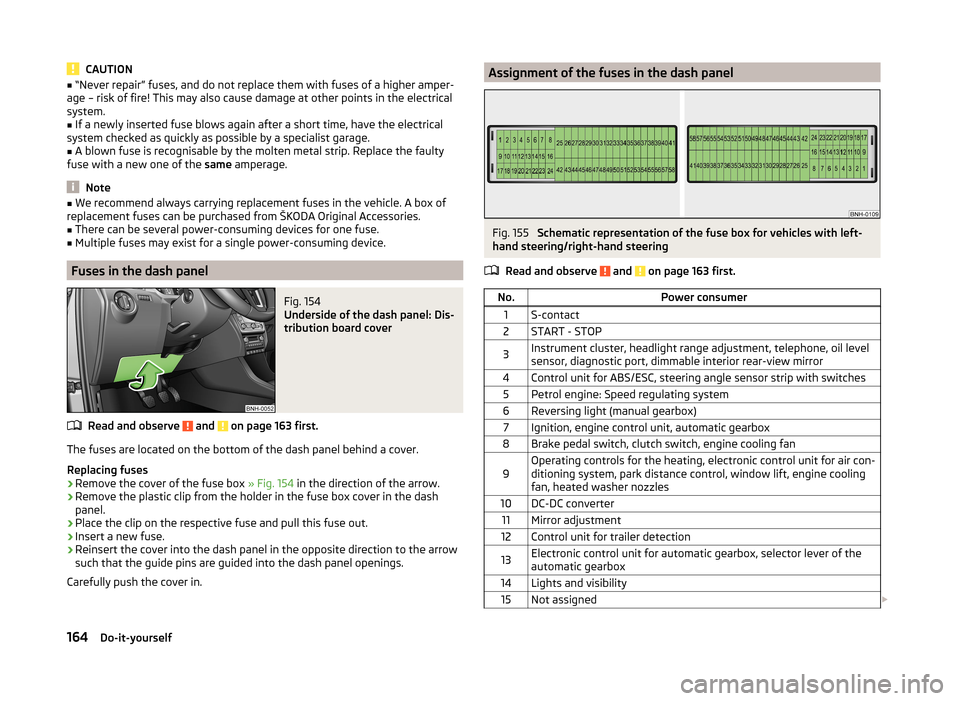
Fig. 154
Underside of the dash panel: Dis-
tribution board cover
Read and observe and on page 163 first.
The fuses are located on the bottom of the dash panel behind a cover.
Replacing fuses
›
Remove the cover of the fuse box » Fig. 154 in the direction of the arrow.
›
Remove the plastic clip from the holder in the fuse box cover in the dash
panel.
›
Place the clip on the respective fuse and pull this fuse out.
›
Insert a new fuse.
›
Reinsert the cover into the dash panel in the opposite direction to the arrow
such that the guide pins are guided into the dash panel openings.
Carefully push the cover in.
Assignment of the fuses in the dash panelFig. 155
Schematic representation of the fuse box for vehicles with left-
hand steering/right-hand steering
Read and observe
and on page 163 first.
No.Power consumer1S-contact2START - STOP3Instrument cluster, headlight range adjustment, telephone, oil level
sensor, diagnostic port, dimmable interior rear-view mirror4Control unit for ABS/ESC, steering angle sensor strip with switches5Petrol engine: Speed regulating system6Reversing light (manual gearbox)7Ignition, engine control unit, automatic gearbox8Brake pedal switch, clutch switch, engine cooling fan9Operating controls for the heating, electronic control unit for air con-
ditioning system, park distance control, window lift, engine cooling
fan, heated washer nozzles10DC-DC converter11Mirror adjustment12Control unit for trailer detection13Electronic control unit for automatic gearbox, selector lever of the
automatic gearbox14Lights and visibility15Not assigned 164Do-it-yourself
Page 167 of 193
No.Power consumer16Power steering, speed sensor, engine control unit, control unit for
fuel pump17Daytime running lights/radio for vehicles with START-STOP18Mirror heater19Ignition lock input20Engine control unit, electronic control unit for fuel pump, fuel pump21Reversing lamp (automatic gearbox), fog lights with the function
CORNER
22
Operating controls for the heating, electronic control unit for air con-
ditioning system, telephone, instrument cluster, steering angle
sender, multi-function steering wheel, ignition key removal lock, di-
agnostic port, rain sensor23Interior lighting, storage compartment and luggage compartment,
side lights24Central control unit25Light switch26Rear window wiper27Steering wheel module28Petrol engine: ACF valve, PTC heater29Injection, coolant pump30Fuel pump, ignition system, cruise control31Lambda probe32High pressure fuel pump, pressure valve33Engine control unit34Engine control unit, vacuum pump35Switch illumination, number plate light, parking light36High beam, light switch37Rear fog light, DC-DC converter38Fog lights39Air blower for heating40Not assigned41Heated front seats42Rear window heaterNo.Power consumer43Horn44Windscreen wipers45Boot lid lock, central locking system46Alarm47Cigarette lighter48ABS49Turn signal lights, brake lights50DC-DC converter, radio51Electric windows (driver's window and rear left window)52Electric windows (front passenger's window and rear right)53Windscreen washer54START-STOP instrument cluster, steering wheel module, multi-func-
tion steering wheel55Control unit for automatic gearbox56Headlight cleaning system57Headlights front, rear58Headlights front, rear
Fuses in the engine compartment
Fig. 156
Vehicle battery: Cover for the
fuse box - variant 1
165Fuses and light bulbs
Page 168 of 193
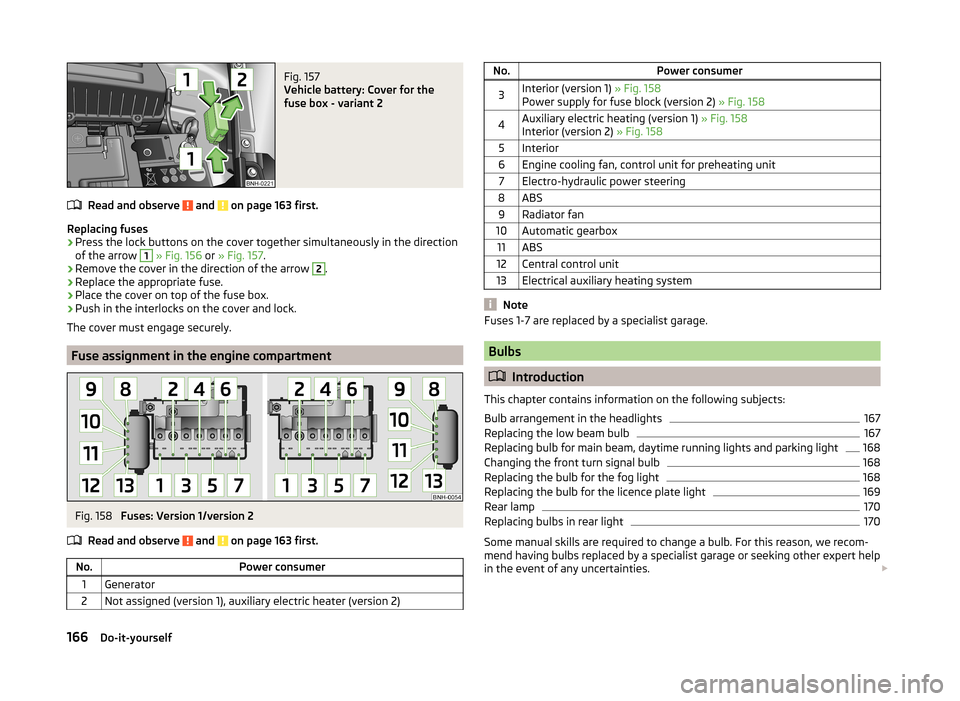
Fig. 157
Vehicle battery: Cover for the
fuse box - variant 2
Read and observe and on page 163 first.
Replacing fuses
›
Press the lock buttons on the cover together simultaneously in the direction
of the arrow
1
» Fig. 156 or » Fig. 157 .
›
Remove the cover in the direction of the arrow
2
.
›
Replace the appropriate fuse.
›
Place the cover on top of the fuse box.
›
Push in the interlocks on the cover and lock.
The cover must engage securely.
Fuse assignment in the engine compartment
Fig. 158
Fuses: Version 1/version 2
Read and observe
and on page 163 first.
No.Power consumer1Generator2Not assigned (version 1), auxiliary electric heater (version 2)No.Power consumer3Interior (version 1) » Fig. 158
Power supply for fuse block (version 2) » Fig. 1584Auxiliary electric heating (version 1) » Fig. 158
Interior (version 2) » Fig. 1585Interior6Engine cooling fan, control unit for preheating unit7Electro-hydraulic power steering8ABS9Radiator fan10Automatic gearbox11ABS12Central control unit13Electrical auxiliary heating system
Note
Fuses 1-7 are replaced by a specialist garage.
Bulbs
Introduction
This chapter contains information on the following subjects:
Bulb arrangement in the headlights
167
Replacing the low beam bulb
167
Replacing bulb for main beam, daytime running lights and parking light
168
Changing the front turn signal bulb
168
Replacing the bulb for the fog light
168
Replacing the bulb for the licence plate light
169
Rear lamp
170
Replacing bulbs in rear light
170
Some manual skills are required to change a bulb. For this reason, we recom-
mend having bulbs replaced by a specialist garage or seeking other expert help
in the event of any uncertainties.
166Do-it-yourself
Page 185 of 193
Emergency equipmentFire extinguisher150
First aid kit149
Jack150
Vehicle tool kit150
Warning triangle149
emergency wheel146
Emissions173
Engine Switching off the engine
98
Engine compartment131
Brake fluid138
Overview133
Vehicle battery138
Engine number172
engine oil specification
135
Engine oil134
change134
Checking135
Information messages31
Replenishing136
Warning light31
Environment104
EPC Warning light
34
ESC Function
106
Warning light32
Exhaust inspection system Warning light
34
F
Fastening elements
76
Films124
Fire extinguisher150
First aid kit149
Flashing55
Flexible storage compartment79
Fog lights56
Warning light36
Fog lights with CORNER function56
Footmats101
refer to footmats101
Force limit Power windows
52
Front airbag15
Front interior light58
fuel lead-free petrol
130
Fuel129
Diesel131
Fuel gauge28
refer to Fuel129
Refuelling129
Fuel consumption104, 173
Fuel reserve Warning light
35
Fuses Assignment
163
Assignment of fuses in the dash panel164
Colour coding163
Fuse assignment in the engine compartment166
Replacing163
Fuses in the engine compartment Assignment
166
G
Gearbox Warning messages
29
Gear change Gear recommendation
38
Information on the selected gear38
Gear changing Gear stick
101
gears spare
147
General viewCockpit25
Generator Indicator light
31
Genuine parts120
Glasses compartment73
Glow plug system Warning light
34
GSM89
H
Handbrake
100
Warning light30
Hazard warning light system57
HBA107
Head airbag17
Headlight cleaning system Headlight cleaning system
62
Headlights Bulb arrangement
167
Driving abroad58
Headlight cleaning system62
Headrest removing and installing
65
Head restraints65
Adjust height65
Heating84
Air distribution control85
Control elements86
Exterior mirror63
Rear window59
Seats66
Heating rear window59
HHC107
Hill Hold Control (HHC)107
Hitch112
Drawback load112
Hooks77
Horn25
183Index
Page 188 of 193
Bulb for the licence plate light169
Bulb in rear light170
Bulbs166
Fuses163
Fuses in the dash panel164
Fuses in the engine compartment165
Low beam bulb167
Vehicle battery141
Windscreen wiper blades162
Wiper blades163
Replenishing Coolant
137
Engine oil136
Windscreen washer fluid134
Revolution counter27
Roof Load
83
Roof rack mounting points
83
Roof load83
Roof rack system83
Rubber seals124
S
SAFE See Safe securing system
47
SAFELOCK See Safe securing system
47
Safe securing system47
Safety6
Child safety20
Child safety seats20
Correct seated position7
Head restraints65
ISOFIX22
TOP TETHER23
Saving electrical energy104
Seals Vehicle care
124
SeatAdjusting64
Seat belt Warning light
31
Seat belts10
Belt tensioners13
fastening and unfastening12
Height adjustment13
Inertia reels13
The physical principle of a frontal collision11
Seat features66
Seats Front armrest
67
Head restraints65
Heating66
Rear armrest67
Seat backrests67
Seats and head restraint64
Selector lever Refer to Selector lever
102
Service120
Service interval display43
Setting29
Lower position of the variable loading floor81
seats and head restraints64
Upper position of the variable loading floor80
Setting the29
Side airbag16
Snow chains148
Spare change
147
spare wheel146
change147
instructions147
Speedometer27
See speedometer27
Speed symbol Refer to Wheels
145
Spoiler121
START-STOP109
Manually deactivating/activating the system111
Operating conditions of the system110
operation in vehicles with automatic gearbox110
operation in vehicles with manual gearbox110
system-related automatic start-up111
Starting engine Jump-starting
157
Starting the engine Jump-starting
158
START STOP Information messages
111
Jump-starting158
Start the engine98
Stating and turning off the engine97
Steering wheel8
Stopping100
Storage68
Storage compartment Glasses compartment
73
in the centre console69
in the front arm rest73
on the front passenger side73
Storage compartments68
Storage compartments in the boot78
Storage net bag79
Storage pockets on the front seats74
Stowage compartments in the doors
69
Sun visors60
Switching off the engine98
Switch light on/off53
T
Taking care of your vehicle Automatic car wash system
122
High-pressure cleaner123
Washing by hand122
Wash system122
186Index