lock SKODA RAPID SPACEBACK 2013 1.G Owner's Guide
[x] Cancel search | Manufacturer: SKODA, Model Year: 2013, Model line: RAPID SPACEBACK, Model: SKODA RAPID SPACEBACK 2013 1.GPages: 193, PDF Size: 14.8 MB
Page 53 of 193
NoteThe function of the button in the grip above the licence plate is deactivated
when starting off or at a speed of 5 km/hour or more for vehicles with central
locking. The function is restored after the vehicle stops and the door is
opened.
Opening/closing
Fig. 34
Opening / closing tailgate
Read and observe
on page 50 first.
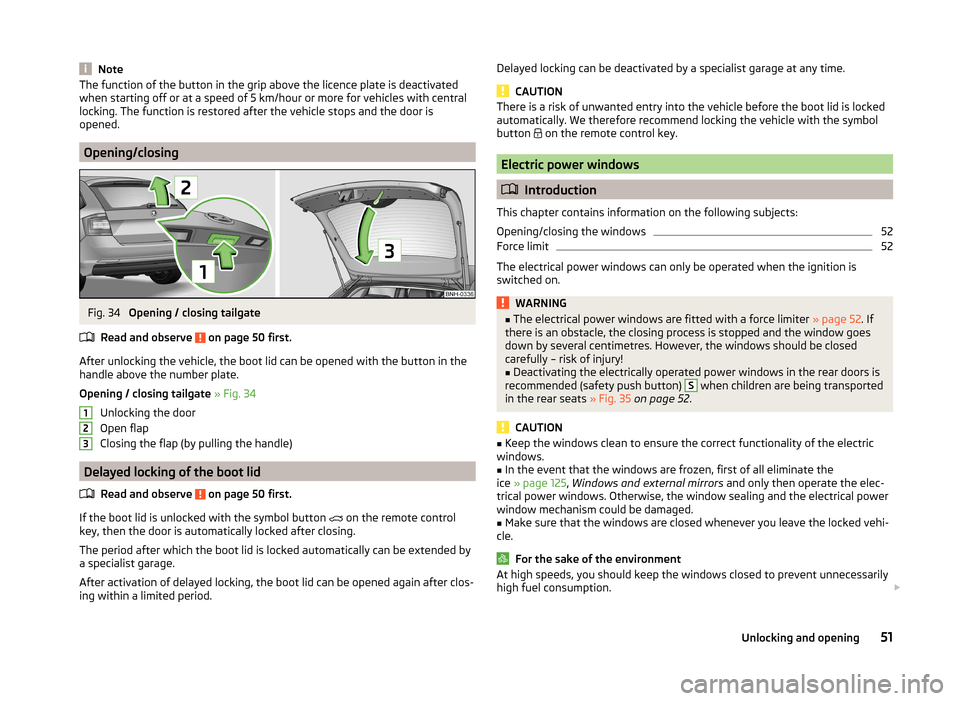
After unlocking the vehicle, the boot lid can be opened with the button in the
handle above the number plate.
Opening / closing tailgate » Fig. 34
Unlocking the door
Open flap
Closing the flap (by pulling the handle)
Delayed locking of the boot lid
Read and observe
on page 50 first.
If the boot lid is unlocked with the symbol button on the remote control
key, then the door is automatically locked after closing.
The period after which the boot lid is locked automatically can be extended by a specialist garage.
After activation of delayed locking, the boot lid can be opened again after clos-
ing within a limited period.
123Delayed locking can be deactivated by a specialist garage at any time.
CAUTION
There is a risk of unwanted entry into the vehicle before the boot lid is locked
automatically. We therefore recommend locking the vehicle with the symbol
button
on the remote control key.
Electric power windows
Introduction
This chapter contains information on the following subjects:
Opening/closing the windows
52
Force limit
52
The electrical power windows can only be operated when the ignition is
switched on.
WARNING■ The electrical power windows are fitted with a force limiter » page 52. If
there is an obstacle, the closing process is stopped and the window goes
down by several centimetres. However, the windows should be closed
carefully – risk of injury!■
Deactivating the electrically operated power windows in the rear doors is
recommended (safety push button)
S
when children are being transported
in the rear seats » Fig. 35 on page 52 .
CAUTION
■
Keep the windows clean to ensure the correct functionality of the electric
windows.■
In the event that the windows are frozen, first of all eliminate the
ice » page 125 , Windows and external mirrors and only then operate the elec-
trical power windows. Otherwise, the window sealing and the electrical power
window mechanism could be damaged.
■
Make sure that the windows are closed whenever you leave the locked vehi-
cle.
For the sake of the environment
At high speeds, you should keep the windows closed to prevent unnecessarily high fuel consumption. 51Unlocking and opening
Page 59 of 193

COMING HOME / LEAVING HOMERead and observe
on page 53 first.
COMING HOME (hereinafter referred to only as a function) switches the light
automatically for a short time after leaving the vehicle.
LEAVING HOME (hereinafter referred to only as a function) switches the light
automatically for a short time when approaching the vehicle.
The function switches on the following light, depending on the equipment
fitted.
› Parking lights
› Low beam
› Entry lighting in the exterior mirrors
› Licence plate light
COMING HOME
The daytime running lights are switched on automatically if the following
conditions are met.
The light switch is in position
» Fig. 38 on page 55 .
The visibility in the vehicle environment is reduced.
The ignition is switched off.
The function was activated before leaving the vehicle by briefly switching
on the headlight flasher » page 55, Turn signal and main beam .
The driver's door was open - within 60 seconds after turning off the igni-
tion.
The light goes out 10 seconds after closing all of the doors and the boot lid.
If a door or the boot lid remains open, the light goes out after 60 seconds.
LEAVING HOME
The daytime running lights are switched on automatically if the following
conditions are met.
The light switch is in position
» Fig. 38 on page 55 .
The visibility in the vehicle environment is reduced.
The ignition is switched off.
The vehicle was unlocked with the radio remote control.
The light goes off after 10 seconds or when locking the vehicle.
CAUTION■
Do not attach any stickers or similar objects in front of the light sensor on
the windscreen to avoid impairing the function or its reliability.■
If this function is activated, the battery will be heavily discharged particularly
in short-haul traffic.
Note
Poorer visibility are evaluated on the basis of information that is collected from
the sensor mounted in the interior mirror holder.
Hazard warning light system
Fig. 40
Button for hazard warning light
system
Read and observe on page 53 first.
Switching on/off
›
Press the button
» Fig. 40 .
All the turn signal lights on the vehicle flash at the same time when the hazard
warning light system is switched on. The warning light for the turn signals and
the warning light in the button also flash at the same time. The hazard warn-
ing light system can also be operated if the ignition is switched off.
If one of the airbags is deployed, the hazard warning light system will switch
on automatically.
If the turn signal light is switched on when the hazard warning light and the
ignition are both switched on, then only the turn signal light on the corre-
sponding vehicle side will flash.
57Lights and visibility
Page 60 of 193

WARNINGSwitch on the hazard warning light system if, for example, the following oc-
curs.■
You encounter a traffic congestion.
■
The vehicle has broken down.
Parking light
Read and observe
on page 53 first.
The parking light is provided for a temporary lighting of the parked vehicle.
Parking light switching on
›
Switch off the ignition.
›
Place the control lever into position
A
or
B
as far as it can go
» Fig. 37 on
page 55 - the parking light on the right/left-hand side of the vehicle is
switched on.
If the right or left turn signal light has been switched on and the ignition is
switched off, the parking light is not automatically switched on.
Switching on the side light on both sides
›
Turn the light switch
A
to position
» Fig. 36 on page 53 and lock the vehi-
cle.
On vehicles with a MAXI DOT display, the symbol in the light switch also
lights up when the two-sided parking light is switched on.
CAUTION
Turning on the parking light means the battery is heavily loaded, especially
over short distances.
Driving abroad
Read and observe
on page 53 first.
The low beam is set asymmetrically. It illuminates the side of the road on
which the vehicle is being driven to a greater extent.
When driving in countries with opposing traffic system (traffic on the left/
right), asymmetric headlight adjustment can dazzle oncoming traffic. In order
to avoid this, the headlights must be adjusted at a specialist garage.
NoteYou can find out more information on adjusting the headlights at a specialist
garage.
Interior lighting
Front interior light
Fig. 41
Front interior light - Version 1 / Version 2
Positions of sliding switch
A
» Fig. 41
Switching on
Switching off
Operating with the door contact switch
Switch for reading light
B
» Fig. 41
Switching left reading lamp on/off
Switching right reading lamp on/off
Conditions for the lighting operation with the door contact switch
The system is turned on when any of the following is present.
› The vehicle is unlocked.
› One of the doors is opened.
› The ignition key is removed.
The system is turned off when any of the following is present.
› The vehicle is locked.
› The ignition is switched on.
› About 30 seconds after all the doors have been closed.
58Using the system
Page 66 of 193
Seats and head restraints
Seats and head restraints
Introduction
This chapter contains information on the following subjects:
Adjusting the front seats
64
Head restraints - adjusting height
65
Head restraints - Removing and installing
65
The driver's seat should be adjusted in such a way that the pedals can be fully
pressed to the floor with slightly bent legs.
The seat backrest on the driver's seat should be adjusted in such a way that the upper point of the steering wheel can be easily reached with slightly bent
arms.
Correct adjustment of the seats is particularly important for the following rea-
sons.
› Reaching the controls safely and quickly.
› A relaxed and fatigue-free body position.
› Achieving the maximum protection offered by the seat belts and the airbag
system.
WARNING■ Only adjust the driver's seat when the vehicle is stationary – risk of acci-
dent!■
Caution when adjusting the seat! You may suffer injuries or bruises as a
result of adjusting the seat without paying proper attention.
■
Never carry more people than the number of seats in the vehicle.
■
Do not carry any objects on the front passenger seat, except objects de-
signed for this purpose (e.g. child seats) – risk of accident!
Note
After a certain time, play can develop within the adjustment mechanism of the
backrest angle.Adjusting the front seatsFig. 49
Control elements at the seat
Read and observe on page 64 first.
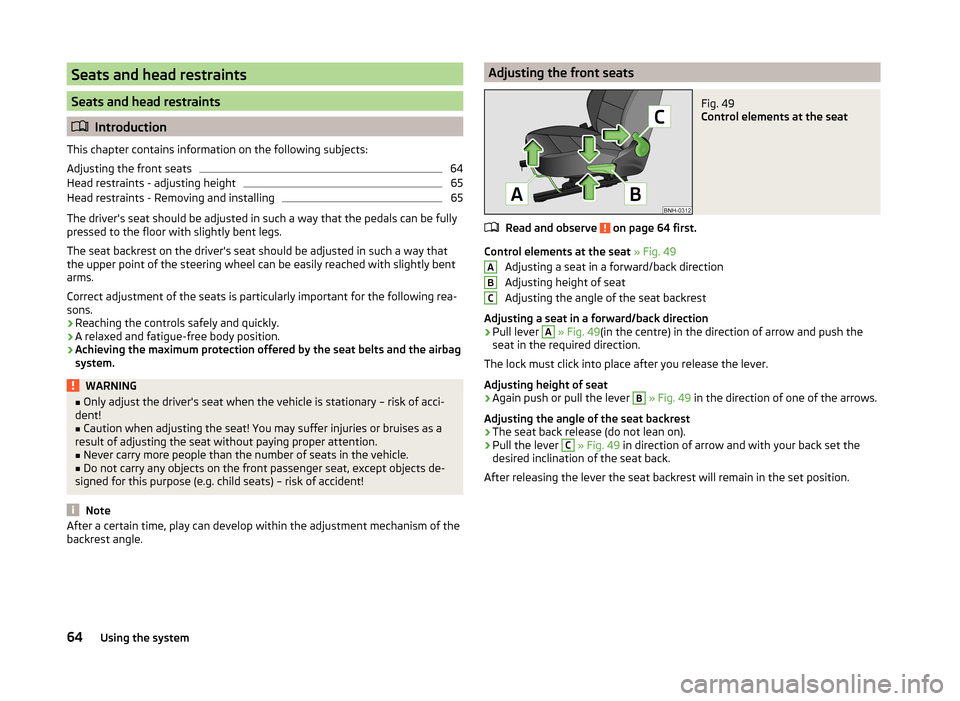
Control elements at the seat » Fig. 49
Adjusting a seat in a forward/back direction
Adjusting height of seat
Adjusting the angle of the seat backrest
Adjusting a seat in a forward/back direction
›
Pull lever
A
» Fig. 49 (in the centre) in the direction of arrow and push the
seat in the required direction.
The lock must click into place after you release the lever.
Adjusting height of seat
›
Again push or pull the lever
B
» Fig. 49 in the direction of one of the arrows.
Adjusting the angle of the seat backrest
›
The seat back release (do not lean on).
›
Pull the lever
C
» Fig. 49 in direction of arrow and with your back set the
desired inclination of the seat back.
After releasing the lever the seat backrest will remain in the set position.
ABC64Using the system
Page 68 of 193
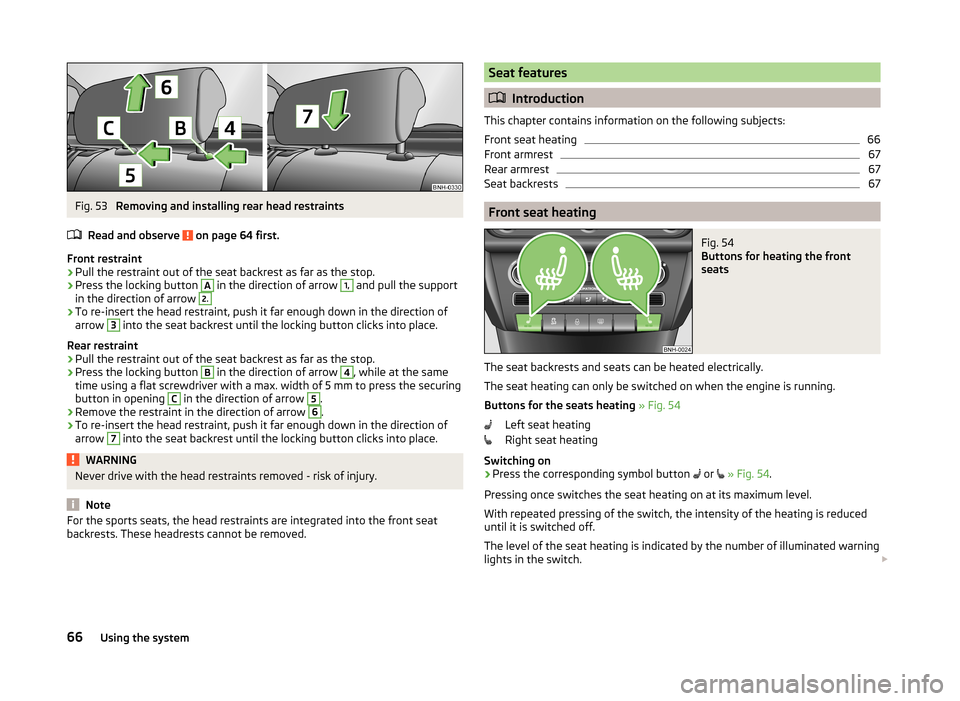
Fig. 53
Removing and installing rear head restraints
Read and observe
on page 64 first.
Front restraint
›
Pull the restraint out of the seat backrest as far as the stop.
›
Press the locking button
A
in the direction of arrow
1,
and pull the support
in the direction of arrow
2.›
To re-insert the head restraint, push it far enough down in the direction of
arrow
3
into the seat backrest until the locking button clicks into place.
Rear restraint
›
Pull the restraint out of the seat backrest as far as the stop.
›
Press the locking button
B
in the direction of arrow
4
, while at the same
time using a flat screwdriver with a max. width of 5 mm to press the securing button in opening
C
in the direction of arrow
5
.
›
Remove the restraint in the direction of arrow
6
.
›
To re-insert the head restraint, push it far enough down in the direction of
arrow
7
into the seat backrest until the locking button clicks into place.
WARNINGNever drive with the head restraints removed - risk of injury.
Note
For the sports seats, the head restraints are integrated into the front seat
backrests. These headrests cannot be removed.Seat features
Introduction
This chapter contains information on the following subjects:
Front seat heating
66
Front armrest
67
Rear armrest
67
Seat backrests
67
Front seat heating
Fig. 54
Buttons for heating the front
seats
The seat backrests and seats can be heated electrically.
The seat heating can only be switched on when the engine is running.
Buttons for the seats heating » Fig. 54
Left seat heating
Right seat heating
Switching on
›
Press the corresponding symbol button or
» Fig. 54 .
Pressing once switches the seat heating on at its maximum level.
With repeated pressing of the switch, the intensity of the heating is reduced
until it is switched off.
The level of the seat heating is indicated by the number of illuminated warning
lights in the switch.
66Using the system
Page 69 of 193
WARNINGIf, as an occupant, you have a subdued pain and/or temperature sensitivity,
e.g. through medication, paralysis or because of chronic illness (e.g. diabe-
tes), we recommend you do not use seat heating on the driver or front pas-
senger seat. This can lead to burns on the back, the posterior and the legs
which are difficult to heal. If the seat heating is used, we recommend to
make regular breaks in your journey when driving long distances, so that
the body can recuperate from the stress of the journey. Please consult your
doctor, who can evaluate your specific condition.
CAUTION
■ Do not kneel on the seats or otherwise apply concentrated pressure to them.■The seat heating in the following cases will not turn on - there is a risk of
damaging the seat covers and seat heating. ■The seats are not occupied by people.
■ Items are fastened or stored items on the seats, such as a child seat, a bag
and the like.
■ Additional seat covers or protective covers are fixed to the seats.■
Clean the seat covers » page 128.
Note
If the on-board voltage drops, the heater switches off automatically, in order
to provide sufficient electrical energy for the engine control » page 141, Auto-
matic load deactivation .
Front armrest
Fig. 55
Adjusting armrest
Setting the height
›
Lift the armrest fully upwards in the direction of the arrow » Fig. 55 and then
move it back down completely.
›
Move the armrest into one of the 5 locking positions.
The armrest includes a storage compartment » page 73.
Rear armrest
Fig. 56
Fold the armrest forward
Folding forward
›
Pull on the loop
A
» Fig. 56 and fold the armrest forward in the direction of
the arrow.
A cup holder may be located in the armrest » page 70.
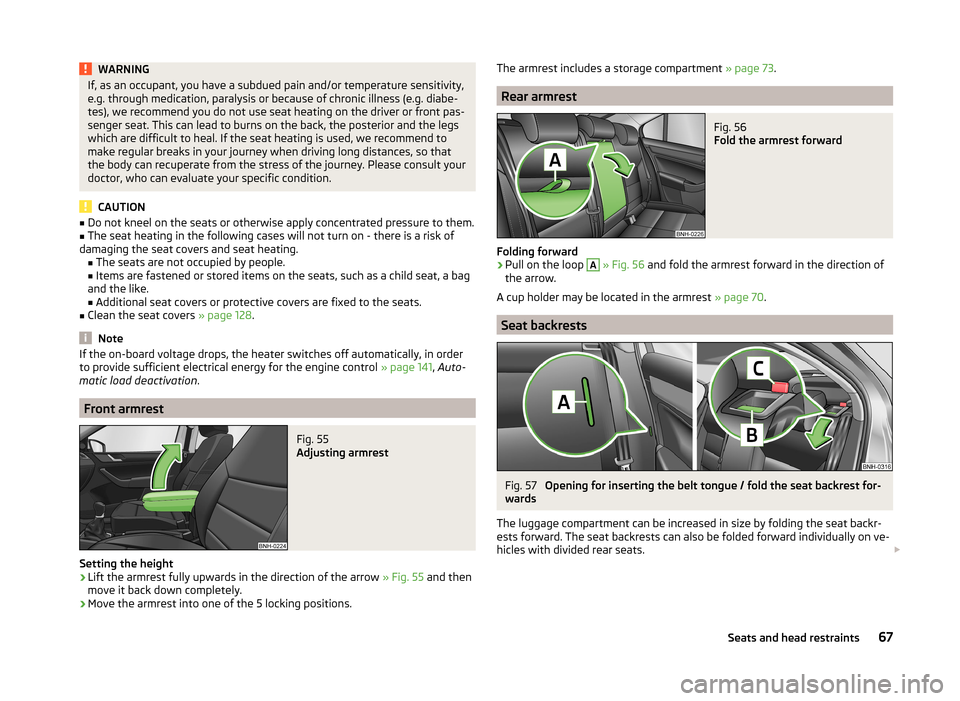
Seat backrests
Fig. 57
Opening for inserting the belt tongue / fold the seat backrest for-
wards
The luggage compartment can be increased in size by folding the seat backr-
ests forward. The seat backrests can also be folded forward individually on ve-
hicles with divided rear seats.
67Seats and head restraints
Page 70 of 193
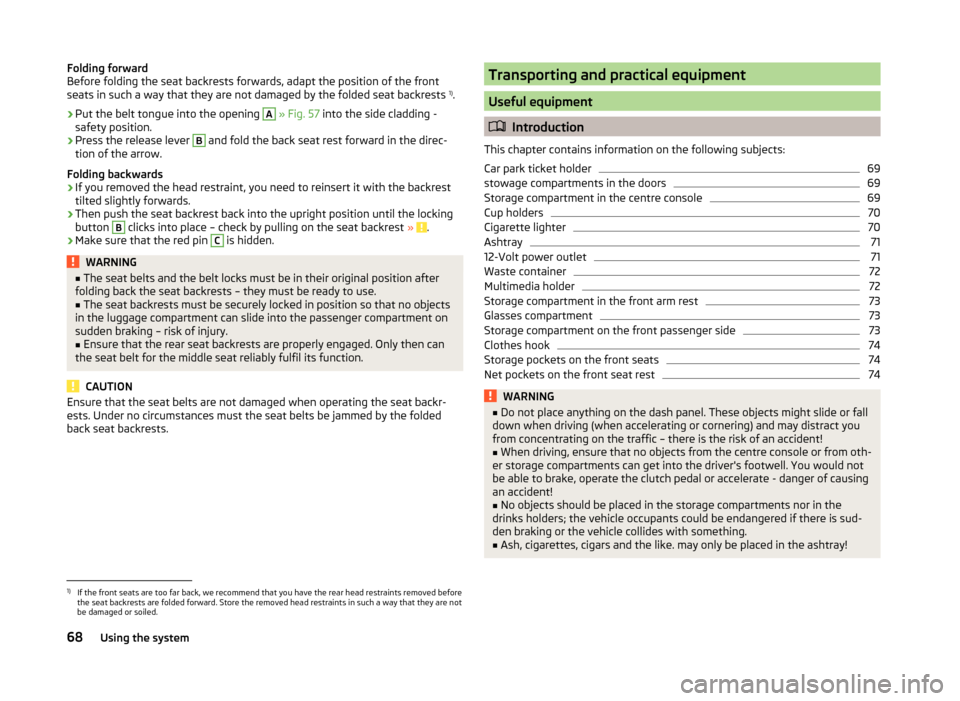
Folding forward
Before folding the seat backrests forwards, adapt the position of the front
seats in such a way that they are not damaged by the folded seat backrests 1)
.›
Put the belt tongue into the opening
A
» Fig. 57 into the side cladding -
safety position.
›
Press the release lever
B
and fold the back seat rest forward in the direc-
tion of the arrow.
Folding backwards
›
If you removed the head restraint, you need to reinsert it with the backrest
tilted slightly forwards.
›
Then push the seat backrest back into the upright position until the locking
button
B
clicks into place – check by pulling on the seat backrest » .
›
Make sure that the red pin
C
is hidden.
WARNING■
The seat belts and the belt locks must be in their original position after
folding back the seat backrests – they must be ready to use.■
The seat backrests must be securely locked in position so that no objects
in the luggage compartment can slide into the passenger compartment on
sudden braking – risk of injury.
■
Ensure that the rear seat backrests are properly engaged. Only then can
the seat belt for the middle seat reliably fulfil its function.
CAUTION
Ensure that the seat belts are not damaged when operating the seat backr-
ests. Under no circumstances must the seat belts be jammed by the folded
back seat backrests.Transporting and practical equipment
Useful equipment
Introduction
This chapter contains information on the following subjects:
Car park ticket holder
69
stowage compartments in the doors
69
Storage compartment in the centre console
69
Cup holders
70
Cigarette lighter
70
Ashtray
71
12-Volt power outlet
71
Waste container
72
Multimedia holder
72
Storage compartment in the front arm rest
73
Glasses compartment
73
Storage compartment on the front passenger side
73
Clothes hook
74
Storage pockets on the front seats
74
Net pockets on the front seat rest
74WARNING■ Do not place anything on the dash panel. These objects might slide or fall
down when driving (when accelerating or cornering) and may distract you
from concentrating on the traffic – there is the risk of an accident!■
When driving, ensure that no objects from the centre console or from oth-
er storage compartments can get into the driver's footwell. You would not
be able to brake, operate the clutch pedal or accelerate - danger of causing
an accident!
■
No objects should be placed in the storage compartments nor in the
drinks holders; the vehicle occupants could be endangered if there is sud-
den braking or the vehicle collides with something.
■
Ash, cigarettes, cigars and the like. may only be placed in the ashtray!
1)
If the front seats are too far back, we recommend that you have the rear head restraints removed before
the seat backrests are folded forward. Store the removed head restraints in such a way that they are not
be damaged or soiled.
68Using the system
Page 71 of 193
Car park ticket holderFig. 58
Parking ticket holder
Read and observe on page 68 first.
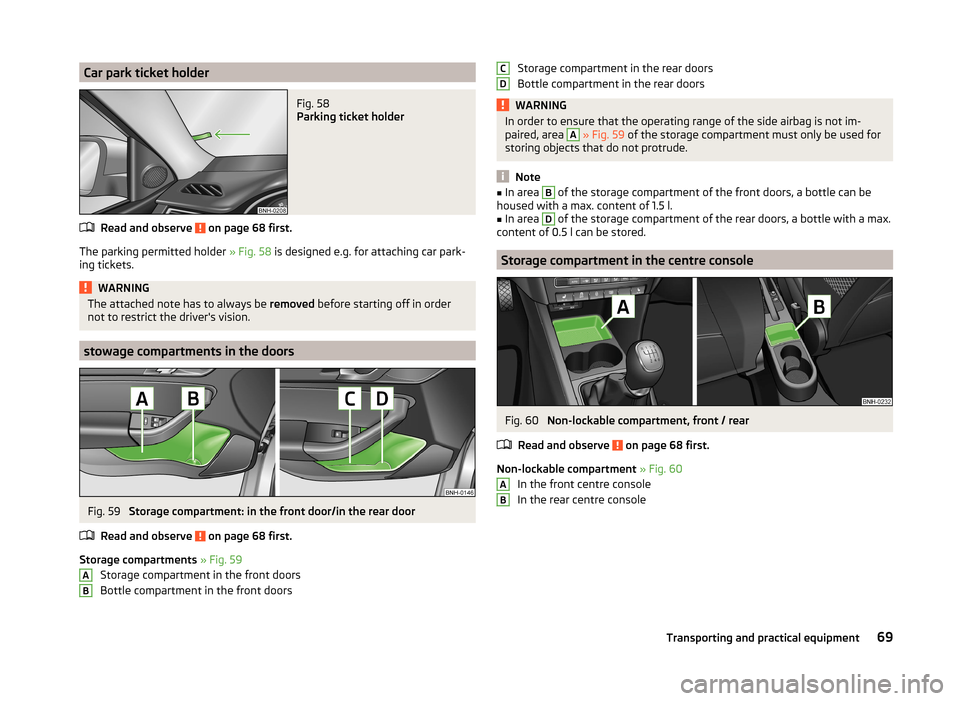
The parking permitted holder » Fig. 58 is designed e.g. for attaching car park-
ing tickets.
WARNINGThe attached note has to always be removed before starting off in order
not to restrict the driver's vision.
stowage compartments in the doors
Fig. 59
Storage compartment: in the front door/in the rear door
Read and observe
on page 68 first.
Storage compartments » Fig. 59
Storage compartment in the front doors
Bottle compartment in the front doors
ABStorage compartment in the rear doors
Bottle compartment in the rear doorsWARNINGIn order to ensure that the operating range of the side airbag is not im-
paired, area A » Fig. 59 of the storage compartment must only be used for
storing objects that do not protrude.
Note
■ In area B of the storage compartment of the front doors, a bottle can be
housed with a max. content of 1.5 l.■
In area
D
of the storage compartment of the rear doors, a bottle with a max.
content of 0.5 l can be stored.
Storage compartment in the centre console
Fig. 60
Non-lockable compartment, front / rear
Read and observe
on page 68 first.
Non-lockable compartment » Fig. 60
In the front centre console
In the rear centre console
CDAB69Transporting and practical equipment
Page 76 of 193

Closing›Lift the lid upwards until it clicks into place.
Air supply into the storage compartment›
Turn the control dial » Fig. 70 -
anti-clockwise to the limit to open the air
supply.
›
Turn the control dial - anti-clockwise to close the air supply.
Opening the air supply when the air conditioning system is switched on allows
cooled air to flow into the storage compartment.
Opening the air supply when the air conditioning system is switched on allows
cooled air to flow into the storage compartment.
WARNINGThe storage compartment must always be closed when driving for safety
reasons.
Note
■ A 1 litre bottle (max. capacity) can be stored in the storage compartment on
the front passenger's side.■
When the storage compartment is opened, a light lights up.
■
If the cooling of the storage compartment is not used, we recommend that
you leave the air supply closed.
Clothes hook
Read and observe
on page 68 first.
The clothes hooks are located on the middle door pillars of the vehicle and onthe handle of the headliner above each of the rear doors.
WARNING■ Only hang light items of clothing on the hooks. Never leave any heavy or
sharp-edged objects in the pockets of the items of clothing.■
Do not use clothes hangers for hanging up items of clothing; this may re-
duce the effectiveness of the head airbags.
■
Ensure that any clothes hanging from the hooks do not impair your vision
to the rear.
CAUTION
The maximum permissible load of the hooks is 2 kg.Storage pockets on the front seatsFig. 71
Map pockets
Read and observe on page 68 first.
The storage pockets » Fig. 71 are intended for the storage of maps, magazines,
etc.
WARNINGNever put heavy items into the map pockets – risk of injury!
CAUTION
Never put large objects into the map pockets, e.g. bottles or objects with sharp
edges - risk of damaging the pockets and seat coverings.
Net pockets on the front seat rest
Fig. 72
Meshed pocket
Read and observe on page 68 first.
The net pockets are used for storage of small and light objects, such as mobile phones and the like.
74Using the system
Page 79 of 193
HooksFig. 76
Hooks
Read and observe and on page 75 first.
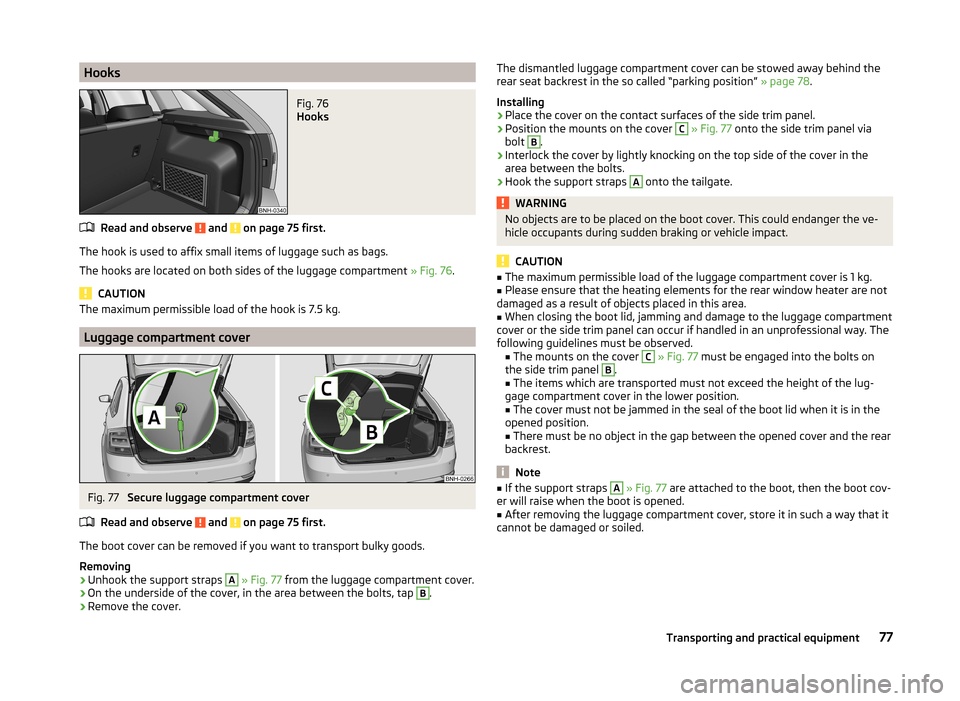
The hook is used to affix small items of luggage such as bags.
The hooks are located on both sides of the luggage compartment » Fig. 76.
CAUTION
The maximum permissible load of the hook is 7.5 kg.
Luggage compartment cover
Fig. 77
Secure luggage compartment cover
Read and observe
and on page 75 first.
The boot cover can be removed if you want to transport bulky goods.
Removing
›
Unhook the support straps
A
» Fig. 77 from the luggage compartment cover.
›
On the underside of the cover, in the area between the bolts, tap
B
.
›
Remove the cover.
The dismantled luggage compartment cover can be stowed away behind the
rear seat backrest in the so called “parking position” » page 78.
Installing›
Place the cover on the contact surfaces of the side trim panel.
›
Position the mounts on the cover
C
» Fig. 77 onto the side trim panel via
bolt
B
.
›
Interlock the cover by lightly knocking on the top side of the cover in the
area between the bolts.
›
Hook the support straps
A
onto the tailgate.
WARNINGNo objects are to be placed on the boot cover. This could endanger the ve-
hicle occupants during sudden braking or vehicle impact.
CAUTION
■ The maximum permissible load of the luggage compartment cover is 1 kg.■Please ensure that the heating elements for the rear window heater are not
damaged as a result of objects placed in this area.■
When closing the boot lid, jamming and damage to the luggage compartment
cover or the side trim panel can occur if handled in an unprofessional way. The
following guidelines must be observed. ■ The mounts on the cover
C
» Fig. 77 must be engaged into the bolts on
the side trim panel
B
.
■ The items which are transported must not exceed the height of the lug-
gage compartment cover in the lower position.
■ The cover must not be jammed in the seal of the boot lid when it is in the
opened position.
■ There must be no object in the gap between the opened cover and the rear
backrest.
Note
■ If the support straps A » Fig. 77 are attached to the boot, then the boot cov-
er will raise when the boot is opened.■
After removing the luggage compartment cover, store it in such a way that it
cannot be damaged or soiled.
77Transporting and practical equipment