warning light SKODA RAPID SPACEBACK 2013 1.G Manual PDF
[x] Cancel search | Manufacturer: SKODA, Model Year: 2013, Model line: RAPID SPACEBACK, Model: SKODA RAPID SPACEBACK 2013 1.GPages: 193, PDF Size: 14.8 MB
Page 153 of 193
WARNINGThe factory-supplied lifting jack is only intended for your model of vehicle.
Under no circumstances attempt to lift heavier vehicles or other loads.
CAUTION
■ Ensure that the vehicle tool kit is safely secured in the boot.■Ensure that the box is always secured with the strap.
Changing a wheel
Introduction
This chapter contains information on the following subjects:
Preliminary work
151
Full wheel trim
152
Wheel bolts
152
Changing a wheel
152
Follow-up work
153
Loosening/tightening wheel bolts
153
Raise vehicle
153
Securing wheels against theft
154WARNING■ If you are in flowing traffic, switch on the hazard warning light system
and set up the warning triangle at the prescribed distance! The national le-
gal requirements must be observed.■
Park the vehicle as far away as possible from the flow of traffic. Park on
as flat and firm a surface as possible.
■
The following instructions must be followed if the vehicle is subsequently
fitted with tyres or rims that differ from the factory-fitted ones » page 144,
New tyres .
WARNINGNotes for vehicle lifting■If the wheel has to be changed on a slope, first of all block the opposite
wheel with a stone or similar object to prevent the vehicle from unexpect-
edly rolling away.WARNING (Continued)■ Secure the base plate of the lifting jack with suitable means to prevent
possible moving. A soft and slippery ground under the base plate may move
the lifting jack, causing the vehicle to fall down. It is therefore always nec-
essary to place the lifting jack on a solid surface or use a wide and stable
base. Use a non-slip base (e.g. a rubber foot mat) if the surface is smooth,
such as cobbled stones, tiled floor, etc.■
Only attach the lifting jack to the attachment points provided for this pur-
pose.
■
Always raise the vehicle with the doors closed.
■
Never position any body parts, such as arms or legs under the vehicle,
while the vehicle is raised with a lifting jack.
■
When the vehicle is raised, never start the engine.
WARNINGInformation on the wheel bolts■The wheel bolts must be clean and must turn easily. Never apply grease
or oil.■
The prescribed tightening torque of the wheel bolts for steel and light al-
loy wheels is 120 Nm.
■
If the wheel bolts are tightened to a too low tightening torque, the rim
can come loose when the car is moving. A tightening torque which is too
high can damage the bolts and threads and this can result in permanent
deformation of the contact surfaces on the rim.
■
In case of incorrect treatment of the wheel bolts, the wheel can loosen
when the car is moving.
Note
The national legal requirements must be observed when changing a wheel.
Preliminary work
Read and observe
on page 151 first.
Always change a wheel on a level surface as far as possible.
The following steps must be carried out before actually changing the wheel:
›
Have all of the occupants get out of the vehicle. While changing a tyre, the
occupants of the vehicle should not stand on the road (they should instead
remain behind a crash barrier).
›
Switch off the engine.
151Emergency equipment and self-help
Page 157 of 193
Tyre repair
Introduction
This chapter contains information on the following subjects:
Breakdown kit
155
Preparations for using the breakdown kit
156
Sealing and inflating the tyre
156
Check after 10 minutes' driving
157
Use the breakdown kit to reliably repair tyre damage caused by foreign bodies
or a puncture with diameters up to approx. 4 mm.
A repair made using the breakdown kit is never intended to replace a perma-
nent repair on the tyre. Its purpose is to get you to the nearest specialist ga-
rage.
The wheel must not be removed during repair.
Do not remove foreign bodies , e.g. screws or nails, from the tyre!
The breakdown kit must not be used under the following circumstances. › There is damage to the rim.
› The outside temperature is less than -20 °C.
› The tears or punctures are greater than 4 mm in size.
› There is damage to the tyre wall.
› Driving with very low tyre pressure or with a completely flat tyre.
› If the use-by-date (see inflation bottle) has passed.
WARNING■
If you are in flowing traffic, switch on the hazard warning light system
and set up the warning triangle at the prescribed distance! The national le-
gal requirements must be observed.■
Park the vehicle as far away as possible from the flow of traffic. Park on
as flat and firm a surface as possible.
WARNING■ A tyre filled with sealant has the same driving characteristics as a stand-
ard tyre.■
Do not travel faster than 80 km/h.
■
Avoid accelerating at full throttle, sharp braking and fast cornering.
WARNING (Continued)■ Check the tyre pressure after driving for 10 minutes.■The sealant is hazardous to heath. Remove immediately if it comes into
contact with the skin.■
Observe the manufacturer's usage instructions for the breakdown kit.
For the sake of the environment
Used sealant or sealant whose expiry date has passed must be disposed of in
accordance with environmental protection regulations.
Note
■ A new bottle of sealant can be purchased from ŠKODA Original Parts.■Immediately replace the tyre that was repaired using the breakdown kit, or
consult a specialist garage about repair options.
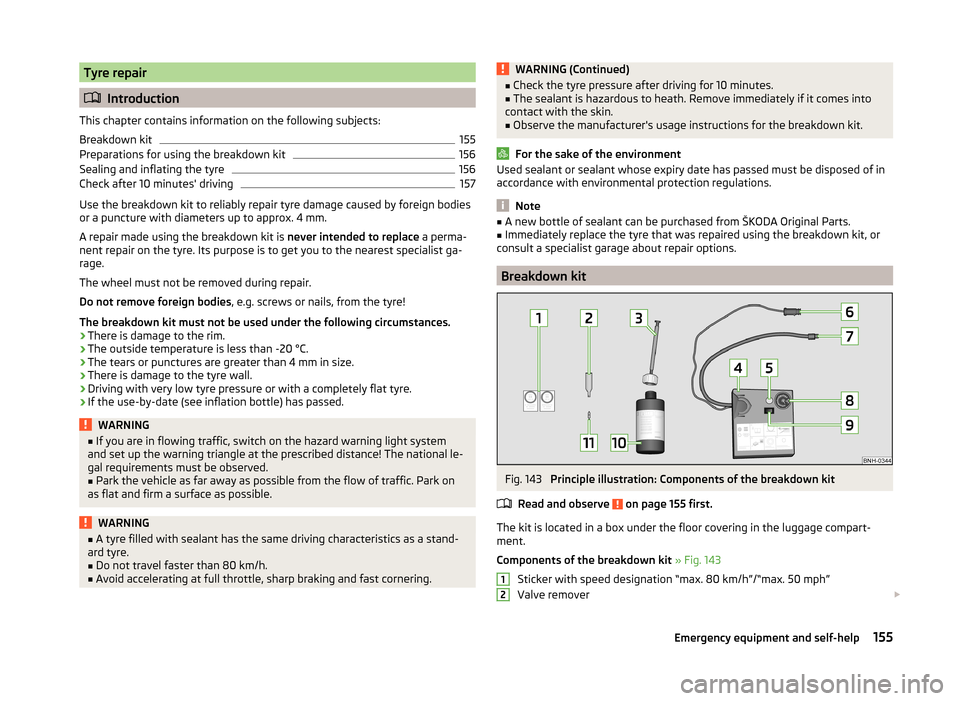
Breakdown kit
Fig. 143
Principle illustration: Components of the breakdown kit
Read and observe
on page 155 first.
The kit is located in a box under the floor covering in the luggage compart-
ment.
Components of the breakdown kit » Fig. 143
Sticker with speed designation “max. 80 km/h”/“max. 50 mph” Valve remover
12155Emergency equipment and self-help
Page 161 of 193

Driver of the tow vehicle›Engage the clutch gently when starting off or depress the accelerator partic-
ularly gently if the vehicle is fitted with an automatic gearbox.›
Only then, approach correctly when the rope is taut.
The maximum towing speed is 50 km/h.
Driver of the towed vehicle
›
Switch on the ignition so that the steering wheel is not locked and so that
the turn signal lights, horn, windscreen wipers and windscreen washer sys-
tem can be used.
›
Take the vehicle out of gear or move the selector lever into position N if the
vehicle is fitted with an automatic gearbox.
Please note that the brake servo unit and power steering only operate if the
engine is running. If the engine is not running, significantly more physical force
is required to depress the brake pedal and steer the vehicle.
If using a tow rope, ensure that it is always kept taught.
Towing another vehicle requires a certain amount of practice. Both drivers
should be familiar with the particular points about towing a vehicle. Unskilled
drivers should not attempt to tow another vehicle or to be towed in one.
The vehicle must be transported on a special breakdown vehicle or trailer if it
is not possible to tow the vehicle in the way described or if the towing dis-
tance is greater than 50 km.
Attach the tow rope or the tow bar to the towing eyes » page 159
or » page 160 to the detachable ball head of the towing equip-
ment » page 112 .
WARNING■
The tow rope must not be twisted as it may in certain circumstances re-
sult in the front towing eye becoming unscrewed from your vehicle.■
Do not use one-sided twisted tow rope, because the towing eye could
become unscrewed on the vehicle under certain circumstances.
■
When towing, respect the national legal provisions, especially those
which relate to the identification of the towing vehicle and the vehicle be- ing towed.
CAUTION■ Do not start the engine by towing – there is a risk of damaging the engine
and the catalytic converter! The battery from another vehicle can be used as a
jump-start aid » page 157, Jump-starting .■
If the gearbox no longer contains any oil because of a defect, your vehicle
must only be towed with the drive wheels raised clear of the ground or on a
special breakdown vehicle or trailer.
■
To protect both vehicles when tow-starting or towing, the tow rope should
be elastic. Thus only plastic fibre rope or a rope made out of a similarly elastic
material should be used.
■
There is always a risk of excessive stresses and damage resulting at the
points to which you attach the tow rope or tow bar when you attempt to tow a
vehicle which is not standing on a paved road.
Note
We recommend using a tow rope from ŠKODA Original Accessories, which is
available from a ŠKODA Partner.
Front towing eye
Fig. 146
Removing the cap/installing the towing eye
Read and observe
and on page 159 first.
Removing/installing the cap
›
Press on the cap in the area
A
» Fig. 146 .
›
Remove the cap in the direction of the arrow
1
.
›
After unscrewing the cap of the towing eye
B
, insert the cap in area
A
and
then press the opposite side of the cap.
The cap must engage firmly.
159Emergency equipment and self-help
Page 165 of 193

Attaching the windscreen wiper blade›Push the windscreen wiper blade to the stop until it locks into place.›
Check that the windscreen wiper blade is correctly attached.
›
Fold the windscreen wiper arm back to the windscreen.
›
Turn on the ignition and press the lever into position
4
» Fig. 46 on page 61 .
Move the windscreen wiper arms into the home position.
Replacing the rear window glass wiper blades
Fig. 153
Rear window wiper blade
Read and observe on page 162 first.
Removing the wiper blade
›
Lift the wiper arm from the window in the direction of
1
» Fig. 153 .
›
Tilt the wiper blade to the stop in the same direction.
›
Hold the windscreen wiper arm at the top end.
›
Press the locking button
A
and remove the wiper blade in the direction of
arrow
2
.
Attaching the windscreen wiper blade
›
Push the windscreen wiper blade to the stop until it locks into place.
›
Check that the windscreen wiper blade is correctly attached.
›
Fold the windscreen wiper arm back to the windscreen.
Fuses and light bulbs
Fuses
Introduction
This chapter contains information on the following subjects:
Fuses in the dash panel
164
Assignment of the fuses in the dash panel
164
Fuses in the engine compartment
165
Fuse assignment in the engine compartment
166
Individual electrical circuits are protected by fuses.
Switch off the ignition and the corresponding power consuming device before
replacing a fuse.
Find out which fuse belongs to the component that is not operat-
ing » page 164 , Assignment of the fuses in the dash panel or » page 166 ,
Fuse assignment in the engine compartment .
Fuse colourMaximum amperagelight brown5dark brown7.5red10blue15yellow20white25green30orange40WARNINGAlways read and observe the warning notes before completing any work in
the engine compartment » page 131, Engine compartment .163Fuses and light bulbs
Page 169 of 193
›Switch off the ignition and all of the lights before replacing a bulb.
› Faulty bulbs must only be replaced with the same type of bulbs. The designa-
tion is located on the light socket or the glass bulb.
› A stowage compartment for replacement bulbs is located in a plastic box in
the spare wheel or underneath the floor covering in the boot.WARNING■ Always read and observe the warning notes before completing any work
in the engine compartment » page 131, Engine compartment .■
Accidents can be caused if the road in front of the vehicle is not suffi-
ciently illuminated and the vehicle cannot be seen or can only be seen with
difficulty by other road users.
■
H7 and H15 bulbs are pressurised and may burst when changing the bulb -
risk of injury! We therefore recommended wearing gloves and safety
glasses when changing a bulb.
■
Gas discharge bulbs (xenon bulbs) operate with a high voltage, professio-
nal knowledge is required – risk of death!
■
Switch off the respective vehicle light when changing the bulb.
CAUTION
Do not take hold of the glass bulb with naked fingers (even the smallest
amount of dirt reduces the working life of the light bulb). Use a clean cloth,
napkin, or similar.
Note
■ This Owner's Manual only describes the replacement of bulbs where it is pos-
sible to replace the bulbs on your own without any complications arising. Other
bulbs must be replaced by a specialist garage.■
We recommend that a box of replacement bulbs always be carried in the ve-
hicle. Replacement bulbs can be purchased from ŠKODAOriginal Accessories.
■
We recommend having the headlight settings checked by a specialist garage
after replacing a bulb in the main, low or fog beam.
■
In case of failure of a xenon gas discharge lamp or an LED diode, visit a spe-
cialist garage.
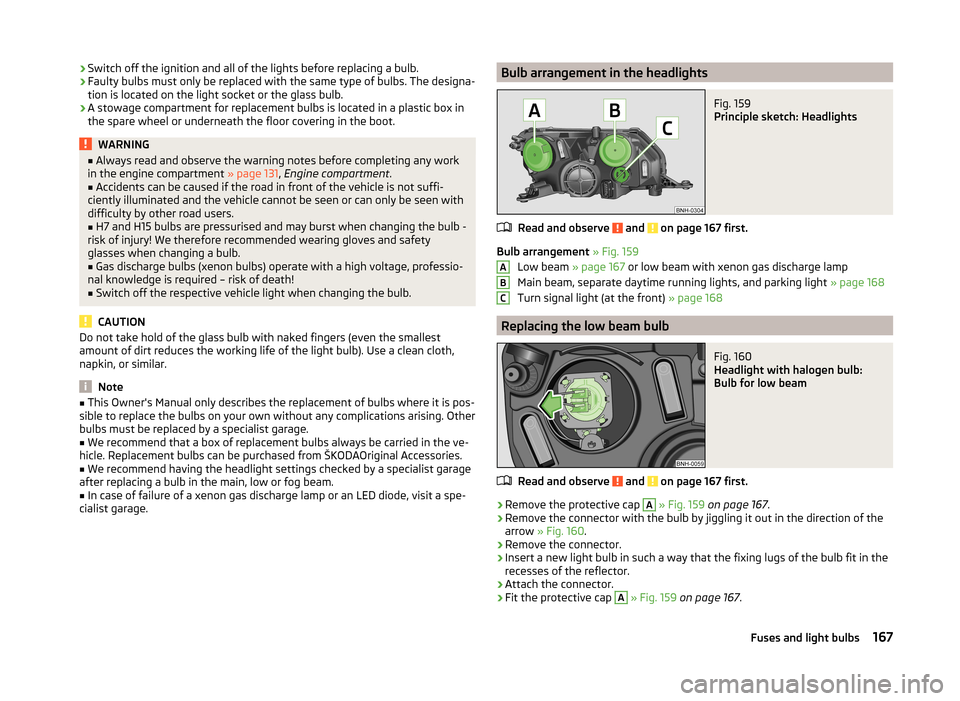
Bulb arrangement in the headlightsFig. 159
Principle sketch: Headlights
Read and observe and on page 167 first.
Bulb arrangement » Fig. 159
Low beam » page 167 or low beam with xenon gas discharge lamp
Main beam, separate daytime running lights, and parking light » page 168
Turn signal light (at the front) » page 168
Replacing the low beam bulb
Fig. 160
Headlight with halogen bulb:
Bulb for low beam
Read and observe and on page 167 first.
›
Remove the protective cap
A
» Fig. 159 on page 167 .
›
Remove the connector with the bulb by jiggling it out in the direction of the
arrow » Fig. 160 .
›
Remove the connector.
›
Insert a new light bulb in such a way that the fixing lugs of the bulb fit in the
recesses of the reflector.
›
Attach the connector.
›
Fit the protective cap
A
» Fig. 159 on page 167 .
ABC167Fuses and light bulbs
Page 182 of 193
Index
A
abroad lead-free petrol
130
Abroad Headlights
58
ABS Function
106
Warning light33
Acceptance and recycling of used vehicles121
Accessories119
Adjusting Belt height
13
Exterior mirror63
head restraints65
Interior mirror62
Seat64
Steering wheel8
Adjusting the seats7
Adjustment Beam range
53
Air-conditioning system Air outlet vents
85
Airbag14
Deactivating18
Deactivating the front passenger airbag18
Deployment14
Front airbag15
Head airbag17
Indicator light35
Modifications and damage to the airbag system 121
Side airbag
16
Airbag system14
Air conditioning84
Air distribution control85
Climatronic87
manual air conditioning86
Air distribution control85
Air outlet vents85
Alarm Switching off
49
Triggering49
Alcantara cleaning
128
Anti-lock Braking System106
Anti-theft alarm system Activating/deactivating
50
Trailer117
Armrest Front
67
Rear67
artificial leather128
Ashtray71
ASR Warning light
33
Assist system ABS
106
Assist systems106
ABS33
ASR33
Cruise Control System108
EDL107
ESC32, 106
HBA107
HHC107
Parking aid107
START-STOP109
TCS106
Auto Check Control29
Automatic driving lamp control55
Automatic gearbox101
Manual shifting of gears103
Selector lever-emergency unlocking162
Selector lever lock102
Starting-off and driving103
Tiptronic103
Using the selector lever102
Automatic gearbox modes102
Automatic load deactivation141
automatic transmission selector lever lock defect
103
Automatic transmission Kickdown
103
Selector lever lock103
AUX96
B
Ball head Check fitting
114
Fitting113
Ready position113
Removing115
Battery In the remote control key
161
Belts10
Belt tensioners13
Bonnet Closing
132
Opening132
Boot Class N1 vehicles
79
Double-sided floor covering79
Hooks77
See Boot lid51
Storage compartments in the boot78
Boot cover Parking position
78
Boot lid automatic locking
51
Closing51
Opening51
Brake Warning light
31
Brake booster99
brake fluid specification
138
180Index
Page 184 of 193

COMING HOME57
compartments68
Computer See multifunction display
39
convenience turn signal55
Coolant136
Checking137
Information messages32
Replenishing137
Temperature gauge27
Warning light32
Cooling system cost-effective use
88
malfunctions88
CORNER See Fog lights with CORNER function
56
Correct seated position7
Driver7
Front passenger8
Instructions9
Rear seats9
Counter for distance driven28
cruise control operation
108
operation description109
Cruise control system Warning light
36
Cruise Control System108
Cup holders70
D
DAY LIGHT See Daytime running lights
54
Daytime running lights54
Dazzle see sun screen of the panoramic roof
60
De-icing windows
125
Deactivating an airbag18
Decorative films124
Defrosting rear window59
Delayed locking of the boot lid see boot lid
51
Departure angle175
Diesel refer to Fuel
131
Diesel fuel Operation in winter
131
Diesel particle filter Information notices
34
Warning light34
Digital Clock Time
29
Dipstick135
Disconnecting and reconnecting vehicle battery
141
Display27
Compass points43
Coolant temperature27
Fuel supply28
Gear changes38
Service intervals43
Display a low temperature38
Display of the second speed29
Disposal Acceptance and recycling of used vehicles
121
Distance driven28
Door Child safety lock
48
Closing49
Emergency locking161
Opening49
Warning light for open door31
Door open Warning light
31
Double-sided floor covering79
Driving Driving through water105
Emissions173
Fuel consumption173
Maximum speed176
off made-up roads105
Driving economically Tips
104
Driving in Brake linings
104
the engine104
Tyres104
Driving off made-up roads105
Driving through water105
Driving with a trailer116
E
Economical driving and environmental friendli- ness
104
EDL107
Electrical power windows Button in the driver's door
51
Button in the rear door52
Buttons in the driver's door52
Electronic Differential Lock (EDL)107
Electronic immobilizer97
Electronic Stability Control (ESC)106
Emergency Changing a wheel
151
Hazard warning light system57
jump-starting158
Jump-starting157
Locking the door without a locking cylinder161
Selector lever-unlocking162
Towing the vehicle158
Towing the vehicle using the tow hitch160
Tyre repair155
Unlocking the tailgate162
emergency equipment reflective vest
149
182Index
Page 185 of 193
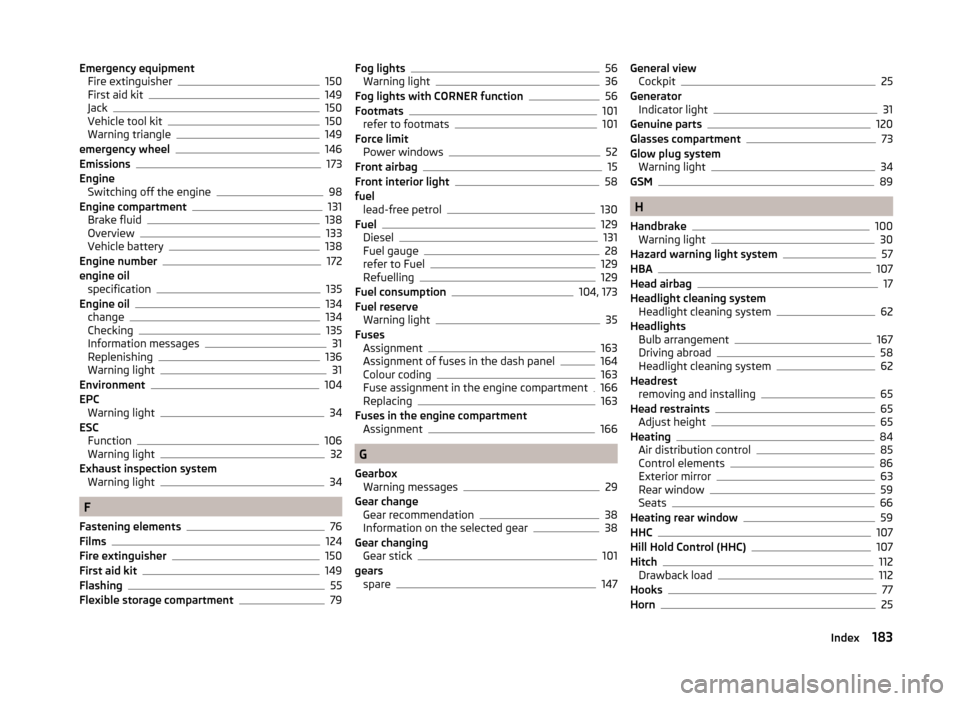
Emergency equipmentFire extinguisher150
First aid kit149
Jack150
Vehicle tool kit150
Warning triangle149
emergency wheel146
Emissions173
Engine Switching off the engine
98
Engine compartment131
Brake fluid138
Overview133
Vehicle battery138
Engine number172
engine oil specification
135
Engine oil134
change134
Checking135
Information messages31
Replenishing136
Warning light31
Environment104
EPC Warning light
34
ESC Function
106
Warning light32
Exhaust inspection system Warning light
34
F
Fastening elements
76
Films124
Fire extinguisher150
First aid kit149
Flashing55
Flexible storage compartment79
Fog lights56
Warning light36
Fog lights with CORNER function56
Footmats101
refer to footmats101
Force limit Power windows
52
Front airbag15
Front interior light58
fuel lead-free petrol
130
Fuel129
Diesel131
Fuel gauge28
refer to Fuel129
Refuelling129
Fuel consumption104, 173
Fuel reserve Warning light
35
Fuses Assignment
163
Assignment of fuses in the dash panel164
Colour coding163
Fuse assignment in the engine compartment166
Replacing163
Fuses in the engine compartment Assignment
166
G
Gearbox Warning messages
29
Gear change Gear recommendation
38
Information on the selected gear38
Gear changing Gear stick
101
gears spare
147
General viewCockpit25
Generator Indicator light
31
Genuine parts120
Glasses compartment73
Glow plug system Warning light
34
GSM89
H
Handbrake
100
Warning light30
Hazard warning light system57
HBA107
Head airbag17
Headlight cleaning system Headlight cleaning system
62
Headlights Bulb arrangement
167
Driving abroad58
Headlight cleaning system62
Headrest removing and installing
65
Head restraints65
Adjust height65
Heating84
Air distribution control85
Control elements86
Exterior mirror63
Rear window59
Seats66
Heating rear window59
HHC107
Hill Hold Control (HHC)107
Hitch112
Drawback load112
Hooks77
Horn25
183Index
Page 186 of 193

Hydraulic Brake Assist (HBA)107
I
Ice scrapers
125
Ignition see ignition lock
98
Ignition lock98
Immobilizer97
Indicator lights30
Individual settings Locking
47
Unlocking47
Inertia reels13
Information system37
Compass point display43
Display a low temperature38
Door warning39
Gear recommendation38
MAXI DOT display42
Multifunction display39
Operation37
Service interval display43
instrument cluster Auto Check Control
29
Instrument cluster26
Counter for distance driven28
Display27
Display of the second speed29
Fuel gauge28
Indicator lights30
Overview26
Revolution counter27
see instrument cluster26
Speedometer27
Temperature gauge27
Interior care126
Natural leather127
Interior monitor50
ISOFIX22
J
Jack
150
Jump-starting157, 158
K
Key Locking
47
Start the engine98
Unlocking47
L
Lamp failure Indicator light
33
Lamps Warning lights
33
Leather Natural leather care
127
LEAVING HOME57
Lever Main beam
55
Turn signal55
Windscreen wipers61
lever lock selection (automatic gearbox) indicator light
36
Light COMING HOME / LEAVING HOME
57
Daytime running lights54
Fog lights with CORNER function56
Parking light58
Replacing bulbs166
Lighting Luggage compartment
75
Lights53
Automatic driving lamp control55
Beam range adjustment53
Cockpit58
Fog lights56
Hazard warning light system57
Headlight flasher55
Indicator lights30
Low beam53
Main beam55
Parking light53
Rear fog light56
switching on/off53
Turn signal55
Lock/unlock steering lock97
Locking Individual settings
47
Key47
Remote control46
Locking and unlocking the vehicle from the in- side
48
Locking the door without a locking cylinder Emergency
161
Low beam53
Luggage compartment75
Cover77
Emergency unlocking162
Fastening elements76
Fixing nets76
Flexible storage compartment79
Lighting75
Unlocking the tailgate162
Variable loading floor80
Luggage compartment cover77
Luggage compartment lid50
Luggage Storage Storage net bag
79
M
Main beam
55
Warning light36
Maintenance see vehicle care
123
Manual air conditioning Air distribution control
85
Operating elements86
184Index
Page 187 of 193

Manual gear changingrefer to gear changing101
MAXI DOT See MAXI DOT display
42
MAXI DOT display42
Main menu42
Operation37
Settings42
Maximum permissible weights
172
Maximum speed176
MDI96
MFD See multifunction display
39
Mirror Exterior mirror
63
Make-up60
Mobile phone89
Connecting to the hands-free system91
Modifications119
Modifications and technical alterations Airbags
121
Service120
Spoiler121
Multifunction display Functions
39
Information40
Memory39
Operation37
Multimedia94
Multimedia holder72
N
N1
79
Nameplate172
Nets76
O
Oil Information messages
31
See Engine oil135
Oil pressure Information messages
31
On-board computer See multifunction display
39
Operating weight172
Operation in winter Diesel fuel
131
Vehicle battery140
Original accessories120
Outside temperature40
Overview Engine compartment
133
Indicator lights30
P
Parking
100
Parking aid107
Parking aid107
Function108
Parking light53
Parking space100
Park the vehicle Parking
100
Passive safety Before setting off
6
Driving safety6
Safety equipment6
Passive Safety6
Payload172
Pedals101
Footmats101
Petrol see fuel
130
Plastic parts124
Pockets on the front seat rests74
Polishing vehicle paint work see vehicle care
123
Power outlet 12 V
71
Power steering Warning light
32
Practical equipment Net pockets on the front seat rests
74
Reflective vest149
Practical features 12-Volt power outlet
71
Storage pockets on the front seats74
Waste container72
R
Radiator fan
133
Raise vehicle153
Rear fog light56
Warning light33
Rear interior light59
Rear mirror62
Exterior mirror63
Interior mirror62
Refuelling129
Fuel129
Remote control Locking
46
Replacing the battery161
Synchronisation process161
Unlocking46
Remote control key Replacing the battery
161
Repairs and technical alterations119
Replacement parts119
Replacing Bulb for main beam, daytime running lights andparking light
168
Bulb for the fog light168
185Index