check engine SKODA ROOMSTER 2006 1.G User Guide
[x] Cancel search | Manufacturer: SKODA, Model Year: 2006, Model line: ROOMSTER, Model: SKODA ROOMSTER 2006 1.GPages: 274, PDF Size: 48.64 MB
Page 113 of 274
Starting-off and Driving
112
For the sake of the environment
Never warm up the engine when the vehicle is standing. Drive off right
away. When driving the engine reaches its operating temperature more
rapidly and the pollutant emissions are lower.
Petrol engines
These engines are fitted with a starter system which selects the correct
fuel/air mixture for every external air temperature.
•Do not operate accelerator before and when starting engine.
•Interrupt the attempt at starting after 10 seconds if the engine does not
start right awayand wait for about 30 seconds before repeating the
attempt.
•It is possible that the fuse on the electrical fuel pump is defect if the
engine still does not start. Check the fuse and replace it if necessary
⇒ page 249.
•If the engine does not start, contact the nearest specialist garage to
obtain professional assistance.
It may be necessary, if the engine is very hot, to slightly depress the
accelerator after the engine has started.
Diesel engines
Glow plug system
Diesel engines are equipped with a glow plug system, the preglow period
being controlled automatically in line with the coolant temperature and
outside temperature. The preglow indicator light
comes on after the ignition has been
switched on.
You should not switch on any major electrical components during
the heating period otherwise the vehicle battery will be drained
unnecessarily.
•You should start the engine immediately after the glow plug warning
light has gone out.
•The glow plug warning light will come on for about one second if the
engine is at a normal operating temperature or if the outside temperature
is above +5°C. This means that you can start the engine right away.
•Interrupt the attempt at starting after 10 seconds if the engine does not
start right awayand wait for about 30 seconds before repeating the
attempt.
•It is possible that the fuse on the diesel preglow system is defect if the
engine still does not start. Check the fuse and replace it if necessary
⇒ page 249.
•Contact the nearest specialist garage to obtain professional assist-
ance.
Starting the engine after fuel tank has run dry
It may take longer than normal to start the engine after refuelling if the fuel
tank has run completely dry - up to one minute. This is because the fuel
system must first of all be filled while the attempting to start the engine.
Switching off the engine
– The engine can be switched off by turning the ignition key from position ⇒page 110, fig. 100 into position .
A1
NKO 20 A05.book Page 112 Wednesday, June 21, 2006 1:42 PM
Page 190 of 274
Driving and the Environment189
Using the systemSafetyDriving TipsGeneral MaintenanceBreakdown assistanceTechnical Data
You should avoid fully exploiting the top speed of your vehicle wherever
possible. Fuel consumption, pollutant emissions and vehicle noises
increase disproportionally at high speeds.
The
⇒page 188, fig. 149 shows the ratio of fuel consumption to the
speed of your vehicle. You will cut your fuel consumption by half if you only
make use three-quarters of the possible top speed of your vehicle.
Reducing idling
Idling also costs fuel.
It is worthwhile switching off the engine in a traffic jam or when waiting at
a level crossing or at traffic lights with a lengthy red phase. Even after just
30 - 40 seconds you will have saved more fuel than that is needed when
you start the engine up again.
If an engine is only idling it takes much longer for it to reach its normal
operating temperature. Wear-and-tear and pollutant emissions, though,
are particularly high in the warming-up phase. This is why you should
drive off right after starting the engine. Do avoid high engine revolutions at
this time, however.
Regular servicing
A poorly tuned engine consumes an unnecessarily high
amount of fuel.
Having your vehicle serviced regularly at a specialist garge enables you
to satisfy one of the requirements for economical motoring even before
you set off on your journey. Keeping your vehicle properly serviced not
only has a positive effect on the safety of your vehicle and maintaining its
value, but also saves on fuel. A poorly tuned engine can result in a fuel consumption which is 10%
higher than normal.
The foreseen maintenance work should be undertaken exactly according
to the Service schedule by a specialist garage.
Also check the
oil level after refueling. Oil consumption is dependent to
a considerable extent on the load and speed of the engine. Oil consump-
tion could be as high as 0.5 litres/1 000 km depending on your style of
driving.
It is quite normal that a new engine has a higher oil consumption at first,
and reaches its lowest level only after a certain running in time. It is there-
fore not possible to correctly assess the oil consumption of a new vehicle
until after you have driven about 5 000 km.
For the sake of the environment
•You can achieve additional improvements in your fuel economy by
using high-lubricity oils.
•Check the ground below your car at regular intervals to detect any
leakages in good time. Please have your vehicle inspected by a specialist
garge if you find any stains caused by oil or other fluids on the floor.
NKO 20 A05.book Page 189 Wednesday, June 21, 2006 1:42 PM
Page 191 of 274
Driving and the Environment
190
Avoid driving short distances
Short distances result in an above-average high fuel
consumption.
– Avoid driving a distance of no more than 4 km if the engine is
cold.
The engine and catalytic converter must first have reached their optimal
operating temperature in order to effectively reduce fuel consumption
and pollutant emissions.
The cold engine vehicle consumes approx. 15 - 20 litres/100 km of fuel
immediately after starting. Fuel consumption drops to 10 litres/100 km
after just 1 kilometre. The engine reaches its operating temperature
(outside temperature and engine dependent) only after about 4 to 10 kilo-
metres and the fuel consumption then stabilizes. You should therefore
avoid driving short distances whenever possible. An important factor in this connection is also the
ambient temperature.
The ⇒fig. 150 shows the different fuel consumptions for the same
distance, on the one hand at +20°C and on the other hand at -10°C. Your
vehicle has a higher fuel consumption in winter than in summer.
Checking tyre inflation pressures
Tyres which are correctly inflated save fuel.
Always ensure that your tyres are inflated to the correct pressure at all
times. The rolling resistance will be increased if the tyre filling pressure is
too low. This will not only increase fuel consumption but also tyre wear and
the driving behaviour will worsen.
Always check the inflation pressure of the tyres when cold.
Do not drive with winter tyres all year round for this costs about 10 %
more fuel. Winter tyres are also louder.
No unnecessary ballast
Transporting ballast costs fuel.
The fact that every kilogram of extra weight increases your fuel consump-
tion means that it is worth taking a look in the luggage compartment to
avoid transporting any unnecessary ballast.
It is particularly in town traffic, when one is accelerating quite often, that
the vehicle weight will have a significant effect upon the fuel consumption.
A rule of thumb here is that an increase in weight of 100 kilograms will
cause an increase in fuel consumption of about 1 litre/100 kilometres.
You may frequently also leave a roof rack fitted on just out of conven-
ience, although you no longer need it. The increased aerodynamic drag of
Fig. 150 Fuel
consumption in
litres/100 km at
different temperatures
NKO 20 A05.book Page 190 Wednesday, June 21, 2006 1:42 PM
Page 192 of 274
Driving and the Environment191
Using the systemSafetyDriving TipsGeneral MaintenanceBreakdown assistanceTechnical Data
your vehicle causes it to use about 1 l more fuel than normal at a speed
of 100 - 120 km/h, even when you are not carrying a load on the roof.
Saving electricity
Generating electricity costs fuel.
– Switch off electrical components as soon as you no longer
need them.
When the engine is running, the alternator generates and supplies elec-
trical power. The greater the load on the alternator as a result of having a
large number of electrical components switched on, the more fuel will be
consumed for operating the alternator.
Keeping a log of your fuel consumption
If you really wish to keep a close check on your fuel consumption, it is
best to enter the figures in a logbook. This does not take much time but is
a very worthwhile exercise. It enables you to detect any change (positive
and negative) at an early stage and to take any appropriate action.
If you find that your fuel consumption is too high, you should reflect on
how, where and in what conditions you have driven the vehicle since you
last refuelled.
Environmental compatibility
Environmental protection has played a major role in the design, selection
of materials and manufacture of your new Škoda. Particular emphasis has
been paid to a number of aspects, including:
Design measures
•joints designed to be easily detached
•simplified disassembly due to the modular structure system
•improved purity of different classes of materials
•identification of all plastic parts in accordance with VDA Recommen-
dation 260
•reduced fuel consumption and exhaust emission CO2
•minimum fuel leakage during accidents
•reduced noise
Choice of materials
•extensive use of recyclable material
•air conditioning filled with CFC-free refrigerant
•no cadmium
•no asbestos
•reduction in the “vaporisation” of plastics
Manufacture
•solvent-free cavity protection
•solvent-free protection of the vehicle for transportation from the
production plant to the customer
•the use of solvent-free adhesives
•no CFCs used in the production process
•without use of mercury
•use of water-soluble paints
NKO 20 A05.book Page 191 Wednesday, June 21, 2006 1:42 PM
Page 196 of 274
Towing a trailer195
Using the systemSafetyDriving TipsGeneral MaintenanceBreakdown assistanceTechnical Data
You must always reduce your speed immediately as soon as you detect
even just the
slightest swaying of the trailer. On no account attempt to
stop the trailer from “swaying” by accelerating.
Apply the brakes in good time! If the trailer is fitted with a trailer brake,
apply the brakes gently at first and then brake firmly. This will avoid brake
jolts resulting from the trailer wheels locking. Shift down gears in good
time before negotiating a downhill section to allow the engine to also act
as a brake.
Engine overheating
Please keep a check on the coolant temperature gauge if you have to
negotiate a lengthy slope in a low gear at a high engine speed when the
outside temperature is very high ⇒page 14.
If the needle of the coolant temperature gauge moves into the right-hand
area or even the red area of the scale, reduce your speed immediately.
Stop and switch off the engine if the warning light
in the instrument
cluster begins flashing. Wait a few minutes and check the level of coolant
in the coolant expansion bottle ⇒page 216, “Inspecting the coolant level”.
Please refer to the following guidelines ⇒page 31, “Coolant tempera-
ture/coolant level ”.
The coolant temperature can be reduced by switching on the heating.
Any increase in the cooling effect of the coolant fan through shifting down
a gear and increasing the engine speed is not possible since the fan
speed is independent of the engine speed. One should also not drop a
gear for this reason when towing a trailer as long as the engine can
manage the slope without any drop in speed.
NKO 20 A05.book Page 195 Wednesday, June 21, 2006 1:42 PM
Page 211 of 274
Inspecting and Replenishing
210
Opening the bonnet
– Unlock the bonnet ⇒page 209, fig. 153 .
– Ensure that the arms of the windscreen wipers are correctly in place against the windscreen before opening the bonnet
otherwise damage could occur to the paintwork.
– Press the locking button ⇒page 209, fig. 154 , the bonnet
unlocks itself.
– Grip the bonnet and lift it up.
– Take the bonnet support out of its holder and set it in the opening designed for it ⇒page 209, fig. 155 .
Closing the bonnet
– Lift the bonnet slightly and unhook the bonnet support. Press the bonnet support into the holder designed to hold it.
– Allow the bonnet to drop from a height of about 30 cm into the lock - bonnet do not press down on it!
WARNING
•Never open the bonnet if you see that steam or coolant is
flowing out of the engine compartm ent - risk of scalding! Wait long
enough until the steam or coolant has stopped escaping.
•For safety reasons, the bonnet must always be properly closed
when driving. One should therefore check that the lock has in fact
engaged properly after closing the bonnet.
•Stop your vehicle immediately wh ile driving if you notice that
the lock is not properly engaged and close the bonnet properly -
risk of an accident!
Caution
•Before opening the bonnet, ensure that the arms of the windscreen
wipers are correctly in place against the windscreen. Otherwise, there is
a risk of damage to the paintwork.
Working in the engine compartment
Particular care is required when carrying out any work in
the engine compartment!
There is a risk of injuries, scalding, accidents and fire when working
in the engine compartment, e.g. inspecting and replenishing oil and
other fluids. For this reason, it is essential to comply with the
warning instructions stated below and with the general applicable
rules of safety. The engine compartment of your car is a hazardous
area ⇒ .
WARNING
•Never open the bonnet if you see that steam or coolant is
flowing out of the engine compartment - risk of scalding! Wait long
enough until the steam or coolant has stopped escaping.
•Switch off the engine and pull out the ignition key.
•Apply the handbrake firmly.
•If your vehicle is fitted with a manual gearbox, move the gear-
shift lever into Neutral, or if it is fitted with automatic gearbox, move
the selector lever into position P.
•Allow the engine to cool down.
•Keep children clear of the engine compartment.
•Do not touch any hot engine parts - risk of burns!
NKO 20 A05.book Page 210 Wednesday, June 21, 2006 1:42 PM
Page 214 of 274
Inspecting and Replenishing213
Using the systemSafetyDriving TipsGeneral MaintenanceBreakdown assistanceTechnical Data
Engine oil specifications for models with flexible service intervals
(QG1)
Caution
Only the above-mentioned oils may be used on vehicles with flexible
service intervals (QG1). We recommend always refilling with oil of the
same specification since this will maintain the properties of the oil. In
exceptional cases, you must top up only once engine oil complying with
Specification VW 502 00 (only for petrol engines) or Specification VW 505
01 (only for diesel engines) to maximum 0.5 litres. You must not use other
engine oils - risk of engine damage!
Note
•Before a long drive we recommend that you purchase and carry with
you engine oil which complies with the specification for your vehicle.
Consequently, you will always have the correct engine oil for refilling.
•We recommend using a preservative from the Škoda original accesso-
ries offered by your Škoda dealer.
•For further information - see Service shedule.
Check engine oil level
The dipstick indicates the level of oil in the engine.
Checking the oil level
– Park the vehicle on a horizontal surface.
– Switch the engine off.
– Open the bonnet ⇒ in “Working in the engine compart-
ment” on page 210.
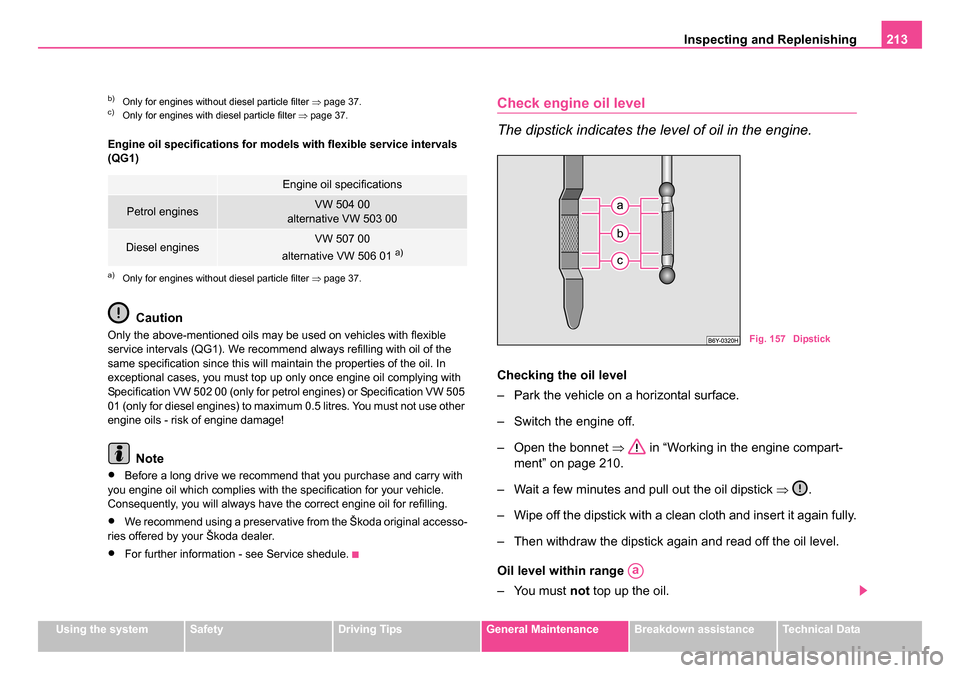
– Wait a few minutes and pull out the oil dipstick ⇒.
– Wipe off the dipstick with a clean cloth and insert it again fully.
– Then withdraw the dipstick again and read off the oil level.
Oil level within range
– You must not top up the oil.
b)Only for engines without diesel particle filter ⇒page 37.c)Only for engines with diesel particle filter ⇒page 37.
Engine oil specifications
Petrol enginesVW 504 00
alternative VW 503 00
Diesel enginesVW 507 00
alternative VW 506 01 a)
a)Only for engines without diesel particle filter ⇒page 37.
Fig. 157 Dipstick
Aa
NKO 20 A05.book Page 213 Wednesday, June 21, 2006 1:42 PM
Page 215 of 274
Inspecting and Replenishing
214
Oil level within range
– You may top up the oil. It is possible that the oil level may then
be within range after doing this.
Oil level within range
– You must top up the oil. It is sufficient, once this is done, to
keep the oil level is within range .
It is normal for the engine to consume oil. The oil consumption may be as
much as 0.5 l/1 000 km depending on your style of driving and the condi-
tions under which you operate your vehicle. The oil consumption may be
slightly higher than this during the first 5 000 kilometres.
One should therefore check the oil level at regular intervals, preferably
every time after the fuel tank is filled or after driving for long stretches.
We recommend maintaining the oil level within the range if the engine
has been operating at high loads, for example during a lengthy motorway
trip during the summer months, towing a trailer or negotiating a high
mountain pass, but not above this .
The warning light in the instrument cluster* will indicate ⇒page 32
whether the oil level is too low. In this case, check the oil level as soon as
possible. Top up with an appropriate quantity of oil.
WARNING
Read and observe the warning notes ⇒page 210, “Working in the
engine compartment” before working in the engine compartment.
Caution
•Always check the oil level on vehicles with engine 1.2 l/47 kW when
the engine is warm. Otherwise the measuring result is incorrect und oil
could be incorrectly replenished - risk of engine damage!
•The oil level must on no account extend beyond the range . Danger
of damaging the catalytic converter.
•Do not continue your journey if for some reason it is not possible
under the conditions prevailing to top up with oil. Switch the engine off
and obtain professional assistance from a specialist garage, otherwise it
could lead to severe engine damage.
Replenishing engine oil
– Inspect the oil level ⇒page 213.
– Unscrew the cap of the engine oil filler opening.
– Pour in a suitable grade of oil in portions of 0.5 litres ⇒page 212, “Engine oil specifications”.
– Inspect the oil level ⇒page 213.
– Carefully screw on the cap of the filler opening and push the dipstick in fully.
WARNING
•Avoid dripping oil onto hot parts of the engine when topping up
will oil - a risk of fire!
•Read and observe the warning notes ⇒page 210, “Working in
the engine compartment” before working in the engine compart-
ment.
Ab
Aa
Ac
Ab
Ab
Aa
NKO 20 A05.book Page 214 Wednesday, June 21, 2006 1:42 PM
Page 217 of 274
Inspecting and Replenishing
216
You can increase the amount of antifreeze in the coolant if a higher
concentration of antifreeze is necessary for climatic reasons but only up
to 60% (antifreeze protection down to approx. -40°C). The antifreeze
protection tails off above that concentration.
Vehicles exported to countries with a cold climate (e.g. Sweden, Norway,
Finland) are already factory-filled with a coolant which offers antifreeze
protection down to about -35°C. In these countries the concentration of
coolant additive should be at least 50 %.
Coolant
The cooling system is filled at the works with coolant (purple in colour),
which complies with the specification TL-VW 774 F.
We recommend that you use the antifreeze agent - G12 PLUS (purple in
colour).
We recommend that you contact your Škoda Service Partner if you have
any questions regarding the coolant or if you wish to fill up with a different
coolant.
Your Škoda Service Partner can also supply you with the correct coolant
additives.
Caution
•Other coolant additives may cause operational problems which,
in particular, involves significantly reducing the anticorrosion effect.
•Any faults or problems resulting from corrosion may cause a loss
of coolant and, as a consequence of this, result in major engine
damage.
Inspecting the coolant level
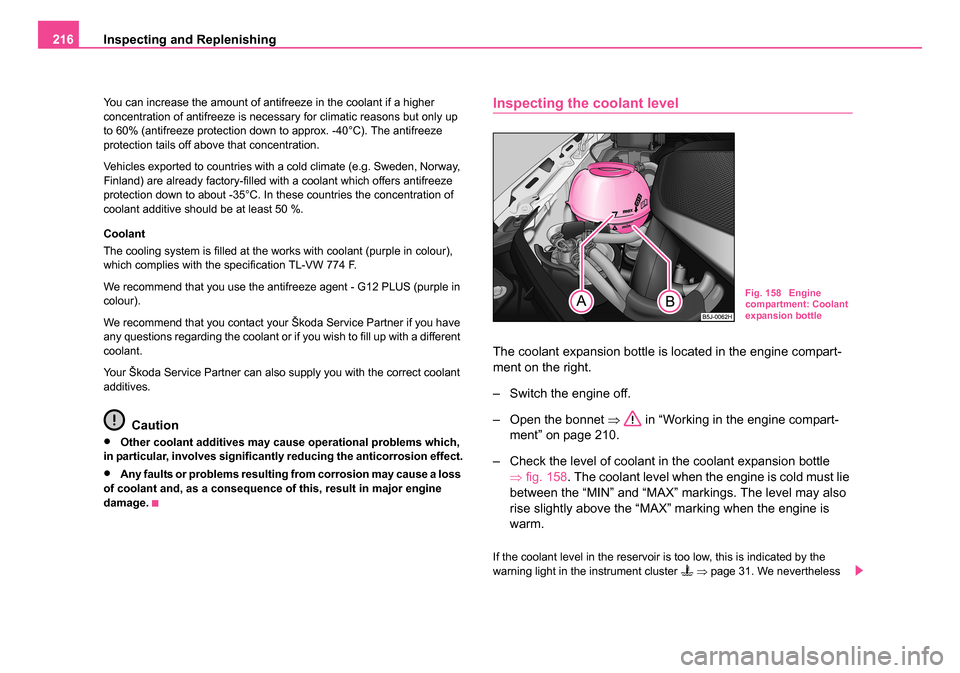
The coolant expansion bottle is located in the engine compart-
ment on the right.
– Switch the engine off.
– Open the bonnet ⇒ in “Working in the engine compart-
ment” on page 210.
– Check the level of coolant in the coolant expansion bottle ⇒fig. 158 . The coolant level when the engine is cold must lie
between the “MIN” and “MAX” markings. The level may also
rise slightly above the “MAX” marking when the engine is
warm.
If the coolant level in the reservoir is too low, this is indicated by the
warning light in the instrument cluster ⇒ page 31. We nevertheless
Fig. 158 Engine
compartment: Coolant
expansion bottle
NKO 20 A05.book Page 216 Wednesday, June 21, 2006 1:42 PM
Page 223 of 274
Inspecting and Replenishing
222
Air bubbles can influence the colour of the “magic eye”. For this reason
carefully knock on the “magic eye” before carrying out the check.
•Green colour - the battery is adequately charged.
•Dark colour - the battery has to be charged
•Colourless or yellow colour - we recommend you have the battery
checked by a Škoda Service Partner.
Batteries, which are more than 5 years old, must be replaced. We recom-
mend you have the electrolyte level inspected and adjusted to the correct
level or the battery replaced if necessary by a Škoda Service Partner.
Caution
If the vehicle has not been driven for more than 3 to 4 weeks, the battery
will discharge because certain electrical components consume electricity
(e.g. control units) also in idle state. You can prevent the discharging of
the battery by disconnecting the negative terminal or charging the battery
constantly with a very low charging current. Please also refer to the notes
when working on the battery ⇒page 220, “Working on the battery”.
Inspecting the electrolyte level
The battery is practically maintenance-free under normal operating
conditions. We do, however, recommend that you have the electrolyte
level inspected from time to time by a Škoda Service Partner when outside
temperatures are high or when driving on long trips. You should also
check the electrolyte level ⇒page 222 each time the battery is charged.
The battery acid level will also be checked as part of the Inspection
Service.
Operation in winter
The battery has to provide greater amounts of electricity during the winter.
It also has only part of the initial power output at low temperatures that it
has at normal temperatures.
A discharged battery may already freeze at temperatures just below
0°C.
We therefore recommend that you have the battery checked by a Škoda
Service Partner before the start of the winter, and recharged if
necessary.
Charging the battery
A properly charged battery is essential for reliably starting
the engine.
– Read the warning notes ⇒ in “Working on the battery” on
page 220 and ⇒.
– Switch the ignition and all electrical components off.
– Only for “quick-charging”: Disconnect both battery cables (first of all “negative”, then “positive”).
– Carefully attach the terminal clamps of the charger to the battery terminals (red = “positive”, black = “negative”).
– You can now plug the mains cable of the charger into the power socket and switch on the charger.
– When charging is completed: switch the charger off and unplug the mains cable from the power socket.
NKO 20 A05.book Page 222 Wednesday, June 21, 2006 1:42 PM