oil level SKODA ROOMSTER 2006 1.G Owner's Manual
[x] Cancel search | Manufacturer: SKODA, Model Year: 2006, Model line: ROOMSTER, Model: SKODA ROOMSTER 2006 1.GPages: 274, PDF Size: 48.64 MB
Page 26 of 274
Instruments and Indicator/Warning Lights25
Using the systemSafetyDriving TipsGeneral MaintenanceBreakdown assistanceTechnical Data
The red symbols indicate
danger (priority 1) while the yellow symbols indi-
cate a warning (priortity 2). Information for the driver may also appear in
addition to the symbols ⇒page 27.
Investigate the displayed faults as soon as possible. If several operational
faults exist at the same time, the symbols will appear one after the other
and light up each for about 10 seconds.
The error messages are displayed and stored in the menu VEH. STATUS.
There is at least one error message to be read when the term VEH.
STATUS is flashing in the main menu. The display will show STATUS 1/2
(for example) if a number of error messages are displayed. This display
indicates that the first of a total of two error messages should be
displayed.
Actuate the rocker switch , to call up the individual error messages.
If a fault occurs, a warning signal will also sound in addition to the symbol
and text in the display:
•Priority 1 - three warning signals,
•Priority 2 - one warning signal.
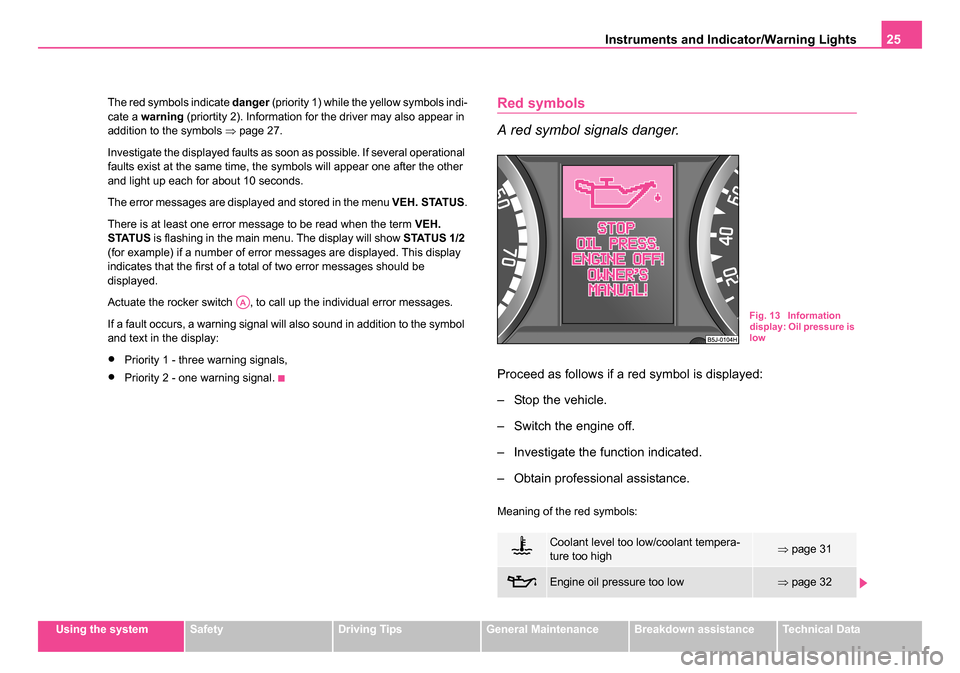
Red symbols
A red symbol signals danger.
Proceed as follows if a red symbol is displayed:
– Stop the vehicle.
– Switch the engine off.
– Investigate the function indicated.
– Obtain professional assistance.
Meaning of the red symbols:
AA
Coolant level too low/coolant tempera-
ture too high⇒ page 31
Engine oil pressure too low⇒page 32
Fig. 13 Information
display: Oil pressure is
low
NKO 20 A05.book Page 25 Wednesday, June 21, 2006 1:42 PM
Page 27 of 274
Instruments and Indicator/Warning Lights
26
Three successive warning signals will sound if a red symbol appears.
If several operational faults of priority 1 exist, the symbols appear one after
the other and are each illuminated for about 5 seconds.
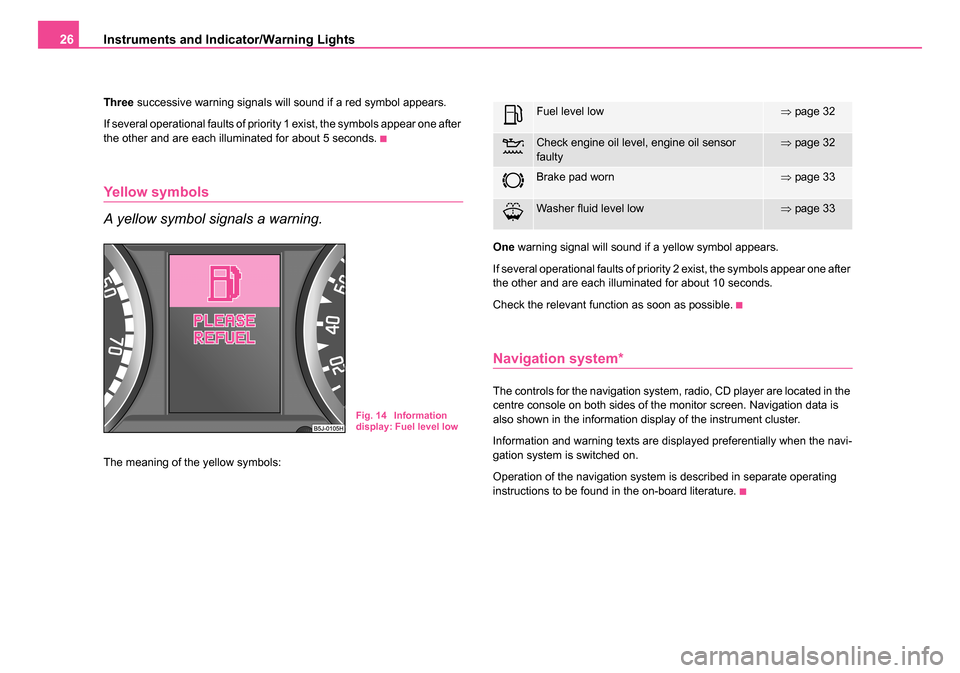
Yellow symbols
A yellow symbol signals a warning.
The meaning of the yellow symbols: One
warning signal will sound if a yellow symbol appears.
If several operational faults of priority 2 exist, the symbols appear one after
the other and are each illuminated for about 10 seconds.
Check the relevant function as soon as possible.
Navigation system*
The controls for the navigation system, radio, CD player are located in the
centre console on both sides of the monitor screen. Navigation data is
also shown in the information display of the instrument cluster.
Information and warning texts are displayed preferentially when the navi-
gation system is switched on.
Operation of the navigation system is described in separate operating
instructions to be found in the on-board literature.
Fig. 14 Information
display: Fuel level low
Fuel level low⇒ page 32
Check engine oil level, engine oil sensor
faulty⇒page 32
Brake pad worn⇒page 33
Washer fluid level low⇒page 33
NKO 20 A05.book Page 26 Wednesday, June 21, 2006 1:42 PM
Page 29 of 274
Instruments and Indicator/Warning Lights
28
WARNING
•If you do not pay attention to the warning lights coming on and
the corresponding descriptions and warning notes, this may result
in severe body injuries or major vehicle damage.
•The engine compartment of your car is a hazardous area. There
is a risk of injuries, scalding, accid ents and fire when working in the
engine compartment, e.g. inspecting and replenishing oil and other
fluids. It is also essential to observe all warnings ⇒page 210.
Note
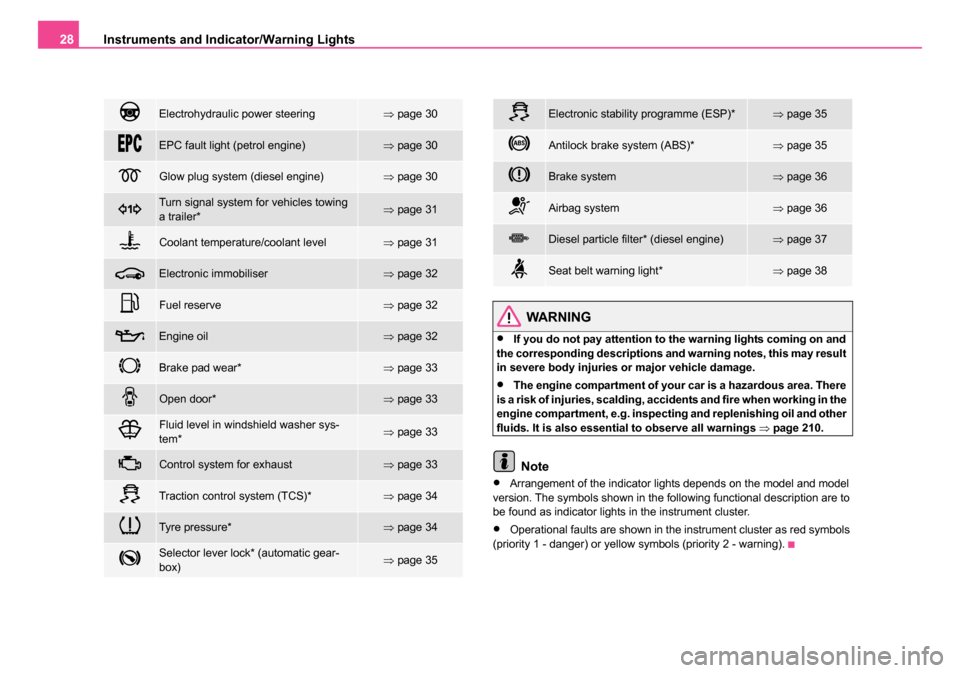
•Arrangement of the indicator lights depends on the model and model
version. The symbols shown in the following functional description are to
be found as indicator lights in the instrument cluster.
•Operational faults are shown in the instrument cluster as red symbols
(priority 1 - danger) or yellow symbols (priority 2 - warning).
Electrohydraulic power steering⇒ page 30
EPC fault light (petrol engine)⇒page 30
Glow plug system (diesel engine)⇒page 30
Turn signal system for vehicles towing
a trailer*⇒page 31
Coolant temperature/coolant level⇒page 31
Electronic immobiliser⇒page 32
Fuel reserve⇒page 32
Engine oil⇒page 32
Brake pad wear*⇒page 33
Open door*⇒page 33
Fluid level in windshield washer sys-
tem*⇒page 33
Control system for exhaust⇒page 33
Traction control system (TCS)*⇒page 34
Tyre pressure*⇒page 34
Selector lever lock* (automatic gear-
box)⇒page 35
Electronic stability programme (ESP)*⇒page 35
Antilock brake system (ABS)*⇒page 35
Brake system⇒page 36
Airbag system⇒page 36
Diesel particle filter* (diesel engine)⇒page 37
Seat belt warning light*⇒page 38
NKO 20 A05.book Page 28 Wednesday, June 21, 2006 1:42 PM
Page 33 of 274
Instruments and Indicator/Warning Lights
32
Electronic immobiliser
Data is compared between the ignition key and the control unit when
switching on the ignition. The indicator light will light up for a few
seconds when ignition key authorisation is confirmed.
The warning light will start flashing continuously if a non-authorised igni-
tion key (for example the wrong ignition key) has been used. The engine
cannot be started ⇒page 41.
It is only possible to start the engine of your car with a Genuine Škoda key
with the matching code .
Fuel reserve
The warning light comes on, if the fuel level is still about 7 litres.
A peep sounds as an additional warning signal.
The following text will be displayed in the information display*: PLEASE REFUEL
Engine oil
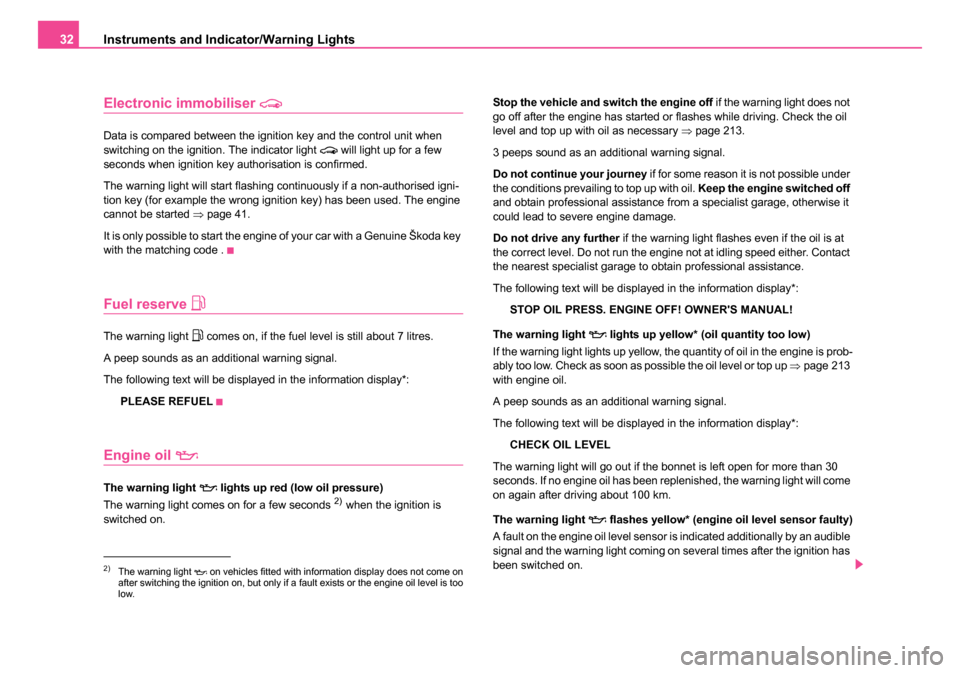
The warning light lights up red (low oil pressure)
The warning light comes on for a few seconds 2) when the ignition is
switched on. Stop the vehicle and switch the engine off
if the warning light does not
go off after the engine has started or flashes while driving. Check the oil
level and top up with oil as necessary ⇒page 213.
3 peeps sound as an additional warning signal.
Do not continue your journey if for some reason it is not possible under
the conditions prevailing to top up with oil. Keep the engine switched off
and obtain professional assistance from a specialist garage, otherwise it
could lead to severe engine damage.
Do not drive any further if the warning light flashes even if the oil is at
the correct level. Do not run the engine not at idling speed either. Contact
the nearest specialist garage to obtain professional assistance.
The following text will be displayed in the information display*:
STOP OIL PRESS. ENGINE OFF! OWNER'S MANUAL!
The warning light
lights up yellow* (oil quantity too low)
If the warning light lights up yellow, the quantity of oil in the engine is prob-
ably too low. Check as soon as possible the oil level or top up ⇒page 213
with engine oil.
A peep sounds as an additional warning signal.
The following text will be displayed in the information display*:
CHECK OIL LEVEL
The warning light will go out if the bonnet is left open for more than 30
seconds. If no engine oil has been replenished, the warning light will come
on again after driving about 100 km.
The warning light
flashes yellow* (engine oil level sensor faulty)
A fault on the engine oil level sensor is indicated additionally by an audible
signal and the warning light coming on several times after the ignition has
been switched on.
2)The warning light on vehicles fitted with information display does not come on
after switching the ignition on, but only if a fault exists or the engine oil level is too
low.
NKO 20 A05.book Page 32 Wednesday, June 21, 2006 1:42 PM
Page 34 of 274
Instruments and Indicator/Warning Lights33
Using the systemSafetyDriving TipsGeneral MaintenanceBreakdown assistanceTechnical Data
In this case have the engine inspected without delay by a specialist
garage.
The following text will be displayed in the information display*:
OIL SENSOR WORKSHOP! (OIL SENSOR WORKSHOP!)
WARNING
•If you must stop for technical reasons, then park the vehicle at
a safe distance from the traffic and switch off the engine and switch
on the hazard warning light system ⇒page 59.
•The red oil pressure light is not an oil level indicator! One
should therefore check the oil level at regular intervals, preferably
after every refueling stop.
•Pay attention to the following instructions ⇒page 210,
“Working in the engine compartmen t” before checking the coolant
fluid level and opening the bonnet.
Thickness of the brake pads*
If the warning light comes on, contact a specialist garage immediately
and have the brake pads on all of the wheels inspected.
A peep sounds as an additional warning signal.
The following text will be displayed in the information display*: CHECK BRAKE PAD
Open door*
The warning light comes on if one or several doors, the bonnet or tail-
gate is opened.
The warning light comes on even when the ignition is switched off. The
warning light goes out 5 minutes after switching off the ignition if one or
several doors, the bonnet or tailgate is opened. The warning light goes out
after closing the doors.
Windshield washer fluid level*
The warning light comes on when the ignition is switched on if there is
insufficient fluid in the windshield washer system. Top up with liquid
⇒ page 224.
A peep sounds as an additional warning signal.
The following text will be displayed in the information display*: REFILL WASHER LIQUID
Control system for exhaust
The warning light comes on after the ignition has been switched on.
If the warning light does not go out after starting the engine or it lights up
or flashes when driving, a fault exists in an exhaust relevant component.
The engine management system selects an emergency programme
which enables you to drive to the nearest specialist garage by adopting a
gentle style of driving.
NKO 20 A05.book Page 33 Wednesday, June 21, 2006 1:42 PM
Page 182 of 274
Intelligent Technology181
Using the systemSafetyDriving TipsGeneral MaintenanceBreakdown assistanceTechnical Data
Low brake fluid level
An insufficient level of brake fluid may result in problems in the brake
system. The level of the brake fluid is monitored electronically
⇒page 36,
“Brake system ”.
WARNING
•Only apply the brakes for the purpose of drying and cleaning the
brake discs if the traffic conditions permit this. Do not place any
other road users in jeopardy.
•When retrospectively mounting a front spoiler, solid wheel hubs
etc. one must ensure that the air supply to the front wheel brakes
is not reduced otherwise the braking system could run too hot.
•Allow for the fact that new brake pads do not achieve their full
braking efficiency until approximately 200 kilometres. New brake
pads must be first “run in” before they develop their optimal fric-
tion force. You can, however, compensate for this slightly reduced
braking force by increasing the pressure on the brake pedal. This
guideline also applies to any new brake pads installed at a future
date.
Caution
•Never allow the brakes to rub by applying slight pressure if you do not
wish to brake the vehicle. This causes the brakes to overheat and can also
result in a longer braking distance and excessive wear.
•Before negotiating a steep downhill section, please reduce your speed
and shift down into the next lower gear (manual gearbox) or select a lower
driving stage (automatic gearbox). This enables you to make full use of
the braking power of the vehicle and reduces the strain on the brakes. Any
additional braking should be done intermittently, not continuously.
Brake booster
The brake booster boosts the pressure which you generate with the brake
pedal. The necessary pressure is only generated when the engine is
running.
WARNING
•Never switch off the engine before the vehicle is stationary.
•The brake booster only operates when the engine is running.
Greater physical effort for braking is required when engine is
switched off. Because if you do not stop as normal, this can cause
an accident and severe injuries.
Antilock brake system (ABS)*
ABS prevents the wheels locking when braking.
General
The ABS contributes significantly to enhancing the active safety of your
vehicle. Compared to a car not fitted with the ABS brake system, you are
able to retain optimal steering ability even during a full brake application
on a slippery road surface because the wheels do not lock up.
You must not expect, however, that the braking distance will be shorter
under all circumstances as a result of the ABS. The braking distance for
example on gravel and fresh snow, when you should anyway be driving
slowly and cautiously, will be longer.
NKO 20 A05.book Page 181 Wednesday, June 21, 2006 1:42 PM
Page 190 of 274
Driving and the Environment189
Using the systemSafetyDriving TipsGeneral MaintenanceBreakdown assistanceTechnical Data
You should avoid fully exploiting the top speed of your vehicle wherever
possible. Fuel consumption, pollutant emissions and vehicle noises
increase disproportionally at high speeds.
The
⇒page 188, fig. 149 shows the ratio of fuel consumption to the
speed of your vehicle. You will cut your fuel consumption by half if you only
make use three-quarters of the possible top speed of your vehicle.
Reducing idling
Idling also costs fuel.
It is worthwhile switching off the engine in a traffic jam or when waiting at
a level crossing or at traffic lights with a lengthy red phase. Even after just
30 - 40 seconds you will have saved more fuel than that is needed when
you start the engine up again.
If an engine is only idling it takes much longer for it to reach its normal
operating temperature. Wear-and-tear and pollutant emissions, though,
are particularly high in the warming-up phase. This is why you should
drive off right after starting the engine. Do avoid high engine revolutions at
this time, however.
Regular servicing
A poorly tuned engine consumes an unnecessarily high
amount of fuel.
Having your vehicle serviced regularly at a specialist garge enables you
to satisfy one of the requirements for economical motoring even before
you set off on your journey. Keeping your vehicle properly serviced not
only has a positive effect on the safety of your vehicle and maintaining its
value, but also saves on fuel. A poorly tuned engine can result in a fuel consumption which is 10%
higher than normal.
The foreseen maintenance work should be undertaken exactly according
to the Service schedule by a specialist garage.
Also check the
oil level after refueling. Oil consumption is dependent to
a considerable extent on the load and speed of the engine. Oil consump-
tion could be as high as 0.5 litres/1 000 km depending on your style of
driving.
It is quite normal that a new engine has a higher oil consumption at first,
and reaches its lowest level only after a certain running in time. It is there-
fore not possible to correctly assess the oil consumption of a new vehicle
until after you have driven about 5 000 km.
For the sake of the environment
•You can achieve additional improvements in your fuel economy by
using high-lubricity oils.
•Check the ground below your car at regular intervals to detect any
leakages in good time. Please have your vehicle inspected by a specialist
garge if you find any stains caused by oil or other fluids on the floor.
NKO 20 A05.book Page 189 Wednesday, June 21, 2006 1:42 PM
Page 214 of 274
Inspecting and Replenishing213
Using the systemSafetyDriving TipsGeneral MaintenanceBreakdown assistanceTechnical Data
Engine oil specifications for models with flexible service intervals
(QG1)
Caution
Only the above-mentioned oils may be used on vehicles with flexible
service intervals (QG1). We recommend always refilling with oil of the
same specification since this will maintain the properties of the oil. In
exceptional cases, you must top up only once engine oil complying with
Specification VW 502 00 (only for petrol engines) or Specification VW 505
01 (only for diesel engines) to maximum 0.5 litres. You must not use other
engine oils - risk of engine damage!
Note
•Before a long drive we recommend that you purchase and carry with
you engine oil which complies with the specification for your vehicle.
Consequently, you will always have the correct engine oil for refilling.
•We recommend using a preservative from the Škoda original accesso-
ries offered by your Škoda dealer.
•For further information - see Service shedule.
Check engine oil level
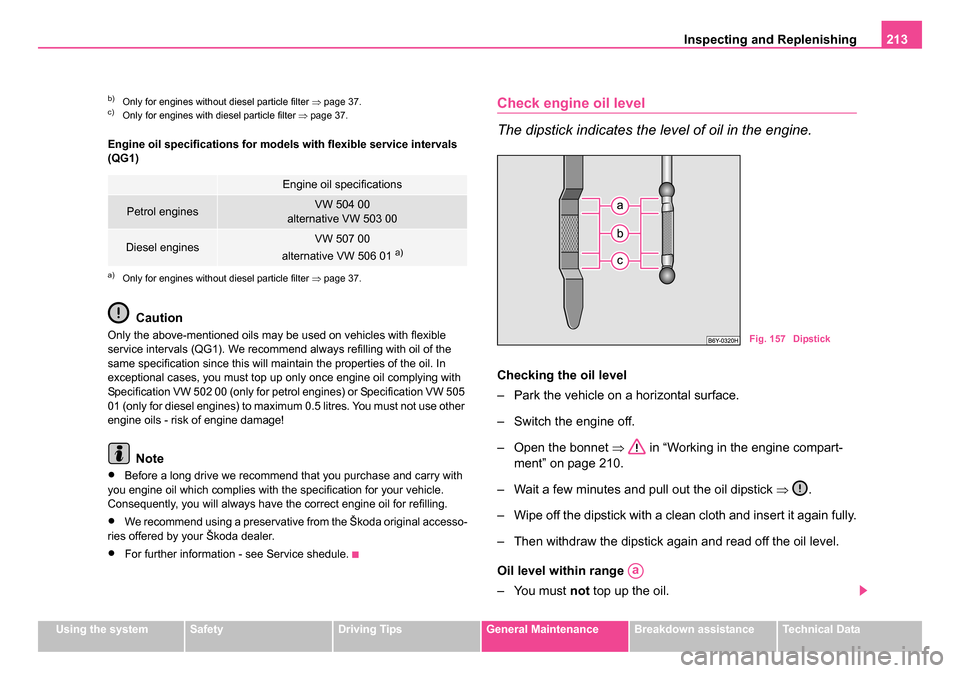
The dipstick indicates the level of oil in the engine.
Checking the oil level
– Park the vehicle on a horizontal surface.
– Switch the engine off.
– Open the bonnet ⇒ in “Working in the engine compart-
ment” on page 210.
– Wait a few minutes and pull out the oil dipstick ⇒.
– Wipe off the dipstick with a clean cloth and insert it again fully.
– Then withdraw the dipstick again and read off the oil level.
Oil level within range
– You must not top up the oil.
b)Only for engines without diesel particle filter ⇒page 37.c)Only for engines with diesel particle filter ⇒page 37.
Engine oil specifications
Petrol enginesVW 504 00
alternative VW 503 00
Diesel enginesVW 507 00
alternative VW 506 01 a)
a)Only for engines without diesel particle filter ⇒page 37.
Fig. 157 Dipstick
Aa
NKO 20 A05.book Page 213 Wednesday, June 21, 2006 1:42 PM
Page 215 of 274
Inspecting and Replenishing
214
Oil level within range
– You may top up the oil. It is possible that the oil level may then
be within range after doing this.
Oil level within range
– You must top up the oil. It is sufficient, once this is done, to
keep the oil level is within range .
It is normal for the engine to consume oil. The oil consumption may be as
much as 0.5 l/1 000 km depending on your style of driving and the condi-
tions under which you operate your vehicle. The oil consumption may be
slightly higher than this during the first 5 000 kilometres.
One should therefore check the oil level at regular intervals, preferably
every time after the fuel tank is filled or after driving for long stretches.
We recommend maintaining the oil level within the range if the engine
has been operating at high loads, for example during a lengthy motorway
trip during the summer months, towing a trailer or negotiating a high
mountain pass, but not above this .
The warning light in the instrument cluster* will indicate ⇒page 32
whether the oil level is too low. In this case, check the oil level as soon as
possible. Top up with an appropriate quantity of oil.
WARNING
Read and observe the warning notes ⇒page 210, “Working in the
engine compartment” before working in the engine compartment.
Caution
•Always check the oil level on vehicles with engine 1.2 l/47 kW when
the engine is warm. Otherwise the measuring result is incorrect und oil
could be incorrectly replenished - risk of engine damage!
•The oil level must on no account extend beyond the range . Danger
of damaging the catalytic converter.
•Do not continue your journey if for some reason it is not possible
under the conditions prevailing to top up with oil. Switch the engine off
and obtain professional assistance from a specialist garage, otherwise it
could lead to severe engine damage.
Replenishing engine oil
– Inspect the oil level ⇒page 213.
– Unscrew the cap of the engine oil filler opening.
– Pour in a suitable grade of oil in portions of 0.5 litres ⇒page 212, “Engine oil specifications”.
– Inspect the oil level ⇒page 213.
– Carefully screw on the cap of the filler opening and push the dipstick in fully.
WARNING
•Avoid dripping oil onto hot parts of the engine when topping up
will oil - a risk of fire!
•Read and observe the warning notes ⇒page 210, “Working in
the engine compartment” before working in the engine compart-
ment.
Ab
Aa
Ac
Ab
Ab
Aa
NKO 20 A05.book Page 214 Wednesday, June 21, 2006 1:42 PM
Page 216 of 274
Inspecting and Replenishing215
Using the systemSafetyDriving TipsGeneral MaintenanceBreakdown assistanceTechnical Data
For the sake of the environment
The oil level must on no account be above the range ⇒page 213. Oil
will otherwise be drawn in through the crankcase ventilation and may pass
through the exhaust system to atmosphere. The oil may combust in the
catalytic converter and damage it.
Changing engine oil
The engine oil must be changed at the intervals stated in the Service
schedule or according to the service interval indicator ⇒page 16.
WARNING
•Only carry out the engine oil change, if you have the required
professional knowledge!
•Read and observe the warning notes ⇒page 210, “Working in
the engine compartment” before working in the engine compart-
ment.
•Let the engine cool down - risk of burning from hot oil.
•Wear an eye protection - risk of caustic burns due to oil
splashes.
•Oil is toxic! Store old oil in a safe place out of the reach of chil-
dren and unauthorized persons until you dispose of it properly.
Caution
You must not pour any additives into the engine oil - risk of engine
damage! Damage, which results from such product, are excluded from the
warranty.
For the sake of the environment
•You must on no account pour oil into the ground or into the sewage
system.
•In view of the problems involved in properly disposing of old oil, the
material, equipment and the knowledge required for such work, we recom-
mend that you have the oil and oil filter change carried out by your Škoda
Service Partner.
Note
After your skin has come in contact with the oil, you must thoroughly wash
your skin.
Cooling system
Coolant
The job of the coolant is to cool the engine.
The cooling system does not require any maintenance under normal oper-
ating conditions. The coolant consists of water with a concentration of
coolant additive of 40 %. This mixture not only provides antifreeze protec-
tion down to -25°C but also protects the cooling and heating system from
corrosion. It also prevents the formation of scale and significantly
increases the boiling point of the coolant.
You must therefore not reduce the concentration of antifreeze agent in the
coolant by adding water, also not during the summer months or in coun-
tries with a warm climate. The concentration of coolant additive in the
coolant must be at least 40%.
Aa
NKO 20 A05.book Page 215 Wednesday, June 21, 2006 1:42 PM