travel SKODA ROOMSTER 2008 1.G Owner's Guide
[x] Cancel search | Manufacturer: SKODA, Model Year: 2008, Model line: ROOMSTER, Model: SKODA ROOMSTER 2008 1.GPages: 248, PDF Size: 46.44 MB
Page 142 of 248
Transporting children safely141
Using the systemSafetyDriving TipsGeneral MaintenanceBreakdown assistancePraktikTechnical Data
Universal category - seat is suitable for all approved types of child safety seats.
The seat can be fitted wi th fixing eyes for the “ISOFIX*”system.
The seat is equipped as standa rd with the fixing system “To p Te t h e r”.
Child seats of group 0/0+
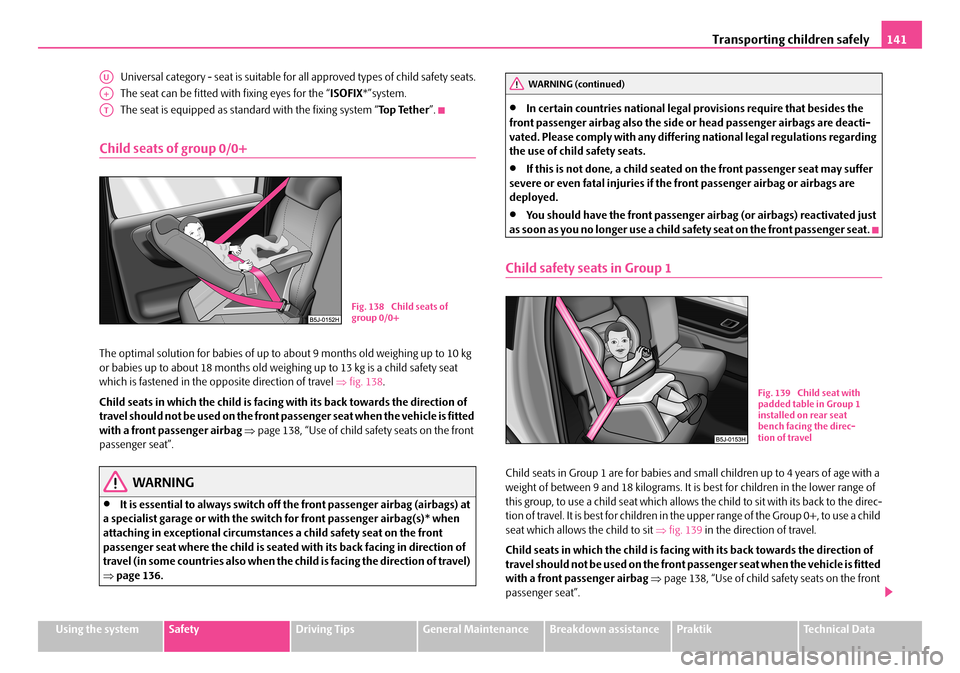
The optimal solution for babies of up to about 9 months old weighing up to 10 kg or babies up to about 18 mont hs old weighing up to 13 kg is a child safety seat which is fastened in the opposite direction of travel ⇒fig. 138.
Child seats in which the child is facing with its back towards the direction of travel should not be used on the front pa ssenger seat when the vehicle is fitted with a front passenger airbag ⇒page 138, “Use of child safety seats on the front passenger seat”.
WARNING
•It is essential to always switch off the front passenger airbag (airbags) at a specialist garage or with the switch for front passenger airbag(s)* when attaching in exceptional circumstances a child safety seat on the front passenger seat where the child is seated with its back facing in direction of travel (in some countries also when the child is facing the direction of travel) ⇒ page 136.
•In certain countries national legal provisions require that besides the front passenger airbag also the side or head passenger airbags are deacti- vated. Please comply with any differin g national legal regulations regarding the use of child safety seats.
•If this is not done, a child seated on the front passenger seat may suffer severe or even fatal injuries if the front passenger airbag or airbags are deployed.
•You should have the front passenger ai rbag (or airbags) reactivated just as soon as you no longer use a child sa fety seat on the front passenger seat.
Child safety seats in Group 1
Child seats in Group 1 are for babies and small children up to 4 years of age with a weight of between 9 and 18 kilograms. It is best for children in the lower range of this group, to use a child seat which allows the child to sit with its back to the direc- tion of travel. It is best for children in the upper range of the Group 0+, to use a child seat which allows the child to sit ⇒fig. 139 in the direction of travel.
Child seats in which the child is facing with its back towards the direction of travel should not be used on the front pa ssenger seat when the vehicle is fitted with a front passenger airbag ⇒page 138, “Use of child safety seats on the front passenger seat”.
AU
A+
AT
Fig. 138 Child seats of group 0/0+
WARNING (continued)
Fig. 139 Child seat with padded table in Group 1 installed on rear seat bench facing the direc-tion of travel
NKO A05R 20 MR08.book Page 141 Wednesday, March 28, 2007 9:42 AM
Page 143 of 248
Transporting children safely142
WARNING
•It is essential to always switch off the front passenger airbag (airbags) at a specialist garage or with the switch for front passenger airbag(s)* when attaching in exceptional circumstances a child safety seat on the front passenger seat where the child is seated with its back facing in direction of travel (in some countries also when the child is facing the direction of travel) ⇒ page 136.
•In certain countries national legal provisions require that besides the front passenger airbag also the side or head passenger airbags are deacti- vated. Please comply with any differin g national legal regulations regarding the use of child safety seats.
•If this is not done, a child seated on the front passenger seat may suffer severe or even fatal injuries if the front passenger airbag or airbags are deployed.
•You should have the front passenger ai rbag (or airbags) reactivated just as soon as you no longer use a child sa fety seat on the front passenger seat.
Child safety seats in Group 2
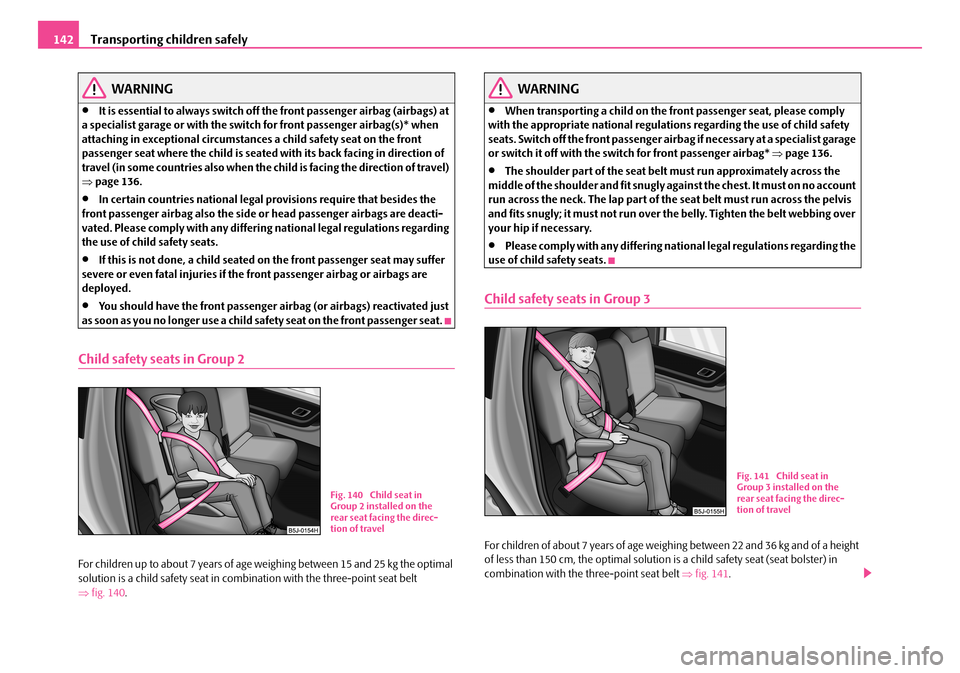
For children up to about 7 years of age weighing between 15 and 25 kg the optimal solution is a child safety seat in comb ination with the three-point seat belt ⇒ fig. 140.
WARNING
•When transporting a child on the front passenger seat, please comply with the appropriate national regulati ons regarding the use of child safety seats. Switch off the front passenger airb ag if necessary at a specialist garage or switch it off with the switch for front passenger airbag* ⇒page 136.
•The shoulder part of the seat belt must run approximately across the middle of the shoulder and fit snugly agai nst the chest. It must on no account run across the neck. The lap part of the seat belt must run across the pelvis and fits snugly; it must not run over the belly. Tighten the belt webbing over your hip if necessary.
•Please comply with any differing nati onal legal regulations regarding the use of child safety seats.
Child safety seats in Group 3
For children of about 7 years of age weighi ng between 22 and 36 kg and of a height of less than 150 cm, the optimal solution is a child safety seat (seat bolster) in combination with the three-point seat belt ⇒fig. 141.
Fig. 140 Child seat in Group 2 installed on the rear seat facing the direc-tion of travel
Fig. 141 Child seat in Group 3 installed on the rear seat facing the direc-tion of travel
NKO A05R 20 MR08.book Page 142 Wednesday, March 28, 2007 9:42 AM
Page 188 of 248

Wheels and Tyres187
Using the systemSafetyDriving TipsGeneral MaintenanceBreakdown assistancePraktikTechnical Data
Wheels and Tyres
Wheels
General comments
•New tyres do not offer optimal grip at first and should therefore be run in for about 500 km at a moderate speed and an appropriately cautious style of driving. You will also profit from longer tyre life.
•The tread depth of new tyres may differ because of design features and the configuration of the tread (depending on the type of tyre and the manufacturer).
•Drive over curbs on the side of the road and other such obstacles slowly and, where possible, at a right angles in order to avoid damage to tyres and wheel trims.
•Inspect your tyres from time to time for damage (punctures, cuts, splits and bulges). Remove foreign bodies from the tyre profile.
•Damage to tyres and wheels is frequent ly not visible. Unusual vibrations or pulling of the vehicle to one side could be a sign of tyre damage. Please reduce your speed immediately and stop if you suspect that a wheel is damaged. Inspect the tyres for signs of damage (bulge s, splits, etc.) If no visible damage is present, please drive at an appropriatel y slow speed and carefully to the nearest specialist garage in order to have your vehicle inspected.
•Also protect your tyres from contact with oil, grease and fuel.
•Immediately replace any dust caps of the valves which have got lost.
•Mark wheels before removing them so th at their previous direction of running can be maintained when mounted them again.
•Always store wheels or tyres which been removed in a cool, dry and, where possible, dark place. Tyres which are not fixed to a wheel trim should be stored upright.
Unidirectional tyres*
The direction of rotation of the tyres is marked by arrows on the wall of the tyre. This indicates the direction of rotation of the tyre, and it is essential that the tyres are fitted on to run in this direction. Only then are the tyres able to provide the optimal properties in terms of grip, low noise, wear-and-tear and aquaplaning.
Further information concerning the use of unidirectional tyres ⇒page 191.
WARNING
•New tyres during the first 500 km do not offer optimal grip and should therefore be run appropriately - risk of accident!
•Never drive with damaged tyres - risk of accident!
Note
Please observe the various differing legal requirements regarding tyres.
Tyre life
The life of your tyres very much depends on the following points:
Tyre pressure
The working life of tyres will be shortened considerably if the tyres are insufficiently or over-inflated and this will have an adverse effect on the handling of your vehicle.
Correctly inflated tyres are of partic ular importance when travelling at high speeds. It is therefore good to check the pressure at least once a month and also before
Fig. 164 An opened fuel filler flap with the tyre inflation pressure table
NKO A05R 20 MR08.book Page 187 Wednesday, March 28, 2007 9:42 AM
Page 189 of 248
Wheels and Tyres188
setting off on a long trip. Please do not forget the spare wheel when checking the tyres.
The tyre inflation pressures for summer tyres are indicated on the inside of the fuel filler flap ⇒page 187, fig. 164. The inflation pressures for winter tyres are 20 kPa (0.2 bar) higher than those for summer tyres ⇒page 190.
The tyre pressure should be at the highest pressure specified for your vehicle at all times.
Always check the inflation pressure of ty res when cold. Do not reduce the higher pressure of warm tyres. Adapt the inflation pressure of the tyres accordingly if your vehicle is carrying a significantly higher payload.
Driving style
Fast cornering, sharp acceleration and braking (squealing tyres) increase wear-and- tear on your tyres.
Balancing wheels
The wheels of a new vehicle are balanced. There are a wide range of influences when driving which may result in an imbalance and which makes themselves felt through vibration in the steering.
You should have the wheels rebalanced since any imbalance increases wear-and- tear on the steering, the suspension and tyres. A wheel must also be rebalanced when a new tyre is fitted and each time a tyre is repaired.
Wheel alignment errors
Incorrect wheel alignment at the front and re ar will not only increase wear-and-tear on the tyres but will also has an adverse effect on vehicle safety. Contact your specialist garage if you notice any unusual tyre wear.
WARNING
•If the inflation pressure is too low, the tyre must perform a greater flexing work. At higher speeds the tyre will warm up as a result of this. This can result in tread separation and even a tyre blowout.
•Immediately replace the damaged rims or tyres.
For the sake of the environment
Tyres which are insufficiently inflated increase your fuel consumption.
Wear indicators
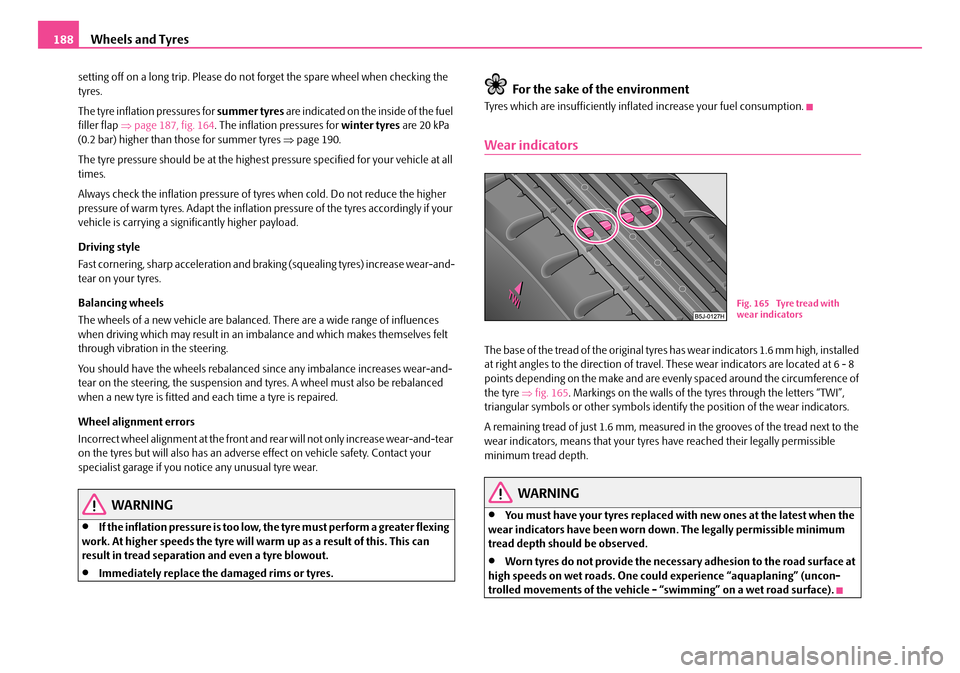
The base of the tread of the original tyres has wear indicators 1.6 mm high, installed at right angles to the direction of travel. These wear indicators are located at 6 - 8 points depending on the make and are evenly spaced around the circumference of the tyre ⇒fig. 165. Markings on the walls of the tyres through the letters “TWI”, triangular symbols or other symbols identi fy the position of the wear indicators.
A remaining tread of just 1.6 mm, measured in the grooves of the tread next to the wear indicators, means that your tyres have reached their legally permissible minimum tread depth.
WARNING
•You must have your tyres replaced with new ones at the latest when the wear indicators have been worn do wn. The legally permissible minimum tread depth should be observed.
•Worn tyres do not provide the necessary adhesion to the road surface at high speeds on wet roads. One coul d experience “aquaplaning” (uncon- trolled movements of the vehicle - “swimming” on a wet road surface).
Fig. 165 Tyre tread with wear indicators
NKO A05R 20 MR08.book Page 188 Wednesday, March 28, 2007 9:42 AM
Page 194 of 248
Accessories, changes and replacement of parts193
Using the systemSafetyDriving TipsGeneral MaintenanceBreakdown assistancePraktikTechnical Data
Accessories, changes and replacement of parts
Accessories and replacement parts
Škoda vehicles have been built according to the latest discoveries in safety engi- neering. Thus one should no t change the condition in which the vehicle was deliv- ered from the manufacturer without some thought.
The following guidelines should be observed when a vehicle is to be retrofitted with accessories, have technical ch anges made to it or a par t has to be replaced at some time in the future.
•Advise should always be obtained from a Škoda Service Partner before buying any accessories and before making any technical changes ⇒.
•This is particularly the case when accessories are bought in a foreign country.
•Škoda Genuine Accessories which have been released for use and Skoda orig- inal parts can be obtained from Škoda Se rvice Partners. They will install them professionally and correctly.
•All Škoda original accessory which is listed in the catalogue such as tilting roofs, spoilers, wheels etc. must have an official stamp of approval.
•Radios, aerials and other electrical accessories should only be installed by an authorised workshop.
•The guidelines issued by Škoda Auto a.s. must be observed when making tech- nical changes.
•This is to ensure that no technical damage occurs to the vehicle, that travelling and operating safety are maintained and that the chnages are permissible. Škoda Service Partners undertake this work professionally or refer it to an specialist company in special cases.
Any damage which is done caused by technical changes made without consulting a Skoda a.s. dealer is excluded from the guarantee.
WARNING
•We advise you, in your own interest, to only use Škoda Genuine Accesso- ries and Škoda original parts which have been expressly approved for use on
your Škoda. Reliability, safety and su itabiliity have been established for these Škoda original parts.
•We cannot guarantee suitability of installation into your vehicle of other products despite keeping a constant ey e on market developments (also not in the case where there is an attestation or permission can be produced).
Technical changes
Interference on the electronic components and their software can lead to opera-tional faults. This interference can also impair not directly affected systems because of the networking of the electronic co mponents. This means that the operating safety of your vehicle can be considerably jeopardized, a greater wear of vehicle parts can occur and finally the vehi cle registration documents expire.
We trust that you will understand that yo ur Škoda Service Partner cannot be liable for damage resulting from unprofessional work.
We therefore recommend that you have a ll work carried out with Škoda original parts at your authorised Škoda Service Partners.
WARNING
Work or modifications on your vehicle, which have been carried out unpro-fessionally, can cause operational faults - risk of accident!
WARNING (continued)
NKO A05R 20 MR08.book Page 193 Wednesday, March 28, 2007 9:42 AM