brakes SKODA ROOMSTER 2009 1.G User Guide
[x] Cancel search | Manufacturer: SKODA, Model Year: 2009, Model line: ROOMSTER, Model: SKODA ROOMSTER 2009 1.GPages: 263, PDF Size: 32.25 MB
Page 160 of 263
Intelligent Technology159
Using the system
Safety
Driving Tips
General Maintenance
Breakdown assistance
Praktik
Technical Data
WARNING
•
Never switch off the engine before the vehicle is stationary.
•
The brake booster only operates when the engine is running. Greater
physical effort for braking is required when engine is switched off. Because
if you do not stop as normal, this can cause an accident and severe injuries.
Antilock brake system (ABS)*ABS prevents the wheels locking when braking.General
The ABS contributes significantly to enhancing the active safety of your vehicle.
Compared to a vehicle not fitted with the ABS brake system, you are able to retain
optimal steering ability even during a full brake application on a slippery road
surface because the wheels do not lock up.
You must not expect, however, that the braking distance will be shorter under all
circumstances as a result of the ABS. The braking distance for example on gravel
and fresh snow, when you should anyway be driving slowly and cautiously, will be
longer.
Operating principle
As soon as the vehicle speed has increased to about 20 km/hour an automatic test
procedure is conducted during which you will be able to hear a pumping noise for
about 1 second.
The brake pressure will be reduced on a wheel which is rotating at a speed which is
too low for the speed of the vehicle and tending to lock. This control cycle is notice-
able from a pulsating movement of the brake pedal which is accompanied by
noises. This is consciously intended to provide the driver with the information that
the wheels are tending to lock (ABS control range). You must always keep the brake
pedal depressed to enable the ABS to optimally control the brake application in this
braking range. Never interrupt the application of the brakes!
WARNING
•
The ABS can also not overcome the physical limits of your vehicle. Please
do not forget this, particularly when driving on icy or wet road surfaces. If the
ABS is operating within the control range, adapt your speed immediately to
the conditions of the road surface and the traffic situation. The increased
safety offered by the ABS must not tempt you to take greater risks than
otherwise - risk of an accident!
•
The normal braking system is still fully functional if there is an ABS fault.
Visit a specialist garage as quickly as possible and adjust your style of driving
to take account of the ABS fault in the meantime since you will not know the
extent of the fault and in how far the braking efficiency is affected.Note
•
A warning light comes on if a fault occurs in the ABS system
⇒page 35.
•
Changes to vehicle (e.g. on engine, on the brakes, on chassis or another combi-
nation of tyres and wheels) can influence the function of the ABS ⇒page 204,
“Accessories, changes and replacement of parts”.
Brake Assist*During a severe brake application (e.g. if a hazard exists), the Brake Assist increases
the braking force and thus makes it possible to rapidly produce the pressure
required in the brake system.
The majority of drivers do apply the brakes in good time in dangerous situations,
but do not depress the brake pedal with sufficient pressure. Consequently, it is not
possible for the vehicle to achieve its maximum deceleration and the vehicle covers
a greater distance than necessary.
The Brake Assist is activated by the very quick operation of the brake pedal. In such
cases, a much greater braking pressure exists than during a normal brake applica-
tion. This makes it possible, even with a relatively low resistance of the brake pedal,
to produce an adequate pressure in the brake system in the shortest possible time,
which is required for maximum deceleration of the vehicle. You must apply the
s29g.4.book Page 159 Wednesday, June 17, 2009 9:54 AM
Page 161 of 263
Intelligent Technology 160brake pedal firmly and hold it in this position in order to achieve the shortest
possible braking distance.
The Brake Assist is able to help you achieve a shorter braking distance in emergency
situations by rapidly producing the pressure required in the brake system. It fully
exploits the attributes of the ABS. After you release the brake pedal, the function of
the Brake Assist is automatically switched off and the brakes operate in the normal
way.
The Brake Assist is part of the ESP system. If a fault occurs in the ESP, the Brake Assist
function is also not available. Further information on the ESP ⇒page 155.
WARNING
•
The Brake Assist is also not able to overcome the physical limits of your
vehicle in terms of the braking distance required.
•
Adapt your speed to the conditions of the road surface and to the traffic
situation.
•
The increased safety offered by the Brake Assist must not tempt you to
take a greater safety risk than otherwise.
Electrohydraulic power steeringThe power steering enables you to steer the vehicle with less physical force.
The steering characteristics can be changed by a specialist garage.
You will place great stresses on the power steering system if the steering is turned
to full lock when the vehicle is stationary. Turning the steering to full lock in such a
situation will be accompanied by noises.
It is still possible to fully steer the vehicle if the power steering fails or if the engine
is not running (vehicle being towed in). The only difference is that greater physical
effort is required.
It is possible that the hydraulic pump of the power steering will not run due to the
low vehicle network voltage if the battery has gone flat and the engine must started
with the help off jump leads. This condition will be indicated by lighting up of the
warning light.The power steering operates again if the battery is charged to a specific range when
engine is running. It also operates again, if the engine can be started with its own
battery.
If there is a fault in the power steering, the warning light lights up in the instrument
cluster
⇒page 29.
Caution
Do not leave the steering at full lock for more than 15 seconds when the engine is
running - risk of damaging the power steering!
Note
Have the steering inspected as soon as possible by a specialist garage if there is a
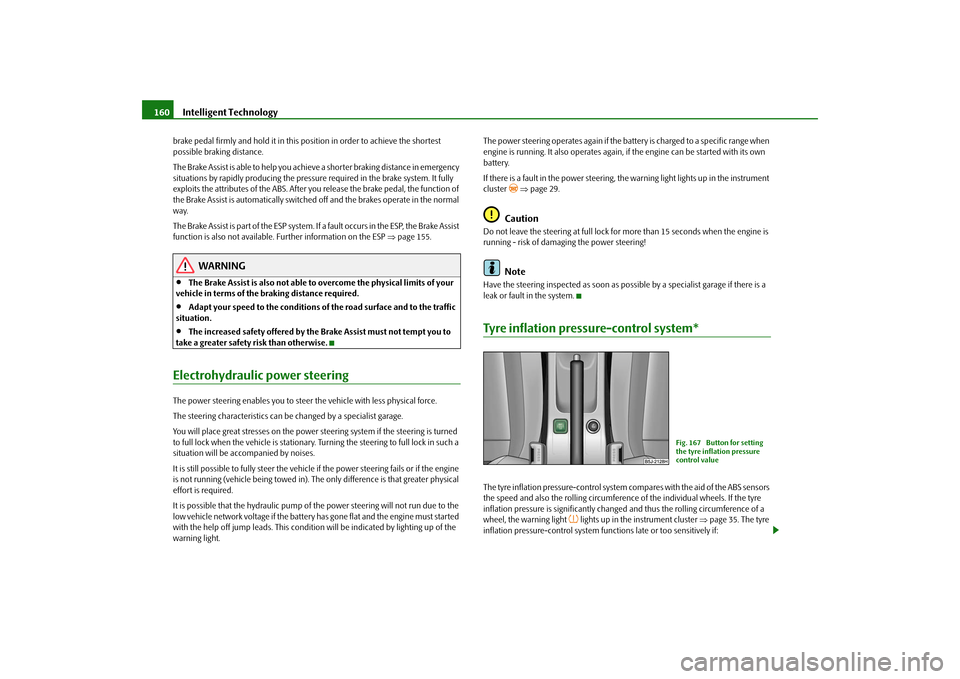
leak or fault in the system.Tyre inflation pressure-control system*The tyre inflation pressure-control system compares with the aid of the ABS sensors
the speed and also the rolling circumference of the individual wheels. If the tyre
inflation pressure is significantly changed and thus the rolling circumference of a
wheel, the warning light
lights up in the instrument cluster ⇒page 35. The tyre
inflation pressure-control system functions late or too sensitively if:
Fig. 167 Button for setting
the tyre inflation pressure
control value
s29g.4.book Page 160 Wednesday, June 17, 2009 9:54 AM
Page 164 of 263
Driving and the Environment163
Using the system
Safety
Driving Tips
General Maintenance
Breakdown assistance
Praktik
Technical Data
Driving and the EnvironmentThe first 1 500 kilometres and then afterwardsA new engine
The engine has to be run in during the first 1 500 kilometres.Up to 1 000 kilometres
– Do not drive faster than 3/4 of the maximum speed of the gear in use,
that is 3/4 of the maximum permissible engine speed.
– Do not use full throttle.
– Avoid high engine revolutions.
– Do not tow a trailer.
From 1 000 up to 1 500 kilometres
– Increase the power output of the engine gradually up to the full
speed of the gear engaged, that is up to the maximum permissible
engine revolutions.During the first operating hours the engine has higher internal friction than later
until all of the moving parts have harmonized. The driving style which you adopt
during the first approx.1 500 kilometres plays a decisive part in the success of
running in your vehicle.
You should not drive at unnecessarily high engine revolutions even after the
running-in period is complete. The maximum permissible engine speed is marked
by the beginning of the red zone on the scale of the revolutions counter. Shift up
into the next higher gear on a vehicle fitted with manual gearbox before the red
zone is reached. During acceleration (depressing the accelerator) exceptionally
high engine speeds are automatically reduced, yet the engine is not protected
against too high engine speeds which are caused by incorrectly shifting down the
gears resulting in a sudden increase of the engine speeds above the permitted
maximum revolutions which can lead to engine damage.For a vehicle fitted with a manual gearbox the converse situation also applies: Do
not drive at engine revolutions which are too low. Shift down as soon as the engine
is no longer running smoothly.
Caution
All the speed and engine revolution figures apply only when the engine is at its
normal operating temperature. Never rev up an engine which is cold, neither when
the vehicle is stationary nor when driving in individual gears.
For the sake of the environment
Not driving at unnecessarily high engine revolutions and shifting to a higher gear as
early as possible are ways to minimise fuel consumption, operating noise levels as
well as protects the environment and contributes to a longer life and reliability of
the engine.New tyresNew tyres have to be “run in” since they do not offer optimal grip at first. You should
take account of this fact for the first 500 kilometres and drive particularly carefully.New brake padsAllow for the fact that new brake pads do not achieve their full braking efficiency
until approximately 200 kilometres. New brake pads must be first “run in” before
they develop their optimal friction force. You can, however, compensate for this
slightly reduced braking force by increasing the pressure on the brake pedal.
This guideline also applies to any new brake pads installed at a future date.
During the running-in period, you should avoid excessive stresses on the brakes.
This includes, for example, violent braking, particularly from very high speeds, and
also when crossing mountain passes.
s29g.4.book Page 163 Wednesday, June 17, 2009 9:54 AM
Page 165 of 263
Driving and the Environment 164Catalytic converterProper operation of the emission control system (catalytic converter)
is of major significance for driving your vehicle in an environmen-
tally conscious way.Please refer to the following guidelines:
– For vehicles with petrol engine only refuel with unleaded petrol
⇒page 181, “Grades of petrol”.
– Never run the fuel tank completely empty.
– Do not switch off the ignition while you are driving the vehicle.
– Do not pour too much oil into the engine ⇒page 188, “Replenishing
engine oil”.
– Do not tow-start the vehicle over a distance of more than 50 metres
⇒page 216, “Tow-starting a vehicle”.If you drive your vehicle in a country in which unleaded petrol is not available, you
must have the catalytic converter replaced later when driving the vehicle into a
country in which use of a catalytic converter is mandatory.
WARNING
•
In view of the high temperatures which may be produced in the catalytic
converter, one should always park a vehicle in such a way that the catalytic
converter cannot come into contact with easily flammable materials below
the vehicle - a risk of fire!
•
Never use additional underbody protection or corrosion-protection
agents for the exhaust pipes, catalytic converters or heat shields. Such
substances might ignite when driving - risk of fire!
Caution
•
On vehicles fitted with a catalytic converter, never let the fuel tank run
completely empty. An irregular fuel supply can result in poor ignition or misfiring.
Unburnt fuel may get into the exhaust system and damage the catalytic converter.
•
Filling the tank even only once with leaded petrol will result in the catalytic
converter being destroyed.
•
If you detect misfiring, a drop in performance or irregular engine running when
driving, reduce your speed immediately and have the vehicle inspected by the
nearest specialist garage. The symptoms described may be caused by a fault in the
ignition system. Unburnt fuel may get into the exhaust system and damage the
catalytic converter.For the sake of the environment
Even if the exhaust system is operating properly, a sulphur-like exhaust odour may
be produced under certain operating conditions of the engine. This depends on the
sulphur content of the fuel. It is often sufficient to refuel with unleaded premium-
grade petrol of a different brand or at a different filling station.Driving in an economical and environmentally
conscious mannerGeneral
Your personal style of driving is a major factor.Your fuel consumption, any pollution of the environmental and the wear-and-tear
to the engine, brakes and tyres, depend essentially on three factors:•
your personal style of driving;
•
the conditions under which your vehicle is operated;
•
technical aspects.
You can easily improve your fuel economy by 10 - 15 percent by driving in an
economical way with foresight. This section is intended to provide you with a
s29g.4.book Page 164 Wednesday, June 17, 2009 9:54 AM
Page 172 of 263
Towing a trailer171
Using the system
Safety
Driving Tips
General Maintenance
Breakdown assistance
Praktik
Technical Data Exterior mirrors
You have to have additional exterior mirrors fitted if you are not able to see the
traffic behind the trailer with the standard rear-view mirrors. Both exterior mirrors
should be attached to folding arms. Adjust the mirrors so that they provide you with
an adequate field of view to the rear.
Headlights
Before starting off with a hitched trailer, also check the setting of the headlights.
Alter the setting as necessary with the aid of the headlight beam adjuster
⇒page 55.
Detachable ball head
The ball rod is detachable on vehicles with towing device and suppliable from
Škoda original accessories. It is stowed together with separate fitting instructions in
the spare wheel well in the luggage compartment of the vehicle.
Note
•
We recommend that you also have your vehicle inspected between service
intervals if you tow a trailer frequently.
•
The handbrake on the towing vehicle must be put on when coupling and
decoupling the trailer.
Driving Tips
Particular caution is required when towing a trailer.– Do not, as far as possible, drive with your vehicle unladen and the
trailer laden.
– Do not make full use of the legal maximum speeds. This applies in
particular to downhill sections.
– Apply the brakes in good time.
– Keep a check on the coolant temperature gauge if the outside temper-
ature is high.
Distribution of weight
The distribution of the weight is very poor if your vehicle is unladen and the trailer
is laden. Maintain a particularly low speed if you cannot avoid driving with this
combination.
Driving speed
Do not drive faster than 80 km/h for safety reasons. This also applies for countries
in which higher speeds are allowed.
The fact that the driving stability of the vehicle + trailer combination reduces with
increasing speed means that the legally allowed speed should not be used when
there are unfavourable road, weather or wind conditions, particularly near accident
black spots.
You must always reduce your speed immediately as soon as you detect even just
the slightest swaying of the trailer. On no account attempt to stop the trailer from
“swaying” by accelerating.
Apply the brakes in good time! If the trailer is fitted with a trailer brake, apply the
brakes gently at first and then brake firmly. This will avoid brake jolts resulting from
the trailer wheels locking. Shift down gears in good time before negotiating a down-
hill section to allow the engine to also act as a brake.
Engine overheating
Please keep a check on the coolant temperature gauge if you have to negotiate a
lengthy slope in a low gear at a high engine speed when the outside temperature is
very high ⇒page 19.
If the needle of the coolant temperature gauge moves into the right-hand area or
even the red area of the scale, reduce your speed immediately. Stop and switch off
the engine if the warning light
in the instrument cluster begins flashing. Wait a
few minutes and check the level of coolant in the coolant expansion bottle
⇒page 189, “Inspecting the coolant level”.
Please refer to the following guidelines ⇒page 32, “Coolant temperature/coolant
level ”.
The coolant temperature can be reduced by switching on the heating.
Any increase in the cooling effect of the coolant fan through shifting down a gear
and increasing the engine speed is not possible since the fan speed is independent
s29g.4.book Page 171 Wednesday, June 17, 2009 9:54 AM
Page 193 of 263
Inspecting and replenishing 192
WARNING
•
Read and observe the warning notes ⇒page 185, “Working in the engine
compartment” before working in the engine compartment.
•
If the fluid level has dropped below the MIN marking, do not drive any
further - risk of accident! Obtain professional assistance.
Replacing brake fluidBrake fluid absorbs moisture. This causes the fluid to absorb moisture from the
surrounding air over a period of time. Excessive water in the brake fluid may be the
cause of corrosion in the brake system. The water content also lowers the boiling
point of the brake fluid. This is why brake fluid must be replaced every two
years.
One may only use new genuine brake fluid from Škoda Auto. The specification for
the brake fluid is “FMVSS 116 DOT 4”.
We recommend that you have the brake fluid replaced by a specialist garage as
part of an Inspection Service.
WARNING
•
Using old brake fluid can result in severe stress on the brakes because of
the formation of vapour bubbles in the brake system. This greatly impairs
the braking efficiency and thus also the safety of your vehicle.
•
Brake fluid is toxic! It must therefore be kept safely in closed original
containers and well away from children and unauthorized persons.Caution
Brake fluid damages the paintwork of the vehicle.
For the sake of the environment
In view of the problems involved with proper disposal of brake fluid, the special
tools and the professional knowledge required, we recommend you have the brake
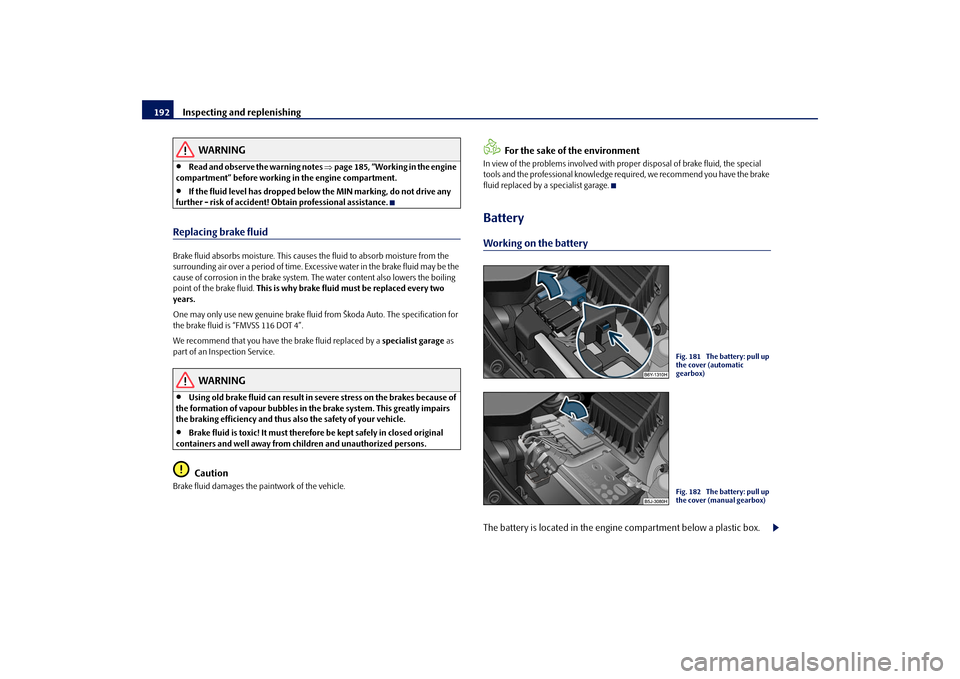
fluid replaced by a specialist garage.BatteryWorking on the batteryThe battery is located in the engine compartment below a plastic box.
Fig. 181 The battery: pull up
the cover (automatic
gearbox)Fig. 182 The battery: pull up
the cover (manual gearbox)
s29g.4.book Page 192 Wednesday, June 17, 2009 9:54 AM
Page 252 of 263
Index251
Using the system
Safety
Driving Tips
General Maintenance
Breakdown assistance
Praktik
Technical Data
Index
AAbroad . . . . . . . . . . . . . . . . . . . . . . . . . . . . . . . . . . . . . 168
ABS . . . . . . . . . . . . . . . . . . . . . . . . . . . . . . . . . . . . . . . . . 159
Warning light . . . . . . . . . . . . . . . . . . . . . . . . . . . . . 35
Accessories . . . . . . . . . . . . . . . . . . . . . . . . . . . . . . . . . 204
Adjusting seats . . . . . . . . . . . . . . . . . . . . . . . 63, 68, 128
Adjusting the seat backrest . . . . . . . . . . . . . . . . . . . . 67
Adjusting the steering wheel . . . . . . . . . . . . . . . . . . . 99
Air conditioning system . . . . . . . . . . . . . . . . . . . . . . . 92
Airbag . . . . . . . . . . . . . . . . . . . . . . . . . . . . . . . . . . . . . . 138
Deployment . . . . . . . . . . . . . . . . . . . . . . . . . . . . . 139
Front airbag . . . . . . . . . . . . . . . . . . . . . . . . . . . . . 139
Head airbag . . . . . . . . . . . . . . . . . . . . . . . . . . . . . 143
Side airbag . . . . . . . . . . . . . . . . . . . . . . . . . . . . . . 142
Warning light . . . . . . . . . . . . . . . . . . . . . . . . . . . . . 36
Airbag system . . . . . . . . . . . . . . . . . . . . . . . . . . . . . . . 138
Warning light . . . . . . . . . . . . . . . . . . . . . . . . . . . . . 36
Alarm . . . . . . . . . . . . . . . . . . . . . . . . . . . . . . . . . . . . . . . . 48
Alternator
Warning light . . . . . . . . . . . . . . . . . . . . . . . . . . . . . 31
Antilock brake system . . . . . . . . . . . . . . . . . . . . . . . . 159
Antilock brake system - ABS
Warning light . . . . . . . . . . . . . . . . . . . . . . . . . . . . . 35
Anti-theft alarm system . . . . . . . . . . . . . . . . . . . . . . . 48
Ashtray . . . . . . . . . . . . . . . . . . . . . . . . . . . . . . . . . . . . . . 81
Auto Check Control . . . . . . . . . . . . . . . . . . . . . . . . . . . 27
Auto Computer . . . . . . . . . . . . . . . . . . . . . . . . . . . . . . . 22Automatic gearbox . . . . . . . . . . . . . . . . . . . . . . . . . . 107
Emergency programme . . . . . . . . . . . . . . . . . . 111
Kickdown . . . . . . . . . . . . . . . . . . . . . . . . . . . . . . . 110
Tiptronic . . . . . . . . . . . . . . . . . . . . . . . . . . . . . . . . 110
Automatic vehicle wash systems . . . . . . . . . . . . . . 174
Automatic wiper/washer system . . . . . . . . . . . . . . . 59
Avoiding damage to your vehicle . . . . . . . . . . . . . 169
BBattery . . . . . . . . . . . . . . . . . . . . . . . . . . . . . . . . . . 31, 192
change . . . . . . . . . . . . . . . . . . . . . . . . . . . . . . . . . . 196
Charge . . . . . . . . . . . . . . . . . . . . . . . . . . . . . . . . . . 195
Inspecting the electrolyte level . . . . . . . . . . . . 195
Operation in winter . . . . . . . . . . . . . . . . . . . . . . 195
Before setting off . . . . . . . . . . . . . . . . . . . . . . . . . . . . 128
Belt tensioner . . . . . . . . . . . . . . . . . . . . . . . . . . . . . . . 136
Belt tensioners . . . . . . . . . . . . . . . . . . . . . . . . . . . . . . 136
Belts . . . . . . . . . . . . . . . . . . . . . . . . . . . . . . . . . . . . . . . . 132
Bicycle carrier . . . . . . . . . . . . . . . . . . . . . . . . . . . . . . . . 77
Bluetooth . . . . . . . . . . . . . . . . . . . . . . . . . . . . . . . . . . . 121
Bonnet . . . . . . . . . . . . . . . . . . . . . . . . . . . . . . . . . . 16, 184
Boot lid
Warning light . . . . . . . . . . . . . . . . . . . . . . . . . . . . . 34
Brake
Handbrake . . . . . . . . . . . . . . . . . . . . . . . . . . . . . . 103
Brake booster . . . . . . . . . . . . . . . . . . . . . . . . . . . . . . . 158
Brake fluid . . . . . . . . . . . . . . . . . . . . . . . . . . . . . . . . . . 191Brake system
Warning light . . . . . . . . . . . . . . . . . . . . . . . . . . . . . 36
Brakes . . . . . . . . . . . . . . . . . . . . . . . . . . . . . . . . . . . . . . 158
Bulbs . . . . . . . . . . . . . . . . . . . . . . . . . . . . . . . . . . . . . . . 223
Button on the driver's door
Central locking system . . . . . . . . . . . . . . . . . . . . 44
Electrical power windows . . . . . . . . . . . . . . . . . . 49
CCar state . . . . . . . . . . . . . . . . . . . . . . . . . . . . . . . . . . . . . 27
Catalytic converter . . . . . . . . . . . . . . . . . . . . . . . . . . 164
CD changer . . . . . . . . . . . . . . . . . . . . . . . . . . . . . . . . . 123
Central locking system . . . . . . . . . . . . . . . . . . . . . . . . 42
lock . . . . . . . . . . . . . . . . . . . . . . . . . . . . . . . . . . . . . . 44
unlock . . . . . . . . . . . . . . . . . . . . . . . . . . . . . . . . . . . 43
Changing a wheel . . . . . . . . . . . . . . . . . . . . . . . . . . . 209
Changing wheels around . . . . . . . . . . . . . . . . . . . . . 200
Charging the battery . . . . . . . . . . . . . . . . . . . . . . . . . 195
Warning light . . . . . . . . . . . . . . . . . . . . . . . . . . . . . 31
Check engine oil level . . . . . . . . . . . . . . . . . . . . . . . . 187
Child safety . . . . . . . . . . . . . . . . . . . . . . . . . . . . . . . . . 147
Side airbag . . . . . . . . . . . . . . . . . . . . . . . . . . . . . . 149
Child safety lock . . . . . . . . . . . . . . . . . . . . . . . . . . . . . . 41
Child safety seat
on the front passenger seat . . . . . . . . . . . . . . . 148
Safety information . . . . . . . . . . . . . . . . . . . . . . . 147
s29g.4.book Page 251 Wednesday, June 17, 2009 9:54 AM