gearbox SKODA ROOMSTER 2009 1.G Owner's Guide
[x] Cancel search | Manufacturer: SKODA, Model Year: 2009, Model line: ROOMSTER, Model: SKODA ROOMSTER 2009 1.GPages: 263, PDF Size: 32.25 MB
Page 193 of 263
Inspecting and replenishing 192
WARNING
•
Read and observe the warning notes ⇒page 185, “Working in the engine
compartment” before working in the engine compartment.
•
If the fluid level has dropped below the MIN marking, do not drive any
further - risk of accident! Obtain professional assistance.
Replacing brake fluidBrake fluid absorbs moisture. This causes the fluid to absorb moisture from the
surrounding air over a period of time. Excessive water in the brake fluid may be the
cause of corrosion in the brake system. The water content also lowers the boiling
point of the brake fluid. This is why brake fluid must be replaced every two
years.
One may only use new genuine brake fluid from Škoda Auto. The specification for
the brake fluid is “FMVSS 116 DOT 4”.
We recommend that you have the brake fluid replaced by a specialist garage as
part of an Inspection Service.
WARNING
•
Using old brake fluid can result in severe stress on the brakes because of
the formation of vapour bubbles in the brake system. This greatly impairs
the braking efficiency and thus also the safety of your vehicle.
•
Brake fluid is toxic! It must therefore be kept safely in closed original
containers and well away from children and unauthorized persons.Caution
Brake fluid damages the paintwork of the vehicle.
For the sake of the environment
In view of the problems involved with proper disposal of brake fluid, the special
tools and the professional knowledge required, we recommend you have the brake
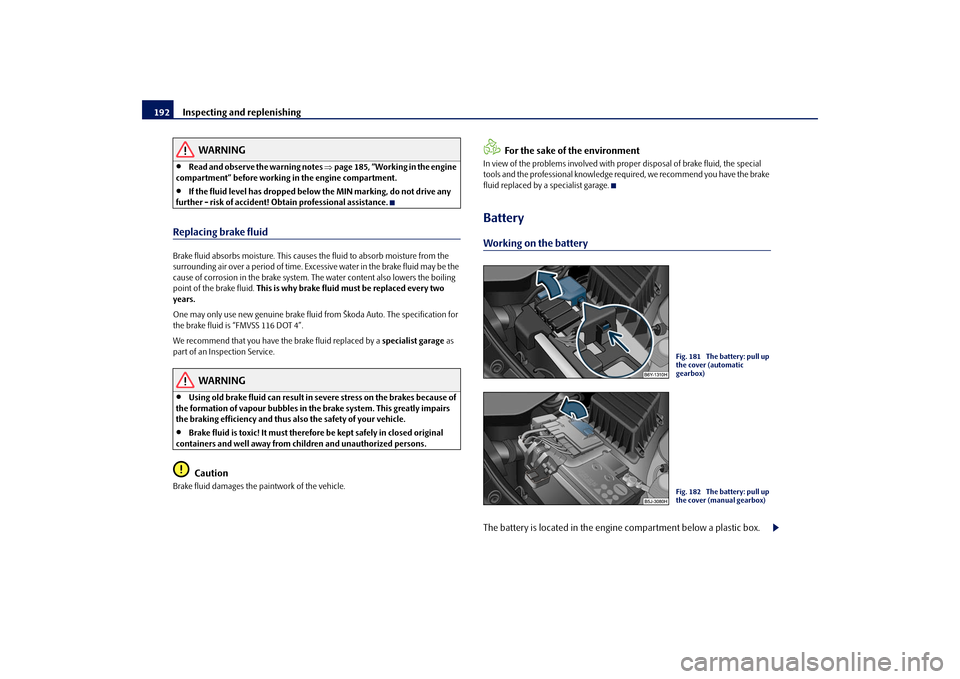
fluid replaced by a specialist garage.BatteryWorking on the batteryThe battery is located in the engine compartment below a plastic box.
Fig. 181 The battery: pull up
the cover (automatic
gearbox)Fig. 182 The battery: pull up
the cover (manual gearbox)
s29g.4.book Page 192 Wednesday, June 17, 2009 9:54 AM
Page 194 of 263
Inspecting and replenishing193
Using the system
Safety
Driving Tips
General Maintenance
Breakdown assistance
Praktik
Technical Data
– Unlock the interlock on the positive terminal side of the battery
⇒page 192, fig. 181.
– Pull up the cover in direction of arrow ⇒page 192, fig. 181 (automatic
gearbox) or ⇒page 192, fig. 182 (manual gearbox).
– The installation of the battery cover on the positive terminal side takes
place in the reverse order.Removal and installation of the battery is not recommended since it can, under
certain circumstances, lead to major damage to the battery and fuse boxes. Contact
a specialist garage.
There is a risk of injuries, scalding, accidents and burns when carrying out any work
on the battery and on the electrical system. For this reason, it is essential to comply
with the warning instructions ⇒ stated below and with the general applicable
rules of safety.
WARNING
•
The battery acid is strongly corrosive and must, therefore, be handled
with the greatest of care. Always wear protective gloves, eye and skin
protection when handling batteries. Corrosive fumes in the air irritate the
air passages and lead to conjunctivitis and inflammation of the air passages
in the lungs. Battery acid corrodes dental enamel and creates deep wounds
after contact with the skin which take a long time to heal. Repeated contact
with diluted acids causes skin diseases (inflammations, ulcers, slin cracks).
Acids coming into contact with water are diluted accompanied by significant
development of heat.
•
Do not tilt the battery otherwise battery electrolyte may flow out of the
battery vent openings. Protect the eyes with safety glasses or a shield! There
is the danger of suffering blindness! If any battery electrolyte gets into your
eye, rinse out your eye immediately with clear water for several minutes.
Contact a doctor without delay.
•
Splashes of acid on your skin or clothes should be neutralised as soon as
possible using soap suds and then rinsed with plenty of water. Contact a
doctor immediately if you swallow battery electrolyte.
•
Keep batteries out of the reach of children.
•
Hydrogen is released when you charge a battery and a highly explosive
gas mixture is produced. An explosion can be caused through sparkling over
during unclamping or loosening of the cable plug while the ignition is on.
•
Bridging of the poles will create a short circuit (e.g. through metal
objects, cables). Possible consequences of a short circuit: Melting of lead
struts, explosion and burning of the battery, jets of acid spurting out.
•
It is prohibited to work with a naked flame and light, to smoke or to carry
out any activities which produce sparks. Avoid creating sparks when
working with cables and electrical devices. Strong sparking represents a risk
of injury.
•
Before carrying out any work on the electrical system, switch off the
engine, the ignition as well as all electrical components and disconnect the
negative cable (-) on the battery. If you wish to replace a bulb it is sufficient
to switch off the appropriate light.
•
Never charge a frozen or thawed battery - risk of explosion and caustic
burns! Replace a frozen battery.
•
Never use a battery which is damaged - risk of explosion! Immediately
replace a damaged battery.Caution
•
You must only disconnect the battery if the ignition is switched off, otherwise
the electrical system (electronic components) of the vehicle may be damaged.
When disconnecting the battery from the electrical system of the vehicle, first
disconnect the negative terminal (-) of the battery. Then disconnect the positive
terminal (+).
•
When reconnecting the battery, first connect the positive terminal (+) and only
then the negative terminal (-) of the battery. You must on no account connect the
cables wrongly - risk of a cable fire.
•
Ensure that battery acid does not come into contact with the vehicle body
otherwise damage could occur to the paintwork.WARNING (continued)
s29g.4.book Page 193 Wednesday, June 17, 2009 9:54 AM
Page 210 of 263
Breakdown assistance209
Using the system
Safety
Driving Tips
General Maintenance
Breakdown assistance
Praktik
Technical Data Unidirectional tyres*
If you have such tyres on your vehicle, please refer to the notes below:
•
The spare wheel provided with a car fitted with unidirectional tyres has different
dimensions. The wheel is provided with a warning sticker.
•
The warning label must not be covered after installing the wheel.
•
Do not drive faster than 80 km/h with this spare wheel and pay particular atten-
tion while driving. Avoid accelerating at full throttle, sharp braking and fast
cornering.
•
The inflation pressure for this spare wheel is identical to the inflation pressure
of the standard tyres.
•
Use this spare wheel only to reach the nearest specialist garage as it is not
intended for continuous use.
Changing a wheelPreliminary workThe following steps should be carried out before actually changing the
wheel.
– If it is necessary to change a wheel, park the vehicle as far away as
possible from the traffic flow. The place you choose should be level.
– Have all the occupants get out. While changing a wheel, the occu-
pants of the vehicle should not stand on the road (e.g. behind a crash
barrier).
– Apply the handbrake firmly.
–Engage 1st gear or if your vehicle is fitted with an automatic gearbox,
position the selector lever into position P.
– If a trailer is coupled, uncouple it.
– Take the vehicle tool kit and the spare wheel ⇒page 208 out of the
luggage compartment.
WARNING
•
If you find yourself in flowing traffic switch on the hazard warning lights
system and place the warning triangle on the side of the road at the
prescribed distance from your vehicle while observing all national legal
provisions. In this way you are protecting not only yourself but also other
road users.
•
Never start the engine with the vehicle sitting on the raised jack - danger
of suffering injury.Caution
If you have to change a wheel on a slope first block the opposite wheel with a stone
or similar object in order to secure the vehicle from unexpectedly rolling away.
Note
Comply with the national legal regulations.Changing a wheelAlways change a wheel on a level surface as far as possible.
– Take off the full wheel trim* ⇒page 210 or the caps ⇒page 211.
– Slacken the wheel bolts ⇒page 211.
– Jack up the vehicle until the wheel to be changed is clear of the ground
⇒page 212.
– Unscrew the wheel bolts and place them on a clean surface (cloth,
paper etc.).
– Take off the wheel.
– Fit on the spare wheel* and tighten the wheel bolts slightly.
– Lower the car.
s29g.4.book Page 209 Wednesday, June 17, 2009 9:54 AM
Page 216 of 263
Breakdown assistance215
Using the system
Safety
Driving Tips
General Maintenance
Breakdown assistance
Praktik
Technical Data
Tow-starting and towing vehicleGeneralPlease pay attention to the following instructions if you are going to use a
tow rope:
Driver of the towing vehicle
– Do not drive off until the tow rope is taught.
– Release the clutch particularly gently when starting off.
Driver of the towed vehicle
– Switch the ignition on so that the steering wheel is not blocked and
you can also operate the turn signal lights, the headlight flasher, the
windscreen wipers and windscreen washer system.
– Take the vehicle out of gear or move the selector lever into position N
if your vehicle is fitted with an automatic gearbox.
– Note that the brake servo unit and power steering only operate if the
engine is running. You will require significantly greater physical force
to depress the brake pedal and to steer the vehicle if the engine is not
running.
– Ensure that the tow rope is always kept taught.Tow rope or tow bar
A tow bar is safest way of towing a vehicle and also minimizes any shocks. You can
use a tow rope only if a suitable tow bar is not available.
The tow rope must be elastic to protect the vehicle. Thus one should only use
plastic fibre rope or a rope made out of a similarly elastic material.
Attach the tow rope or the tow bar only to the towing eyes provided for this
purpose ⇒page 215, “Front towing eye” and ⇒page 216, “Rear towing eye”.Driving style
Towing another vehicle requires a certain amount of practice. Both drivers should
be familiar with the particular points about towing a vehicle. Unskilled drivers
should not attempt to tow in another vehicle or to be towed in.
One should be constantly vigilant not to allow impermissibly high towing forces or
jerky loadings. There is always a risk of excessive stresses and damage resulting at
the points to which you attach the tow rope or tow bar when you attempt to tow a
vehicle which is not standing on a paved road.
Caution
If the gearbox of your vehicle no longer contains any oil because of a defect, your
vehicle must only be towed in with the driven wheels raised clear of the ground, or
on a special vehicle transporter or trailer.
Note
•
Please comply with any legal requirements particularly regarding the switched
on signal systems, when towing in or tow-starting another vehicle.
•
The tow rope must not be twisted as it may in certain circumstances result in the
front towing eye being unscrewed out of your vehicle.
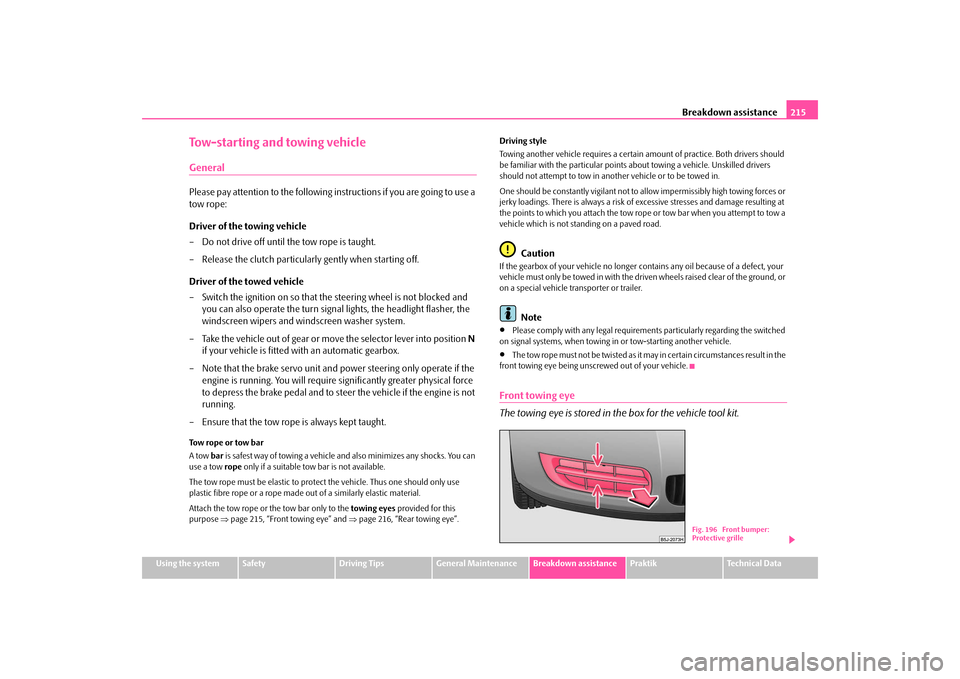
Front towing eye
The towing eye is stored in the box for the vehicle tool kit.
Fig. 196 Front bumper:
Protective grille
s29g.4.book Page 215 Wednesday, June 17, 2009 9:54 AM
Page 218 of 263
Breakdown assistance217
Using the system
Safety
Driving Tips
General Maintenance
Breakdown assistance
Praktik
Technical Data
WARNING
There is high risk of having an accident when tow-starting a vehicle, when
for example the towed vehicle runs into the towing vehicle.
Caution
Vehicles which are fitted with a catalytic converter should not be tow-started over
a distance of more than 50 metres. Unburnt fuel may get into the catalytic converter
and damage it.Towing in a vehicle fitted with a manual gearboxPlease refer to the notes ⇒page 215.
The vehicle can be towed in with a tow bar or a tow rope or with the front or rear
wheels raised. The maximum towing speed is 50 km/h.Towing of a vehicle with an automatic gearboxPlease refer to the notes ⇒page 215.
The car can be towed in with a tow bar or a tow rope. Refer at the same time to the
following guidelines:•
Move selector lever into N.
•
The maximum towing speed is 50 km/h.
•
The maximum permissible towing distance is 50 km. The gear oil pump does
not operate when the engine is not running; the gearbox would not be adequately
lubricated at higher speeds and over longer towing distance.Caution
If the vehicle is towed in by a recovery vehicle, it should only be towed in with the
front wheels raised. If the vehicle is raised at rear, the automatic gearbox is
damaged!
Note
The vehicle must be transported on a special vehicle or trailer if it is not possible to
tow in the vehicle in the way described or if the towing distance is greater than
50 km.
s29g.4.book Page 217 Wednesday, June 17, 2009 9:54 AM
Page 220 of 263
Fuses and light bulbs219
Using the system
Safety
Driving Tips
General Maintenance
Breakdown assistance
Praktik
Technical Data
Note
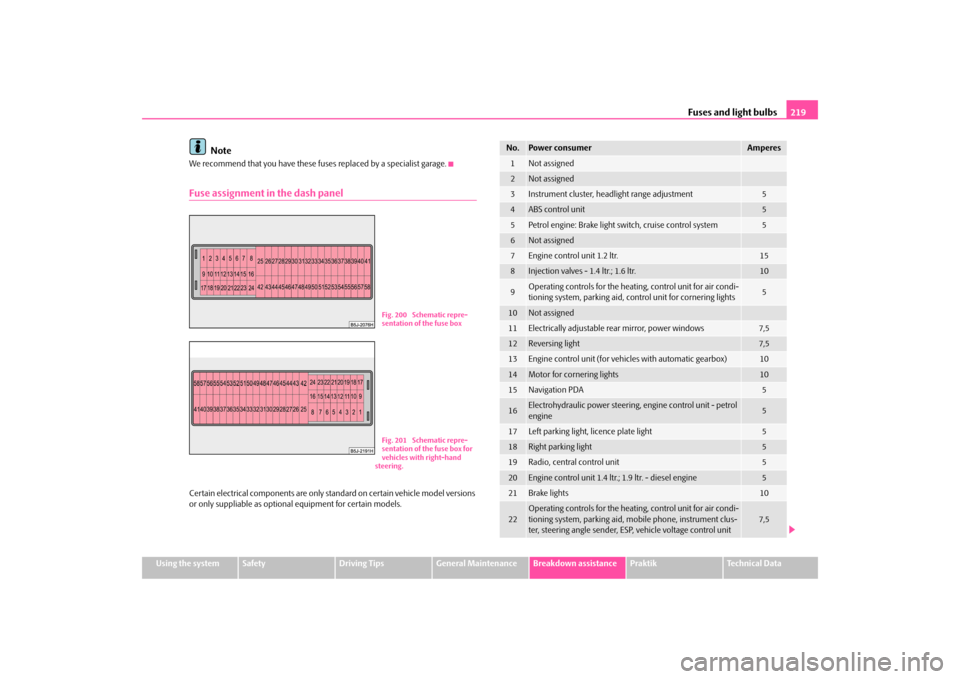
We recommend that you have these fuses replaced by a specialist garage.Fuse assignment in the dash panelCertain electrical components are only standard on certain vehicle model versions
or only suppliable as optional equipment for certain models.
Fig. 200 Schematic repre-
sentation of the fuse boxFig. 201 Schematic repre-
sentation of the fuse box for
vehicles with right-hand
steering.
No.
Power consumer
Amperes
1
Not assigned
2
Not assigned
3
Instrument cluster, headlight range adjustment
5
4
ABS control unit
5
5
Petrol engine: Brake light switch, cruise control system
5
6
Not assigned
7
Engine control unit 1.2 ltr.
15
8
Injection valves - 1.4 ltr.; 1.6 ltr.
10
9
Operating controls for the heating, control unit for air condi-
tioning system, parking aid, control unit for cornering lights
5
10
Not assigned
11
Electrically adjustable rear mirror, power windows
7,5
12
Reversing light
7,5
13
Engine control unit (for vehicles with automatic gearbox)
10
14
Motor for cornering lights
10
15
Navigation PDA
5
16
Electrohydraulic power steering, engine control unit - petrol
engine
5
17
Left parking light, licence plate light
5
18
Right parking light
5
19
Radio, central control unit
5
20
Engine control unit 1.4 ltr.; 1.9 ltr. - diesel engine
5
21
Brake lights
10
22
Operating controls for the heating, control unit for air condi-
tioning system, parking aid, mobile phone, instrument clus-
ter, steering angle sender, ESP, vehicle voltage control unit
7,5
s29g.4.book Page 219 Wednesday, June 17, 2009 9:54 AM
Page 222 of 263
Fuses and light bulbs221
Using the system
Safety
Driving Tips
General Maintenance
Breakdown assistance
Praktik
Technical Data
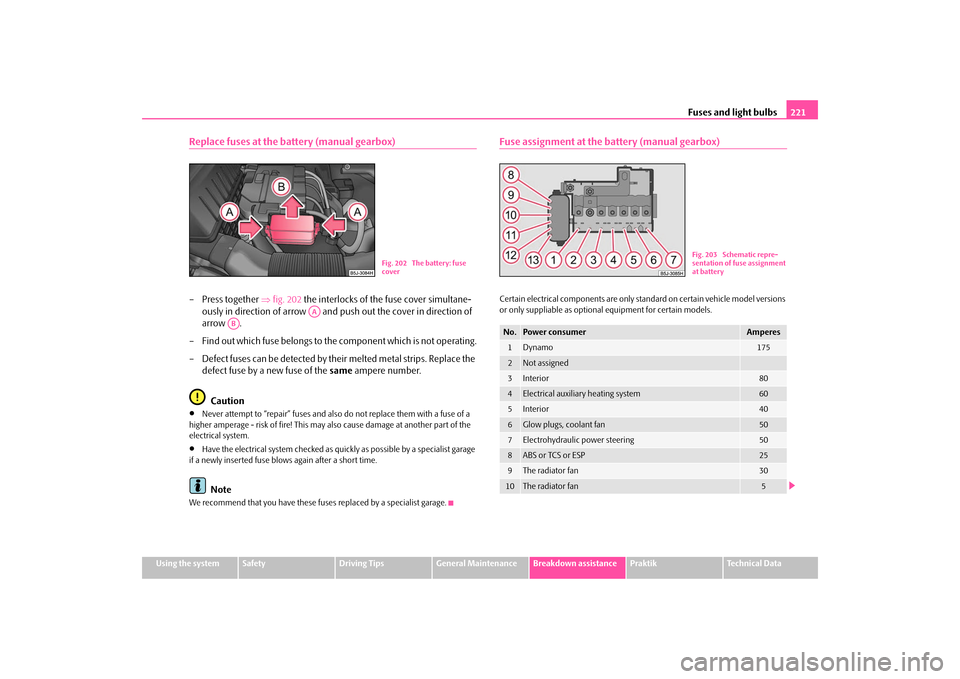
Replace fuses at the battery (manual gearbox)– Press together ⇒fig. 202 the interlocks of the fuse cover simultane-
ously in direction of arrow and push out the cover in direction of
arrow .
– Find out which fuse belongs to the component which is not operating.
– Defect fuses can be detected by their melted metal strips. Replace the
defect fuse by a new fuse of the same ampere number.
Caution•
Never attempt to “repair” fuses and also do not replace them with a fuse of a
higher amperage - risk of fire! This may also cause damage at another part of the
electrical system.
•
Have the electrical system checked as quickly as possible by a specialist garage
if a newly inserted fuse blows again after a short time.Note
We recommend that you have these fuses replaced by a specialist garage.
Fuse assignment at the battery (manual gearbox)Certain electrical components are only standard on certain vehicle model versions
or only suppliable as optional equipment for certain models.
Fig. 202 The battery: fuse
cover
AA
AB
No.
Power consumer
Amperes
1
Dynamo
175
2
Not assigned
3
Interior
80
4
Electrical auxiliary heating system
60
5
Interior
40
6
Glow plugs, coolant fan
50
7
Electrohydraulic power steering
50
8
ABS or TCS or ESP
25
9
The radiator fan
30
10
The radiator fan
5
Fig. 203 Schematic repre-
sentation of fuse assignment
at battery
s29g.4.book Page 221 Wednesday, June 17, 2009 9:54 AM
Page 223 of 263
Fuses and light bulbs 222
CautionObserve the following guidelines ⇒ in “Replace fuses at the battery (manual
gearbox)”.
Note
The fuses 1 - 7 can be replaced by a specialist garage.Replace fuses at the battery (automatic gearbox)
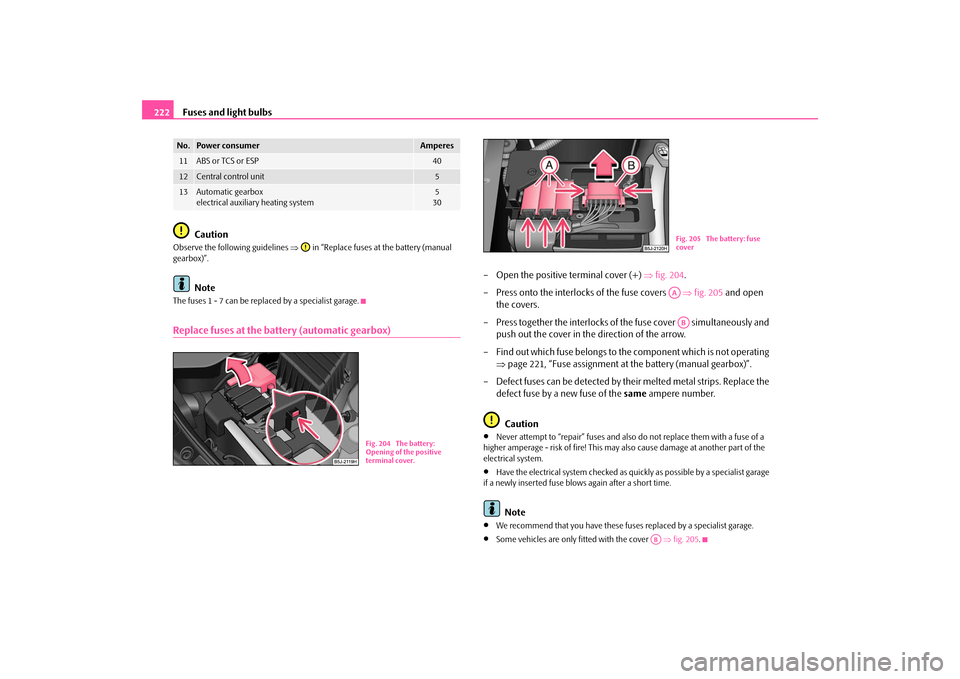
– Open the positive terminal cover (+) ⇒fig. 204.
– Press onto the interlocks of the fuse covers ⇒fig. 205 and open
the covers.
– Press together the interlocks of the fuse cover simultaneously and
push out the cover in the direction of the arrow.
– Find out which fuse belongs to the component which is not operating
⇒page 221, “Fuse assignment at the battery (manual gearbox)”.
– Defect fuses can be detected by their melted metal strips. Replace the
defect fuse by a new fuse of the same ampere number.
Caution•
Never attempt to “repair” fuses and also do not replace them with a fuse of a
higher amperage - risk of fire! This may also cause damage at another part of the
electrical system.
•
Have the electrical system checked as quickly as possible by a specialist garage
if a newly inserted fuse blows again after a short time.Note
•
We recommend that you have these fuses replaced by a specialist garage.
•
Some vehicles are only fitted with the cover ⇒fig. 205.
11
ABS or TCS or ESP
40
12
Central control unit
5
13
Automatic gearbox
electrical auxiliary heating system
5
30
No.
Power consumer
Amperes
Fig. 204 The battery:
Opening of the positive
terminal cover.
Fig. 205 The battery: fuse
coverAAAB
AB
s29g.4.book Page 222 Wednesday, June 17, 2009 9:54 AM
Page 224 of 263
Fuses and light bulbs223
Using the system
Safety
Driving Tips
General Maintenance
Breakdown assistance
Praktik
Technical Data
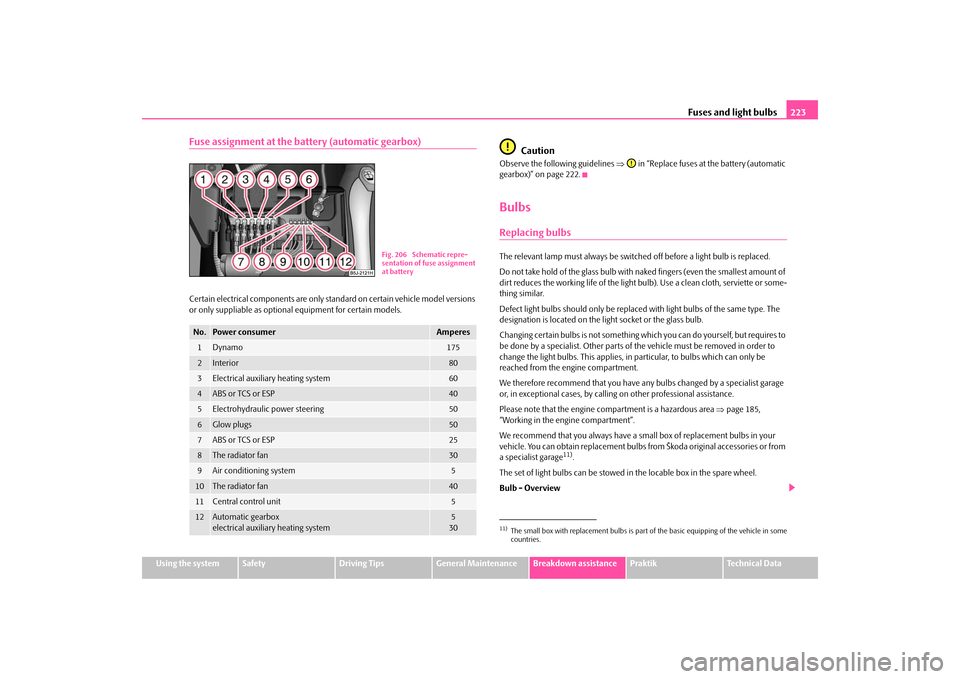
Fuse assignment at the battery (automatic gearbox)Certain electrical components are only standard on certain vehicle model versions
or only suppliable as optional equipment for certain models.
Caution
Observe the following guidelines ⇒ in “Replace fuses at the battery (automatic
gearbox)” on page 222.BulbsReplacing bulbsThe relevant lamp must always be switched off before a light bulb is replaced.
Do not take hold of the glass bulb with naked fingers (even the smallest amount of
dirt reduces the working life of the light bulb). Use a clean cloth, serviette or some-
thing similar.
Defect light bulbs should only be replaced with light bulbs of the same type. The
designation is located on the light socket or the glass bulb.
Changing certain bulbs is not something which you can do yourself, but requires to
be done by a specialist. Other parts of the vehicle must be removed in order to
change the light bulbs. This applies, in particular, to bulbs which can only be
reached from the engine compartment.
We therefore recommend that you have any bulbs changed by a specialist garage
or, in exceptional cases, by calling on other professional assistance.
Please note that the engine compartment is a hazardous area ⇒page 185,
“Working in the engine compartment”.
We recommend that you always have a small box of replacement bulbs in your
vehicle. You can obtain replacement bulbs from Škoda original accessories or from
a specialist garage
11).
The set of light bulbs can be stowed in the locable box in the spare wheel.
Bulb - Overview
No.
Power consumer
Amperes
1
Dynamo
175
2
Interior
80
3
Electrical auxiliary heating system
60
4
ABS or TCS or ESP
40
5
Electrohydraulic power steering
50
6
Glow plugs
50
7
ABS or TCS or ESP
25
8
The radiator fan
30
9
Air conditioning system
5
10
The radiator fan
40
11
Central control unit
5
12
Automatic gearbox
electrical auxiliary heating system
5
30
Fig. 206 Schematic repre-
sentation of fuse assignment
at battery
11)The small box with replacement bulbs is part of the basic equipping of the vehicle in some
countries.
s29g.4.book Page 223 Wednesday, June 17, 2009 9:54 AM
Page 234 of 263
Technical Data233
Using the system
Safety
Driving Tips
General Maintenance
Breakdown assistance
Praktik
Technical Data
Technical DataTechnical DataGeneral informationThe details given in the official vehicle registration documents always take prece-
dence over the details in the Owner's Manual. Please refer to the official vehicle
registration documents or consult a specialist garage concerning the engine with
which your vehicle is equipped.Used abbreviationsPerformancesThe listed performance values were determined without performance-reducing
equipment, e.g. air conditioning system.
WeightThe loading capacity is reduced in line with the range of the special equipment. The
unloaden weight contains a fuel tank topped up to 90%. A driver with a weight of
75 kg is also included in the value.Identification detailsVehicle data sticker
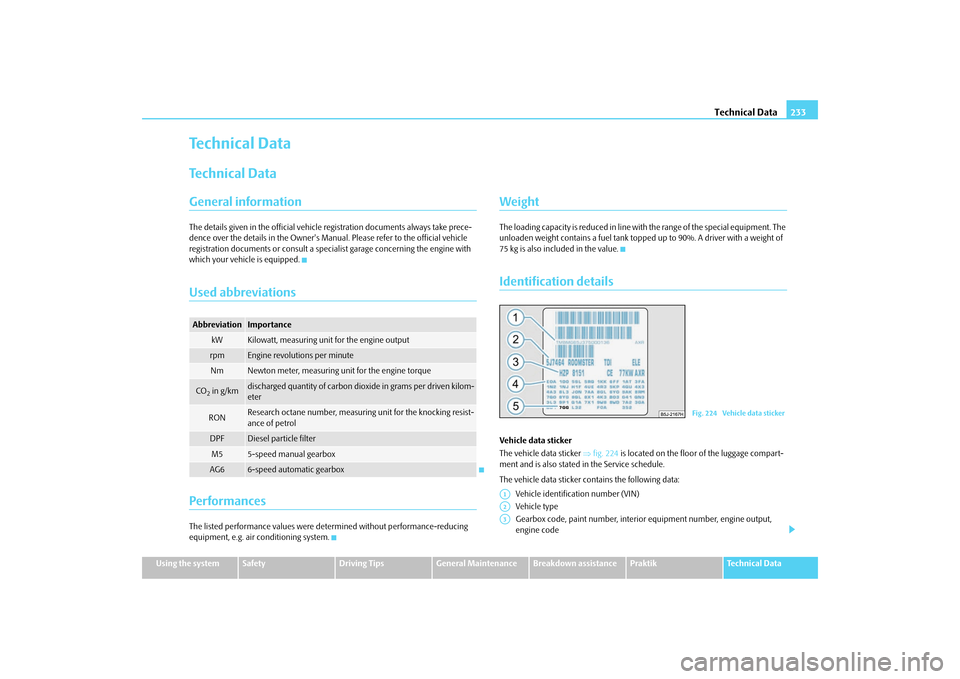
The vehicle data sticker ⇒fig. 224 is located on the floor of the luggage compart-
ment and is also stated in the Service schedule.
The vehicle data sticker contains the following data:
Vehicle identification number (VIN)
Vehicle type
Gearbox code, paint number, interior equipment number, engine output,
engine code
Abbreviation
Importance
kW
Kilowatt, measuring unit for the engine output
rpm
Engine revolutions per minute
Nm
Newton meter, measuring unit for the engine torque
CO2 in g/km
discharged quantity of carbon dioxide in grams per driven kilom-
eter
RON
Research octane number, measuring unit for the knocking resist-
ance of petrol
DPF
Diesel particle filter
M5
5-speed manual gearbox
AG6
6-speed automatic gearbox
Fig. 224 Vehicle data sticker
A1A2A3
s29g.4.book Page 233 Wednesday, June 17, 2009 9:54 AM