seats SKODA ROOMSTER 2009 1.G Owner's Guide
[x] Cancel search | Manufacturer: SKODA, Model Year: 2009, Model line: ROOMSTER, Model: SKODA ROOMSTER 2009 1.GPages: 263, PDF Size: 32.25 MB
Page 76 of 263
Seats and Storage75
Using the system
Safety
Driving Tips
General Maintenance
Breakdown assistance
Praktik
Technical Data
The variable loading floor makes it easier to handle bulky goods and
creates an even luggage compartment floor when the rear seats are
folded forward. The maximum permissable surface load of the variable
loading floor is 75 kg.
Remove variable loading floor
– Unhook the loops ⇒page 74, fig. 82 of the elastic partition out of
the fixing points.
– Unlock the loading floor by turning the locking bolts by approx.
180° to the left ⇒page 74, fig. 82.
– You can fold together the loading floor by moving in the direction of
arrow.
– Lift up the loading floor in direction of arrow ⇒page 74, fig. 83
and take out the loading floor by pulling in direction of arrow
⇒page 74, fig. 83.
Install variable loading floor
– Place the loading floor once folded together onto the carrier rails.
– Fold open the loading floor.
– Lock the loading floor by turning the locking bolts ⇒page 74,
fig. 82 by approx. 180° to the right.
– Attach the loops of the elastic partition to the fixing points.
WARNING
Pay attention when installing that the carrier rails and the variable loading
floor are correctly fixed, otherwise the occupants are at risk.
Note
If the variable loading floor* is installed, no flexible storage compartment or fixing
nets* can be installed.
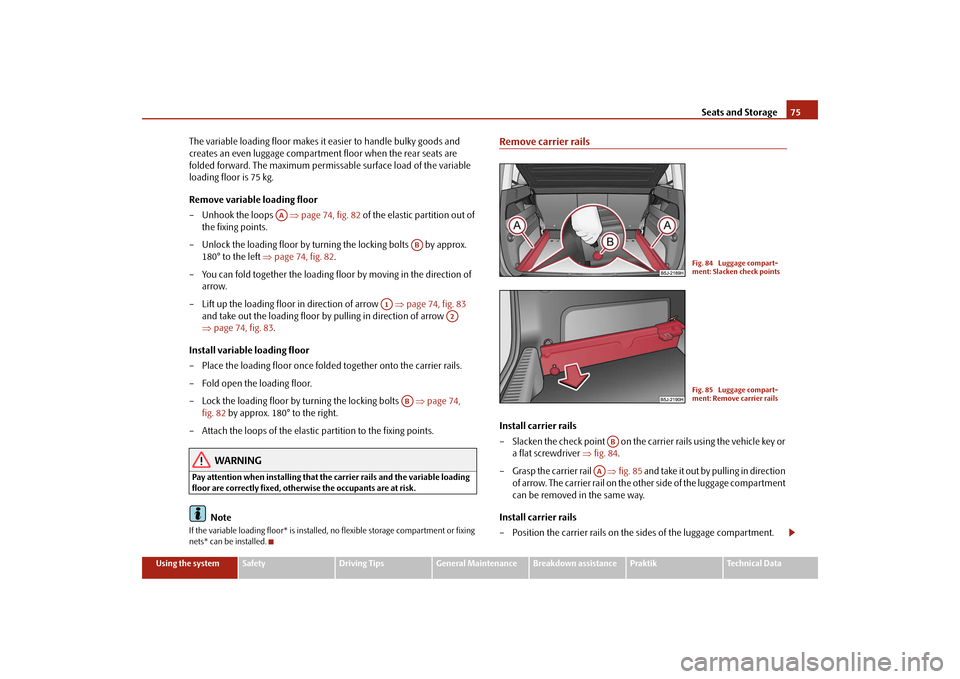
Remove carrier railsInstall carrier rails
– Slacken the check point on the carrier rails using the vehicle key or
a flat screwdriver ⇒fig. 84.
– Grasp the carrier rail ⇒fig. 85 and take it out by pulling in direction
of arrow. The carrier rail on the other side of the luggage compartment
can be removed in the same way.
Install carrier rails
– Position the carrier rails on the sides of the luggage compartment.
AA
AB
A1
A2
AB
Fig. 84 Luggage compart-
ment: Slacken check pointsFig. 85 Luggage compart-
ment: Remove carrier rails
AB
AA
s29g.4.book Page 75 Wednesday, June 17, 2009 9:54 AM
Page 77 of 263
Seats and Storage 76
– Press the check point on each carrier rail up to the stop.
– Check the attachment of the carrier rails by pulling it.
WARNING
Pay attention when installing that the carrier rails and the variable loading
floor are correctly fixed, otherwise the occupants are at risk.Take out lateral carrier rail and fixing wedges
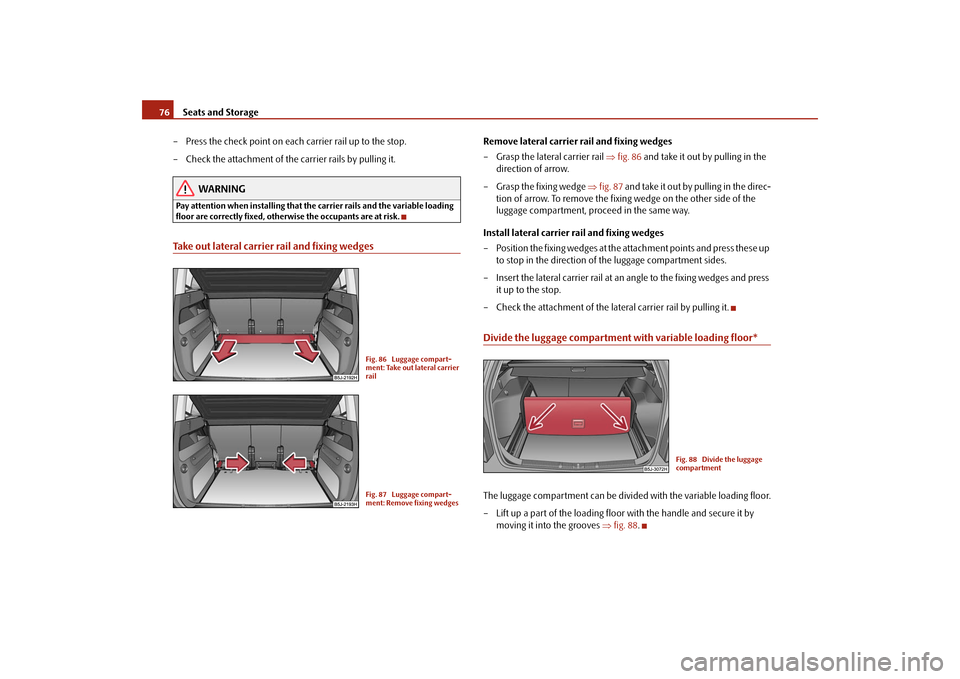
Remove lateral carrier rail and fixing wedges
– Grasp the lateral carrier rail ⇒fig. 86 and take it out by pulling in the
direction of arrow.
– Grasp the fixing wedge ⇒fig. 87 and take it out by pulling in the direc-
tion of arrow. To remove the fixing wedge on the other side of the
luggage compartment, proceed in the same way.
Install lateral carrier rail and fixing wedges
– Position the fixing wedges at the attachment points and press these up
to stop in the direction of the luggage compartment sides.
– Insert the lateral carrier rail at an angle to the fixing wedges and press
it up to the stop.
– Check the attachment of the lateral carrier rail by pulling it.Divide the luggage compartment with variable loading floor*The luggage compartment can be divided with the variable loading floor.
– Lift up a part of the loading floor with the handle and secure it by
moving it into the grooves ⇒fig. 88.
Fig. 86 Luggage compart-
ment: Take out lateral carrier
railFig. 87 Luggage compart-
ment: Remove fixing wedges
Fig. 88 Divide the luggage
compartment
s29g.4.book Page 76 Wednesday, June 17, 2009 9:54 AM
Page 78 of 263
Seats and Storage77
Using the system
Safety
Driving Tips
General Maintenance
Breakdown assistance
Praktik
Technical Data
Bicycle carrier*Install cross member– Remove the rear seats or fold the seats fully forwards, in order to make
available the necessary space in the luggage compartment
⇒page 68.
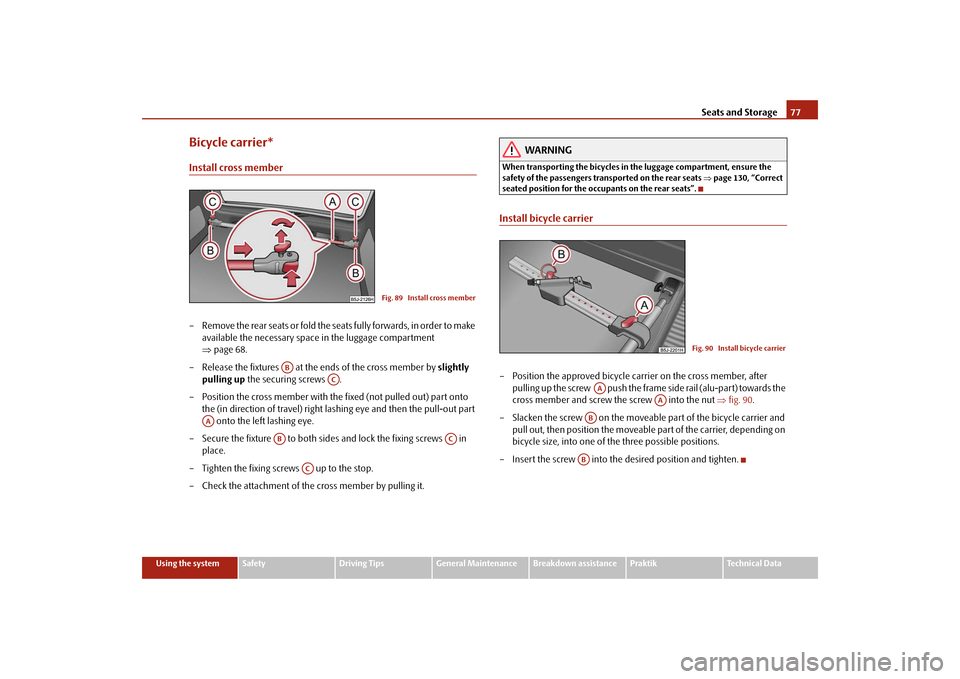
– Release the fixtures at the ends of the cross member by slightly
pulling up the securing screws .
– Position the cross member with the fixed (not pulled out) part onto
the (in direction of travel) right lashing eye and then the pull-out part
onto the left lashing eye.
– Secure the fixture to both sides and lock the fixing screws in
place.
– Tighten the fixing screws up to the stop.
– Check the attachment of the cross member by pulling it.
WARNING
When transporting the bicycles in the luggage compartment, ensure the
safety of the passengers transported on the rear seats ⇒page 130, “Correct
seated position for the occupants on the rear seats”.Install bicycle carrier– Position the approved bicycle carrier on the cross member, after
pulling up the screw push the frame side rail (alu-part) towards the
cross member and screw the screw into the nut ⇒fig. 90.
– Slacken the screw on the moveable part of the bicycle carrier and
pull out, then position the moveable part of the carrier, depending on
bicycle size, into one of the three possible positions.
– Insert the screw into the desired position and tighten.
Fig. 89 Install cross member
AB
AC
AA
AB
AC
AC
Fig. 90 Install bicycle carrier
AA
AA
ABAB
s29g.4.book Page 77 Wednesday, June 17, 2009 9:54 AM
Page 79 of 263
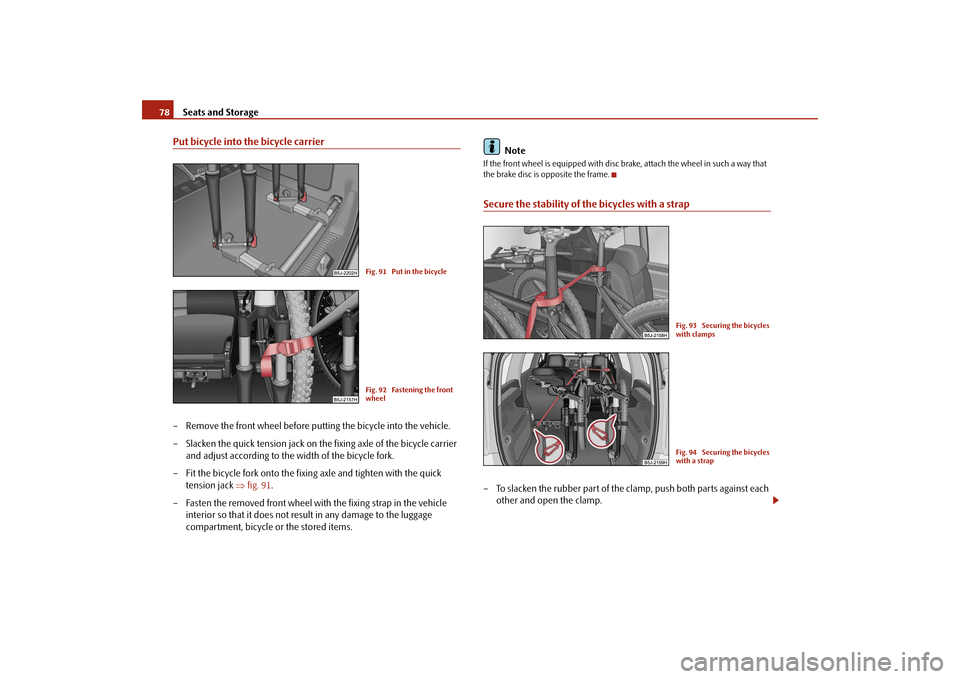
Seats and Storage 78Put bicycle into the bicycle carrier– Remove the front wheel before putting the bicycle into the vehicle.
– Slacken the quick tension jack on the fixing axle of the bicycle carrier
and adjust according to the width of the bicycle fork.
– Fit the bicycle fork onto the fixing axle and tighten with the quick
tension jack ⇒fig. 91.
– Fasten the removed front wheel with the fixing strap in the vehicle
interior so that it does not result in any damage to the luggage
compartment, bicycle or the stored items.Note
If the front wheel is equipped with disc brake, attach the wheel in such a way that
the brake disc is opposite the frame.Secure the stability of the bicycles with a strap– To slacken the rubber part of the clamp, push both parts against each
other and open the clamp.
Fig. 91 Put in the bicycleFig. 92 Fastening the front
wheel
Fig. 93 Securing the bicycles
with clampsFig. 94 Securing the bicycles
with a strap
s29g.4.book Page 78 Wednesday, June 17, 2009 9:54 AM
Page 80 of 263
Seats and Storage79
Using the system
Safety
Driving Tips
General Maintenance
Breakdown assistance
Praktik
Technical Data
– Position the clamp with the rubber part to the front (in direction of
travel) as far as possible below the saddle rod and close the clamp
⇒page 78, fig. 93.
– When transporting two bicycles tension the strap ⇒page 78, fig. 93
between the saddle rods.
– Hang the carabines at the ends of the strap into the lashing eyes
behind the rear seats.
– Pull the strap through the tensioning clasp, first of all on the one side
and then on the other side.
– If it is necessary, the position of the bicycles in the vehicle can be addi-
tionally rectified.
WARNING
•
When transporting passengers and objects, which require the seats to be
folded forwards, ensure the safety of the passengers being transported on
the rear seats ⇒page 130, “Correct seated position for the occupants on the
rear seats”.
•
Place the bicycles in the bicycle carrier in such a position that no collision
between the steering arm and the rear window can occur.
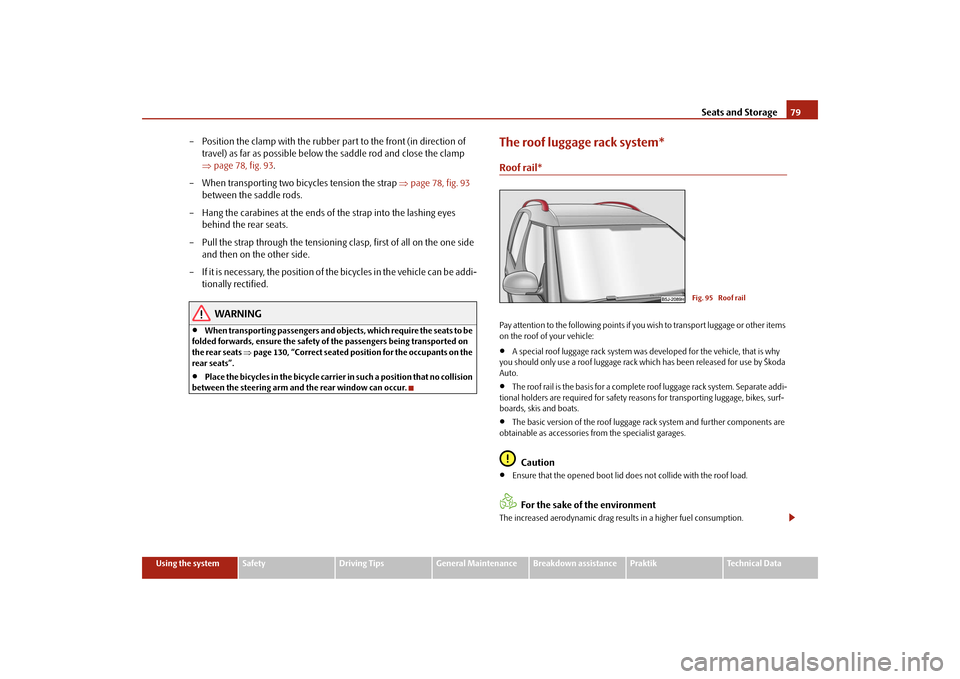
The roof luggage rack system*Roof rail*Pay attention to the following points if you wish to transport luggage or other items
on the roof of your vehicle:•
A special roof luggage rack system was developed for the vehicle, that is why
you should only use a roof luggage rack which has been released for use by Škoda
Auto.
•
The roof rail is the basis for a complete roof luggage rack system. Separate addi-
tional holders are required for safety reasons for transporting luggage, bikes, surf-
boards, skis and boats.
•
The basic version of the roof luggage rack system and further components are
obtainable as accessories from the specialist garages.Caution
•
Ensure that the opened boot lid does not collide with the roof load.For the sake of the environment
The increased aerodynamic drag results in a higher fuel consumption.
Fig. 95 Roof rail
s29g.4.book Page 79 Wednesday, June 17, 2009 9:54 AM
Page 81 of 263
Seats and Storage 80
NoteIf a roof rail is not fitted onto a vehicle at the works, it is obtainable from a specialist
garage which carries out the professional fitting.Roof loadDistribute weight evenly over the roof luggage rack system. The maximum permis-
sible roof load (including roof rack system) of 75 kg and the maximum permissible
total weight of the vehicle should not be exceeded.
You cannot make full use of the permissible roof load if you use a roof luggage rack
system with a lower load carrying capacity. The load transported on the roof
luggage rack system must not exceed the weight limit which is stated in the fitting
instructions.
WARNING
•
The items which you transport on the roof bar system must be reliably
attached - risk of accident!
•
You must on no account exceed the permissible roof load, the permis-
sible axle loads and the permissible gross weight of your vehicle - risk of
accident!
•
Please note that the handling properties of your vehicle change when
you transport heavy or bulky items on the roof bar system as a result of the
displacement of the centre of gravity and the increased wind attack area -
risk of accident! You must absolutely adapt your style of driving and the
speed of the vehicle to the specific circumstances.
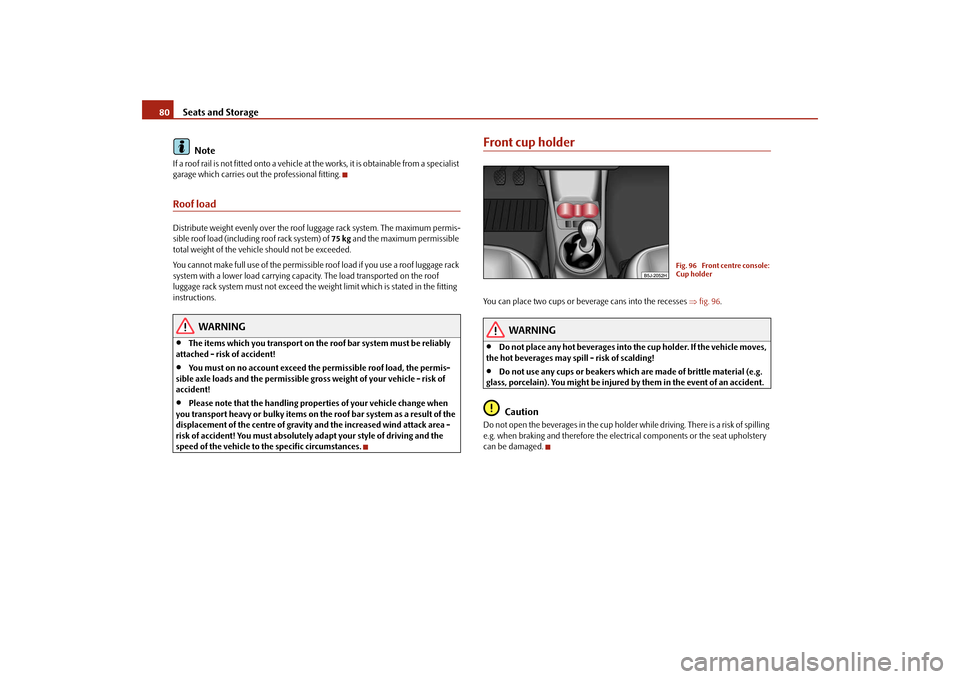
Front cup holderYou can place two cups or beverage cans into the recesses ⇒fig. 96.
WARNING
•
Do not place any hot beverages into the cup holder. If the vehicle moves,
the hot beverages may spill - risk of scalding!
•
Do not use any cups or beakers which are made of brittle material (e.g.
glass, porcelain). You might be injured by them in the event of an accident.Caution
Do not open the beverages in the cup holder while driving. There is a risk of spilling
e.g. when braking and therefore the electrical components or the seat upholstery
can be damaged.
Fig. 96 Front centre console:
Cup holder
s29g.4.book Page 80 Wednesday, June 17, 2009 9:54 AM
Page 82 of 263
Seats and Storage81
Using the system
Safety
Driving Tips
General Maintenance
Breakdown assistance
Praktik
Technical Data
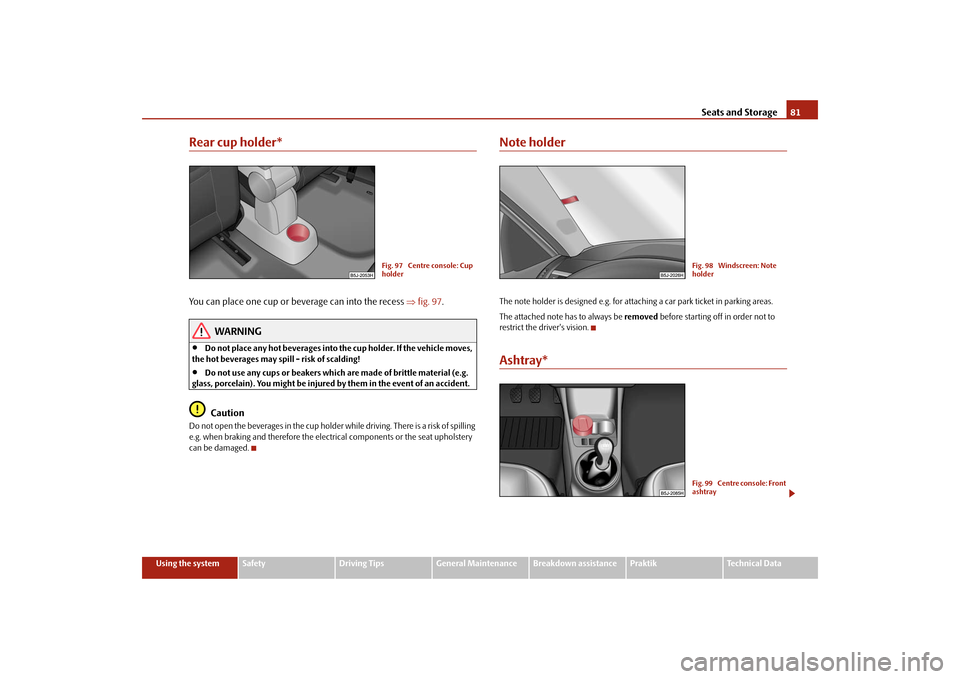
Rear cup holder*You can place one cup or beverage can into the recess ⇒fig. 97.
WARNING
•
Do not place any hot beverages into the cup holder. If the vehicle moves,
the hot beverages may spill - risk of scalding!
•
Do not use any cups or beakers which are made of brittle material (e.g.
glass, porcelain). You might be injured by them in the event of an accident.Caution
Do not open the beverages in the cup holder while driving. There is a risk of spilling
e.g. when braking and therefore the electrical components or the seat upholstery
can be damaged.
Note holderThe note holder is designed e.g. for attaching a car park ticket in parking areas.
The attached note has to always be removed before starting off in order not to
restrict the driver's vision.Ashtray*
Fig. 97 Centre console: Cup
holder
Fig. 98 Windscreen: Note
holderFig. 99 Centre console: Front
ashtray
s29g.4.book Page 81 Wednesday, June 17, 2009 9:54 AM
Page 83 of 263
Seats and Storage 82
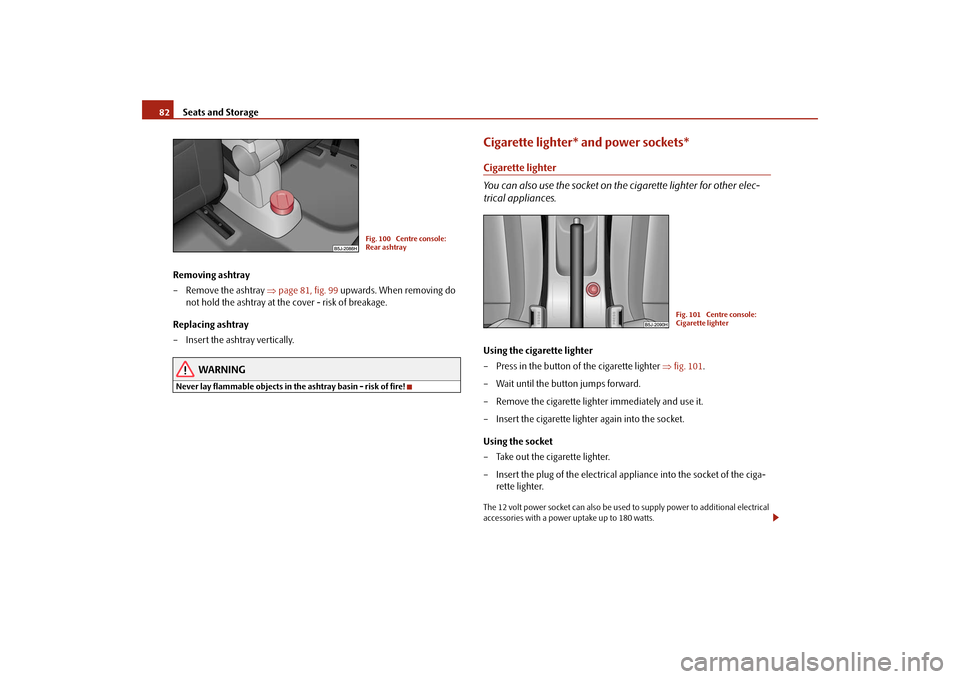
Removing ashtray
– Remove the ashtray ⇒page 81, fig. 99 upwards. When removing do
not hold the ashtray at the cover - risk of breakage.
Replacing ashtray
– Insert the ashtray vertically.
WARNING
Never lay flammable objects in the ashtray basin - risk of fire!
Cigarette lighter* and power sockets*Cigarette lighter
You can also use the socket on the cigarette lighter for other elec-
trical appliances.Using the cigarette lighter
– Press in the button of the cigarette lighter ⇒fig. 101.
– Wait until the button jumps forward.
– Remove the cigarette lighter immediately and use it.
– Insert the cigarette lighter again into the socket.
Using the socket
– Take out the cigarette lighter.
– Insert the plug of the electrical appliance into the socket of the ciga-
rette lighter.The 12 volt power socket can also be used to supply power to additional electrical
accessories with a power uptake up to 180 watts.
Fig. 100 Centre console:
Rear ashtray
Fig. 101 Centre console:
Cigarette lighter
s29g.4.book Page 82 Wednesday, June 17, 2009 9:54 AM
Page 84 of 263
Seats and Storage83
Using the system
Safety
Driving Tips
General Maintenance
Breakdown assistance
Praktik
Technical Data
WARNING
•
Take care when using the cigarette lighter! Not paying proper attention
or incorrect use the cigarette lighter in an uncontrolled manner may result in
burns.
•
The cigarette lighter and the power socket also operates when the igni-
tion is switched off or the ignition key withdrawn. This is why you should
never leave children unattended in the vehicle!Caution
Only use matching plugs, which fulfils the DIN - ISO Standard 4165, to avoid
damaging the power sockets.
Note
Connecting electrical components when the engine is not running will drain
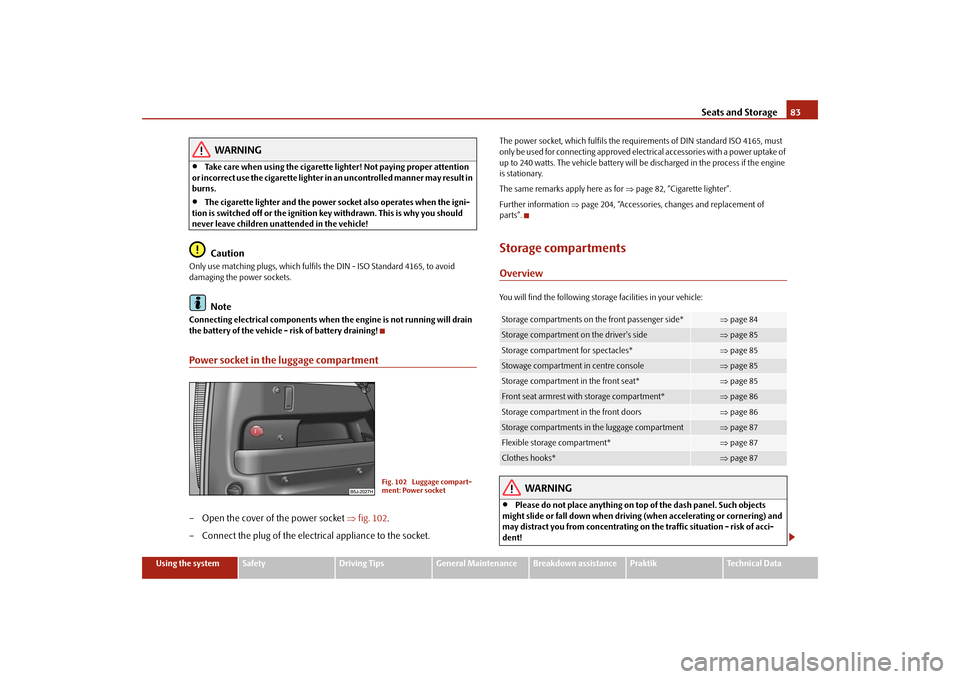
the battery of the vehicle - risk of battery draining!Power socket in the luggage compartment– Open the cover of the power socket ⇒fig. 102.
– Connect the plug of the electrical appliance to the socket.
The power socket, which fulfils the requirements of DIN standard ISO 4165, must
only be used for connecting approved electrical accessories with a power uptake of
up to 240 watts. The vehicle battery will be discharged in the process if the engine
is stationary.
The same remarks apply here as for ⇒page 82, “Cigarette lighter”.
Further information ⇒page 204, “Accessories, changes and replacement of
parts”.Storage compartmentsOverviewYou will find the following storage facilities in your vehicle:
WARNING
•
Please do not place anything on top of the dash panel. Such objects
might slide or fall down when driving (when accelerating or cornering) and
may distract you from concentrating on the traffic situation - risk of acci-
dent!
Fig. 102 Luggage compart-
ment: Power socket
Storage compartments on the front passenger side*
⇒page 84
Storage compartment on the driver's side
⇒page 85
Storage compartment for spectacles*
⇒page 85
Stowage compartment in centre console
⇒page 85
Storage compartment in the front seat*
⇒page 85
Front seat armrest with storage compartment*
⇒page 86
Storage compartment in the front doors
⇒page 86
Storage compartments in the luggage compartment
⇒page 87
Flexible storage compartment*
⇒page 87
Clothes hooks*
⇒page 87
s29g.4.book Page 83 Wednesday, June 17, 2009 9:54 AM
Page 85 of 263
Seats and Storage 84•
Ensure that when driving no objects from the centre console of from
other storage possibilities may get into the footwell of the driver. You would
then no longer be able to apply the brakes, operate the clutch or accelerator
- risk of accident!
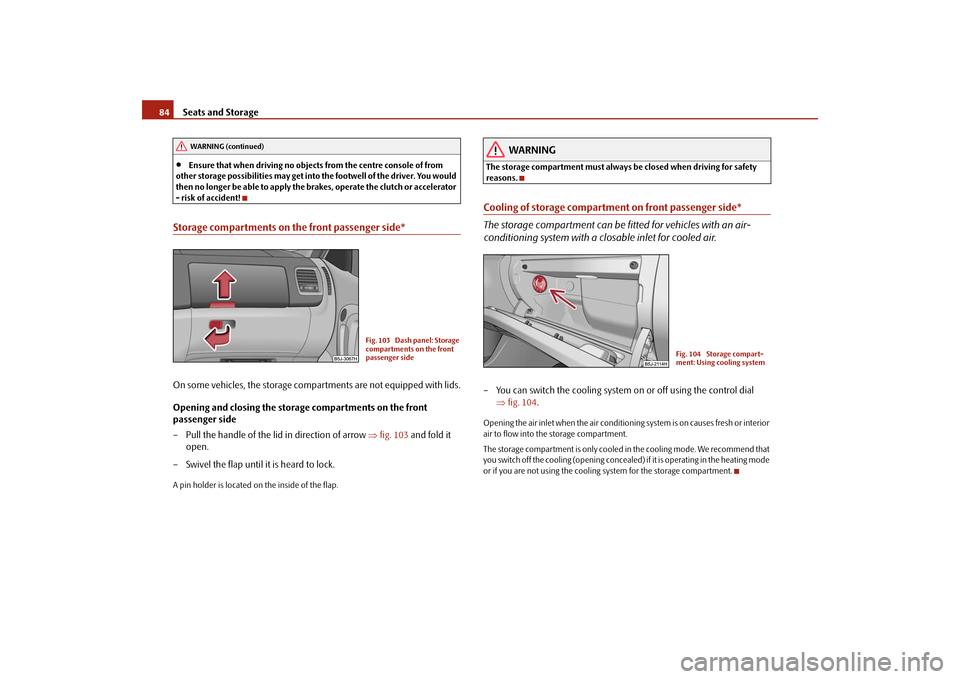
Storage compartments on the front passenger side*On some vehicles, the storage compartments are not equipped with lids.
Opening and closing the storage compartments on the front
passenger side
– Pull the handle of the lid in direction of arrow ⇒fig. 103 and fold it
open.
– Swivel the flap until it is heard to lock.A pin holder is located on the inside of the flap.
WARNING
The storage compartment must always be closed when driving for safety
reasons.Cooling of storage compartment on front passenger side*
The storage compartment can be fitted for vehicles with an air-
conditioning system with a closable inlet for cooled air.– You can switch the cooling system on or off using the control dial
⇒fig. 104.Opening the air inlet when the air conditioning system is on causes fresh or interior
air to flow into the storage compartment.
The storage compartment is only cooled in the cooling mode. We recommend that
you switch off the cooling (opening concealed) if it is operating in the heating mode
or if you are not using the cooling system for the storage compartment.
WARNING (continued)
Fig. 103 Dash panel: Storage
compartments on the front
passenger side
Fig. 104 Storage compart-
ment: Using cooling system
s29g.4.book Page 84 Wednesday, June 17, 2009 9:54 AM