warning SKODA ROOMSTER 2009 1.G Service Manual
[x] Cancel search | Manufacturer: SKODA, Model Year: 2009, Model line: ROOMSTER, Model: SKODA ROOMSTER 2009 1.GPages: 263, PDF Size: 32.25 MB
Page 58 of 263
Lights and Visibility57
Using the system
Safety
Driving Tips
General Maintenance
Breakdown assistance
Praktik
Technical Data
– Push the lever forwards - the main beam and warning light in the
instrument cluster come on.
– Pull the lever back into the initial position in order to switch the main
beam off again.
Headlight flasher
– Pull on the lever of the steering wheel (sprung position) - the main
beam and warning light in the instrument cluster come on.
Parking light
– Switch off the ignition.
– Push the lever up or down - the right-hand or left-hand parking light
is switched on.Information concerning the function of the lights.•
The turn signal system only operates when the ignition is switched on. The
corresponding indicator light
or in the instrument cluster also flashes.
•
The turn signal is automatically cancelled after negotiating a curve.
•
The side light and rear light on the appropriate side of the vehicle are switched
on when the parking light is selected. The parking light function only operates if
the ignition is switched off.
•
An acoustic warning signal will sound when the driver's door is opened if the
lever is not in the middle position after removing the ignition key. The acoustic
warning signal will stop just as soon as the driver's door is closed.Caution
Use main beam or the headlight flasher only if this does not risk dazzling other road
users.
Note
Use only in accordance with the legal requirements the described lighting and
signal systems.
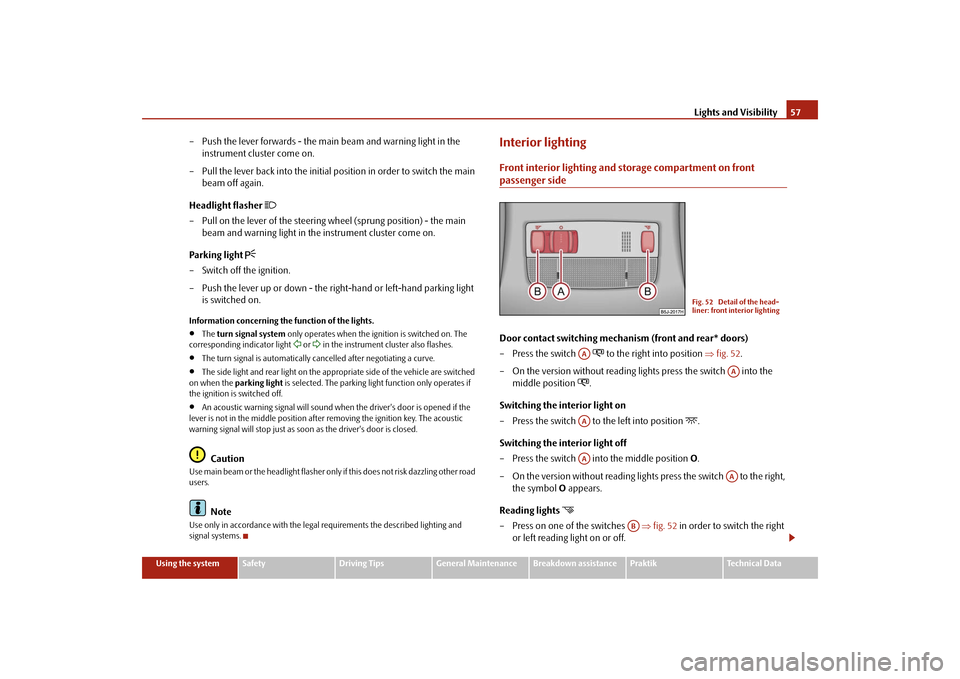
Interior lightingFront interior lighting and storage compartment on front passenger sideDoor contact switching mechanism (front and rear* doors)
– Press the switch
to the right into position ⇒fig. 52.
– On the version without reading lights press the switch into the
middle position
.
Switching the interior light on
– Press the switch to the left into position
.
Switching the interior light off
– Press the switch into the middle position O.
– On the version without reading lights press the switch to the right,
the symbol O appears.
Reading lights
– Press on one of the switches ⇒fig. 52 in order to switch the right
or left reading light on or off.
Fig. 52 Detail of the head-
liner: front interior lighting
AA
AA
AAAA
AA
AB
s29g.4.book Page 57 Wednesday, June 17, 2009 9:54 AM
Page 60 of 263
Lights and Visibility59
Using the system
Safety
Driving Tips
General Maintenance
Breakdown assistance
Praktik
Technical Data
For the sake of the environment
As soon as the window is de-iced or free from mist, the heating should be switched
off. The reduced current consumption will have a favourable effect on fuel
economy ⇒page 167, “Saving electricity”.Sun visors
Using the sun visors can contribute to increasing road safety.You can pull the sun visor for the driver or front passenger out of the fixture and
swivel it toward the door in the direction of the arrow ⇒fig. 55.
The vanity mirrors* for the driver and front passenger, which are integrated in the
sun visors, are provided with covers. Push the cover in direction of arrow .
WARNING
The sun visors must not be swivelled to the side windows into the deploy-
ment area of the head airbags if any objects, such as ball-point pens etc. are
attached to them. This might result in injuries to the occupants if the head
airbag is deployed.
Windshield wiper and wash systemWindshield wiper
You can operate the windscreen wipers and automatic wipe/wash
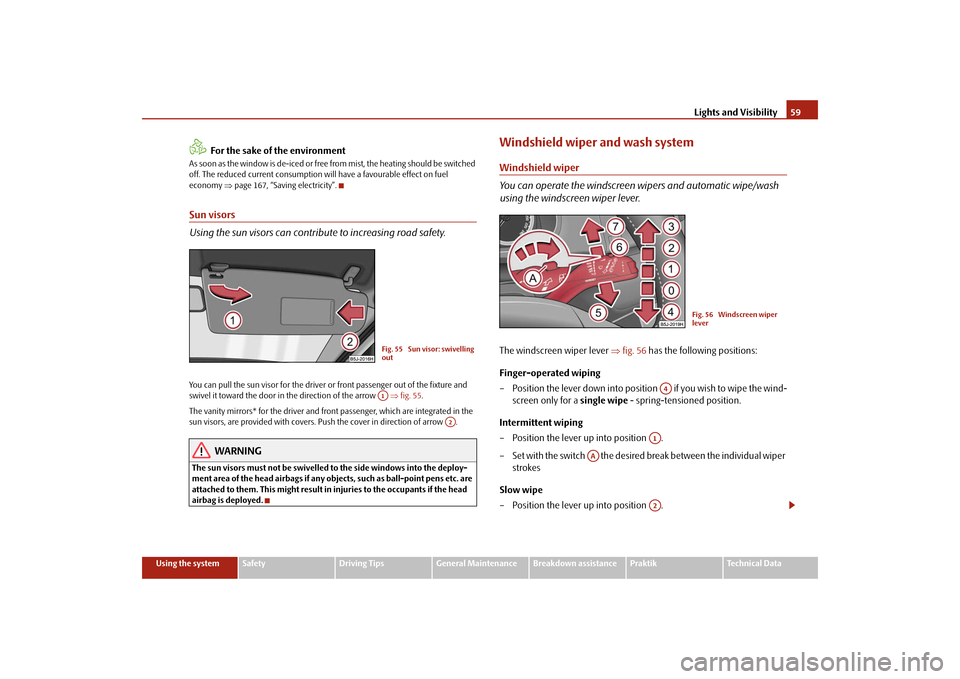
using the windscreen wiper lever.The windscreen wiper lever ⇒fig. 56 has the following positions:
Finger-operated wiping
– Position the lever down into position if you wish to wipe the wind-
screen only for a single wipe - spring-tensioned position.
Intermittent wiping
– Position the lever up into position .
– Set with the switch the desired break between the individual wiper
strokes
Slow wipe
– Position the lever up into position .
Fig. 55 Sun visor: swivelling
outA1
A2
Fig. 56 Windscreen wiper
lever
A4
A1
AA
A2
s29g.4.book Page 59 Wednesday, June 17, 2009 9:54 AM
Page 61 of 263
Lights and Visibility 60
Fast wipe
– Position the lever up into position .
Automatic wipe/wash for windscreen
– Pull the lever towards the steering wheel into position and the
widescreen wiper and wash system will operate - in the sprung posi-
tion.
– Release the lever. The windscreen wash system stops and the wiper
continues for another 1 - 3 wiper strokes (depending on the period of
spraying of the windscreen).
Wiping the rear window pane*
– Push the lever away from the steering wheel into position
⇒page 59, fig. 56, the widescreen wiper will operate every 6 seconds.
Automatic wipe/wash for the rear window pane*
– Push the lever away from the steering wheel into position - the
widescreen wiper and wash system will operate - in the sprung posi-
tion.
– Letting go of the lever will cause the windscreen wash system to stop
and the wiper to continue for another 1 - 3 wiper strokes (depending
on the period of spraying of the windscreen). The lever will stay in
position after releasing it .
Switching windscreen wipers off
– Move the lever back into its home position .The windscreen wipers and the windscreen washer system only operate if the igni-
tion is switched on.
The rear window will be wiped again if the window wipers are on when reverse gear
is selected.
The windscreen washer nozzles are heated* when the ignition is switched on.Top up with wash liquid ⇒page 196.
WARNING
•
Properly maintained windscreen wiper blades are essential for clear visi-
bility and safe driving ⇒page 61.
•
Do not use the windscreen washer system at low temperatures, without
heating the windscreen beforehand. Otherwise the window cleaner could
freeze on the windscreen and restrict the view to the front.
•
In the event of a freezing up of the windscreen, first of all eliminate the ice
⇒page 176 and then operate the windscreen wiper otherwise the wind-
screen wiper blades could be damaged.Caution
In frosty weather, please first of all check whether the windscreen wiper blades are
not frozen to the windscreen before switching them on. Switching on windscreen
wipers when the blades are frozen to the windscreen may result in damage both to
the blades and the motor of the windscreen wipers!Headlight cleaning system*The headlights are being cleaned after the windscreen washer system has been
operated for the fifth time, the low beam or main beam are switched on as well as
the windscreen wiper lever is held in the position ⇒page 59, fig. 56 for about 1
second.
You should remove stubborn dirt (such as insect residues) from the headlight
lenses at regular intervals, for example when refuelling. Please refer to the following
guidelines ⇒page 176, “The headlight lenses”.
You should remove any snow from the fixtures of the washer nozzles and clear ice
in winter with a de-icing spray in order to ensure proper operation of the cleaning
system.
A3
A5A6A7
A6
A0
A5
s29g.4.book Page 60 Wednesday, June 17, 2009 9:54 AM
Page 62 of 263
Lights and Visibility61
Using the system
Safety
Driving Tips
General Maintenance
Breakdown assistance
Praktik
Technical Data
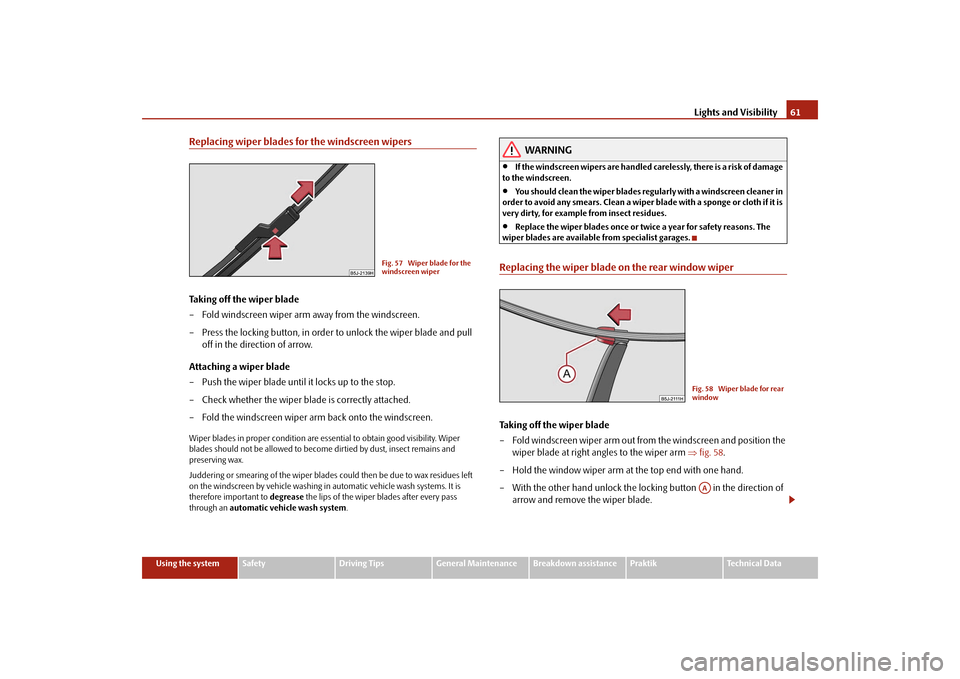
Replacing wiper blades for the windscreen wipersTaking off the wiper blade
– Fold windscreen wiper arm away from the windscreen.
– Press the locking button, in order to unlock the wiper blade and pull
off in the direction of arrow.
Attaching a wiper blade
– Push the wiper blade until it locks up to the stop.
– Check whether the wiper blade is correctly attached.
– Fold the windscreen wiper arm back onto the windscreen.Wiper blades in proper condition are essential to obtain good visibility. Wiper
blades should not be allowed to become dirtied by dust, insect remains and
preserving wax.
Juddering or smearing of the wiper blades could then be due to wax residues left
on the windscreen by vehicle washing in automatic vehicle wash systems. It is
therefore important to degrease the lips of the wiper blades after every pass
through an automatic vehicle wash system.
WARNING
•
If the windscreen wipers are handled carelessly, there is a risk of damage
to the windscreen.
•
You should clean the wiper blades regularly with a windscreen cleaner in
order to avoid any smears. Clean a wiper blade with a sponge or cloth if it is
very dirty, for example from insect residues.
•
Replace the wiper blades once or twice a year for safety reasons. The
wiper blades are available from specialist garages.
Replacing the wiper blade on the rear window wiperTaking off the wiper blade
– Fold windscreen wiper arm out from the windscreen and position the
wiper blade at right angles to the wiper arm ⇒fig. 58.
– Hold the window wiper arm at the top end with one hand.
– With the other hand unlock the locking button in the direction of
arrow and remove the wiper blade.
Fig. 57 Wiper blade for the
windscreen wiper
Fig. 58 Wiper blade for rear
windowAA
s29g.4.book Page 61 Wednesday, June 17, 2009 9:54 AM
Page 63 of 263
Lights and Visibility 62
Attaching a wiper blade
– Position the wiper blade onto the wiper arm and lock the locking
button .
– Check whether the wiper blade is correctly attached.The same remarks apply here as for ⇒page 61.Rear mirrorYou can adjust the exterior mirrors electrically*.Adjust the rear mirror before commencing to drive so that there is a clear
view to the rear.
Dimming the interior mirror
– Pull the lever on the bottom edge of the mirror toward rear (the lever
on the interior mirror must point forwards in it home position).
Heating of the external mirror*
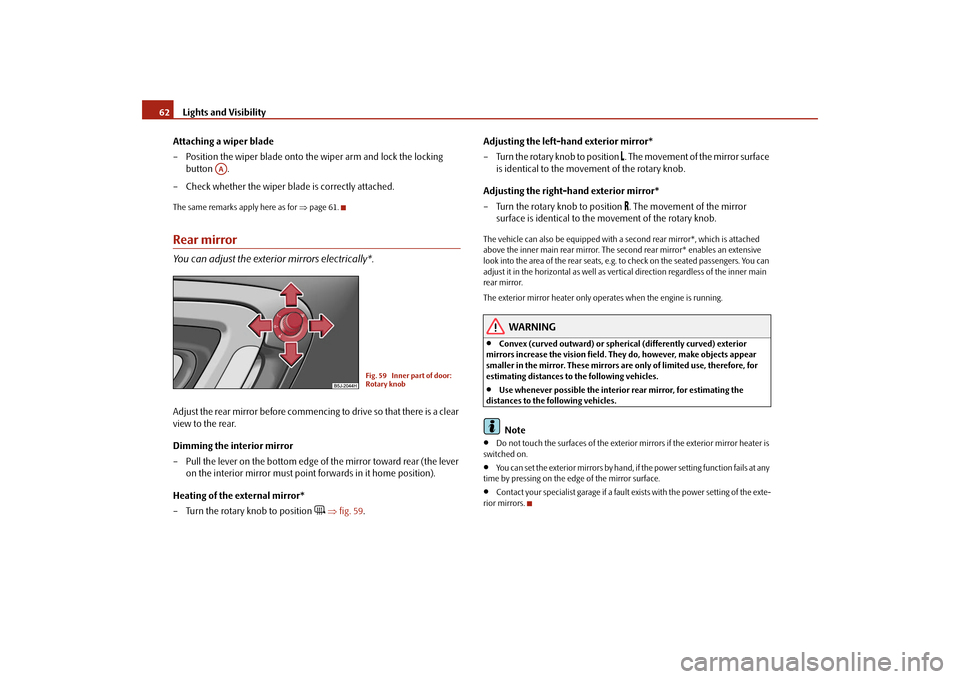
– Turn the rotary knob to position
⇒fig. 59.Adjusting the left-hand exterior mirror*
– Turn the rotary knob to position
. The movement of the mirror surface
is identical to the movement of the rotary knob.
Adjusting the right-hand exterior mirror*
– Turn the rotary knob to position . The movement of the mirror
surface is identical to the movement of the rotary knob.
The vehicle can also be equipped with a second rear mirror*, which is attached
above the inner main rear mirror. The second rear mirror* enables an extensive
look into the area of the rear seats, e.g. to check on the seated passengers. You can
adjust it in the horizontal as well as vertical direction regardless of the inner main
rear mirror.
The exterior mirror heater only operates when the engine is running.
WARNING
•
Convex (curved outward) or spherical (differently curved) exterior
mirrors increase the vision field. They do, however, make objects appear
smaller in the mirror. These mirrors are only of limited use, therefore, for
estimating distances to the following vehicles.
•
Use whenever possible the interior rear mirror, for estimating the
distances to the following vehicles.Note
•
Do not touch the surfaces of the exterior mirrors if the exterior mirror heater is
switched on.
•
You can set the exterior mirrors by hand, if the power setting function fails at any
time by pressing on the edge of the mirror surface.
•
Contact your specialist garage if a fault exists with the power setting of the exte-
rior mirrors.
AA
Fig. 59 Inner part of door:
Rotary knob
s29g.4.book Page 62 Wednesday, June 17, 2009 9:54 AM
Page 64 of 263
Seats and Storage63
Using the system
Safety
Driving Tips
General Maintenance
Breakdown assistance
Praktik
Technical Data
Seats and StorageFront seatsBasic informationThe front seats have a wide range of different settings and can thus be matched to
the physical characteristics of the driver and front passenger. Correct adjustment of
the seats is particularly important for:•
safely and quickly reaching the controls;
•
a relaxed, fatigue-free body position;
•
achieving the maximum protection offered by the seat belts and the airbag
system.
The chapters which follow describe the procedure which you should adopt for
adjusting the seats.
WARNING
•
Never transport more occupants than the maximum seating in the
vehicle.
•
Each occupant must correctly fasten the seat belt belonging to the seat.
Children must be fastened ⇒page 147, “Transporting children safely” with
a suitable restraint system.
•
The front seats and the head restraints must always be adjusted to match
the body size of the seat occupant as well as the seat belts must always be
correctly fastened in order to provide an optimal protection for you and your
occupants.
•
Always keep your feet in the footwell when the vehicle is being driven -
never place your feet on the instrument panel, out of the window or on the
surfaces of the seats. This is particularly important for the front seat
passenger. You will be exposed to increased risk of injury if it becomes
necessary to apply the brake or in the event of an accident. If an airbag is
deployed, you may suffer fatal injuries when adopting an incorrect seated
position!
•
It is important for the driver and front passenger to maintain a distance
of at least 25 cm from the steering wheel or dash panel. Not maintaining this
minimum distance will mean that the airbag system will not be able to prop-
erly protect you - hazard! The front seats and the head restraints must
always also be correctly adjusted to match the body size of the occupant.
•
Ensure that there are no objects in the footwell as any objects may get
behind the pedals during a driving or braking manoeuvre. You would then
no longer be able to operate the clutch, to brake or accelerate.
Adjusting the front seatsAdjusting a seat in a forward/back direction
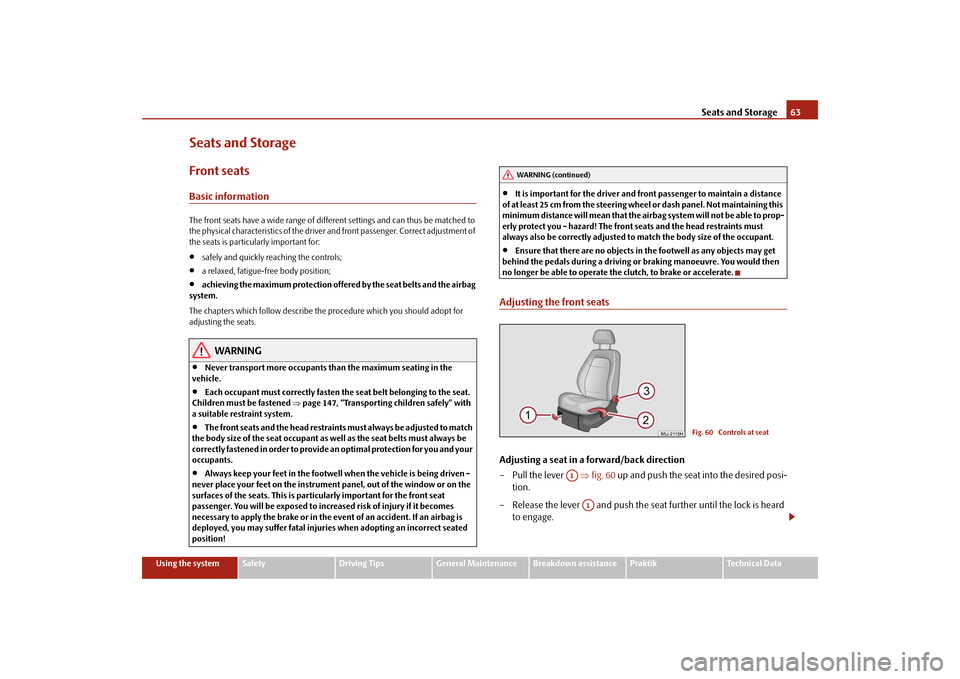
–Pull the lever ⇒fig. 60 up and push the seat into the desired posi-
tion.
– Release the lever and push the seat further until the lock is heard
to engage.
WARNING (continued)
Fig. 60 Controls at seat
A1
A1
s29g.4.book Page 63 Wednesday, June 17, 2009 9:54 AM
Page 65 of 263
Seats and Storage 64
Adjusting height of seat*
– Lift the seat if required by pulling or pumping lever upwards.
– Lower the seat if required by pushing or pumping lever down-
wards.
Adjust the angle of the seat backrest
– Relieve any pressure on the seat backrest (do not lean on it) and turn
the handwheel to adjust the angle of the backrest.The driver's seat should be adjusted in such a way that the pedals can be fully
pressed to the floor with slightly bent legs.
The seat backrest on the driver's seat should be adjusted in such a way that the
upper point of the steering wheel can be easily reached with slightly bent arms.
WARNING
•
Only adjust the driver seat when the vehicle is stationary - risk of injury!
•
Take care when adjusting the seat! Adjusting the seat without care can
lead to bruises or injuries.
•
The seat backrests must not be angled too far back when driving other-
wise this will affect proper operation of the seat belts and of the airbag
system - risk of injury!
Head restraintsBest protection is achieved if the top edge of the head restraint is at the
same level as the upper part of your head.
Adjusting the height of a head restraint
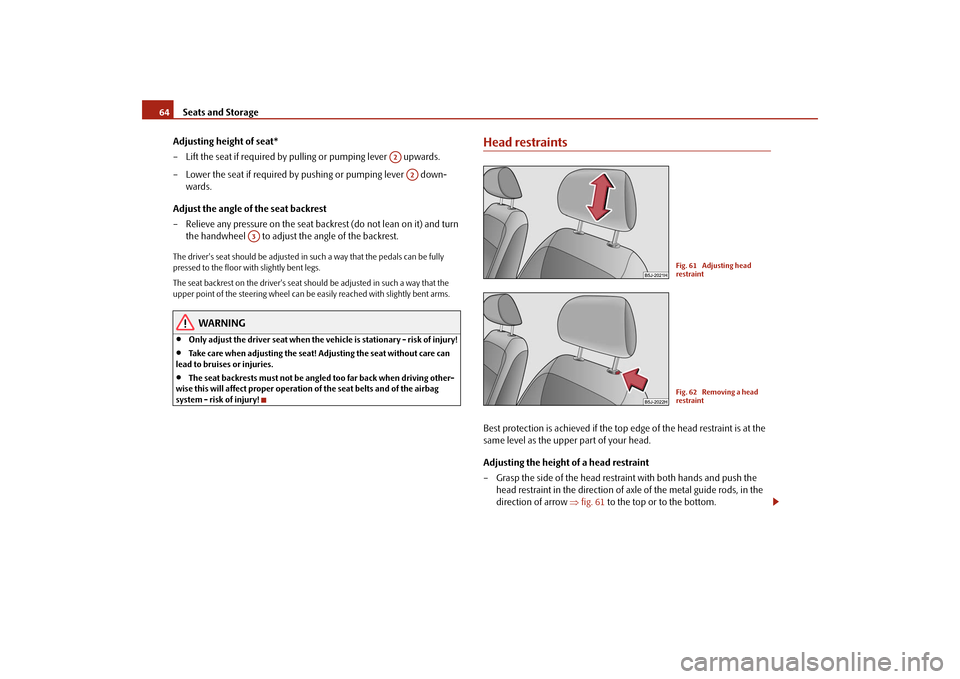
– Grasp the side of the head restraint with both hands and push the
head restraint in the direction of axle of the metal guide rods, in the
direction of arrow ⇒fig. 61 to the top or to the bottom.
A2
A2
A3
Fig. 61 Adjusting head
restraintFig. 62 Removing a head
restraint
s29g.4.book Page 64 Wednesday, June 17, 2009 9:54 AM
Page 66 of 263
Seats and Storage65
Using the system
Safety
Driving Tips
General Maintenance
Breakdown assistance
Praktik
Technical Data
– Move the head restraint downwards if required by pressing the locking
button ⇒fig. 62 and by pressing with the other hand the head
restraint downwards.
Removing and installing a head restraint
– Pull the head restraint out of the seat backrest as far as the stop.
– Press the locking button in the direction of arrow ⇒fig. 62 and pull
the head restraint out.
– To re-insert the head restraint, push it down into the seat backrest far
enough until you hear the locking button engage.The position of the front, rear outer head restraints and the rear middle head
restraint* is adjustable for height.
The head restraints must be adjusted to match the size of the seat occupant.
Correctly adjusted head restraints together with the seat belts offer effective
protection for the occupants ⇒page 128.
WARNING
•
The head restraints must be correctly adjusted in order to offer effective
protection for the occupants in the event of an accident.
•
Do not drive under any circumstance with removed head restraints - risk
of injury!
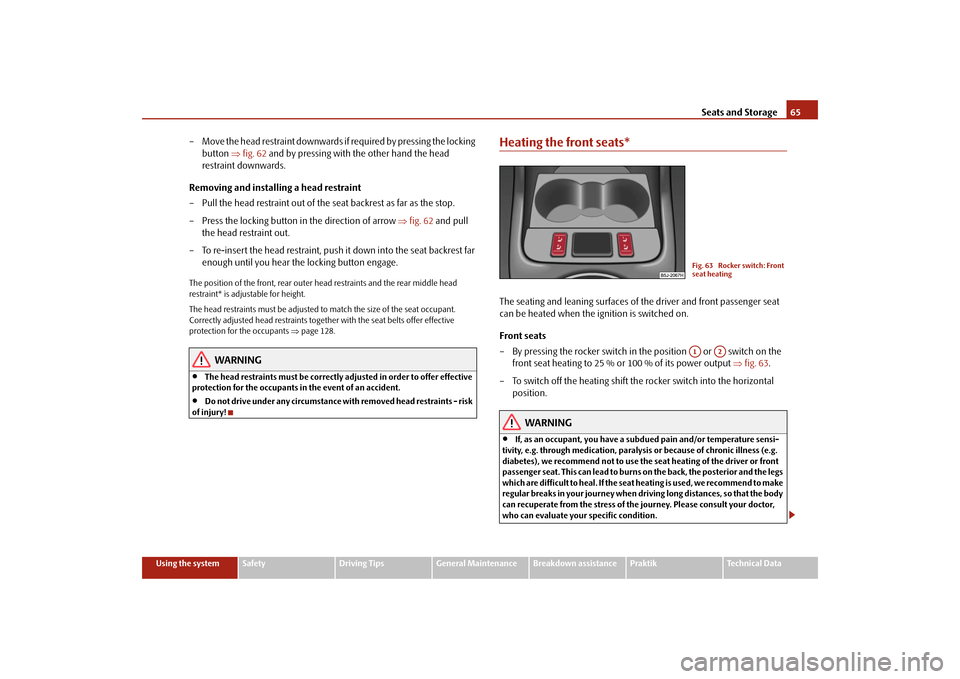
Heating the front seats*The seating and leaning surfaces of the driver and front passenger seat
can be heated when the ignition is switched on.
Front seats
– By pressing the rocker switch in the position or switch on the
front seat heating to 25 % or 100 % of its power output ⇒fig. 63.
– To switch off the heating shift the rocker switch into the horizontal
position.
WARNING
•
If, as an occupant, you have a subdued pain and/or temperature sensi-
tivity, e.g. through medication, paralysis or because of chronic illness (e.g.
diabetes), we recommend not to use the seat heating of the driver or front
passenger seat. This can lead to burns on the back, the posterior and the legs
which are difficult to heal. If the seat heating is used, we recommend to make
regular breaks in your journey when driving long distances, so that the body
can recuperate from the stress of the journey. Please consult your doctor,
who can evaluate your specific condition.
Fig. 63 Rocker switch: Front
seat heatingA1
A2
s29g.4.book Page 65 Wednesday, June 17, 2009 9:54 AM
Page 67 of 263
Seats and Storage 66•
Do not use the seat heating if objects are fastened or stored on a seat for
example a child seat, a bag etc. A fault in the system of the seat heating can
occur.Caution
•
You should not kneel on the seats or otherwise apply pressure at specific points
in order to avoid damaging the heating elements of the seat heaters.
•
Do not clean the seats moist ⇒page 178.Note
The seat heating should only be switched on when the engine is running. This has
a significant effect of saving on the battery capacity.Rear seatsAdjusting seats in forward/back direction
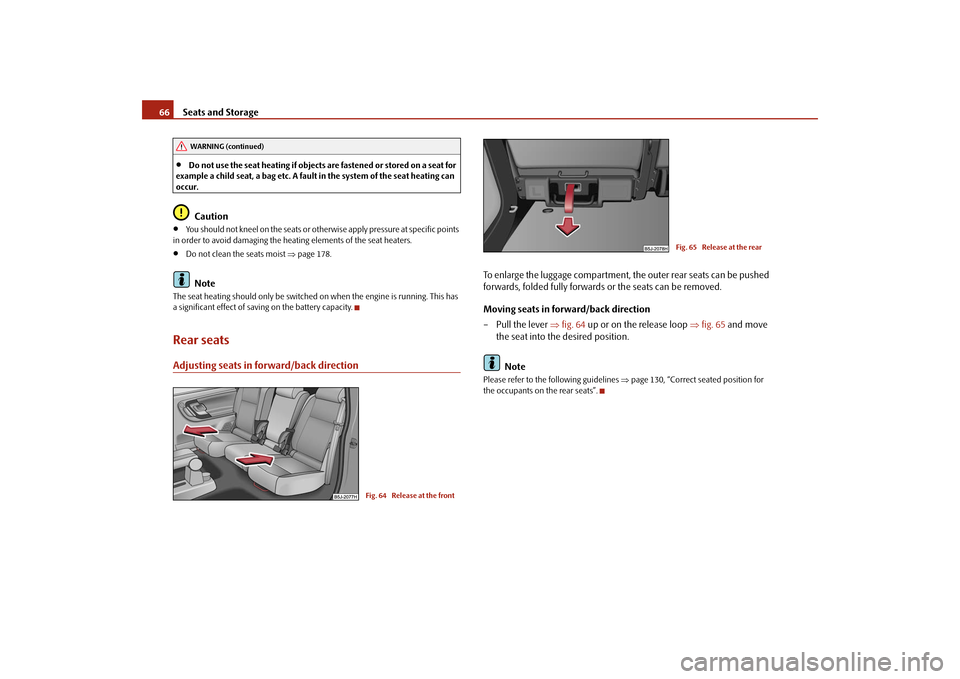
To enlarge the luggage compartment, the outer rear seats can be pushed
forwards, folded fully forwards or the seats can be removed.
Moving seats in forward/back direction
– Pull the lever ⇒fig. 64 up or on the release loop ⇒fig. 65 and move
the seat into the desired position.
NotePlease refer to the following guidelines ⇒page 130, “Correct seated position for
the occupants on the rear seats”.
WARNING (continued)
Fig. 64 Release at the front
Fig. 65 Release at the rear
s29g.4.book Page 66 Wednesday, June 17, 2009 9:54 AM
Page 68 of 263
Seats and Storage67
Using the system
Safety
Driving Tips
General Maintenance
Breakdown assistance
Praktik
Technical Data
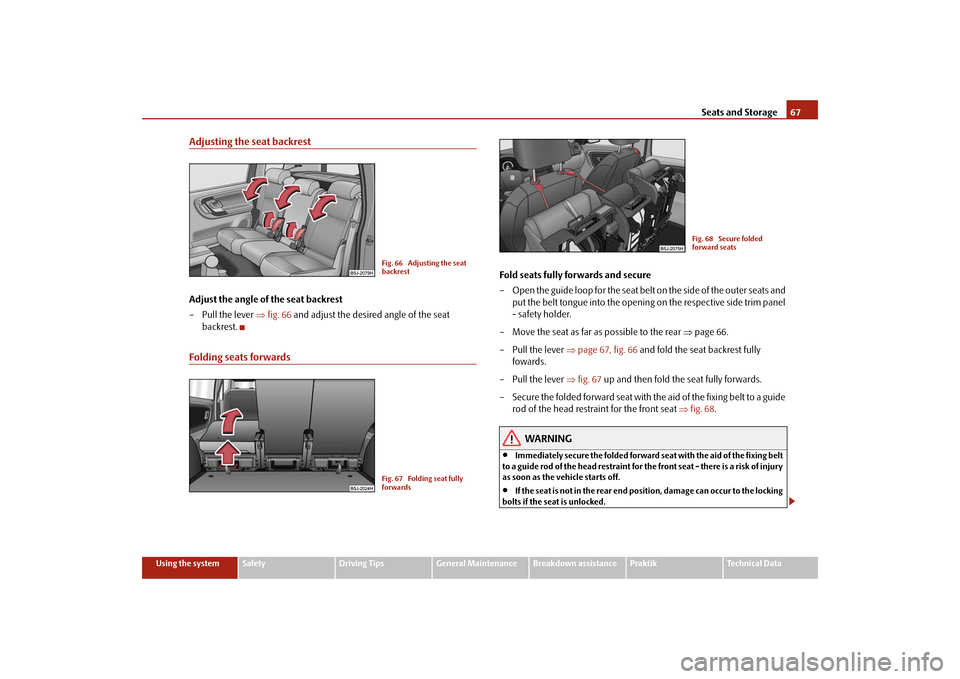
Adjusting the seat backrestAdjust the angle of the seat backrest
– Pull the lever ⇒fig. 66 and adjust the desired angle of the seat
backrest.Folding seats forwards
Fold seats fully forwards and secure
– Open the guide loop for the seat belt on the side of the outer seats and
put the belt tongue into the opening on the respective side trim panel
- safety holder.
– Move the seat as far as possible to the rear ⇒page 66.
–Pull the lever ⇒page 67, fig. 66 and fold the seat backrest fully
fowards.
–Pull the lever ⇒fig. 67 up and then fold the seat fully forwards.
– Secure the folded forward seat with the aid of the fixing belt to a guide
rod of the head restraint for the front seat ⇒fig. 68.
WARNING
•
Immediately secure the folded forward seat with the aid of the fixing belt
to a guide rod of the head restraint for the front seat - there is a risk of injury
as soon as the vehicle starts off.
•
If the seat is not in the rear end position, damage can occur to the locking
bolts if the seat is unlocked.
Fig. 66 Adjusting the seat
backrestFig. 67 Folding seat fully
forwards
Fig. 68 Secure folded
forward seats
s29g.4.book Page 67 Wednesday, June 17, 2009 9:54 AM