engine SKODA ROOMSTER 2010 1.G Owner's Guide
[x] Cancel search | Manufacturer: SKODA, Model Year: 2010, Model line: ROOMSTER, Model: SKODA ROOMSTER 2010 1.GPages: 231, PDF Size: 12.91 MB
Page 47 of 231
Lights and Visibility
46
Lights and VisibilityLightsSwitching lights on and off
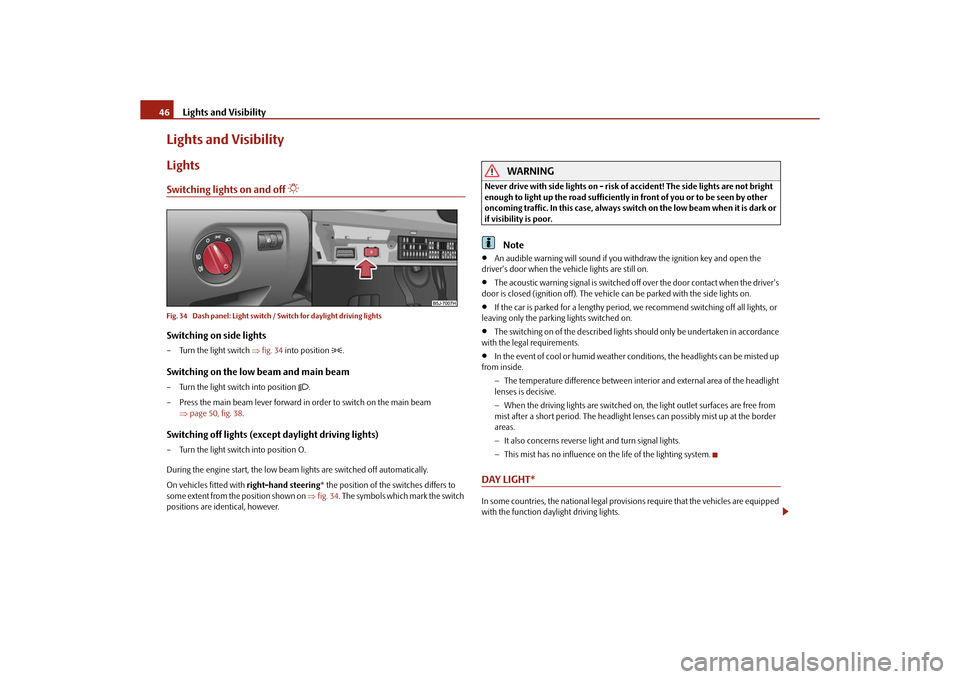
Fig. 34 Dash panel: Light switch / Switch for daylight driving lightsSwitching on side lights– Turn the light switch fig. 34 into position
.
Switching on the low beam and main beam– Turn the light switch into position
.
– Press the main beam lever forward in order to switch on the main beam page 50, fig. 38 .
Switching off lights (except daylight driving lights)– Turn the light switch into position O.
During the engine start, the low beam lights are switched off automatically.
On vehicles fitted with right-hand steering* the position of the switches differs to
some extent from the position shown on fig. 34 . The symbols which mark the switch
positions are identical, however.
WARNING
Never drive with side lights on - risk of accident! The side lights are not bright
enough to light up the road sufficiently in front of you or to be seen by other
oncoming traffic. In this case, always switch on the low beam when it is dark or
if visibility is poor.
Note
An audible warning will sound if you wi thdraw the ignition key and open the
driver's door when the vehicle lights are still on.
The acoustic warning signal is switched off over the door contact when the driver's
door is closed (ignition off). The vehicle can be parked with the side lights on.
If the car is parked for a lengthy period, we recommend switching off all lights, or
leaving only the parking lights switched on.
The switching on of the described lights should only be undertaken in accordance
with the legal requirements.
In the event of cool or humid weather conditions, the headlights can be misted up
from inside.
The temperature difference between interior and external area of the headlight
lenses is decisive.
When the driving lights are switched on, the light outlet surfaces are free from
mist after a short period. The headlight lens es can possibly mist up at the border
areas.
It also concerns reverse light and turn signal lights.
This mist has no influence on th e life of the lighting system.
DAY LIGHT*In some countries, the national legal provisions require that the vehicles are equipped
with the function daylight driving lights.
s16g.4.book Page 46 Wednesda y, February 10, 2010 3:53 PM
Page 49 of 231
Lights and Visibility
48
The adaptation of the halogen projector he adlights must be performed as follows
page 146.Fog lights*
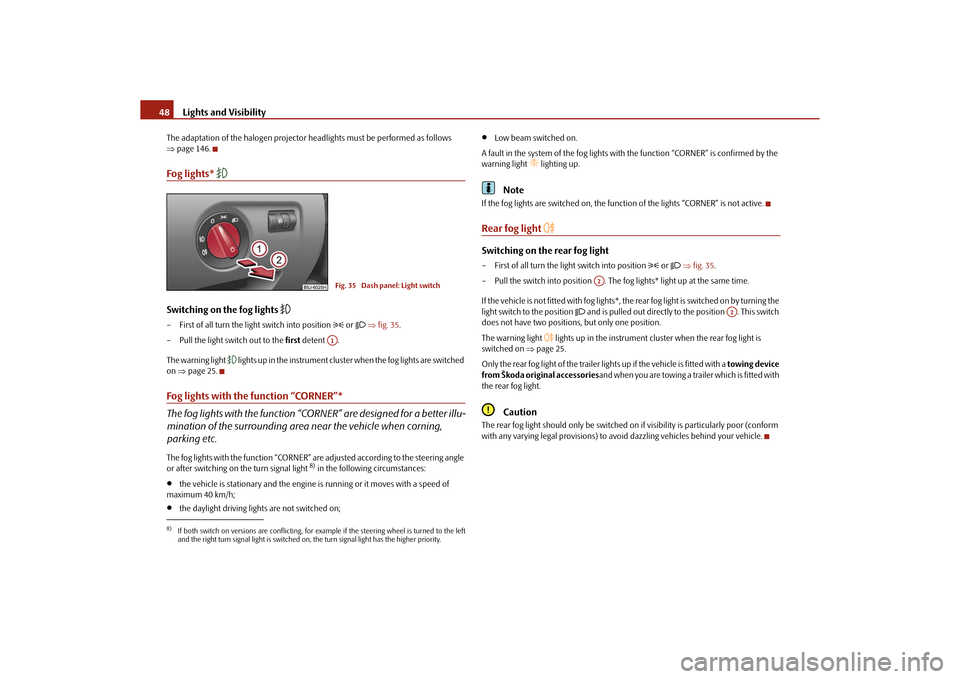
Switching on the fog lights
– First of all turn the light switch into position
or fig. 35 .
– Pull the light switch out to the first detent .
The warning light
l i g h t s u p i n t h e i n s t r u m e n t c l u s t e r when the fog lights are switched
on page 25.
Fog lights with the function “CORNER”*
The fog lights with the function “CORNER” are designed for a better illu-
mination of the surrounding area near the vehicle when corning,
parking etc.The fog lights with the function “CORNER” ar e adjusted according to the steering angle
or after switching on the turn signal light
8) in the following circumstances:
the vehicle is stationary and the engine is running or it moves with a speed of
maximum 40 km/h;
the daylight driving lights are not switched on;
Low beam switched on.
A fault in the system of the fog lights with the function “CORNER” is confirmed by the
warning light
lighting up.
Note
If the fog lights are switched on, the function of the lights “CORNER” is not active.Rear fog light
Switching on the rear fog light– First of all turn the light switch into position
or fig. 35 .
– Pull the switch into position . The fog lights* light up at the same time.
If the vehicle is not fitted with fog lights*, th e rear fog light is switched on by turning the
light switch to the position
and is pulled out directly to the position . This switch
does not have two position s, but only one position.
The warning light
lights up in the instrument cluster when the rear fog light is
switched on page 25.
Only the rear fog light of the trailer lights up if the vehicle is fitted with a towing device
from Škoda original accessories and when you are towing a trailer which is fitted with
the rear fog light.
Caution
The rear fog light should only be switched on if visibility is partic ularly poor (conform
with any varying legal provisions) to avoid dazzling vehicles behind your vehicle.
8)If both switch on versions are conflicting, for example if the steering wheel is turned to the left
and the right turn signal light is switched on, the turn signal light has the higher priority.
Fig. 35 Dash panel: Light switchA1
A2
A2
s16g.4.book Page 48 Wednesda y, February 10, 2010 3:53 PM
Page 53 of 231
Lights and Visibility
52Note
We recommend having the bulb replaced by a specialist garage.Luggage compartment lightThe lighting comes on automatically when th e boot lid is opened. If the lid remains
open for more than about 10 minutes, the luggage compartment lighting switches off
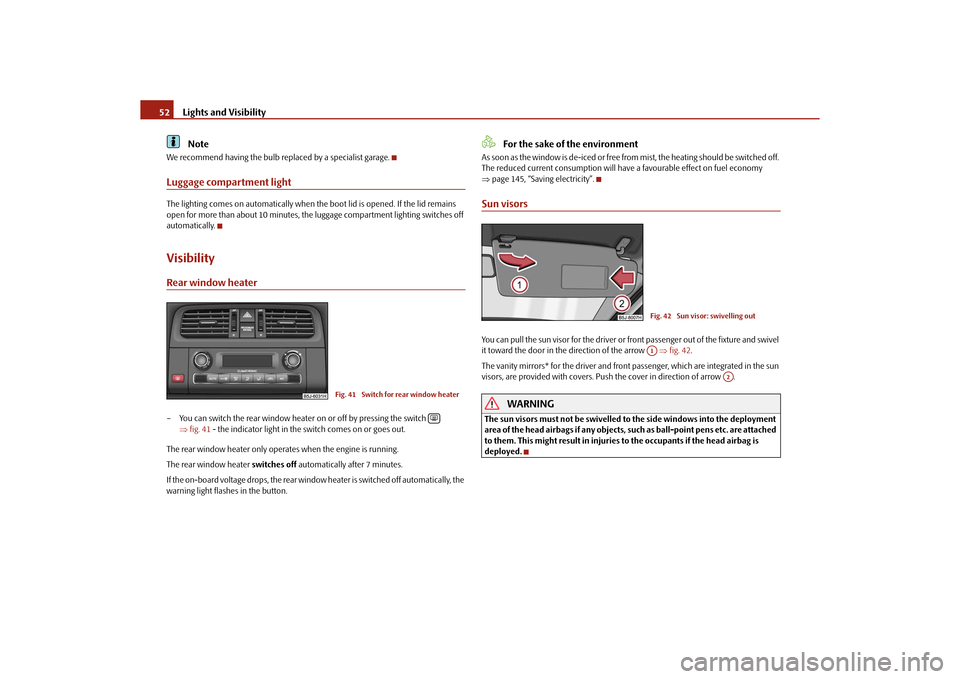
automatically.VisibilityRear window heater– You can switch the rear window heater on or off by pressing the switch
fig. 41 - the indicator light in the switch comes on or goes out.
The rear window heater only operates when the engine is running.
The rear wind ow heater switches off automatically after 7 minutes.
If the on-board voltage drops, the rear window heater is switched off automatically, the
warning light flashes in the button.
For the sake of the environment
As soon as the window is de-iced or free fr om mist, the heating should be switched off.
The reduced current consumption will have a favourable effect on fuel economy
page 145, “Saving electricity”.Sun visorsYou can pull the sun visor for the driver or front passenger out of the fixture and swivel
it toward the door in the direction of the arrow fig. 42 .
The vanity mirrors* for the driver and front passenger, which are integrated in the sun
visors, are provided with covers. Push the cover in direction of arrow .
WARNING
The sun visors must not be swivelled to the side windows into the deployment
area of the head airbags if any objects, su ch as ball-point pens etc. are attached
to them. This might result in injuries to the occupants if the head airbag is
deployed.
Fig. 41 Switch for rear window heater
Fig. 42 Sun visor: swivelling outA1
A2
s16g.4.book Page 52 Wednesda y, February 10, 2010 3:53 PM
Page 57 of 231
Lights and Visibility
56
The exterior mirror heater only op erates when the engine is running.
WARNING
Convex (curved outward) or spherical (differently curved) exterior mirrors
increase the vision field. They do, howe ver, make objects appear smaller in the
mirror. These mirrors are only of limited use, therefore, for estimating distances
to the following vehicles.
Use whenever possible the interior rear mirror, for estimating the distances
to the following vehicles.Note
Do not touch the surfaces of the exterior mirrors if the exterior mirror heater is
switched on.
You can set the exterior mirrors by hand, if the power setting function fails at any
time by pressing on the edge of the mirror surface.
Contact your specialist garage if a fault ex ists with the power setting of the exterior
mirrors.
s16g.4.book Page 56 Wednesda y, February 10, 2010 3:53 PM
Page 60 of 231
Seats and Storage59
Using the system
Safety
Driving Tips
General Maintenance
Breakdown assistance
Praktik
Technical Data
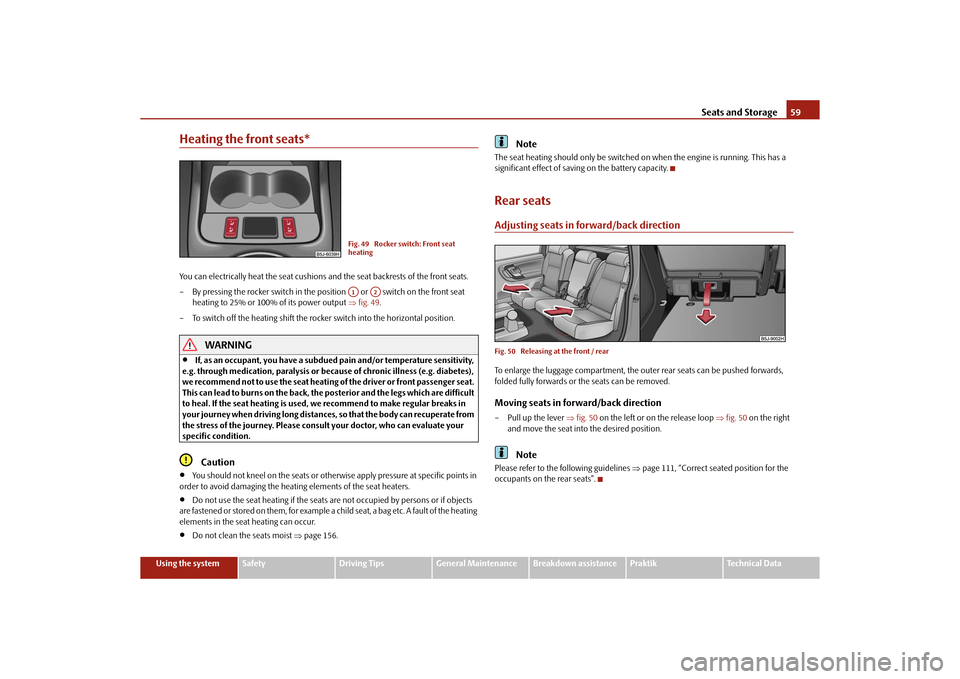
Heating the front seats*You can electrically heat the seat cushions and the seat backrests of the front seats.
– By pressing the rocker switch in the posi tion or switch on the front seat
heating to 25% or 100% of its power output fig. 49 .
– To switch off the heating shift the rocker switch into the horizontal position.
WARNING
If, as an occupant, you have a subdued pain and/or temperature sensitivity,
e.g. through medication, paralysis or beca use of chronic illness (e.g. diabetes),
we recommend not to use the seat heating of the driver or front passenger seat.
This can lead to burns on the back, the posterior and the legs which are difficult
to heal. If the seat heating is used, we recommend to make regular breaks in
your journey when driving long distances, so that the body can recuperate from
the stress of the journey. Please consult your doctor, who can evaluate your
specific condition.Caution
You should not kneel on the seats or otherwise apply pressure at specific points in
order to avoid damaging the heating elements of the seat heaters.
Do not use the seat heating if the seats are not occupied by persons or if objects
are fastened or stored on them, for example a child seat, a bag etc. A fault of the heating
elements in the seat heating can occur.
Do not clean the seats moist page 156.
Note
The seat heating should only be switched on when the engine is running. This has a
significant effect of saving on the battery capacity.Rear seatsAdjusting seats in forward/back directionFig. 50 Releasing at the front / rearTo enlarge the luggage compartment, the ou ter rear seats can be pushed forwards,
folded fully forwards or the seats can be removed.Moving seats in forward/back direction– Pull up the lever fig. 50 on the left or on the release loop fig. 50 on the right
and move the seat into the desired position.
Note
Please refer to the following guidelines page 111, “Correct seated position for the
occupants on the rear seats”.
Fig. 49 Rocker switch: Front seat
heatingA1
A2
s16g.4.book Page 59 Wednesda y, February 10, 2010 3:53 PM
Page 74 of 231
Seats and Storage73
Using the system
Safety
Driving Tips
General Maintenance
Breakdown assistance
Praktik
Technical Data
WARNING
Take care when using the cigarette ligh ter! Not paying proper attention or
incorrect use the cigarette lighter in an uncontrolled manner may result in
burns.
The cigarette lighter and the power socket also operates when the ignition is
switched off or the ignition key withdrawn. This is why you should never leave
children unattended in the vehicle!Caution
Always use matching plugs to avoid damagi ng the power socket.
Note
Connecting electrical components when the engine is not running will drain
the battery of the vehicle - risk of battery draining!
Further information page 179.
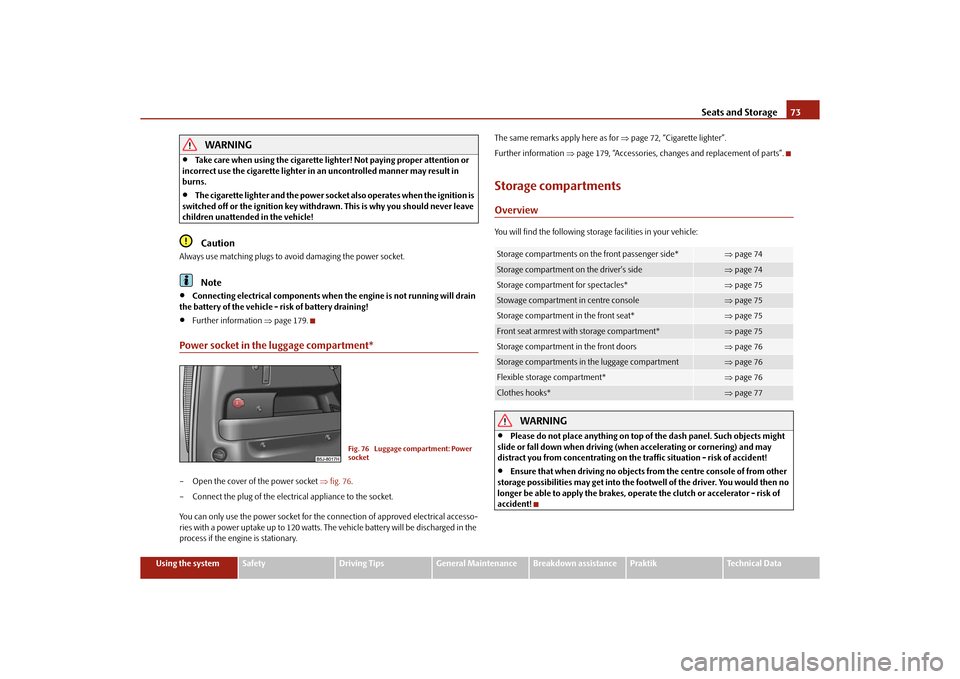
Power socket in the luggage compartment*– Open the cover of the power socket fig. 76 .
– Connect the plug of the electrical appliance to the socket.
You can only use the power socket for the connection of approved electrical accesso-
ries with a power uptake up to 120 watts. The vehicle battery will be discharged in the
process if the engine is stationary. The same remarks apply here as for
page 72, “Cigarette lighter”.
Further information page 179, “Accessories, changes and replacement of parts”.
Storage compartmentsOverviewYou will find the following storag e facilities in your vehicle:
WARNING
Please do not place anything on top of the dash panel. Such objects might
slide or fall down when driving (whe n accelerating or cornering) and may
distract you from concentrating on the traffic situation - risk of accident!
Ensure that when driving no objects from the centre console of from other
storage possibilities may get into the fo otwell of the driver. You would then no
longer be able to apply the brakes, oper ate the clutch or accelerator - risk of
accident!
Fig. 76 Luggage compartment: Power
socket
Storage compartments on the front passenger side*
page 74
Storage compartment on the driver's side
page 74
Storage compartment for spectacles*
page 75
Stowage compartment in centre console
page 75
Storage compartment in the front seat*
page 75
Front seat armrest with storage compartment*
page 75
Storage compartment in the front doors
page 76
Storage compartments in the luggage compartment
page 76
Flexible storage compartment*
page 76
Clothes hooks*
page 77
s16g.4.book Page 73 Wednesda y, February 10, 2010 3:53 PM
Page 80 of 231
Heating and air conditioning system79
Using the system
Safety
Driving Tips
General Maintenance
Breakdown assistance
Praktik
Technical Data
HeatingUsing the system
The heating system delivers air into the interior of the vehicle and
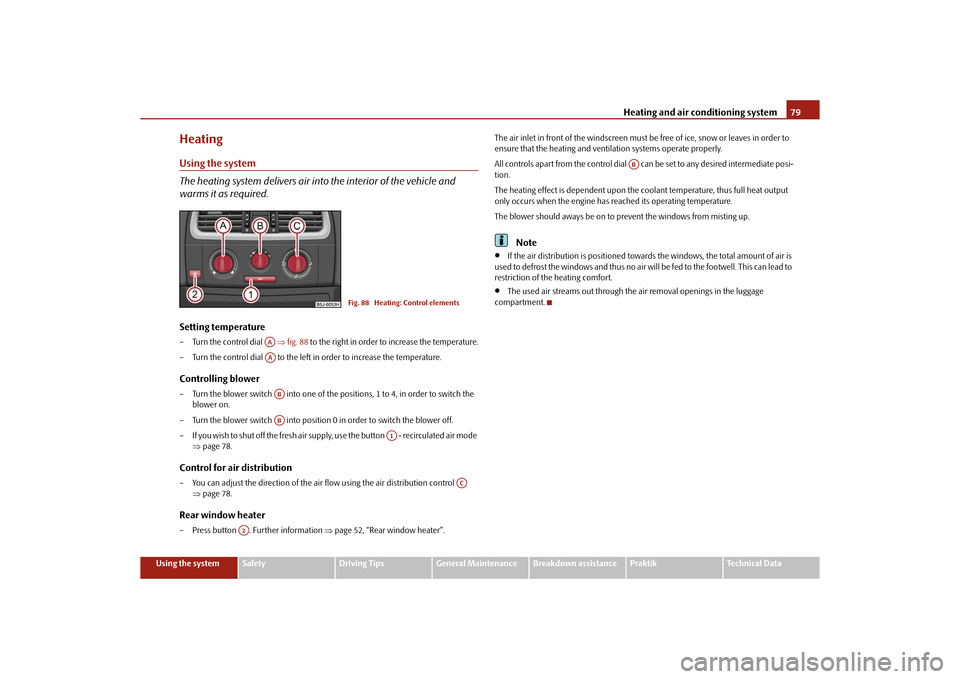
warms it as required.Setting temperature– Turn the control dial fig. 88 to the right in order to increase the temperature.
– Turn the control dial to the left in order to increase the temperature.Controlling blower– Turn the blower switch into one of the po sitions, 1 to 4, in order to switch the
blower on.
– Turn the blower switch into position 0 in order to switch the blower off.
– If you wish to shut off the fresh air supply , use the button - recirculated air mode
page 78.Control for air distribution– You can adjust the direction of the air flow using the air distribution control
page 78.Rear window heater– Press button . Further information page 52, “Rear window heater”. The air inlet in front of the windscreen must be free of ice, snow or leaves in order to
ensure that the heating and ventilation systems operate properly.
All controls apart from the control dial
can be set to any desired intermediate posi-
tion.
The heating effect is dependent upon the c oolant temperature, thus full heat output
only occurs when the engine has reached its operating temperature.
The blower should aways be on to prevent the windows from misting up.
Note
If the air distribution is positioned toward s the windows, the total amount of air is
used to defrost the windows and thus no air will be fed to the footwell. This can lead to
restriction of the heating comfort.
The used air streams out through the air removal openings in the luggage
compartment.
Fig. 88 Heating: Control elements
AAAAABAB
A1
AC
A2
AB
s16g.4.book Page 79 Wednesda y, February 10, 2010 3:53 PM
Page 82 of 231
Heating and air conditioning system81
Using the system
Safety
Driving Tips
General Maintenance
Breakdown assistance
Praktik
Technical Data
Climatic (semi-automatic air conditioning system)*Description
Climatic is a combined cooling and heating system with electronic
control of the convenience temperature in the vehicle interior. It makes
it possible to optimally control the air temperature at any season of the
year.Description of the Climatic
It is important for your safety and for your driving comfort that the Climatic is operating
properly.
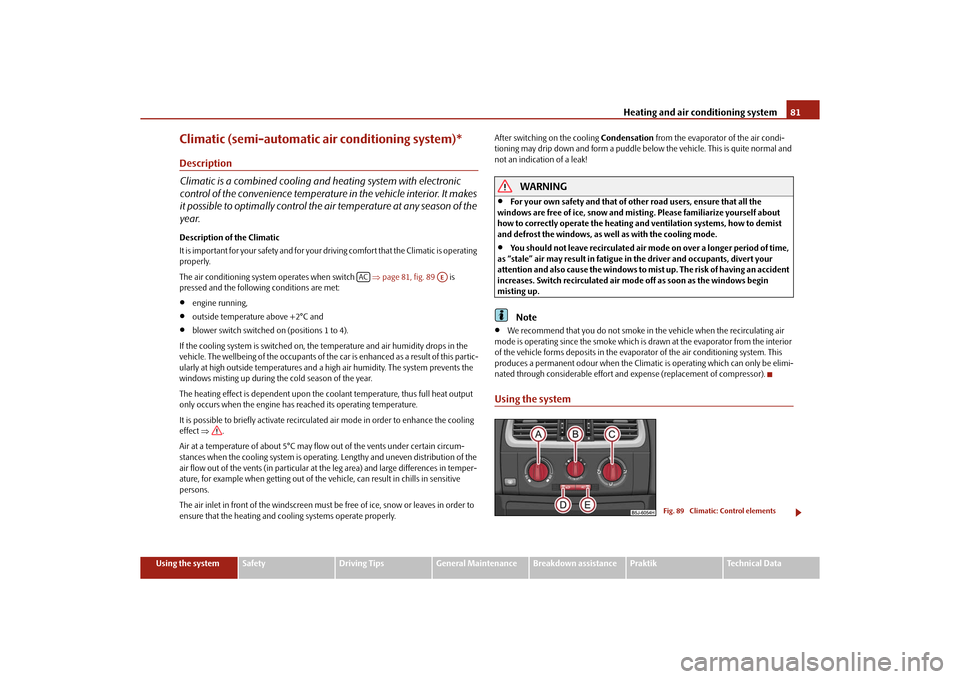
The air conditioning system operates when switch page 81, fig. 89 is
pressed and the following conditions are met:
engine running,
outside temperature above +2°C and
blower switch switched on (positions 1 to 4).
If the cooling system is switched on, the temperature and air humidity drops in the
vehicle. The wellbeing of the occupants of the car is enhanced as a result of this partic-
ularly at high outside temperatures and a high air humidity. The system prevents the
windows misting up during th e cold season of the year.
The heating effect is dependent upon the c oolant temperature, thus full heat output
only occurs when the engine has reached its operating temperature.
It is possible to briefly activate recirculat ed air mode in order to enhance the cooling
effect .
Air at a temperature of about 5°C may flow out of the vents under certain circum-
stances when the cooling system is operatin g. Lengthy and uneven distribution of the
air flow out of the vents (in particular at the leg area) and large differences in temper-
ature, for example when getting out of the ve hicle, can result in chills in sensitive
persons.
The air inlet in front of the windscreen must be free of ice, snow or leaves in order to
ensure that the heating and cooling systems operate properly. After switching on the cooling
Condensation from the evaporator of the air condi-
tioning may drip down and form a puddle be low the vehicle. This is quite normal and
not an indication of a leak!
WARNING
For your own safety and that of other road users, ensure that all the
windows are free of ice, snow and misting. Please familiarize yourself about
how to correctly operate the heating and ventilation systems, how to demist
and defrost the windows, as well as with the cooling mode.
You should not leave recirculated air mode on over a longer period of time,
as “stale” air may result in fatigue in the driver and occupants, divert your
attention and also cause the windows to mist up. The risk of having an accident
increases. Switch recirculated air mo de off as soon as the windows begin
misting up.Note
We recommend that you do not smoke in the vehicle when the recirculating air
mode is operating since the smoke which is drawn at the evaporator from the interior
of the vehicle forms deposits in the evapor ator of the air conditioning system. This
produces a permanent odour when the Climat ic is operating which can only be elimi-
nated through considerable effort and expense (replacement of compressor).
Using the system
AC
AE
Fig. 89 Climatic: Control elements
s16g.4.book Page 81 Wednesday, February 10, 2010 3:53 PM
Page 85 of 231
Heating and air conditioning system
84
Using the air conditioning system economicallyThe compressor on the Climatic uses powe r from the engine when in cooling mode
which will effect the fuel consumption.
It recommended to open the windows or the doors of a vehicle for which the interior
has been strongly heated through the effect of direct sunlight in order to allow the
heated air to escape.
The cooling system should not be switched on while travelling when the window is
open.
The desired interior temperature can also be achieved without switching in the cooling
system just by switching to fresh air mode.
For the sake of the environment
When you economize on fuel, you also reduce pollutant emissions.Operational malfunctionsIf the cooling system does not operate at outside temperatures higher than +5 °C,
there is a problem in the system. The reasons for this may be:
The fuse of the Climatic is defective. Check the fuse, replace it if necessary
page 191.
The cooling system has switched off automatically for a short time because the
coolant temperature of the engine is too hot page 16.
If you are not able to rectify the operational problem yourself, or if the cooling capacity
decreases, switch the cooling system off. Contact a specialist garage.
Climatronic* (automatic air conditioning)Description
The Climatronic system is a combinat ion of an automatic heating, fresh
air and cooling system which provides optimal comfort for the occu-
pants of the car.The Climatronic maintains a constant temperat ure fully automatically, once it has been
set. This is achieved by automatically varying the temperature of the outflowing air, the
blower stages and the air distribution. The system also takes into account sunlight
which eliminates the need to alter the settings manually. The automatic mode
page 86 ensures maximum wellbeing of the occupants at all times of the year.
Description of Climatronic system
The cooling operates only if the following conditions are met:
engine running,
outside temperature above approx. +2°C,
switched on.
If the cooling system is switched on, th e temperature and air humidity drops in the
vehicle. The wellbeing of the occupants of the car is enhanced as a result of this partic-
ularly at high outside temperatures and a high air humidity. The system prevents the
windows misting up during the cold season of the year.
The heating effect is dependent upon the coolant temperature, thus full heat output
only occurs when the engine has reached its operating temperature.
It is possible to briefly activate recirculat ed air mode in order to enhance the cooling
effect .
The air inlet in front of the windscreen must be free of ice, snow or leaves in order to
ensure that the heating and cooling systems operate properly.
The AC compressor is switched off at a high coolant temperature in order to provide
cooling at a high load of the engine.
After switching on the cooling Condensation from the evaporator of the air condi-
tioning may drip down and form a puddle be low the vehicle. This is quite normal and
not an indication of a leak!AC
s16g.4.book Page 84 Wednesda y, February 10, 2010 3:53 PM
Page 88 of 231
Starting-off and Driving87
Using the system
Safety
Driving Tips
General Maintenance
Breakdown assistance
Praktik
Technical Data
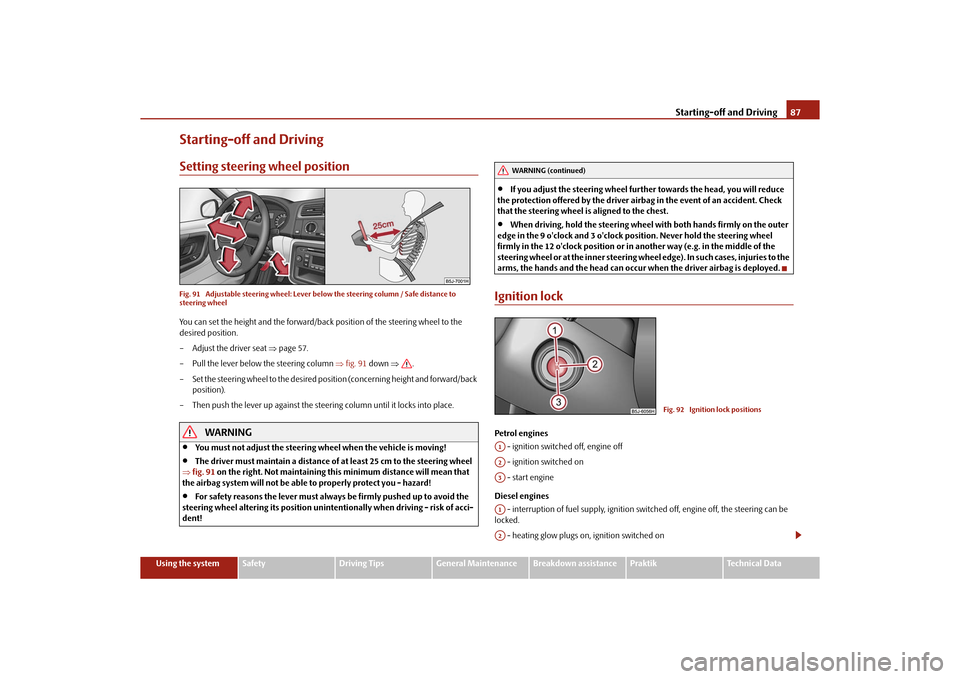
Starting-off and DrivingSetting steering wheel positionFig. 91 Adjustable steering wheel: Lever be low the steering column / Safe distance to
steering wheelYou can set the height and the forward/back position of the steering wheel to the
desired position.
– Adjust the driver seat page 57.
– Pull the lever below the steering column fig. 91 down .
– Set the steering wheel to the desired position (concerning height and forward/back position).
– Then push the lever up against the steering column until it locks into place.
WARNING
You must not adjust the steering wheel when the vehicle is moving!
The driver must maintain a distance of at least 25 cm to the steering wheel
fig. 91 on the right. Not maintaining this minimum distance will mean that
the airbag system will not be able to properly protect you - hazard!
For safety reasons the lever must always be firmly pushed up to avoid the
steering wheel altering its po sition unintentionally when driving - risk of acci-
dent!
If you adjust the steering wheel furthe r towards the head, you will reduce
the protection offered by the driver airbag in the event of an accident. Check
that the steering wheel is aligned to the chest.
When driving, hold the steering wheel with both hands firmly on the outer
edge in the 9 o'clock and 3 o'clock position. Never hold the steering wheel
firmly in the 12 o'clock position or in another way (e.g. in the middle of the
steering wheel or at the inne r steering wheel edge). In such cases, injuries to the
arms, the hands and the head can occur when the driver airbag is deployed.
Ignition lockPetrol engines
- ignition switched off, engine off
- ignition switched on
- start engine
Diesel engines - interruption of fuel supply, ignition swit ched off, engine off, the steering can be
locked.
- heating glow plugs on, ignition switched on
WARNING (continued)
Fig. 92 Ignition lock positions
A1A2A3A1A2
s16g.4.book Page 87 Wednesda y, February 10, 2010 3:53 PM