technical data SKODA ROOMSTER 2011 1.G Owners Manual
[x] Cancel search | Manufacturer: SKODA, Model Year: 2011, Model line: ROOMSTER, Model: SKODA ROOMSTER 2011 1.GPages: 212, PDF Size: 3.3 MB
Page 181 of 212
Fuses and light bulbs
Electric fuses Replacing fuses in the dash panel Replace the defect fuse by a new fuse of the same ampere number.
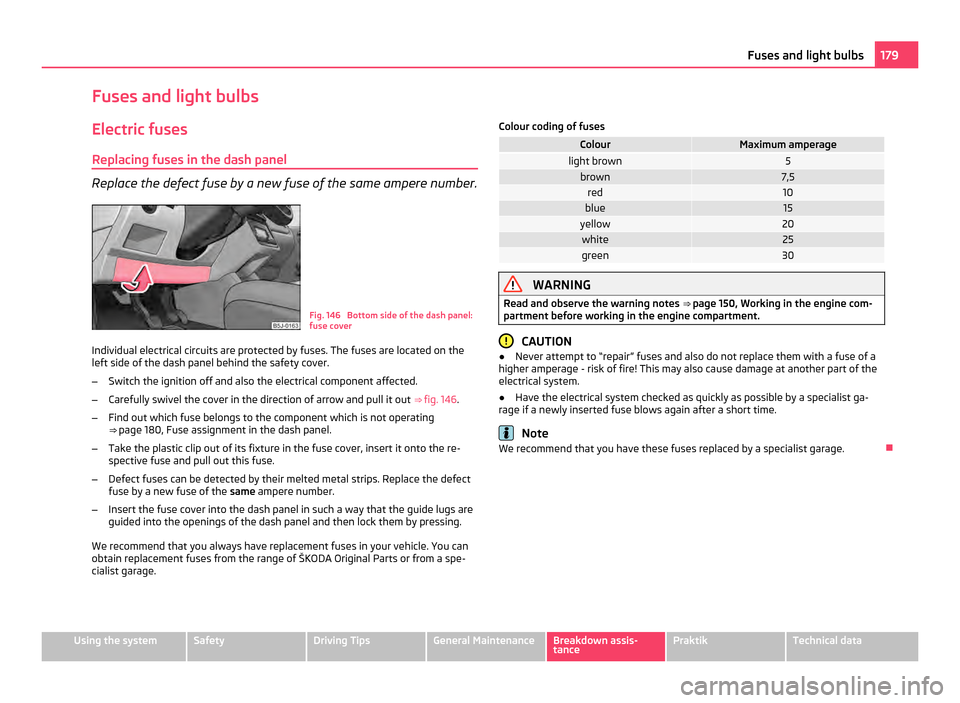
Fig. 146 Bottom side of the dash panel:
fuse cover
Individual electrical circuits are protected by fuses. The fuses are located on the
left side of the dash panel behind the safety cover.
– Switch the ignition off and also the electrical component affected.
– Carefully swivel the cover in the direction of arrow and pull it out ⇒ fig. 146 .
– Find out which fuse belongs to the component which is not operating
⇒ page 180
, Fuse assignment in the dash panel.
– Take the plastic clip out of its fixture in the fuse cover, insert it onto the re-
spective fuse and pull out this fuse.
– Defect fuses can be detected by their melted metal strips. Replace the defect
fuse by a new fuse of the same ampere number.
– Insert the fuse cover into the dash panel in such a way that the guide lugs are
guided into the openings of the dash panel and then lock them by pressing.
We recommend that you always have replacement fuses in your vehicle. You can
obtain replacement fuses from the range of
ŠKODA Original Parts or from a spe-
cialist garage. Colour coding of fuses Colour Maximum amperage
light brown 5
brown 7,5
red 10
blue 15
yellow 20
white 25
green 30
WARNING
Read and observe the warning notes ⇒ page 150
, Working in the engine com-
partment before working in the engine compartment. CAUTION
● Never attempt to
“repair” fuses and also do not replace them with a fuse of a
higher amperage - risk of fire! This may also cause damage at another part of the
electrical system.
● Have the electrical system checked as quickly as possible by a specialist ga-
rage if a newly inserted fuse blows again after a short time. Note
We recommend that you have these fuses replaced by a specialist garage. 179
Fuses and light bulbs Using the system Safety Driving Tips General Maintenance Breakdown assis-
tance Praktik Technical data
Page 183 of 212
No. Power consumer
43 Horn
44 Front window wiper
45 Central control unit for convenience system
46 Engine control unit
Engine control unit
Fuel pump relay
Fuel pump control unit
47 Cigarette lighter, power socket in the luggage compartment
a)48 ABS, START-STOP - DC/DC converter ESP
49 Turn signal lights, brake lights
50 START-STOP - DC/DC converter infotainment
Radio
51 Electrical power window (front and rear) - left side
52 Electrical power window (front and rear) - right side
53 Parking light - left side
Electric sliding/tilting roof
54 START-STOP - instrument cluster
Anti-theft alarm system
55 Control unit for automatic gearbox DSG
56 Headlight cleaning system
Parking light - right side
57 Left low beam, headlight range adjustment
58 Low beam on the right
a)
If the engine is switched off already one electrical component which is connected can discharge the
battery. Replacing fuses at the battery (manual gearbox, automatic
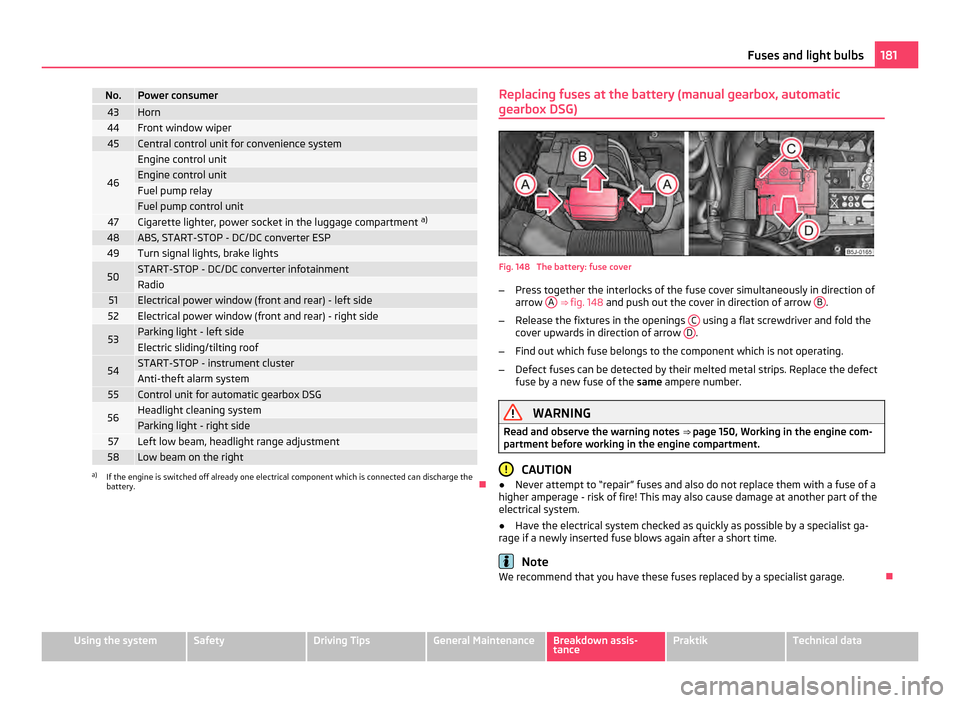
gearbox DSG) Fig. 148 The battery: fuse cover
– Press together the interlocks of the fuse cover simultaneously in direction of
arrow A
⇒ fig. 148 and push out the cover in direction of arrow B .
– Release the fixtures in the openings C using a flat screwdriver and fold the
cover upwards in direction of arrow D .
– Find out which fuse belongs to the component which is not operating.
– Defect fuses can be detected by their melted metal strips. Replace the defect
fuse by a new fuse of the same ampere number. WARNING
Read and observe the warning notes ⇒ page 150 , Working in the engine com-
partment before working in the engine compartment. CAUTION
● Never attempt to
“repair” fuses and also do not replace them with a fuse of a
higher amperage - risk of fire! This may also cause damage at another part of the
electrical system.
● Have the electrical system checked as quickly as possible by a specialist ga-
rage if a newly inserted fuse blows again after a short time. Note
We recommend that you have these fuses replaced by a specialist garage. 181
Fuses and light bulbs Using the system Safety Driving Tips General Maintenance Breakdown assis-
tance Praktik Technical data
Page 185 of 212
Note
● We recommend that you have these fuses replaced by a specialist garage.
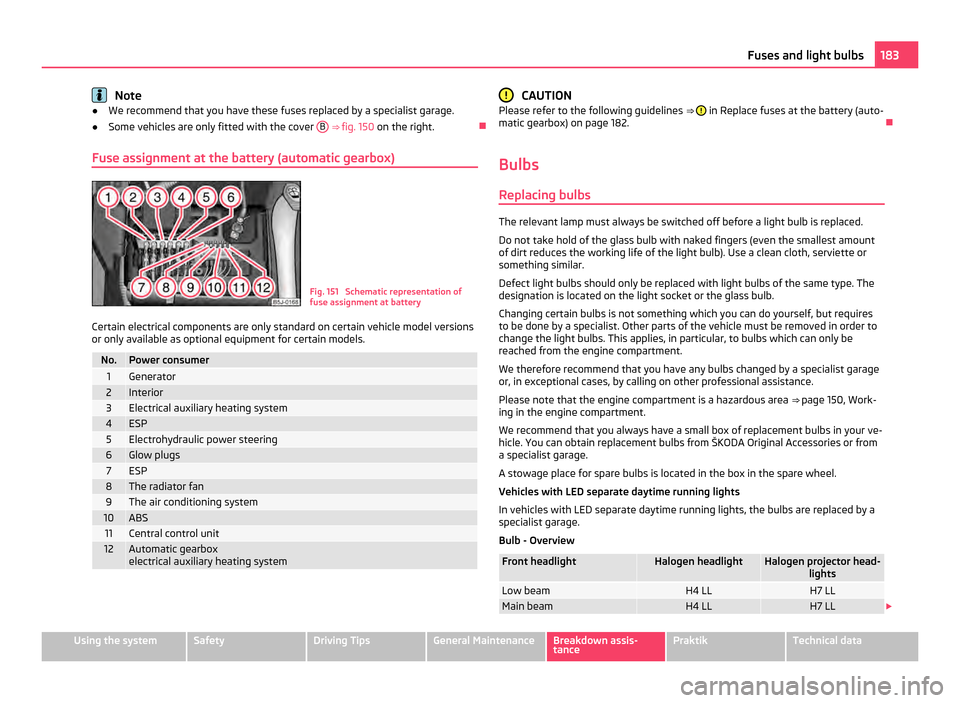
● Some vehicles are only fitted with the cover B ⇒ fig. 150
on the right.
Fuse assignment at the battery (automatic gearbox) Fig. 151 Schematic representation of
fuse assignment at battery
Certain electrical components are only standard on certain vehicle model versions
or only available as optional equipment for certain models. No. Power consumer
1 Generator
2 Interior
3 Electrical auxiliary heating system
4 ESP
5 Electrohydraulic power steering
6 Glow plugs
7 ESP
8 The radiator fan
9 The air conditioning system
10 ABS
11 Central control unit
12 Automatic gearbox
electrical auxiliary heating system CAUTION
Please refer to the following guidelines ⇒ in Replace fuses at the battery (auto-
matic gearbox)
on page 182.
Bulbs Replacing bulbs The relevant lamp must always be switched off before a light bulb is replaced.
Do not take hold of the glass bulb with naked fingers (even the smallest amount
of dirt reduces the working life of the light bulb). Use a clean cloth, serviette or
something similar.
Defect light bulbs should only be replaced with light bulbs of the same type. The
designation is located on the light socket or the glass bulb.
Changing certain bulbs is not something which you can do yourself, but requires
to be done by a specialist. Other parts of the vehicle must be removed in order to
change the light bulbs. This applies, in particular, to bulbs which can only be
reached from the engine compartment.
We therefore recommend that you have any bulbs changed by a specialist garage
or, in exceptional cases, by calling on other professional assistance.
Please note that the engine compartment is a hazardous area ⇒ page 150
, Work-
ing in the engine compartment.
We recommend that you always have a small box of replacement bulbs in your ve-
hicle. You can obtain replacement bulbs from ŠKODA Original Accessories or from
a specialist garage.
A stowage place for spare bulbs is located in the box in the spare wheel.
Vehicles with LED separate daytime running lights
In vehicles with LED separate daytime running lights, the bulbs are replaced by a
specialist garage.
Bulb - Overview Front headlight Halogen headlight Halogen projector head-
lights Low beam H4 LL H7 LL
Main beam H4 LL H7 LL
£ 183
Fuses and light bulbs Using the system Safety Driving Tips General Maintenance Breakdown assis-
tance Praktik Technical data
Page 187 of 212
Low beam and main beam (halogen headlights)
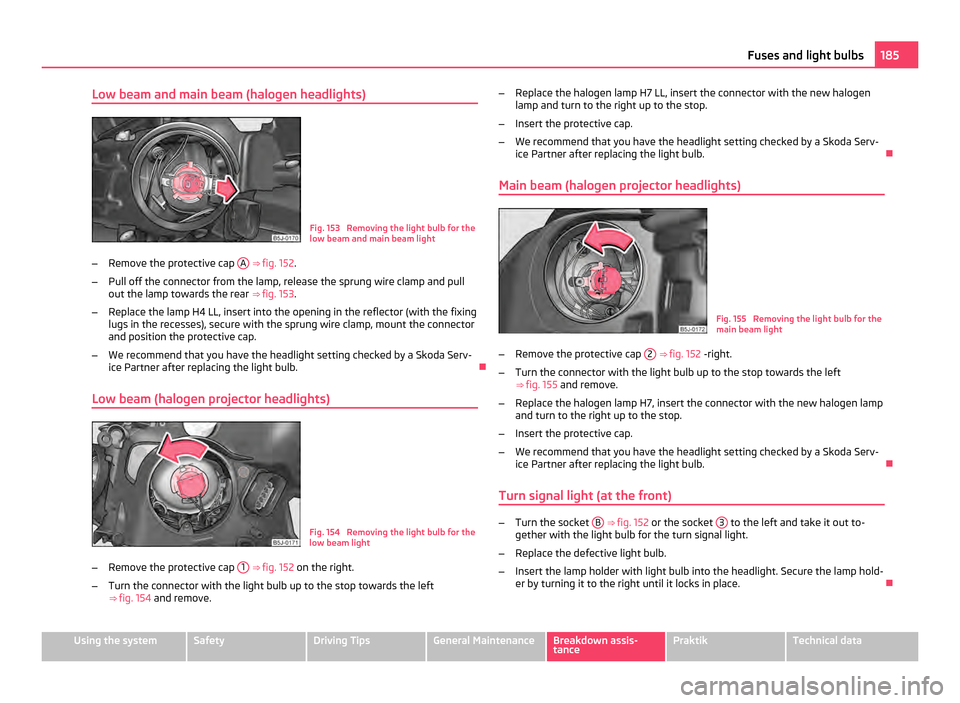
Fig. 153 Removing the light bulb for the
low beam and main beam light
– Remove the protective cap A
⇒ fig. 152.
– Pull off the connector from the lamp, release the sprung wire clamp and pull
out the lamp towards the rear ⇒
fig. 153.
– Replace the lamp H4 LL, insert into the opening in the reflector (with the fixing
lugs in the recesses), secure with the sprung wire clamp, mount the connector
and position the protective cap.
– We recommend that you have the headlight setting checked by a Skoda Serv-
ice Partner after replacing the light bulb.
Low beam (halogen projector headlights) Fig. 154 Removing the light bulb for the
low beam light
– Remove the protective cap 1
⇒
fig. 152 on the right.
– Turn the connector with the light bulb up to the stop towards the left
⇒ fig. 154 and remove. –
Replace the halogen lamp H7 LL, insert the connector with the new halogen
lamp and turn to the right up to the stop.
– Insert the protective cap.
– We recommend that you have the headlight setting checked by a Skoda Serv-
ice Partner after replacing the light bulb.
Main beam (halogen projector headlights) Fig. 155 Removing the light bulb for the
main beam light
– Remove the protective cap 2
⇒
fig. 152 -right.
– Turn the connector with the light bulb up to the stop towards the left
⇒ fig. 155 and remove.
– Replace the halogen lamp H7, insert the connector with the new halogen lamp
and turn to the right up to the stop.
– Insert the protective cap.
– We recommend that you have the headlight setting checked by a Skoda Serv-
ice Partner after replacing the light bulb.
Turn signal light (at the front) –
Turn the socket B
⇒ fig. 152 or the socket 3 to the left and take it out to-
gether with the light bulb for the turn signal light.
– Replace the defective light bulb.
– Insert the lamp holder with light bulb into the headlight. Secure the lamp hold-
er by turning it to the right until it locks in place. 185
Fuses and light bulbs Using the system Safety Driving Tips General Maintenance Breakdown assis-
tance Praktik Technical data
Page 189 of 212
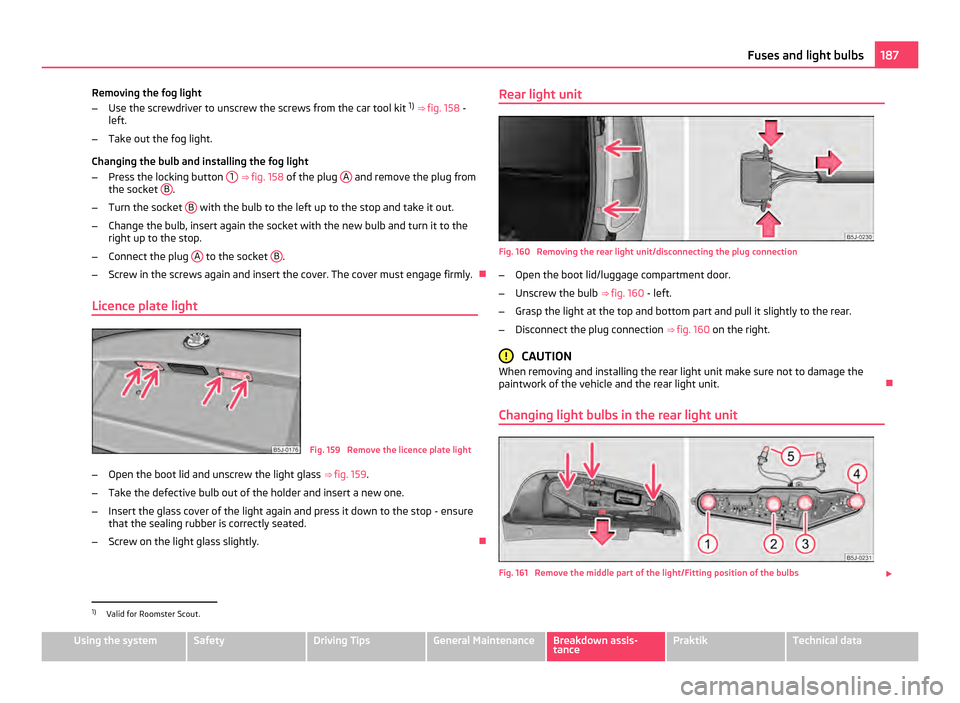
Removing the fog light
–
Use the screwdriver to unscrew the screws from the car tool kit 1)
⇒ fig. 158 -
left.
– Take out the fog light.
Changing the bulb and installing the fog light
– Press the locking button 1 ⇒ fig. 158
of the plug A and remove the plug from
the socket B .
– Turn the socket B with the bulb to the left up to the stop and take it out.
– Change the bulb, insert again the socket with the new bulb and turn it to the
right up to the stop.
– Connect the plug A to the socket
B .
– Screw in the screws again and insert the cover. The cover must engage firmly.
Licence plate light Fig. 159 Remove the licence plate light
– Open the boot lid and unscrew the light glass ⇒
fig. 159 .
– Take the defective bulb out of the holder and insert a new one.
– Insert the glass cover of the light again and press it down to the stop - ensure
that the sealing rubber is correctly seated.
– Screw on the light glass slightly. Rear light unit
Fig. 160 Removing the rear light unit/disconnecting the plug connection
–
Open the boot lid/luggage compartment door.
– Unscrew the bulb ⇒ fig. 160 - left.
– Grasp the light at the top and bottom part and pull it slightly to the rear.
– Disconnect the plug connection ⇒ fig. 160 on the right. CAUTION
When removing and installing the rear light unit make sure not to damage the
paintwork of the vehicle and the rear light unit.
Changing light bulbs in the rear light unit Fig. 161 Remove the middle part of the light/Fitting position of the bulbs
£1)
Valid for Roomster Scout. 187
Fuses and light bulbs Using the system Safety Driving Tips General Maintenance Breakdown assis-
tance Praktik Technical data
Page 191 of 212
Praktik
Praktik Rear interior lighting Switching the interior light on
–
Position the cover glass into position .
Switching the interior light off
– Position the cover glass into position O.
Door contact setting
– Position the cover glass into middle position .Note
We recommend having the bulb replaced by a specialist garage.
Lashing eyes Fig. 162 Loading area: Lashing eyes
Eyes are located on the sides of the loading area for lashing the load to be loaded
⇒ fig. 162 . WARNING
The load to be transported must be fixed in place in such a way that it cannot
move during the journey and when braking. Adjustable safety partition behind the front seats
Fig. 163 Adjustable safety partition
The adjustable safety partition behind the front seats can be adjusted up to 100
mm (only valid for certain countries) for improving the comfort for the driver and
the front passenger.
Fixing of the loading floor Fig. 164 Loop for raising the loading floor/Fixing the loading floor with a plastic hook
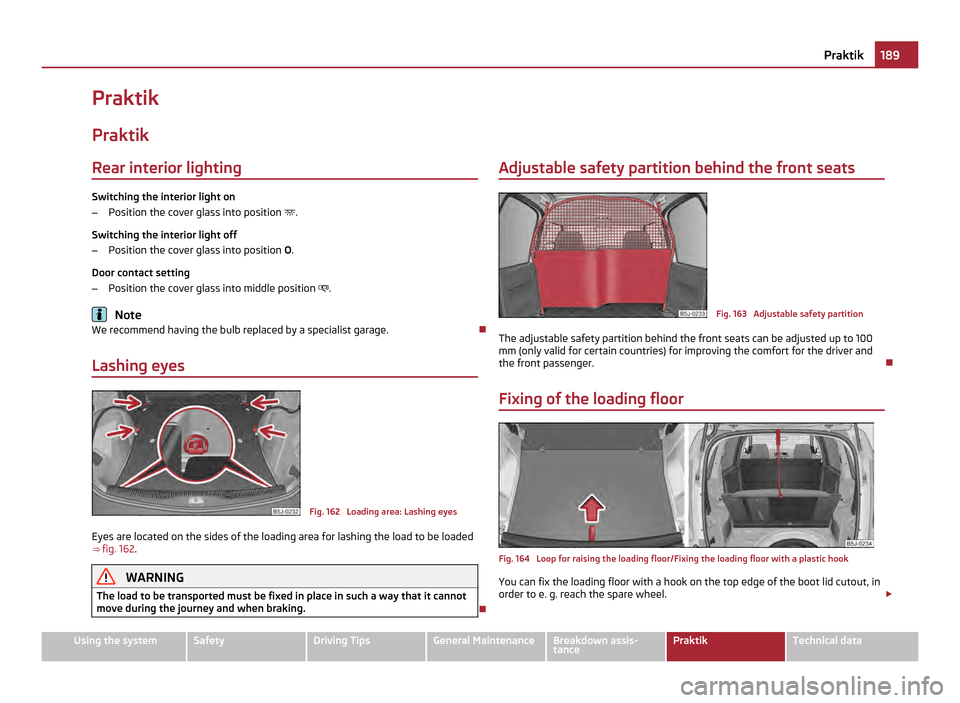
You can fix the loading floor with a hook on the top edge of the boot lid cutout, in
order to e. g. reach the spare wheel. £ 189
Praktik Using the system Safety Driving Tips General Maintenance Breakdown assis-
tance Praktik Technical data
Page 193 of 212
Technical data
Technical data General information The details given in the official vehicle registration documents always take prece-
dence over the details in the Owner's Manual. Please refer to the official vehicle
registration documents or consult a specialist garage concerning the engine with
which your vehicle is equipped.
Used abbreviations Abbreviation Meaning
kW Kilowatt, measuring unit for the engine output
rpm Engine revolutions per minute
Nm Newton meter, measuring unit for the engine torque
g/km discharged quantity of carbon dioxide in grams per driven
kilometre
TSI Petrol engine with a turbocharger and a direct fuel injec-
tion system TDI CR Diesel engine with turbocharger and injection system
Common Rail
M5 5-speed manual gearbox
AQ6 6-speed automatic gearbox
DQ7 7-speed automatic gearbox DSG
N1 The vehicles of this category are designed and construc-
ted for conveying goods with a maximum weight of
3.5
tons DPF Diesel particle filter Performances The listed performance values were determined without performance-reducing
equipment, e.g. air conditioning system.
Weight Fig. 167 Type plate
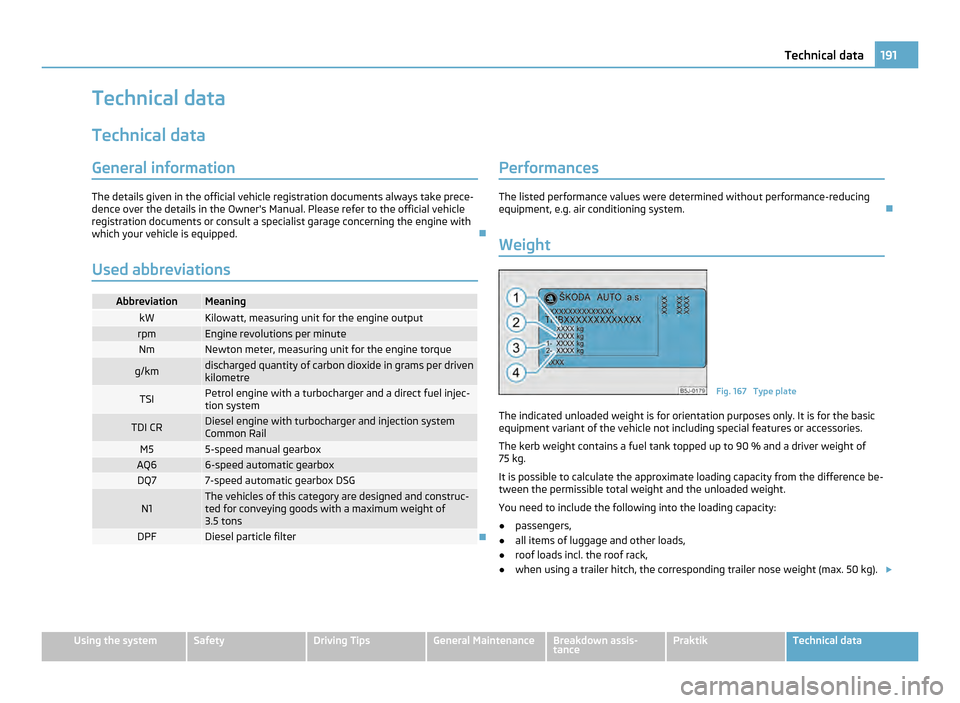
The indicated unloaded weight is for orientation purposes only. It is for the basic
equipment variant of the vehicle not including special features or accessories.
The kerb weight contains a fuel tank topped up to 90 % and a driver weight of
75 kg.
It is possible to calculate the approximate loading capacity from the difference be-
tween the permissible total weight and the unloaded weight.
You need to include the following into the loading capacity:
● passengers,
● all items of luggage and other loads,
● roof loads incl. the roof rack,
● when using a trailer hitch, the corresponding trailer nose weight (max. 50 kg). £ 191
Technical data Using the system Safety Driving Tips General Maintenance Breakdown assis-
tance Praktik Technical data
Page 194 of 212
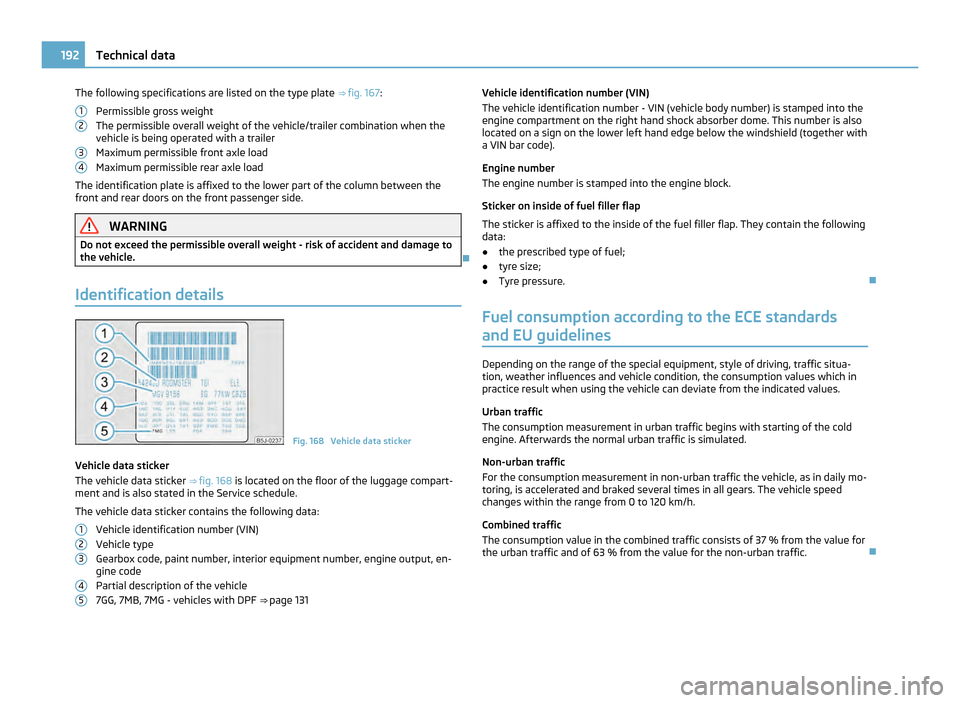
The following specifications are listed on the type plate
⇒ fig. 167:
Permissible gross weight
The permissible overall weight of the vehicle/trailer combination when the
vehicle is being operated with a trailer
Maximum permissible front axle load
Maximum permissible rear axle load
The identification plate is affixed to the lower part of the column between the
front and rear doors on the front passenger side. WARNING
Do not exceed the permissible overall weight - risk of accident and damage to
the vehicle.
Identification details Fig. 168 Vehicle data sticker
Vehicle data sticker
The vehicle data sticker ⇒ fig. 168
is located on the floor of the luggage compart-
ment and is also stated in the Service schedule.
The vehicle data sticker contains the following data:
Vehicle identification number (VIN)
Vehicle type
Gearbox code, paint number, interior equipment number, engine output, en-
gine code
Partial description of the vehicle
7GG, 7MB, 7MG - vehicles with DPF ⇒ page 131
1 2
3
4
1
2
3
4
5 Vehicle identification number (VIN)
The vehicle identification number - VIN (vehicle body number) is stamped into the
engine compartment on the right hand shock absorber dome. This number is also
located on a sign on the lower left hand edge below the windshield (together with
a VIN bar code).
Engine number
The engine number is stamped into the engine block.
Sticker on inside of fuel filler flap
The sticker is affixed to the inside of the fuel filler flap. They contain the following
data:
● the prescribed type of fuel;
● tyre size;
● Tyre pressure.
Fuel consumption according to the ECE standards
and EU guidelines Depending on the range of the special equipment, style of driving, traffic situa-
tion, weather influences and vehicle condition, the consumption values which in
practice result when using the vehicle can deviate from the indicated values.
Urban traffic
The consumption measurement in urban traffic begins with starting of the cold
engine. Afterwards the normal urban traffic is simulated.
Non-urban traffic
For the consumption measurement in non-urban traffic the vehicle, as in daily mo-
toring, is accelerated and braked several times in all gears. The vehicle speed
changes within the range from 0 to 120 km/h.
Combined traffic
The consumption value in the combined traffic consists of 37 % from the value for
the urban traffic and of 63 % from the value for the non-urban traffic. 192
Technical data
Page 195 of 212
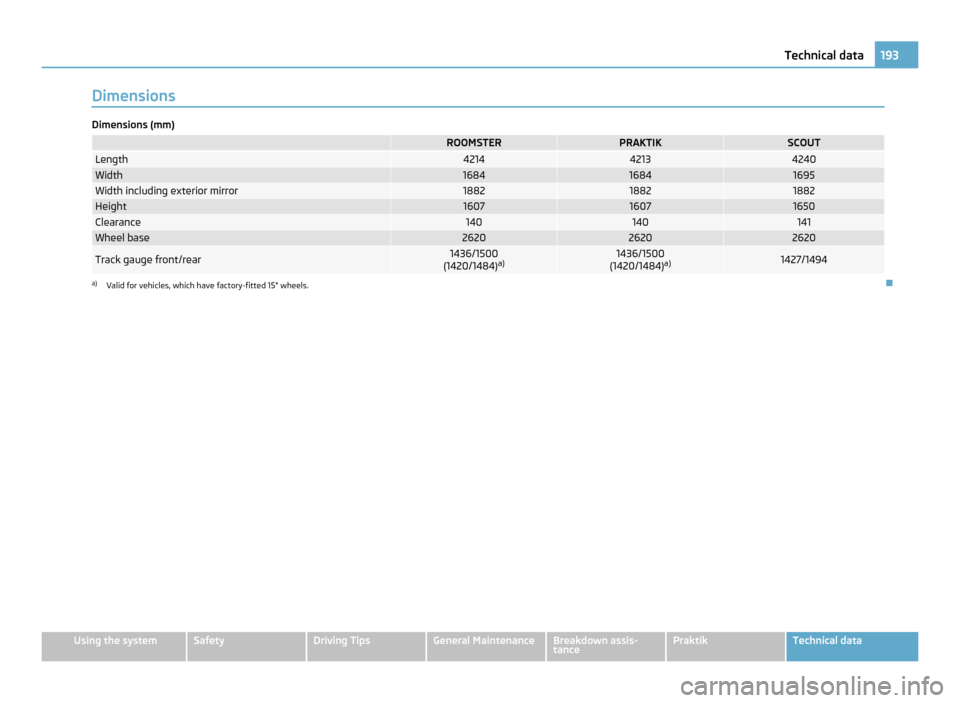
Dimensions
Dimensions (mm)
ROOMSTER PRAKTIK SCOUT
Length 4214 4213 4240
Width 1684 1684 1695
Width including exterior mirror 1882 1882 1882
Height 1607 1607 1650
Clearance 140 140 141
Wheel base 2620 2620 2620
Track gauge front/rear 1436/1500
(1420/1484) a) 1436/1500
(1420/1484) a) 1427/1494
a)
Valid for vehicles, which have factory-fitted 15" wheels. 193
Technical data Using the system Safety Driving Tips General Maintenance Breakdown assis-
tance Praktik Technical data
Page 196 of 212
Engine oil specifications
The grade of engine oil should be selected in accordance with pre-
cise specifications.
The engine of your vehicle has been factory-filled with a high-grade oil which you
can use throughout the year - except in extreme climatic regions.
You can mix various oils together with each other when refilling with oil. This does
not, however, apply for models with flexible service intervals (QG1).
Engine oils are, of course, undergoing continuous further development. Thus the
information stated in this Owner's Manual is only correct at the time of publica-
tion.
Specialist garages are informed by ŠKODA about the latest changes. We recom-
mend having this oil change undertaken by a specialist garage.
The specifications (VW standards) stated in the following must be indicated sepa-
rately or together with other specifications on the bottle.
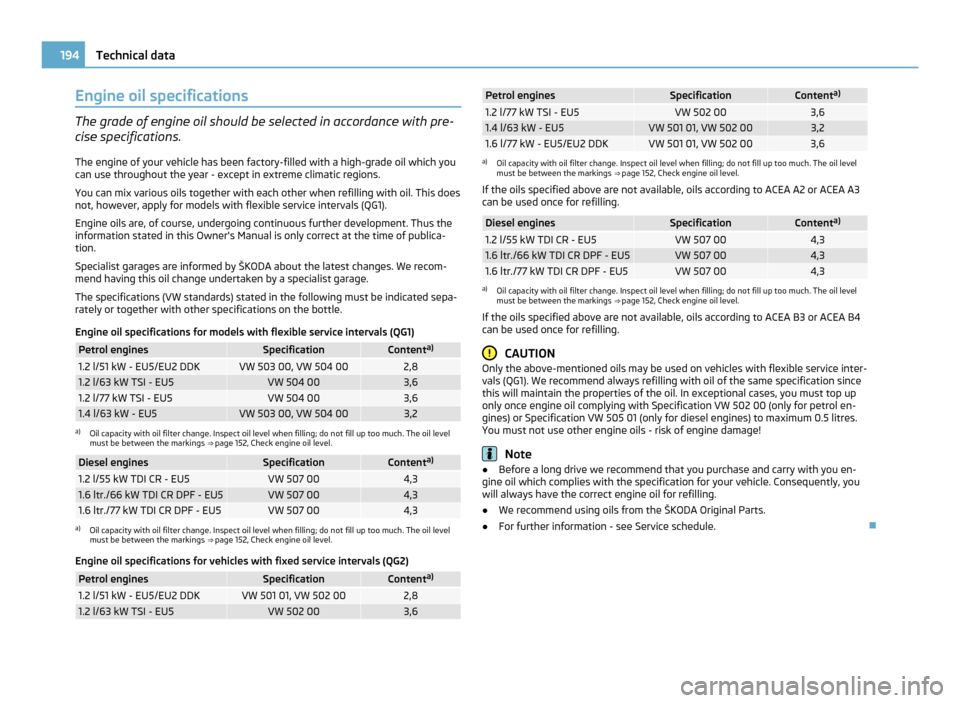
Engine oil specifications for models with flexible service intervals (QG1) Petrol engines Specification Content
a)1.2 l/51 kW - EU5/EU2 DDK VW 503 00, VW 504 00 2,8
1.2 l/63 kW TSI - EU5 VW 504 00 3,6
1.2 l/77 kW TSI - EU5 VW 504 00 3,6
1.4 l/63 kW - EU5 VW 503 00, VW 504 00 3,2
a)
Oil capacity with oil filter change. Inspect oil level when filling; do not fill up too much. The oil level
must be between the markings ⇒ page 152, Check engine oil level
.Diesel engines Specification Content
a)1.2 l/55 kW TDI CR - EU5 VW 507 00 4,3
1.6 ltr./66 kW TDI CR DPF - EU5 VW 507 00 4,3
1.6 ltr./77 kW TDI CR DPF - EU5 VW 507 00 4,3
a)
Oil capacity with oil filter change. Inspect oil level when filling; do not fill up too much. The oil level
must be between the markings ⇒ page 152, Check engine oil level
.
Engine oil specifications for vehicles with fixed service intervals (QG2) Petrol engines Specification Content
a)1.2 l/51 kW - EU5/EU2 DDK VW 501 01, VW 502 00 2,8
1.2 l/63 kW TSI - EU5 VW 502 00 3,6 Petrol engines Specification Content
a) 1.2 l/77 kW TSI - EU5 VW 502 00 3,6
1.4 l/63 kW - EU5 VW 501 01, VW 502 00 3,2
1.6 l/77 kW - EU5/EU2 DDK VW 501 01, VW 502 00 3,6
a)
Oil capacity with oil filter change. Inspect oil level when filling; do not fill up too much. The oil level
must be between the markings ⇒ page 152, Check engine oil level
.
If the oils specified above are not available, oils according to ACEA A2 or ACEA A3
can be used once for refilling. Diesel engines Specification Content
a) 1.2 l/55 kW TDI CR - EU5 VW 507 00 4,3
1.6 ltr./66 kW TDI CR DPF - EU5 VW 507 00 4,3
1.6 ltr./77 kW TDI CR DPF - EU5 VW 507 00 4,3
a)
Oil capacity with oil filter change. Inspect oil level when filling; do not fill up too much. The oil level
must be between the markings ⇒ page 152, Check engine oil level
.
If the oils specified above are not available, oils according to ACEA B3 or ACEA B4
can be used once for refilling. CAUTION
Only the above-mentioned oils may be used on vehicles with flexible service inter-
vals (QG1). We recommend always refilling with oil of the same specification since
this will maintain the properties of the oil. In exceptional cases, you must top up
only once engine oil complying with Specification VW 502 00 (only for petrol en-
gines) or Specification VW 505 01 (only for diesel engines) to maximum 0.5 litres.
You must not use other engine oils - risk of engine damage! Note
● Before a long drive we recommend that you purchase and carry with you en-
gine oil which complies with the specification for your vehicle. Consequently, you
will always have the correct engine oil for refilling.
● We recommend using oils from the ŠKODA Original Parts.
● For further information - see Service schedule. 194
Technical data