boot SKODA ROOMSTER 2013 1.G Owner's Guide
[x] Cancel search | Manufacturer: SKODA, Model Year: 2013, Model line: ROOMSTER, Model: SKODA ROOMSTER 2013 1.GPages: 219, PDF Size: 13.83 MB
Page 65 of 219
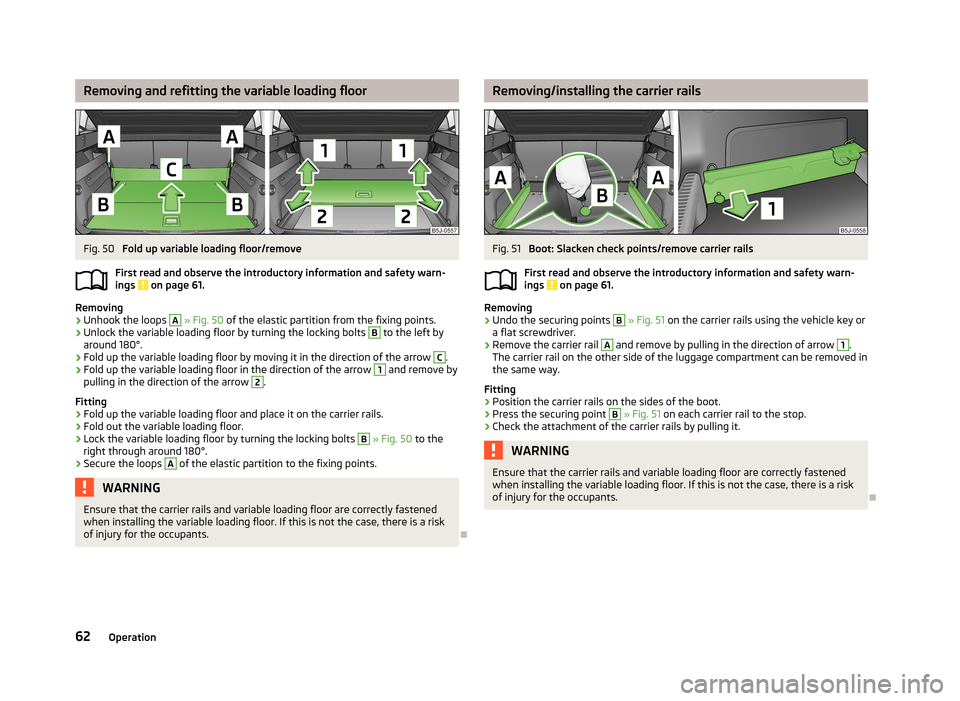
Removing and refitting the variable loading floorFig. 50
Fold up variable loading floor/remove
First read and observe the introductory information and safety warn- ings
on page 61.
Removing
›
Unhook the loops
A
» Fig. 50 of the elastic partition from the fixing points.
›
Unlock the variable loading floor by turning the locking bolts
B
to the left by
around 180°.
›
Fold up the variable loading floor by moving it in the direction of the arrow
C
.
›
Fold up the variable loading floor in the direction of the arrow
1
and remove by
pulling in the direction of the arrow
2
.
Fitting
›
Fold up the variable loading floor and place it on the carrier rails.
›
Fold out the variable loading floor.
›
Lock the variable loading floor by turning the locking bolts
B
» Fig. 50 to the
right through around 180°.
›
Secure the loops
A
of the elastic partition to the fixing points.
WARNINGEnsure that the carrier rails and variable loading floor are correctly fastened
when installing the variable loading floor. If this is not the case, there is a risk
of injury for the occupants.
Removing/installing the carrier railsFig. 51
Boot: Slacken check points/remove carrier rails
First read and observe the introductory information and safety warn-
ings
on page 61.
Removing
›
Undo the securing points
B
» Fig. 51 on the carrier rails using the vehicle key or
a flat screwdriver.
›
Remove the carrier rail
A
and remove by pulling in the direction of arrow
1
.
The carrier rail on the other side of the luggage compartment can be removed in
the same way.
Fitting
›
Position the carrier rails on the sides of the boot.
›
Press the securing point
B
» Fig. 51 on each carrier rail to the stop.
›
Check the attachment of the carrier rails by pulling it.
WARNINGEnsure that the carrier rails and variable loading floor are correctly fastened
when installing the variable loading floor. If this is not the case, there is a risk of injury for the occupants.
62Operation
Page 66 of 219
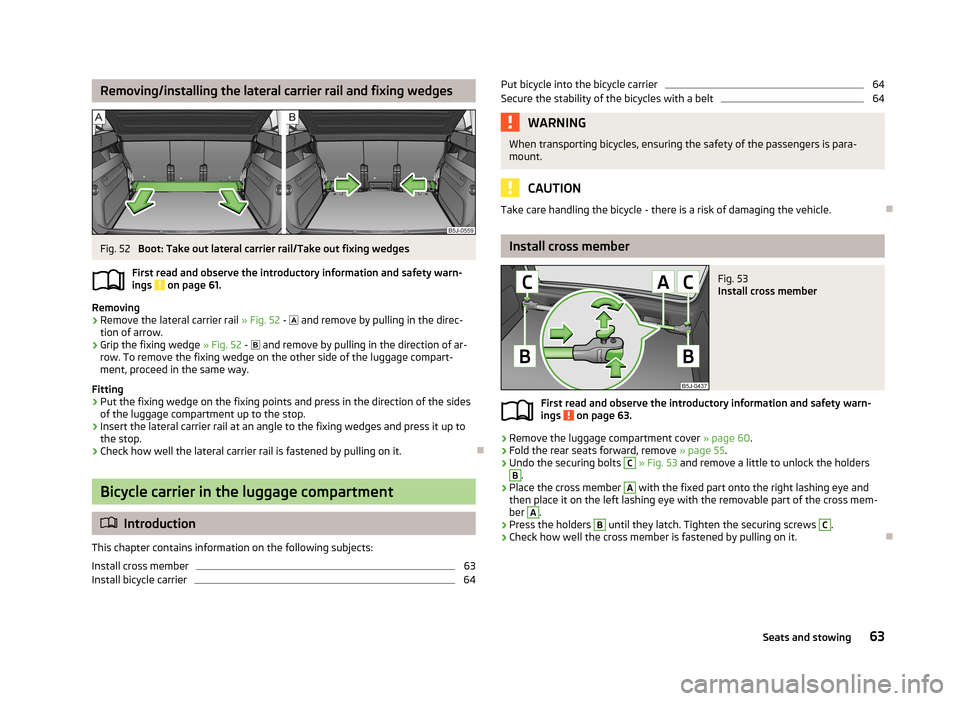
Removing/installing the lateral carrier rail and fixing wedgesFig. 52
Boot: Take out lateral carrier rail/Take out fixing wedges
First read and observe the introductory information and safety warn- ings
on page 61.
Removing
›
Remove the lateral carrier rail » Fig. 52 -
and remove by pulling in the direc-
tion of arrow.
›
Grip the fixing wedge » Fig. 52 -
and remove by pulling in the direction of ar-
row. To remove the fixing wedge on the other side of the luggage compart-
ment, proceed in the same way.
Fitting
›
Put the fixing wedge on the fixing points and press in the direction of the sides
of the luggage compartment up to the stop.
›
Insert the lateral carrier rail at an angle to the fixing wedges and press it up to
the stop.
›
Check how well the lateral carrier rail is fastened by pulling on it.
Bicycle carrier in the luggage compartment
Introduction
This chapter contains information on the following subjects:
Install cross member
63
Install bicycle carrier
64Put bicycle into the bicycle carrier64Secure the stability of the bicycles with a belt64WARNINGWhen transporting bicycles, ensuring the safety of the passengers is para-
mount.
CAUTION
Take care handling the bicycle - there is a risk of damaging the vehicle.
Install cross member
Fig. 53
Install cross member
First read and observe the introductory information and safety warn- ings on page 63.
›
Remove the luggage compartment cover » page 60.
›
Fold the rear seats forward, remove » page 55.
›
Undo the securing bolts
C
» Fig. 53 and remove a little to unlock the holders
B
.
›
Place the cross member
A
with the fixed part onto the right lashing eye and
then place it on the left lashing eye with the removable part of the cross mem-
ber
A
.
›
Press the holders
B
until they latch. Tighten the securing screws
C
.
›
Check how well the cross member is fastened by pulling on it.
63Seats and stowing
Page 67 of 219
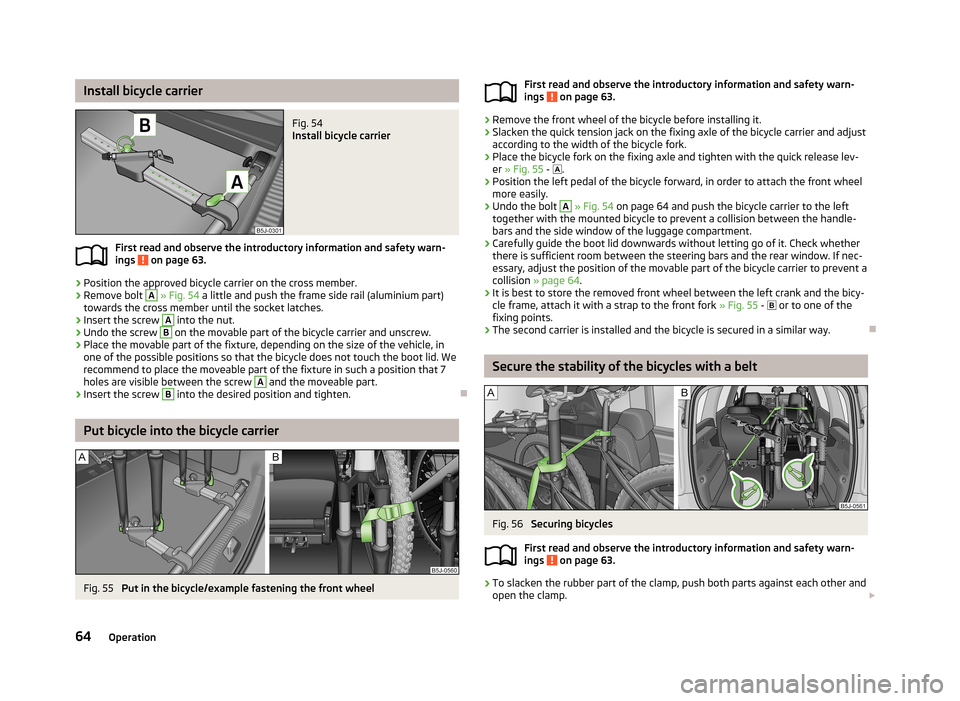
Install bicycle carrierFig. 54
Install bicycle carrier
First read and observe the introductory information and safety warn-ings on page 63.
›
Position the approved bicycle carrier on the cross member.
›
Remove bolt
A
» Fig. 54 a little and push the frame side rail (aluminium part)
towards the cross member until the socket latches.
›
Insert the screw
A
into the nut.
›
Undo the screw
B
on the movable part of the bicycle carrier and unscrew.
›
Place the movable part of the fixture, depending on the size of the vehicle, in
one of the possible positions so that the bicycle does not touch the boot lid. We
recommend to place the moveable part of the fixture in such a position that 7 holes are visible between the screw
A
and the moveable part.
›
Insert the screw
B
into the desired position and tighten.
Put bicycle into the bicycle carrier
Fig. 55
Put in the bicycle/example fastening the front wheel
First read and observe the introductory information and safety warn-
ings on page 63.›
Remove the front wheel of the bicycle before installing it.
›
Slacken the quick tension jack on the fixing axle of the bicycle carrier and adjust
according to the width of the bicycle fork.
›
Place the bicycle fork on the fixing axle and tighten with the quick release lev- er » Fig. 55 - .
›
Position the left pedal of the bicycle forward, in order to attach the front wheel
more easily.
›
Undo the bolt
A
» Fig. 54 on page 64 and push the bicycle carrier to the left
together with the mounted bicycle to prevent a collision between the handle-
bars and the side window of the luggage compartment.
›
Carefully guide the boot lid downwards without letting go of it. Check whether there is sufficient room between the steering bars and the rear window. If nec-essary, adjust the position of the movable part of the bicycle carrier to prevent a
collision » page 64 .
›
It is best to store the removed front wheel between the left crank and the bicy-
cle frame, attach it with a strap to the front fork » Fig. 55 -
or to one of the
fixing points.
›
The second carrier is installed and the bicycle is secured in a similar way.
Secure the stability of the bicycles with a belt
Fig. 56
Securing bicycles
First read and observe the introductory information and safety warn- ings
on page 63.
›
To slacken the rubber part of the clamp, push both parts against each other and
open the clamp.
64Operation
Page 68 of 219
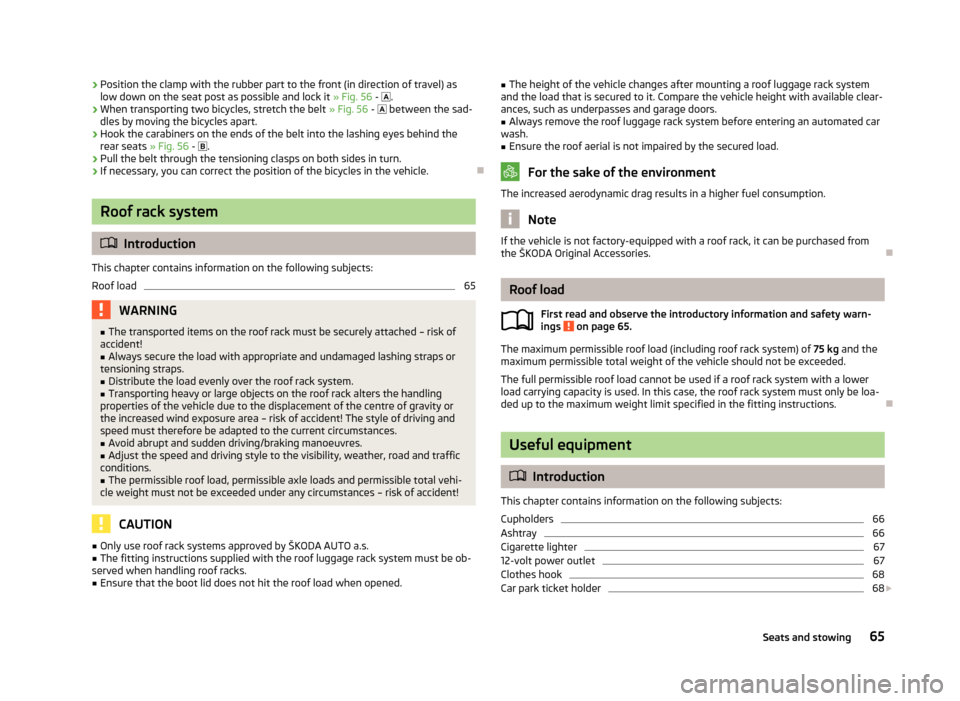
›Position the clamp with the rubber part to the front (in direction of travel) as
low down on the seat post as possible and lock it » Fig. 56 - .›
When transporting two bicycles, stretch the belt » Fig. 56 - between the sad-
dles by moving the bicycles apart.
›
Hook the carabiners on the ends of the belt into the lashing eyes behind the rear seats » Fig. 56 - .
›
Pull the belt through the tensioning clasps on both sides in turn.
›
If necessary, you can correct the position of the bicycles in the vehicle.
Roof rack system
Introduction
This chapter contains information on the following subjects:
Roof load
65WARNING■ The transported items on the roof rack must be securely attached – risk of
accident!■
Always secure the load with appropriate and undamaged lashing straps or
tensioning straps.
■
Distribute the load evenly over the roof rack system.
■
Transporting heavy or large objects on the roof rack alters the handling
properties of the vehicle due to the displacement of the centre of gravity or
the increased wind exposure area – risk of accident! The style of driving and
speed must therefore be adapted to the current circumstances.
■
Avoid abrupt and sudden driving/braking manoeuvres.
■
Adjust the speed and driving style to the visibility, weather, road and traffic
conditions.
■
The permissible roof load, permissible axle loads and permissible total vehi-
cle weight must not be exceeded under any circumstances – risk of accident!
CAUTION
■ Only use roof rack systems approved by ŠKODA AUTO a.s.■The fitting instructions supplied with the roof luggage rack system must be ob-
served when handling roof racks.■
Ensure that the boot lid does not hit the roof load when opened.
■ The height of the vehicle changes after mounting a roof luggage rack system
and the load that is secured to it. Compare the vehicle height with available clear- ances, such as underpasses and garage doors.■
Always remove the roof luggage rack system before entering an automated car
wash.
■
Ensure the roof aerial is not impaired by the secured load.
For the sake of the environment
The increased aerodynamic drag results in a higher fuel consumption.
Note
If the vehicle is not factory-equipped with a roof rack, it can be purchased from
the ŠKODA Original Accessories.
Roof load
First read and observe the introductory information and safety warn-
ings
on page 65.
The maximum permissible roof load (including roof rack system) of 75 kg and the
maximum permissible total weight of the vehicle should not be exceeded.
The full permissible roof load cannot be used if a roof rack system with a lower
load carrying capacity is used. In this case, the roof rack system must only be loa-
ded up to the maximum weight limit specified in the fitting instructions.
Useful equipment
Introduction
This chapter contains information on the following subjects:
Cupholders
66
Ashtray
66
Cigarette lighter
67
12-volt power outlet
67
Clothes hook
68
Car park ticket holder
68
65Seats and stowing
Page 70 of 219
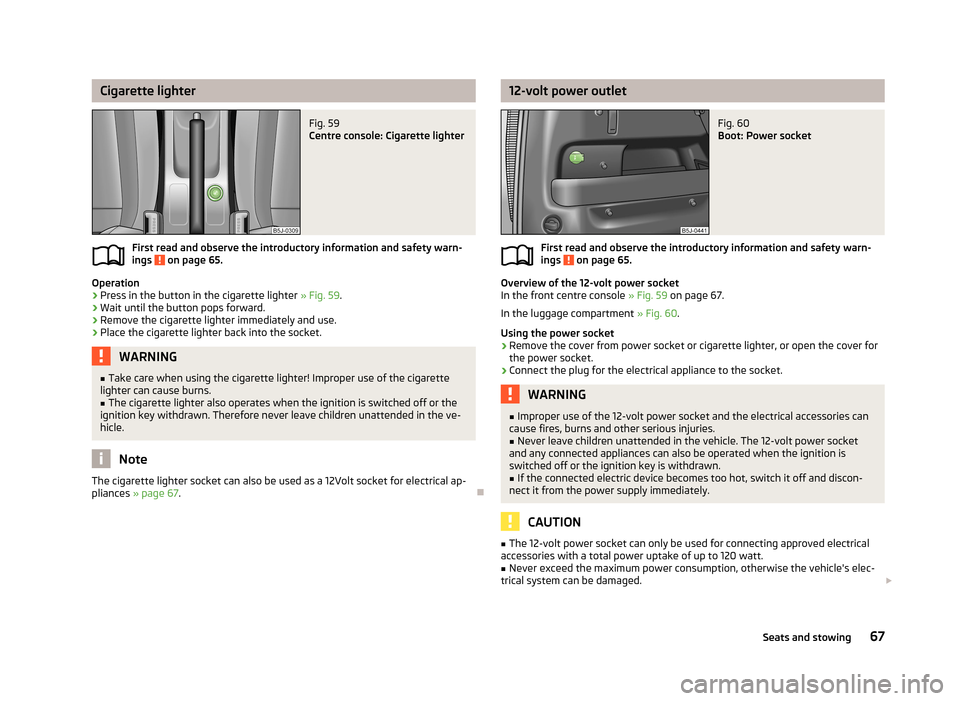
Cigarette lighterFig. 59
Centre console: Cigarette lighter
First read and observe the introductory information and safety warn-
ings on page 65.
Operation
›
Press in the button in the cigarette lighter » Fig. 59.
›
Wait until the button pops forward.
›
Remove the cigarette lighter immediately and use.
›
Place the cigarette lighter back into the socket.
WARNING■
Take care when using the cigarette lighter! Improper use of the cigarette
lighter can cause burns.■
The cigarette lighter also operates when the ignition is switched off or the
ignition key withdrawn. Therefore never leave children unattended in the ve-
hicle.
Note
The cigarette lighter socket can also be used as a 12Volt socket for electrical ap-
pliances » page 67 .
12-volt power outletFig. 60
Boot: Power socket
First read and observe the introductory information and safety warn-
ings on page 65.
Overview of the 12-volt power socket
In the front centre console » Fig. 59 on page 67.
In the luggage compartment » Fig. 60.
Using the power socket
›
Remove the cover from power socket or cigarette lighter, or open the cover for
the power socket.
›
Connect the plug for the electrical appliance to the socket.
WARNING■ Improper use of the 12-volt power socket and the electrical accessories can
cause fires, burns and other serious injuries.■
Never leave children unattended in the vehicle. The 12-volt power socket
and any connected appliances can also be operated when the ignition is switched off or the ignition key is withdrawn.
■
If the connected electric device becomes too hot, switch it off and discon-
nect it from the power supply immediately.
CAUTION
■ The 12-volt power socket can only be used for connecting approved electrical
accessories with a total power uptake of up to 120 watt.■
Never exceed the maximum power consumption, otherwise the vehicle's elec-
trical system can be damaged. 67Seats and stowing
Page 76 of 219
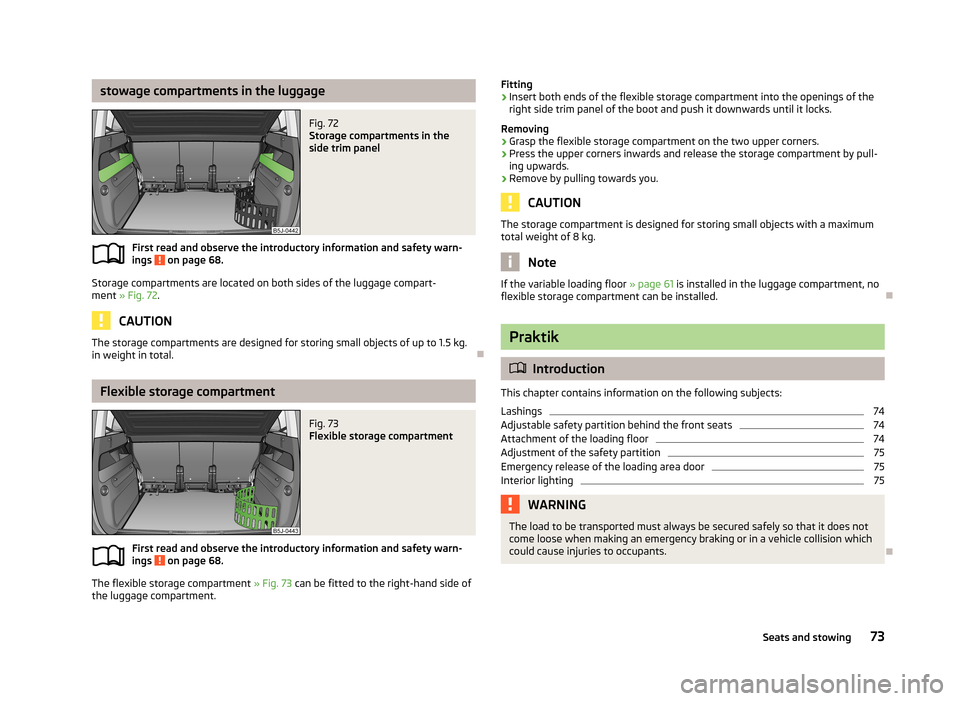
stowage compartments in the luggageFig. 72
Storage compartments in the
side trim panel
First read and observe the introductory information and safety warn-
ings on page 68.
Storage compartments are located on both sides of the luggage compart-
ment » Fig. 72 .
CAUTION
The storage compartments are designed for storing small objects of up to 1.5 kg.
in weight in total.
Flexible storage compartment
Fig. 73
Flexible storage compartment
First read and observe the introductory information and safety warn-
ings on page 68.
The flexible storage compartment » Fig. 73 can be fitted to the right-hand side of
the luggage compartment.
Fitting›Insert both ends of the flexible storage compartment into the openings of the
right side trim panel of the boot and push it downwards until it locks.
Removing›
Grasp the flexible storage compartment on the two upper corners.
›
Press the upper corners inwards and release the storage compartment by pull-
ing upwards.
›
Remove by pulling towards you.
CAUTION
The storage compartment is designed for storing small objects with a maximum
total weight of 8 kg.
Note
If the variable loading floor » page 61 is installed in the luggage compartment, no
flexible storage compartment can be installed.
Praktik
Introduction
This chapter contains information on the following subjects:
Lashings
74
Adjustable safety partition behind the front seats
74
Attachment of the loading floor
74
Adjustment of the safety partition
75
Emergency release of the loading area door
75
Interior lighting
75WARNINGThe load to be transported must always be secured safely so that it does not
come loose when making an emergency braking or in a vehicle collision which
could cause injuries to occupants.
73Seats and stowing
Page 77 of 219
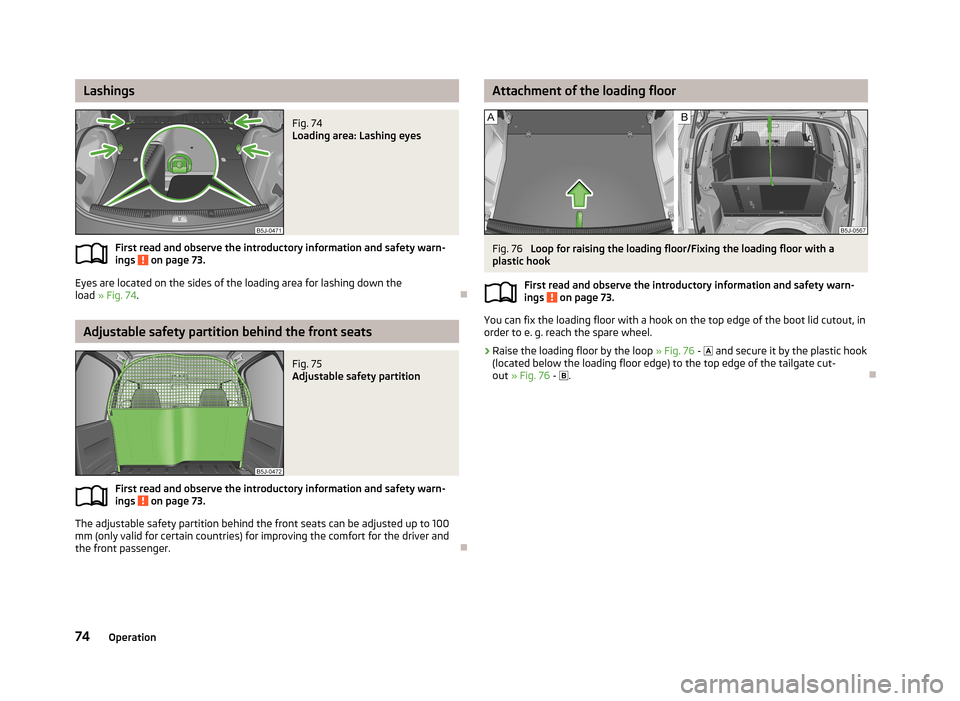
LashingsFig. 74
Loading area: Lashing eyes
First read and observe the introductory information and safety warn-ings on page 73.
Eyes are located on the sides of the loading area for lashing down the
load » Fig. 74 .
Adjustable safety partition behind the front seats
Fig. 75
Adjustable safety partition
First read and observe the introductory information and safety warn-
ings on page 73.
The adjustable safety partition behind the front seats can be adjusted up to 100
mm (only valid for certain countries) for improving the comfort for the driver and
the front passenger.
Attachment of the loading floorFig. 76
Loop for raising the loading floor/Fixing the loading floor with a
plastic hook
First read and observe the introductory information and safety warn-ings
on page 73.
You can fix the loading floor with a hook on the top edge of the boot lid cutout, inorder to e. g. reach the spare wheel.
›
Raise the loading floor by the loop » Fig. 76 -
and secure it by the plastic hook
(located below the loading floor edge) to the top edge of the tailgate cut-
out » Fig. 76 -
.
74Operation
Page 123 of 219
The ball head is released in this position and falls freely into the hand. If it does
not fall freely into the hand, use your other hand to push it upwards.
At the same time, the ball head latches into the ready position and is thus readyto be re-inserted into the mounting recess »
.
›
Fit the cover for the mounting recess
4
» Fig. 103 on page 117 in the opposite
direction to the arrow.
›
Offer up the cap to the rear bumper
2
» Fig. 103 on page 117 aligning it with
“check mark” in the lower bumper area.
›
Push the cap in first on the left and right and then at the top.
WARNINGNever allow the ball head to remain unsecured in the boot. This could cause damage in a sudden braking manoeuvre and put the safety of the occupantsat risk.
CAUTION
■ If the lever is held firm and not pushed downwards as far as it can go, it will go
back up after the ball head is removed and will not latch into the ready position.
The ball head then needs to be brought into this position before the next time it
is fitted.■
Stow the ball head in the ready position with the key inserted in the box. When
doing so, make the side opposite to the inserted key face downwards – there is a
risk of damaging the key.
■
Do not use excessive force when handling the operating lever (e.g. do not step
on it).
Note
■ We recommend that you put the protective cap on the ball before removing the
ball head.■
Clean any dirt from the ball head before stowing it away in the box with the ve-
hicle tool kit.
Use and care
First read and observe the introductory information and safety warn-
ings
on page 117.
Close the mounting recess with the cap to prevent any ingress of dirt.
Always check the ball head before hitching a trailer. Apply a suitable grease where necessary.
Fit the protective cap when stowing away the ball head to protect the luggage
compartment against dirt.
In the event of dirt, clean the surfaces of the mounting recess and treat with a
suitable preservative.
CAUTION
Apply grease to the upper part of the mounting recess. Make sure you do not re-
move any grease.
Trailer
Introduction
This chapter contains information on the following subjects:
Loading a trailer
120
Towing a trailer
121
Anti-theft alarm system
122WARNINGAlways drive particularly carefully with the trailer.
Loading a trailer
First read and observe the introductory information and safety warn-
ings
on page 120.
The vehicle/trailer combination must be balanced, whereby the maximum permis-
sible drawbar load must be utilised. If the drawbar load is too low, it jeopardises the performance of the vehicle/trailer combination.
Distribution of the load
Distribute the load in the trailer in such a way that heavy items are located as close to the axle as possible. Secure the items from slipping.
120Driving
Page 133 of 219
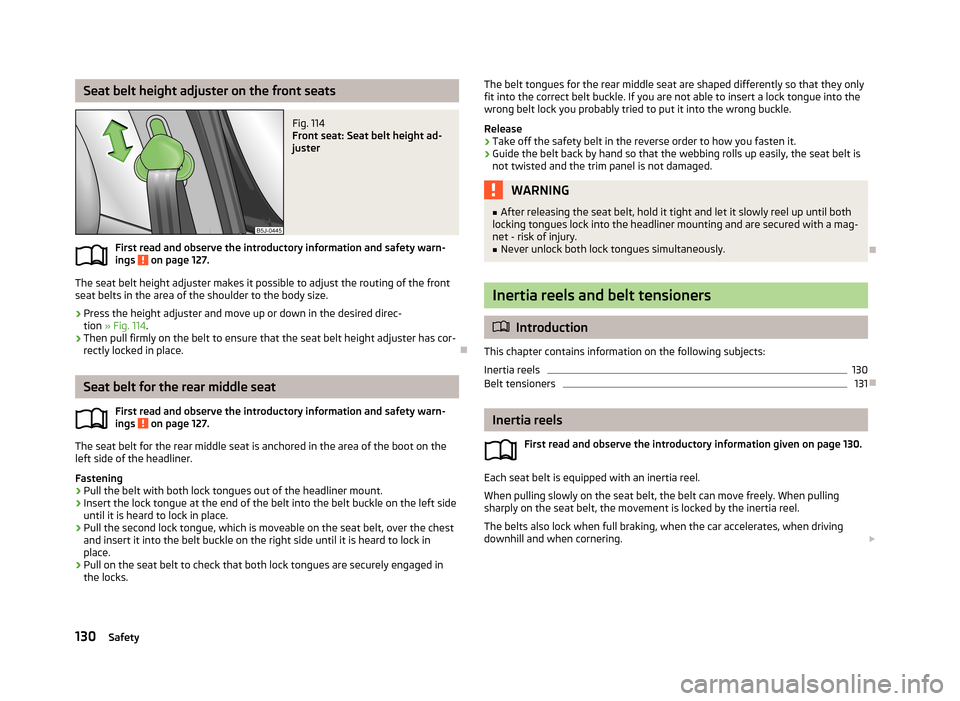
Seat belt height adjuster on the front seatsFig. 114
Front seat: Seat belt height ad-
juster
First read and observe the introductory information and safety warn-
ings on page 127.
The seat belt height adjuster makes it possible to adjust the routing of the front
seat belts in the area of the shoulder to the body size.
›
Press the height adjuster and move up or down in the desired direc- tion » Fig. 114 .
›
Then pull firmly on the belt to ensure that the seat belt height adjuster has cor-
rectly locked in place.
Seat belt for the rear middle seat
First read and observe the introductory information and safety warn-
ings
on page 127.
The seat belt for the rear middle seat is anchored in the area of the boot on the
left side of the headliner.
Fastening
›
Pull the belt with both lock tongues out of the headliner mount.
›
Insert the lock tongue at the end of the belt into the belt buckle on the left side
until it is heard to lock in place.
›
Pull the second lock tongue, which is moveable on the seat belt, over the chest
and insert it into the belt buckle on the right side until it is heard to lock in place.
›
Pull on the seat belt to check that both lock tongues are securely engaged inthe locks.
The belt tongues for the rear middle seat are shaped differently so that they only
fit into the correct belt buckle. If you are not able to insert a lock tongue into the
wrong belt lock you probably tried to put it into the wrong buckle.
Release›
Take off the safety belt in the reverse order to how you fasten it.
›
Guide the belt back by hand so that the webbing rolls up easily, the seat belt is not twisted and the trim panel is not damaged.
WARNING■ After releasing the seat belt, hold it tight and let it slowly reel up until both
locking tongues lock into the headliner mounting and are secured with a mag-
net - risk of injury.■
Never unlock both lock tongues simultaneously.
Inertia reels and belt tensioners
Introduction
This chapter contains information on the following subjects: Inertia reels
130
Belt tensioners
131
Inertia reels
First read and observe the introductory information given on page 130.
Each seat belt is equipped with an inertia reel.
When pulling slowly on the seat belt, the belt can move freely. When pulling
sharply on the seat belt, the movement is locked by the inertia reel.
The belts also lock when full braking, when the car accelerates, when driving downhill and when cornering.
130Safety
Page 158 of 219
Natural leatherFirst read and observe the introductory information and safety warn-
ings
on page 154.
Leather is a natural material with specific properties, and requires regular clean-
ing and maintenance.
The leather should be cleaned on a regular basis depending on the amount of
wear-and-tear.
Dust and dirt in the pores and folds act as abrasive materials. This leads to severe corrosion and the premature brittleness of the leather surface.
We recommend that you remove dust regularly and at short intervals using a
cloth or vacuum cleaner.
Clean soiled leather surfaces with a water-dampened cotton or woollen cloth and
then dry with a clean, dry cloth »
.
Clean severely soiled areas with a cloth soaked in a mild soap solution (2 table-
spoons of neutral soap to 1 litre of water).
To remove stains, use a cleaning agent specially designed for this purpose.
Treat the leather regularly and at suitable intervals using a suitable leather care
product.
CAUTION
■ Ensure that no part of the leather is soaked through during cleaning and that
no water gets into the seams. Otherwise, the leather could become brittle or
cracked.■
Avoid leaving the vehicle for lengthy periods in bright sunlight to avoid the
leather from bleaching. If the vehicle is parked in the open for lengthy periods, protect the leather from direct sunlight by covering it.
■
Sharp-edged objects on items of clothing such as zip fasteners, rivets, sharp-
edged belts, jewellery and pendants may leave permanent scratches or signs of
rubbing on the surface. Such damage cannot be subsequently recognised as a
justified complaint.
■
The use of a mechanical steering wheel lock may damage the leather surface of
the steering wheel.
■ Use a care cream with light blocker and impregnation effect on a regular basis
and each time after cleaning. The cream nourishes the leather, allows it to
breathe and keeps it supple and also provides moisture. It also creates surface
protection.■
Some clothing materials, e.g. dark denim, do not have sufficient colour fastness.
This can cause damage or clearly visible discolouration to seat covers, even when used correctly. This applies particularly to light-coloured seat covers. This does
not relate to a fault in the seat cover, but rather to poor colour fastness of the
clothing textiles.
Note
When using the vehicle, minor visible changes may occur to the leather parts of
the covers (e.g. wrinkles or creases) as a result of the stress applied to the covers.
Synthetic leather, fabrics and Alcantara ®
First read and observe the introductory information and safety warn- ings
on page 154.
Artificial leather
Clean artificial leather with a damp cloth.
If this method does not completely clean the artificial leather, use a mild soap sol-ution or cleaning products specially designed for this purpose.
Fabric
Clean upholstery cover materials and cloth trims on doors, boot cover, etc. using
specific cleaning agents, e.g., dry foam.
Use a soft sponge, brush, or commercially available microfibre cloth.
Use a cloth and special detergent to clean the headlining.
Remove any lumps on the cover fabric and any fabric residue using a brush.
Remove stubborn hair using a “cleaning glove”.
Alcantara ®
Dust and fine dirt particles in pores, creases and seams may chafe and damage the surface.
If you leave your vehicle parked in the open for lengthy periods, protect the Al-
cantara ®
seat upholstery from direct sunlight to prevent fading.
Minor changes in colour caused by use are normal.
155Car care